Contemplative Inquiry

This blog is about contemplative inquiry

Tag: nature spirituality

AUTHENTICITY IN MODERN DRUIDRY

“Contemporary Druidry is a flourishing creative spirituality that is inspiring people the world over. Is it a closed system that was only open to new inputs several thousand years ago? Or is it an open system that allows for development and evolution?” Philip Carr-Gomm, Chosen Chief of OBOD (1) explores these questions in his foreword to ‘Contemplative Druidry’ (2) adding, “Scratch the surface of any religion and you find that it is made up of a number of influences and elements. Examine a ritual text or liturgy and you can see the bricolage at work.” Moving deeper into the world of Celtic spirituality, he goes on to say:

“Mgr. Mael, the founder of the Celtic Orthodox Church in Brittany … received a series of meditative physical exercises in a vision and taught these as a system of ‘Celtic Yoga’. Are such attempts valid? … And are they not ‘fake’, having been so recently invented, while the Eastern systems are clearly genuine having been around for centuries? As regards validity, a method that is valid is one that works, however young or old it is. As regards inauthenticity, if a method is pretending to be one thing, while in reality being another, then that is indeed inauthentic. If Mgr. Mael had pretended his system of Celtic Yoga was practiced by the ancient Druids, this would have been inauthentic. But since he clearly stated he had received the exercises in a series of dreams, his system is what he authentically stated it to be: a method received in an altered state of consciousness. A false claim to an ancient lineage made for a system that has only been recently created renders it inauthentic, but if no such claim is made, can we use the term Druid to describe it?

“… Modern Druidry has been growing and evolving for the last three hundred years and if we were to throw out any additions to its body of teachings and ritual practice made during this time, we would be left with a small and unworkable set of conjectures. If we didn’t allow ourselves to call something Druidic that has only recently been created, we would have no Druidry to practice. But this shouldn’t mean that we can simply call anything Druidic. Druidry has specific features which help to define what it has become and how it is evolving. … Druidry has developed into a spiritual and philosophical approach that embraces embodiment and does not deny the gifts of the physical world and the body. In addition, it cultivates both inwardness and outwardness – an appreciation of the inner and outer worlds that fosters an engagement with the Earth and with community as much as it encourages an exploration of the depths of the soul and merging with the Divine. The evidence of the centrality of this approach can be found in Druidry’s love of Nature, its reverence for the Earth, and its cornerstone ritual observance: the Eightfold Wheel of the Year. These characteristics define Druidry and they also tell us what it is not.”

Specifically on contemplative Druidry he suggests:

“When it comes to the subject of this book, contemplation and meditation within Druidry, it seems perfectly reasonable to me to talk in terms of ‘Druid meditation’ or to describe techniques and approaches as Druidic, if they fall within the ethos of Druidry, because that ethos is specific: it does not try to subjugate, transcend or deny they body. There is no emphasis on the illusory nature of the physical world. The goal in Druidry, and hence in meditation for Druids, is to enhance our engagement with our embodies life, not to distance or separate ourselves from it.”

  • Order of Bards Ovates and Druids druidry.org/
  • James Nichol Contemplative Druidry: People, Practice and Potential Amazon/CreateSpace, 2014 (Foreword Deep Peace of the Quiet Earth: The Nature Mysticism of Druidry by Philip Carr-Gomm)
IMBOLC ADVENT

Erin nighean Brighde* has recently written about ‘Imbolc Advent’. I like this term. Where I live, mid-January could feel cold and dull and flat. It could be a time of post-festive blues, and a very long way from spring. My cure, from the early 1990’s, has been the eight-fold wheel of the year, now lived by many groups within and beyond the modern Pagan community. It has enriched me enormously.

For the last week or so I have been leaning in to Imbolc, the festival that, at the beginning of February (Northern hemisphere), celebrates the return of the light, the appearance of early flowers and traditionally also the birth of lambs. In Druidry, it is strongly linked to the Goddess Brigid. My leaning in to Imbolc this year has been interwoven with the transformation of three initially parched hyacinth bulbs (a late seasonal gift) in a pot of dry earth. The change began when I saw them draw water from a saucer. Its rapid disappearance was like watching a speeded-up film. Within a couple of days, stalks had burst almost alarmingly out of the bulbs, and it was not long before the scented bell-like lavender blue flowers emerged from the spikes. I realize that this was a contrived indoor event, but I have experienced it over the last week as a stunning display of life and growth, and hence an image of Imbolc Advent.

During the life-time of the Druid contemplative group, we tended to meet outside the festival times, partly to avoid clashes with other commitments, and partly to practice tuning into the year at other times. We could do this by taking the previous or following festival as a reference point and notice the mid-term difference, or we could more simply pay attention to the world we were in at the time of meeting. Over time, we developed a greater sensitivity to the rhythms and tides in the year as nature’s unfolding processes, since we were not focusing on the festivals themselves as events. Nonetheless, they remained important markers for our experience. They helped to provide us with a common language and orientation. That being said, I remember something special around Imbolc, out of all the eight festivals. The fire in the hearth, the arrangement and decoration of the space (snowdrops in particular) gave us a powerful experience of Brigid as a presiding energy, making Imbolc one of our most resonant times.

*Erin nighean Brighde https://hereternalflame.wordpress.com/2018/01/14/imbolc-advent-2018/

SHADOW

“We identify our shadow … with that visible shape we see projected on the pavement or the whitewashed wall. Since what we glimpse there is a being without depth, we naturally assume that shadows themselves are basically flat – and if we are asked, by a curious child, about the life of shadows we are apt to reply that their lives exist only in two dimensions.

“Suppose, however, that on the same afternoon a bumblebee is making its way from a clutch of clover blossoms on one side of the road to another cluster of blooms in an overgrown weedlot across the street, and that as it does so the bee happens to pass between me and the flat shape that my body casts upon the pavement. The sunlit bee buzzes toward me, streaking like an erratic, drunken comet against the asphalt sky, and then it crosses an unseen boundary in the air: instantly its glow dims, the sun is no longer upon it – it has moved into a precisely bounded zone of darkness that floats between my opaque flesh and that vaguely humanoid silhouette laid out upon the pavement – until a moment later the bee buzzes out the opposite side of that zone and emerges back into the day’s radiance.

“Although it was zipping along several feet above the street, the bumblebee had passed into and out of my real shadow. Its visible trajectory – gleaming, then muted, then gleaming again – shows that my actual shadow is an enigma more substantial than that flat shape on the paved ground. That silhouette is only my shadow’s outermost surface. The actual shadow does not reside primarily on the ground; it is a voluminous being of thickness and depth, a mostly unseen presence that dwells in the air between my body and that ground. The dusky shape on the asphalt touches me only at my feet, and hence seems largely separate from me, even independent from me – a kind of doppelganger. The apparent gap between myself and that flat swath of darkness is what prompts me, now and then to accept its invitation to dance, the two of us then strutting and ducking in an improvised pas de deux wherein it’s never very clear which one of us is leading and which is following. It is now obvious, however, that that shape slinking along on the pavement is merely the outermost edge of a thick volume of shade, an umbral depth that extends from the pavement right up to my knees, torso, and head – a shadow touching me not just at my feet, but at every point of my person.”

David Abram Becoming Animal: An Earthly Cosmology New York: Vintage Books, 2011

GARY SNYDER: ‘WILD’

“The word wild is like a grey fox trotting off through the forest, ducking behind bushes, going in and out of site. Up close, first glance, it is ‘wild’ – then further into the woods next glance it’s ‘wyld’ and it recedes and it recedes via Old Norse villr and Old Tuetonic wilthijaz into a faint pre-Tuetonic ghweltijos which means, still, wild and maybe wooded (wald) and lurks back there with possible connections to will, to Latin silva (forest, sauvage) and to the Indo-European root ghwer, base of Latin ferus (feral, fierce), which swings us around to Thoreau’s ‘awful ferity’ shared by virtuous people and lovers. The Oxford English Dictionary has it this way:

Of animals – not tame, undomesticated, unruly

Of plants – not cultivated

Of land – uninhabited, uncultivated

Of foodcrops – produced or yielded without cultivation

Of societies – uncivilized, rude, resisting constituted government

Of individuals – unrestrained, insubordinate, licentious, dissolute, loose. “Wild and wanton widowes”, 1614

Of behavior – violent, destructive, cruel, unruly

Of behavior – artless, free, spontaneous. “Warble his native wood-notes wild” – John Milton

Wild is largely defined in our dictionaries by what – from a human standpoint – it is not. It cannot be seen by this approach for what is is. Turn it the other way:

Of animals – free agents, each with its own endowments, living in natural systems

Of plants – self-propagating, self-maintaining, flourishing in accord with innate qualities

Of land – a place where the original and potential vegetation and fauna are intact and in full interaction and the landforms are entirely the result of non-human forces. Pristine.

Of foodcrops – food supplies made available and sustainable by the natural excess and exuberance of wild plants in their growth and in the production of quantities of fruit and seeds

Of societies – societies whose order has grown from within and is maintained by the force of consensus and custom rather than explicit legislation. Primary cultures, which consider themselves the original and eternal inhabitants of their territory. Societies which resist political and economic domination by civilization. Societies whose economic system is in a close and sustainable relation to the local ecosystem

Of individuals – following local custom, style and etiquette without concern for the standards of the metropolis or nearest trading post. Unintimidated, self-reliant, independent

Of behavior – freely resisting any oppression, confinement or exploitation. Far-out, outrageous, ‘bad’, admirable.

Of behavior – artless, free, spontaneous, unconditioned. Expressive, physical, openly sexual, ecstatic

Most of the senses in this second set of definitions come close to being how the Chinese define the term Dao, the way of Great Nature: eluding analysis, beyond categories, self-organizing, self-informing, playful, surprising, impermanent, insubstantial, independent, complete, orderly, unmediated, freely manifesting, self-authenticating, self-willed, complex, quite simple. Both empty and real at the same time. In some cases, we might call it sacred. It is not far from the Buddhist term Dharma with its original senses of forming and firming.”

Gary Snyder The Practice of the Wild Berkeley, CA: Counterpoint, 1990

In a preface to the 2010 edition, Gary Snyder describes his path as “a kind of old time Buddhism which remains connected to animist and shamanist roots. Respect for all living beings is a basic part of that tradition. I have tried to teach others to meditate and enter into the wild areas of the mind. … Even language can be seen as a wild system”.

TIMES AND SEASONS

Winter began for me yesterday, in a soft and gentle evening. Over a period of about an hour I watched the light drain from the sky on the final day of British Summer Time (BST). It didn’t feel much like winter, except through my feelings of farewell to the light. The experience was shot through with anticipation and letting go.

Next week’s Saturday will be different. Then, on the night of a full moon, sunset will happen just a little before 4.30 p.m. It may be a fine day, warm even. There will be leaves on trees, as the slow English fall continues. The morning will get lighter, sooner, than yesterday’s. But, for me, the early sunset makes it winter. It comes with the withdrawal of evening light.

Thanks largely to my time in Druidry, I have become sensitized to the ebb and flow of seasons, and eight, more-or-less evenly spaced, festivals that mark the wheel of the year. But I am also guided by clock time. I got my first wrist watch as an eighth birthday present, a time when I had already attended a very clock oriented school for some years. It wasn’t yet the era of the mobile phone, but clock consciousness was well-anchored then, as it is now. It is still with me. Likewise, light and darkness are very potent indicators, whatever else is going on. So even though it is beautiful and autumnal outside as I write at the new midday, winter has arrived.

I don’t have a neat, reciprocal experience at the opposite time of the year. Sunset is restored to about 5.30 p.m. before the end of February. I enjoy the returning light, but I don’t think about summer. It is generally cold by local standards, still liable to be frosty. BST is re-introduced at the end of March, just after the spring equinox. But my personal sense of spring starts at the equinox itself. It is a short season and ends with April. I find it a precious, poignant moment in the year.

My summer runs from the beginning of May, Beltane, right up to the autumn equinox. Autumn is another short (also precious, also poignant) season that ends for me with BST, close to Samhain. In my world, this current transition is the one with the greatest impact.

Throughout the year, one day leads to the next with small changes in the balance of light and dark, and small, incremental shifts for the land and its life. This remains true even as weather patterns get palpably more volatile and unpredictable – with bigger changes to come. Yet the naming of four seasons enriches my experience. The eight-fold wheel of the year and the clock time of modern culture combine to shape my year.

THE VERY EARLIEST TIME

The words of Nalungiaq, an Inuit woman interviewed by the ethnologist Knud Rasmussen early in the twentieth century.

In the very earliest time

when both people and animals lived on earth,

a person could become an animal if he wanted to

and an animal could become a human being.

Sometimes they were people

and sometimes animals

and there was no difference.

All spoke the same language.

That was the time when words were like magic.

The human mind had mysterious powers.

A word spoken by chance

might have strange consequences.

It would suddenly come alive

and what people wanted to happen could happen –

all you had to do was say it.

Nobody could explain this:

That’s the way it was.

Quoted in: David Abram The Spell of the Sensuous: Perception and Language in a More-Than-Human World New York: Vintage Books, 1997 & 2017


SPIDER

I’ve been busy with spiders over the last few weeks, noticing their variety both indoors and out. There’s one outside my window as I write. Some of this attention has involved removing spiders from the house. As I become more sensitized to their sentience, I’ve grown somewhat ambivalent about this. Yet from a wider household perspective, it does need to be done. The extract below is from David Abram’s Spell of the Sensuous and looks at the life of a spider.

“Consider a spider weaving its web, for instance, and the assumption still held by many scientists that the behavior of such a diminutive creature is thoroughly ‘programmed in its genes.’ Certainly, the spider has received a rich genetic inheritance from its parent and predecessors. Whatever ‘instructions’, however, are enfolded within the living genome, they can hardly predict the specifics of the microterrain within which the spider may find itself in any given moment. They could hardly have determined in advance the exact distances between the cave wall and the branch that the spider is now employing as an anchorage point for her current web, or the exact strength of the monsoon rains that make web-spinning a bit more difficult on this evening.

“The genome could not have explicitly commanded the order of every flexion and extension of her various limbs as she weaves this web into its place. However complex are the inherited ‘programs’, patterns or predispositions, they must still be adapted to the immediate situation in which the spider finds itself. However determinate its genetic inheritance, it must still, as it were, be woven into the present, an activity that necessarily involves both a receptivity to the specific shapes and textures of that present and a spontaneous creativity by which every animate organism necessarily orients itself to the world (and orients the world around itself), that we speak of by the term ‘perception’”.

David Abram The Spell of the Sensuous: Perception and Language in a More-Than-Human World New York: Vintage Books, 1997 & 2017

This book has been an inspiration to many people over the last 20 years, including both naturalist and animist Pagans. The extract comes from a section entitled The Mindful Life of the Body.

BOOK REVIEW: THE CRANE BAG

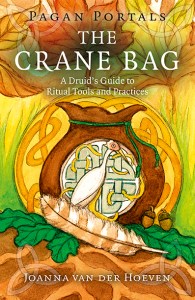
The Craane BagThe Crane Bag, Joanna van der Hoeven’s forthcoming book*, offers an introduction to the ritual tools and practices found in the Druid tradition. It achieves this briefly, simply and with a light touch – as books in the Pagan Portals series are designed to do. Yet it much more than a tick box guide. It provides context and meaning, showing the modern evolution of the Druid tradition itself.

The author makes it clear that she wants readers “to develop their own path in their own time in their own fashion”. Re-enchantment is both path and goal. With proper use, the crane bag “can further the Druid in working with the tides of nature, finding his or her own place in the environment, living in balance, harmony and peace”. The movement overall is “toward reintegration with the natural world”.

At its simplest, the crane bag is the container for Druid ritual tools and as such enables the practices. Bag and tools provide the practitioner with “something tangible to express the spiritual”, acting as a portable “map of the soul”. Behind the crane bag lies an ancient Irish story beginning with the contention between two sisters and the transformation of one of them, Aoife, into a crane. The story is beautifully told and its relevance clearly explained in the first chapter of the book.

In ritual, a period of time and an area of space are set apart and dedicated. This is not to create a lasting duality of sacred and mundane, but a step on the way to experiencing everything as sacred. “Ritual helps us to step back from the busyness, into another way of being. It is a change of consciousness, where we can shift our perception away from a singular view to a more plural view, realising that we are part of an ecosystem”. There is a clear preference for working outdoors, where awareness can shift more readily, though this is not insisted on.

A Druid’s tools will vary with the Druid. The book identifies the following: a silver branch; a staff; cups/bowls/cauldrons; drums; a sickle or knife; robes; altars; fire/candles; incense. People may make or buy them. Ethical sourcing of tools and materials is discussed in some detail, in line with the values of The Crane Bag overall.

What goes into a ritual is explored under the headings of call for peace; preparing the nemeton; honouring spirits of place, three worlds, four directions, ancestors, deities; ritual action; prayers and magic; offerings; eisteddfod; sacrifice; feast; closing. There’s encouragement to practitioners to craft what is right for them from within this set of suggestions and beyond it. The author adds, “I have been in circles with Christian Druids and Buddhist monks, as well as other religions from all over the world”. What matters in ritual is being present and performing the ritual with mindfulness, so that “any words that you speak, any gesture or movement you make will flow more easily, be more graceful and filled with meaning”.

There’s a final chapter on ‘altered states’. I don’t use the term myself, because it makes an ‘altered’ vs ‘normal’ distinction that doesn’t really work for me in my own life. But I recognise it as a term that is widely and usefully employed. Here, it facilitates valuable discussions of meditation, drumming, chanting and song, sensory deprivation, sacred landscape and sitting out. Three kinds of meditation are distinguished: calming the mind and re-tuning the body, journeying and problem solving. Guidance is offered on each kind. Different suggestions are also explored within the other topics. For sensory deprivation, there are two. One is the Celtic version of the sweat lodge, called teach an alais. The other is total immersion in darkness for a considerable period before being brought out into the light. The author refers to early medieval accounts of this, where it was done in aid of Bardic inspiration and prophesy: imbhas forosna.

I found The Crane Bag a very useful contribution to its topic and highly recommend it.


Joanna van der Hoeven The Crane Bag: a Druid’s guide to ritual tools and practices Winchester UK & Washington USA: Moon Books, 2017

*According to the publisher, the book is due for release on 28 July, and can be pre-ordered through Amazon US & UK, Indiebound and Hive.

REBLOG: SCIENCE IN SERVICE TO MOTHER EARTH

Science is, after all, an endeavor of humans and our machines. What would it mean to put this endeavor at the service of Mother Earth? Presumably, our efforts must always be guided by human discernment, in all its fallibility. Who decides what best serves this vision of the Greater Good?

via [A Pedagogy of Gaia] Science in Service to Mother Earth, by Bart Everson — Humanistic Paganism

EPICURUS AND THE BUTTER

“Epicurus had a garden just near Athens. He was also one of the rarest of men, just like Chuang Tzu. He didn’t believe in God, he didn’t believe in anything, because belief is nonsense. Only foolish people believe. A man of understanding has faith, not belief. Faith is different. Faith means trusting life, trusting it so absolutely that one is ready to go with it, anywhere.

“He had a small garden, and he lived there with his disciples. People thought that he was an atheist, immoral. He did not believe in God, he did not believe in the scriptures, he did not believe in any temple. He was an atheist. But he lived in such a great way. His life was superb, magnificent, even though he had nothing, even though they were very poor. The king heard about them and wanted to see how they lived, and how they could be happy without belief. If you could not be happy even with a belief in God, how could these people be happy without God?

“So he came one evening to visit Epicurus’ garden. He was really surprised, amazed – it was a miracle. They had nothing, almost nothing, but they lived like emperors. Like gods they lived. Their whole life was a celebration.

“When they went to the stream to take their bath, it was not simply a bath; it was a dance with the river. They sang and they danced and they swam and they jumped and they dived. Their eating was a celebration, a feast, and they had nothing, just bread and salt, not even butter. But they were so thankful that just to be was enough; nothing more was needed.

“The emperor was very much impressed, and he asked Epicurus: ‘next time I come, I would like some gifts for you. What would you like?’

“Epicurus said, ‘Give us time to think. We never thought that anybody would give us gifts, and we have so many gifts from nature. But if you insist, then bring us a little butter, nothing else. Just that will do.’”

  • Osho When the shoe fits: commentaries on the stories of the Taoist mystic Chuang Tzu London: Watkins Publishing, 2004


Earth Eclectic

music that celebrates Earth and speaks to the heart

Sarah Fuhro Star-Flower Alchemy

Follow the Moon's Cycle

Muddy Feet

Meeting nature on nature's terms

Rosher.Net

A little bit of Mark Rosher in South Gloucestershire, England

Becoming Part of the Land

A monastic polytheist's and animist’s journal

selkiewife

Selkie Writing…

Charlotte Rodgers

Images and words set against a backdrop of outsider art.

Prof Jem Bendell

living with metacrisis and collapse

Towint

The pagan path. The Old Ways In New Times

The Druids Garden

Spiritual journeys in tending the living earth, permaculture, and nature-inspired arts

The Blog of Baphomet

a magickal dialogue between nature and culture

This Simple Life

The gentle art of living with less

Musings of a Scottish Hearth Druid and Heathen

Thoughts about living, loving and worshiping as an autistic Hearth Druid and Heathen. One woman's journey.

Wheel of the Year Blog

An place to read and share stories about the celtic seasonal festivals

Walking the Druid Path

Just another WordPress.com site

anima monday

Exploring our connection to the wider world

Grounded Space Focusing

Become more grounded and spacious with yourself and others, through your own body’s wisdom

The Earthbound Report

Good lives on our one planet

Hopeless Vendetta

News for the residents of Hopeless, Maine