Contemplative Inquiry

This blog is about contemplative inquiry

Tag: nature spirituality

CONTINUITY AND CHANGE

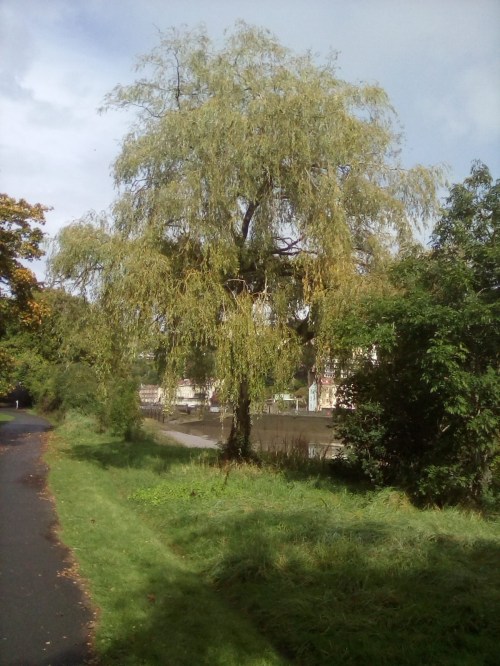
IMG_20191001_124254

I took this picture on 1 October this year. The subject is a willow tree I befriended many years ago as part of my Druid training. It lives in Bristol beside the Avon as the river begins to leave the city, passing through the Clifton gorge and under the suspension bridge. The path, here at the edge of a park, is also a cycle track and continues towards the Severn estuary beside the river. Although I no longer live in Bristol, I continue to visit the willow from time to time and renew the contact.

My strongest link with the tree was in early spring. where I got the most powerful sense of its pulse and vibration, felt especially whilst touching the trunk with the palms of my hands. But I was careful to follow it through a year of regular communion during which it lost a substantial branch to a violent storm. I learned to associate this tree with regeneration, resilience and  generativity. The tree re-established its balance. The dead branch rotted gently in the ground, and contributed to other forms. Nothing was lost.

I’m about to go on a rare visit to my home town, partly to contemplate the continuities and discontinuities of my life and consider future directions. The image of the willow is with me.


CONTEMPLATION AND ENGAGEMENT


According to my dictionary, one of the meanings of ‘signature’ is, “a distinctive pattern, product, or characteristic by which someone or something can be identified: the chef produced the pate as his signature dish”.

I want to adjust the signature of this blog. I want now to explore the relationship between contemplation and engagement more explicitly. A blog is itself a form of engagement, and this one has so far combined a strong curatorial thread with personal sharing. Now, for me as for many others, a deepening social and ecological crisis asks for a work of preserving existing life-affirming aspects of our culture and developing new ones. I see this work as enhanced by outward-looking forms of contemplation. I want this blog to contribute.

I started this blog as a Druid. My personal path, which I have described more recently as a Sophian Way, has become more Universalist. I have described it as a path of healing, peace and illumination, which encourages a spirit of openness, an ethic of interdependence and a life of abundant simplicity. Its ‘sacrament of the present moment’ involves resting in a place of underlying stillness, freedom and love within any experience – good experiences, wonderfully, but also bad ones that need active resisting on the ground. For some, this suggests an experience of divine support, or the activation of the divine within us or of the divinity that we truly are. For others it seems to come from a deep wellspring within the psyche that needs no further point of reference. This sacrament is my core practice, to be dropped into at any time. It doesn’t always take a pure form, but it usually makes a difference. In the myth of my own life, it is Sophia’s principal teaching.

At the level of the wider word, I continue to feel a strong sense of alignment with Pagan, Animist, and Earth spiritualities like Druidry – more than to the Buddhist or Gnostic families or to movements like the Headless Way, even though they have given me a lot. Philip Pullman in his The Secret Commonwealth* has a character who says that where we stand revolves around one key question – ‘is the world dead or alive?’ I say ‘alive’ without worrying about scientific definitions or the metaphysics of reality. Something in me just has to say ‘alive’ – alive and interconnected as a web of life. This re-affirmation is important to me, and as a ‘light bulb moment’ on a level with the more seemingly individual aspects of my Sophian Way. I don’t expect to change the blog that much, but there’s enough adjustment of signature here to demand explicit affirmation.

*Philip Pullman The Secret Commonwealth Oxford, David Fickling Books & London, Penguin, 2019 (Vol. 2 of The Book of Dust)


BOOK REVIEW: SEEK TEACHINGS EVERYWHERE

This post is about Philip Carr-Gomm’s Seek Teachings Everywhere: Combining Druid Spirituality with Other Traditions. I highly recommend this book to anyone interested in the specific topic and/or the development of modern spiritual movements more generally.

Elegantly and accessibly presented, the book testifies both to a personal journey and a key role in developing modern British Druidry. Both the journey and the role are an interweaving of Pagan and Universalist threads. PCG’s approach has been to adopt Druidry as a ‘meta-path’, one able “to transcend religious distinctions”, and allowing of involvement in other paths as well. The Jain path, shared with his Druid mentor Ross Nichols, is the one given the greatest individual attention in the book, in a long section on Druidry and Dharmic traditions. This section touches also on other Indian derived movements and practices (Buddhism, Yoga Nidra) and speculates on ancient cultural and linguistic resonances between early Indian traditions and early European Druidry. PCG dedicates other sections of the book to Christianity and Wicca, with suggestions about how they too can harmonise with Druidry.

This overall approach is reflected in the lived culture of the Order of Bards, Ovates and Druids (OBOD), which PGC has led for thirty years. He is now in a process of stepping down from the role, and so the book is a timely account of both vision and legacy. He says: “each spiritual way has gifts to offer, and some people find in Druidry all the spiritual nourishment they need. Others combine their Druidry with other approaches, such as Wicca, Taoism, Christianity, Buddhism, Hinduism or Jainism”. OBOD’s ancestry as a movement derives from Celtic and Western Way currents within early twentieth century theosophy. The Order remains true to that heritage – as evidenced by a website that actively describes synergies with other paths and provides links to them – see www.druidry.org/ .

My personal takeaway from the book concerns PCG’s substantial presentation of Jain ethics, grounded in three key principles: ahimsa, aparigraha and anekant, here described as the Triple A. PCG explains: “Ahimsa is the doctrine of harmlessness or non-violence, made famous by Gandhi, and espoused by the other Dharmic traditions of Buddhism and Hinduism”. Aparigraha, the doctrine of non-attachment, non-possessiveness or non-acquisition, likewise appears in these other schools. Anekant, a doctrine of many-sidedness, multiple viewpoints, non-absolutism or non-one-sidedness, is unique to The Jains. The three principles can be seen as completing each other – with many-sidedness an aspect of non-violence and non-attachment, and so on.

PCG recommends these principles for our time. They inform his own vision of Druidry. “We know that the world suffers from too much conflict, too much fundamentalism, and too much consumption. This suffering can be alleviated by applying the Triple A doctrines: seeking non-violent solutions, respecting and learning from others’ opinions and beliefs, and reducing consumption to sustainable levels”. In the Jain tradition, such an approach to life is supported by practices of ritual and meditation that work towards the release of negative attachments. PCG recommends versions of these as well.

Part of the beauty of this book is that different readers will find different reasons to take note and learn from it. I have found it valuable both as an authoritative record of a current in modern Druidry, and as a personal inspiration.

Philip Carr-Gomm Seek Teachings Everywhere: Combining Druid Spirituality with Other Traditions Lewes, UK: Oak Tree Press, 2019 (Foreword by Peter Owen Jones)

OPENING TO SUBTLE CHANGES

A good reflection on giving attention from Mark Green’s in Atheopaganism blog.

WHEN I WAS A CREEK

When I was

a tree,

I sang and danced

with the wind

and offered

food and refuge

to all who came.

When I was

a cloud,

I floated freely,

bringing

shade and rain

wherever they

were needed.

When I was

a creek,

I flowed effortlessly

around stones

and nourished life

everywhere

I went.

When I was

a seed,

I held

the story

of what

I would become

inside me

until the sun

and rain

let me know

it was time

to share it.

When I was

a flower,

I opened up

to reveal

my beauty

and invited the bees

to share

the sweetness.

Now I am

human

and can do so many things,

yet I am

full of questions

about who I am

and why I’m here.

Kai Siedenburg Poems of Earth and Spirit: 70 Poems and 40 Practices to Deepen your Connection with Nature Our Nature Connection, 2017

CONTEMPLATION

I like this poem for its economy and simplicity, and for its gentle, shape-shifting animism – for the ease with which it moves between identities in nature. For me, there is power and beauty in this, all the better for a relative lack of ornament.

As a human, I do feel a bit set up. Whereas the rest of nature is awarded an innocence and generosity not always evident in the apparent world, we humans are implicitly stigmatised for our questions, and thereby separated from the rest of nature. In our mainstream culture (both religious and secular) we place ourselves above the rest of nature, so the polar opposite perspective does have a corrective value. But it leaves me unsatisfied.

My sense is that the writer is placing herself alongside me, the reader, and the other humans. She is not awarding herself a free pass on the grounds of her vividly present and enacted imaginative empathy. So I would say to her what I say to myself. As I read it, there’s a strong invitation to self-compassion in the last verse.

Our finite minds are as natural as anything on earth.. Our questions about who we are, why we’re here and what to do are part of us. For me, the only way through them is become more skilled in the process of inquiry and to learn to live by its fruits. I value this poem partly through what it evokes directly, and partly because it stimulates useful inquiry.


POEM: A SPECIAL DAY (CHOSEN FOR ELAINE)

Today

is a very special day.

Today we celebrate

sun and rain,

light and dark,

the cycles of life,

the great turning

of the wheel.

Today we celebrate

every leaf on every tree,

every feather on every bird,

every drop of water in every stream.

Today we celebrate

green growing ones and winged ones,

two leggeds and four leggeds,

all who walk, crawl,

swim or fly.

We celebrate

each breath of air,

each morsel of food,

each beat of our hearts,

each healthy cell.

We celebrate

the profound miracle

of being alive

in this body

in this moment

on this planet.

Today,

like every other day,

is a very special day.

Kai Siedenburg Poems of Earth and Spirit: 70 Poems and 40 Practices to Deepen your Connection with Nature Our Nature Connection, 2017

(Poem shared on the occasion of my wife Elaine’s birthday. It was transcribed for me  on a card sent to me on my own birthday last month. It prompted me to buy the collection, which I recommend.)


ARNE NAESS AS PHILOSOPHICAL VAGABOND

“Naess embodies the spirit of philosophy in its original sense as being a loving pursuit of wisdom. It is a deep exploration of our whole lives and context in pursuit of living wisely. The essence of Socratic inquiry is to know ourselves. From his work on Pyrrhonian scepticism to his … positive statements on pluralism and possibilism, Naess says he is a ‘philosophical vagabond’ or ‘wandering seeker’, what the ancient Greeks called a zetetic’” (1).

In 1968 Arne Naess (1912-2009) published Scepticism (2) two years before resigning as chair of philosophy at the University of Oslo to devote himself to environmental problems. Part of this book focuses on Sextus Empiricus (150-225 CE), the last recorded Pyrrhonist philosopher in a line going back to Pyrrho of Elis (c360-c272 BCE).

Pyrrhonists, as described by Sextus Empiricus, neither made truth claims nor denied the possibility of making them. Instead, they cultivated a deeply embedded attitude of suspension of judgement (epoche), allowing possibilities to stand open within the process of continuing inquiry. Such a turning away from the drive for intellectual closure enables peace of mind (ataraxia) in our engagement with the richness and diversity of experience. As Naess says, the Pyrrhonist philosopher “leaves questions open, but without leaving the question. He has however given up his original, ultimate aim of gaining peace of mind by finding truth because it so happened that he came by peace of mind in another way.” (2)

Naess was not himself a Pyrrhonist, but clearly valued the Pyrrhonist frame of mind. He took something from it into his later work, as is made clear in Alan Drengson’s introduction to Naess’s Ecology of Wisdom (1):

“… there is never one definitive interpretation of philosophical texts; there is never one description of an event and all processes are complex interactions involving changing forces and relations, internal and external. Experience and the processes around us form changing patterns or gestalts. The nature of reality is multidimensional and creative. … Our spontaneous experience is so rich and deep that we can never give a complete account of it in any language, be it mathematics, science, music or art … As a deep questioner and seeker, Naess remains free of dogmatic and monolithic doctrine about the world … [which]  partly explains why he celebrates a movement supported by diverse people with many world views”.

I enjoy this view of inquiry, and feel inspired to carry it forward more consciously in my own work. My sense is that it will bring my inquiry more into the world, without its losing its contemplative core.

(1) Arne Naess Ecology of Wisdom UK: Penguin Books, 2016 (Penguin Modern Classic. First published 2008)

(2) Arne Naess Scepticism Abingdon, UK: Routledge, 1968

See also:

https://contemplativeinquiry.wordpress.com/2019/04/27/pyrrho-scepticism-arne-naess/

https://contemplativeinquiry.wordpress.com/2019/04/25/spiritual-truth-claims/


DEFINING ‘SECULAR’

Stephen Batchelor’s Secular Buddhism (1) explores what a “nonreligious, this-worldly, secularised Buddhism” might look like. This post is part of my own inquiry into what it means to feel ‘secular’ whilst  engaged in ‘spiritual’ practices and connected with modern Paganism. Batchelor uses ‘secular’ in three overlapping senses:

  1. A general contemporary usage where ‘secular’ stands in contrast to whatever is ‘religious’ – the two terms being clearly polarised whilst not very clearly defined.
  2. A Latin derived sense of ‘this age’ (saeculum) – referring to “those concerns we have about this world, that is, everything that has to do with the quality of our personal, social and environmental experience of living on this planet”.
  3. A Western, historical-political sense, acknowledging a 2-300-year period of ‘secularisation’ that has transformed the whole culture to the point where most people can live “almost their entire lives without giving religion a thought”.

Stephen Batchelor talks about an “uncompromisingly secular reading” of the Buddha’s teaching, in which “one returns to the mystery and tragedy of the everyday sublime. Instead of nirvana being located in a transcendent realm beyond the human condition, it would be restored to its rightful place at the heart of what it means each moment to be fully human”. He is an admirer of Ludwig Feuerbach, a student of Hegel who came to reject his teacher’s emphasis on the primacy of Spirit in the unfolding of history and advocated instead a liberal, materialist and atheist view of the world. “Feuerbach’s basic idea is simple. ‘Religion’, he wrote in the preface to his most famous book, The Essence of Christianity (1841) ‘is the dream of the human mind. But even while dreaming we are not in heaven or the realm of Nothingness. We are right here on earth’”.

In this way, Batchelor acknowledges all three senses of ‘secular’: a distancing from traditional religious belief, an affirmation of the world and time, and the rise of modern secular belief systems – Feuerbach was an early influence on Karl Marx. I like the way Batchelor teases out these meanings, especially his acknowledgement of ‘movement in time’ aspects as well as ‘not religious’ ones. I am more open and agnostic about the language of ‘heaven or the realm of Nothingness’ alongside that of being ‘right here on earth’. If we treat these as states rather than places, then I can see them intertwined dimensions of being. But I do not hold this as an ideology.  I stand, rather, in openness and unknowing: the direct experience of At-Homeness in a flowing now is my ground and source, with or without a cosmic warranty.

Another sense, that of interconnectedness in the web of life, grows out of my At-Homeness – and this is firmly situated in place, time, and history. That place and time, right now, is one of distress, division and confusion, facing runaway climate change as a collective existential threat. My inquiry asks to to be alive to this collective wounding, and to contribute to a healing. In previous inquiry phases, I worked with modern Druidry and Paganism, focusing largely on the ‘nature’ aspect, but also on the powers of imagination and deep cultural stories. I then turned to other paths with a stronger emphasis on contemplative practice and its benefits. There is a treasure trove of resources in all of these these explorations, and I shall continue to draw upon them in my new inquiry cycle.

(1) Stephen Batchelor Secular Buddhism: Imagining the Dharma in an Uncertain World New Haven & London: Yale University Press, 2017

POEM: FIELD AND SKY

At the sallow’s* gap

we step through the hedge

and are nothing but field and sky.

Hares race, lurching

to a tussle,

their frenzy printed in the soil.

The kestrel soars –

pausing, head down,

to sew with the finest needle.  (1)

I like this poem for two reasons. The first is as a beautifully written nature poem. The second is the experience it triggered for me in the second and third lines:

we step through the hedge

and are nothing but field and sky.

It is as if the hedge is a portal, and stepping through it takes us into another world, changing us into field and sky. Yet it is the same world, experienced differently. In this version we contain the natural world, holding the lives of hare and kestrel.

Contemplative moments like this – whether directly in nature or evoked in poetry – can take me out of my  boundaried sense of self and place me more fully in the flow of experience and relationship. In their afterglow, I feel a certain poignancy at the fragile, ephemeral, not-to-be-taken-for-granted quality of such connections.

*salix caprea, also called pussy willow

(1) Colin Oliver High River Sudbury: Downstream Press, 2006 (Available from poetry section of the shop at http://www.headless.org/ )


BEING IN TRANSIT

If I ask myself, ‘where is my spiritual centre?’ I do not find an answer within any named tribe. Spiritual friendships, communities of practice and generic webs of connection can all help, and I hope that I give something back. But my path is fundamentally solitary. Perhaps even the notion of having a centre is limiting.

I’ve learned a lot from Druidry. Partly thanks to Druid practice, I experience myself as more fully alive on a living Earth. I honour the wheel of the year as it turns in my locality. In Druidry, I’ve been enabled to explore a contemplative dimension within Earth spirituality. I have also connected with ancestral threads I might otherwise have neglected. But I’m not a polytheist Pagan and I have never felt attracted to Shamanism. I’ve learned from Buddhist tradition too. I’m a meditator. I have a deepened sense of interconnectedness and the call to kindness that goes with it. But I have not adopted the four noble truths as the basis of my path, and I do not seek refuge in Buddha, Dharma and Sangha. I am grateful for my connections to Druidry and Buddhism and will continue to take an interest in their literature. I also sense that, with certain understandings and practices now ingrained, their active roles in my life are over.

My creative edge has for some time been elsewhere. I have been working with the insight that perceptions, apparently of the world, do not establish the existence of a world, but only of perceiving (or awareness, or being). Sensations, apparently of a body, do not establish the existence of embodiment, but only of sensing (or awareness, or being). Thoughts, apparently of a mind, do not establish the existence of a mind, but only of thinking (or awareness, or being). This can seem destructively sceptical, even solipsistic. Yet for many people it signals the possibility of a ‘more than’ (or awareness, or being), rather than a dissociated ‘less than’. Mind, body and world can return enhanced rather than diminished by this kind of exercise, with a sense of a ‘not I not other than I’ connection with primordial awareness or being.

This is the basic stance of nondualist traditions, ancient and modern. In Indian culture, the stripping down and reduction to nothingness is sometimes identified as Vedantic, and the subsequent return and flowering in everything as Tantric. In the Gospel of St. Thomas, a Christian Gnostic text, Yeshua (Jesus) says: “I come from the One who is Openness” and the aspiration of disciples is to make themselves “the abode of Openness, a house that welcomes the breeze, a body that has become transparent, like a crystal flooded with light”. Here, a metaphor concerned with transparency emphasizes power and energy rather than vulnerability and exposure.

I am not a member of a nondualist group, or a Christian Gnostic. But I am moved by these spiritual currents. I am in dialogue with them. I think that ‘being in dialogue’ is a good place to be. For me, certainly now, it has more integrity than formal membership or adherence to a system.

(1) Jean-Yves Leloup The Gospel of Thomas: The Gnostic Wisdom of Jesus Rochester, VA: Inner Traditions, 2005 (English translation and notes by Joseph Rowe. Foreword by Jacob Needleman)

Earth Eclectic

music that celebrates Earth and speaks to the heart

Sarah Fuhro Star-Flower Alchemy

Follow the Moon's Cycle

Muddy Feet

Meeting nature on nature's terms

Rosher.Net

A little bit of Mark Rosher in South Gloucestershire, England

Becoming Part of the Land

A monastic polytheist's and animist’s journal

selkiewife

Selkie Writing…

Charlotte Rodgers

Images and words set against a backdrop of outsider art.

Prof Jem Bendell

living with metacrisis and collapse

Towint

The pagan path. The Old Ways In New Times

The Druids Garden

Spiritual journeys in tending the living earth, permaculture, and nature-inspired arts

The Blog of Baphomet

a magickal dialogue between nature and culture

This Simple Life

The gentle art of living with less

Musings of a Scottish Hearth Druid and Heathen

Thoughts about living, loving and worshiping as an autistic Hearth Druid and Heathen. One woman's journey.

Wheel of the Year Blog

An place to read and share stories about the celtic seasonal festivals

Walking the Druid Path

Just another WordPress.com site

anima monday

Exploring our connection to the wider world

Grounded Space Focusing

Become more grounded and spacious with yourself and others, through your own body’s wisdom

The Earthbound Report

Good lives on our one planet

Hopeless Vendetta

News for the residents of Hopeless, Maine