Contemplative Inquiry

This blog is about contemplative inquiry

Tag: Nature mysticism

LIVING PRESENCE

In my part of the world, we have begun the greening of the year. But I can’t go out to meet it, or if so, only a little. I can’t go out, so I have to go in. In the greening of my contemplative life, a sense of ‘living presence’ has been the key.

My bespoke liturgy speaks to me and at times asks for change. A section of my morning practice, an affirmation of ‘at-homeness in the present moment’, wants to expand into a ‘celebration of living presence’. At-homeness stood for a place of safety and regeneration. ‘Living presence’ includes that and points to more. In the celebration, I affirm myself as ‘living presence in a field of living presence: here, now and home’. I’ve added a period of walking meditation (20 minutes or so), mindful to breath and footfall and also including liv-ing pres-ence as a mantra over two full breaths.

The Phrase ‘living presence’ came up spontaneously but realising that I didn’t actually make it up, I checked up on where I first came across it. It comes from the Sufi teacher Kabir Edmund Helminski (1). “Presence signifies the quality of consciously being here … the way in which we occupy space. Presence shapes our self-image and emotional tone. Presence determines the degree of our alertness, openness and warmth. Presence decides whether we leak and scatter our energy or embody and direct it”.

For Helminski, presence is also our link to the divine. since in the bigger picture it is “the presence of Absolute Being reflected through the human being. We can learn to activate this presence at will. Once activated, we can find this presence both within and without. Because we find it extending beyond the boundaries of what we thought was ourselves, we are freed from separation, from duality. We can then speak of being in this presence”.

My picture of leaves in light against a darker background is, for me, an image of living presence. It wasn’t intended to look like this, but I’m glad that it does. It said ‘living presence’ to me as soon as I saw it. Each leaf grows out of the tree and is extended by the light of the sun. All are enabled and nourished by ‘interbeing’, the Buddhist teacher Thich Nhat Hanh’s (2) reframe of ‘dependent origination’. But the elements of darkness and shade, whilst delineating the tree trunk, also suggest the mystery of a primordial nature, no-thing in itself yet making everything possible. The picture seems to be saying that the potential for greening is everywhere, outside and within.

(1) Kabir Edmund Helminski Living Presence: A Sufi Way to Mindfulness & the Essential Self New York, NY: Jeremy P. Tarcher/Putnam, 1992

(2) Thich Nhat Hanh The Other Shore: A New translation of the Heart Sutra with Commentaries Berkeley, CA: Palm Leaves Press, 2017

RESILIENCE AND REGENERATION

In my world, early March is a pre-equinoctial period of its own. In the emergence from winter, it manifests both resilience and regeneration. This year I have experienced an elephant’s ears plant (bergenia cordifolia) as an marker for resilience. This evergreen lives close to our back garden gate. It has been flowering, and it leaves have kept shiny, for most of 2020 so far. It has given me a lift every time I have walked past it, in all manner of weather. I feel grateful to it just for being there.

Why have I noticed it this year in particular? In the past I’ve taken this plant for granted. I’ve walked past without seeing it. I’ve only paid attention when the leaves need pruning, having strayed onto a path. Yet now this plant feels like a friend and nourishes me with its presence. It doesn’t just demonstrate its own resilience. It supports mine. I’ve been experiencing 2020 as tough and likely to stay that way, so I suppose that something in me has been looking for ways of feeling resilient. As a result, I’ve been able to notice something that’s been there all along, though largely neglected.

As well a resilience, I’ve been having a sense of regeneration, though the dynamics are a little different. One difference is that I expect to be leaning into regeneration at this time because it’s part of my wheel of the year narrative. I also expect it to be linked to the presence of willow trees (see picture below) because I befriended one many years ago. I have stayed in touch even after moving to a different town. The early re-greening of willow trees is part of my direct experience, and also part of my myth. It feels as if I am being taken by the hand and led towards the equinox.

I don’t want to get there prematurely. A patient, attentive journey emphasises the freshness and novelty of each year. I took the photograph below a couple of days ago on impulse, and it felt like a nudge into a process of renewal that I don’t want to undertake too quickly and don’t want to make assumptions about. Regeneration happens. Although I’m starting to feel my age, I’m still part of it. Let’s see how it goes in 2020.

LIGHT ON TREES

Bright light as a valley experience. Sunlight on trees. February 6, the day I took this picture, provided my first experience of intense sunlight this year. It got through to me even in a shady place. My eyes were dazzled and my head struck by an unexpected warmth.

I noticed mixed feelings. Yes, I celebrated the return of the light. Yes, it was a reference experience for the spring aspect of Imbolc in my part of the world. More visceral than snowdrops, the sun truly reached me and not just my nature-observant sensibilities. It was almost shocking.

Looking out, after that first moment, my world filled up with light on trees. I wondered if they too had any resistance to waking up and being visible and called upon to grow and change and open to the light more fully. I don’t know what it’s like to be a tree. Not really. Withdrawing my projections, I am turned back to my own responses. Parts of me have reservations about immersion in the light. Perhaps they have a wisdom of their own.

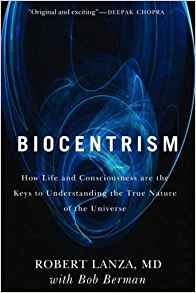
BIOCENTRISM

Biocentrism (1) and the follow-up Beyond Biocentrism (2) are science-referenced explorations of cosmos and consciousness. Unusually, they present a ‘consciousness first’ view. In the first book authors Robert Lanza and Bob Berman work through the evidence and identify seven principles of biocentrism.

“If one removes space and time as actual entities rather than subjective, relative and observer-created phenomena, it pulls the rug from the notion that an external world exists within its own independent skeleton. Where is this external objective existence if it has neither time nor space? we can, at this point formulate seven principles:

“First Principle of Biocentrism: What we perceive as reality is a process that involves our consciousness. An ‘external’ reality if it existed, would – by definition – have to exist in space. But this is meaningless, because space and time are not absolute realities but rather tools of the human and animal mind.

“Second Principle of Biocentrism: Our external and internal perceptions are inextricably intertwined. They are different sides of the same coin and cannot be divorced from one another.

“Third Principle of Biocentrism: The behaviour of subatomic particles – indeed all particles and objects – is inextricably linked to the presence of an observer. Without the presence of a conscious observer, they at best exist in an undetermined state of probability waves.

“Fourth Principle of Biocentrism: without consciousness, ‘matter’ dwells in an undetermined state of probability. Any universe that could have preceded consciousness only existed in a probability state.

“Fifth Principle of Biocentrism: the structure of the universe is explainable only through biocentrism. The universe is fine-tuned for life, which makes perfect sense as life creates the universe, not the other way around. The ‘universe’ is simply the complete spatio-temporal logic of the self.

“Sixth Principle of Biocentrism: Time does not have a real existence outside of animal-sense perception. It is the process by which we perceive changes in the universe.

“Seventh Principle of Biocentrism: Space, like time, is not an object or a thing. Space is another form of our animal understanding and does not have an independent reality. We carry space and time around with us like turtles with shells. Thus, there is no absolute self-existing matrix in which physical events occur independent of life.”

Beyond Biocentrism summarises and extends Biocentrism. It does not repeat the principles, but elegantly summarises the perspective of biocentrism and takes the argument into new territory. An appendix to the book lists its major topics as: the exploration of time; the unreality of death; the nonreality of space; the nature of consciousness; science proofs of biocentrism; asking about awareness in machines (probably no) and plants (certainly yes).

When I contemplate biocentric thinking, I feel engaged and intrigued – without taking a stance on its truth claims. I can see how the universe of the space/time continuum, and within it the earth that I love, may be but a bubble of local, provisional reality. In the light of this narrative, simply experiencing life, being part of it, feels vividly magical. The effect is to ground me even more in my earth spirituality, gratefully celebrating the experienced here and now.

(1) Robert Lanza, MD, with Bob Berman Biocentrism: How Life and Consciousness are the Keys to Understanding the True Nature of the Universe Dallas, TX: Benbella Books, 2009

(2) Robert Lanza, MD, with Bob Berman Beyond Biocentrism: Rethinking Time, Space, Consciousness, and the Illusion of Death Dallas, TX: Benbella Books, 2016

IMBOLC 2020

Spaces ‘between’ can be numinous. They feed the soul. Imbolc for me is like a pre-dawn light. I am not yet out of winter, but something else is happening, and palpably growing in strength.

The hierophant of the Wildwood Tarot – the Ancestor – is placed as a power of Imbolc. An antlered figure clothed in reindeer skins and evergreen leaves, she has a resonance of Elen of the Ways, the reindeer goddess who stands for the sovereignty of the land. She calls to us from a deep past where Ice Age hunters followed reindeer through ancient forest, “following the deer trods” (1,2) responsive to the herds and attuned to the landscape. They lived with little personal property and without long hours of alienating work. The Ancestor invites us to wonder what these early ancestors  might have to teach us under our very different conditions.

On the card, the Ancestor is sounding a drum and calling us into another consciousness – one more open and aware of our place within the web of life. In her world, deer and people are kin. She herself is ambiguous – she might be wearing a mask, or she might be a truly theriomorphic figure. I respond to her call by sinking deeply into my felt sense – the embodied life of sensation, feelings and belly wisdom. The call of the Ancestor  is a pathway to greater wholeness and connection, both personally and collectively. As the year wakes up, it is a good call to hear.

(1) Elen Sentier Elen of the Ways: British Shamanism – Following the Deer Trods Arlesford, Hants: Moon Books, 2013 (Shaman Pathways series)

(2) Elen Sentier Following the Deer Trods: A Practical Guide to Working with Elen of the Ways Arlesford, Hants: Moon Books, 2014 (Shaman Pathways series)

See also book review at: https://contemplativeinquiry.blog/2014/06/22/

NEAR NATURE

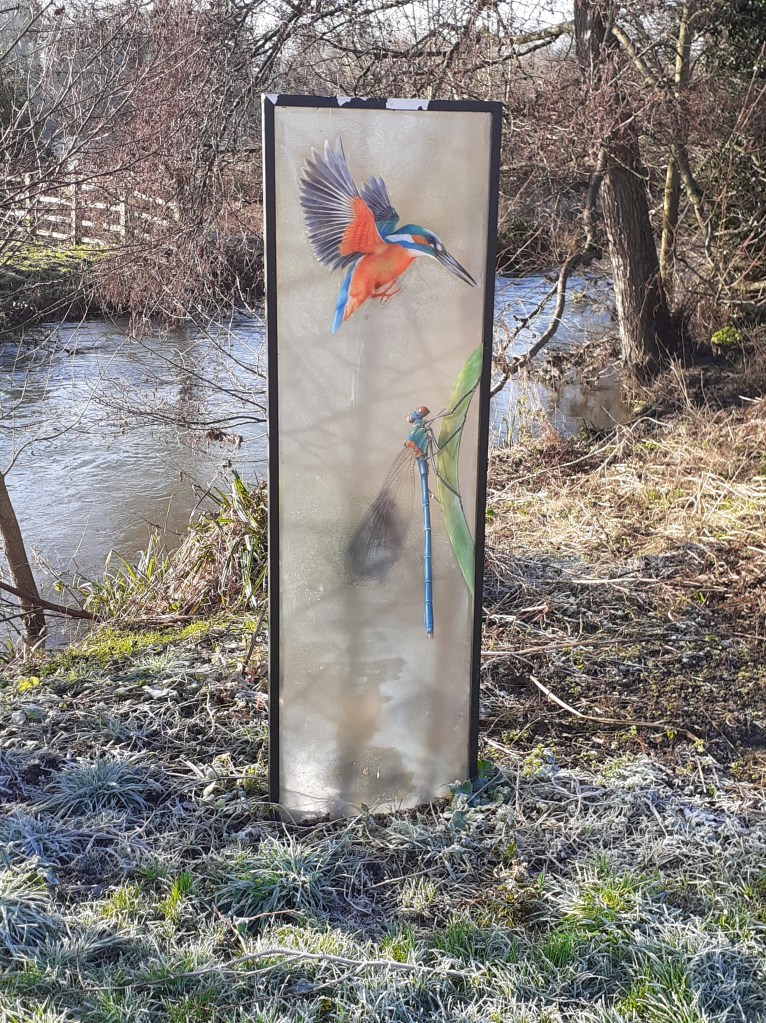
I have never been much of a wilderness person. In times past I have foolishly used this to feel like a lesser Druid. ‘Near nature’ is my habitat. It is a world of parks, streams, canals, accessible hills, woodlands and former rail tracks. Human artefacts of varying vintages are very much part of the scene. These places keep on giving. Over the last couple of days a touch of frost coupled with brighter light has changed the feeling tone of a generally wet and clouded winter. Pictures celebrate this bounty.

SCEPTICISM, OPENNESS AND FLOW

This post summarises where I stand philosophically at this stage of my inquiry, and how my stance affects my practice. When investigating the Direct Path (1) I realised that one possible destination might be radical scepticism about everything. Awakening to Awareness as ultimate ground of being is not the inevitable end point. The only Direct Path teacher who publicly discusses this is Greg Goode (2), who says: “Over the years, I had studied many philosophies and paths. I was aware of a variety of vocabularies. And now, unless I was explicitly playing the role of a direct path participant, none of these vocabularies seemed preferable in terms of truth or accuracy. When I was left to myself, experience didn’t show up as anything at all. There was nothing strictly true or strictly false to say about it”.

Goode reports a sense of confirmation on reading a privately circulated document attributed to Shri Atamananda Krishna Menon, founder of the Direct Path. According to Greg Goode, the gist is “that we can’t say anything at all … everything is paradoxical. We can’t even say that it’s consciousness or that anything exists! It’s a joyful, effusive case of saying without saying!” It helped Goode to get to his final position of ‘joyful irony’, which I have discussed in an earlier post. (3). His key point is that “the joyful ironist has found loving, open-hearted happiness without dogmatism”. For this to work “the joy and the irony must work together. If you’re joyful without being ironic, you’ll still have attachments to your own views of things. And if you’re ironic without being joyful, you may be bitter, cynical, sarcastic and pessimistic. Heartfelt wisdom includes both sides. Joy adds love to irony. Irony adds clarity to joy.” (2)

This sounds almost postmodern, but in fact echoes an ancient wisdom. Philip Carr-Gomm (4) shows its presence in Jain ethics, grounded in the three principles: ahimsa, aparigraha and anekant. Ahimsa is the doctrine of harmlessness or non-violence. Aparigraha is the doctrine of non-attachment, non-possessiveness or non-acquisition, Anekant is a doctrine of many-sidedness, multiple viewpoints, non-absolutism or non-one-sidedness. The three principles can be seen as completing each other, with non-absolutism as an intellectual aspect of non-violence and non-attachment, and hence a virtue.

Pyrrho of Elis, a Greek philosopher of the fourth century BCE, probably met both Jains and Buddhists, when accompanying Alexander ‘the Great’ to India. Indian influence is certainly evident the school of philosophy he created on his return home. In Greek culture this school was treated as a form of Scepticism, but unlike other Sceptics, Pyrrhonists “neither made truth claims nor denied the possibility of making them. Instead, they cultivated a deeply embedded attitude of suspension of judgement (epoche), allowing possibilities to stand open within the process of continuing inquiry. Such a turning away from the drive for intellectual closure enables peace of mind (ataraxia) in our engagement with the richness and diversity of experience” (5).  This teaching seems to combine the Jain view of non-absolutism and the Buddhist view of equanimity and freedom from dukka, (suffering or dis-ease).

As my contemplative inquiry has progressed, I have grown increasingly attracted to the wisdom of this view. I name it as openness, to keep my inquiry process appreciative rather than deconstructive. I have written about it before and this post builds on others. What I notice now is a greater clarity and confidence in this view, reinforcing my stance of At-Homeness in ‘the flowing moment’. Although not perfectly reliable, this At-Homeness is as close as I get to a place of safety. Everything else is uncertain. Everything else can be taken away. I treat ‘flowing moment’ as a simple description of living experience. I find stillness there if I slow down and attend to it. Stillness can be a portal to spontaneous joy and appreciation if I open up and am present to them . It is a good basis for coming back to Earth. From this space I can better connect with other beings, the wider world and the wheel of the year.

(1) A name given to the teachings inspired by Shri Atmananda Krishna Menon (1883 -1959).

(2) Greg Goode After Awareness: The End of the Path Oakland, CA: Non-Duality Press, 2016

(3) https://contemplativeinquiry.wordpress.com/2019/06/11/greg-goode-and-joyful-irony/

(4) Philip Carr-Gomm Seek Teachings Everywhere: Combining Druid Spirituality with Other Traditions Lewes, UK: Oak Tree Press, 2019 (Foreword by Peter Owen Jones)

(5) Arne Naess Scepticism Abingdon: Routledge, 2015 (First published 1968. Scepticism is the last book Arne Naess wrote as an academic philosopher, before going on to devote himself to the development of deep ecology, coining the term ecosophy to describe his stance.)

JANUARY DAYS

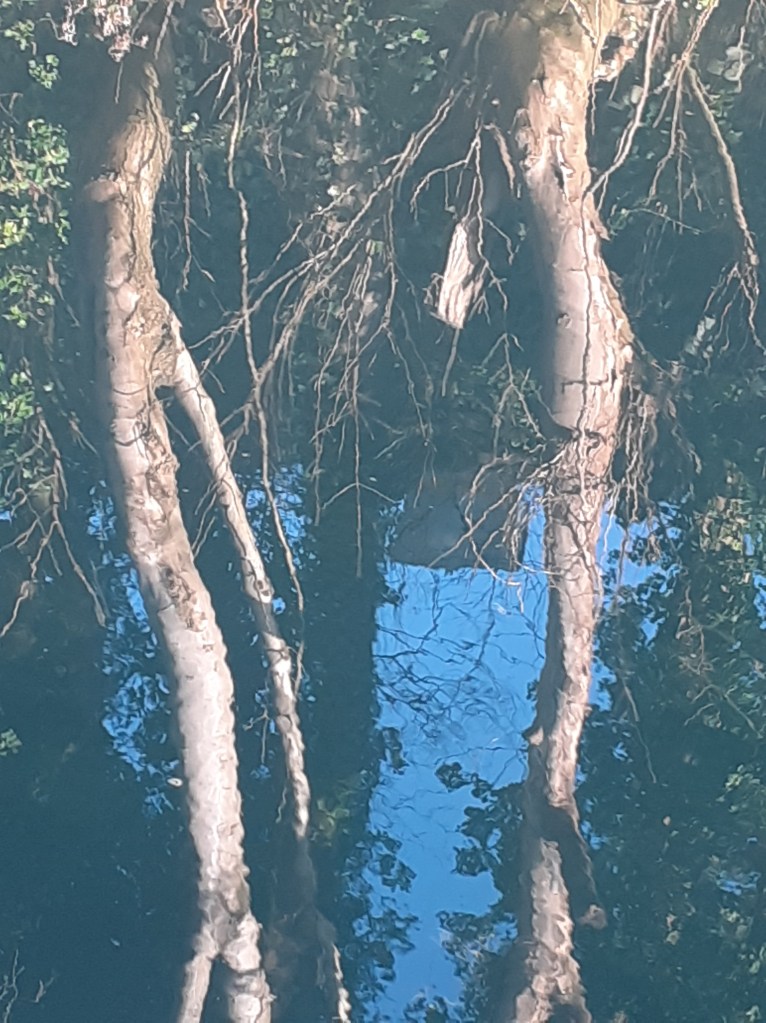
I am conscious now of moving beyond midwinter and towards Imbolc (1 February), the first celebration of returning light. For me, the-mid January period is held in the above image. Tree trunks reflected in water evoke depth rather than height. The image faithfully depicts their withdrawn winter life whilst hinting at other life below the surface, as the world turns over in its sleep.

HOODED HERMIT

Winter in the  Wildwood Tarot lasts from Samhain (1 November) to Imbolc (1 February), whereupon the spring quarter begins. The hooded man, hermit of this deck, is shown as solstice figure whose influence pervades the whole winter. The image depicts a hooded figure, staff in the left hand and lantern in the right, standing by a great oak tree. The lantern illuminates a door in the tree, which itself suggests, through cracks in its timbers, an illuminated space inside. A wren sits on a stone nearby.

There is power in this image. The world tree, standing for life and wisdom, is both source and refuge. The hooded hermit seems to model intention and training, and his lantern and staff are potent tools. The wren once won a contest to be king of the birds by riding on the back of an eagle and thus flying highest. An animal ally, perhaps.

The face of the hooded hermit is hidden: no visible sign of a forest rebel; no sign, specifically, of a man. Does this suggest a talent for invisibility or shape-shifting? Perhaps. But what I chiefly sense is a Zen emptiness, of which Thich Nhat Hanh (2) says: “At first, we think emptiness is the opposite of fullness but, as we saw earlier, emptiness is fullness. You are empty of your separate self, but full of the cosmos.” According to another Zen writer (3), “the Buddha called himself tathagata or ‘that which is thus coming and going’ …a flowing occurrence, and the outward form ,,, was constant, calm, compassionate availability to people who came to him for help.”

I am not a Buddhist and I do not seek to appropriate the hooded hermit for Buddhism. Similar ideas about the emptying out of personality to make room for a greater life can be found in Taoism (4) and Douglas Harding’s Headless Way (5). There’s a reminder here that path and goal are one, and that an emptied fullness of experiencing is available at any point of the journey.

(1) Mark Ryan & John Matthews The Wildwood Tarot Wherein Wisdom Resides London: Connections, 2011. Illustrations by Will Worthington

(2) Thich Nhat Hanh The Other Shore: A New Translation of the Heart Sutra with Commentaries Berkeley, CA: Palm Leaves Press, 2017

(3) Ben Connelly Inside Vasubandhu’s Yogacara: A Practitioner’s Guide Somerville, MA: Wisdom Publications, 2016

(4) Lao Tzu Tao Te Ching: A Book about the Power and the Way Boston & London: Shambhala, 1998 (A new English version by Ursula K. Le Guin, with the collaboration of J.P. Seaton, Professor of Chinese, University of North Carolina, Chapel Hill)

 (5) http://www.headless.org

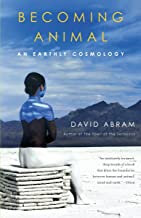
DAVID ABRAM: RECIPROCITY

“Wander over to that oak, or a maple, or a sycamore, reach out your hand to feel the surface of a single many-pointed leaf between your thumb and fingers. Note the coolness of that leaf against your skin, the veined texture your fingertips discover as they roam across it. But notice, too, another slightly different sensation: that you are also being touched by the tree. That the leaf itself is gently exploring your fingers, its pores sampling the chemistry of your skin, feeling the smooth and bulging texture of your thumb even as the thumb moves upon it.

“As soon as we notice than our hands are being included within the tactile world, we are forced to notice this reciprocity: whenever we touch any entity, we are also being touched by that entity.

…..

“Such reciprocity is the very structure of perception. We experience the sensuous world only by rendering ourselves vulnerable to that world. Sensory perception is this ongoing interweavement: the terrain enters into us only to the extent that we allow ourselves to be taken up within that terrain.”

David Abram Becoming Animal: An Earthly Cosmology New York: Vintage Books, 2010

Earth Eclectic

music that celebrates Earth and speaks to the heart

Sarah Fuhro Star-Flower Alchemy

Follow the Moon's Cycle

Muddy Feet

Meeting nature on nature's terms

Rosher.Net

A little bit of Mark Rosher in South Gloucestershire, England

Becoming Part of the Land

A monastic polytheist's and animist’s journal

selkiewife

Selkie Writing…

Charlotte Rodgers

Images and words set against a backdrop of outsider art.

Prof Jem Bendell

living with metacrisis and collapse

Towint

The pagan path. The Old Ways In New Times

The Druids Garden

Spiritual journeys in tending the living earth, permaculture, and nature-inspired arts

The Blog of Baphomet

a magickal dialogue between nature and culture

This Simple Life

The gentle art of living with less

Musings of a Scottish Hearth Druid and Heathen

Thoughts about living, loving and worshiping as an autistic Hearth Druid and Heathen. One woman's journey.

Wheel of the Year Blog

An place to read and share stories about the celtic seasonal festivals

Walking the Druid Path

Just another WordPress.com site

anima monday

Exploring our connection to the wider world

Grounded Space Focusing

Become more grounded and spacious with yourself and others, through your own body’s wisdom

The Earthbound Report

Good lives on our one planet

Hopeless Vendetta

News for the residents of Hopeless, Maine