Contemplative Inquiry

This blog is about contemplative inquiry

Tag: Mystery

FAITH

In my Druid circle, I associate the northern quarter with faith. The quality and context of faith are not defined. They could simply mean faith in the practice and path. My contemplative inquiry overall has tended towards a stance of ‘sacred agnosticism’ (1), in which faith is not emphasised. This has served me in many ways. I have avoided mixing up the idea of ‘faith’ with affiliation to authoritarian movements, mandated beliefs, or the surrender of self-responsibility and personal discernment. I have been alert to the metaphysical group think and consensus collusion that can show up in any spiritual movement (other kinds of movement too). I have done my best to gather and evaluate information skilfully, when developing principles about how to live ethically and gracefully in an increasingly scary world.

And yet … this is not the whole story, or I would feel spiritually malnourished. In recent months I have experienced a strong felt sense of the divine. When I describe myself as ‘living presence in a field of living presence in a more than human world’ – an animist identification – the identification now seems more than animist, though the animism is still there. I pray more congruently to the Goddess as Ancient Mother and talk, less anthropomorphically, about the ‘bubbling source from which I spring’. The Divine is beyond name, form or description – and some people prefer a specialist, capitalised use of rather abstract terms like Consciousness, Awareness, Void, Ground of Being. But the ones from my own practice are the ones that work for me. They come from the intuitive heart and the imagination. To me they offer a deeper knowing, though I am personally cautious about the use of the word gnosis. For me, it can reduce the sense of mystery,  banishing the creative role of faith itself.

I have become a provisional panentheist, experiencing intimations of a divine which is everywhere and no-where, and from which we are not separate. This partly reprises work I did in the earlier days of my inquiry using the framework of non-duality. Now I find panentheism a better term than non-duality for affirming both the divine and the world. The earth spirituality in the Druid tradition is in no way compromised by a panentheist perspective. If anything it is enhanced.

(1) See https://contemplativeinquiry.blog/2024/02/16/sacred-agnos
‘MYSTERY’ IN A MORE THAN HUMAN WORLD

“Half-way between the certainty of science on one hand, and the supernatural on the other, is mystery …. Mystery is central to enchanted experience because enchantment is not a rational process of recognition, categorization, knowledge, facts or rationalizations. It is, instead, a pure experience of sensing and being.” (1)

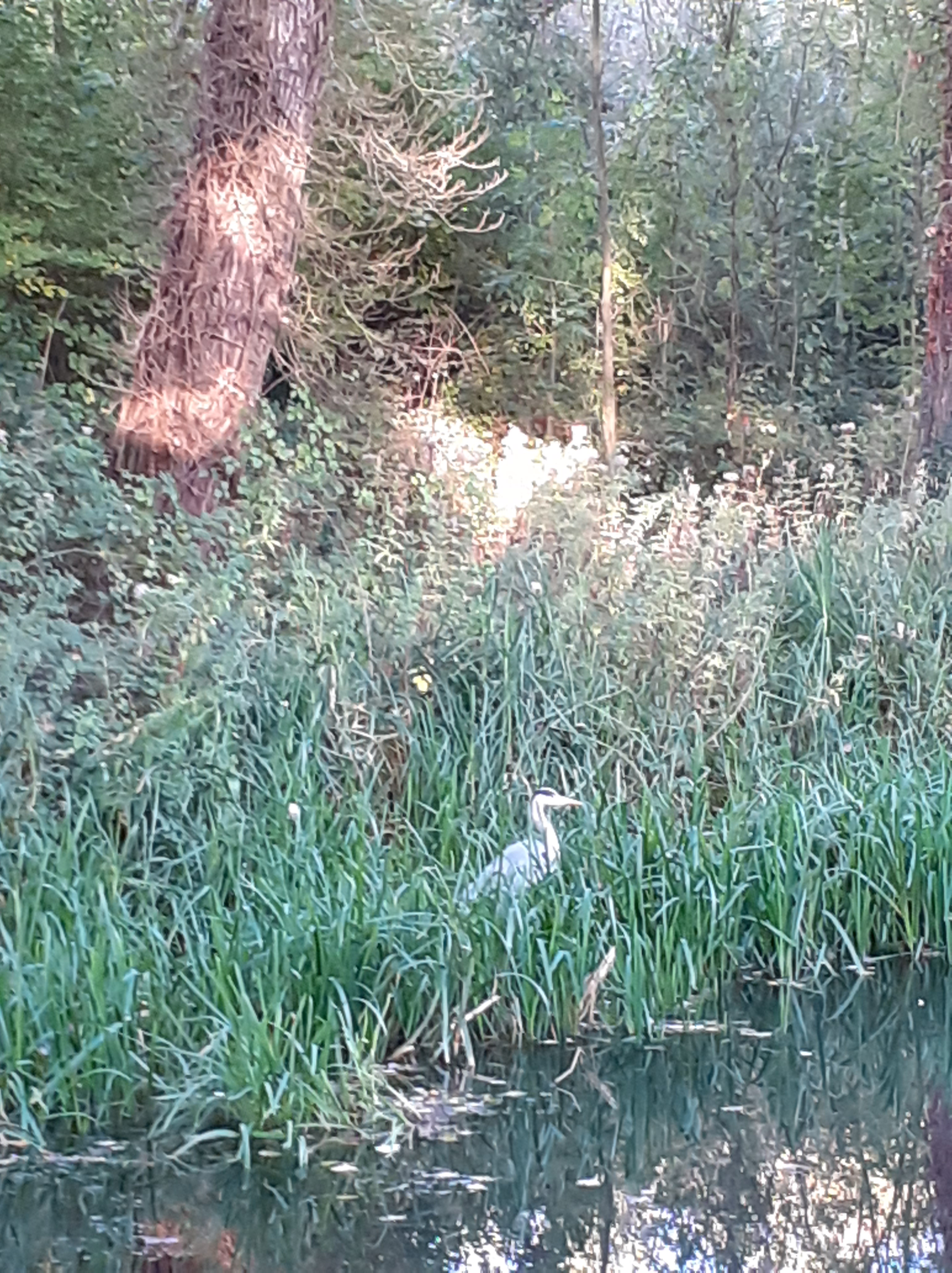
I saw the heron on 11 October 2020, in the first year of the pandemic and just a little after dawn. I had been walking for about forty minutes, beginning in near darkness and experiencing the gradual coming of the light. I described this walk at the time as an “enchanted meander” at a liminal point in that day (2).

My encounter with the heron was unexpected and I responded with “delighted surprise”. Four years later, reflecting on the memory, I note that I was able to experience delighted surprise from within stillness. In that moment I was a still human sharing space with a still heron on a still early morning. So the heron stayed in place, not needing to fly away. Beyond that there was no communing, but this was somehow blessing enough. Stillness of this kind, in contact with our more than human world, allows space for an enhanced bandwidth of experience. It is, perhaps, an opening to what Arran Stibbe calls “mystery”.

On that morning, my enhanced experience was partly displaced into the taking of a picture and also the wider purpose of my walk. That’s fine, a good enough choice. But I wonder what would have happened if I, like the heron, had stayed in place.

(1) Arran Stibbe Econarrative: Ethics, Ecology and the Search for New Narratives to Live By London: Bloomsbury Academic, 2024

(2) https://contemplativeinquiry.blog/2020/10/14/walking-towards-sunrise/

‘SACRED AGNOSTICISM’

In the later stages of a post mostly about the spiritual benefits of ‘deep adaptation’ (1), Jem Bendell discusses “sacred agnosticism, where the mystery of consciousness is surrendered”. I wish that I had come up with ‘sacred agnosticism’ myself, and the use of ‘surrendered’ in that context. I see it as a highly skilful use of language, that tricky medium, and resonant in the present stage of my own life and practice.

Describing his journey to this position, Bendall says: “for many years, I’d ditched religious stories of a soul that exists, like my current consciousness, in an afterlife. I’d also realised that aspects of reality and consciousness are ineffable. Meaning, once we use concept and language to describe the ultimate truth, we are moving away from reality.”

However, he goes on to acknowledge that: “I still had part of me that wanted to know. Will I still be conscious after death? Will I merge, will I reincarnate, will I experience nothing? Will I leave no trace in the universal information field or akashic record? Did I even exist much in the first place?”

Through reflection and meditation Bendall discovered that any narrative of this kind would, for him, “have originated in fear, where the ego needs to map, order and control reality and assert that to others”. In the absence of such stories he suggests that “the mystery itself is an invitation to transcend the ego.” So he decided that: “I wanted to cultivate a way of being where I will actually celebrate that ‘not-knowingness’ and would naturally feel that way at the time of dying”.

The content of the reflections isn’t new to me. Yet I do strongly feel that I’ve been gifted the right words at the right time. I am grateful to Jem Bendall for his post.

(1) https://jembendell.com/2024/02/13/major-life-changes-become-the-least-risky-option/

LIVING WITH AN OPEN HEART

“There is a pervasive feeling of poignancy. It is like the cosmic hum, the radiation left over after the Big Bang. It is always present. It is the feeling of existence. We recognize ourselves as open awareness when we stand in the mystery of this feeling. This is our true nature, our open heart. We are searching for this total openness. We’re running from it too.

“….

“We try to run from the poignancy at the heart of existence into plans, projects, fantasies, worries, regrets and images of serenity and peace. Or we try to perfect it, ‘tweak’ it somehow. But it is already perfect, in that it transcends any concept we would have of it. If we must have a project, we can appreciate the mystery of existence without trying to resolve it into a specific feeling or understanding that we will then articulate, control or repeat.”

J. Jennifer Mathews (2010) Radically Condensed Instructions for Being Just As You Are.

‘WHIRLPOOL’: THE POWER OF AN IMAGE

For R. J. Stewart (1), the deepest vision and reality of the Underworld is “that the stars are within the Earth, within ourselves, not distant and remote”. He explains a vision in which our habitual awareness, personal and collective, “is on the surface of existence” and that “the primal reality is in the depths, not only of ourselves, but of the land and planet, which are of the universal Being. So we do not reach out and away from ourselves, but plunge into the otherworld that is the source of our own and, more important, is the source of the stars themselves.  In the Whirlpool realm, we find the deepest intimations of our inherent universal Being. It leads us to the sacredness of the planet, of the body, for deep within is all that is, the source of the four Powers emerging from the Void”*.

The Dreampower Tarot, which Stewart devised together with artist Stuart Littlejohn, is structured around a descent from the surface through three realms: stone, pearl and whirlpool. To a large extent these correspond to the traditional western distinctions of body, soul and spirit, though emphasising a journey of descent rather than ascent. The Whirlpool realm, and the individual Whirlpool card, involve a quest “for truth and reality that reaches within towards the source of Being. In this sense it also shows wonder and awe, the Mystery within that turns all existence, setting the worlds in motion through the cycle of the Powers and Elements.” Hence the Whirlpool can be called an archetypal image – putting a star field in the foundational depths of consciousness. The use of the term ‘whirlpool’ for a “spiralling nebula of stars” skilfully introduces water references into the picture, offering further disruptions of common sense for the imagination to make use of.

In an earlier work (2), Stewart places a star field at the centre of a creation myth, one that begins with darkness and void until light begins to appear, and “the light that spreads through the darkness is starlight, and we find that we are in the centre of a vast wheel of stars, rising and falling all around us”. Here he introduces the Goddess Ariadne, “Weaver of Being and Unbeing”, creator of form. Her description is too specific and too anthropomorphic for me. But there is something in the process which unfolds that resonates: “Out of the silence a sound emerges … It is the sound of breath. We become aware of a breathing in and out, and realize that this breathing is our breath and yet the breath of all Being. We breathe, Being breathes. Slowly we feel form assemble from the breathing, and realize that we have a body which is the body of all Being.  The stars are within us, we are formed of the Weaving.” 

I have a powerful sense of the motherhood of the cosmos, and of being companioned, though not instructed, in learning to breathe. I have intrauterine and early post natal experiences – not readily accessible, but held within me – to influence my shaping of experience. I have adult experiences of rebirthing and holotropic breathing that have enabled me to reprise the original process and helped me distinguish personal from transpersonal and universal elements. Today I can add the sense of a universe born with every breath, here and now. Somewhere here I do indeed find the Goddess, as I also find her in everything around me.

(1) R. J. Stewart The Dreampower Tarot: The Three Realms of Transformation in the Underworld London: The Aquarian Press, 1993 Illustrated by Stewart Littlejohn

(2) R. J. Stewart The Way of Merlin: the Prophet, the Goddess and the Land London: The Aquarian Press, 1991

*In this vision the Void is the source of all being, and the four powers are life, light, love and law – with the last being alternately understood as liberation. These powers are associated with the four elements, respectively air, fire, water and earth.

LUNAR WISDOM

” The moon was the image in the sky that was always changing yet always the same. What endured was the cycle, whose totality could never be seen at any one moment. All that was visible was the constant interplay between light and dark in an ever recurring sequence. Implicitly however, the early people must have come to see every part of the cycle from the perspective of the whole. The individual phases could not be named, nor the relations between them expressed, without assuming the presence of the whole cycle. The whole was invisible, an enduring and unchanging circle, yet it contained the visible phases. Symbolically, it was as if the visible ‘came from’ and ‘returned to’ the invisible – like being born and dying, and being born again.

“The great myth of the bronze age is structured on the distinction between the ‘whole’, personified as the Great Mother Goddess, and the ‘part’, personified as her son-lover or her daughter. She gives birth to her son as the new moon, marries him as the full moon, loses him to the darkness as the waning moon, goes in search of him as the dark moon, and rescues him as the returning crescent. In the Greek myth, in which the daughter plays the role of ‘the part’, the cycle is the same, but the marriage is between the daughter and a god who personifies the dark phase of the moon. The daughter, like the son, is rescued by the mother. In both variations of the myth, The Goddess may be understood as the eternal cycle s a whole: the unity of life and death as a single process. The young goddess or god is her mortal form in time, which, as manifested life, whether plant, animal or human being – is subject to a cyclical process of birth, flowering, decay, death and rebirth.

“The essential distinction between the whole and the part was later formulated in the Greek language by the two different Greek words for life, zoe and bios, as the embodiment of two dimensions co-existing in life. Zoe is infinite, eternal life; bios is finite and individual life. Zoe is infinite ‘being’; bios is the living and dying manifestation of this eternal world in time.”

(1) Anne Baring Anne and Jules Cashford The Myth of the Goddess: Evolution of an Image London: Penguin, Arkana Books, 1993

INQUIRY NOTE: For me this modern interpretation of Bronze Age myth offers a good Pagan way of talking about ‘non-duality’, a strong thread in my inquiry in recent years. In its Sanskrit origin, advaita simply means ‘not two’. It speaks of a unity that is not exactly oneness in the sense of complete assimilation. It points to the sense that we are bios in our transient personal lives yet also zoe the life eternal, both the wave and the ocean. In Western theistic culture this view seems consistent with either pantheism or panentheism. It also fits modern understandings of animism and biocentrism. While I find it useful to know about these models and frameworks, I avoid strong identification with them. There remains an underlying mystery, which is where myth and imagination come into their own.

IMAGINING MYSTERY

‘Imagining mystery’ is the title given by Ursula K. Le Guin for Chapter 25 in A Book About the Way and the Power of the Way, her English rendition of the Tao Te Ching.

“There is something

that contains everything

Before heaven and earth

it is.

Oh, it is still, unbodied,

all on its own, unchanging.

“all-pervading,

ever moving.

So it can act as the mother

of all things.

Not knowing its real name,

we only call it the Way.

“If it must be named,

Let its name be Great.

Greatness means going on,

going on means going far,

and going far means turning back.

“So they say, ‘the Way is great,

heaven is great, earth is great;

four greatnesses in the world,

and humanity is one of them’.

“People follow earth,

earth follows heaven,

heaven follows the Way,

the Way follows what is.”

Ursula Le Guin comments: “I’d like to call the ‘something’ of the first line a lump – an unshaped, undifferentiated lump, chaos, before the Word, before Form, before Change. Inside it is time, space, everything; in the womb of the Way. The last words of the chapter, tzu jan, I render as ‘what is’. I was tempted to say, ‘The Way follows itself’, because the Way is the way things are; but that would reduce the significance of the words. They remind us to see the way not as a sovreignty or a dominion, all creative, all yang. The Way itself is a follower. Though it is before everything, it follows what is.”

She also owns to a piece of creative editing. “in all the texts, the fourth verse reads: So they say, ‘the Way is great/heaven is great;/earth is great;/and the king is great./Four greatnesses in the world/and the king is one of them’.” Yet in the next verse, which is the same series in reverse order, instead of ‘the king’, it is ‘the people’ or ‘humanity’. I think a Confucian copyist slipped the king in. The king garbles the sense of the poem and goes against the spirit of the book. I dethroned him.”

I share Ursula Le Guin’s lens, and editorial calls like this are the reason I am drawn to her version more than any other. The text as a whole speaks to our experience of moving between non-duality, dualities, and the multiplicity of the 10,000 the things. For me, the work Ursula Le Guin has done, in reframing traditional understandings of A Book About the Way and the Power of the Way, makes her a teacher in her own right.

She calls the first chapter of her version Taoing, emphasising process and flow, and the need to stay open to uncertainties and ambiguities. The text both acknowledges that words over-define experience (thus limiting and distorting it) and understands the need to use them (otherwise why write it?) When taoing, we hold such points of tension. For they are the key to imagining mystery.

“The way you can go

isn’t the real way,

The name you can say

isn’t the real name.

Heaven and earth

begin in the unnamed:

name’s the mother

of the ten thousand things.

So the unwanting soul

sees what’s hidden,

and the ever-wanting soul

sees only what it wants.

Two things, one origin,

but different in name,

whose identity is mystery,

Mystery of all mysteries!

The door to the hidden.”

Lao Tzu Tao Te Ching: A Book About the Way and the Power of the Way Boston & London: Shambhala A new English version by Rrsula K. Le Guin, with the collaboration of J. P. Seaton, Professor of Chinese, University of North Carolina, Chapel Hill.

CELEBRATING THE MYSTERY

Yesterday my wife Elaine and I went to visit Gloucester Cathedral, where a beautifully crafted model of the moon has been hung in the body of the church. There were many visitors, most of them clearly drawn to this display and enlivened by it. For everyone there was something special about a scientifically accurate depiction of the moon in a medieval Christian building that continues to be an active space for worship. For some, the presence of the moon would also have suggested Pagan and archetypal references to provide a balancing influence in a splendidly patriarchal setting. It also allowed for a sense of only slightly subdued informality and fun, which I don’t generally associate with Church of England cathedrals. People felt free to enjoy themselves, and I give great credit to the organisers for their achievement.

The concept paid tribute to our age-old human search for meaning, and a sense of place within the cosmos. I was reminded of some reading I’d done only a couple of days before, and I’ve checked out the reference. For me, the image above and the words below show the same attractive spirit, one I find an inspiration for my contemplative inquiry.

“Both science and spirituality reflect our human urge to know – that perennial itch to make sense of the world and who we are. This quest is an essential part of being human. We probe reality as best we can with our tools of understanding – structures, models, theories, myths, beliefs, teachings – but those tools of understanding also define the limits of our knowledge. … There is no ultimate truth. No teacher, no scientist will give us all the answers. Let us simply bow to the intelligence of our hearts, drop into not knowing, keep our minds open, cherish the questions, and let the answers arise and evolve, all the while celebrating this mystery called life.”*

*Zia and Maurizio Benazzo On the Mystery of Being: Contemporary Insights on the Convergence of Science and Spirituality Oakland, CA: Reveal Press, 2019. (Reveal Press is an imprint of New Harbinger Press)

Earth Eclectic

music that celebrates Earth and speaks to the heart

Sarah Fuhro Star-Flower Alchemy

Follow the Moon's Cycle

Muddy Feet

Meeting nature on nature's terms

Rosher.Net

A little bit of Mark Rosher in South Gloucestershire, England

Becoming Part of the Land

A monastic polytheist's and animist’s journal

selkiewife

Selkie Writing…

Charlotte Rodgers

Images and words set against a backdrop of outsider art.

Prof Jem Bendell

living with metacrisis and collapse

Towint

The pagan path. The Old Ways In New Times

The Druids Garden

Spiritual journeys in tending the living earth, permaculture, and nature-inspired arts

The Blog of Baphomet

a magickal dialogue between nature and culture

This Simple Life

The gentle art of living with less

Musings of a Scottish Hearth Druid and Heathen

Thoughts about living, loving and worshiping as an autistic Hearth Druid and Heathen. One woman's journey.

Wheel of the Year Blog

An place to read and share stories about the celtic seasonal festivals

Walking the Druid Path

Just another WordPress.com site

anima monday

Exploring our connection to the wider world

Grounded Space Focusing

Become more grounded and spacious with yourself and others, through your own body’s wisdom

The Earthbound Report

Good lives on our one planet

Hopeless Vendetta

News for the residents of Hopeless, Maine