Contemplative Inquiry

This blog is about contemplative inquiry

Tag: Modern Paganism

ETHICS AND ‘CIVILIZATION’

In his Reclaiming Civilization (1), modern Pagan philosopher Brendan Myers asks three questions: What is civilization? What is wrong with it? What should we do about it? As part of his work with the third question, he looks at ethics. He starts with the proposition that a flourishing life is ethically desirable and good. This proposition may seem simple and obvious, yet it has not been a reliable quality of ‘civilization’ as we know and have known it.

Myers goes on to describe virtue ethics as the branch of philosophy that investigates character and identity. To live a flourishing happy life, we need to install ways of understanding, responding to, and acting in the world that will tend to support it. These are the virtues. Through the process of identifying and working with virtues, we reach towards the person we want to be and the world we want to live in. Myers implies a necessary inner work, when he speaks of “the possibility of a greater depth of life-experience that can appear when I am willing to let go of my illusions, willing to risk harm and despair, in pursuit of a more honest relationship with reality”. He then presents his own list, offering his virtues as ways of responding to three ‘immensities’: earth, interpersonal otherness, and solitude/death.

For earth, the virtues are “those ways of being in the world that enable you to look upon the earth, in all its beauty and danger yet feel no need to own it all, nor to destroy it … but to explore it, play with it, know it. Myers recommends “virtues of wonder: including imagination, creativity, open-mindedness, aesthetic taste, and curiosity”. He adds that this does not preclude practices such as farming but does call for them to be “conducted in careful (as in full-of-care), sustainable and co-operative ways”.

For interpersonal otherness, the virtues are “those ways of being that enable you to look upon your neighbor, however strange or different she may be, and feel no need to make her conform to your demands, nor a need to send her away (such as, to her death) … the virtues … enable you to see another earth, in a manner of speaking … your neighbor’s eyes are another way of looking upon the earth … you have another way of exploring it”. Here, Myers recommends “virtues of humanity” – care, courage, friendship, generosity and the “Seven Grandfathers of Wisdom, Truth, Humility, Bravery, Honesty, Love and Respect”.

For “the immensity of solitude, and of death”, the virtues are qualities that contradict any need to avoid solitude and death at “any cost, however destructive to yourself and others”. These, for Myers, are “virtues of integrity: including reason, consistency, dignity, Socratic wisdom, acknowledged vulnerability, forgiveness, mercy, the will to establish a legacy, and the will to let go”.

When I reviewed Reclaiming Civilization last year (2) I knew that I would want to return to it and examine its ethical approach more closely. What I like about this approach is that it avoids both a ‘follow your bliss’ vagueness and a rigid prescriptive system. It fits very well with my sense of a Sophian Way. It suggests principles and a method and then challenges us to develop our own list. Here, we have an ethics that asks for close attention, questioning and (I would suggest) a continuous work of understanding our chosen ‘virtues’ and checking them out in practice. For me, the notion of a flourishing life for ourselves and others has to extend to the biosphere. A purely human approach no longer serves even we humans ourselves. I also like an approach that (without being partisan) has political implications. It is not just an ethics for private life. Myers provides a tool for living the ‘good life’, and perhaps, identifying possible contributions to reclaiming (and re-framing) ‘civilization’ – the central theme of Myers’ book and the context for his ethical discussion.

(1) Brendan Myers Reclaiming Civilization: A Case for Optimism for the Future of Humanity Winchester, UK & Washington, USA: Moon Books, 2017

(2)  https://contemplativeinquiry.wordpress.com/2017/08/24/book-review-recl…ing-civilization/ ‎
SOPHIA SOURCE OF WISDOM

“The Holy Spirit of Wisdom as the guiding archetype of human evolution is one of the great images of universality. Transcending the limitations of any one religious belief, it is an image that embraces all human experience, inspiring trust in the capacity of the soul to find its way back to the source.  … To discover the root of the idea of Wisdom we have to go back once again to the Neolithic era, when the goddess was the image of the Whole, when life emerged from and was returned to her, and she was conceived as the door or gateway to a hidden dimension of being that was her womb, the eternal source and regenerator of life … the idea of Wisdom was always related in the pre-Christian world to the image of the goddess; Nammu and Inanna in Sumeria, Maat and Isis in Egypt, and Athena and Demeter in Greece. Even the passages in the Old Testament that describe Hokhmah, the Holy Spirit of Wisdom, powerfully evoke her lost image, though here the image is dissociated from the world.

“But as we move into the Christian era there is a profound shift in archetypal imagery as Wisdom becomes associated with Christ as Logos, the Word of God, and the whole relationship between Wisdom and the Goddess is lost. Now, the archetypal feminine is finally deleted from the divine, and the Christian image of the deity as a trinity of Father, Son and Holy Spirit becomes wholly identified with the masculine archetype. … This theological development effectively erased the ancient relationship between Wisdom and the image of the goddess. Gnostic Christianity, however, retained the older tradition and the image of Sophia as the embodiment of Wisdom survived. Here she was the Great Mother, the consort and counterpart of the God head. When the Gnostic sects were repressed by the edicts of the Emperor Constantine in AD 326 and 333, the image of Sophia as the embodiment of Wisdom was again lost. However, after an interlude of several hundred years, it reappeared in the Middle Ages, in the great surge of devotion to the Virgin Mary and the pilgrimages to the shrines of the Black Virgin … then, in the sudden manifestation of the Order of the Knights Templar, the Grail legends, alchemy, the troubadours and the Cathar Church of the Holy Spirit, Sophia, or Sapientia, as the image of Wisdom, became the inspiration, guide and goal of a spiritual quest of overwhelming numinosity.” (1)

I am committed to a Sophian Way. My view and practice are largely settled. I have worked, studied and sometimes simply surrendered over a long period, exploring methods and movements and gaining insights from them. That phase is done. On several occasions now, the phrase ‘it’s over’ has flashed into my mind, imprinting itself with the force of command. A quest is fulfilled. I know how best to maintain (to use my own language) a sense of At-Homeness, a living ‘not-I-not-other-than-I’ interconnectedness with the Divine. With this, my contemplative inquiry has reached the high-water mark of ‘contemplative’. It is therefore set to become a contemplation-and-action inquiry, in which I will, among other things, look at my understanding of ‘action’ at this time in my life.

One concern, given this confirmation of personal path, is the question of affiliation, and of social identity in the spiritual domain. How do I place myself in culture and community? Merely to name a ‘Sophian Way’ is an invocation of sorts, yet I am neither a Christian nor a Gnostic in the sense of the old movements. My valuing of a wisdom text like the Gospel of Thomas is on a par with my valuation of texts from other traditions – the Prajnaparamita Heart Sutra, the Tao Te Ching, or Rumi’s poetry. I don’t have a category called ‘scripture’. I value the concept of gnosis, especially as defined by Baring and Cashford: “knowledge in the sense of insight or understanding, which requires participation not merely of the intellect but of the whole being. It is knowledge discovered with the intuition – the eye of the heart – which has no need of the intermediary of a priesthood”. But people in many spiritual movements would stand by this definition, and I have limited resonance with the specific frameworks of the ancient and medieval movements that we call Gnostic.

I have talked recently about being ‘spiritual but not religious’, but this now feels somehow weak and lacking in content. My sense is that both words have lost precise definition in the English language. Thinking of my commitment, and conscious of the Baring and Cashford passage above, I feel Pagan, and still held within modern Paganism. Baring and Cashford describe a twelfth century image of Mary in her Sophia aspect at an Oxfordshire church. It is in a Christian setting but for me works most powerfully with a Pagan understanding. She is “seated on a lion throne, as were all the goddesses before her. The divine child is held on her lap and her right hand holds the root of the flower, which blossoms as the lily, disclosing that she is the root of all things. The dove, for so many thousand years the principal emblem of the goddess, rests on the lily, and a stylized meander frames the right-hand side of the scene. All these images relate the medieval figure of Sophia to the older images of the goddess, which reach back into the Neolithic past. But in her the goddess is given a specific emphasis, which offers an image of wisdom as the highest quality of the soul, and suggests that, evolving from root to flower, the soul can ultimately blossom as the lily and, understanding all things, soar like a bird between the dimensions of earth and heaven. Nor is this Christian image unrelated to that of the shaman lying in trance in the cave of Lascaux, for there, also, the bird mask he wears and the bird resting on his staff symbolize the flight his flight into another dimension of consciousness”.

From about the twelfth century, people in the West have increasingly made themselves creators of their own mythology (2), at an increasing rate. As a modern Pagan I know this and respond to the challenge. As a modern Pagan I can honour the tree of life, which is also the tree of knowledge, one tree, the Goddess’s tree, from root to crown. I can be At Home.

(1) Anne Baring & Jules Cashford Sophia, Mother, Daughter and Bride, Chapter 15 in The Myth of the Goddess: Evolution of an Image London” Arkana Penguin Books, 1993

(1) Joseph Campbell The Masks of God: Creative Mythology Harmondsworth: Penguin, 1976 (First edition published 1968 in New York by the Viking Press. Creative Mythology is fourth in a series of The Mask of God)

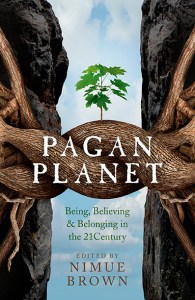
BOOK REVIEW: PAGAN PLANET

jhp55ddc04c930d1“For this reason I am doing what I do, working towards …. the more beautiful world our hearts know is possible”. Simon Wakefield is a biologist, Druid and contributor to Pagan Planet: Being, Believing and Belonging in the 21st Century. He talks about the “most profound experience of my life” when observing a nesting sea turtle on a starlit Greek beach. “Putting aside all the requirements to measure and monitor I decided just to be present, and I opened up to an experience of deep time and an ancient longing by another creature simply to be, to express its uniqueness, which has never left me”.

For me, Simon has expressed a point of unity in this diverse collection of essays edited by Nimue Brown and published by Moon Books. The authors come from a variety of Pagan traditions, though with a tilt towards Druidry. Many stand witness to a growing movement of Pagan activism, where people find themselves involved in the demanding, draining and potentially perilous work of resistance, protection and defence. The value of Simon’s words (which he attributes originally to Charles Eisenstein) is to keep an eye on the prize: “the more beautiful world our hearts know is possible”. Beauty, of course, depends on our ability to perceive, name and cherish it. Reading the essays in Pagan Planet, I come away with a sense of this as a unifying Pagan commitment.

What moves me most, I think, is an overall sense of resilience and optimism – not so much an optimism of calculation as an optimism of the heart. In his piece about the foundation of PaganAid, Ian Chandler says: “I have heard people’s stories that make me cry, I have seen destruction that has brought me to my knees with despair. But I have also met people whose dedication against all odds fills me with awe. I have seen achievements that make me want to sing and dance in the street. Now is not the time for us to give up on the future – it is time for us to decide what we want and to make that future happen”. Edwina Hodkinson talks about the frontline herbalism of the Wild Sistas in anti-fracking protection camps. “We dispensed tinctures, teas, creams, cough syrups, health advice, general nurturing and lots of first aid. Protectors who had been injured from interaction with the police wanted treatment for badly bruised ribs and groins, sprained wrists, and grazes … people had great faith in what we did, compliance was good and the results of the herbs spectacular … I’ve come to believe that when we go out of our comfort zones and are prepared to make some kind of sacrifice for ourselves and the earth, the earth responds and works with us”. One of their successes was the ‘warrior drops’ created to deal with trauma, stress and anger on the front line. “Protectors said that these really made a difference in calming them down” and one said “it grounded him and reminded him why he was doing the protest”.

A number of the essays stand witness to the creative energy of Pagan vision and life practice at this moment in history. These include Lorna Smithers’ visionary evocation of Castle Hill, Penwortham, described as “a magical place, in spite of the damage”, whose “alternative story” has been passed on “by its spirits, by decree of the fay king”. Hearth Moon Rising says that “my vision for some time has been to ground modern witchcraft more completely and more concretely in the natural world, to create a deeper understanding of what it means to have an animistic practice”.  Other people are exploring roads less travelled, like Laura Perry in Walking the Modern Minoan Path or Calantirniel in Working with Tolkien, where part of the purpose is to integrate the “Christ energy” into a Pagan path. Irisanya from the Reclaiming tradition offers a piece on Lifestyle/Work/Relationships which is centred on overlapping considerations of gender and peer communication and the magic of knowing how to track the energy in a conversation, when to listen, when to speak up and how to be supportive of voices that are not being heard. There are a number of pieces about the family context, including supporting dependent elders and raising children. In The Teachings of Children, Romany Rivers reports that people ask her whether her spirituality affects her parenting; her view is that it’s the other way round – her parenting affects her spirituality. “I realised how one small person’s emotional state can impact an entire environment. I have learned more about Reiki from working with my children during times of pain and stress, peace and snuggles. I have discovered new reasons to meditate. I have reconnected with the power of imagination. I have found new creative expressions”. She concludes, “I believe that is my children who are Pagan, and it is they who raise me.”

There is much more. I’ve got a piece called Living Presence in a Field of Living Presence: Practicing Contemplative Druidry. I would certainly have thought of it as supporting “the more beautiful world that our hearts know is possible” at the levels of perception, recognition and cherishing. But I didn’t think of it, and have only done so now as a result of reading the rest of this book: the value of community! Because of my involvement, I’m not going to review the book outside this blog or award points. I hope instead that I’ve been able to demonstrate something of its energy, diversity and commitment – and that the Modern Pagan movement from which it comes.


Nimue Brown (ed.) Pagan Planet: Being, Believing & Belonging in the 21st Century Moon Books, 2016

Earth Eclectic

music that celebrates Earth and speaks to the heart

Sarah Fuhro Star-Flower Alchemy

Follow the Moon's Cycle

Muddy Feet

Meeting nature on nature's terms

Rosher.Net

A little bit of Mark Rosher in South Gloucestershire, England

Becoming Part of the Land

A monastic polytheist's and animist’s journal

selkiewife

Selkie Writing…

Charlotte Rodgers

Images and words set against a backdrop of outsider art.

Prof Jem Bendell

living with metacrisis and collapse

Towint

The pagan path. The Old Ways In New Times

The Druids Garden

Spiritual journeys in tending the living earth, permaculture, and nature-inspired arts

The Blog of Baphomet

a magickal dialogue between nature and culture

This Simple Life

The gentle art of living with less

Musings of a Scottish Hearth Druid and Heathen

Thoughts about living, loving and worshiping as an autistic Hearth Druid and Heathen. One woman's journey.

Wheel of the Year Blog

An place to read and share stories about the celtic seasonal festivals

Walking the Druid Path

Just another WordPress.com site

anima monday

Exploring our connection to the wider world

Grounded Space Focusing

Become more grounded and spacious with yourself and others, through your own body’s wisdom

The Earthbound Report

Good lives on our one planet

Hopeless Vendetta

News for the residents of Hopeless, Maine