Contemplative Inquiry

This blog is about contemplative inquiry

Tag: J.R.R Tolkien

DEEP AUTUMN 2025

“All things ripen and rot that rose up at first,

And so the year runs away in yesterdays many,

And here winter wends again, as by the way of the world it ought,

Until the Michaelmas moon has winters boding brought.” (1)

Even today, deep autumn opens the door to winter. This was even more the case in the North Staffordshire and Derbyshire regions of 14th century England, where Sir Gawain and the Green Knight was written. Even in castles, people were less sheltered from the growing cold and damp than we are. So readers and listeners of the period are reminded that the coming of winter is both natually and divinely ordained.

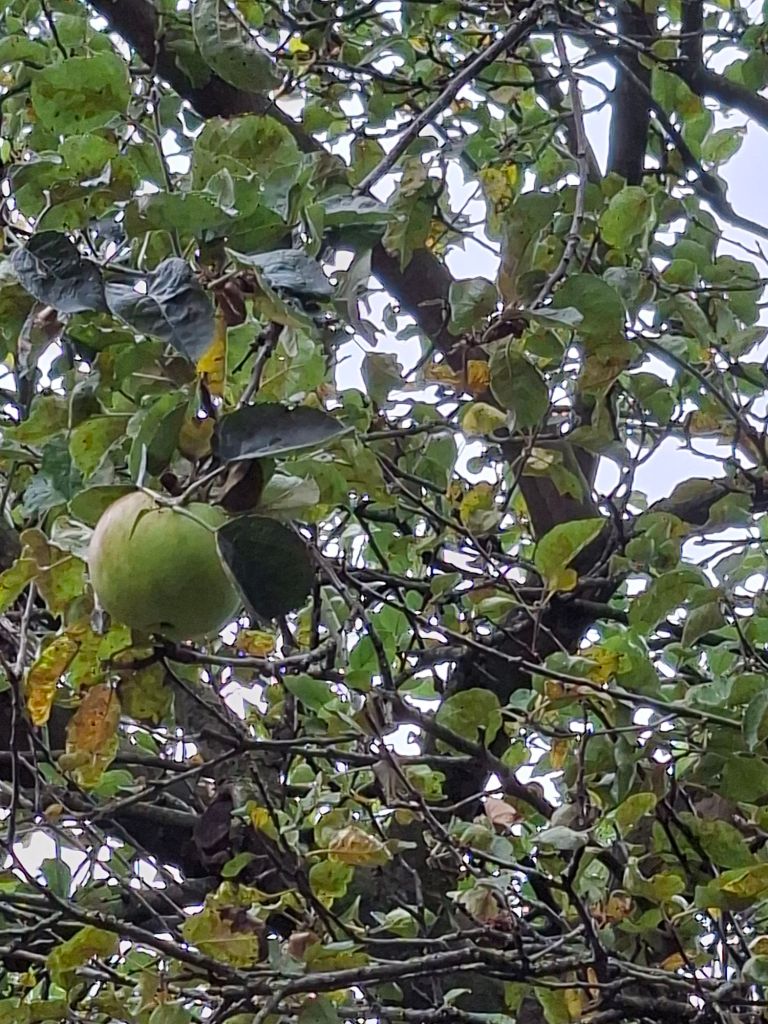
Here and now, the sight of the apple harvest in its later stages (pictured above) seems quite different than in the early ones (2) – less bright, less novel, less shiny. Rotting apples lie on the ground, now fallen outside the wall of  Gloucester Cathedral’s orchard. From Nature’s exuberant perspective, this is all part of the plan.  Waste is built in.

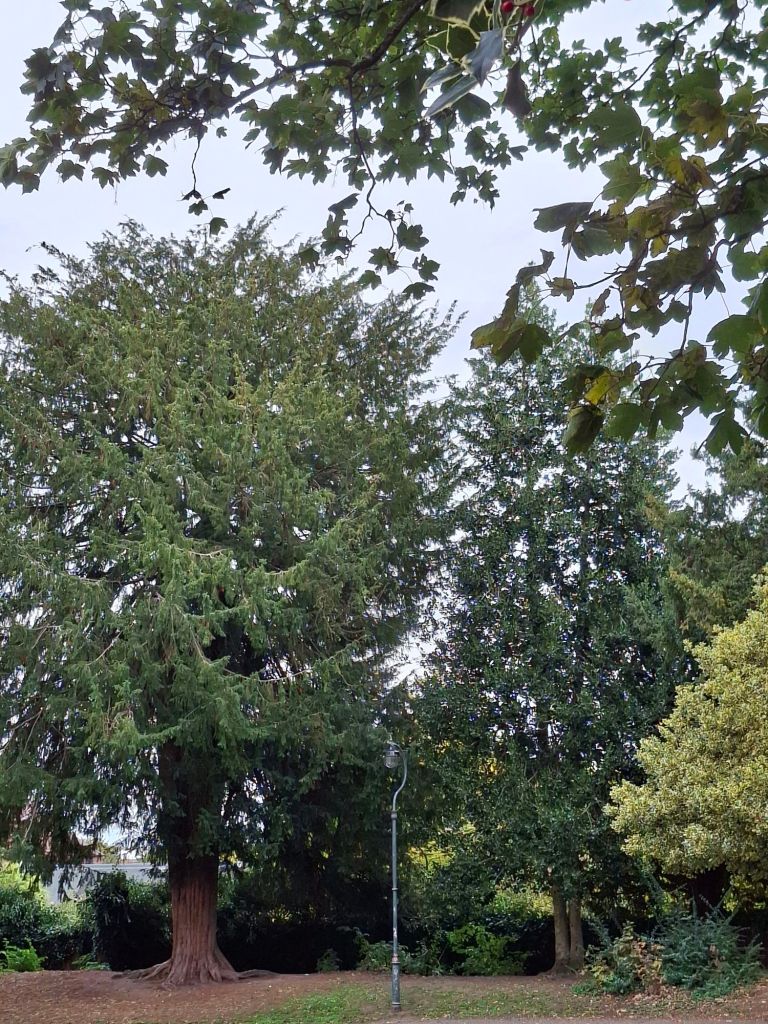
This time draws me further into the declining year. I am in the cathedral’s  grounds, now looking at a yew tree and its associations with death. I’m thinking of the approach of Samhain (aka Halloween/All Hallows) at the turn of the month. Once it marked the 3rd harvest of the year – the blood harvest, where animals were slaughtered in preparation for winter. Now it is more a time to remember our ancestors, and our dead more widely.

Yet the seasonal moment, and the yew, can also be linked to wisdom and transformative change in life. I launched my contemplative inquiry at Samhain 2011. Like many people, I find that this period can be a resonant and creative time.

Below the yew, I have included a section of the cathedral itself. I have old personal associations linking medieval Gothic architecture with the feeling-tone of the declining year. I am also aware that this building is linked to the trees I picture and discuss. Gloucester Cathedral was a monastery when Sir Gawain and the Green Knight was written but many of its features were already in place.
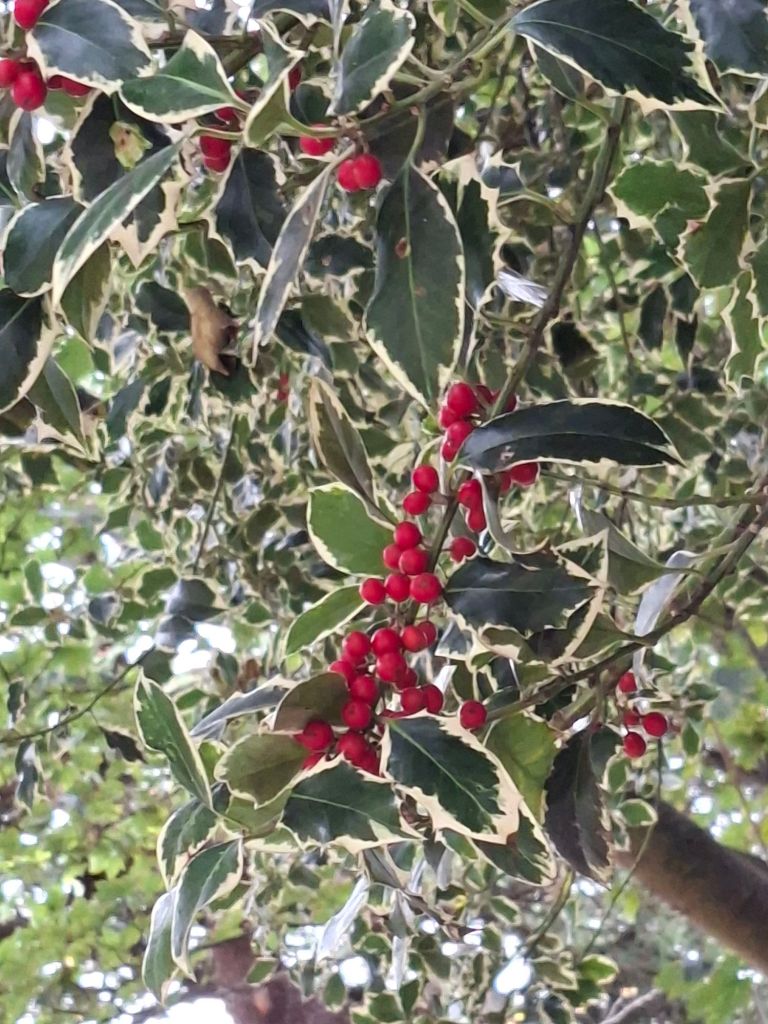
In the same space, I find both holly and ivy, with berries on the holly tree.  I immediately thought of the Christmas carol The Holly and the Ivy. It is an ancient folk carol, which interweaves Christian themes and others that belong with the land. The version which is now popular was collected by Cecil Sharp in 1909 in Gloucestershire from Mary  Clayton.

Many people think that the indigenous Pagan themes are the oldest, and that the central focus here is on the holly. The authors of The Green Man Tree Oracle say: “Holly’s connection with the Green Man is especially strong. In his guise as the Holly King – an ancient giant and symbol of fertility – the Green Man makes a notable appearance in the 14th century poem Gawain and d the Green Knight. Here he takes the form of a fearsome knight, who comes to King Arthur’s court to offer a midwinter challenge, carrying a club of holly and wearing a holly crown (as symbols of his true identity).” This challenge happens every year, where the Green Man/Holly King demands that we encounter him through our dealings with the natural world.

Elaine and I went to the Gloucester Cathedral Close and its surroundings on Saturday afternoon 18 October to outrun an  extended period of gloom, wind and rain. We are now in it, so the lessons of the trees in deep autumn, anticipating the coming of winter, are not lost on us. The dark of the year is on its way.
(1) J.R R. Tolkien (translation of anonymous texts) Sir Gawain and the Green Knight, Pearl, Sir Orfeo New York: Ballantine Books, 1980.

(2) https://contemplativeinquiry.blog/2025/08/22/ (3rd photo)

(3) John Matthews & Will Worthington The Green Man Tree Oracle: Ancient Wisdom from the Greenwood London: Connections, 2003

BOOK REVIEW: UNSEEN BEINGS

Highly recommended. Unseen Beings: How We Forgot the World Is More Than Human (1) is about the many beings we humans have actively ‘unseen’ and the consequences of our human-centric lens. Author Erik Jampa Andersson describes his book as a diagnostic exploration of the roots of the climate crisis, itself an extreme consequence of a much wider malaise. Whereas the common view of ‘saving the planet’ tends to be one of ‘guarding the storehouse’, a better focus would be on ‘supporting the welfare of living beings’.

Andersson has a background in Tibetan Buddhism and Tibetan medicine. In the manner of Buddhism’s Four Noble Truths, and of his medical training, he divides his book into four parts: Diagnosis, Causes and Conditions, Prognosis, Treatment.

Diagnosis concerns “our ecological disease”. Andersson reminds us of what the climate crisis is, how far it has been allowed to go, and the “fanciful stories” with which we have soothed our fears: “full of human exceptionalism, divine protection, techno-fixes and post-apocalyptic salvation”. For Andersson, the foundational root cause is “the sundering of human and non-human beings, and our perceptual separation from ‘Nature’. He refers to “the poison of anthropocentricity”. He reviews the evidence for plant and fungal sentience and awareness as well as that of the animal kingdom. He concludes that Nature is not a place, but “a tightly knit community of interconnected beings, some seen, many unseen, all engaged in their own affairs and with their own experience of reality”. He describes this relational approach to the living world as “what most scholars now call ‘animism’ … neither a religion nor a system of belief, but a paradigm of more-than-human relationship”. He sees this stance toward the world as “our natural state”.

Causes and Conditions A mini-ice age some 13,000 years ago interrupted an early agricultural period in some places and prompted a series of innovations. The domestication of the horse was especially significant. Andersson sees a move away from our ‘natural state’ beginning at this time. But it is not fully evident to us until the age of written philosophy and scripture. The Greek philosophers Plato and Aristotle declare a hierarchy of sentience from plants up to animals and then humans at the top, uniquely endowed with a rational soul. In the Hebrew book of Genesis, God gives dominion over the Earth and its animals to man for his use. In the Western Christianity of the 13th century CE, Thomas Aquinas says that Christians have no duty of charity to non-humans because they are resources, not persons. In the 17th century CE, early in the West European led colonial era, Descartes holds public vivisections of dogs and other animals declaring that they are soulless automata and that their apparent distress is meaningless. In the mid 19th century CE, Darwin restores other beings as our ancestors and cousins, but but without much sense of kinship or empathy.

Prognosis Here Andersson introduces two concepts from Tibetan medicine: ‘provocation’ and ‘spirit illness’. The provocation of other sentient beings is a health risk. He discusses the origins of the recent Covid-19 pandemic in these terms, as human become ever more invasive of our remaining wild spaces. In cases of deforestation, pollution, and any disruption of air, water, soil and trees, there is a price to pay for the wounding of other spirits, whether seen by the eye, seen through a microscope and normally unseen but recognised by tradition. (‘Supernatural’ is an unhelpful word here – everyone is part of nature). In Tibetan tradition, the cultivation of a clear mind is highly prized and works within human psychology, but not for disruptive events like these. There is a need to make amends. Rituals are held in sensitive and damaged places. The damage caused in these circumstances and the resultant chronic collective disease can only be addressed by learning how to care for eachother, non-human beings and the planet itself.

Treatment Using the Buddhist 8-fold path as a structure, Andersson recommends ‘cultivating care’ over a system of rules and regulations aimed at a ‘sustainability’ which tries to restore the old status quo. We cultivate care of the Earth, one another and non-human beings. Hence: 1 right view is a return to our ‘natural state’, as described under Diagnosis; 2 right intention describes commitment to a path of rewilding and regeneration; 3 right speech is the use of “life-affirming language” (e.g. using ‘they’ as an alternative to ‘it’ for non-human beings); 4 right action is causing as little harm as possible to other beings; 5 right livelihood means adopting principles of authentic sustainability and non-exploitation; 6 right diligence is based on “the durability of the heart-felt ethic; 7 right mindfulness means “paying attention to nature’s vitality”; 8 right concentration involves imaging a new future with “authentic myth-making”.

Concerning 8 above, Andersson has been profoundly moved by the work of J. R. R. Tolkien from his later childhood onwards. As a result, he developed a high valuation of authentic myth-making and enchantment. In this realm, the non-human is essential. Tolkien had his own life-changing moment of enchantment when, as a student, he first read the Old English words: Eala earendel engla beorhtast, ofer middangeard monnum sended. (Hail Earendel brightest of angels, above the middle-earth sent unto men). Of this evocation of Venus arising as the morning star, in the old language, Tolkien later wrote: “there was something very remote and strange and beautiful about these words, if I could grasp it, far beyond ancient English”. For Andersson, authentic myth and authentic science work together in support of a redemptive animist vision. By contrast, the form of discourse to worry about is ‘fallacy’ – a complete dissociation from the truth. Andersson again quotes Tolkien: “if men were ever in a state in which they did not want to know or could not perceive truth (facts and evidence) then Fantasy would languish until they were cured. If they ever get into that state (it would not seem at all impossible) Fantasy will perish and become morbid delusion”. For Andersson, this too has become a symptom of our current ecological disease, making the need for honest and healthy communication all the more urgent.

For me, Andersson has made a valuable addition to a growing literature about the current crisis, whose most alarming symptom is climate breakdown. He goes to the root of the problem, offering a clear and coherent view about how to stand in the face of it. It is a well-researched, well-crafted and compassionate contribution to the genre.

(1) Erik Jampa Andersson Unseen Beings: How We Forgot the World is More Than Human Carlsbad, CA & New York City; London; Sydney; New Delhi: Hay House, 2023

I attach a links to conversations between the author and Andrew Harvey below. It adds considerably to what I can present in a review:

POETRY FOR THE MERRY MONTH

Below are two versions of late fourteenth century verse, written by an anonymous English author, probably from North Staffordshire or Cheshire. It depicts the turning of the wheel of the year as it moves through spring into summer.

The first version is a mid-twentieth century translation by J.R.R. Tolkien. The second is the original. The poem is embedded in the text of Sir Gawain and the Green Knight, which arguably shows an immature warrior class (King Arthur’s knights) being taken down a peg by the primal forces of nature.

The extract here stands outside the main narrative, which occurs during the Christmas festivities of one year and the Hallowe’en to Christmas period of the next.

“But then the weather in the world makes war on the winter,

Cold creeps into the earth, clouds are uplifted,

Shining rain is shed in showers that all warm

Fall on the fair turf, flowers there open,

Of grounds and of groves green is the raiment,

Birds as busy a-building and gravely are singing

For sweetness of the soft summer that will soon be

On the way.

And blossoms burgeon and blow

In hedgerows bright and gay;

Then glorious musics go

Through the woods in proud array.

After the season of summer with its soft breezes,

When Zephyr goes sighing through seeds and herbs,

Right glad is the grass that grows in the open,

When the damp leaves

To greet a gay glance of the glistening sun”. (1)

“Bot thenne the weder of the worlde with winter hit threpes,

Colde clenges adoun, cloudes uplyften,

Shyre schedes the rayn in schowres ful warme,

Falles upon fayre flat, flowres there schewen.

Bothe groundes and the greves grene are her wedes,

Bryddes busken to bylde, and bremlych syngen

For solace of the softe somer that sues thereafter

Bi bonk;

And blossoumes bolne to blowe

Bi rawes rych and ronk,

Then notes noble innoghe

Are herde in wod so wlonk.

After, the sesoun of somer with the soft wyndes,

Quen Zeferus syfles himself on sedes and erbes;

Wela wynne is the wort that waxes theroute,

When the donkande dewed dropes of the leves,

To bide a blysful blusch of the bright sunne.”

(1) Sir Gawain and the Green Knight, Pearl and Sir Orfeo translated by J. R. R. Tolkien New York, NY: Ballantine Books, 1975

(2) C. Cawley (ed.) Pearl and Sir Gawain and the Green Knight London: Dent & New York: Dutton: Everyman’s Library, 1962

Earth Eclectic

music that celebrates Earth and speaks to the heart

Sarah Fuhro Star-Flower Alchemy

Follow the Moon's Cycle

Muddy Feet

Meeting nature on nature's terms

Rosher.Net

A little bit of Mark Rosher in South Gloucestershire, England

Becoming Part of the Land

A monastic polytheist's and animist’s journal

selkiewife

Selkie Writing…

Charlotte Rodgers

Images and words set against a backdrop of outsider art.

Prof Jem Bendell

living with metacrisis and collapse

Towint

The pagan path. The Old Ways In New Times

The Druids Garden

Spiritual journeys in tending the living earth, permaculture, and nature-inspired arts

The Blog of Baphomet

a magickal dialogue between nature and culture

This Simple Life

The gentle art of living with less

Musings of a Scottish Hearth Druid and Heathen

Thoughts about living, loving and worshiping as an autistic Hearth Druid and Heathen. One woman's journey.

Wheel of the Year Blog

An place to read and share stories about the celtic seasonal festivals

Walking the Druid Path

Just another WordPress.com site

anima monday

Exploring our connection to the wider world

Grounded Space Focusing

Become more grounded and spacious with yourself and others, through your own body’s wisdom

The Earthbound Report

Good lives on our one planet

Hopeless Vendetta

News for the residents of Hopeless, Maine