Contemplative Inquiry

This blog is about contemplative inquiry

Tag: Health

LIMITATION

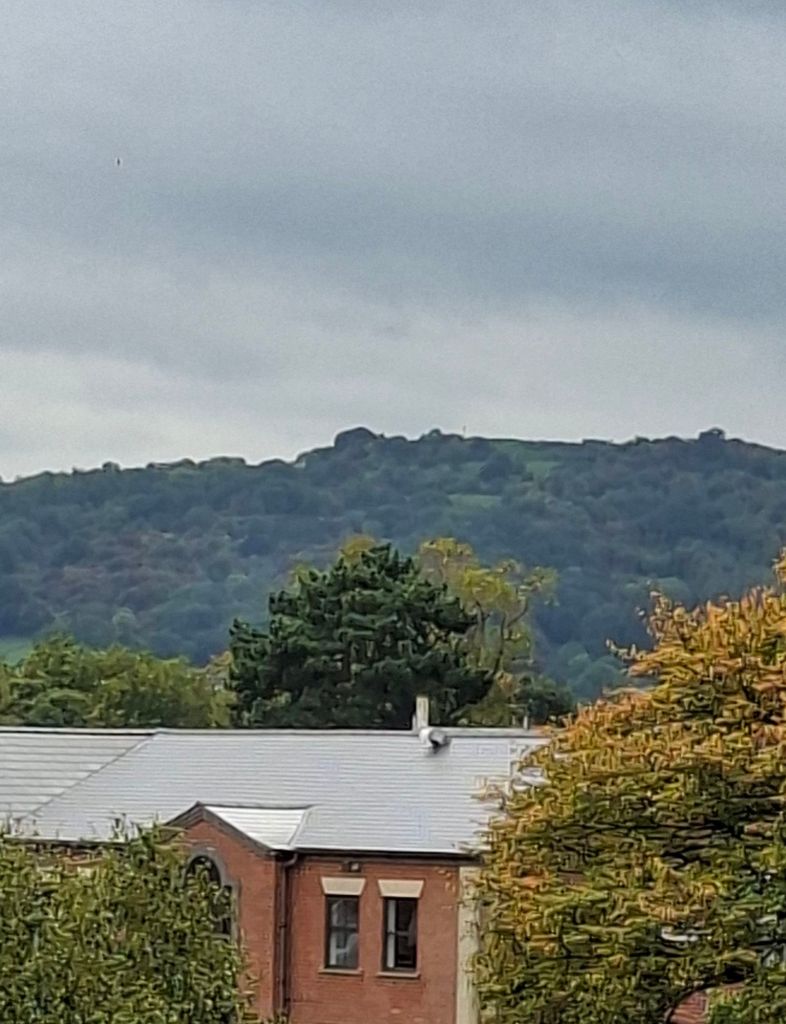
A familiar scene, in its equinoctial clothing. My experience of it is made different by a recent fall, in which I fractured my left humerus bone near the shoulder. I am left-handed, so it’s the ‘wrong’ side for a break. Happily my wrist and fingers remain flexible, and I don’t need surgery for the fracture. It could have been much worse.

Nonetheless Elaine, still depending on a rollator for walking, and I have to be resourceful and strategic in leaving and re-entering our apartment. Essentially I specialise in legs and she specialises in arms, though we each have some capacity in the other’s domain. We’re a team, after all. We work together. But we aren’t getting out much for the time being.

I look out a little wistfully and write a bit ouchilly. I feel limited and constrained. I also feel loved and supported. I’m a little foggy in my thinking, but I don’t see an episode like this as time off from my contemplative inquiry. All experiences are there to be acknowledged, moment by moment, day by day. Otherwise the practice becomes an alienated exercise, or performance, separated from the ups and downs of life. In reality, it sits ever-present within them.

I look within myself. I look across at Elaine. I also look out of window to connect with the world outside and its changes over the year. The grey sky is typical for this September, but blue sky is too. Variation is the overall story. It’s an inherently changeful and unsettled time. I’m intrigued by the way in which Robinswood Hill retains its green cover, when the town trees are in an advanced stage of turning. I’m alive.

ELAINE: IMAGES FROM A HEALING JOURNEY

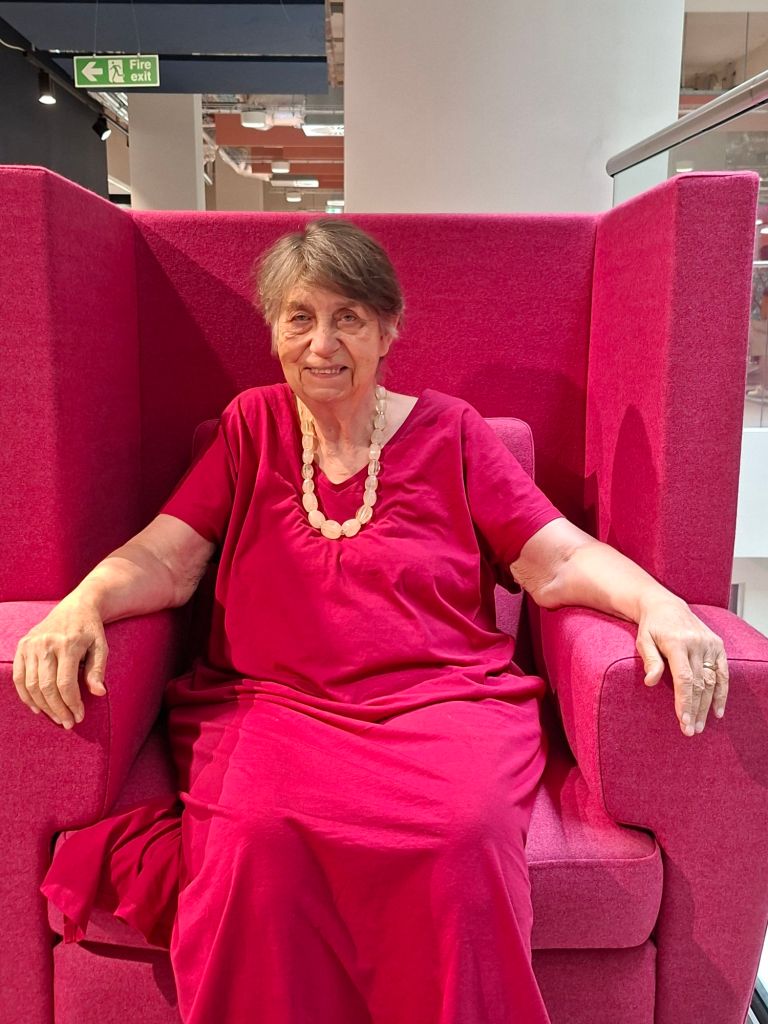
In the picture above, my wife Elaine sits at ease on a softly majestic chair. The occasion is the opening of a new University of Gloucestershire building refashioned from an empty Debenham’s department store. Primarily it is for the university’s faculties of education, psychology and social work.

It is also for the local community. The city’s public library is being amalgamated with the campus one. This will be on the bottom floor together with shared study spaces and meeting rooms.

Elaine has chosen one of the plusher available chairs to begin her ownership of a space that is likely to become important in our lives. I see her as showing that she is back in the world, 16 months after her accident in Gran Canaria and all the related health problems that manifested as a result of it.

The picture below is from early October last year, 6 months after the accident. Elaine is in transition from wheelchair to rollater, at least in our immediate neighbourhood. Being outdoors at all under her own steam is new. To me she looks tentative and inward. Looking at the picture now, Elaine says she looks marked by suffering. It is certainly a very different picture from the one at the top.

The two pictures together show healing in later life to be a long process making serious demands on the person who is healing. It is a joy for me to see Elaine’s transformation.

ENTERING SUMMER 2025

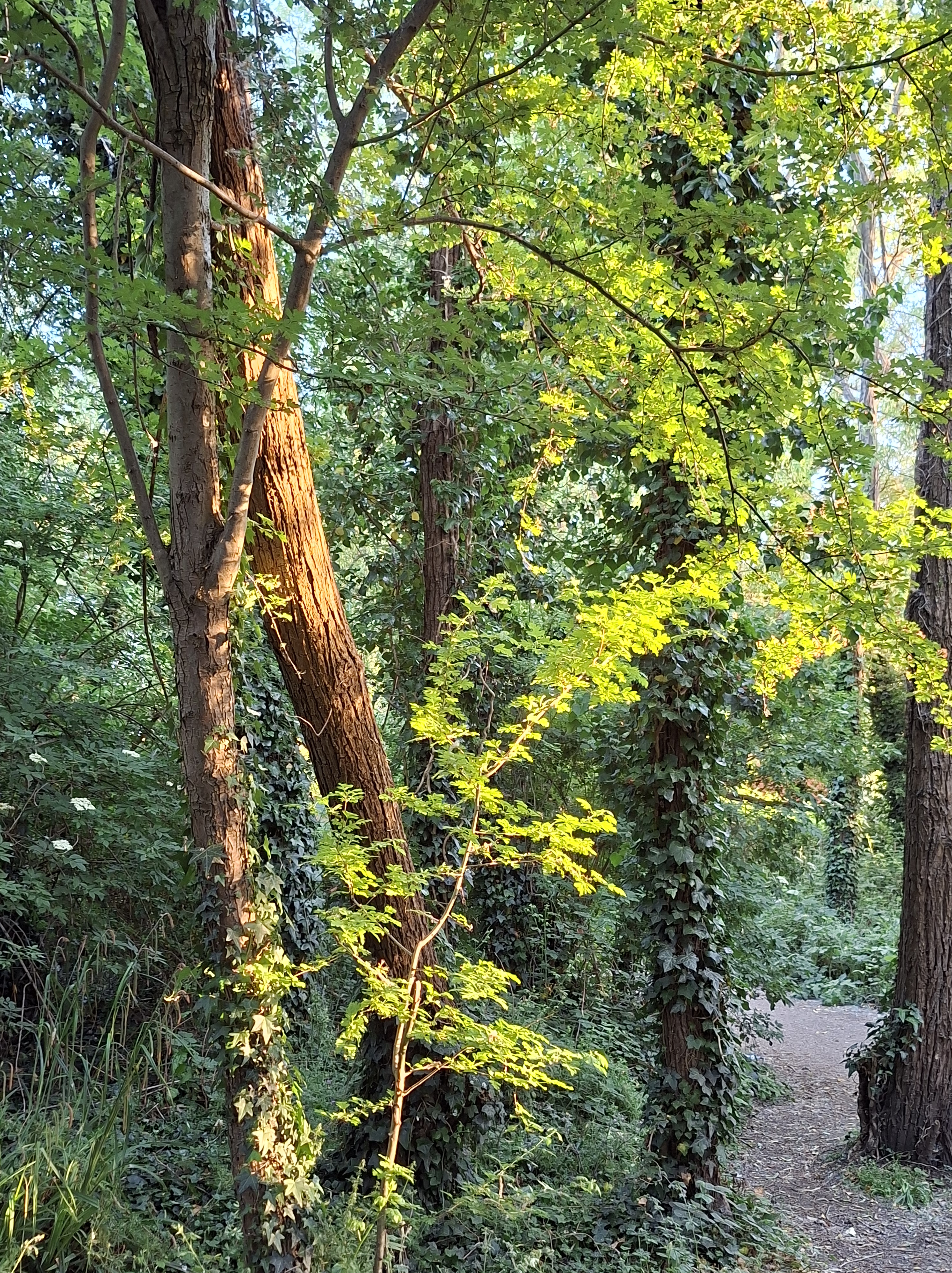
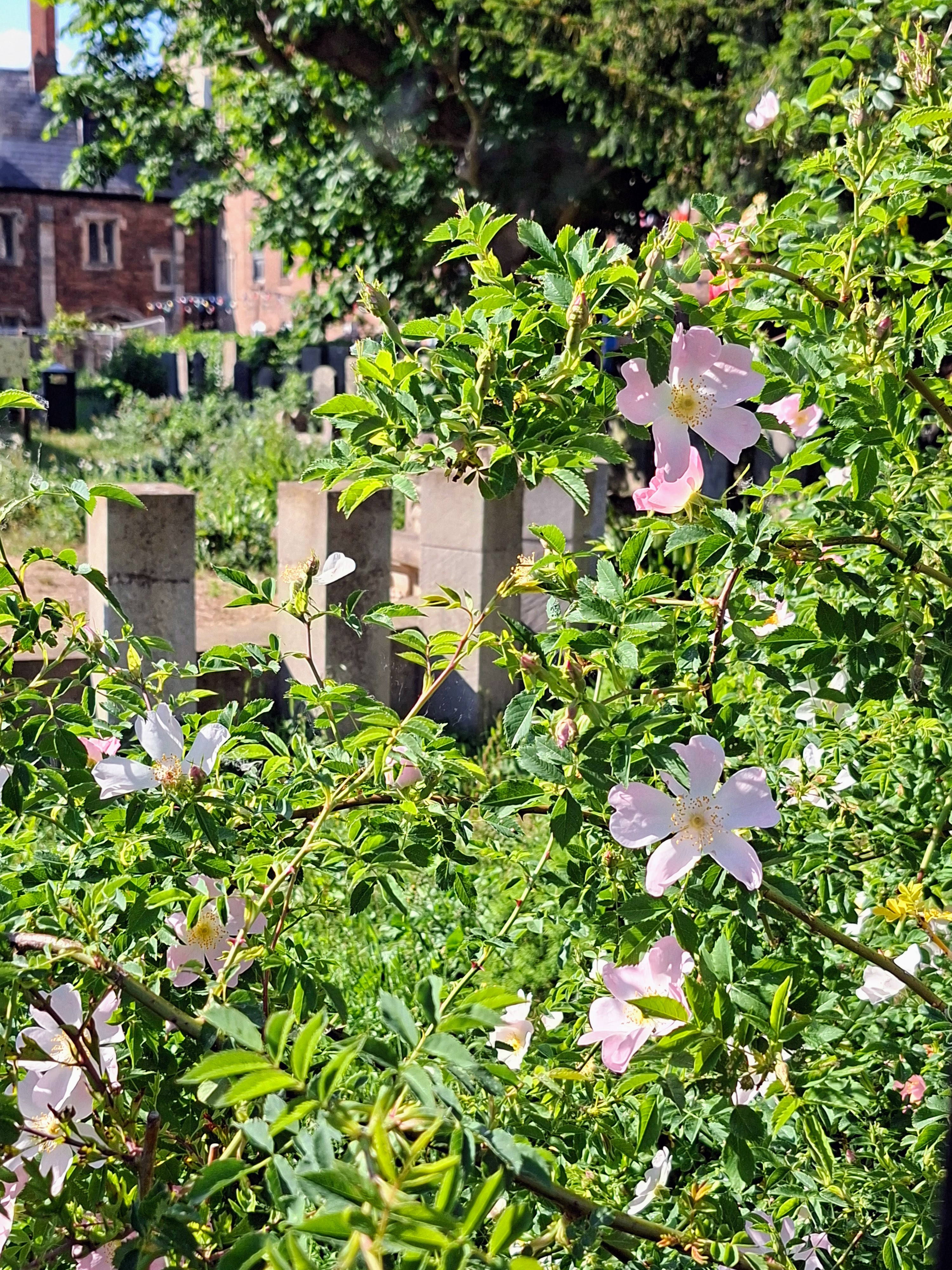
For me, mid May is the beginning of summer. All of the pictures in this post were taken between 16 and 24 May. It was a warm and sunny time that has now morphed into something else – cooler, wetter and windier.

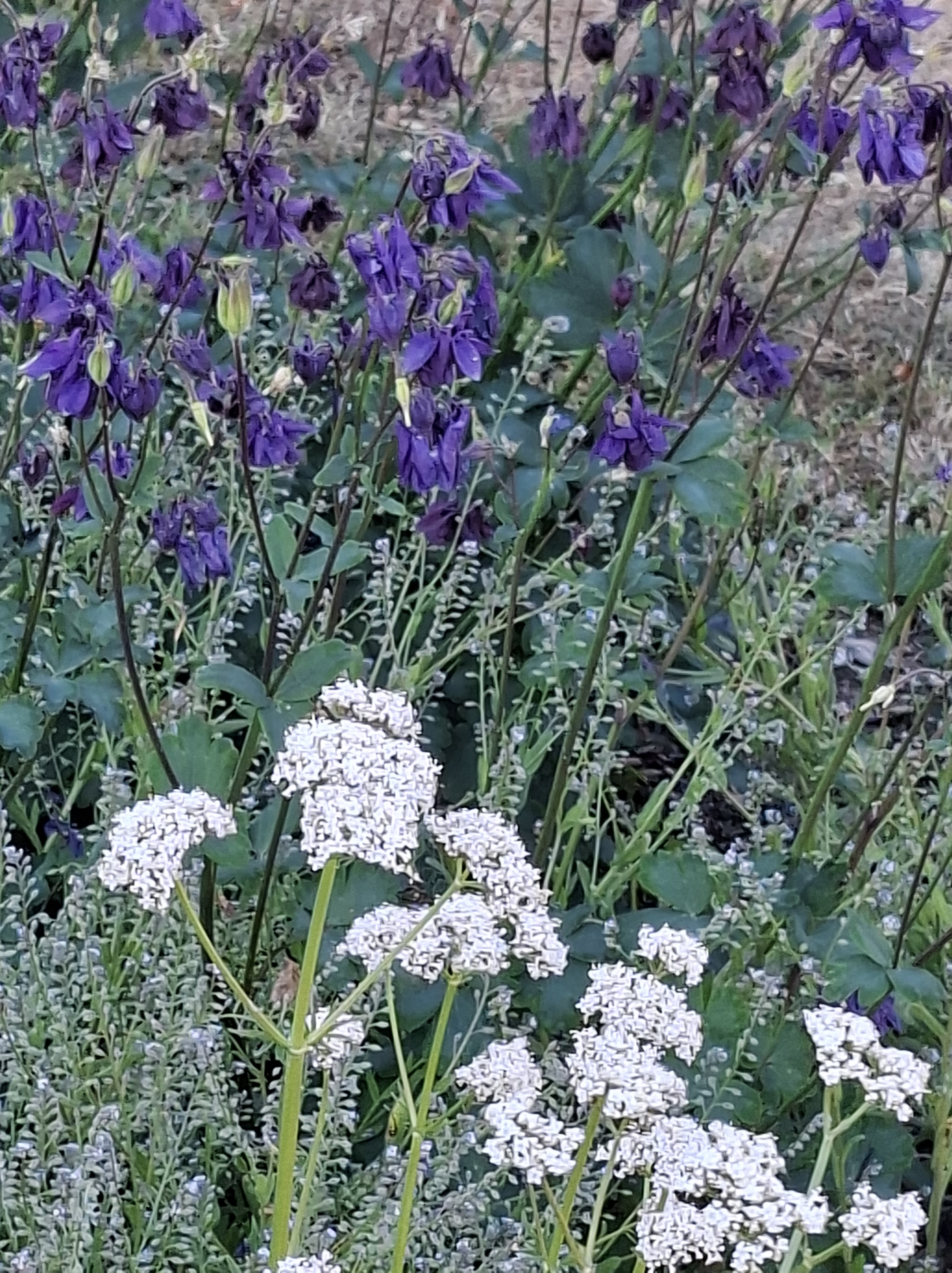
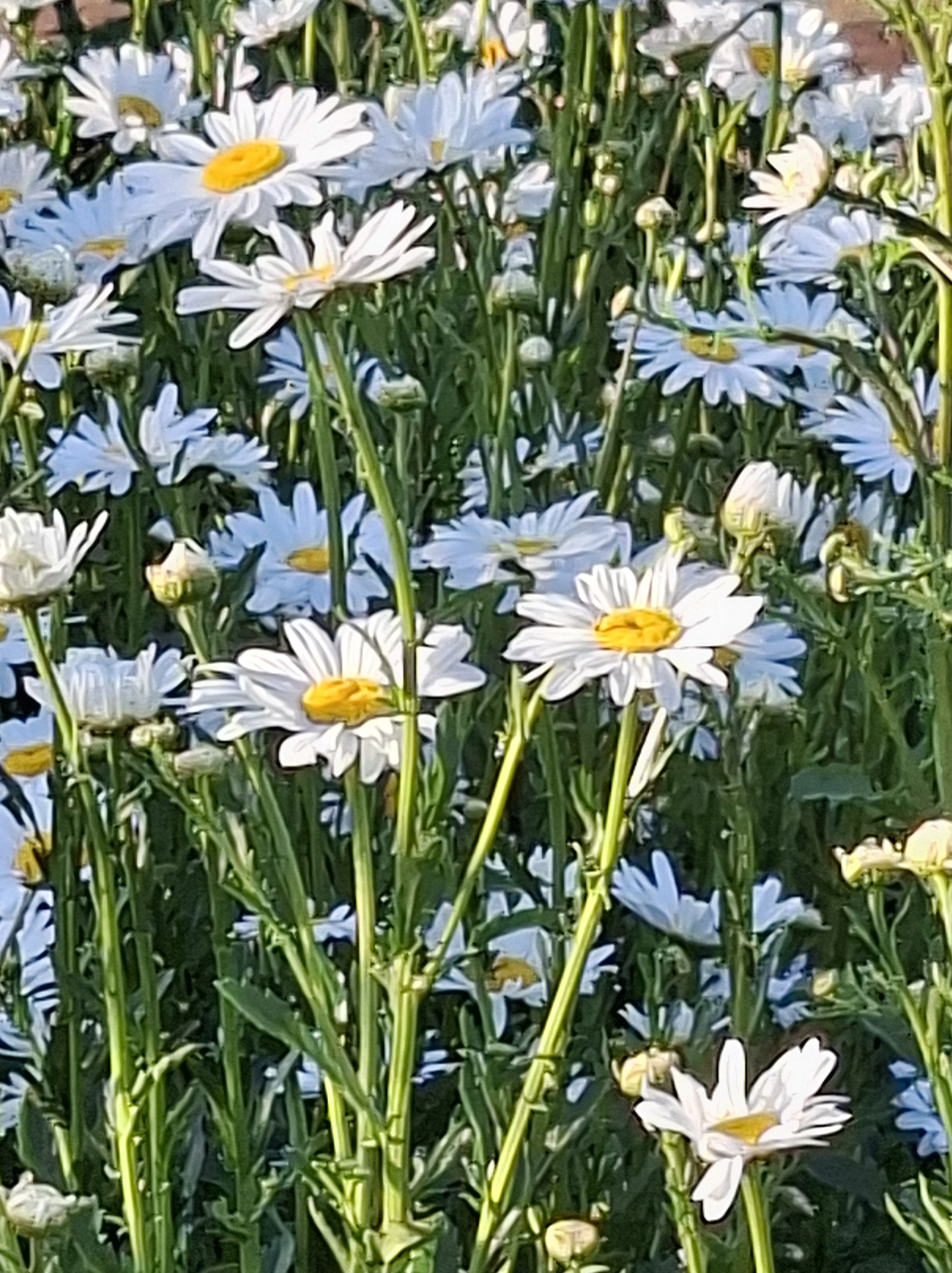
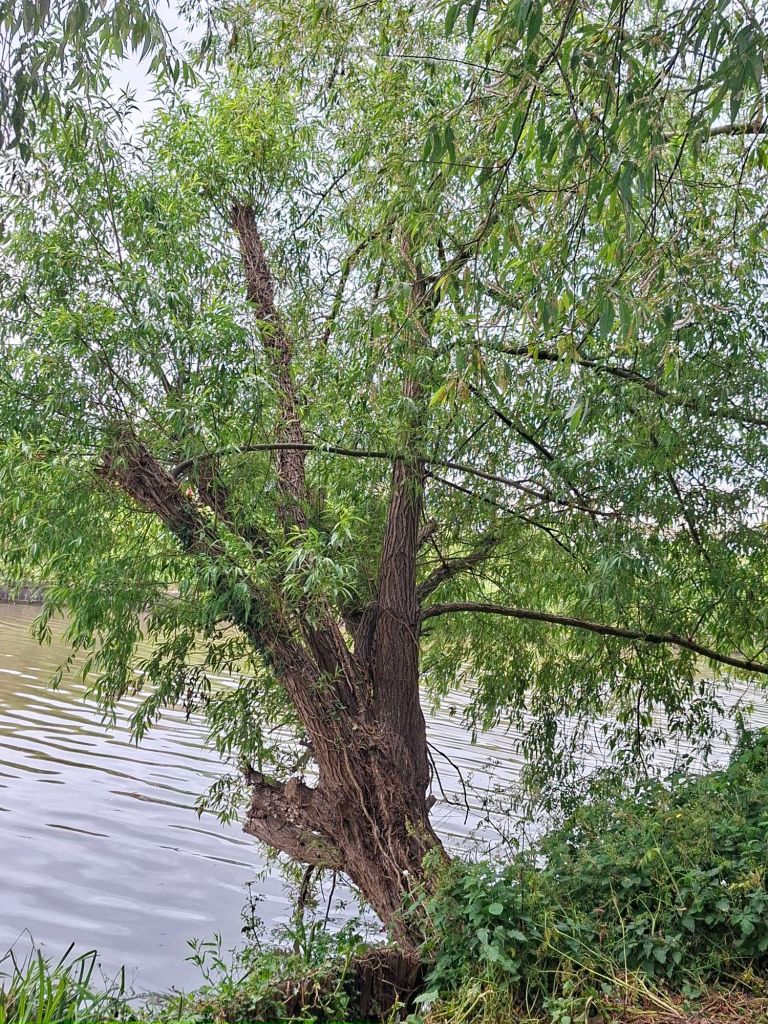
It was a time of brightness and growth. The plant kingdom showed a tremendous will to live and flourish: above, on the canal path as it skirted adjacent apartment buildings; below, close to the Greyfriars ruins, looking out towards the old town.

The following three pictures are all from Llanthony Priory, in what was once once the ‘physic garden’ of the monks. What moves me about all of them is the vitality, variety and colour they display. Such an affirmation of abundance.

The same benign and dynamic period saw a big step forward in my wife Elaine’s mobility. She can now leave and return to our flat, sit in pleasant public spaces, walk around town, attend local events and shop on her own. This is new and different for both of us, emancipatory yet still slightly unfamiliar. A new way of life is emerging for both of us.

On 25 May, about the time the weather broke, I celebrated my 76th birthday and entered my 77th year. As I wrote to one of my grandsons, ‘sounds terrible, feels OK’. In truth, it feels more than OK. I feel good.

It was also the anniversary of Elaine’s homecoming after her hip fracture in Gran Canaria, her hospitalisation for a month there, her repatriation and another 12 days in the Gloucester Royal Hospital. The year has been a tough one, especially after the strain on Elaine’s already vulnerable heart became fully manifest. But Elaine herself has been an inspiration with her own will to live and thrive. This feels like a good moment in my life and our lives together. Much gratitude for that.

SWEET SUCCESS

The picture* shows Waterstones in Gloucester, not far from where Elaine and I live. It’s a well-stocked bookshop on two levels. The upstairs includes a cafe. Before Elaine’s hip fracture in April (1,2,3) and its attendant complications, we were frequent visitors. The cafe offers good coffee. It is a pleasant place to be. It hosts both a writers’ group and a book group that we have attended.

Waterstones has been out of bounds to Elaine, and effectively me, since April. Elaine was completely house-bound until the middle of August. Even then, we worried about whether her wheelchair would fit the door of the lift giving access to the upper floor. Would the formal ‘accessibility’ option lead to actual access? I measured the breadth both of Elaine’s wheelchair and the lift doorway. The distances were bothersomely similar, and this had a slightly inhibiting, effect. We didn’t want drama or disappointment.

But on Saturday, 8 September, we lost our hesitation. We wheeled boldly into the shop and put the lift to the test. Lining the chair up carefully, we ascended to the top floor. It was indeed a tight fit, but doable, which is what matters. We reached the cafe, and had our first coffee out together for a long time, happy in the familiar atmosphere of a favourite haunt, knowing too that we would be able to attend its meetings and events. A sweet success!

(1) https://contemplativeinquiry.blog/2024/06/27/elaine-knight-haiku/

(2) https://contemplativeinquiry.blog/2024/05/25/festive-moment/

(3) https://contemplativeinquiry.blog/2024/05/12/unsought-journey/

*Picture from Google Maps.

UNSOUGHT JOURNEY

Ego sets me up, in both a narcissistic and rational way, to be the hero of my own journey. But it’s at least equally valuable to have a support role in someone else’s. On Monday 8 April my wife Elaine flew to Gran Canaria with her sister Glynis for a restful and undemanding holiday. It worked brilliantly for nearly three days. On Thursday 11 April Elaine had a fall resulting in a fractured femur. Instead of a restful and undemanding holiday, they were in a health disaster overseas.

Elaine was duly admitted to hospital. Other health complications – a characteristic of we older people – meant it took 9 days for Elaine to have a successful operation: not ideal given the problem being addressed. Glynis was the support person and champion at this stage. But soon it became evident that Elaine would not be well enough for repatriation for some time. An original plan for me to be the person who organised things at home was ditched, and I flew to Gran Canaria on 28 April allowing Glynis to go home.

In a way it wasn’t hard. But I was knocked around by Elaine’s predicament, which might have been fatal, and by the culture shock of being in a new place where, but for the kindness of strangers, I had the verbal and communication skills of, at best, a chimpanzee. I also had to be, or at least appear to be, competent in managing (influencing?) the hospital and insurance companies’ relationship both with Elaine and each other. A completely unfamiliar situation for me, and not one that I would want to be in again.

We managed somehow. Elaine and I know and love each other. We supported each other in our respective roles. I liked my hotel though its amenities were largely wasted on me. Its great virtue was in being 15 minutes easy walking distance from the hospital. I spent several hours a day with Elaine, but also had several on my own. I needed to be away from stimulation for a good deal of time. I did enjoy the warmth, and especially at sundown, the sky over Gran Canaria’s south coast.

The repatriation, when it came, felt almost sudden. We flew back, together with a wonderful paramedic and minder sent over for the purpose, on Friday 10 May. Elaine, whose left leg is not weight bearing at all, was trolleyed and chaired both on an off a commercial flight where she got her own row of three seats. The cabin crew were great.

The repatriation process ended with an ambulance journey to the Gloucester Royal hospital, where our paramedic had organised Elaine’s admission in advance and Elaine was wheeled straight onto the orthopaedic ward where she now is. This is also in walking distance from our home. At the moment she is largely being monitored and tested. A new phase will begin when the physiotherapists show up on Monday. I hope soon to get some sense of how soon Elaine will come home, and what resources we will need for our lives going forward. It’s my 75th birthday on 25 May, and my best present would be to have Elaine home by then.

This post has been a simple story, without much obviously contemplative, reflective or overtly ‘spiritual’ content. But I don’t in my own life and practice make much distinction between the spiritual and mundane, and I do know that this has been a life-changing event. A pilgrimage, of sorts.

HOW WE INTERPRET PAIN

Atul Gawande’s Being Mortal: Illness, Medicine and What Matters at the End (1) is about life when independent living is no longer an option, and also about the end-game. I intend to review the book fully in a later post. Here, I have extracted a passage about how we evaluate the experience of pain and suffering, and how they vary according the the stories we tell about ourselves and our lives. The author draws on his experience as a physician, a teacher and a family member.

“The brain gives us two ways to evaluate experiences like suffering – there is how we apprehend such experiences in the moment and how we look at them afterward – and the two ways are deeply contradictory. … People seem to have two different selves – an experiencing self who endures every moment equally and a remembering self who gives all the weight of judgement to two single points in time, the worst moment and the last one.

“The remembering self seems to stick to the Peak-End rule even when the ending is an anomaly”. In a hospital-based experiment (2) “just a few minutes without pain at the end of their medical procedure dramatically reduced the patients’ overall pain ratings even after they’d experienced more than half an hour of high level pain. ‘That wasn’t so terrible,’ they’d reported afterward. A bad ending skewed the pain scores upwards just as dramatically. …

“Research has also shown that the phenomenon applies just as readily to the way people rate pleasurable experiences. Everyone knows the experience of watching sports when a team, having performed beautifully for nearly the entire game, blows it at the end. We feel that the ending ruins the whole experience. Yet there’s a contradiction at the root of that judgement. The experiencing self had whole hours of pleasure and just a moment of displeasure, but the remembering self sees no pleasure at all.

“If the remembering (or anticipating) self and the experiencing self can come to radically different opinions about the same experience, then the difficult question is which one to listen to. …. In the end, people don’t view their life as merely the average of all of its moments – which, after all, is mostly nothing much plus some sleep. For human beings, life is meaningful because it is a story. A story has a sense of a whole, and its arc is determined by the significant moments, the ones where something happens. Measurements of people’s minute-by-minute levels of pleasure and pain miss this fundamental aspect of human experience. A seemingly happy life may be empty. A seemingly difficult life may be devoted to a great cause. We have purposes larger than ourselves. Unlike your experiencing self – which is absorbed in the moment – your remembering self is attempting to recognize not only the peaks of joy and valleys of misery but also how the story works out as a whole. That is profoundly affected by how things ultimately turn out.”

(1)Atul Gawande Being Mortal: Illness, Medicine and What Matters in the End London: Profile Books in association with Wellcome Collection, 2014 (UK edition)

(2) NOTE: Gawande describes research by Daniel Kahneman and Donald Redelmeier involving 287 hospital patients who underwent colonoscopy and kidney stone procedures while awake. The patients were given a device that let them rate their pain every sixty seconds on a scale of 1 (no pain) to 10 (intolerable pain), a system that provided a quantifiable measurement of a moment-by-moment experience of suffering. At the end the patients were also asked to rate the total amount of pain they experienced during the procedure. The procedures lasted anywhere from 4 minutes to more than an hour. The patients typically reported extended periods of low to moderate pain punctuated by moments of significant pain. A third of the colonoscopy patients and a quarter of the kidney stone patients had a pain score of 10 at least once during the procedure. Patients’ final ratings were not based on the whole experience and its duration but by what Kahneman called the ‘Peak-End rule’, an average of the pain experienced – the single worst moment of the procedure and the very end. This research is described in Daniel Kahneman’s book Thinking Fast and Slow.

HEALTH PROBLEMS

We’ve lost the chance to sugar the pill.

This is a very bad result.

This situation won’t stay still.

This is a very bad result.

The problem came from an animalcule.

This is a very bad result.

Small and unseen – yet we look like fools

This is a very bad result.

Much more lethal than Covid 19

This is a very bad result.

The most toxic critter ever seen

This is a very bad result.

Coincidence it must surely be

This is a very bad result

That it came from my brother’s laboratory.

This is a very bad result.

Synchronicity? Cause and effect?

This is a very bad result.

Whatever the case we’re completely wrecked.

This is a very bad result.

One per cent will survive this thing.

This is a very bad result.

I hope it’s the one that I am in.

This is a very bad result.

I wrote this piece some months ago, still digesting the experience of the Covid 19 pandemic, the public health response to it, and the continuing presence of the virus in our world. I had also been reflecting on formal political messaging – government as public relations and media theatre, the intense pre-occupation with opinion polls and beauty contest elections – together with halting and inconsistent approaches to real-world problem-solving.

Writing of this kind is part of my Druid path and not a separate activity. My practice might have a contemplative foundation, but contemplation isn’t everything. The inheritance of Bardistry, and engagement with the wider world also matter. Currently, I feel a pull towards working for the healthy use of language, and challenging its corrupt and unhealthy deployments. T. S. Eliot once talked about poets being tasked to ‘purify the dialect of the tribe’. That’s not quite my language, but I can appreciate what he is pointing to.

I have recently been given another nudge, by Naomi Klein’s book Doppelganger: A Trip into the Mirror World (1) where she talks about the rise of ‘conspiracy influencers’ in a world where governments and corporations have deservedly lost our trust. “Conspiracy influencers perform what I have to think of as a doppelganger of investigative journalism, including many of its stylistic conventions, while hopping over its accuracy guardrails”. She goes on to say that “the end result of being surrounded by this kind of discourse is … a state of continuous disbelief” that replaces real threats with distorted versions of themselves. Hence the belief that “the problem with Covid was not a highly infectious disease being fought half-heartedly by for-profit drug companies and hollowed-out states, but an app that wanted to turn you into a slave”.

Klein also helps me to see a connection between the defence of language and contemplative spirituality. She speaks of calm as form of shock resistance. “When people and societies enter into a state of shock, they lose their identities and footing”. In the midst of such break down, the effect of conspiracy culture is to maintain panic and confusion. She suggests that some conspiracy culture influences are simply part of the panic and confusion. Others, more knowingly, manipulate it for ulterior ends. If shock induces a loss of identity, calm returns us to ourselves. “I write to tame the chaos in my surroundings, in my own mind, and – I hope – in the minds of my readers as well. The information is almost always distressing, and, for many, shocking, but in my view the goal should never be to put readers into a state of shock. It should be to pull them out of it”. Of her chosen work overall she says: “the role of the researcher-analyst is plain: to try and create some sense, some ordering of events, maps of power”. Clarity, calm and purpose support each other.

(1) Naomi Klein Doppelganger: A Trip into the Mirror World London: Penguin Random House, 2023

BOOK REVIEW: UNLIKELY ALLIANCES

Highly recommended. Unlikely Alliances (1) is set in the years 2029-2033, in a fictional town on England’s south coast. It offers a degree of hope about the climate crisis, presenting a positive response to its challenges at the global, national and, especially, local levels. Towards the close of the book, one of the characters reflects on a benign economic austerity that includes social justice: “limited food in the shops, clothes and shoes having to last many years, trips abroad requiring special license … but look around us, are we really worse off?” The answer is a qualified no, on the grounds that everyday life has become less constrained and less stressful, thanks to the choices that have been made.

Unlikely Alliances offers a gentle, compassionate and good-humoured lens on a subject that can seem grim and edgy. The title refers to the changing political, professional and above all personal relationships of people working on adaptation goals in their Bourne Valley community. They are from a wide variety of backgrounds, including local government, academia, trade unions, churches, the voluntary sector, management consultancy, the hospitality industry, sports organisations and farming. Unexpected synergies are generated. The novel shows how its band of protagonists find themselves, each other and a new sense of purpose in this work. As fiction, the book has the space to be about lives as well as issues. New culture, adapted to new times, is created in the lived experience of friendship, romance and community building.

The Climate Action Plan of a progressive coalition government provides a political framework, drawing on ideas from the US 1930’s New Deal and the UK reconstruction post World War 2. It is in power because of a wake-up call resulting from a huge inundation in the Netherlands and the presence of a large number of Dutch refugees in Britain – a disaster too close to ignore. For the first time since the mid twentieth century, serious wealth taxes are in place. Food and fuel are rationed: everyone gets at least something at an affordable price. There are new approaches to housing. A Civilian Community Service Corps provides training and jobs for the unemployed and a two-years national community service for school and college leavers.

In crisis conditions, this government is broadly popular. Even so, it is vulnerable to defections within its own Parliamentary ranks, the vigorous opposition of vested interests and those who speak for them, and the violence of militant climate denialists on the street. These struggles are not minimised, and they are vividly portrayed in the book. But most of the focus is on resource and resiliency building at the local and regional levels, and on the changes in the lives of the main characters, as they open up to each other’s influence and affection. It is their efforts that prevail, since they come to make practical sense to more and more people.

A brief review cannot do full justice to a book that deals with a civilisation at the edge, presented from a stance of generosity and warm commitment to human flourishing. Tony Emerson has long experience of working with environmental issues and is also an accomplished storyteller. I found Unlikely Alliances heartening and enjoyable to read, and a well-informed glimpse into a possible near future.

(1) Tony Emerson Unlikely Alliances https://FeedARead.com 2021 – e-book created by White Magic Studios – http://www.whitemagicstudios.co.uk 1922. Available on Amazon (UK and USA).

A TAKE ON ‘GENEROSITY’

“Generosity begins in welcome: a hospitality that offers whatever the host has that would meet the need of a guest. The welcome of opening the doors of one’s home signifies the opening of the self to others, including guests who may disrupt and demand. To guests who suffer, the host’s welcome is an initial promise of consolation. If the cosmic creation of life is the founding act of generosity, the human gift of consolation has at least one analogous quality: no reciprocity is required, for indeed none may be possible.

“When the giving of consolation is taken to be the paradigm of generosity, our imagination of what might be a generous relationship moves beyond material gifts and the economy of exchange that material gifts instigate. Generosity transcends any expectation of what the gift may bring back in reciprocity. Generosity implies the host’s trust in the renewable capacity to give; the generous person feels no need to measure what is given against what is received. Generosity does not plan for the giver’s own future. It responds to the guest’s need.

“Yet because what is offered can never meet the guest’s need completely, the welcome that generosity offers contains a plea for forgiveness. The biblical story of Job’s three friends, who arrive to console him and stay to accuse him, reminds us that consolation will always go wrong to some degree, and generosity always falls short.

“Generosity accepts our ultimate human failure to be generous. What counts is continuing to reopen the door of hospitality, welcoming the guest who needs consolation.” (1)

(1) Arthur W. Frank The Renewal of Generosity: Illness, Medicine, and How to Live Chicago & London: University of Chicago Press, 2004 (In the context of the book, Frank advocates a generosity of spirit both to the givers and receivers of care, in systems that tend to be technocratic and subject to resource constraints.)

STRENGTH IN SIMPLICITY

In recent days, living a pared down life, I have seen the strength in simplicity. Both my contemplation and my inquiry are reflecting this. I have a few simple practices adapted from a variety of sources. At first under the pressure of illness, I have moved away from the kind of system building that was drawing my attention a month ago (1). Now I have reminded myself that customising, using a light touch, and keeping practice relatively simple has been my generally preferred way of responding to influences. It helps me to avoid half-awarely ventriloquising teachers and to maintain my own discernment.

As an example (2), I describe a simple meditation. It focuses on the breath because that is something I am busy with – and ambivalent about thanks to my COPD. In it I draw on the understanding that breath and spirit share the same word in some languages (e.g pneuma in Greek). No more than ten minutes is needed for a session.

Although simple, the practice does have a liturgical framing – for instance adapting one of Stewart’s Qabalistic crossing forms from The Miracle Tree. I also draw on my OBOD background, especially the commitment to finding peace. This kind of framing helps. In formal practices like this, I am not just plunging into raw experience. I have other opportunities for that. Rather, the practice affirms an already existing perspective, developed over time, and this is what the words proclaim.

(1) https://contemplativeinquiry.blog/2022/04/05/towards-an-integration/

(2) See text below:

Crossing, using my right hand, I say: In the name of Wisdom (forehead), Love (pubic bone), Justice (right shoulder), Mercy (left shoulder), and the Living Breath (both hands over upper chest). I enter stillness. Then I say: Deep within my innermost being, I find peace. Silently, within the stillness of this space, I cultivate peace. Heartfully, within the wider web of life, may I radiate peace.

I do a breath exercise*, and then say: I am a movement of the breath and stillness in the breath; living presence in a field of living presence: here, now, and home.

Then, I begin slow, deep breathing, as if inviting the Cosmos to breathe through me. I may use the I AM mantra. For me it affirms the non-separation of the finite life and the Source, and the gift of a place within the ecology of being.

On completion I repeat the Crossing and say: I give thanks for this meditation. May it nourish and illuminate my life. May there be peace throughout the world.

*11x breathe in through nose, counting to 8; hold, counting to 8; out through mouth, counting to 8, hold, counting to 8.

Earth Eclectic

music that celebrates Earth and speaks to the heart

Sarah Fuhro Star-Flower Alchemy

Follow the Moon's Cycle

Muddy Feet

Meeting nature on nature's terms

Rosher.Net

A little bit of Mark Rosher in South Gloucestershire, England

Becoming Part of the Land

A monastic polytheist's and animist’s journal

selkiewife

Selkie Writing…

Charlotte Rodgers

Images and words set against a backdrop of outsider art.

Prof Jem Bendell

living with metacrisis and collapse

Towint

The pagan path. The Old Ways In New Times

The Druids Garden

Spiritual journeys in tending the living earth, permaculture, and nature-inspired arts

The Blog of Baphomet

a magickal dialogue between nature and culture

This Simple Life

The gentle art of living with less

Musings of a Scottish Hearth Druid and Heathen

Thoughts about living, loving and worshiping as an autistic Hearth Druid and Heathen. One woman's journey.

Wheel of the Year Blog

An place to read and share stories about the celtic seasonal festivals

Walking the Druid Path

Just another WordPress.com site

anima monday

Exploring our connection to the wider world

Grounded Space Focusing

Become more grounded and spacious with yourself and others, through your own body’s wisdom

The Earthbound Report

Good lives on our one planet

Hopeless Vendetta

News for the residents of Hopeless, Maine