
DEEP AUTUMN 2025

“All things ripen and rot that rose up at first,
And so the year runs away in yesterdays many,
And here winter wends again, as by the way of the world it ought,
Until the Michaelmas moon has winters boding brought.” (1)
Even today, deep autumn opens the door to winter. This was even more the case in the North Staffordshire and Derbyshire regions of 14th century England, where Sir Gawain and the Green Knight was written. Even in castles, people were less sheltered from the growing cold and damp than we are. So readers and listeners of the period are reminded that the coming of winter is both natually and divinely ordained.
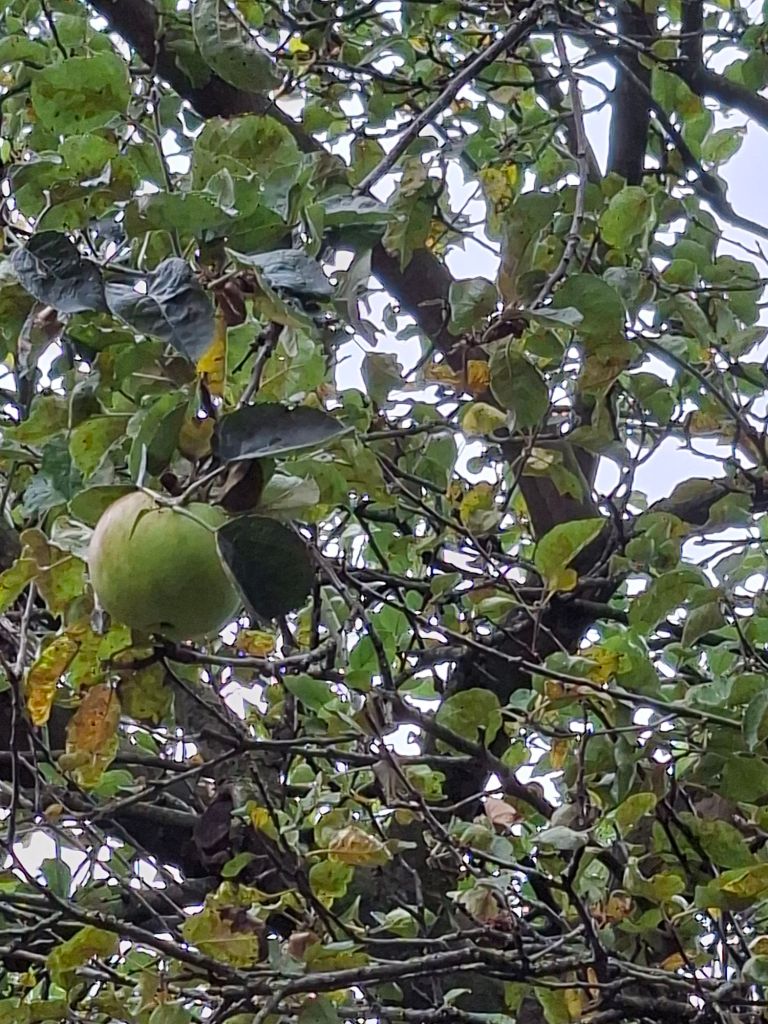
Here and now, the sight of the apple harvest in its later stages (pictured above) seems quite different than in the early ones (2) – less bright, less novel, less shiny. Rotting apples lie on the ground, now fallen outside the wall of Gloucester Cathedral’s orchard. From Nature’s exuberant perspective, this is all part of the plan. Waste is built in.
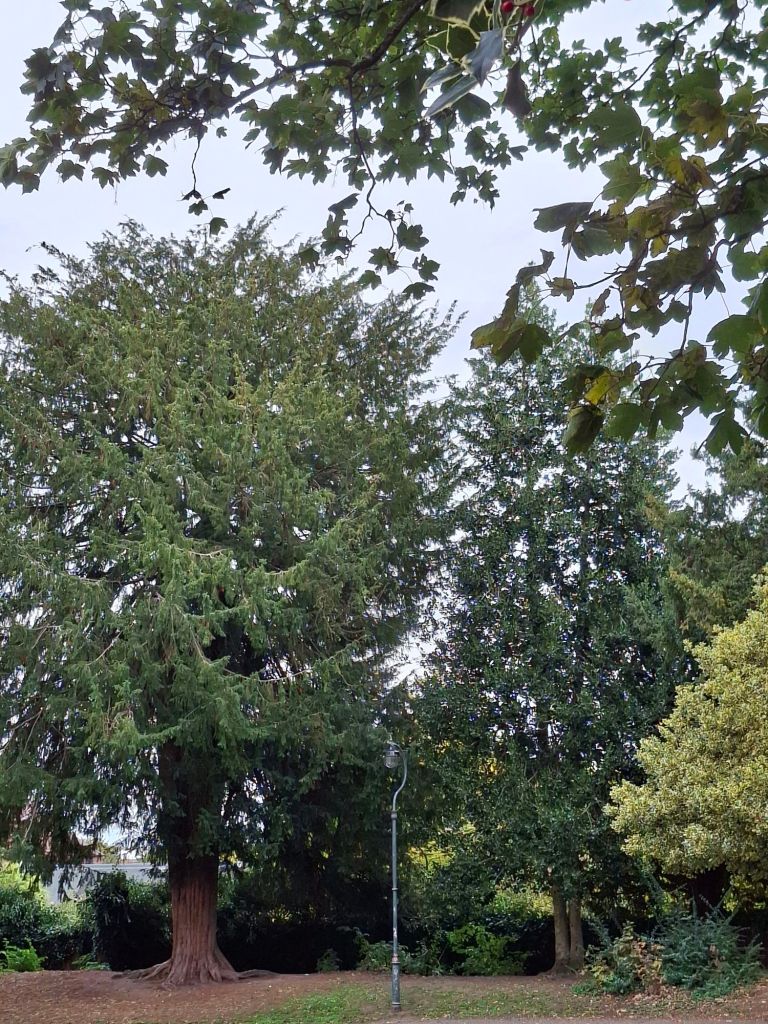
This time draws me further into the declining year. I am in the cathedral’s grounds, now looking at a yew tree and its associations with death. I’m thinking of the approach of Samhain (aka Halloween/All Hallows) at the turn of the month. Once it marked the 3rd harvest of the year – the blood harvest, where animals were slaughtered in preparation for winter. Now it is more a time to remember our ancestors, and our dead more widely.
Yet the seasonal moment, and the yew, can also be linked to wisdom and transformative change in life. I launched my contemplative inquiry at Samhain 2011. Like many people, I find that this period can be a resonant and creative time.
Below the yew, I have included a section of the cathedral itself. I have old personal associations linking medieval Gothic architecture with the feeling-tone of the declining year. I am also aware that this building is linked to the trees I picture and discuss. Gloucester Cathedral was a monastery when Sir Gawain and the Green Knight was written but many of its features were already in place.

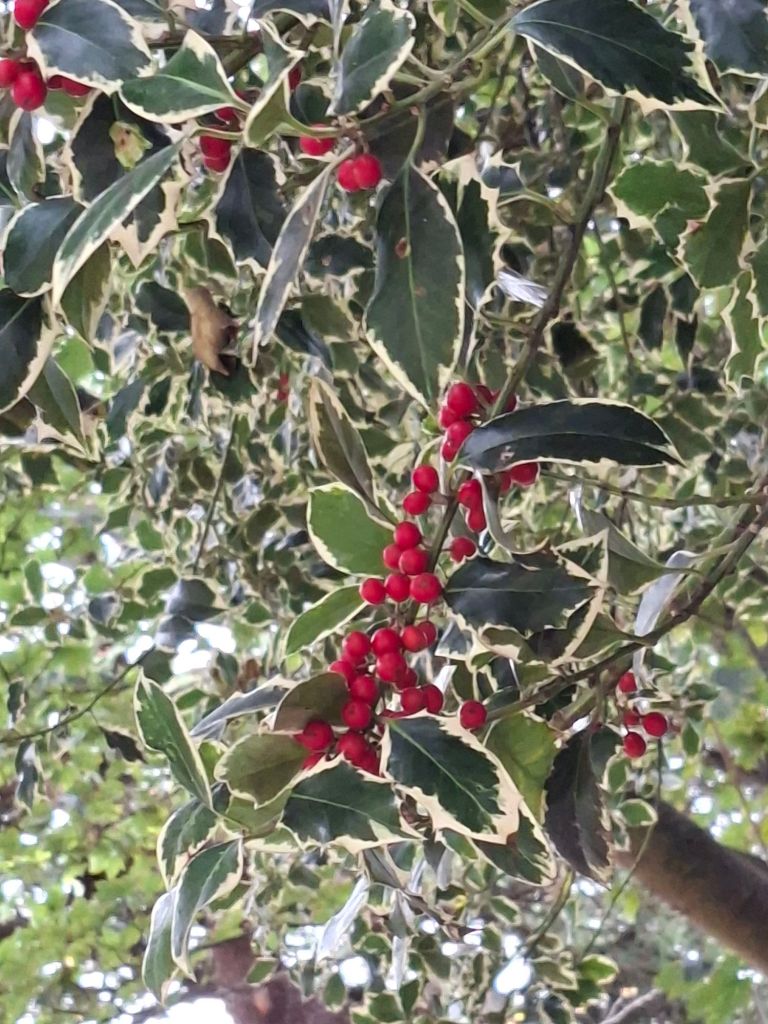
In the same space, I find both holly and ivy, with berries on the holly tree. I immediately thought of the Christmas carol The Holly and the Ivy. It is an ancient folk carol, which interweaves Christian themes and others that belong with the land. The version which is now popular was collected by Cecil Sharp in 1909 in Gloucestershire from Mary Clayton.
Many people think that the indigenous Pagan themes are the oldest, and that the central focus here is on the holly. The authors of The Green Man Tree Oracle say: “Holly’s connection with the Green Man is especially strong. In his guise as the Holly King – an ancient giant and symbol of fertility – the Green Man makes a notable appearance in the 14th century poem Gawain and d the Green Knight. Here he takes the form of a fearsome knight, who comes to King Arthur’s court to offer a midwinter challenge, carrying a club of holly and wearing a holly crown (as symbols of his true identity).” This challenge happens every year, where the Green Man/Holly King demands that we encounter him through our dealings with the natural world.
Elaine and I went to the Gloucester Cathedral Close and its surroundings on Saturday afternoon 18 October to outrun an extended period of gloom, wind and rain. We are now in it, so the lessons of the trees in deep autumn, anticipating the coming of winter, are not lost on us. The dark of the year is on its way.

(1) J.R R. Tolkien (translation of anonymous texts) Sir Gawain and the Green Knight, Pearl, Sir Orfeo New York: Ballantine Books, 1980.
(2) https://contemplativeinquiry.blog/2025/08/22/ (3rd photo)
(3) John Matthews & Will Worthington The Green Man Tree Oracle: Ancient Wisdom from the Greenwood London: Connections, 2003
 Contemplative Inquiry