Contemplative Inquiry

This blog is about contemplative inquiry

Tag: Gnostic Christianity

MODERN TRADITIONAL GNOSTICISM

Modern iterations of traditional Gnostic Christianity are alive and well. Stephan Hoeller is a major figure in this movement. When he discusses ‘the Gnostic worldview’ (1), he implies an essential consensus around a single view, which is not what I find. But I do like the spirit in which he approaches it. “At the core of Gnosticism is a specific spiritual experience, grounded in vision and union, that does not lend itself to the language of theology and philosophy, but instead has a close affinity to and expresses itself through myth”. He applauds the late twentieth century’s “minor mythic renaissance”, facilitated by the ground-breaking work of C.G Jung, Mircea Eliade and Joseph Campbell. He suggests that “their work fostered the widespread understanding that the meanings present in mythologies, ancient and otherwise, could help undo the alienation and rootlessness prevalent in the individual and collective psyches of our culture”.

Whilst expressing a reluctance to define his brand of Gnosticism (“real gnosis is not concerned with definitions”), he does so on the grounds that “the ego-involved mind requires definitions and is uneasy without them”. He then sets out “a summary of Gnostic recognitions”, which he asks us to see as a compendium of “flashes of the Vision Glorious” rather than a “statement of religious tenets in the conventional mode”.

Working through Hoeller’s list (set out, below, in italics) helps me to identify a mixed set of responses in myself.

1. There is an original and transcendental spiritual unity from which emanated a vast manifestation of pluralities.

When I open myself to this story, it sets up a kind of yearning. The original unity, the emanation and the manifestation of pluralities sound wonderfully real. Yet the sentence also hints at distance and the prospect of separation. A poignant sense of loss is built into the cosmic wonder itself.

2.The manifest universe of matter and mind was created not by the original spiritual unity but by spiritual beings possessing inferior powers.

Here, we have a confirmation that something might be wrong. Our ‘manifest universe of matter and mind’ – not just matter – is quite late in the process of emanation and manifestation. What are the consequences of being in a world created by ‘inferior powers’? In today’s mundane terms, we might ponder the word ‘sub-contractor’. Historically, this gave Gnostics an answer to the question ‘how does the ultimate Divine allow horrible things in our world? It’s because another agency is locally more powerful.

3. One of the objectives of these creators is the perpetual separation of humans from the unity (God).

Our first taste of actual malignancy in ‘the creators’. They have an agenda, which depends on maintaining our separation from the unity. In our section of the cosmos, there is the looming threat of constant assaults on our integrity and authenticity insofar as there is anything of the divine in us.

4. The human being is a composite; the outer aspect is the handiwork of the inferior creators, while the inner aspect is a fallen spark of the ultimate divine unity.

We now find that our own very beings are the product of this botched sub-creation. We are separated, not only from the divine source, but within ourselves. We cannot trust our own bodies and minds. I think of the fictive worlds of Franz Kafka and Philip K. Dick, both Gnostic-influenced.

5. The sparks of transcendental holiness slumber in their material and mental prison, their self-awareness stupefied by the forces of materiality and mind.

Here, my modern cultural reference is the early stages of the late 1990’s film, The Matrix. This leads me to think about the stages, not specifically articulated by this list, of turning over in my sleep or beginning to wake up – the sense of alienation, being a stranger is a strange land even at home , of something fundamentally out of kilter about apparent ‘reality’. Something in me cries out for another way of being, which can’t be satisfied by material changes, greater influence or improved relationships. Something hard to identify – and pushing against any spiritual narrative that all is for the best in the best of possible worlds. I don’t experience this feeling now, but it has featured in periods of my life, late adolescence probably being the most intense.

6. The slumbering sparks have not been abandoned by the ultimate unity; rather, a constant effort directed towards their awakening and liberation comes forth from this unity.

The story tells us that we are not alone or without help. An aspect or image of the Divine actually dwells in us and has been there all along. There’s nudging, a prompting, and signposting that comes from outside, and then from inside as the spark is re-ignited. There’s’ a task of noticing and responding to signs, which is how the journey of gnosis begins. If we take up the challenge, the world will begin to shift.

7. The awakening of the inmost divine essence in humans comes through salvific knowledge, called gnosis.

The central proposition of the path.

8. Gnosis is not brought about by belief or the performance of virtuous deeds or obedience to commandments; these at best serve to prepare one for liberating knowledge.

The only way to bust out of the Matrix is to bust out of the Matrix. Release is not granted as a reward for good behaviour. But ethical behaviour may help a mindset favourable to gaining liberating insight.

9. Among those aiding the slumbering sparks, a particular position of honour and importance belongs to a female emanation of the unity, Sophia (Wisdom). She was involved in the creation of the world and ever since has remained the guide of her orphaned human children.

Hoeller here glosses over a traditional narrative, for example in the Secret Book of John (2), that it is Sophia who inadvertently brings evil into the universe by giving birth to a son Ialdabaoth without permission or a male partner, thereby upsetting the cosmic harmony. Ialdabaoth becomes the false god and ruler of our world, with sub-creations of his own. Sophia repents and sets herself to repair the damage by aiding us wherever she can.  This Sophia is the mainstream Eve on another plane. Although presenting an image of the divine feminine, she is shown as transgressive in her independence and stigmatised for it. This is the opposite point of view to that of the Sophia in Thunder, Perfect Mind, who speaks for herself, with her story of neglect and abuse, whilst actually representing the unity itself – to me a more powerful story. Perhaps this is why Hoeller hedges his bets. For me this is the problem of distilling myth, with its creative capacity to shift and change with culture, and Hoeller’s timeless, ahistorical propositions, which can’t – and are therefore no longer mythically alive.

10.From the earliest times in history, messengers of light have been sent forth from the ultimate unity for the purpose of advancing gnosis in the souls of humans.

This view is common to many spiritual groups, though ‘advancing gnosis’ is a characteristically Gnostic way of describing the mission that messengers of light are given. I find that from this point onwards the list gets more propositional and less mythic, and that I find less to say about it.

11. The greatest of these messengers in our historical and geographical matrix was the descended Logos of God manifested in Jesus Christ.

This is where Hoeller clearly asserts a Christian orientation, whilst recognising spaces for other figures to fill this role at different times and different parts of the world. At this point I can’t quite stay in the story. ‘Our’ seems to assume a ‘western’ cultural framework, in a taken-for-granted and essentialist way.

12. Jesus exercised a twofold ministry; he was a teacher, imparting instruction concerning the way of gnosis; and he was a hierophant, imparting mysteries.

This shows the importance of sacraments as well as teaching for Gnostic churches. I notice that Jesus’ much attested role as healer is not mentioned. I’m not sure why that is.

13. The mysteries imparted by Jesus (which are also known as sacraments) are mighty aids towards gnosis and have been entrusted by him to his apostles and their successors.

The additional information here is that Gnostic churches have their own apostolic succession.

14. Through the spiritual practice of the mysteries (sacraments) and a relentless and uncompromising striving for gnosis, humans can steadily advance toward liberation from all confinement, material or otherwise. The ultimate objective of this process of liberation is the achievement of salvific knowledge, and with it, freedom from embodied existence and return to the ultimate unity”.

Christian Gnosticism is presented as a path of great personal effort – ‘relentless and striving’. True freedom means freedom from bodily existence, and this is something that Hoeller clearly intends literally, faithful to much of the old tradition. . There is no return to the ultimate unity in this world. This doesn’t correspond with my experience, either in its austerity or in this conclusion. But I’m still left with respect  for the uncompromising focus and energy of Hoeller’s path, though I cannot call it mine.

(1) Stephan A. Hoeller Gnosticism: New Light on the Ancient Tradition of Inner Knowing Wheaton, ILL: Quest Books, 2002

(2) Nicola Denzey Lewis Introducing ‘Gnosticism’: Ancient Voices, Christian Worlds Oxford University Press, 2013
GNOSIS AND ‘GNOSTICISM’

There is a tension between gnosis and ‘Gnosticism’. The first is an ancient Greek word for spiritual insight. It is about personal experience and the intelligence of the heart. The second is a seventeenth century term for an officially defunct transgressive movement. It seeks to classify this movement by identifying specific characteristics. The Gnostics had no Nicene Creed to make the job easy. With their more individual orientation and commitment to ‘continuous revelation’, they generated a great diversity of understandings. There were Jewish, Christian, and Pagan Gnostics in the Roman Empire, and others from further east. – Mandaeans and Manichaeans. Later centuries saw Gnostic currents in Islam and the Cathar movement in southern France.

Modern scholars of the Nag Hammadi literature are unhappy with ‘Gnosticism’ as a term (1). Some have abandoned it. Others continue to find it useful, recognising the many people in the ancient world “for whom the pursuit of gnosis was a spiritual goal. Even though the terms ‘Gnosticism’ or ‘Gnostic’ are not found in the ancient literature, …the term ‘gnosis’ appears frequently. Thus, what ties together a variety of ancient writings is this emphasis on gnosis as a positive goal or achieved state”.

I value these distinctions because they help me separate out my cultural fascination with a set of traditions, and my personal Sophian Way. This path is to an extent fed by the traditions, and I have a sense of gnosis. But I do not place myself directly in any of the four streams identified by the Nag Hammadi editors (2): Thomas Christianity; the Sethian School; the Valentinian School; and Hermetic spiritual philosophy. But all of them have texts, or passages in texts, of contemplative value to me. They have inspired and fed me in an indirect, but powerful way, and I am very grateful for their recovery of the Nag Hammadi texts in particular in 1945 and their somewhat tardy publication in 1978.

(1) Nicola Denzey Lewis Introducing ‘Gnosticism’: Ancient Voices, Christian Worlds Oxford University Press, 2013

(2) Marvin Meyer The Nag Hammadi Scriptures HarperCollins, 2009 (Kindle edition)

FACES OF THE GNOSTIC GODDESS

Tau Malachi is the Bishop of a Christian Gnostic Church, the Ecclesia Pistis Sophia, also known as the Sophian Fellowship. In his, Sophian, tradition, Sophia is essentially God the Mother and Mary Magdalene is the Christ Sophia, born at the same time as Jesus of Nazareth, the incarnation of the Christ Logos. Tau Malachi’s St. Mary Magdalene: The Gnostic Tradition of the Holy Bride collects, and reworks oral tradition developed over a long period and in different cultures.

This tradition shows the Gnostic affinity to what we would now describe as Goddess, Pagan and Tantric themes, whilst remaining distinctively Gnostic and Christian. The mainstream church is explicitly criticized for “following in the way of Peter, who rejected the Bride and placed himself as an enemy to her”. As a result, “many secrets and mysteries she had to tell were not received”. The conflict between Mary Magdalene and Peter is indeed an early-appearing narrative, also described in at least four Gnostic texts dating from the second and third centuries C.E. – The Gospel of Thomas, The Gospel of Philip, The Gospel of Mary Magdalene, and Pistis Sophia). The Gospel of Philip also includes an account of the close relationship between Mary Magdalene and Jesus. Another early work in the Jacobs collection Thunder (also known as Thunder Perfect Mind) gives a voice to the repression of the Divine Feminine, whilst also pointing to a transcendence of opposites.

To provide a flavour of Tau Malachi’s collection, I offer the extract below:

“The Holy Bride has seven faces, the principal face being Our Lady in Red, St. Mary Magdalene. But she also has six other faces, all of which were embodied in Lady Mary. The three bright faces are Maiden of Light, Mother of the Royal Blood, and Crone of Ancient Knowledge; the three dark faces are the Mistress of the Night, Queen of Demons and Hag of the Void.

“These are as seven veils of Bride Sophia. Unless the Holy Bride reveals herself to a person, those who know her cannot speak the mysteries of the seven faces. It is she who must choose her lovers and bring them into herself.

“Without breaking our vows to her, however, we can say this: these faces correspond to the seven rays of the Light-transmission, and within every face there are seven faces; thus, there are forty-nine faces of Bride Sophia. The fiftieth face of Sophia is Mother Sophia, and those who behold it attain the perfection of understanding called Primordial Wisdom. Of these it is said, ‘their crowns are in their heads’.

“Let one who seeks to understand this invoke the Holy Bride, seek their revelation, and contemplate deeply what is said here. Remember what the Lord said: ‘seek and you will find; ask and you will receive; knock and the door will be opened unto you’. The Holy Bride is the everlasting door, the gate of all-gnosis.”

THE COMPLETED HUMAN BEING

22 July is dedicated to Mary Magdalene, and this post is a short extract from The Meaning of Mary Magdalene, by Cynthia Bourgeault, an Episcopal priest based in the United States (1). Her understanding draws heavily on Gnostic Gospels banned in the 4th century and recovered in the 20th. It articulates a Sophian, or Magdalenian, Christianity – a Gnostic Christianity – in a modern form. At the very least, it deserves space in our cultural memory, as a treasure not to lose again through carelessness, forgetting, or organised misrepresentation.

“In the Gospel of Philip, as in the Gospels of Thomas and Mary Magdalene, the backdrop against which everything unfolds is the quest for the Anthropos ‘the completed human being’.   Philip makes it expressly clear, however, that this two-becoming-one is not simply a union of opposites as we understand it nowadays: not simply the integration of the masculine and feminine, or any of the other great binaries. … The primordial union is   [that of ]   one’s temporal humanity with its eternal prototype or ‘angel’… one Heart, one Being, one Will.”

But this is not all. Singleness is not all.  “There is still one greater mystery to be revealed. … Deeper than at-one-ment lies communion, love come full in the act of giving itself away. The nondualism of the Western metaphysical stream is a flowing unity – a ‘not one, not two, but both one and two’ in which the continuous exchange of twoness and oneness in the dance of self-giving love captures the very dynamism of the divine life itself. To discover myself as a divine being is certainly a spiritual attainment, but to discover myself as the divine beloved is to discover something even more intimate and profound”.

(1) Cynthia Bourgeault The Meaning of Mary Magdalene: Discovering the Woman at the Heart of Christianity Boston & London: Shambhala, 2010

THE WAY OF SOPHIA REVISITED

Five months ago, I wrote a post summing up my recent inquiry work (1). I was moving into an engagement with ‘Direct Path’ approaches and during this period I have been in transition and flux. This has been liberating, but at times hard to articulate publicly. Partly, this is a penalty of lacking clear identification with a specific spiritual brand.

Now, I feel a new sense of synthesis. It is built on a fresh understanding of a tradition discussed in my November 2017 post. This is the Way of Sophia, which I conflated in the post with Sophian Gnosticism. I said:

“To the extent that it is connected to a method, the Sophian (or Magdalenian) journey is a Christian Kabbalist one, a Jacob’s ladder from the apparent world to a Void beyond describable divinity and back again to a new experience of the world as kingdom, transfigured by a super-celestial vision. To the extent that I find a problem with this method, it is a tendency for the reality of my true nature to seem remote and hidden, obscured by a too-vivid myth making. The spirit gets drowned in the cocktail.”

I also said: “When working with the image of Sophia, I found a more playful and free-spirited energy, not fitting easily in formal Gnostic Christian tradition. So, the system, as a system, doesn’t quite work for me.” I notice now that I had already separated my sense of Sophia from my sense of “the system”. I only half-noticed at the time because of my pull towards the Direct Path. I’m glad of this, because my extended check-in with the Direct Path has enabled me to build a new house on better foundations, though still using materials from the old one.

Direct Path teachers have enabled a more rigorous investigation of non-duality than I have experienced before, one that points to a simplified spiritual life now the investigation is complete. Christian Gnosticism and Mahayana Buddhism (including, in practice, Zen) are gradual path non-dualisms. The Headless Way is a variant form of direct path. I believe that the animist and pantheist (or panexperientialist) currents in Druidry and Paganism point in a non-dualist direction. Sophia, for me, is the patron goddess of non-duality.

Tantric tradition shows how we can have a goddess of non-duality without compromising a non-dualist view. Here, Shiva is the empty awareness at the heart of reality and Shakti is its energy and form. She is both the Cosmic Mother and everything that is. Neither can exist without the other. Shiva and Shakti are not in reality separate from each other and we are not separate from them. We are them.

The non-dualist teacher Francis Lucille said: “When we see that the mind, in spite of all its abilities, is absolutely unable to comprehend the truth for which we are striving, all effort to reach enlightenment ceases naturally. This effortlessness is the threshold of real understanding beyond all limitations.” (2) At this point I find that an element of mythology helps. I need stories and for me, a Tantric iteration of Sophia is closer than the more familiar Gnostic one. She is part of my-here-and now reality, rather than the illuminator of a distant goal.

As well as being a Cosmic Mother, Sophia becomes, in active imagination, a guide and focus for devotion – less abstract, more relational than the empty abstract Shiva. Even in recent months, I have continued the occasional practice of using ‘Ama-Aima’ as a mantra within a breath meditation that borders on prayer. Now, I reclaim the ‘Way of Sophia’ as the best way of describing my spiritual identity and path. Everything I’ve learned can be integrated under this single title.

(1) https://contemplativeinquiry.wordpress.com/2017/11/21/intensive-inquiry/

(2) Francis Lucille Eternity Now Temecula, CA: Truespeech Productions, 2006 (Edited by Alan Epstein)

See also: https://contemplativeinquiry.wordpress.com/2015/11/26/the-way-of-sophia/

SEEING: DOUGLAS HARDING AND ST. THOMAS

I’ve been working with The Gospel of Thomas (1), for two reasons. First, it is a non-dual text. Second, it comes from my native tradition, by which I here mean the one I was personally born into. The Gospel is a collection of stories and aphorisms attributed to the teacher Yeshua (Jesus), without any accompanying life-story.

Some of these are very unlike the stories and aphorisms we find in the canonical gospels, unlike enough to get the text banned in the later fourth century C.E., a time of hardening Christian Orthodoxy. But others appear within them. I remember hearing these as a small child who knew himself to have been baptised and given a Christian name. They captured my imagination, and I remember liking and indeed loving them.

Thanks to this background, Christianity – even in the form of an early ‘heresy’ – affects me differently from other paths. I need to be on guard against emotionally driven reverence and dismissal alike. Fortunately this is not too difficult with St. Thomas. There’s a way in which this text heals my relationship with the tradition of my birth, though without any call to renew my allegiance to it.

Douglas Harding was a non-dualist teacher who faced the same issue, only more so, having been brought up in the Plymouth Brethren and subsequently become estranged from his family through religious differences. He wrote an essay about the Gospel of Thomas, giving it a warm welcome (2):

“In this early apocryphal Christian text, the living voice of Jesus comes down to us directly, bypassing all that men have been saying about him and doing in his name. It comes across distinctly, high above the confused roar of two millennia of Christianity, so-called. It’s as if he himself had planted this beneficent time-bomb in the cave at Nag Hammadi, carefully setting the fuse to delay its explosion till the world would be ready for the impact. It’s as if, so tragically far ahead of his own time, he knew when significant numbers of quite ordinary men and women (as distinct from highly specialised and disciplined saints and sages and seers) would at last be capable of catching up with his vision of the Light, his experience of what he calls the Kingdom.”

Harding also says that we owe it to such a teacher “not to believe in this teaching of his in Thomas, but to test it, sincerely verifying (and falsifying) the scriptures by our experience instead of our experience by the scriptures”. In the essay, he goes on to accomplish this by identifying parallels between the Gospel of Thomas and his own Headless Way (3).

I will deepen my work with the Gospel of Thomas. I already know the text quite well, but I think that my understanding of it has changed since my last close reading of it several years ago. I hope also to clear up any residual unfinished business with my Christian roots, and allow the text itself a stronger role in my ongoing life and practice.

(1) Jean-Yves Leloup The Gospel of Thomas: The Gnostic Wisdom of Jesus Rochester, VA: Inner Traditions, 2005 (English translation and notes by Joseph Rowe. Foreword by Jacob Needleman)

(2) Douglas Harding A Jesus for Our Time. Chapter 14 in Look for Yourself: the Science and Art of Self-Realisation London: The Shollond Trust 2015 (first published the The Head Exchange in 1996)

(3) http://www.headless.org/

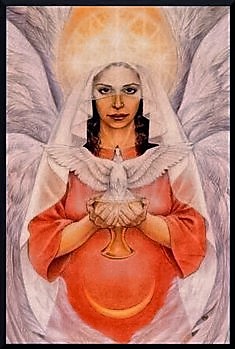
REFLECTION: THE IMAGE OF SOPHIA

bcf2c26ec7720ed734fccc2b13534310Pay attention, those that meditate

Upon me, and listen well!

All of you who are patiently waiting,

Take me to yourself!

Don’t dismiss me from your mind

And don’t let your inner voices

Despise me; don’t forget me at any

Time or place; be watchful!


I am both the first and the last,

I am both respected and ignored,

I am both harlot and holy.

I am wife and virgin, mother and daughter.

I am the unfathomable silence,

And the thought that comes often,

The voice of many sounds,

And the word that appears frequently.

I have been hated everywhere

But also adored.

I am that which people call

Life and you call death.

I am called the Law

And lawlessness.

I am the hunted and the captured.

The dispersed and the collected.

I don’t keep festivals

But have many feasts.

I am ignorant, yet I teach.

I am despised, yet admired.

I am substance

And insubstantial.

I am the union

And the dissolution.

For I am the one

Who alone exists

And I have no-one

Who will judge me.

The lines above have been extracted from an old Gnostic text usually known as Thunder: Perfect Mind. It is part of a collection of fourth century texts known as the Nag Hammadi library, discovered in Egypt in 1945 though not published until 1978. They were buried towards the end of the fourth century, a time of intensified Christian Orthodoxy in the Roman Empire when it had become dangerous to own them. As well as Thunder, the collection includes the Gospel of Thomas, the Gospel of Mary Magdalene and the Gospel of Philip. After over 1500 years of burial, these texts are now once again widely known and appreciated. They might not have appeared at all but for the staunch championship of C. J. Jung towards the end of his life.

Generally, Thunder is thought to be about Sophia, who despite her Greek name is a figure from Jewish tradition – a disregarded voice of wisdom, culturally descended from the dethroned Goddess of Israel. In Christian Gnostic tradition, she is partly reinstated both in the myth of Sophia as a cosmic figure and alternative understanding of Mary Magdalene as a human one. This is one of the main reasons why these texts were suppressed. Thunder goes furthest, in identifying her as supreme being and beyond judgement –  unusual even in the paganism of the day. She also says, “I am the bride and the bridegroom”, calling to mind the Gnostic valorisation of the androgyne as symbol of aware wholeness.

Thunder has many themes: the Goddess and what she stands for; contested understandings of gender, social relations  and religious expression; recognition and non-recognition; the vulnerability of wisdom and spiritual insight in human communities; dualities and the non-duality they are seen to be hiding. In the historical life of Thunder, one toxic duality was to be the co-arising of widespread literacy and systematic censorship. For the Gnostics, there was no redemption to be had in history – only in the transcendent light of a realised Divine identity.

I don’t fully know why Sophia became a numinous image for me. Culturally her Gnostic story is compelling. I notice that I am not interested in the Sophia of Orthodoxy, where wisdom is the wisdom of submission (to God, church and Christian monarchy). Nor am I drawn by Sophia as a Romantic, or Jungian, symbol of the ‘divine feminine’ – with archetype as stereotype writ large. The image of the Gnostic Sophia came to me when I was working within a Pagan context and feeling uninspired by gendered north European deities, with the partial exception of Brigid. In any case, I didn’t want to lose touch with the near eastern traditions, especially in this dissident form from Alexandria, which I felt to be part of my spiritual culture. Whatever the reason, Sophia entered my heart and imagination in a way that no other named and anthropomorphised deity has ever done. She became the perfect patron for a contemplative inquiry, taking on especial significance in the final year, when I talked about a ‘Way of Sophia’.

I still keep the icon close to me, and intend to continue doing so. But two recent dreams suggest some withdrawal of presence and energy. Not in a bad way – it’s more like fare-welling a companion or guide at the end of a journey. I am left with gratitude, inspiration, memory – and some continued sense of connection. This post is a way of honouring her.

Mostly I have selected the text above from the Alan Jacobs translation in The Gnostic Gospels published in London by the Watkins Press in 2005 as part of a series entitled Sacred Texts. However this translation is both free and  incomplete, and for my last four lines I went back to the third revised edition of The Nag Hammadi Library in English published by Harper San Francisco in 1990, with James M. Robinson as general editor.

Artist Hrana Janto at http://hranajanto.com/ (The image at the top of this post is used with her permission.)


WESTERN WAYS: DRUIDRY AND SOPHIA

In my world, Druidry and the Way of Sophia are linked, though not the same. In The Western Way (1,2) authors Caitlin and John Matthews made a distinction between a ‘Native’ Tradition and a ‘Hermetic’ one, which act as “complementary opposites”. The Native Tradition is “the inward spiral of a maze which leads into the heart of ancestral earth-wisdom”. The Hermetic Tradition is the outward spiral of the same maze: a path of evolving consciousness which is informed by the inner resources of our ancestral roots, “augmented in a macrocosmic way” (2).

My original interest in a ‘Celtic’ spiritual thread, developing from the 1980s, wasn’t specifically Druid or Pagan. It came mostly through Celtic and Celtic influenced literature. Although a long tradition in its own right, it post-dates the demise of institutional Druidry and Paganism in Celtic speaking regions. Most of it has been written with at least an element of Christian reference and influence. So we get verses like this from the medieval Welsh Book of Taliesin:

I was at the cross

With Mary Magdalene.

I received the Awen

From Ceridwen’s cauldron. (3)


What I intuitively liked about this was the sense of a culture working to integrate diverse influences rather than attempting to be ‘pure’. Pure culture (or the attempt at it) narrows horizons and banishes possible resources, becoming limited and inflexible in my view. Sophia is both an image of the divine and expresses a blending of Jewish and Greek wisdom traditions. She came to prominence in Alexandria, the largest city of Roman Egypt. She is cosmopolitan. In the verse above Mary Magdalene (an incarnation of Sophia in some gnostic traditions) and Ceridwen (not a traditional Celtic goddess from Pagan times) both have Sophian roles in relation to male figures seen in different ways as light bringers.

Some of the Celtic-derived stories from the medieval period are clearly breaking new cultural ground whilst using resources from the Celtic past. They belong to a realm of creative mythology, as Joseph Campbell called it, whose purpose is “the opening … of one’s own truth and depth to the depth and truth of another in such a way as to establish an authentic community of existence” (4). Twelfth century Western Europe sought to renew itself by drawing on its classical heritage (native in Italy) and Geoffrey of Monmouth drew on it in his Mystic Life of Merlin (5), for example by dedicating a contemplative ‘Observatory’ to the owl deity Minerva, Roman Goddess of Wisdom. It also drew on Celto-Germanic heritage, with the Arthurian mythos – the matter of Britain – taking a prominent place. This mythos does not name Sophia. But it does have the image of the grail and the story of the grail quest. For me the grail represents the presence and energy of Sophia, and Caitlin Matthews has described it as “a prime symbol of Sophia” (6).  Perceval, the grail winner, has to encounter the divine in a new way for himself. At one level his role is to honour and heal the land, renewing its tantric energy. But the Grail Goddess, whilst enabling that traditional collective healing, adds a new and more individuated depth of wisdom and compassion. So although I have always been moved by the scenes and images of the more archaically oriented Peredur (7), I have found a more compelling narrative in Parzival (8). It is the innovative aspect of the story that engages me and the grail image that nourishes me.

In the Gnostic Gospel of Thomas, (9) Jesus of Nazareth asks three leading followers to say what they think he is like. Peter, traditionally Jewish, says “you are like a just messenger” (or righteous angel in other translations). Matthew, familiar with Graeco-Roman ways, says “you are like a wise philosopher”. Thomas says, “my mouth is utterly unable to say what you are like”. The teacher responds, ‘I am not your TeacherBecause you have drunk, you have been intoxicated from the bubbling spring that I have tended’.  As I read this text, it is a confirmation that a lived spirituality is beyond packaging.

In this sense, terms like Druidry, Way of Sophia or Western Way have only a limited use. Joseph Campbell said “the best things cannot be told; the second best are misunderstood; after that comes civilised conversation”. The problem is real yet I believe he overstates his case. I think it is worth the effort of finding words, making distinctions and enabling affiliations in full awareness of the difficulties. Civilised conversation with moments of … something more … feels like an honourable pursuit.

  1. Caitlin & John Matthews (1985) The Western Way: A Practical Guide to the Western Mystery Tradition: Volume 1 – the Native Tradition London: Arkana
  2. Caitlin & John Matthews (1986) The Western Way: A Practical Guide to the Western Mystery Tradition: Volume 2 – the Hermetic Tradition London: Arkana
  3. John Matthews (1991) Taliesin: Shamanism and the Bardic Mysteries in Britain and Ireland London: The Aquarian Press (with additional material by Caitlin Matthews)
  4. Joseph Campbell (1976) The Masks of God: Creative Mythology Harmondsworth: Penguin
  5. R. J. Stewart (1986) The Mystic life of Merlin London: Arkana 
  6. Caitlin Matthews (1986) Sophia Goddess of Wisdom, Bride of God Wheaton, IL: Quest Books
  7. The Mabinogion (1976) Harmondsworth: Penguin (translated with an introduction by Geoffrey Gantz)
  8. Wolfram von Eschenbach, W. (1980) Parzival Harmondsworth: Penguin (translated by A. T. Hatto)
  9. The Gospel of Thomas: the Hidden Sayings of Jesus (1992) San Francisco, CA, USA: Harper San Francisco (translation with introduction, critical edition of the Coptic text and notes by Marvin Meyer; with an interpretation by Harold Bloom)
Earth Eclectic

music that celebrates Earth and speaks to the heart

Sarah Fuhro Star-Flower Alchemy

Follow the Moon's Cycle

Muddy Feet

Meeting nature on nature's terms

Rosher.Net

A little bit of Mark Rosher in South Gloucestershire, England

Becoming Part of the Land

A monastic polytheist's and animist’s journal

selkiewife

Selkie Writing…

Charlotte Rodgers

Images and words set against a backdrop of outsider art.

Prof Jem Bendell

living with metacrisis and collapse

Towint

The pagan path. The Old Ways In New Times

The Druids Garden

Spiritual journeys in tending the living earth, permaculture, and nature-inspired arts

The Blog of Baphomet

a magickal dialogue between nature and culture

This Simple Life

The gentle art of living with less

Musings of a Scottish Hearth Druid and Heathen

Thoughts about living, loving and worshiping as an autistic Hearth Druid and Heathen. One woman's journey.

Wheel of the Year Blog

An place to read and share stories about the celtic seasonal festivals

Walking the Druid Path

Just another WordPress.com site

anima monday

Exploring our connection to the wider world

Grounded Space Focusing

Become more grounded and spacious with yourself and others, through your own body’s wisdom

The Earthbound Report

Good lives on our one planet

Hopeless Vendetta

News for the residents of Hopeless, Maine