Contemplative Inquiry

This blog is about contemplative inquiry

Tag: embodied spirituality

POEM: THE OLD PEONY STALK

Seeming old dry stick

and yet …

a whole ecology

of

moist earth

tiny insects

a little live stem

whiskers and bones

whiskers and bones

dying back to the earth

without fuss

and not too fast

enough life left to feel/hear its

resonance

… a  subtle one.

Stillness allowing movement

permitting earth, moisture, fragmentation

in slow process

easy not to notice

yet, in softened, mutated from –

Part of the Song.

One of the cultural values of the Druid path is that those of us who are not dedicated, specialised poets and artists are encouraged to write poetry and to practise in the arts. I wrote this yesterday after participating in a ‘Lectio Divina from the Book of Nature’ practice with my partner Elaine. This practice was first introduced to us by our colleague Julie Bond and Elaine has adapted it. She will be offering it at our Contemplative Druid Retreat this weekend (17-19 April). I enjoyed rehearsing the practice with her very much, and am glad to have this record of its fruits.

ORAN MOR THE MAGIC OF SKYPE

Last night (my time) I had a Skype conversation with a group of people mostly in Nova Scotia (their early evening) and a person from Washington State, USA (early afternoon). I had been invited by Alix Sandra Huntley-Speirs of Alba Nuadh: the Druid Arts of Nova Scotia, a group which can be found on http://www.albanuadh.com

The topic was the Oran Mor, including its relationship to the contemplative thread in Druidry. As it happens I’ve been quite recently re-alerted to the Oran Mor, and it wasn’t a topic within my book Contemplative Druidry: People Practice and Potential which we also discussed a little bit. Additionally, the Nova Scotia group are wanting to incorporate their sense of the Oran Mor into their work together. So this made for a dynamic and flowing conversation. From my point of view I certainly needed to respond and think and talk on the spot. So I believe did everyone else.

I felt that I had been privileged to enter an authentic space of co-creation. I had a certainty that something of significance will come of this, both for the group and also for those of us who were in (literally) different places. I can’t ‘know’ that of course, yet I feel it strongly. Speaking for myself, I moved on in an important way. I moved from a space in which I was focused on early meanings and subsequent interpretations of Oran Mor, and how they might guide me, to one where my inquiry has become more visceral. How will The Oran Mor live through me, in my body, heart and mind. How will it shift my experience, my life world?

I appreciate all the people who made this conversation happen, including myself, and to the technology. I know that Alba Nuadh want to continue the practice of Skype conversations and I recommend others to experiment with this medium for Druid conversations.

KABIR: WATER IN THE HOLY POOLS

There is nothing but water in the holy pools.

I know, I have been swimming in them.

All the gods sculpted of wood and ivory can’t say a word.

I know, I have been crying out to them.

The Sacred Books of the East are nothing but words.

I looked through their covers one day sideways.

What Kabir talks of is only what he has lived through.

If you have not lived through something, it is not true.

Kabir Ecstatic poems Boston, MA: Beacon Press, 1992 (The English translations are free enough for Robert Bly to call them ‘versions by Robert Bly’. There is an earlier set of translations published by MacMillan in New York in 1915 by Rabindranath Tagore assisted by Evelyn Underhill under the title Songs of Kabir. Whilst I don’t follow Bly in calling the English of the earlier work “useless”, I do find that Bly’s interpretation has more passion and power. The Bly work includes an insightful afterword Kabir and the transcendental Bly by John Stratton Hawley).

HEARTFULNESS & EMBODIMENT

I decided to kindle a Mindfulness 101 book* and do a spot check out how far my own practice meets ‘mindfulness’ criteria as currently understood. I was glad to find – as a wayward intuitive Druid – that I still seem to be incorporating the essential principles. I especially enjoyed the comment: “Ask someone from Tibet where their mind is and they may point to their chest – the word for mind and heart in Tibetan, and many other eastern languages, is the same. When we practice mindfulness, we’re recalibrating our centre downwards – as such, the practice might better be described as ‘heartfulness’ or even ‘bodyfulness’.” On this reading mindfulness becomes “an open hearted awareness of what’s happening, and learning from what we find” so that something which in English sounds like a quality of thinking in fact brings us down from our heads and into our whole bodies. Body sensations are driven at a deeper level than thought, which is why we can’t change how we feel simply be thinking about it. “By bringing attention to sensations within the body … we work with them more skilfully.”

My personal practice includes devotional, energetic and meditative elements with the meditative slightly more emphasised than the others. It includes a review of body, senses, life energy, feelings, thoughts and images. It also includes a period of either breath meditation or ‘choiceless awareness’. All of these elements are in the mindfulness book. What re-assured me most was the implicit validation of my recent choice of Duidsg mo chridhe/dooshk mo chree (awaken my heart) as an affirmation and reminder phrase during this period. This phrase comes from a Ceile De Fonn, and called to me strongly when I chose it. I’d already thought of ‘heartfulness’ as my preferred term for an awakened state – a fuller, more spacious and generous kind of presence than is conveyed to me by the term mindfulness itself. So I liked getting synchronous support from a book about mindfulness practice.

* Ed Halliwell Mindfulness: how to live well by paying attention Hay House Basics

Information about the Ceile De is available on http://www.ceilede.co.uk

FUINN II: THE POETRY OF PRACTICE

I’m a Pagan Druid, happily placed in a tradition that values poetry and seership over dogma and system building. I experience my practice as a sort of poetry. In this poetry of practice, I am held in a compelling myth of origin, an ever-now origin, and I have found a new way of working with it.

My new collection of Fuinn (Ceile De chants in Scottish Gaelic) includes a very simple one which goes A Hu Thi (ah – hoo – hee) repeated over and over again. The Ceile De interpretation, a Celtic Christian one, is that this chant “represents the three stages of the unfolding of creation … A– the Great Mystery draws in its breath … Hu – that breath is breathed out, and creation is born from out of the Mystery … God becomes matter … Thi – the Divine nature, beingness and intention acts within the field of intention … Some Ceile De would say that this final stage represents Christ Consciousness.”

It’s a bit different for me. I’ve been working with this Fonn daily for a couple of weeks now.  I don’t chant. I use slow deep breathing with a silent awareness of the sounds. I find that for me, the A sets up a sense of latency, a subtle pulse and vibration on the brink of becoming. I feel it in the quality of my inbreath, as a kinaesthetic song. Hu the outbreath feels more vigorous and intentional; there’s a real sense of movement, expressed as exhalation – the breath moves out from my body, through my nostrils. Thi breathed in feels like the delighted expression of a new reality, one that I share in, distinct yet inseparable as a sentient being. This generally brings up feelings exhileration, gratitude and joy. It leads me on to the use of another Fonn as a contemplative and devotional prayer, which I wrote myself using my collection of Fuinn as a model.

A Brighde, A Brighde, solus an domhain; A Brighde, A Brigdhe, Brighde mo chridhe

A Vree-jah, A Vree-jah, solus an dowan; A Vree-jah, A Vree-jah, Bree-jah mo cree

Brighde, Brighde, light of the world; Brighde, Brighde, Brighde my heart

Brighde is the breath, the practice and the Fuinn. When writing my Fonn I wanted to build a felt sense of Brighde as cosmic birther, initiator into being, with a seat in my heart.  Her name evokes power and the prayer invokes relationship – identified as She is with primal generativity and the deep powers of life and land, and also One who inspires skill and accomplishment in those She supports and fosters. Through my experience of relationship and connection, deep levels of feeling and intuition are satisfied, in some way met. I feel empowered, with a sense of having more resources available to me. Why would this be? I don’t really know. What I do know is the value of practice as poetry, and the magic it holds.

The Ceile De can be found on http://www.ceilede.co.uk

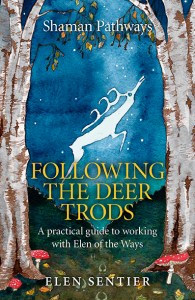
BOOK REVIEW: FOLLOWING THE DEER TRODS

jhp5423fc87b679cThe full title of this book is Following the Deer Trods: a practical guide to working with Elen of the Ways. It is written as part of Moon Book’s Shaman Pathways series, and is positioned as a stand-alone introduction to its topic, which includes working methods for the aspiring practitioner. As such this book certainly meets its criteria.

I personally think it works best in tandem with Elen Sentier’s other book on the topic, also a Shaman Pathways book, Elen of the Ways; following the deer trods – the ancient Shamanism of Britain, which I reviewed in July 2014. This earlier book establishes the overall context much better and for me they belong together.

Following the Deer Trods begins with a summary of the ideas offered in Elen of the Ways. This works well, even magically, in the opening pages – but I was saddened by a seeming loss of perspective when we get to the Romans and beyond. The author shows no recognition of Christianity as a diverse, complex and internally contested path, not least in the Celtic lands; or of the effects which holding political power can have on religious traditions, regardless of the actual faith. There’s also no clear flagging of the extent to which the positive, Pagan side of the story is necessarily reliant on intuitive reconstruction, relevant records being sparse and problematic, oral traditions highly mutable over time, and material remains providing only limited insight into hearts and minds. There is so much we don’t know, and will never know, about our ancestors, their traditions and what it was like to be them. When talking about them, we do best to avoid the language of certainty.

For me the book picks up from that point, providing the promised guide to working in a series of well-organised practice chapters. The main areas covered (in my language) are meditation, energy work, service, shamanic journeying, relationships with familiar spirits (power animals), and working with trickster figures. The author also discusses the ‘journey horse’ or method of trance induction – and the relative merits for this purpose of drumming, the sound of waves, rain, or a flowing stream; the steady roaring of wind; the recorded purring of cats. That bit of the discussion is a true gem, reflecting a lot of playful trial and experience.

These chapters also lay out a basic cosmology for the work – a cosmology of three worlds (middle, lower, and upper) on the vertical axis and four elements radiating out from the middle world on the horizontal, with the nigh universal notion of the world tree/tree of life very much in mind. Elen describes the image of the six armed cross as a means of bringing them together. She talks about her understanding of the inner world of the journey as a place of ‘interface’, the portal which she, as awenydd, and the Otherworld co-create as a meeting place between them.

The instructions for practice are highly specific and directive and therefore best-suited to people who are new to this kind of work, who don’t have access to hands-on teaching or established learning communities, and who need nonetheless to be strongly held as they begin their exploration. Other readers will look to the offerings provided as a source of new or variant ideas, or information about a specific way of working.

My heart didn’t sing, when I read this book, as it had when I read its predecessor. But it makes its contribution and, with the one significant reservation about the presentation of history, I’m happy to recommend it.

UPDATE ON CONTEMPLATIVE DRUID EVENTS

After the publication of Contemplative Druidry last October, I set up Contemplative Druid Events together with my partner Elaine Knight, supported by other members of our local group – particularly Nimue Brown, Julie Bond, JJ Middleway and Karen Webb. Our main purpose is to organise, publicise and run a limited number of contemplative Druid events for the wider Druid community and others of like intent. We will also respond to inquiries from people wishing to join a Druid contemplative group or start one of their own.

We have arranged three events for 2015:

  1. A half day introduction to contemplative Druidry in London on Sunday 22 February
  2. A weekend retreat near Malvern from Friday 17- Sunday19 April
  3. A contemplative Druid day in Stroud on Saturday 3 October

For more information, or to arrange a booking please go to our dedicated blog at http://contemplativedruidevents.tumblr.com/

These events are all in southern England. I am open to going further afield, and other colleagues might be. In this regard I am happy to hear proposals from people who are willing to gather together their own group and to negotiate times, programme and costs.

Overall our vision for the contemplative thread in Druidry is that it will develop organically, with initiatives coming from different sources and taking different forms. We don’t seek to own or manage this development under the banner of Contemplative Druid Events, though we do see a value in offering programmes of our own on a modest scale.

POEM: WOLF VOICE

Happy New Year to all readers of this post! My very best wishes for 2015. I offer a poem by Martin Pallot, a wolf’s life-world in the northern winter.

Martin is my fourth poet from the collection ‘Moon Poets: Six Pagan poets’ published by Moon Books and edited by Trevor Greenfield. Martin has been writing poetry since the early 1980s, mainly inspired by Nature and his pagan beliefs. He admires the early poets and story tellers and the way they engaged the ear, as well as the mind of their audience, and encourages people to say his poetry as well as just reading it. The collection as a whole also includes work by Tiffany Chaney, Lorna Smithers, Robin Herne, Romany Rivers and Beverley Price.

Wolf Voice

Wolf, howling to the moon,

The wind hears your words,

The earth feels your voice,

Sending out your spirit sound,

Calling to the great She wolf

Who shakes the stars from her fur.

Loping in the light of her one great eye,

Silver, shadowing the pack path,

Snow, scented by the passing prey,

Guides you on your killing way.

The trackless whiteness,

Sculpted by spirits of the air,

Into shape of deer and bison.

These insubstantial ghosts,

A pulsating presence in your

Preternatural eye.

When the kill is made,

The pack song rises,

To thank the She Wolf

For her gift of life,

To the den of generations.

And the moon,

Resting on a bed

Of winter branches,

Smiles, to hear

The voice of Wolf.

‘CELEBRATE … MORE THAN’: SHARING A PRACTICE

Earlier in December I shared ‘Awen space’, a Druid contemplative practice from my local group. Today I’m sharing something from my solo morning practice. It’s a set of statements that originally grew out of a traditional ‘who am I?’ inquiry but have now morphed into something else. They are partly a means of scanning and personal review  – and partly a celebration or even re-enchantment of identity, supporting a gradual shift in my experienced centre of gravity.

The specific statements may look fixed but in practice they are in process: they shift and evolve over time. My rule of thumb is that they have to describe experiences I live and embody, or have at least touched into. I can borrow other people’s language, but I can’t use anything here on a purely liturgical or aspirational basis.  I find this a dynamic and valuable way of working, I think largely because tailored to my emergent experience and understanding. If taken off the shelf, as a formula, these statements might not have had so much power. I suspect that this is a form of practice that has to be customised by the individual practitioner to work well, despite (or even because of) its transpersonal direction.

I celebrate my body and my senses – and I am more than my body and my senses.

I celebrate my life energy – and I am more than my life energy.

I celebrate my feelings, thoughts and images – and I am more than these.

I celebrate my everyday self-sense and the web of story it weaves – and I am more than that everyday self-sense.

I am the song in the heart; I am the healer in the heart; I am the wisdom in the heart.

I am the space inside the breath, and the stillness in that space.

Living presence, in a field of living presence.

Already enough and already at home. Awen.

THE MYSTIC SENSE

In his book on Zen Paganism (1), Tom Swiss has a chapter called The Mystic Sense. He includes Mystic, a poem by D.H. Lawrence.


They call all experiences of the

senses mystic, when the

experience is considered.

So an apple becomes mystic

when I taste in it

the summer and the snows, the

wild welter of earth

and the insistence of the sun.


Swiss notes, “one specific, wonderful deep type of beauty comes … from the perception of a relationship between our immediate subjective experience and the broader world”. He adds that depending on our social conditioning and religious training we may come to conceptualise this in terms like ‘cosmic consciousness’, ‘the presence of the divine’, ‘the perception of emptiness’, a feeling of ‘oneness with the universe’, or of ‘sacredness’ or an experience of ‘no-mind’. They are all expressions of the mystical sense, and we have entered a period in which we can let go of any residual belief that this sense is a rare possession, or the exclusive province of a few spiritual specialists and champions.

The way we make meaning and find a language for such experiences may still be heavily conditioned by culture and still be used to justify the truth of dogmas that have in reality “only provided a filter” and “determined what color glasses” we are wearing when we “behold the Clear Light”. But behold it we do, in many different ways, and “with practice we can develop this sense”. Indeed we can “even manage to perceive the mystical experience from multiple perspectives, to swap the glasses for a couple of different colors”. In this context, Swiss reminds us that “this is one of the goals of ceremonial magic, as practised by occultists and Pagans” and not at all confined to still, meditative states.


  1. Swiss, Tom (2013) Why Buddha touched the earth: Zen Paganism for the 21st. century Stafford, UK: Megalithica books
Earth Eclectic

music that celebrates Earth and speaks to the heart

Sarah Fuhro Star-Flower Alchemy

Follow the Moon's Cycle

Muddy Feet

Meeting nature on nature's terms

Rosher.Net

A little bit of Mark Rosher in South Gloucestershire, England

Becoming Part of the Land

A monastic polytheist's and animist’s journal

selkiewife

Selkie Writing…

Charlotte Rodgers

Images and words set against a backdrop of outsider art.

Prof Jem Bendell

living with metacrisis and collapse

Towint

The pagan path. The Old Ways In New Times

The Druids Garden

Spiritual journeys in tending the living earth, permaculture, and nature-inspired arts

The Blog of Baphomet

a magickal dialogue between nature and culture

This Simple Life

The gentle art of living with less

Musings of a Scottish Hearth Druid and Heathen

Thoughts about living, loving and worshiping as an autistic Hearth Druid and Heathen. One woman's journey.

Wheel of the Year Blog

An place to read and share stories about the celtic seasonal festivals

Walking the Druid Path

Just another WordPress.com site

anima monday

Exploring our connection to the wider world

Grounded Space Focusing

Become more grounded and spacious with yourself and others, through your own body’s wisdom

The Earthbound Report

Good lives on our one planet

Hopeless Vendetta

News for the residents of Hopeless, Maine