Contemplative Inquiry

This blog is about contemplative inquiry

Tag: embodied spirituality

EPICURUS AND THE BUTTER

“Epicurus had a garden just near Athens. He was also one of the rarest of men, just like Chuang Tzu. He didn’t believe in God, he didn’t believe in anything, because belief is nonsense. Only foolish people believe. A man of understanding has faith, not belief. Faith is different. Faith means trusting life, trusting it so absolutely that one is ready to go with it, anywhere.

“He had a small garden, and he lived there with his disciples. People thought that he was an atheist, immoral. He did not believe in God, he did not believe in the scriptures, he did not believe in any temple. He was an atheist. But he lived in such a great way. His life was superb, magnificent, even though he had nothing, even though they were very poor. The king heard about them and wanted to see how they lived, and how they could be happy without belief. If you could not be happy even with a belief in God, how could these people be happy without God?

“So he came one evening to visit Epicurus’ garden. He was really surprised, amazed – it was a miracle. They had nothing, almost nothing, but they lived like emperors. Like gods they lived. Their whole life was a celebration.

“When they went to the stream to take their bath, it was not simply a bath; it was a dance with the river. They sang and they danced and they swam and they jumped and they dived. Their eating was a celebration, a feast, and they had nothing, just bread and salt, not even butter. But they were so thankful that just to be was enough; nothing more was needed.

“The emperor was very much impressed, and he asked Epicurus: ‘next time I come, I would like some gifts for you. What would you like?’

“Epicurus said, ‘Give us time to think. We never thought that anybody would give us gifts, and we have so many gifts from nature. But if you insist, then bring us a little butter, nothing else. Just that will do.’”

  • Osho When the shoe fits: commentaries on the stories of the Taoist mystic Chuang Tzu London: Watkins Publishing, 2004


FULLNESS

Yesterday I spent 90 minutes watching trees, their branches now bare, against a steadily darkening sky. I forgot myself in the scene, feeling filled with it. The core experience was fullness.

I suppose that this is what I mean by the ‘sacrament of the present moment’ – though this experience was of the flowing present, extended over time, noticing and enjoying change in nature. On later reflection, I was less reminded of mystics and meditators than of poets, particularly John Keats and his ‘negative capability’. He contrasted this with another type of response, which he called “the Wordsworthian or egotistical sublime”. Negative capability is “everything and nothing – it has no character – it enjoys light and shade; it lives in gusto, be it foul or fair, high or low, rich or poor, mean or elevated – It has as much delight in conceiving an Iago as an Imogen. What shocks the virtuous philosopher delights the chameleon poet”. (1)

‘Everything and nothing’ can be experienced as empty or full. I’m increasingly finding fullness. This has the effect of holding me in nature and time, in my unique human life soon enough to be over. This is where I want to be, with the important qualification that ‘fullness’ gives me a additional sense of being resourced by a larger well-spring of life than I might otherwise recognise. Experienced fullness doesn’t come simply from trees and sky. It comes also from the receptive openness I access when my senses are attuned. I find myself feeling a stillness underneath and within all movement; hearing a silence underneath and within all sound; seeing a soft luminescence underneath and within all colour and form, and in darkness too. These are the keys to fullness – a fullness where everything stills and slows down yet doesn’t stop.

Largely this is what I now mean (for myself) by a ‘contemplative’ state. Its development reflects a magpie approach to learning and my felt sense of what is right for me. I discovered the stillness through Buddhist breath meditation (movement of the breath as the belly rises and falls; yet stillness within). But I am not a Buddhist. I learned the silence through listening to the Oran Mor (Song of the World), though I don’t currently work within Gaelic traditions. I discovered (what should I call it?) primordial luminescence within the Headless Way (2). But I’m not continuing with the Headless path, because the headless trope itself now feels tedious and I don’t entirely share the Harding world view. Fullness has a link to Sophian Gnosticism, of all these traditions the closest to my heart, under the Greek name Pleroma. But my ‘fullness’ has come out of direct experience and I’m being careful to keep it that way. I like the resonance of the English word fullness, and it helps to maintain a degree of separation from the ancient view. Yet even whilst maintaining my inner authority, I am grateful for these inputs from the world’s spiritual heritage. I remain indebted whilst crafting my own path.

I’m not Keats and, for me, negative capacity for fullness tends to come as an alloy. It is generally interspersed with a certain amount of egotistical sublime, in my case as an upgraded stream of consciousness or monkey mind narrative. In my universe, that’s fine too, and all part of the fullness. I would like more skill in switching between the two modes at will, and I believe this to be achievable. At another level, it doesn’t really matter.

(1) Keats selected poems and letters Oxford: Heinemann Educational Publishers, 1995 (Selected by Robert Gittings; edited by Sandra Anstey)

(2) http://www.headless.org

STROKE OF INSIGHT

On a December morning in 1996, Jill Bolte Taylor – a neuroscientist at Harvard Medical School – experienced a stroke in the left side of her brain. “Within four brief hours, I watched my mind completely deteriorate in its ability to process information. By the end of that morning, I could not walk, talk, read, write or recall any of my life. Curled up into a little fetal ball, I felt my spirit surrender to my death, and it certainly never dawned on me that I would ever be capable of sharing my story with anyone”.

Her book, My stroke of insight is a product of this experience. Bolte Taylor describes it as “a weaving of my academic training with personal experience and insight. As far as I am aware, this is the first documented account of a neuroanatomist who has completely recovered from a severe brain hemorrhage”. Much of the book, which moves elegantly between first and third person perspectives, is focused on stroke, stroke survival, recovery and health advocacy. I am not here reviewing the book as a whole. I am focusing on the spiritual journey at its heart, which I see as having major contemplative interest.

Early in her stroke experience Bolte Taylor tried to work out what was going on. What was happening in her brain? “The harder I tried to concentrate, the more fleeting my ideas seemed to be. Instead of finding answers and information, I met a growing sense of peace. In place of that constant chatter that had attached me to the details of my life, I felt enfolded in a blanket of tranquil euphoria. How fortunate I was that the portion of my brain that registered fear, the amygdala, had not reacted with alarm to these unusual circumstances and shifted me into a state of panic. As the language centers in my left hemisphere grew increasingly silent and I became detached from the memories of my life, I was comforted by an expanding sense of grace. In this void of higher cognition and details pertaining to my normal life, my consciousness soared into an all-knowingness, a ‘being at one’ with the universe, if you will. In a compelling sort of way, it felt like the good road home and I liked it”.

She was ready to lie down on her waterbed and simply drift away, but it was not to be. “Resounding like thunder from deep within my being, a commanding voice spoke clearly to me: If you lie down now you will never get up.” Just in time, Bolte Taylor found the will and capacity to dial a phone number and mumble into the ears of a close work colleague, who immediately drove to her house. Her slow journey back into the linguistic and social world – at times a reluctant one – was about to begin. It was clear that that this would not be a simple return to life before the stroke. It would have to be something new.

“My escape into bliss was a magnificent alternative to the daunting sense of mourning and devastation I felt every time I was coaxed back into some type of interaction with the percolating world outside of me. … It was clear that the ‘I’ whom I had grown up to be had not survived this neurological catastrophe. I understood that Dr. Jill Bolte Taylor died that morning, and yet, with that said, who was left? Or, with my left hemisphere destroyed, perhaps I should now say, who was right? Without a language center telling me: ‘I am Dr. Jill Bolte Taylor. I am a neuroanatomist. I live at this address and can be reached at this phone number’, I felt no obligation to be her any more … Now that I didn’t know her life … I was no longer bound to her decisions or self-induced limitations … Dr. Jill Bolte Taylor had grown up with lots of anger and a lifetime of emotional baggage that must have required a lot of energy to sustain. She was passionate about her work and advocacy. She was intensely committed to living a dynamic life. But, despite her likeable and even admirable characteristics, in my present form I had not inherited her fundamental hostility. I had forgotten about my brother and his illness. I had forgotten about my parents and their divorce. I had forgotten about my job and all the things in my life that brought me stress – and with this obliteration of memories, I felt both relief and joy. I had spent a life-time of 37 years being enthusiastically committed to ‘do-do-doing’ lots of stuff at a very fast pace. On this special day, I learned the meaning of simply ‘being’”.

It took eight years for Jill Bolte Taylor to make a complete recovery from her stroke, and she is clear about what she has learned. “Prior to this experience with stroke, the cells in my left hemisphere had been capable of dominating the cells in my right hemisphere. The judging and analytical character in my left mind dominated my personality. When I experienced the hemorrhage and lost my left hemisphere language center cells that defined my self, those cells could no longer inhibit the cells in my right mind. As a result, I have gained a very clear delineation of the two very distinct characters cohabiting my cranium. The two halves of my brain don’t just perceive and think in different ways at a neurological level, but they demonstrate very different values based upon the types of information they perceive, and thus exhibit very different personalities. My stroke of insight is that at the core of my right hemisphere consciousness is a character that is directly connected to my feeling of deep inner peace. It is completely connected to the expression of peace, love, joy and compassion in the world”

Bolte Taylor now wants to maintain a “healthy balance” between both the functional abilities of the two hemispheres, and also “to have more say over which character dominates my perspective at any given moment”. Her left brain is now ‘normal’ again. It perceives the shorter wavelengths of light, increasing its ability to clearly delineate sharp boundaries – adept at identifying separation lines between adjacent entities. It tunes into the higher frequencies of sound, supporting the development and use of language. It speaks constantly, weaves stories, processes information with remarkable speed and efficiency, maintains personal identity and communicates with the outside world. The right brain thinks in collages and images. Responding to the longer wave lengths of light, its visual perception is blended and softened, with a lack of edge that allows it to dwell on the bigger picture and how things relate to one another. It tunes in to the lower frequencies of sound that are readily generated by our body gurgles and other natural tones. It is biologically designed to readily tune in to our physiology. Bolte Taylor says, “I’m having a big love-fest with the fifty trillion molecular geniuses making up my body. I am so grateful that they are alive and working together in perfect harmony that I implicitly trust them to bring me health”. Quoting a saying that ‘peacefulness should be the place we begin rather than the place we try to achieve’, Bolte Taylor takes this to mean that “we should stem from the peaceful consciousness of our right mind and use the skills of our left mind to interact with the external world”.

Towards the end of the book there are specific recommendations for the rebalancing of consciousness. These include: interrupting negative self-talk or replacing it with vivid imagery; coming back to the here-and-now (where the right brain always dwells) though sensory stimulation, music, deep body massage, or simply walking in the rain. Bolte Taylor also touches on energy dynamics and intuition, seeing them as right brain qualities unrecognized by the left. She says, “our right hemisphere is designed to perceive and decipher the subtle energy dynamics we perceive intuitively … Since the stroke, I steer my life almost entirely by how people, places and things feel to me energetically. In order to hear the intuitive wisdom of my right mind, however, I must consciously slow my left mind down so I am not simply carried along by the current of my chatty story-teller. Intuitively, I don’t question why I am subconsciously attracted to some people and situations, and yet repelled by others. I simply listen to my body and implicitly trust my instincts.”

Jill Bolte Taylor’s message is a simple invitation to tend the garden of the mind from a standpoint of compassion towards self, others and the wider world. It is hardly new or surprising. It is the nature, integrity and inner authority of this individual journey that mark it out.

Jill Bolte Taylor My stroke of insight: a brain scientist’s personal journey London: Hodder & Stoughton, 2008

SOPHIA THE CATALYST

bcf2c26ec7720ed734fccc2b13534310In my universe, Sophia primarily acts as a catalyst for what Cynthia Bourgeault (1) calls ‘singleness’ – the spacious mind of non-dual awareness.  I find that gazing into the eyes of my icon (2), or at the image as a whole, triggers me into the Seeing state that I first fully entered with Headless Way (3) exercises. I make a slight shift into what they call the ‘one eye’ perspective, and there I am.

Of course this isn’t dependent on the icon, but the timeless, momentary, gaze in this instance connects with the imaginal realm where I find feelings and intuition to be most present, with a diminished foregrounding of the sensations and thoughts that predominate in other exercises. The experience is the same, yet the feeling-tone is different.

I am still clear awake space, and capacity for the world. I remain grounded in silent stillness. But the passing content, or form, which the changeless emptiness also is and interweaves, is different. A different constellation of human characteristics is brought into the cosmic play. I value and cherish this. The archaic Gaelic tradition spoke of the Oran Mor (Great Song, or Song of the World). I’ve always thought of a Silence being key, holding the Song, and giving it – in a sense – shape; preventing it from being just noise. Yet the distinctions between individual notes also matter – small and transient though they may be. The Song depends on them, too, for its coherence.

At the human level, I have an abiding sense that my true individual note in the Song is Sophian. I do not experience Sophia as simply an abstract Wisdom figure. Nor am I a conventional believing theist (whether unitarian, trinitarian or polytheist) – yet to a degree I am a Sophian devotee, under the tutelage of a psychopomp.

Overall, I associate the Sophian note with a modern Gnosticism, “based in an affirmation of nature and the world and a positive relation to embodiment, not the classical Gnosticism of world denial and pure transcendentalism. It is a gnosis based on bringing the world fully to life, while also enjoying the state of embodiment and sensual pleasure, without excess or obsessive appetite. This affirmation of the world also requires an affirmation of the World-Soul in all its vast complexity as the primary ground of a living and animate nature. This also includes higher orders of perception and awareness leading to more mystical states of unity and participation in the creative founding of human experience” (4).

Through Seeing, I have learned that the “higher orders of perception” are more accessible than usually suggested, hidden by their obviousness and simplicity, yet entering into empty awareness, recognised as original nature or divine ground. This is why it has become my primary practice. I think there is something of this in earlier Sophian tradition. In the ancient Jewish text The Wisdom of Solomon (5), characteristics of clear and empty awareness are at least intimated, and are linked to Her name.

She is the mobility of all movement;

She is the transparent nothing that pervades all things.

She is the breath of God,

A clear emanation of Divine Glory.

No impurity can stain Her.

She is God’s spotless mirror

Reflecting eternal light

And the image of divine goodness.

Although She is one,

She does all things.

Without leaving Herself

She renews all things.”

Wisdom of Solomon 7: 24-27

Cynthia Bourgeault comments: “This remarkable passage envisions Wisdom as the primordial reflective principle, simultaneously creating and created in a seamless dance of divine becoming. There is a goddess aspect to her portrayal, to be sure – the hint of a divine co-creator – but the important thing to keep in mind is that Sophia/wisdom is presented not as a divinity to be worshipped but as a transformational force to be actualized … Wisdom is about transformation and transformation is about creativity; the three form an unbroken circle.”

Moving forward into the early days of Christianity, Bourgeault says: “The logos (Word) of St. John’s Gospel is merely the grammatically masculine synonym for exactly the same job description as has already been ascribed to Sophia in The Wisdom of Solomon; or, in other words, it is wisdom minus the feminine personification. Functionally, the terms are equivalent, and the gospel text could just as easily have begun, ‘In the beginning was the Wisdom, and the Wisdom was with God, and the Wisdom was God … and the Wisdom became flesh and dwelled among us’. In so doing, it might better have conveyed the context and mystical lineage out of which this insight actually emerges. There is no ‘male’ ordering principle counterbalancing a ‘female’ ordering principle – only grammatically masculine and feminine synonyms for a single ordering principle.”

Sophian teaching stands for the transcendence of polarities, as made clear by the Jesus of the St. Thomas Gospel. “When you are able to make the two become one, the inside like the outside, the higher like the lower, so that a man is no longer male and a woman female, but male and female become a single whole … then you will enter in” (6).

Likewise, the Gospel of St. Philip says: “the embrace of opposites occurs in this world: masculine and feminine, strength and weakness. In the Great Age – the Aion – something similar to what we call embrace occurs as well, but though we use the same name for it, forms of union there transcend what can be described here. For in that place … Reality is One and Whole” (6).

‘This world’ and ‘that world’ are not different places – but the same one seen in different ways. In a similar way, Sophia can be described as “the transparent nothing that pervades all things” and also presented anthropomorphically and mythically, as in my icon. Both understandings have value to me. The world of ‘normal’ perception: embodied, of the earth – albeit ‘re-enchanted’ as we say in Druidry, and the setting for a nature mysticism (7); the world of what S. T. Coleridge called the ‘primary imagination’, and of Sophia as image of the divine (8); and the world of Seeing are the same world seen through three different lenses: all to be savoured, all to be enjoyed, all to be known as One.

(1) Cynthia Bourgeault The meaning of Mary Magdalene: discovering the woman at the heart of Christianity Boston & London: Shambala, 2010

(2) Artist Hrana Janto at http://hranajanto.com/ (This image is used with her permission.)

(3) http://www.headless.org/

(4) Lee Brown Gnostic tarot: mandalas for spiritual transformation York Beach, ME: Samuel Weiser, 1998

(5) Rami Shapiro (translator) in The divine feminine in biblical wisdom literature Woodstock, VT: Skylight Paths, 2005 (The Wisdom of Solomon was originally written in Greek, probably by a Jewish sage writing in Alexandria during the intertestamental era.)

(6) Lynn Bauman, Ward Bauman & Cynthia Bourgeault The luminous gospels Telephone, TX: Praxis Institute Publishing, 2008

(7) http://www.druidry.org/

(8) S. T. Coleridge Biographia Literaria London: Everyman’s Library, 1956 (First published 1817)

METHODS IN CONTEMPLATIVE INQUIRY: PART 2

In my last post I talked about the ritual patterning of my morning practice and, in my understanding, the Sophian values it enacts. Here I discuss what happens in the main body of the practice. This begins with a set of physical and breath related exercises, which I originally learned in a Tantric setting. They draw on a kundalini yoga tradition (1) and to an extent on Chinese energy arts. I call them ‘rejuvenation exercises’ and I do them because I like them and find them beneficial.

I do not have a strong view of subtle energy or deep experience of energetic healing. But I do feel charged by this work and I go on to a contemplative engagement with the chakra system. This system  is now widely use and has been described as “part of a common, New Age esotericism in the West, entering from pan-Hindu use of the six or seven chakras in Yoga to indicate centres of power within the body and specifically arranged along the central axis of the trunk. Within Indian medicine this central axis became identified with the spinal column, and there are … fusions of Western anatomy with Indian esoteric anatomy (2)”. Druids and Pagans use this system too, and are therefore to my mind a sub-set of the ‘New Age’ in this regard. For me, the main value of this work is that it offers a for of practice that is both contemplative and embodied.

Historically, “the Tantric body is encoded in tradition-specific and text-specific ways. The practitioner inscribes the body through ritual and forms of interiority or asceticism, and so writes the tradition onto the body. Such transformative practices are intended to create the body as divine. This inscribing of the body is also a reading of text and tradition … Any distinctions between knowing and acting, mind and body, are disrupted by the Tantric body in the sense that what might be called imagination becomes a kind of action in tantric ritual and the forms that the body takes in ritual are a kind of knowing”. The description describes an Indian spiritual culture, transgressive in certain respects, but quite typical of medieval (and to a degree modern) cultures in creating practices where first person, subjective experience is moulded by reference to authoritative texts. Tantric teachers took care to write their works in Sanskrit, no longer spoken but still the holy language of their cultural zone.

I’m aware of being from a different culture in both time and place. For me the chakra rainbow works because it creates the body as more fully human, rather than ‘divine’. For this very reason it suits me better, I now find, than the Kabbalistic middle pillar system which I have sometimes used as an alternative. I begin this section of  my morning practice by raising my arms and holding them up with the palms of my hands pressed together just above the crown of my head. Then I move down the chakra positions, using gesture, sound, and colour to inscribe and energize them:

At crown level, palms in prayer position, syllable nngg as in sing, colour violet-flecked white.

At 3rd eye level, index fingers touching brow, syllable mmm as at end of Om, colour indigo.

At throat level, hand cupped below my throat, syllable eee, colour bright blue.

At heart centre level, hands crossed over my heart centre, syllable ayy as in play, colour green.

A little above my navel, hands clasped together, syllable ahh as in father, colour yellow.

At the pelvic level, hands in a diamond mudra, syllable oooo as in rule, colour orange

Bent down, each hand on a foot, syllable ohh as in road, colour red.

 From here, I turn my attention around and move slowly up again, elaborating meanings, and noticing my responses – sensations, feelings, thoughts. The following is an example of how I can work in a session, here using affirmations. I check out my congruence in using the chosen words: how fully do I stand behind them? Do I experience any promptings to change them?  I also check out the ‘demons’ present at each level and ways in they test the affirmations.

Feet: earth/body/senses: ‘I am a child of the Earth. I am welcome here.’ [Demon: Fear]

Sexual/Sacral: water/desire/sexuality/feelings: ‘I embrace sensory pleasure’ [Demon: Guilt]

Belly:  fire/will/power/self-sense: ‘I celebrate my personal power’ [Demon: Shame]

Heart: air/thinking/social sense: ‘I love and am available for love’ [Demon: Grief]

Throat: sound/resonance/creativity/expression: ‘I speak my truth’ [Demon: Lies]

Brow: light/imagination/vision: ‘I am guided by the Light of Sophia’ [Demon: Illusion]

Crown: awareness/capacity: ‘Empty awareness, holding the world’ [Demon: Attachment]

I have to say that there is indeed a text behind this practice, and a tradition. The text is Eastern Body: Western Mind by Anodea Judith, and I picked it up and worked with it easily because I already shared certain cultural features – some background in ‘New Age’ Tantra, more extensive background in humanistic/transpersonal and in particular Jungian psychology and therapeutics, and a knowledge of developmental psychology. This presentation of the chakras draws attention to the human life course. The upward hierarchy is aligned to the developmental tasks of different age groups – root, pre-birth to one year; sexual/sacral six months to two years; belly two to four years; heart four to seven years; throat, seven to twelve years; brow, adolescence; crown, adult. The practice is made powerful by the reality that ideal development is not normal, and most of us live with some level of wounding at more than one developmental stage. Our younger selves, and their needs, continue to live within us.

Contemplative chakra work  reinforces my commitment to the human side of human spirituality. The stresses and distresses of the human body/mind are part of contemplative work in my view and this work is a direct challenge to ‘bypassing’ – the flight into love and light as a means of escape from aspects of life experienced as negative or distasteful. I don’t treat Judith’s work as gospel and I have customised her framework in important respects. But in what I hope is an authentic and creative way, I freely acknowledge being text and tradition based in my use of chakras, happily using conventional frameworks and understandings to the extent that I find them useful.

In my next post I will discuss the forms I meditation I currently use and why I have chosen them for this stage of my inquiry.

(1) Swami Satyananda Saraswati Kundalini Tantra Munger, Bihar, India: Yoga Publications Trust, 1984

(2) Gavin Flood The Tantric body: the secret tradition of Hindu religion London & New York: I.B. Taurus, 2006

(3) Anodea Judith Eastern body: Western mind: psychology and the chakra system a a path to the self Berkeley, CA, 2004 (rev. ed.)


BOOK REVIEW: SPINNING IN PLACE

4163oG+V32L._AC_US160_Highly recommended: Spinning in Place is a clear and thought-provoking guide to the festival year from the perspective of a humanist/naturalist Pagan. Bart Everson describes it as not so much a ‘how to’ as a ‘why bother’ book, for “no-one can dictate what the festivals mean or how to observe them”.
What he offers is a narrative of how he works the widely adopted eight festival cycle in New Orleans, and “idiosyncratic encouragement” to “spin your own wheel”.  The reader he imagines is “an atheist, or perhaps a pantheist or an agnostic”, someone “without a strong belief in gods or supernatural powers”.  Yet, within this philosophical naturalism, he imagines also an interest in religion and spirituality – perhaps in the form of “being surprised by a sudden awakening” and entering upon “a quest for something more”. For me, it also has a value to anyone with an interest in the Wheel of the Year.

Everson makes two important points about the festivals in general. One is the sense of a holiday as more than a vacation – more than time off for relaxation and recreation, important though these are. A true holiday enshrines values, “reminding us again and again of certain existential truths”. Modern ‘Western’ style societies tend to be “mobile, rootless, divorced from the specific realities of a particular place … it’s my thought that if we spin in one spot for a while, dervish-like, perhaps we’ll corkscrew right down into the Earth and regain our sense of location.”

The second point to remember is that “seasonal variation happens according to its own schedule and not according to any calendar devised by humans.” When festivals become entrenched, “conventions have a tendency to become concretized in our minds, as if they were the primary reality rather than a convenient symbolic expression”. Everson invites an open and fresh approach to ritual celebration. This will of course include the repetition of loved and familiar patterns, but not imprisonment within them.

The book gives a chapter to each season, opening with December: Solstice Connections where the solstice is seen not as a Solar event (nothing happens to the sun) but an Earth-Solar event. Everson’s ritual year is about Earth and its cycles, celebrating an Earth spirituality. January/February: Searching the Depths remind us that there is no Nordic winter in New Orleans, and a Carnival season starting at Twelfth Night, with Mardi Gras any time from 3 February – 9 March. For Everson, it is the time for Candlemas and Brighid crosses. March: Spring in the Subtropics, Spring in the Self – and oak pollen on the porch a sure sign of the equinox. A theme of balance rather than excess: purification understood as “feeling good, staying strong, promoting vitality, improving focus, and nurturing inspiration”. April/May:  May Day x2 The Worker’s holiday matters as much as Beltane to Everson: celebration of revolutionary political desire, the notion of power to the imagination, the spiritual dimension of politics – “the sense of connection to Earth and humanity fuels outrage at manifest injustices”.

To begin the second half of the year we have June: Flowers to Flame, a time of sunshine and superabundance – yet at the same time, acknowledging limits set by nature. Flowers coming to full form, and flowers given over to the bonfire’s flames. Then comes July/August: How Lammas Changed my Life The warmth of the year has continued to increase. Everson remembers his first link to a local Pagan group, a Paganism for kids event to which he took his daughter. Making corn dollies. Still making them, and baking bread together. September: The Other Equinox is elusive as a season, though it is getting darker and it is the time of Lycoris radiata – naked ladies, red magic lilies, hurricane lilies locally. The hurricane season peaks on 10 September and goes on to 1 November. Themes of loss and darkness, yet also gratitude (rather than fear or denial). Making ‘gratitude garlands’, since gratitude is always for something and to someone. Finally, we have October/November: Dead Time where All Saints, All Souls and Dia de los Muertos are all celebrated locally. Everson talks both of celebrating ancestors’ night and what he calls “surfing the new spooky” – “there is something delectable about the spooky, something desirable, something necessary”.

Spinning in Place shows how to create a wheel of the year which honours tradition, place and personal history. This approach allows fluidity and responsiveness to environment, community and culture both past and present. It clearly works for Bart Everson. Spinning in Place does not offer an off the peg set of rituals. Rather, it asks readers to wonder what we might do, in our place, using our histories and our forms of expression. That’s what makes it inspiring.


Bart Everson Spinning in place: a secular humanist embraces the wheel of the year New Orleans, LA: Frowning Cat Books, 2016 (E-book available on Amazon Kindle)


DIRTY LOVE

Jeff Foster on ‘dirty love’ and the place of rawness in lives that we package as ‘spiritual’ – a word that sometimes goes with a certain kind of polish.

“Love is … a living, breathing, real-time reality. The poets and sages were right. …This love, this deep and ever present silence that you are, is so vast it swallows everything. It pays no heed to images of how it should be. It does not try to impress, it is not looking for rewards, acceptance or validation. It is not pretending to be transcendent, or fearless, or beyond pain, it has no use for the word ‘spiritual’ or ‘enlightened’, it does not act as if it’s above everything. It knows no bypassing, no clever tricks, no way to numb itself to itself. It gets its hands dirty.

“Yes, this is a dirty love. The unloved and unwanted and unmet get stuck under its fingernails. It wants all of its children, not just the pretty ones. It is the mother, the father, the lover, the guru we have always longed for. It loves because that’s all it knows. It would work its knuckles to the bones just to be here.

“We pretend to be fearless and beyond human concerns only because we are afraid. We act at being peaceful and undisturbed only because there is a storm inside. We strain to show others how far beyond anger we have gone, only because anger still rages within us, longing to be met. We show off our perfect spiritual know-ledge in public to mask our perfect private doubt. It’s a perfect balance.

“Who will stop pretending? Who will meet the ‘shadow’, the misunderstood ‘dark side’ of life, those waves of ourselves that are not inherently negative or sinful or dark, just neglected and abandoned and longing for home? Who will meet life’s orphaned children? Who will sacrifice the image for the delight of not knowing?

….

“Even the unwanted are wanted here in the vastness that we are. There is plenty of space. Beyond awakening, there is this grace, this inexplicable and heart-breaking timeless welcoming of everything as it arises. By dirtying itself until it cannot dirty itself any more, love purifies itself.”


Jeff Foster Falling in love with where you are: a year of prose and poetry on radically opening up to the pain and joy of life Salisbury: Non-Duality Press, 2013

HEADLESSNESS AND DRUIDRY

Douglas Harding (1909 – 2007) described his ‘Headless Way’ as a “truly contemporary and Western way of ‘seeing into one’s Nature’ or ‘Enlightenment’” He went on to say that “though in essence the same as Zen, Sufism, and other spiritual disciplines, this way proceeds in an unusually down-to-earth fashion” which would save the Seeker/Seer “years of reading, lecture-attending, thinking, ritual observances, and passive meditation of the traditional sort”.

This is achieved by “a variety of simple, non-verbal, fact-finding tests, all of them asking: how do I look to myself? They direct my attention to my blind spot – to the space I occupy, to what’s given right here at the Centre of my universe, to what it’s like being 1st-person singular, present tense” (1). Elsewhere he describes “a Reality which is Indivisible …not a thing, nor even a mind, but pure Spirit or clear Consciousness; and we are That and nothing but That … and the only way to find It is to look steadily within, where are to be found utmost peace, unfading joy, and eternal life itself” (2).

Harding claims that this experience is natural, ordinary and easy to obtain – not at all something that demands extreme practices for spiritual heroes. The real question is about how to make the experience habitual and how, if at all, we might need to do life differently. He is careful to say that “by habitual I mean remaining in contact with one’s central clarity and not … clinging to it. Not demanding that it should remain in the forefront of one’s attention in all the changing circumstances of life. The alternative is a crippling obsession. ‘In darkness are they who only look outwards, but in thicker darkness are they who only look within” (1).

I am now working with the Headless Way, a path culturally grounded in the Sophia Perennis – see  https://contemplativeinquiry.wordpress/2016/04/11/wisdom-of-Sophia/ – here based in Western modernity yet with a global and trans-historical frame of reference. I have known about it for some time, but discovered it in earnest only three weeks ago whilst checking information about something else. I do feel in some way nudged. I find the way of working very effective, partly because I have been warmed up to this kind of spirituality for many years without finding quite the right vehicle for it. This changes things for me.

The main change is that Headless Way exercises have largely replaced the Kabbalah based work I was planning and beginning as a complement to my Druidry. The new methods move me away from the direct heritage of the Occult revival and its use of Jewish tradition. Not completely – I still use the Middle Pillar, with vowel sounds instead of the names of God, as an energy/light body exercise. The Sophia icon described in my last post remains highly important to me as a visual and symbolic representation, with Sophia sensed as a psychic power of guidance. But that’s about it. Relative plainness is my direction now, with an emphasis on brief and tightly focused formal practices.

As it happens, my personal practice of Druidry – especially the contemplative work – has moved stylistically in the same direction: naturalism, minimalism, plainness, economy of form; making sure that the spirit isn’t lost in the cocktail. The integration, it seems to me at this early stage, is that for me the Headless Way primarily supports an inward arc, from the apparent world to the central clarity of the void. Druidry, as embodied earth spirituality, supports an outward arc, from the central clarity back to the apparent world. My life experience is made different by this two-way flow, now more fully known as contained within the Oneness. But from the standpoint of my life in the apparent world, this is a work of progress, and moving quickly. From this perspective I don’t yet know how the process is going to evolve.

(1) Douglas Harding The Headless Way Leaflet out of print. There is now a website of that name at www.headless.org

(2) Douglas Harding Religions of the World London: Shollond Trust, 2014. Revised edition.

POEM: A PILLOW BOOK

The wisdom of diffident humanism. Spontaneity, immersion-in-the-moment and dissolved boundaries aren’t everything. Our narrative natures may be present, self-conscious and hyper-sensitive as we negotiate connection between self and other.  In my world this too has integrity, beauty, and tenderness.

I lie in bed, watching you

Dress yourself in nudity

For your part in a story

You are about to tell me.

Once upon a time, you seem to say,

There was a woman who took off all her clothes

And stood for a moment

With one hand on her hip.

You have my full attention

As you pile your hair on top of your head

And let it fall down again.

Up to this point I am familiar with the story.

Your movements suggest a possible outline,

But nothing is certain yet.

You lift your arms above your head

In a gesture of boredom or surrender.

Your hands touch in mid-air

And you turn them palm-side out

In a kind of question mark,

As you ask for help with the ending.

Hugo Williams, West End Final London: Faber & Faber, 2009. The publisher’s blurb describes this collection as a set of “sardonic investigations into the fault line between voice and projection”.

POPPY

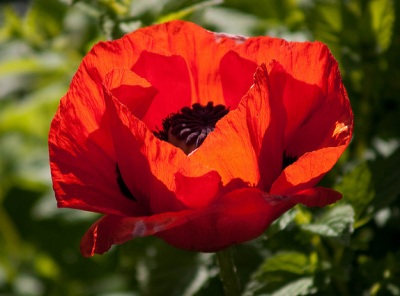
red poppy MIA_400x296“We call the poppy ‘vanity’ and we write it down as a weed. It is humiliating to think that, when we are taking ourselves seriously, we are considering our own self-preservation, or the greater scheme for the preservation of mankind. What is it that really matters? For the poppy, that the poppy disclose its red … Seed and fruit and produce, these are only a minor aim: children and good works are a minor aim. Work, in its ordinary meaning, and all effort for the public good, these are the labour of self-preservation, they are only means to an end. The final aim is the flower, the fluttering, singing nucleus which is a bird in spring, the magical spurt of being which is a hare all explosive with fullness of self, in the moonlight; the real passage of a man down the road, no sham, no shadow, no counterfeit, whose eyes shine blue with his own reality, as he moves amongst things free as they are, a being; the flitting under the lamp of a woman incontrovertible, distinct from everything and everybody, as one who is herself, of whom Christ said, ‘to them that have shall be given’.

“The final aim of every living thing, creature, or being is the full achievement of itself. This accomplished, it will produce what it will produce, it will bear the fruit of its nature. Not the fruit however, but the flower is the culmination and climax, the degree to be striven for. Not the work I shall produce, but the real Me I shall achieve, that is the consideration; of the complete Me will come the fruit of me, the work, the children.

“And I know that the common wild poppy has achieved so far its complete poppy-self, unquestionable. It has uncovered its red. Its light, its self, has risen and shone out, has run on the winds for a moment. It is splendid. The world is a world because of the poppy’s red. Otherwise it would be a lump of clay.”

D. H. Lawrence A Study of Thomas Hardy in D. H. Lawrence Complete Works Delphi Classics on Kindle

When reviewing Nature Mystics – https://contemplativeinquiry.wordpress.com/2015/7/6/  – I mentioned D.H. Lawrence and Thomas Hardy as two of the named writers who had become part of my life during my teens. I also wondered how far such free spirited people can be enrolled as ‘properly’ proto-Pagan as suggested by the author. This passage is certainly very Laurentian. In modern terms, it seems to connect with the current conversation about ‘wildness’ rather than religious Paganism or nature mysticism, though of course these are all interconnected. I have certainly enjoyed revisiting Lawrence’s words after a long absence.  They were written early in 1915, with the red poppy simply representing abundant life, and so before its memorialising significance became marked. Lawrence was just under 30 at the time of writing, with  just 15 years left to him.

Earth Eclectic

music that celebrates Earth and speaks to the heart

Sarah Fuhro Star-Flower Alchemy

Follow the Moon's Cycle

Muddy Feet

Meeting nature on nature's terms

Rosher.Net

A little bit of Mark Rosher in South Gloucestershire, England

Becoming Part of the Land

A monastic polytheist's and animist’s journal

selkiewife

Selkie Writing…

Charlotte Rodgers

Images and words set against a backdrop of outsider art.

Prof Jem Bendell

living with metacrisis and collapse

Towint

The pagan path. The Old Ways In New Times

The Druids Garden

Spiritual journeys in tending the living earth, permaculture, and nature-inspired arts

The Blog of Baphomet

a magickal dialogue between nature and culture

This Simple Life

The gentle art of living with less

Musings of a Scottish Hearth Druid and Heathen

Thoughts about living, loving and worshiping as an autistic Hearth Druid and Heathen. One woman's journey.

Wheel of the Year Blog

An place to read and share stories about the celtic seasonal festivals

Walking the Druid Path

Just another WordPress.com site

anima monday

Exploring our connection to the wider world

Grounded Space Focusing

Become more grounded and spacious with yourself and others, through your own body’s wisdom

The Earthbound Report

Good lives on our one planet

Hopeless Vendetta

News for the residents of Hopeless, Maine