Contemplative Inquiry

This blog is about contemplative inquiry

Tag: Earth spirituality

NINESPRINGS

IMG_20191020_091537This is my image of Autumn for this year. Before Samhain. Before most of the fall. Leafy and watery. The sun is still an influence, a soft one. I took the picture this morning whilst walking in Ninesprings (one word), the gem of the Yeovil Country Park.

I took a number of pictures and then had to stop and just be there. It’s a carefully managed area, hardly wild nature. But it has a long history in roughly it’s present form and is linked for me with positive childhood memories. It is a great place to visit again, and balm for the soul. And it is more than that. The English West Country is my motherland. This place represents it, in my consciousness a half degree lusher than where I live now. When here today – without turning it into too much of an exercise – I found myself entering rapport with the spirit of place and renewing the connection.

IMG_20191020_090619_burst_03

HOME

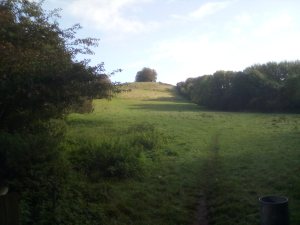
IMG_20191019_100111This is Wyndham Hill, Yeovil. I was born only a few hundred yards away, and I felt a close connection with it throughout my childhood. As representing ‘nature’  or the countryside, it felt safe when I was little  and reassuring later on. It hasn’t changed much, and I am still reassured.

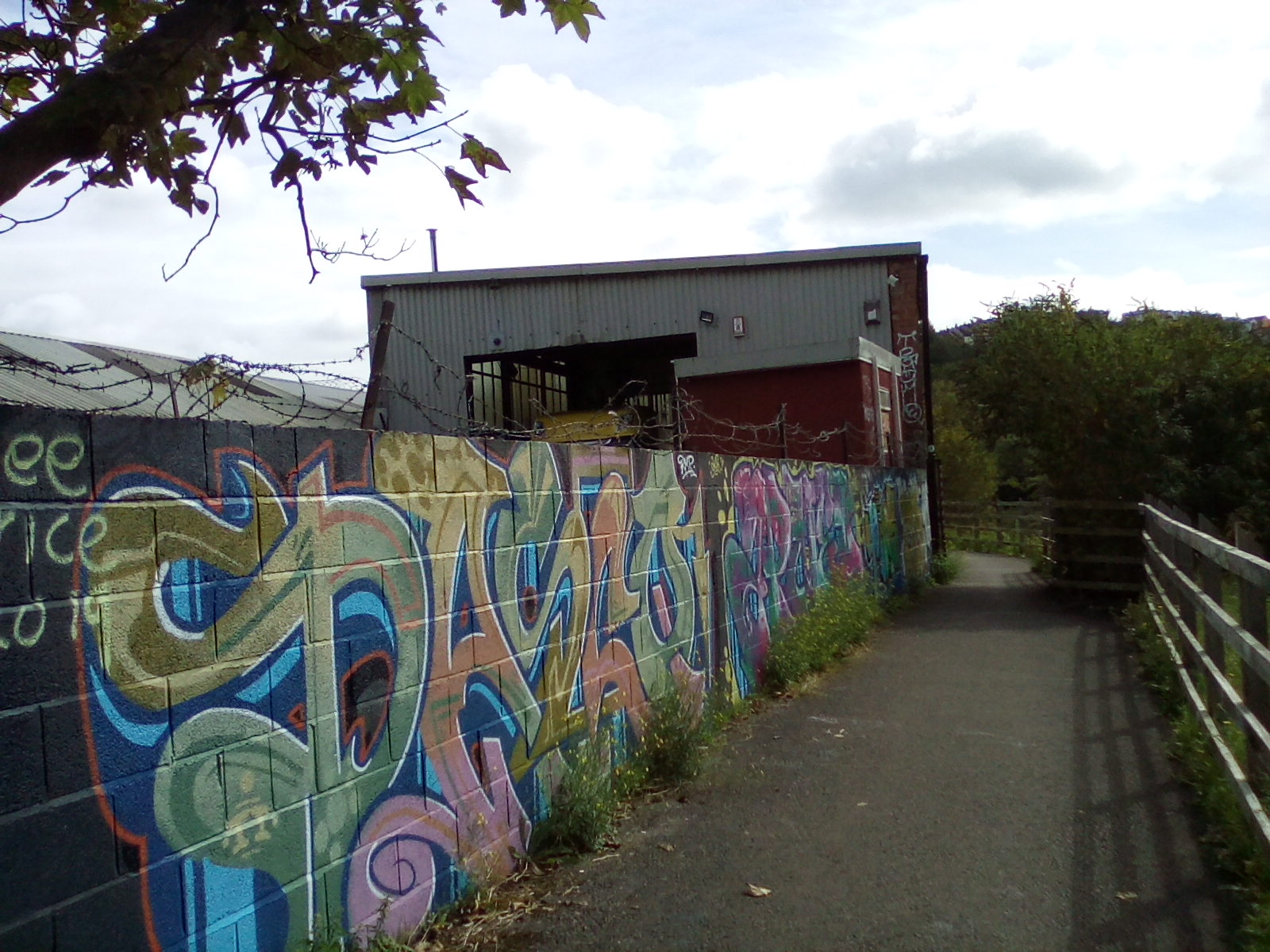
IMG_20191019_094110  Above is the house I grew up in – the grey one. It was a pharmacy when I lived there, though it ceased to be that in 1973, three years after I left home at the age of 21. Its value as a retail site and community resource had long been weakened by a movement of people away from the old town and the building of a ring road within the modern town rather than around it. I don’t know about the later history of the house that brought about its dereliction. Clearly the house doesn’t now evoke the sense of safety and reassurance that it once did.

By a happy chance I read some these  words in a novel today, a few hours after taking the pictures. “Home  is a feeling. The memory of a warm bed. The voice of your parents calling you to breakfast. Home isn’t a roof or four walls. It’s  not a place at all. Maybe that’s why it’s so hard to find again once you’ve been gone too long. “*

I could end by recollecting my own inquiry insights about ‘at-homeness in the present moment ‘. But in the moment – this one – I need to find room, within that very at-homeness, for heartache and sadness about the fate of my childhood home.

* Sebastien de Castell Spellslinger 6: Crownbreaker Hot Key Books, 2019


CONTEMPLATION AND ENGAGEMENT


According to my dictionary, one of the meanings of ‘signature’ is, “a distinctive pattern, product, or characteristic by which someone or something can be identified: the chef produced the pate as his signature dish”.

I want to adjust the signature of this blog. I want now to explore the relationship between contemplation and engagement more explicitly. A blog is itself a form of engagement, and this one has so far combined a strong curatorial thread with personal sharing. Now, for me as for many others, a deepening social and ecological crisis asks for a work of preserving existing life-affirming aspects of our culture and developing new ones. I see this work as enhanced by outward-looking forms of contemplation. I want this blog to contribute.

I started this blog as a Druid. My personal path, which I have described more recently as a Sophian Way, has become more Universalist. I have described it as a path of healing, peace and illumination, which encourages a spirit of openness, an ethic of interdependence and a life of abundant simplicity. Its ‘sacrament of the present moment’ involves resting in a place of underlying stillness, freedom and love within any experience – good experiences, wonderfully, but also bad ones that need active resisting on the ground. For some, this suggests an experience of divine support, or the activation of the divine within us or of the divinity that we truly are. For others it seems to come from a deep wellspring within the psyche that needs no further point of reference. This sacrament is my core practice, to be dropped into at any time. It doesn’t always take a pure form, but it usually makes a difference. In the myth of my own life, it is Sophia’s principal teaching.

At the level of the wider word, I continue to feel a strong sense of alignment with Pagan, Animist, and Earth spiritualities like Druidry – more than to the Buddhist or Gnostic families or to movements like the Headless Way, even though they have given me a lot. Philip Pullman in his The Secret Commonwealth* has a character who says that where we stand revolves around one key question – ‘is the world dead or alive?’ I say ‘alive’ without worrying about scientific definitions or the metaphysics of reality. Something in me just has to say ‘alive’ – alive and interconnected as a web of life. This re-affirmation is important to me, and as a ‘light bulb moment’ on a level with the more seemingly individual aspects of my Sophian Way. I don’t expect to change the blog that much, but there’s enough adjustment of signature here to demand explicit affirmation.

*Philip Pullman The Secret Commonwealth Oxford, David Fickling Books & London, Penguin, 2019 (Vol. 2 of The Book of Dust)


BOOK REVIEW: DRUIDRY AND THE FUTURE

Highly recommended. Druidry and the Future is intended as “antidote to despair” according to author Nimue Brown. She continues:

Druidry & Future 51hWUITk4HL._AC_UY218_ML3_

“This book explores the many ways in which the Druid path can help us to respond to climate chaos, necessary cultural change and political uncertainty. By mixing the spiritual and practical we can be more resilient and resourceful, and aspire to live in regenerative and generous ways.”

An affordably priced and relatively slender volume, Druidry and the Future is full of ideas. It is built around 16 essays covering diverse topics: working with Pagan stories: seasonal living: bardic powers; ‘pragmatic’ animism; working with the elements (three essays); de-colonising your soul; your body is nature; justice and balance; honouring the divine through action; putting ourselves back in the landscape; community solutions; self-care and kindness; trees and wetlands; regeneration and restoration. For me, there is a single overarching theme: enlisting the resources of modern Druid culture to build resilience in the face of climate catastrophe. This resilience includes personal and collective aspects, where humans and their communities are understood as wholly embedded in the wider web of life.

Nimue Brown is clear that “it is not enough to be sustainable”. The crisis invites, or rather requires, a radical change in values and behaviour. Human civilization is ‘just people’ and we have the capacity to live differently. For her, “this is what Druidry means right now. It’s about answering the question of how to put civilization in balance with our living planet. This is Druidry for radical change and I think we’re well placed to take on this work and to inspire others. Philosophy has always been part of Druidry, so has teaching and communication, inspiration and vision. We can, and must make a difference.”

A SMALL GOD OF THE EARTH ATTAINS BUDDHAHOOD

IMG_20191011_101101_kindlephoto-8745263

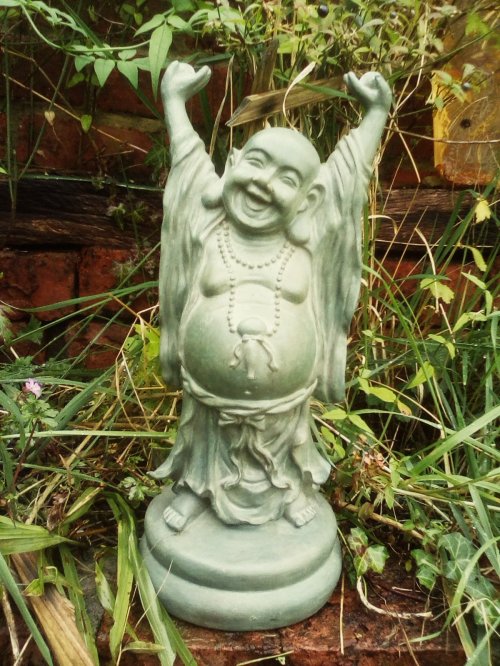
I have had this statue for awhile, and intend to pay it more attention. He might be a small god. or he might be a human priest or shaman, acting as guardian of a sacred place. I imagine it as including a waterfall and springs, with  rocks and earth and trees. Either way he would be eligible to become, or realise that he latently is, a Buddha or Taoist Immortal, to use another framework from his culture of origin.

There are even rumours of his being Maitreya, the next world saviour, on account of his laughing, ecstatic demeanour. For me, this works best in a model where we could all be prompted into saving the world together. I’m not sure how best to name and describe him – what words to use, or references to make. So I took this picture instead.

OPENING TO SUBTLE CHANGES

A good reflection on giving attention from Mark Green’s in Atheopaganism blog.

POEM: RAPT FORM

FIRE upon Night the way flashing

Cove within Earth the seed receiving

South into North of us –

Eagle upon mountain and the light ascending

The Bowl of the daily dark descending

Stars beyond the shore of us

The Centre stays and the pattern fixes

The Centre moves and the diagram mixes

For many and more of us.

The Eye shines as the cast is shining

The Bowl gathers darkness as the shade is spreading

The Pentagram weaves its tent overheading

The stars and the Polestar turning and twining

Until the rotating of day.

O day and night O night of time

[the weft upon the warp of rhyme}

I backward step to the abyss

Where Form ends and Nothing is –

Where Nothing ends and All-Thing is.

Ross Nichols Prophet Priest and King: The Poetry of Ross Nichols Lewes: The Oak Tree Press, 2001 (Edited and introduced by Jay Ramsay)

“Ross Nichols, who was a contemporary of Eliot, and rated highly by many including Edwin Muir, was Chief of the Order of Bards, Ovates and Druids (OBOD) until his sudden and unexpected death in 1975. An accomplished prose writer, essayist, editor and water colourist who exhibited at the Royal Academy, we can now see him as one of the ‘Apocalypse poets’ of the 1940’s As Chief of the Order from 1964, his contribution was substantial, re-introducing into modern Druid practice the Winter Solstice Festival and the four Celtic Fire Festivals, which he led at London and in Glastonbury.”(Book blurb)

For information about OBOD see http://www.druidry.org/

AT-HOMENESS REVISITED

A year ago, I wrote: “within my Sophian Way, I have found healing and grounding in a flowing now, the site of an unexpected At-Homeness. Everything else grows out of that”(1). This post is to re-affirm this insight and to take it forward.

I wrote of a ‘flowing now’ since ‘now’ is not a frozen unit of time but a living stream of experience. Past and future can indeed be conceived and imagined, but only within the flowing now. The experience of At-Homeness can either steal up of itself or I can invite it by slowing down and attentively companioning the flow as it moves, whatever is going on. It is a way of marking this space and time as sacred. My opening and attention are a sacrament, the means through which the flowing now – all that I can be sure of in this life – is recognised and blessed.

I didn’t invent the term At-Homeness. It comes from the proponents of ‘bio-spirituality’, who say (2) “that the beginning of a bio-spiritual awareness … is finding a way to some larger At-Homeness written deep within bodily knowing”. For them, an enabling and loving attention to the body and its processes gives the felt sense of At-Homeness a chance to ripen. My experience of Focusing over the last 15 months tells me this is true. My experience of Headless Way (3) opens up a world of vivid shapes and colours, all boundaries gone, no self in sight. Immersed in this world, I experience a lightness of being, and stillness in a world of movement. This, too, is At-Homeness in the flowing now.

I sense now, more clearly than before, that I am not at home in the realm of abstractions and absolutes. I do not find Sophia there. I flourish, rather, in processes and relationships. I can stand as awareness only through being aware (a process) of something/someone (a relationship). I find the love and magic in the cosmos, as well as its stresses and horrors, only within the play of movement and connection.

For me, Thich Nhat Hanh’s understanding of ‘Interbeing’ provides the most helpful presentation of a non-dual spirituality (4). “The insight of inter-being is that nothing can exist by itself alone, that each thing exists only in relation to everything else. The insight of impermanence is that nothing is static, nothing stays the same. Interbeing means the absence of a separate self. Looking from the perspective of space, we call emptiness ‘inter-being’; looking from the perspective of time we call it impermanence”. Another modern Buddhist writer adds (5), “if you look at experience there are not fixed elements or even moments; there is simply a process, a transformation … the Buddha called himself tathagata or ‘that which is thus coming and going’. He described himself as merely a flowing occurrence, and the outward form that took was constant, calm, compassionate availability to people who came to him for help.”

Reading this, I am pushed uncomfortably into the recognition of my own volatility. I explored this theme in October 2017 (6). However, because I found Buddhist practice, with its emphasis on long periods of sitting meditation, not right for me, I appear to have lost some of this insight, at least consciously. I am somewhat comforted that ‘At-Homeness in a flowing now’ at least preserves the gist, and the simple practices I’m using work well within an ‘inter-being’ framework. This is not so much because of its Buddhist origin, as because as an approach it seems to me to be on the side of life, relationship and movement. It brings me down to earth and closer to Sophia (Prajnaparamita, Guanyin).

(1) https://contemplativeinquiry.wordpress.com/2018/08/20/

(2) Peter Campbell & Edward McMahon Bio-Spirituality: Focusing as a Way to Grow Chicago, Ill: Loyola Press, 1985

(3) www.headless.org/

(4) Thich Nhat Hanh The Other Shore: a New Translation of the Heart Sutra with Commentaries Berkeley, CA: Palm Leaves Press, 2017

(5) Ben Connelly Inside Vasubandhu’s Yogacara: A Practitioner’s Guide Somerville, MA: Wisdom Publications, 2016

(6) https://contemplativeinquiry.wordpress.com/2017/10/21/the-uses-of-emptiness/

ENLIGHTENMENT IS NOW

“Enlightenment is always enlightenment about something. You don’t need to practice eight years to have some enlightenment. Enlightenment is our daily business. If you practice mindfulness and concentration you may get insight, or enlightenment, several times a day. Just breathing in, you can be enlightened about the fact that you are alive. To be alive is already a miracle. While breathing in and making one step, we allow the light of mindfulness to be lit like a candle in our heart. We know that to be walking on this beautiful planet Earth is a wonder. And that kind of awareness and insight can bring peace and happiness already. We don’t want anything else. To be alive, to breathe in, and to make one step, is already wonderful enough. This is already enlightenment. And with the light of mindfulness in us we become a saint, we become a Buddha, we become a bodhisattva. We are a light for the world.”

Thich Nhat Hanh The Other Shore: a New Translation of the Heart Sutra with Commentaries Berkeley, CA: Palm Leaves Press, 2017

LADY OF WOODS AND MISTRESS OF WILD THINGS: MARY MAGDALENE IN PROVENCE

“In the new land, Mary loved to go into the woods for prayer and meditation, just as, in the Holy Land, she had enjoyed retreats into the wilderness of the desert”. Today, 22 July, is St. Mary Magdalene’s day. To honour this, I have chosen to focus on an old tradition that she went to in southern Gaul (France) sometime after Jesus was gone.

The suggestion is that she needed to get away from people in power and a section of the new movement that didn’t want her to teach. It seems she went to Massilia (modern Marseilles). Like Alexandria, the city was a significant Mediterranean port, a Greek foundation with a thriving Jewish community, now under Roman rule. It explains why the Celtic Druids of the region wrote commercial correspondence in Greek, the common language of Mediterranean trade at the time. The city is an entirely plausible choice for an exile in Mary’s position at that time.

Legend says that Mary did not stay in the city but went out into the Gallic hinterland and began a teaching and healing mission. It is not surprising that her lore has incorporated indigenous themes (1):

“One time a young disciple followed her into the woods, wishing to be near her and to see what she was doing. When she passed through a clearing and went into the treeline on the other side, the disciple lost site of her. He ran to catch up, and just as he entered among the trees he found himself surrounded by a pack of wolves, each wolf staring at him in silence. He was frozen with fear and dare not move for fear the wolves would swiftly be upon him. The Lady Mary appeared and said to him, ‘I did not ask for your company. Why are you following me?’ He responded, ‘My Lady I sought only to be near you and see what you were doing’. She said to him, ‘it is dangerous to draw near to a queen without the permission of the king or the queen herself, for her guards are likely to kill a man intruding on her privacy. I go out to meet with my Beloved and it is a private matter. It is unbecoming that you have followed me. Return to your place, and do not come out or go in unless the Spirit of the Lord moves you. Having said this, Lady Mary vanished into the woods. The wolves vanished with her, leaving the young man in awe. Needless to say, the young disciple never followed the Lady Mary into the woods again.

“There were many times the disciples saw wolves going along with the Holy Bride in the woods, as well as other wild beasts. …. There were so many stories of people seeing Our Lady with wild creatures in the woods that many called her the Lady of the Forest, others called her the Mistress of Wild Things and sometimes Lady of the Beasts.”

(1) Tau Malachi St. Mary Magdalene: The Gnostic Tradition of the Holy Bride Woodbury, MN: Llewellyn Publications, 2006

A modern naturalistic account of Mary’s life, including later years in southern France, can be found in: Michele Roberts The Secret Gospel of Mary Magdalene London: Vintage Books, 2007 (originally published by Methuen is 1984 as The Wild Girl)

Earth Eclectic

music that celebrates Earth and speaks to the heart

Sarah Fuhro Star-Flower Alchemy

Follow the Moon's Cycle

Muddy Feet

Meeting nature on nature's terms

Rosher.Net

A little bit of Mark Rosher in South Gloucestershire, England

Becoming Part of the Land

A monastic polytheist's and animist’s journal

selkiewife

Selkie Writing…

Charlotte Rodgers

Images and words set against a backdrop of outsider art.

Prof Jem Bendell

living with metacrisis and collapse

Towint

The pagan path. The Old Ways In New Times

The Druids Garden

Spiritual journeys in tending the living earth, permaculture, and nature-inspired arts

The Blog of Baphomet

a magickal dialogue between nature and culture

This Simple Life

The gentle art of living with less

Musings of a Scottish Hearth Druid and Heathen

Thoughts about living, loving and worshiping as an autistic Hearth Druid and Heathen. One woman's journey.

Wheel of the Year Blog

An place to read and share stories about the celtic seasonal festivals

Walking the Druid Path

Just another WordPress.com site

anima monday

Exploring our connection to the wider world

Grounded Space Focusing

Become more grounded and spacious with yourself and others, through your own body’s wisdom

The Earthbound Report

Good lives on our one planet

Hopeless Vendetta

News for the residents of Hopeless, Maine