“When you perceive nature only through the mind, through thinking, you cannot sense its aliveness, its beingness. You see the form only and you are unaware of the life within the form – the sacred mystery. Thought reduces nature to a commodity to be used in the pursuit of profit or knowledge or some other utilitarian purpose. The ancient forest becomes timber, the bird a research project, the mountain something to be mined or conquered” (1)
Since the beginning of March I have had a connection with Eckhart Tolle’s community (2). Over the next couple of months I will decide whether to make an ongoing commitment. Part of the process is to identify the points of compatibility with my Druidry so that both may support an integrated spiritual life. The view of nature is one point of compatibility, and there is a link to my sense of contemplative Druidry when Eckhart Tolle says: “When you perceive nature, let there be spaces for no-thought, no mind. When you approach nature, it will respond to you, and participate in the evolution of a human and planetary consciousness.” (1)
(1) Eckhart Tolle Stillness Speaks: Whispers of Now London: Hodder & Stoughton, 2003
A blue sky frames quiet branches. It is the midsummer standstill in my neighbourhood – a period extending over several days. I took the picture on 23 June, in the early afternoon, a time of soft warmth and sunshine, with me able to meet it. I had been prepared to miss it this year, and was delighted when the opportunity came.
The picture below shows the play of afternoon light and shade in a semi-sheltered spot, where a footbridge crosses a stream.
The next picture makes it clear that there is substantial built environment too here – one of the things I like about this landscape – in the form of weathered railway arches visible behind the foreground green.
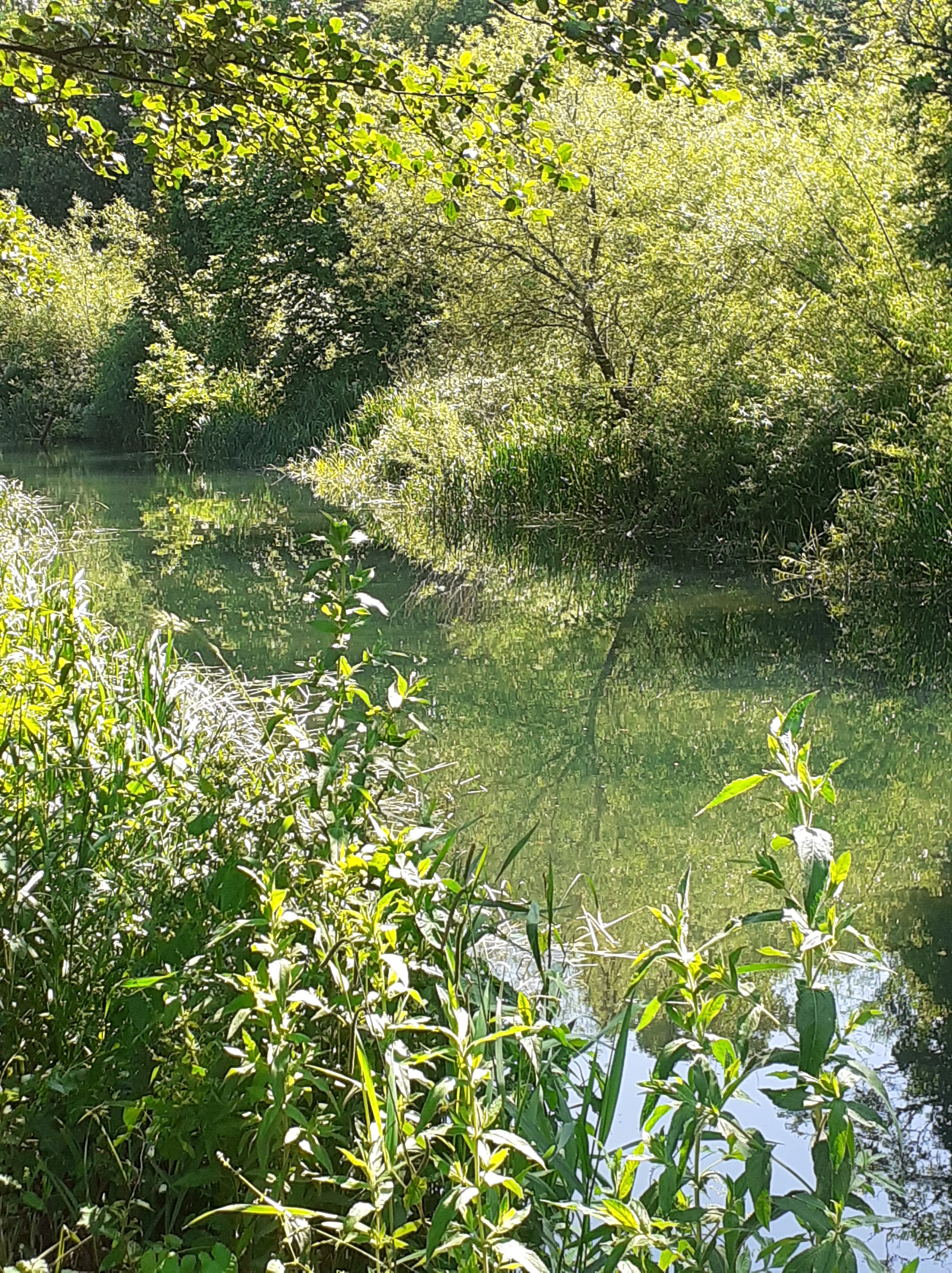
The nearby canal looks sleepier than the stream, as if dreaming in the lushness of the moment.
Below, water margin nettles stand out as part of the richness and fecundity of this space, calling for my attention. Clearly capable of being an irritant and seen largely as a nuisance today, the nettle was highly valued by our ancestors for food, fibre and medicine. The Druid Plant Oracle (1) describes it as “a storehouse of goodness” bearing hidden gifts. Nettle tea is widely thought of as health promoting, and modern research confirms that it is rich in antioxidants and vitamins. It is suggested that its polyphenols are helpful in managing chronic illnesses that involve inflammation. I am taking it up as a drink.
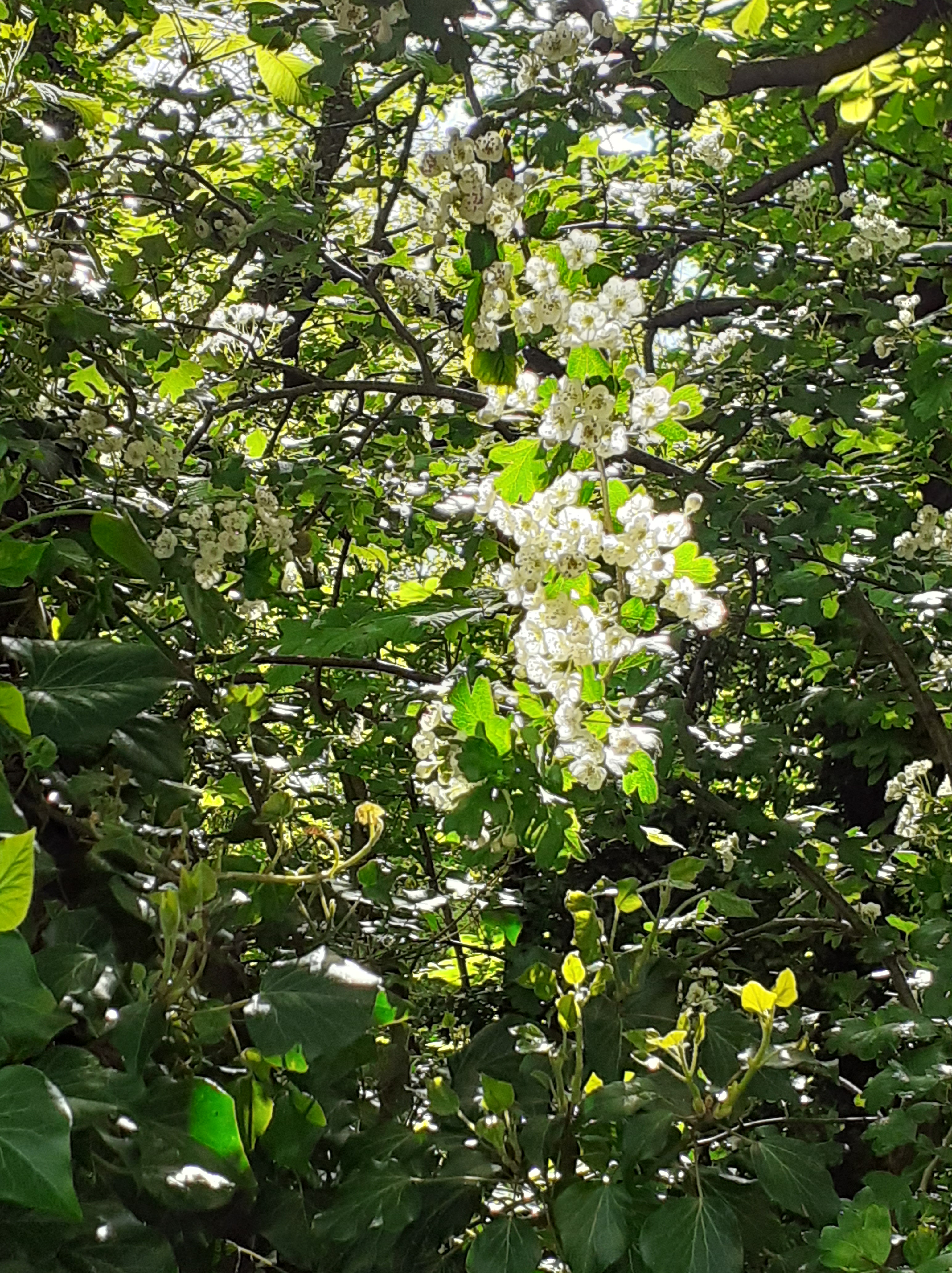
There are other, varied riches beside the path, easy to ignore, but also easy to notice and enjoy for their beauty and vitality alone.
I went for this walk without any intention of taking photographs and I travelled quite a way before I began. I felt as though the landscape was persuading me to record the day, and thus bear witness to the midsummer stasis. Yes, it happened in 2021, as it happens every year. Here is the evidence. I am glad I showed up to be part of it,
(1) Philip and Stephanie Carr-Gomm The Druid Plant Oracle: Working with the Magical Flora of the Druid Tradition London: Connections, 2007 (Illustrated by Will Worthington)
This post is about a midsummer day’s dream in the the Scottish border country, a dream which included a certain kind of waking up. I have written about it before (1,2) but this is the first illustrated version. Fourteen years have passed since that day, which in many ways determined the form which my expression of Druidry would take.
I was near Melrose. The wild rose was one of many on the banks of the Tweed. In this photograph, I am on a riverside path, with my back to the river. I keenly noticed then, as I notice now, the difference between a wild rose and the more familiar cultivated ones. I love both. But I remember feeling a particular delight at the simplicity of the native flower, a sense of easy integration into habitat, and of a plant not committed to being red or white.
Looking more deeply, I have said in my earlier writing how I had a momentary experience in which, gazing at a rose, subject/object distinctions disappeared and it is as if time intersected with eternity. I have identified this with the Seeing experience more systematically explored by Douglas Harding and the community built up around his work (http://www.headless.org). This was the beginning my sense that direct experience of the world, manifesting through a form of nature mysticism, would be my way forward, eventually becoming a contemplative Druidry and the backbone of my contemplative inquiry. I experience this as a direct and simple route to stillness, presence, resting in being., and identifying with source.
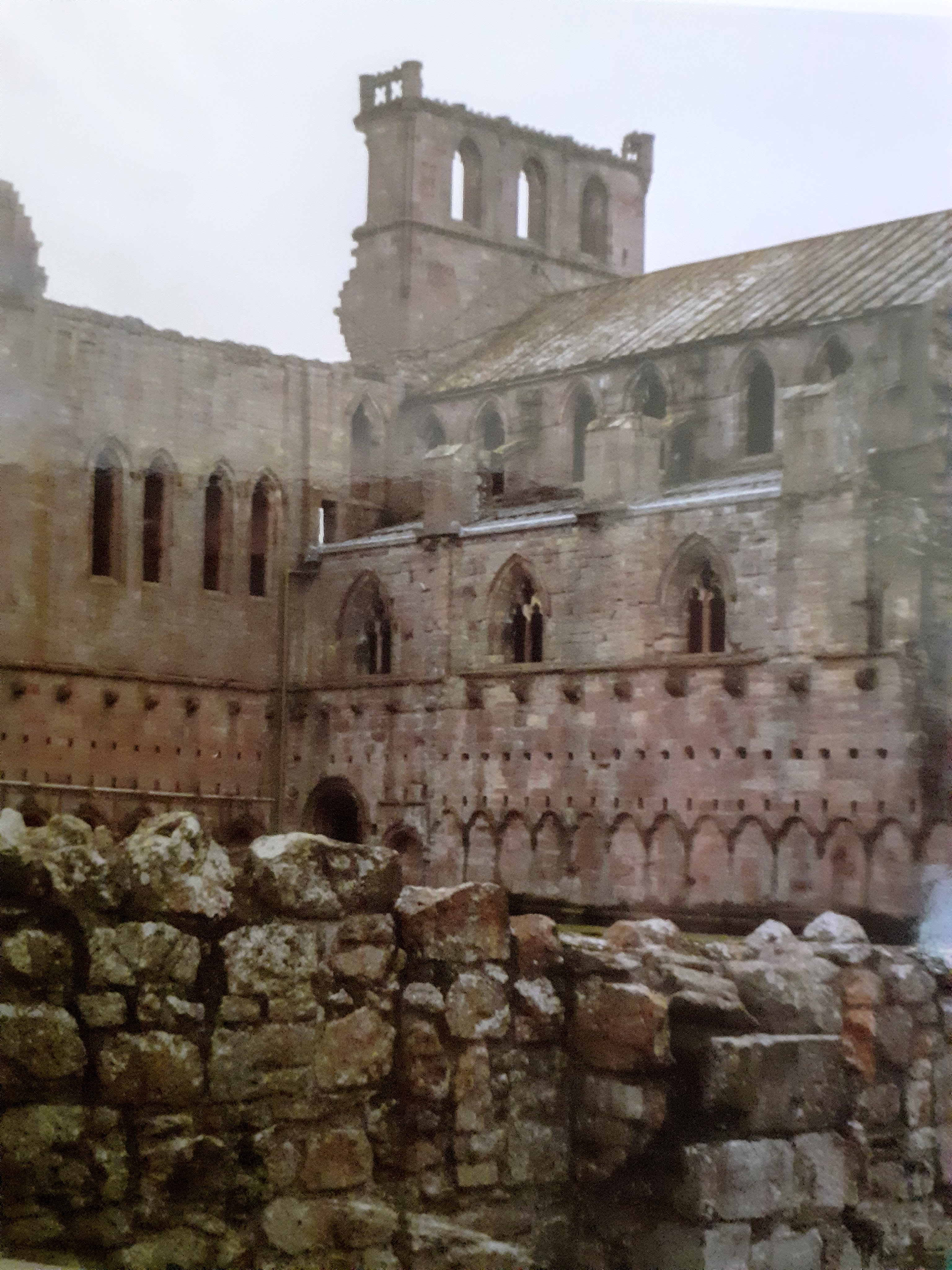
My walk amongst the wild roses had a prequel. Firstly, I had already spent time in the well-preserved ruins of Melrose Abbey. It was a building of Green Man carvings, but, sadly, neither the monks who occupied it nor the iconoclasts who abandoned it had access to the Gospel of Thomas (3) or the words:
“His disciples said to him:
‘When will the dead be at rest?’
‘When will the new world come?’
He answered them:
What you are waiting for has already come,
but you do not see it.” (3)
Here I see the abbey as a solid, material buildings, built with love and care. Even today, it belongs in its landscape, as much as the Tweed or the nearby Eildon Hills, with a semi-wild orchard of apple, pear and cherry trees. What I haven’t written before, in times when I was busy making distinctions between available paths, is that time and eternity intersect in this place too. But, on the day in question, I didn’t have that experience in the abbey grounds. I had it only among the wild roses, down by the river.
The Eildon Hills are also part of the same landscape, indeed a more primal one. But they are fairy hills and they can hide themselves. On that day, they hid from me. There was no invitation – or, rather command – from the Queen of Elfland, who had once ridden out to summon Thomas the Rhymer to her service:
“But you maun go wi’ me now Thomas
True Thomas ye maun go with me
For ye maun serve me seven years
Through weel or wae as may change to be.” (4)
At midsummer in 2007 I was looking for a spiritual home that offered both depth and simplicity. The grim half hidden hills were not appealing to me and I was closed to their magic, with an invitation or without one. I did not want to court danger by ascending into their conceivably treacherous mists. The low road by the river was the one for me.
It was a good decision, and good came of it. But I do also understand that on a different day, those hills could be seen in a different light. I do not now feel constrained to make a neat choice between a broad road, a narrow road and a bonny road. Two cycles of seven years on, well rooted in a nourishing life and practice, I find myself in a more open space, wondering what lessons this Otherworld might yet offer.
(3) The Gospel of Thomas: the Gnostic Wisdom of Jesus (Translation from the Coptic, introduction and commentary by Jean-Yves LeLoup. English translation by Joseph Rowe. Foreword by Jacob Needleman) Rochester, VT: Inner Traditions, 2005
(4) R. J. Stewart The Underworld Initiation: A Journey Towards Psychic Transformation Wellingborough: The Aquarian Press, 1985
As its crown forms his mask and its leafage his features;
‘I speak through the oak’, says the Green Man.
‘I speak through the oak says he'” (1)
In my wheel of the year tree mandala (2), oak covers the period from 16 June-8 July and thus includes Alban Hefin, the summer solstice. I am starting to bring it in. The oak has many associations – regal strength, for example – but for me the sense of the green man, the archetype of our oneness with the earth, speaking through the oak, is the most numinous. At Dodona in ancient Greece (3) an oak shrine was “guarded by priestesses who interpreted the future from the rustling of leaves on the great tree, the voice of the sacred spring that rose at its root and the behaviour of birds in its branches”. Celtic tradition describes a number of sacred oak trees, themselves roosting places for sacred birds. I like the sense that the oak does not stand alone and autonomous in these stories. For leaves to rustle, the wind is needed. Birds and springs may also participate in the ecology, of a distributed wisdom – a wisdom of interdependence, of interbeing. The oak’s great branches are matched by still greater roots, and therefore an underground network of communication and exchange that we now know sustains a mature forest (4).
The ogham name for oak, duir, means door in both Sanskrit and Gaelic (5). This can bespeak solidity and protection, for the oak can survive lightning. It was sacred to Taranis, the Celtic god of lightning and storms, to Thor in the Nordic pantheon. and to Zeus among the Greeks. But a door isn’t just defensive. It is there to be opened as well, with a sense of welcome and relationship. Dagda, father god of Ireland, was associated with the oak and never failed to give hospitality to those who asked for it.
For Druids (whose name means ‘oak wisdom’) oak was the central tree in their mysteries. There is a theme, in these mysteries, of communication between worlds, with a sensed Otherworld being less than a heart beat away. The power of the oak combines strength and sensitivity. My mandala links oak to the period in which the light has its greatest expression, and then gives way, at first very slowly, to its necessary descent into the dark. The tree bears witness as the wheel continues to turn.
(1) William Anderson Green Man: Archetype of Our Oneness with the Earth Harper Collins: London & San Francisco, 1990.
(2) This mandala is based on my personal experience of trees in the neighbourhood as well as traditional lore. Moving around the summer quarter from Beltane, 1 May, the positions and dates of the four trees are: Hawthorn, south-east, 1-23 May; Beech & Bluebell, south-south-east, 24 May – 15 June; Oak, south, 16 June – 8 July; Gorse, south-south-west, 9 – 31 July. The autumn quarter then starts with Apple at Lughnasadh/Lammas. For a complete list of the sixteen trees, see https://contemplativeinquiry.blog/2020/autumn-equinox-2020-hazel-salmon-awen/
(3) John Matthews & Will Worthington The Green Man Tree Oracle London: Connections, 2003.
Highly recommended. Sacred Actions* is an excellent resource for developing sacred relationship with the earth in dedicated spiritual practice and acts of daily life. Pennsylvania-based author Dana O’Driscoll is steeped in Druidry and the U.S. homesteading movement. She is Grand Archdruid of the Ancient Order of Druids in America (AODA), and an OBOD Druid. She is a Mount Haemus scholar, lecturing on Channeling the Awen Within in 2018. In a recent blog post in Druid’s Garden (https://druidgarden.wordpress.com) she describes Sacred Actions as presenting “a hybridization of nature spirituality, sustainability and permaculture practice”.
The book is built around the wheel of the year and its eight festivals. O’Driscoll begins with the Winter Solstice, where her theme is the ethics of care applied at both the private and public levels. New life practices are supported by specific exercises and rituals. She continues the same approach with the other festivals: Imbolc – “wisdom through oak knowledge and re-skilling”; Spring Equinox – “spring cleaning and disposing of the disposable mindset”; Beltane – “sacred action in our homes”; Summer Solstice – “food and nourishment”; Lughnasadh – “landscapes, gardens and lawn liberation”; Fall Equinox = “earth ambassadorship, community and broader work in the world”; Samhain – “sustainable ritual tools, items and objects”.
To prospective readers I suggest an initial reading, followed by more intensive engagement with the individual chapters, season by season. Use this text to identify what inspires and moves you and has the power to bring a richer sense of ‘sacred actions’ into your own life. Sacred Actions is a powerful source of ecological and ethical inspiration, and a fine addition to Druid literature.
* Dana O’Driscoll Sacred Actions: Living the Wheel of the Year through Earth-Centered Sustainable Practices Altglen, PA: Red Feather, 2021
My Druidry is an earth pathway and a nature mysticism – and it is more than that. It is concerned with recognising, and living from, a divine identity in a divine world. I practice a panentheist, non-dual, Druidry. But few of the mystical traditions known to history have fully held the two aspects together as one. Kashmir Shaivism, a form of traditional Indian Tantra, is an exception. Sally Kempton (1) explains.
“Rejecting the Vedantic view that the material world is illusory, an empty dream, the sages of Kashmir Shaivism saw all forms of the universe as manifestations of divine creative energy, of Shakti, the dynamic female principle. They worshipped Shakti in themselves, in the earth, and in every substantial and insubstantial thing, and they looked for the pulsing heart of divine bliss within all domains of experience. Astute seekers of the tradition knew innumerable pathways for uncovering the experience of the divine. They knew how to extract it from states like terror or pleasure or in the high point of a sneeze; the knew how to find the pulsation of ecstasy in empty space, in fixed attention, and in the sensations that come from swaying or twirling, or enjoying music or the taste of food.
“But the crucial insight of Shaivism is the recognition that when human consciousness lets go of its identification with the body and reflects back on itself, it is revealed as a perfect, if limited, form of the supreme ‘I’, which is God. By expanding their own I-consciousness beyond its limits, past its tendency to cling to narrow definitions of itself, yogis of the Shaivite path experienced God as themselves.
“Because they saw the world as divine, the Shaivite yogis of Kashmir had no difficulty enjoying life in all its different flavors. In this they differed from their Vedantic cousins and from the Madhyamika Buddhists who inhabited the same region of India. Shaivism was not a traditional renunciate’s path. Abhinavagupta (975-1025 CE), the preeminent genius of the tradition, was not only a philosopher and a widely revered guru but also an aesthetician, and artist and musician, and the center of a circle where sensory experience – including art, music and drama – was constantly being transmuted into yoga.
“It is this insight – that a serious practitioner of yoga does not reject their world, but instead transforms daily experience through their practice – that sets Kashmir Shaivism apart from many Indian yogic traditions, and has made this system particularly resonant for our time.”
(1) Sally Kempton Meditation for the Love of It: Enjoying Your Own Deepest Experience Boulder, CO: Sounds True, 2011
“Whenever there is beauty, kindness, the recognition of the goodness of simple things in your life, look for the background to that experience within yourself. But don’t look for it as if you were looking for something. You cannot pin it down and say, ‘Now I have it, or grasp it mentally and define it in some way. It is like the cloudless sky. It has no form. It is space; it is stillness, the sweetness of Being and infinitely more than these words, which are only pointers. When you are able to sense it directly within yourself, it deepens. So when you appreciate something simple – a sound, a sight, a touch – when you see beauty, when you feel living kindness toward another, sense the inner spaciousness that is the source and background to that experience.”
Eckhart Tolle Oneness with All Life: Awaken to a Life of Purpose and Presence Penguin Random House UK, 2018 (First ed. published 2008)
Within my mandala of the year (1) Ash and Ivy together are part of a playful period extending to midsummer. The picture above holds memories of the year 2007, when the original photograph was taken in a wood near Bristol. It has recently been digitised and stylised by Elaine Knight, a frequent companion in my adventures with trees during that year.
I was enthusiastically connecting with them at the time, spurred on by an OBOD course (see http://www.druidry.org). My main focus was on being present in the presence of the living trees and connecting with them. I had a secondary concern with information about them. This includes traditional lore now often linked to the ogham alphabet. In that alphabet, ivy is gort and ash is nuin.
In my personal mandala of the year, ash and ivy preside from 23 February to 16 March. Ivy, as ever, is luxurious and abundant. Ash, at this time, is mostly tall and sleepy. I have a strong memory of finding them together as I walked up a tangled, sloping path. I felt an immediate connection with them, which I recorded at the time, though I hardly needed to. The occasion has stayed vividly in my mind ever since. Indeed the wish to celebrate that memory prompted me to include them in my tree mandala when it developed a year or so later.
In ogham lore, ash is connected with themes of rootedness and endurance (2). An ash can bear weight and absorb shocks. It has been the second most popular tree, after hawthorn, for planting at holy wells. It has also been a popular choice for maypoles. In the northern, Viking, tradition, it is Yggdrasil, world tree and wisdom steed of Odin. It links underworld, earth and heaven. It links macrocosm to microcosm, and the inner and outer worlds.
Ivy embodies the strength that can come from seeking support, whilst also being associated with poetry and intoxication. Its spiralling, labyrinthine dance turns both inwards and outwards. Ivy is a tenacious plant, skilled in binding and attachment. It is said also to connect us with our own inner resources, giving us “the ability to see through the eyes of the soul beyond the material world” (3).
I am fascinated by the way in which we can read the characteristics of our own hearts and imaginations into the life of trees whilst also connecting with their independent existence and what it can teach us about, for example, interdependence, a slower rhythm of life or the simple miracle of being. When among trees, I am taken up with the life of the tree on its own terms, more than with either botanical knowledge or inherited mythologies pointing to a larger life. It is when I am away from them that I turn fruitfully to their role in the collective imagination. There are different kinds of attention in play here, and I find that it helps to be aware of the difference without doing too far in disentanglement.
(1) This mandala is based on my personal experience of trees in the neighbourhood as well as traditional lore. Moving around the spring quarter from 1 February, the positions and dates of the four trees are: Birch, north-east, 1-22 February; Ash & Ivy, east-north-east, 23 February – 16 March; Willow, east, 17 March – 7 April; Blackthorn, east-south-east, 8 – 30 April. The summer quarter then starts with Hawthorn at Beltane. For a complete list of the sixteen trees, see https://contemplativeinquiry.blog/2020/autumn-equinox-2020-hazel-salmon-awen/
(2) The image is from: John Matthews & Will Worthington The Green Man Oracle London: Connections, 2003.
(3) Liz and Colin Murray The Celtic Tree Oracle: A System of Divination London: Eddison-Sadd, 1988 (Illustrated by Vanessa Card)
Within my mandala of the year (1) Birch – Beith in the Irish ogham alphabet (2) – is the first tree for the spring quarter beginning at Imbolc. The overall theme of this quarter, in my world, is one of early growth. Birch presides from 1-22 February and will become one of the first trees to flower in spring, from March onwards. It is also one of the first trees to colonise new ground.
In ogham lore Birch is understood to support new beginnings and to encourage careful preparation, a skilful laying of the ground on which we will build. “In making your spiritual journey with this tree as your guide, remember to concentrate your mind on the uplifting slender whiteness of the tree, a whiteness that stands out clearly from the tangled undergrowth and confusion of shrubs and thorny bushes that cover the floor and, hence, may inhibit an easy journey” (3). The Green Man’s wisdom (1) is that a good beginning leads to a good conclusion.
In runic tradition (4), where Birch (Beorc, Berkana) is also linked to new beginnings, there is specific reference to the young Goddess, sexuality and birth, as well as beauty and creativity more generally. Birch may signal a laying aside of old patterns, whether merely redundant or positively toxic, and a willingness to welcome new, more energising and nourishing ways of being.
For me, this is a welcome shift from the necessary defensiveness and protectiveness of alder. This year, it comes just at the moment where such a shift is possible – as my wife Elaine continues her recovery from major illness and we begin to dream and think our way forward, into a new cycle of life. The wheel turns, and there is a promise of positive change in the air.
(1) The image is from: John Matthews & Will Worthington The Green Man Oracle London: Connections, 2003.
(2) This mandala is based on my personal experience of trees in the neighbourhood as well as traditional lore. Moving around the spring quarter from 1 February, the positions and dates of the four trees are: Birch, north-east, 1-22 February; Ash & Ivy, east-north-east, 23 February – 16 March; Willow, east, 17 March – 7 April; Blackthorn, east-south-east, 8 – 30 April. The summer quarter then starts with Hawthorn at Beltane. For a complete list of the sixteen trees, see https://contemplativeinquiry.blog/2020/autumn-equinox-2020-hazel-salmon-awen/
(3) Liz and Colin Murray The Celtic Tree Oracle: A System of Divination London: Eddison-Sadd, 1988 (Illustrated by Vanessa Card)
(4) Sweyn Plowright The Rune Primer: a Down to Earth Guide to the Runes Rune-Net, 2006
Ten suggestions for navigating turbulent times: I am interested in the following list by Carolyn Baker and Andrew Harvey (1). They are not from my tradition, but I find their thoughts relevant and challenging. They prompt me to wonder what my list would be. Their book, which I will review in a later post, was published in the USA in 2020, a little before the November elections.
“1. Stay Safe: wear masks when you are outside, continue social distancing as much as possible, and listen carefully to the scientists who are telling us we are in the middle of a second wave of the pandemic. Shun all large gatherings and rallies and find other ways to protest which can be just as effective.
“2. Take special care of your health and keep your body vibrant with exercise and good nutrition. The psychological and emotional demands of unfolding crises will be far more effectively sustained with a healthy body.
“3. Whatever your spiritual practice, plunge more deeply than ever into it. It is essential to pursue realization of your true Self with more faith and intensity in these exploding times than ever before.
“4. Fill your life with inspiration and beauty. Inspiration will keep your heart buoyant and alive, and beauty will remind you of the magnificence of life and fill you with the energy to want to safeguard it.
“5. If you can, spend 20 minutes in nature per day, experiencing your oneness with it and drinking in through every pore its steadiness and radiance. Allow yourself to become intimate with the Earth.
“6. Stay aware of how the pandemic and environmental crises are evolving. There is no security in denial or ignorance. Learn, however, to pace yourself because the ferocious information you will be taking in can become overwhelming.
“7. Take time to grieve. No one will escape heartbreak in a time such as this, and not attending to the suffering of the heart that inevitably rises in the face of so much destruction will lead to severe depression or a kind of inner deadness that makes it impossible to respond creatively. Get support from others who are also grieving alone, and there is no need to be alone in a crisis that is now global.
“8. Renew old friendships and relish and deepen the ones you have you have because everything now depends on the sanity and joy that only deep friendship and relationship can provide, Take special care and lavish special love on your animal companions, and they will reward you with their tender and miraculous love.
“9. Despite being mostly in lockdown, make an effort to practice Sacred Activism by giving wisely to those in need. Foodbanks need support as do healthcare workers and the homeless who are afraid of going to shelters because they are Petri dishes for the virus. If you are able to assist those in prison by standing up for their rights, or by encouraging them in any way, do so. Take seriously your right to vote, for everything depends throughout the world on turning back the tide of dark money-financed authoritarianism.
“10. Use this book as a way of training your inner eyes to see and celebrate the signs of the Birth of a new humanity that are rising everywhere amidst the obviously apocalyptic death. Note the heroism of extraordinary/ordinary people globally who are turning up to serve the sick and dying. Note the heroism of protestors after the horrific death of George Floyd. Read great evolutionary philosophers and mystics like Sri Aurobindo, Teilhard de Chardin, Bede Griffiths, Satprem, Teresa of Avila, Hildegard of Bingen, and Julian of Norwich, and those who speak of the global dark night, giving birth potentially to an embodied divine humanity.”
(1) Carolyn Baker & Andrew Harvey Radical Regeneration: Birthing the New Human in the Age of Extinction Bloomington, IN: iUniverse, 2020








 Contemplative Inquiry