Contemplative Inquiry

This blog is about contemplative inquiry

Tag: Druidry

CONTEMPLATIVE TASTER AS PROMISED

In my last post I promised to share my Rainbow Druid Camp 2105 taster session. Its aim was to interweave elements of mindfulness, extended sensory perception and celebration, and also to show how silent meditation and group sharing can act together to raise contemplative awareness.

This session was tightly timed to fit with its placement in a larger event – the timing was handled through the use of bells. In a different environment this practice could be run more spaciously, with longer periods devoted to each section of the meditation and space for writing and drawing or indeed simple time out between the sections. It’s a highly malleable programme.


START Welcomes and check-in round of names, including why we are here, how we feel right now, and any expectations we have.

Overview. The purpose of the session is to introduce Contemplative Druid Events and to share some of its working methods. This session aims to interweave aspects of mindfulness, extended sensory perception and celebration.

Entry into sacred space through lean ritual Facilitator leads, saying “we are here today in the strength of heaven, light of sun, radiance of moon, splendour of fire, speed of lightning, swiftness of wind, depth of sea, stability of earth and firmness of rock.   May there be peace in the 7 directions – east, west, north, south, below, above, within; may the spirits of place flourish here; may we be present in this space”.

Meditation in 5 three minute stages:

  • Becoming aware of our body and senses, scanning and finding something specific we appreciate or through which we feel blest
  • Becoming aware of our feelings, thoughts and images, scanning and finding something specific we appreciate or through which we feel blest
  • Becoming aware of the space around us, including each other, scanning and finding something specific we appreciate or through which we feel blest
  • Becoming aware of any other levels of presence or being, scanning and finding something specific we appreciate or through which we feel blest; alternatively extending and intensifying the previous section if nothing specific to this section emerges
  • Resting in awareness of everything that has come up in this meditation so far.


Sharing of experience – In groups of three, each person speaks in turn for three minutes each, with aware, supportive listening in silence, without dialogue or interaction. When everyone has had their turn, there is an opportunity for six minutes conversation in the group. On return to the main group, each person briefly reports back to the whole group.

Exit from sacred space through lean ritual. The facilitator says: “May the 7 directions be thanked for their blessings. May the spirits of place flourish here.  May this work inspire our lives.  We stand today in the strength of heaven, light of sun, radiance of moon, splendour of fire, speed of lightning, swiftness of wind, depth of sea, stability of earth and firmness of rock.”

Any questions? Anything left unsaid? END
RAINBOW DRUID CAMP REFLECTIONS

It’s just under a week since the end of Druid Camp 2015. Time enough to have some perspective. As an event it’s clearly been very successful. It has an experienced leadership which knows how to balance continuity and innovation. The organisation reflects both practicality and care.

Nonetheless I went to the camp with reservations about my proposed role in it. Last year I attended out of a simple desire to try something new. This year I was conscious that the Camp was playing with an element of the ‘contemplative’ practice which I and others have been championing in recent years. For me there was a possible point of tension between the celebratory and releasing flavour of a Lammas camp and the quieter and more inward direction of contemplative practice as usually understood. I felt that I was holding that tension within my own body and energy system and as it turned out this did have a cramping effect on my experience of the Camp.

Of course that’s not the whole story. The Rainbow Druid Camp does have room for a range of micro-cultures within the larger community and, at the Camp, I experienced the management and use of spaces as very enabling. I ran an early session in the space reserved for the contemplative thread.  It was very congenial. An ideal number of people showed up. The session itself was pitched as a warm-up to the theme and it was very well received. I attended some of the other sessions in the same space and heard about others – the offerings were of the kind that I would hope for there. One of the guest speakers, Philip Carr-Gomm, had meditation as his topic. This ended with an extended and lively question and answer session which showed that meditation was a live topic for people attending the Camp.

As time progressed, there were other aspects that I personally enjoyed – like the music on both Friday and Saturday evenings. An unplanned performance by Kevan Manwaring and Chantelle Smith based on two Scottish Border ballads led me to go to a workshop with Kevan the following day. I felt a revival of a lost Bardistry and performance potential, a bit damped down by my ‘contemplative’ turn. I don’t know where this is going but paradoxically my greatest personal gift from this year’s camp.

I’ll post up my session in another blog in case other people might want to use or adapt it. Elaine decided not to present Animist Hermetics, feeling that this practice actually does require a more specialist and protected environment. She will be presenting it at our Contemplative Day on 3 October – see http://contemplativedruidevents.tumblr.com/

This year I didn’t come away from the camp with the feeling of euphoria of 2014. But it’s a good result all the same and I am grateful for Rainbow Druid Camp and its role in modern Druidry.

POEM: MAY UPON ICTIS

Far out at sea beneath rich Tyrian sails

The merchants watch a ghostly mountain spread

Terrific dawn-wings fired with cloudy red,

And cease their barter over purple bales;

Wild headland flames to headland; in the dales

Hushed warriors wait, for now torqued chief may tread

That dim white forest where the vanished dead

Gather like birds before the spume-drenched birds.

Around the mount barbaric trumpets cry;

Then Ictis thunders through her altar-stone

Long-cloven by a god’s mysterious rune;

And pinnacle between the earth and sky

Her savage prophet stands, majestic, lone,

Helmed with the sun and girdled with the moon.

May upon Ictis is one of Six Celtic Sonnets written by Thomas Samuel Jones and included in From the Isles of Dream: Visionary Stories and Poems of the Celtic Renaissance, selected by John Matthews and with a foreword by Robin Williamson (Floris Books, 1993). Ictis, or Iktin, is or was an island described as a tin trading centre in the Bibliotheca Historica of the Sicilian-Greek historian Diodoris Siculus, writing in the first century BC. While Ictis is widely accepted to have been an island somewhere off the southern coast of what is now England, scholars continue to debate its precise location. Candidates include St Michael’s Mount and Looe Island off the coast of Cornwall, the Mount Batten peninsula in Devon, and the Isle of Wight further to the east.

Thomas Samuel Jones (1882-1932) came from Welsh and Irish stock and was born in Oneida County, New York State, near the Adirondack Mountains. Each of the six sonnets reflects a facet of Celtic tradition. They were originally published in 1930 as part of the collection Aknahton and Other Sonnets. For those of us who resonate with Druid and Celtic spirituality, they are part of our modern cultural ancestry.

CONTEMPLATING OUR NEXT ADVENTURE

Druid Camp starts tomorrow. There will be more than 200 people there, perhaps many more since it’s an open event with the option for day tickets. Quite a few people from my local contemplative group will be there.  The site is close to where many of us live, across the River Severn at a point where it is still not quite estuarial. I will be there with my partner Elaine, specifically holding the banner for Contemplative Druid Events (CDE). We have been given the opportunity to offer two sessions, to demonstrate the kind of work we are developing.  Our challenge is to create a contemplative small group atmosphere within a bustling, dynamic environment.

We are going to be focused and experiential. People can fluff around words like ‘contemplative’ and Druidry’ almost endlessly, and ‘Contemplative Druidry’ could have many legitimate iterations. We are there to give a strong taste of ours. Both sessions will be built around specific practices held within a formalised sacred space. We will provide  minimal context, clear practice instructions and leadership in lean ritual. In each session one of us will present the practice, while the other will be in readiness to attend to the process and needs of the group.

I’ll be offering a semi-structured meditation in stages concerned with aspects of the here-and-now, with a maximum of 20 participants. Elaine will be offering Animist Hermetics, a more intense process, with a maximum of 12. We will offer the practices in an experimental way, and participants will have opportunities to talk about their experiences in a mix of smaller groups and the large one.  By the end of these sessions the participants should have a pretty good idea of what these practices have to offer and how we come to be presenting them as ‘Contemplative Druidry’. We are both looking forward to this opportunity to present our work.

POEM: A DRUID TOWN

A sunless maze of tangled lanes enfold

The magic dwellings of the forest race,

Whose hidden shapes are flames that leave no trace

At mid-moon when the Druid’s dream is told;

The shadows of enchanted orchards hold

Red thatch of wings and woad-stained doors that face

The wandering stars, and guard the sacred place

Where faery women thread their warps with gold

The dragon knight shall lose his strength of hand

Nor ever raise his long leaf-shapen shield,

If he but follow where the white deer roam;

And never will the mariner reach land

When harps ring seaward as the dawn fires yield

The golden caer upon the ninth wave’s foam.

A Druid Town is one of Six Celtic Sonnets written by Thomas Samuel Jones and included in From the Isles of Dream: Visionary Stories and Poems of the Celtic Renaissance, selected by John Matthews and with a foreword by Robin Williamson (Floris Books, 1993).

Thomas Samuel Jones (1882-1932) came from Welsh and Irish stock and was born in Oneida County, New York State, near the Adirondack Mountains. Each of the six sonnets reflects a facet of Celtic tradition. They were originally published in 1930 as part of the collection Aknahton and Other Sonnets. For those of us who resonate with Druid and Celtic spirituality, they are part of our modern cultural ancestry.

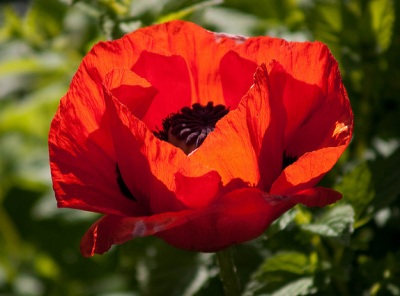
POPPY

red poppy MIA_400x296“We call the poppy ‘vanity’ and we write it down as a weed. It is humiliating to think that, when we are taking ourselves seriously, we are considering our own self-preservation, or the greater scheme for the preservation of mankind. What is it that really matters? For the poppy, that the poppy disclose its red … Seed and fruit and produce, these are only a minor aim: children and good works are a minor aim. Work, in its ordinary meaning, and all effort for the public good, these are the labour of self-preservation, they are only means to an end. The final aim is the flower, the fluttering, singing nucleus which is a bird in spring, the magical spurt of being which is a hare all explosive with fullness of self, in the moonlight; the real passage of a man down the road, no sham, no shadow, no counterfeit, whose eyes shine blue with his own reality, as he moves amongst things free as they are, a being; the flitting under the lamp of a woman incontrovertible, distinct from everything and everybody, as one who is herself, of whom Christ said, ‘to them that have shall be given’.

“The final aim of every living thing, creature, or being is the full achievement of itself. This accomplished, it will produce what it will produce, it will bear the fruit of its nature. Not the fruit however, but the flower is the culmination and climax, the degree to be striven for. Not the work I shall produce, but the real Me I shall achieve, that is the consideration; of the complete Me will come the fruit of me, the work, the children.

“And I know that the common wild poppy has achieved so far its complete poppy-self, unquestionable. It has uncovered its red. Its light, its self, has risen and shone out, has run on the winds for a moment. It is splendid. The world is a world because of the poppy’s red. Otherwise it would be a lump of clay.”

D. H. Lawrence A Study of Thomas Hardy in D. H. Lawrence Complete Works Delphi Classics on Kindle

When reviewing Nature Mystics – https://contemplativeinquiry.wordpress.com/2015/7/6/  – I mentioned D.H. Lawrence and Thomas Hardy as two of the named writers who had become part of my life during my teens. I also wondered how far such free spirited people can be enrolled as ‘properly’ proto-Pagan as suggested by the author. This passage is certainly very Laurentian. In modern terms, it seems to connect with the current conversation about ‘wildness’ rather than religious Paganism or nature mysticism, though of course these are all interconnected. I have certainly enjoyed revisiting Lawrence’s words after a long absence.  They were written early in 1915, with the red poppy simply representing abundant life, and so before its memorialising significance became marked. Lawrence was just under 30 at the time of writing, with  just 15 years left to him.

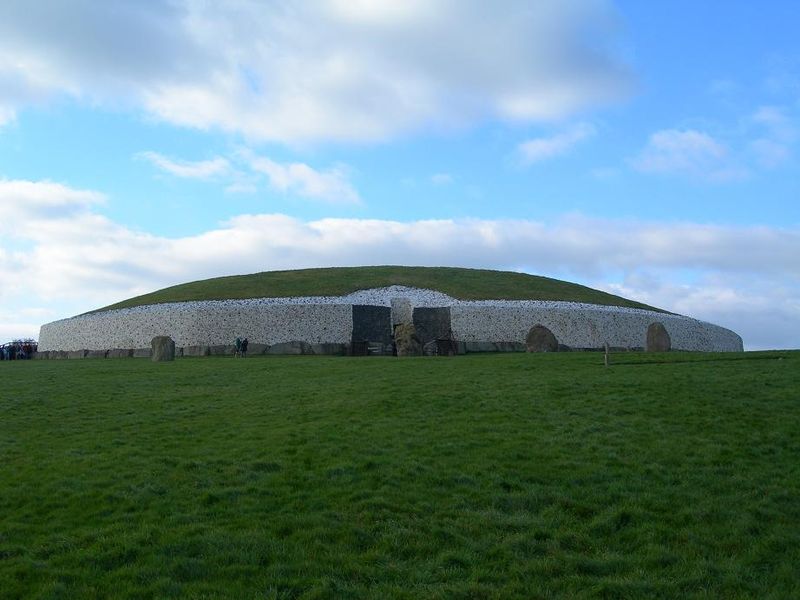
POEM: NEW GRANGE

800px-Newgrange

Picture cc by 2.5 pl – originally uploaded by Shira-commonswiki

The golden hill where long-forgotten kings

Keep lonely watch upon their feasting-floor

Is silent now, – the Dagda’s harp no more

Makes sun and moon move to its murmurous strings;

And never in the leafy star-led Springs

Will Caer and Angus haunt the river shore,

For deep beneath an ogham-carven door

Dust dulls the dew-white wonder of their wings.

Yet one may linger loving the lost dream –

The magic of the heart that cannot die;

Although the Rood destroy the quicken-rods;

To him through earth and air and hollow stream

Wild music whines, as two swans wheeling cry

Above the cromlech of the vanished gods.

New Grange is one of Six Celtic Sonnets written by Thomas Samuel Jones and included in From the Isles of Dream: Visionary Stories and Poems of the Celtic Renaissance, selected by John Matthews and with a foreword by Robin Williamson (Floris Books, 1993).

Thomas Samuel Jones (1882-1932) came from Welsh and Irish stock and was born in Oneida County, New York State, near the Adirondack Mountains. Each of the six sonnets reflects a facet of Celtic tradition. They were originally published in 1930 as part of the collection Aknahton and Other Sonnets. For those of us who resonate with Druid and Celtic spirituality, they are part of our modern cultural ancestry.

BOOK REVIEW: NATURE MYSTICS

jhp54f743a60d1fbHighly recommended. Nature Mystics: the Literary Gateway to Modern Paganism is a new and refreshing departure in Moon Books’ Pagan Portals series. It introduces readers to some of the literature that many modern Pagans perceive to have influenced the culture of their spiritual family. It will be published at the end of this month (31 July 2015) and author Rebecca Beattie dedicates it “to all those Nature Mystics who have come before and continue to inspire us to a spiritual path with their words”.

Selection has clearly been an issue and the author has both used her own judgement and consulted with associates in a ‘Nature Mystic’ blog. Her centre of gravity is England in the closing decades of the nineteenth century and, more particularly, the opening decades of the twentieth. She has chosen five women and five men to represent a place, a time, and a suggested sensibility. There are outliers – John Keats from an earlier time and W. B. Yeats from Ireland – but Beattie shows in her introduction how they fit within the selection. The full list is: John Keats, Mary Webb, Thomas Hardy, Sylvia Townsend Warner, D. H. Lawrence, Elizabeth von Arnim, W. B. Yeats, Mary Butts, J. R. R. Tolkien and E. Nesbit. Each author has a dedicated chapter describing their life, work and cultural setting; exploring specific works in some depth; and discussing both their declared or implied spirituality and ways in which it may inspire modern Pagans. Each is given a remarkably thorough treatment for an introductory book that addresses a larger theme.

I grew up with some of these writers and went on to study English literature for my first degree in the final years of the 1960s. It’s been interesting for me to check back on the writers I knew and those I didn’t, at that time, as a way of checking out how the world has moved on. Four of the men – Keats, Hardy, Lawrence and Yeats – were an important part of my life; Tolkien not so much, though I had read both The Hobbit and Lord of the Rings. E. Nesbit I knew as author of The Railway Children and connected with the Fabian Society, the intellectual voice of respectable British Socialism at the time. Thanks to Nature Mystics, I’ve enjoyed being introduced to her The Accidental Magic: or Don’t Tell All You know and The Story of the Amulet, works for children penned by the Nesbit who was involved, as I knew that Yeats was, with the Hermetic Order of the Golden Dawn. I discovered Mary Webb later, when I went to live in Shropshire where she was remembered. By then I was able to read Precious Bane and Gone to Earth in Virago editions and I later found Sylvia Townsend Warner and Lolly Willows in the same way. I still see these powerful and highly relevant books through a sort of feminist ally lens, as primarily about free-spirited women in outsider positions navigating gender and sexuality in a largely hostile and uncomprehending world, and looking for oases of safety and possible flourishing. Beattie’s book adds to the picture by spelling out Pagan tinged nature mysticism as a spirituality that is congruent with this quest, and also informed by it. I have still not read anything by Elizabeth von Arnim or Mary Butts, and before getting my review copy of this book, knew of them only through their links with other people. Now I’m encouraged to look at their work.

I’ve been delighted to read a work that offers new information and a new lens. The writers concerned are a diverse and free-spirited group. I’m not entirely convinced that they either could or should be enrolled in a league of “properly proto-Pagan” Nature Mystics. It is my belief that most of them would resist the identification. Beattie herself says that Tolkien was dismayed by some of the responses to his work in his own life-time. At the same time I do see a common tendency, in this group, to find the numinous in natural settings and the spirit of place, “that sense of bliss and divine communion that is gained from time spent absorbed in the natural world” as Beattie puts it. I’m sure, too, that there will be a ready assent among many readers to the suggestion that “where Woolf said every woman needed a room of her own, von Arnim would have said every woman needed a garden”.

I will leave the last word to Thomas Hardy, in a brief passage from Tess of the D’Urbervilles, quoted in Nature Mystics. It is about Tess herself, and evokes a moment when a sensitive human consciousness is more fully awakened by a moment in the cycle of the day: “She knew how to hit to a hair’s breadth that moment of evening when the light and darkness are so evenly balanced that the constraint of day and the suspense of night neutralise each other, leaving absolute mental liberty”.

DRUID CAMP, STROUD CONTEMPLATIVE DAY, SMALL GROUPS

I’ve just had a couple of lazy summer days and I feel all the better for them. They’ve been interwoven with a relaxed stocktaking about contemplative Druidry and my part in it. I notice that my main focus is on small groups.

As I write, I’m at peace with my personal life and practice. At the collective level, I’ve had recent good news. My friend and colleague JJ Howell has let me know the specific roles that my partner Elaine Knight and I will be playing at Druid Camp in four weeks’ time. Druid Camp – www.druidcamp.org.uk  – is a large group (200-300 people), but we’ll be working with small groups, offering contemplative sessions from the repertoire built up by our local group over the last year. Meanwhile I also know that an open contemplative day in Stroud, organised by our own outreach arm Contemplative Druid Events –   http://contemplativedruidevents.tumblr.com  – is now viable and will go ahead on 3 October. We have seven people fully booked and three more with strong expressions of interest, with 15 being our max.

The overall position is that we have a flourishing local group, now three years old; a book largely though not exclusively based on the thoughts of its members; and an outreach arm able to offer an annual residential retreat (The Birchwood Retreat) every April and an open contemplative day in October 2015, which might become annual too. In all cases the events concerned will have no more than 15 participants. We could do a little bit more – providing small group sessions at other larger events, or offering more contemplative days either locally or elsewhere. But my sense is that we need to respect limitations in our capacity, stick to the small group approach, and make sure that all our work is experiential and not simply discursive. People need to taste it.

For me perhaps the greatest value of the small group is the opportunity for all participants to introduce ourselves and be heard. For that to work fully, we need a quality of listening which itself becomes a practice and part of our culture, and whose intention is to ensure that no one is either misrecognised or ignored. This in itself is counter to mainstream communication, including ours, and needs conscious practice. It will include mis-steps from time to time within our own groups. So it’s not about ‘getting it right’ all the time: the point is to be conscious. In a contemplative context, we can hope to go further: establishing a level of trust that opens the door to deeper I-Thou recognition and communion. It’s a different opportunity to those provided when large numbers of people become immersed together in prayer, song, ritual or formal meditation. It’s more personal, in the best sense of that term. I find it both more challenging and rewarding, whilst believing that all of these approaches have their honoured place.

Small groups have other advantages too. It is easier to be flexible on programming within the event. It is easier to offer activities which demand time for reflection and debriefing. It is easier to become aware of other people as spiritual companions, even if we have not met them before or do not know them well. I think, too, that it’s easier to learn, not least when in a facilitative role, because the style of the event can be person centred rather than goal centred. Activities are designed to support us in our human, and therefore spiritual, flourishing. They are not Everests to be climbed so we can say that we ‘knocked the bastard off’.

I think this is why we have not oriented our contemplative Druidry around long meditations or meditation training. It was one way to go, and in some ways the obvious one. It would certainly be the most traditional one and my solo practice is very much tilted that way. But the group context changes things. Pragmatically, our local group is about evenly divided between people who gain from long meditations and those who don’t. We would lose people by taking this approach. More importantly, the group is co-creating a culture in which the blessing of space and silence is received differently – through short meditations, attunement to the seasonal moment, silent walks, or activities like ‘Awen space’ in which we sit with each other, open to spirit, and can speak, chant or sing into the silence when so moved. We can also explore co-creation from silence into sound and story, or find different ways of awakening to the fields of energy and presence within us, between us, and around us. It’s a subtle and sensitive kind of work. It needs times of stillness and silence. It also needs times of movement, sound and speech. It needs times of reflection and relaxation.

In my view, we are still at an early stage of this exploration. We have a name – Contemplative Druidry – to hold us. We have literature – Contemplative Druidry and also Nimue Brown’s Druidry and Meditation – to support us. We have a dedicated group and an outreach arm. The small group approach has evolved quite naturally and I see it as a critically important aspect of how we work.

POEM: TALIESIN

An unfamiliar (at least to me) image of Taliesin. One of ‘Six Celtic Sonnets’ by Thomas Samuel Jones, first published in 1930. Taken from the ‘Isles of Dream’, an anthology of work from the ‘Celtic Renaissance ‘.

On lonely shores where dreams are drifted sand

He follows to the end a star’s bright course,

A ghostly hunter without hound or horse,

The warrior-bard, last of the Druid band;

But still his wizard harp rings in his hand

Beside the Stream of Sorrow’s hidden source,

Still from a breaking heart his wild songs force

Their way into the god’s mysterious land.

Dauntless he sings, and sees the drear woods turn

To golden orchards by the river bed

Where healing waters of the rainbow run;

And past the valley near great peaks that burn

With beaconing fire the hero-bard is led

Up toward the Dragon City of the Sun.

Taliesin is one of Six Celtic Sonnets written by Thomas Samuel Jones and included in From the Isles of Dream: Visionary Stories and Poems of the Celtic Renaissance, selected by John Matthews and with a foreword by Robin Williamson (Floris Books, 1993).

Thomas Samuel Jones (1882-1932) came from Welsh and Irish stock and was born in Oneida County, New York State, near the Adirondack Mountains. Each of the six sonnets reflects a facet of Celtic tradition. They were originally published in 1930 as part of the collection Aknahton and Other Sonnets. For those of us who resonate with Druid and Celtic spirituality, they are part of our modern cultural ancestry.

Earth Eclectic

music that celebrates Earth and speaks to the heart

Sarah Fuhro Star-Flower Alchemy

Follow the Moon's Cycle

Muddy Feet

Meeting nature on nature's terms

Rosher.Net

A little bit of Mark Rosher in South Gloucestershire, England

Becoming Part of the Land

A monastic polytheist's and animist’s journal

selkiewife

Selkie Writing…

Charlotte Rodgers

Images and words set against a backdrop of outsider art.

Prof Jem Bendell

living with metacrisis and collapse

Towint

The pagan path. The Old Ways In New Times

The Druids Garden

Spiritual journeys in tending the living earth, permaculture, and nature-inspired arts

The Blog of Baphomet

a magickal dialogue between nature and culture

This Simple Life

The gentle art of living with less

Musings of a Scottish Hearth Druid and Heathen

Thoughts about living, loving and worshiping as an autistic Hearth Druid and Heathen. One woman's journey.

Wheel of the Year Blog

An place to read and share stories about the celtic seasonal festivals

Walking the Druid Path

Just another WordPress.com site

anima monday

Exploring our connection to the wider world

Grounded Space Focusing

Become more grounded and spacious with yourself and others, through your own body’s wisdom

The Earthbound Report

Good lives on our one planet

Hopeless Vendetta

News for the residents of Hopeless, Maine