Contemplative Inquiry

This blog is about contemplative inquiry

Tag: Druidry

SOPHIA THE CATALYST

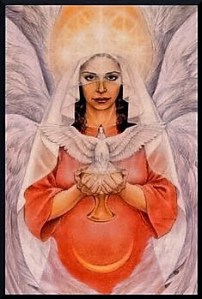
bcf2c26ec7720ed734fccc2b13534310In my universe, Sophia primarily acts as a catalyst for what Cynthia Bourgeault (1) calls ‘singleness’ – the spacious mind of non-dual awareness.  I find that gazing into the eyes of my icon (2), or at the image as a whole, triggers me into the Seeing state that I first fully entered with Headless Way (3) exercises. I make a slight shift into what they call the ‘one eye’ perspective, and there I am.

Of course this isn’t dependent on the icon, but the timeless, momentary, gaze in this instance connects with the imaginal realm where I find feelings and intuition to be most present, with a diminished foregrounding of the sensations and thoughts that predominate in other exercises. The experience is the same, yet the feeling-tone is different.

I am still clear awake space, and capacity for the world. I remain grounded in silent stillness. But the passing content, or form, which the changeless emptiness also is and interweaves, is different. A different constellation of human characteristics is brought into the cosmic play. I value and cherish this. The archaic Gaelic tradition spoke of the Oran Mor (Great Song, or Song of the World). I’ve always thought of a Silence being key, holding the Song, and giving it – in a sense – shape; preventing it from being just noise. Yet the distinctions between individual notes also matter – small and transient though they may be. The Song depends on them, too, for its coherence.

At the human level, I have an abiding sense that my true individual note in the Song is Sophian. I do not experience Sophia as simply an abstract Wisdom figure. Nor am I a conventional believing theist (whether unitarian, trinitarian or polytheist) – yet to a degree I am a Sophian devotee, under the tutelage of a psychopomp.

Overall, I associate the Sophian note with a modern Gnosticism, “based in an affirmation of nature and the world and a positive relation to embodiment, not the classical Gnosticism of world denial and pure transcendentalism. It is a gnosis based on bringing the world fully to life, while also enjoying the state of embodiment and sensual pleasure, without excess or obsessive appetite. This affirmation of the world also requires an affirmation of the World-Soul in all its vast complexity as the primary ground of a living and animate nature. This also includes higher orders of perception and awareness leading to more mystical states of unity and participation in the creative founding of human experience” (4).

Through Seeing, I have learned that the “higher orders of perception” are more accessible than usually suggested, hidden by their obviousness and simplicity, yet entering into empty awareness, recognised as original nature or divine ground. This is why it has become my primary practice. I think there is something of this in earlier Sophian tradition. In the ancient Jewish text The Wisdom of Solomon (5), characteristics of clear and empty awareness are at least intimated, and are linked to Her name.

She is the mobility of all movement;

She is the transparent nothing that pervades all things.

She is the breath of God,

A clear emanation of Divine Glory.

No impurity can stain Her.

She is God’s spotless mirror

Reflecting eternal light

And the image of divine goodness.

Although She is one,

She does all things.

Without leaving Herself

She renews all things.”

Wisdom of Solomon 7: 24-27

Cynthia Bourgeault comments: “This remarkable passage envisions Wisdom as the primordial reflective principle, simultaneously creating and created in a seamless dance of divine becoming. There is a goddess aspect to her portrayal, to be sure – the hint of a divine co-creator – but the important thing to keep in mind is that Sophia/wisdom is presented not as a divinity to be worshipped but as a transformational force to be actualized … Wisdom is about transformation and transformation is about creativity; the three form an unbroken circle.”

Moving forward into the early days of Christianity, Bourgeault says: “The logos (Word) of St. John’s Gospel is merely the grammatically masculine synonym for exactly the same job description as has already been ascribed to Sophia in The Wisdom of Solomon; or, in other words, it is wisdom minus the feminine personification. Functionally, the terms are equivalent, and the gospel text could just as easily have begun, ‘In the beginning was the Wisdom, and the Wisdom was with God, and the Wisdom was God … and the Wisdom became flesh and dwelled among us’. In so doing, it might better have conveyed the context and mystical lineage out of which this insight actually emerges. There is no ‘male’ ordering principle counterbalancing a ‘female’ ordering principle – only grammatically masculine and feminine synonyms for a single ordering principle.”

Sophian teaching stands for the transcendence of polarities, as made clear by the Jesus of the St. Thomas Gospel. “When you are able to make the two become one, the inside like the outside, the higher like the lower, so that a man is no longer male and a woman female, but male and female become a single whole … then you will enter in” (6).

Likewise, the Gospel of St. Philip says: “the embrace of opposites occurs in this world: masculine and feminine, strength and weakness. In the Great Age – the Aion – something similar to what we call embrace occurs as well, but though we use the same name for it, forms of union there transcend what can be described here. For in that place … Reality is One and Whole” (6).

‘This world’ and ‘that world’ are not different places – but the same one seen in different ways. In a similar way, Sophia can be described as “the transparent nothing that pervades all things” and also presented anthropomorphically and mythically, as in my icon. Both understandings have value to me. The world of ‘normal’ perception: embodied, of the earth – albeit ‘re-enchanted’ as we say in Druidry, and the setting for a nature mysticism (7); the world of what S. T. Coleridge called the ‘primary imagination’, and of Sophia as image of the divine (8); and the world of Seeing are the same world seen through three different lenses: all to be savoured, all to be enjoyed, all to be known as One.

(1) Cynthia Bourgeault The meaning of Mary Magdalene: discovering the woman at the heart of Christianity Boston & London: Shambala, 2010

(2) Artist Hrana Janto at http://hranajanto.com/ (This image is used with her permission.)

(3) http://www.headless.org/

(4) Lee Brown Gnostic tarot: mandalas for spiritual transformation York Beach, ME: Samuel Weiser, 1998

(5) Rami Shapiro (translator) in The divine feminine in biblical wisdom literature Woodstock, VT: Skylight Paths, 2005 (The Wisdom of Solomon was originally written in Greek, probably by a Jewish sage writing in Alexandria during the intertestamental era.)

(6) Lynn Bauman, Ward Bauman & Cynthia Bourgeault The luminous gospels Telephone, TX: Praxis Institute Publishing, 2008

(7) http://www.druidry.org/

(8) S. T. Coleridge Biographia Literaria London: Everyman’s Library, 1956 (First published 1817)

GROUNDED

Where do I stand with contemplative Druidry, this Lammas-tide?

My recent Headless Way (1) experience has had the force of a conversion, and I have to re-draw my internal maps.  Interestingly, I now find myself grounded with tendonitis in my left heel. I probably haven’t experienced an actual rupture, and so I am likely to be grounded for “weeks rather than months”. Still, ample space for managing transformation.

One of the things I am doing is to look back at key steps on the way. For instance, in my introduction to Contemplative Druidry (2), I talked of “practices that support a fuller presence within the stream of passing experience … contemplation in its fullest sense enables a transfigured here-and-now, and the dissolving of subject/object distinctions within it”. I mentioned how the contemplation of a wild rose on the banks of the Tweed had triggered such a dissolving, and how this had morphed into a blissful peak experience lasting for some weeks. But I was also clear that such an experience should be framed as an occasional grace, pointing beyond self as commonly understood, and not accessible at will.

This perfectly illustrates why Douglas Harding’s style of Headless Seeing has been a game changer for me. The core experience is readily accessible – i can recognise my true nature, the greater I, at will, through simple Seeing. I am no longer a seeker. In a form of brief contemplative practice,  I see clear awake space and capacity for the world. Since there is no doubt or issue about what I see, the open questions concern capacity for the world. In my human life, in place and time, what capacity do I manifest? Where do I put my energy?

Here I stand, spiritually committed to a contemporary iteration of the Sophia perennis known as the Headless Way.  In terms of ancient wisdom, I’ve understood that there are two continuing lines of tradition that relevantly sustain me. Their pull is largely intuitive and emotional rather than via actual doctrines. One is Christian Gnosticism, theist and often dualist though it may be. The other is the interweaving of Taoist and Chan Buddhist culture in China. There are people and writings in other traditions that I also value, but those are ones I look at with most care.

I do not, now, expect to be in business with any kind of Shamanism, or to have a practitioner relationship with the British/Irish ‘indigenous’ spirituality of any ethnic group or from any pre-Christian period. Of course I continue to be blessed by a level of knowledge and appreciation; they are part of me, in that sense. But that’s as far as it goes. I have let go of my role as a mentor on the OBOD distance learning course (3). I could continue to understand and support people, very congruently, but for me the difference between their practitioner lives and mine has grown too great over the last six months or so. I couldn’t carry on. It didn’t seem right.

On the other hand, what we do in contemplative Druidry is different. Following our learning from Contemplative Druidry our practices support a modern (romantic? post-modern?) ‘nature mysticism’ revolving around forms of lean ritual, group meditation, being/walking in nature and creative arts. I’m entirely up for this, whether it continues under the name of Druidry or not. This is something to work through with my companions in that arena.

The time to leave an activity is when I am no longer learning or contributing. But I want to be accurate in my assessments, and to avoid errors stemming from the force of change, especially letting go of things that I would do better to keep and re-integrate into a new whole.  A time of joy and breakthrough, needing careful navigation.

(1)  Headless Way http://www.headless.org

(2) James Nichol (2014) Contemplative Druidry: people, practice and potential Amazon/KDP (Foreword by Philip Carr-Gomm Deep peace of the quiet Earth: the nature mysticism of Druidry)

(3) Order of Bards, Ovates and Druids (OBOD) http://www.druidry.org/


BOOK REVIEW: SPINNING IN PLACE

4163oG+V32L._AC_US160_Highly recommended: Spinning in Place is a clear and thought-provoking guide to the festival year from the perspective of a humanist/naturalist Pagan. Bart Everson describes it as not so much a ‘how to’ as a ‘why bother’ book, for “no-one can dictate what the festivals mean or how to observe them”.
What he offers is a narrative of how he works the widely adopted eight festival cycle in New Orleans, and “idiosyncratic encouragement” to “spin your own wheel”.  The reader he imagines is “an atheist, or perhaps a pantheist or an agnostic”, someone “without a strong belief in gods or supernatural powers”.  Yet, within this philosophical naturalism, he imagines also an interest in religion and spirituality – perhaps in the form of “being surprised by a sudden awakening” and entering upon “a quest for something more”. For me, it also has a value to anyone with an interest in the Wheel of the Year.

Everson makes two important points about the festivals in general. One is the sense of a holiday as more than a vacation – more than time off for relaxation and recreation, important though these are. A true holiday enshrines values, “reminding us again and again of certain existential truths”. Modern ‘Western’ style societies tend to be “mobile, rootless, divorced from the specific realities of a particular place … it’s my thought that if we spin in one spot for a while, dervish-like, perhaps we’ll corkscrew right down into the Earth and regain our sense of location.”

The second point to remember is that “seasonal variation happens according to its own schedule and not according to any calendar devised by humans.” When festivals become entrenched, “conventions have a tendency to become concretized in our minds, as if they were the primary reality rather than a convenient symbolic expression”. Everson invites an open and fresh approach to ritual celebration. This will of course include the repetition of loved and familiar patterns, but not imprisonment within them.

The book gives a chapter to each season, opening with December: Solstice Connections where the solstice is seen not as a Solar event (nothing happens to the sun) but an Earth-Solar event. Everson’s ritual year is about Earth and its cycles, celebrating an Earth spirituality. January/February: Searching the Depths remind us that there is no Nordic winter in New Orleans, and a Carnival season starting at Twelfth Night, with Mardi Gras any time from 3 February – 9 March. For Everson, it is the time for Candlemas and Brighid crosses. March: Spring in the Subtropics, Spring in the Self – and oak pollen on the porch a sure sign of the equinox. A theme of balance rather than excess: purification understood as “feeling good, staying strong, promoting vitality, improving focus, and nurturing inspiration”. April/May:  May Day x2 The Worker’s holiday matters as much as Beltane to Everson: celebration of revolutionary political desire, the notion of power to the imagination, the spiritual dimension of politics – “the sense of connection to Earth and humanity fuels outrage at manifest injustices”.

To begin the second half of the year we have June: Flowers to Flame, a time of sunshine and superabundance – yet at the same time, acknowledging limits set by nature. Flowers coming to full form, and flowers given over to the bonfire’s flames. Then comes July/August: How Lammas Changed my Life The warmth of the year has continued to increase. Everson remembers his first link to a local Pagan group, a Paganism for kids event to which he took his daughter. Making corn dollies. Still making them, and baking bread together. September: The Other Equinox is elusive as a season, though it is getting darker and it is the time of Lycoris radiata – naked ladies, red magic lilies, hurricane lilies locally. The hurricane season peaks on 10 September and goes on to 1 November. Themes of loss and darkness, yet also gratitude (rather than fear or denial). Making ‘gratitude garlands’, since gratitude is always for something and to someone. Finally, we have October/November: Dead Time where All Saints, All Souls and Dia de los Muertos are all celebrated locally. Everson talks both of celebrating ancestors’ night and what he calls “surfing the new spooky” – “there is something delectable about the spooky, something desirable, something necessary”.

Spinning in Place shows how to create a wheel of the year which honours tradition, place and personal history. This approach allows fluidity and responsiveness to environment, community and culture both past and present. It clearly works for Bart Everson. Spinning in Place does not offer an off the peg set of rituals. Rather, it asks readers to wonder what we might do, in our place, using our histories and our forms of expression. That’s what makes it inspiring.


Bart Everson Spinning in place: a secular humanist embraces the wheel of the year New Orleans, LA: Frowning Cat Books, 2016 (E-book available on Amazon Kindle)


POEM: LULLABY


River stationed.

the damselfly

has stilled its wings,


blue lace folded

on a hunter’s slenderness.


Perch, slanted from their mouths,

speak to the surface an occasional O.


Lily pads are sunk and curled

by the river’s rub,


Papooses

nodding in the waterlight.


From Colin Oliver High River Sudbury, Suffolk: Downstream Press, 2006


RE-DEDICATION

bcf2c26ec7720ed734fccc2b13534310Early this morning, I re-dedicated my contemplative inquiry. Yesterday was my 67th birthday. It seems like a good moment for re-visioning and renewal.  I recently received my Sophia icon from Hrana Janto* and finally understood that my contemplative inquiry is itself my Way of Sophia. I don’t see this as a project – more as an ongoing life practice. My contemplative Druid work and exploration of the Headless Way are aspects of inquiry, and this re-dedication is an integrating move.

The original dedication was at Samhain 2011. It assumed a Druid and specifically OBOD context, and I did see it as a project. I didn’t give it a timescale, but later I thought in terms of 5 years. The re-dedication comes a few months short of that, at a time when – amidst many continuities – there has been a clear shift in focus.

Today I made use of the icon, entered into a reflective space, before deepening into an Innerworld journey. Working with imagery puts me in a realm of what James Hillman (1) understands by ‘soul’ work. For him, soul (or psyche, or anima) is “a perspective, rather than a substance, a view point towards things rather than a thing in itself … by soul, I mean the imaginative possibility in our natures, the experiencing through reflective speculation, dream, image and fantasy – that mode which recognizes all meanings as primarily symbolic or metaphorical”. For Hillman, soul makes meaning possible and turns events into experiences. It is communicated in love, and characteristically has a religious concern.

In my morning ritual, I open my heart to the wisdom of Sophia and gaze at my icon.  I remember and appreciate the initial inquiry – writing articles for OBOD’s member journal Touchstone; gradually bringing people together, holding the first events, launching the Contemplative Druidry Facebook Group, connecting with people in other Druid bodies (The Druid Network and Order of the Sacred Nemeton in particular); developing a monthly meeting cycle for the home group; writing the Contemplative Druidry book, offering contemplative Druid events to the wider Druid and fellow-travelling public, including both day retreats and a residential. This feels good to recall, because sometimes I think that the project hasn’t spread very far or been widely understood, mostly through my own limitations and relative reclusiveness. Here I can focus on what has been achieved, and allow myself to recognize that there is something to appreciate.

Completing this period of reflection, I close my eyes and slip into Sophia’s Innerworld nemeton, which takes the form of a walled garden. At the centre is a fountain surrounded by four rose beds separated by run-offs. Two of the beds hold white roses, and two hold red. There are seats around the fountain, big enough for two people, on all four sides. The rest of the garden is more of an orchard with many kinds of fruit tree, including some trained up the garden walls. These walls are brick, and have an eighteenth century feel.  The orchard isn’t over-manicured. It might indeed be described as slightly unkempt, though not with any sense of neglect. When I visit this garden, the Sophia of the icon may sit opposite or beside me. But she may also take different forms – a dove, a rose, a tree, the fountain itself. She may be another bird or creature that turns up in the space. She may be sunlight in a drop of water. I may also experience her as all of it, so that goddess and nemeton are one. She is always a friend and guide.

This time she is in her icon form, though the dove is in a tree and the chalice by her side as she sits opposite me, in the late May dawn, east facing west. I go into my headless state and know that the same is true of her. But the context (the Innerworld, in this garden, with Sophia) changes the state, making it more intimate, relational and local. I like it. In my heart, I have more care about the particularities, indeed vagaries, of the writing than the pristine emptiness of the paper that holds them, though both perspectives matter and they do belong together. If form is nothing but emptiness, and emptiness nothing but form, then what we always have is paper being written on, and it is the story writing itself that mostly draws a storying monkey like me.

As this thought, within my living dream of the garden, passes through, Sophia comes to sit beside me. We are simply companionable, watching the fountain, as the clear fresh water bubbles up. It is from an inexhaustible spring. In this archetypal garden setting, Sophia renews an eternal pledge – that wisdom’s commitment is to extend and transmute knowledge, and not to repress it. And in this moment the garden, the fountain and Sophia begin to fade …

I came away from my ritual of re-dedication feeling encouraged and refreshed, and a new cycle begins from here.


*http://Hrana.Janto.com

(1) Hillman, James The essential James Hillman: A blue fire London: Routledge, 1990. (Introduced and edited by Thomas Moore)


BOOK REVIEW: GODLESS PAGANISM

Highly recommended. Godless Paganism: voices of Non-Theistic Pagans is the fruit of a substantial pioneering project. The book has 75 chapters, with only a small number of contributors writing more than one. The chapters are arranged in 10 themed sections, with a substantial introduction that surveys the territory as a whole. I think that anyone with an interest in modern Paganism could gain something from this book.

The book exists thanks to the efforts of John Halstead and colleagues at HumanisticPaganism.com. (I notice that, in the text, ‘Naturalistic Paganism’ seems to be the more favoured term). Money was raised by supporters and the book is published by Lulu.com.

Godless Paganism is fresh and alive, and introduces many voices – the voices people who are moving and changing, engaged in experiential exploration, open to new ways of sense-making. Culturally, it has as U.S. centre of gravity, though contributors from other parts of the world are included.

Some contributors report being challenged by fundamentalist Pagans over their right to call themselves Pagan, and this is presented as a problem emerging in the 21st. century rather than an inheritance from the 20th. This may help to explain why Godless Paganism has, for me, a remarkably deity-focused feel. Brendan Myers writes a chapter called The worship of the Gods in not what matters but the book has no overall sense of saying, ‘let’s base our spirituality on a different focus – our response to nature, perhaps, or to suffering’. Approaches like this are represented in the book, but it is more usual for contributors either to present reframed understandings of ‘deity’ and ‘belief’, or to celebrate the play of deity yoga without belief. All fine by me – yet this does suggest a concern with responding to perceived fundamentalist challenges rather than an actual departure from theistic language and theistic frames of reference.

Having said that, I strongly welcome Godless Paganism and what it represents. I hope that it strengthens the confidence and community standing of those who identify as ‘naturalistic Pagans’. I salute the people who have made this happen, and I look forward to future collections on this topic.


John Halstead (editor) Godless Paganism: voices of non-theistic Pagans Lulu.com 2016 (Foreword by Mark Green)

SOPHIA AND THE ORAN MOR

Who is Sophia for me, here and now? To do the question full justice, I want to back up and look again at her presence in Eurasian culture.

In the old cosmologies, she is ‘Wisdom’ in three spiritually influential languages – Sophia (Greek), Hokhmah (Hebrew) and Prajna (Sanskrit). She has attracted titles like Goddess, Mother of Angels, Saint, and Mother of Buddhas. In the Mahayana Buddhist world, she is related to bodhisattvas such as Tara and Kuan Yin. She has resonances with the Shakti power of Kashmiri Shaivism and with ‘spirit of the valley’ and water imagery in the Tao Te Ching.

In the Hellenistic culture of the Roman orient, especially Alexandria with its large Greek and Jewish communities, she has clear resemblances to Isis (already somewhat remodelled by the Greeks from an indigenous original) and to Asherah, the lost goddess of Israel, and her continuing half-recognition as Shekinah. Sophia is also a key figure in certain iterations of Christian Gnosticism, in some of which Mary of Magdala has been understood as her human incarnation. She is sometimes a cosmic mother, but never exclusively an earth mother, though that aspect can be included. Her main role  is to complete our spiritual knowledge and understanding by imbuing us with compassion. The result is wisdom.

I am inspired by these ancient traditions. But I am not directly guided by them. I look more to my own experiences and sense-making, together with input from contemporary teachers. As I write, I sense Sophia as a body-feelings-mind wisdom, a systemic presence greater than my linguistic/narrative identity. It is as if she nudges me from all sorts directions. I might call some of these intuition; others, synchronicity.  Embarking on a Way of Sophia was part of a plan. Discovering the Headless Way, and finding that its methods worked, was not. It came at me in a very odd, sideways manner, that I had not thought of at all, and I just went for it.

In the past I have sometimes thought of Sophia as a cosmic mother, representing the whole world of form. I no longer have this sense. For me she operates at a more personal and human level. To name the world of form, and its relationship to empty awareness, I would rather work with the old Gaelic term Oran Mor (Great Song). Here – adopting auditory language – I am personally an ephemeral note, perhaps a brief tune, in the Great Song. Yet ultimately I, like you, am the timeless aware silence that contains the whole song, and which the song so beautifully fills.

And what is the The Way of Sophia? It is learning to live from the eternal silent centre, and lovingly offering my unique if passing note to the Oran Mor.

HEADLESS AWEN?

In my current spiritual inquiry, I am exploring Douglas Harding’s ‘Headless Way’, now with some direct guidance from Richard Lang and the Shollond Trust. For me, the brief passage below suggests a re-framed view of what we Druids call Awen. It also feels very Sophian, so I’m finding my pointers to an integrated path. I just have to be patient as new understandings unfold and I learn better how to live them.

“Speaking from my own experience now, if I picture a writer here who is thinking up these words, the result is more-or-less mechanical, uninteresting, inappropriate.

“But to the extent that I experience these words moving spontaneously from the empty Awareness that I am, from the Tao, why then they have a more authentic ring. That is not forgetting myself in the heat of literary composition. Quite the contrary: it is being clearly Self-aware as the Tao, the formless origin of all form.” (1)

(1) Douglas Harding Religions of the world: A handbook for the open-minded London: Shollond Trust, 2014 (digital edition). Originally published by Heinemann Educational Books in 1966.

DEVON SPRING

A voice from the opening years of the twentieth century. The love of nature does not require any formal religion to give it spiritual meaning. The setting is Devon in south-west England, home to my mother and her forbears.

George Gissing was an established part of the literary scene in later Victorian Britain, though less well-known to the public than his friends Arthur Conan-Doyle and H.G. Wells. Indeed, he struggled both with his health and his finances throughout much of his working life, and died of TB whilst living in the south of France in 1903, aged 46. His themes include the professional and social consequences of embracing Darwinism and religious scepticism. His last and most popular novel, the Private Papers of Henry Rycroft, was published in the year of his death.

Rather poignantly, the private papers of the title are presented as the musings of an older writer who inherits enough money from an admirer to retire to a cottage just outside Exeter in Devon. He has nothing to do but enjoy himself in the countryside of his native land. The papers are arranged by the four seasons, moving from spring to winter. The passages below are late in the spring section, marking the transition to summer. My mother is from Exeter, and her parents were adults when this book was written.

MORNING AFTER MORNING

“Morning after morning, of late, I have taken my walk in the same direction, my purpose being to look at a plantation of young larches. There is no lovelier colour on earth than that in which they are now clad; it seems to refresh as well as gladden my eyes, and its influence sinks deep into my heart. Too soon it will change; already I think the first radiant verdure has begun to pass into summer’s soberness. The larch has its moment of unmatched beauty – and well for him whose chance permits him to enjoy it, spring after spring.

“Could anything be more wonderful than that fact that here am I, day by day, not only at leisure to walk forth and gaze at the larches, but blessed with the tranquility of mind needful for such enjoyment? On any morning of spring sunshine, how many mortals find themselves so much peace that they are able to give themselves wholly to delight in the glory of heaven and of earth?”

WALKING IN A FAVOURITE LANE

“Walking in a favourite lane today, I found it covered with shed blossoms of the hawthorn. Creamy white, fragrant even in ruin, lay scattered the glory of the May. It told me that spring is over.

“Have I enjoyed it as I should? Since the day that brought me freedom, four times have I seen the year’s new birth, and always, as the violet yielded to the rose, I have known a fear that I have not sufficiently prized this boon of heaven whilst it was with me.

“I recall my moments of delight, the recognition of each flower that unfolded, the surprise of budding branches clothed in a night with green. The first snowy gleam upon the blackthorn did not escape me. By its familiar bank, I watched for the earliest primrose, and in its copse I found an anemone. Meadows shining with buttercups, hollows sunned with the marsh marigold held me long at gaze. I saw the sallow glistening with its cones of silvery fur, and splendid with dust of gold. These common things touch me with more of admiration and of wonder each time I behold them. They are once more gone. As I turn to summer, misgiving mingles with joy.”

George Gissing The Private Papers of Henry Rycroft in The Complete Works of George Gissing Delphi Classics, Kindle edition 2012.

POEM: THE ONENESS OF THINGS

The sun low over the beach:

shining wires of dune grass,

stones and the shadows of stones.

On the shoreline, the rush of foam

mirrored in the wet sand.

In the oneness of things

I am nowhere in sight.


Colin Oliver Nothing But This Moment: Selected Poems London: Shollond Trust, 2013


Earth Eclectic

music that celebrates Earth and speaks to the heart

Sarah Fuhro Star-Flower Alchemy

Follow the Moon's Cycle

Muddy Feet

Meeting nature on nature's terms

Rosher.Net

A little bit of Mark Rosher in South Gloucestershire, England

Becoming Part of the Land

A monastic polytheist's and animist’s journal

selkiewife

Selkie Writing…

Charlotte Rodgers

Images and words set against a backdrop of outsider art.

Prof Jem Bendell

living with metacrisis and collapse

Towint

The pagan path. The Old Ways In New Times

The Druids Garden

Spiritual journeys in tending the living earth, permaculture, and nature-inspired arts

The Blog of Baphomet

a magickal dialogue between nature and culture

This Simple Life

The gentle art of living with less

Musings of a Scottish Hearth Druid and Heathen

Thoughts about living, loving and worshiping as an autistic Hearth Druid and Heathen. One woman's journey.

Wheel of the Year Blog

An place to read and share stories about the celtic seasonal festivals

Walking the Druid Path

Just another WordPress.com site

anima monday

Exploring our connection to the wider world

Grounded Space Focusing

Become more grounded and spacious with yourself and others, through your own body’s wisdom

The Earthbound Report

Good lives on our one planet

Hopeless Vendetta

News for the residents of Hopeless, Maine