Contemplative Inquiry

This blog is about contemplative inquiry

Tag: Druidry

THE BLESSINGS OF TIME

The wheel of the year, particularly now, prompts me to attend to time and the blessings of being time-bound. In John Cowper Powys’ Porius (1), Myrddin Wyllt (Merlin) is an incarnation of Saturn, Cronos, Old Father Time. By the end of the book Porius its main protagonist understands himself as a devotee: “there are many gods; and I have served a great one”. Earlier he reflects on “a delicious human satisfaction, in defiance of so many austere and implacable metaphysicians, in thinking of Time, the alter-ego of crooked-counselling Cronos, as the creator of all the value and beauty there was in Space, if not of Space itself.”

This is directly contrasted with the view of the priest Minnawc Gorsant in the same story. “Upon what great word … does our Christian faith depend? … Eternity! … What eternity destroys – swallows up, rather! – is this contemptible, this miserable, this wretchedly human thing, Time!” Gorsannt goes on to assert that “the human race wasn’t created to be happy, or To be good, or to improve its lot. The human race was created, purely, solely, exclusively, arbitrarily, for the glory of God, and for that alone.”

If there is any meaning in the word eternity, it has proved to be the enabler of time, at least in this universe. Through time I am given life, relationship and agency, however transient they may be. They are the greatest gifts imaginable. If, at times, I also experience them as compromised, then I can look at negative experiences and their roots – physical, psychological, relational, social or ecological. I experience the ‘spiritual’ dimension as living in all of these, not as a separate realm. So distresses and dysfunctions need to be compassionately acknowledged, addressed, perhaps accommodated, perhaps challenged and transformed, at their own level. If I find myself seeing the world (rather than my limited and illusory sense of it) as a prison to bust out of, then something has gone very wrong, because for me there is nowhere else to go.

When I pay attention to the wheel of the year, I experience a day-by-day process where the festivals act as markers. They are not a prime focus, and I have even known them to become another way of being distracted from distraction by distraction. Following the wheel helps me to acknowledge both time and place. Whilst no two years are alike, this way of living in time emphasises the cyclic rather than linear, always with an ebb and flow, a dying away and (where I live, thus far) a promise of renewal.

The effect on me is to slow it down, localise it, and better allow me to discern patterns, rhythms and tides. I find it very suited to an earth-oriented eco-spirituality, and at chosen times it can become a meeting place between stillness and movement. Perception becomes richer and the desire to share this richness becomes stronger. It is a sacrament that collapses the distinction between sacred and secular. It is entirely dependent on time, If Time is a god, it is indeed a “great one”.

(1) John Cowper Powys Porius: a Romance of the Dark Ages Overlook Duckworth, 2007. Edited by Judith Bond and Morine Krissdottir, with a foreword by Morine Krissdottir. The first abbreviated edition was published in 1951.

WINTER MORNING LIGHT

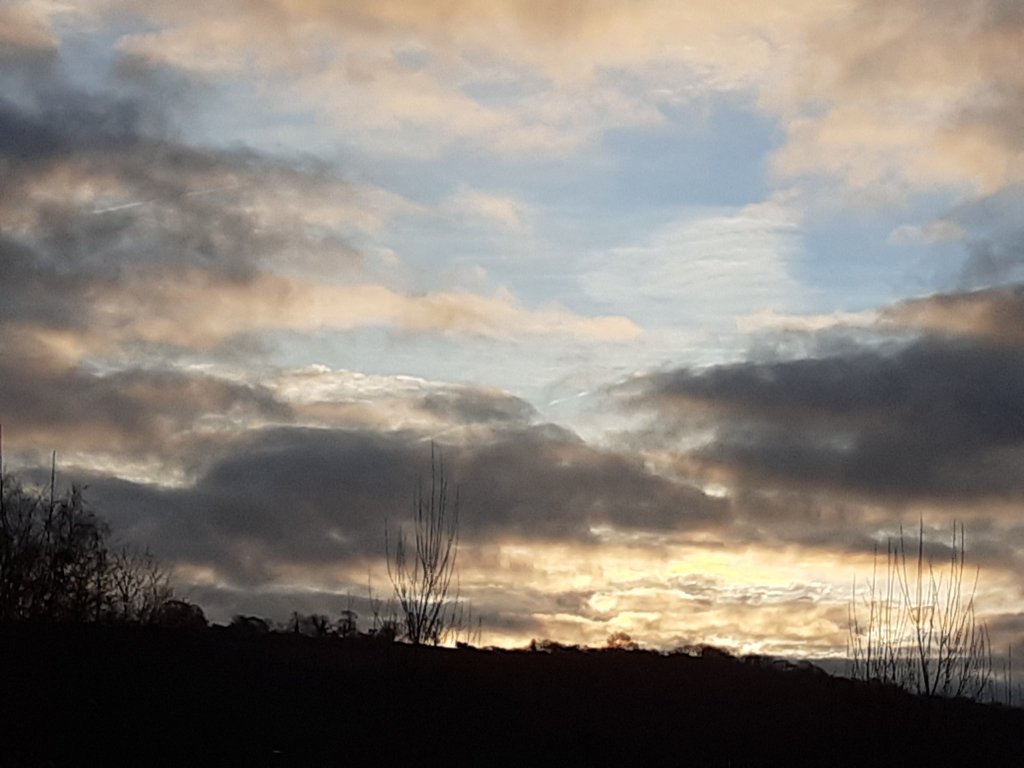
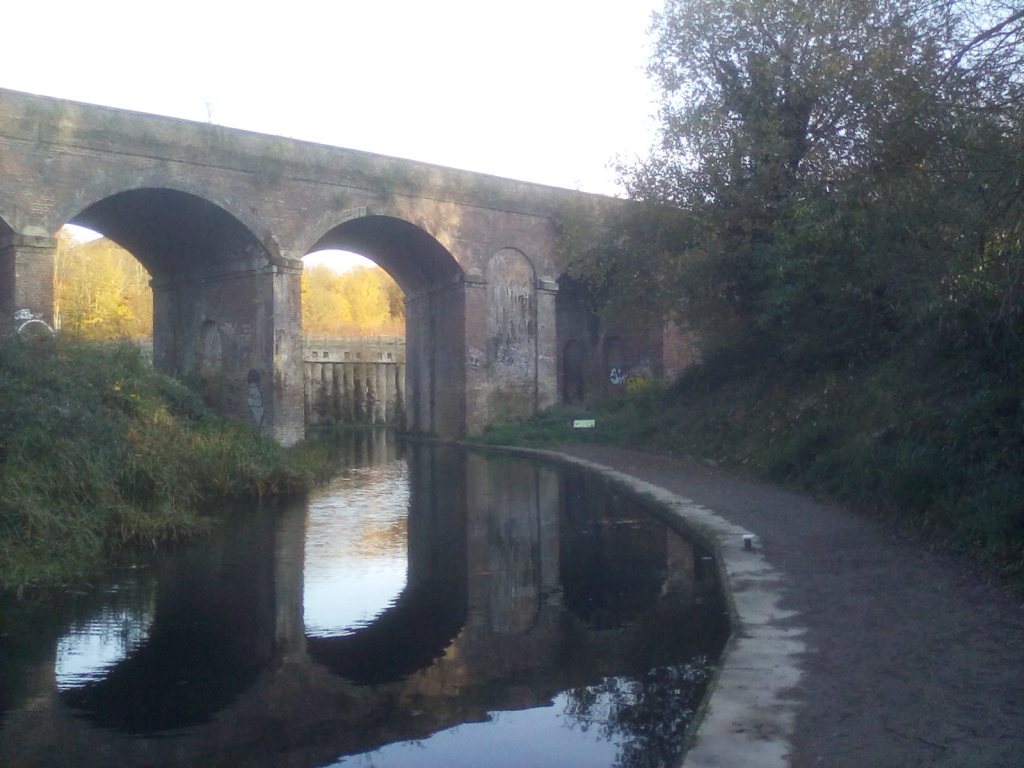
This is 7 December where I live, a little after 8 am, itself a little after the moment of dawn. The sunrise is still early in its process, fifteen days before the turn of the year. I took the pictures on one of my regular canal walks, this time between Stroud and Brimscombe in Gloucestershire, England.

This year I am paying close attention to the dance of place and time. It is part of my re-grounding after my adventures in non-duality, yet retaining the learning they brought. I surrender to the experience of winter sunlight. I breathe it in, and it fills the world, enacting a primal awareness. At the same time I acknowledge the particularity of time and place, of movement and change in nature. I also know that my observation of this winter light, at this time and in this place, is unique. It will never happen again in quite this way. It makes me glad to be alive and here for it. This gift is all the greater, and all the more to be treasured, for that very vulnerability, personal and collective, of which I am also conscious.

REVISED ‘ABOUT’: INQUIRY UPDATE

In my spiritual life, inquiry is one of the disciplines. This is why my contemplative blog is called a ‘contemplative inquiry’. As inquiries run through cycles, and aims are in some sense achieved, my direction needs to be revised and updated. This means that revising the blog’s ‘About’ statement from time to time is a necessary part of the process. When I make revisions I try to make the history clear as well as indicating the new direction. Sometimes, like now, I also want to indicate the shift through posting the new ‘About’ to existing readers. This revision adds a third paragraph to an already existing two – and changes tenses a little in the second.

“I am James Nichol and I live in Stroud, Gloucestershire, England. The Contemplative Inquiry blog started in August 2012, and includes personal sharing, discursive writing, poetry and book reviews. I began my contemplative inquiry within modern British Druidry and my book, Contemplative Druidry: People, Practice and Potential, was published in 2014.  https://www.amazon.co.uk/contemplative-druidry-people-practice-potential/dp/1500807206/

“Over time this blog became a wider exploration of contemplative spirituality, and I identified my path as a Sophian Way. Drawing on the enduring wisdom of many times and places, I have experienced it as a path of healing, peace and illumination. It has encouraged a spirit of openness, an ethic of interdependence and a life of abundant simplicity.

“The most recent phase of my inquiry has been solitary and inward. It had to be. But now I sense a change. As my Sophian Way develops, I am becoming more attentive culture, community and the wider world. Here, the influence of Druidry, as an animist Earth spirituality, takes on a renewed importance. ”

REVISED AND EDITED FRIDAY 6 DECEMBER 2019

JOHN COWPER POWYS: PORIUS AND TALIESIN

Porius (1) is John Cowper Powys’ last novel. It took him seven years to write, and he completed it in 1949, when he was 77. It is set in the year 499 CE, in North Wales. Porius is a Romano-British prince. Arthur, a suspect foreigner to most local people, reigns as Emperor. Rome is ruled by Goths, but links are maintained with Constantinople. The Saxons are an existential threat. People have to find a way of dealing with the situation in which they find themselves. But the book is at least as much about the inner lives of the characters as it is about the action they take.

Powys thought of Porius as his masterpiece. His publishers did not agree and insisted that he cut it by a third, which he did over two agonising years. Fortunately, a complete edition is available now thanks to modern editors Judith Bond and Morine Krissdottir. In her foreword Krissdottir says, “I am always reminded when I read the novel of these lines: ‘we are always in error, lost in the wood, standing in chaos, the original mess, creating a brand-new world’. Powys was as gloriously lost by the time he had written Porius as the reader sometimes is … but he was still the superb craftsman, who knew that it was the story itself that had the power to shape the forest within and without, that had the power to create a brand-new world”.

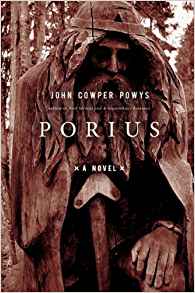
Instead of writing a review, I want to focus on one character, Taliesin, and what Powys has to say through him about the creative life. Powys has a number of point of view characters, with a variety of stances. He seems to give them equal air-time, making Porius a genuinely multi-vocal novel. Taliesin is portrayed as a young, mercurial bard, popular thanks to outstanding skill in cooking as well as poetry. (The cover illustration above is of Merlin – old, saturnine, more central to the book as a whole). Powys builds Taliesin’s bardic character, and the idiosyncratic working of his awen, with care.

“Taliesin had indeed worked out for himself, quite apart from his power of expressing it in such assonances and alliterations as had never been heard before, a really startling philosophy of his own. This philosophy depended on a particular and special use of sensation; and its secret had the power of rendering all matter sacred and pleasure giving to the individual soul. And it had the power … of fusing the immense past with the immeasurable future and of doing this, moreover, not by means of an ‘eternity’ beyond experience and imagination, but by means of a quivering vibrating, yet infinitely quiescent moment of real Time.”

Taliesin can rely on an easy fluency with language. More important is his capacity for open creative reverie, based on a deep sensitivity to the perceptions of the moment. He is described as sitting on a four-legged stool in the deepening of a late October evening. As he sits, he feels the full warmth of a fire and is able to see “the glittering path of moonlight on wind-ruffled water”. He can see a hawk’s nest, and the “ancestral sword of Cynan ap Clydno, thrust to the depth of half its blade, in the buried stump of a vanished oak tree”. The sword is reminiscent of a cross. Taliesin muses that “any sort of thing happening near a cross, not to speak of a sword, always seems in some way to be watched – if not heard and guarded against”. J.C. Powys comments, “considering the sword and the cross, the moonlit space between that figure on the four-legged stool and Clydno’s rusty weapon may well have vibrated with dangerous antipathy as the words ‘The Mothers’ and ‘Nothingness’ and ‘Annwfn’ floated away towards the lake. Rather than writing, Taliesin speaks into the darkness. Writing may come later. The piece that follows is lengthy, and eventually settles into a contemplation of “the thing none can utter, the thing inexpressible” yet “known from before the beginning”. Here is the final section:

“I know it from pond slime and

frog spawn and grub spit,

From bracken’s green coral,

white lichen, yellow mosses,

Newts sinking with their arms

out to reedy pools’ bottoms,

Swords rusting in their oak

stumps, wrapped in the long rains,

Eggs rotting in their lost nests,

enjoying the wild mists, I know it from all these, and to

men proclaim it:

The ending forever of the Guilt

sense and God sense,

The ending forever of the Sin

sense and Shame sense,

The ending forever of the Love

sense and Loss sense,

The beginning forever of the Peace paradisic,

The ‘I feel’ without question,

The ‘I am’ without purpose,

The ‘it is’ that leads nowehre,

the life with no climex,

The ‘Enough’ that leads forward

to no consummation

The answer to all things, that

yet answers nothing,

The centre of all things, yet all

on the surface,

The secret of Nature, yet Nature goes blabbing it

With all of her voices from

earth, air, fire, water!

Whence comes it? Whither

goes it? It is nameless; it is

shameless;

It is Time free at last from its Ghostly Accuser,

Time haunted no more by a

Phantom Eternal;

It is godless; but its gods are as

sea sand in number;

It’s the square with four sides

that encloses all circles;

Four horizons hath this Tetrad

that swallows all Triads;

It includes every creature that

Nature can summon.

It excludes from Annwfyn nor

man, beast nor woman!”

The mid twentieth century was a time of considerable interest in the Matter of Britain and Arthurian themes. But generally, then, we find a polished and rather conservative Christian perspective, applicable even to Taliesin. The Inkling Charles Williams wrote two collections of linked verse about him – Taliessin Through Logres and The Region of the Summer Stars (2). The latter collection includes these lines from the poem Taliessin in the Rose Garden:

“I was Druid-born and Byzantium trained.

Beyond Wye, by the Cauldorn of Ceridwen, I saw

the golden cycle flash in the forest, and heard

the pagans mutter a myth; thence by the ocean

dreaming the matter of Logres I came where the heirarchs

patter the sacred names on the golden floor

under the throne of Empire.”

John Cowper Powys, too, was a man of his time. But insofar as his Porius relies on legendary history, he borrows more from archaic Welsh tradition than the better known pan European literature that developed out of it. He himself is much more nature friendly and Pagan in sensibility. I see him as following a broadly emancipatory direction in modern spiritual culture, and we are his heirs.

(1) John Cowper Powys Porius: a Romance of the Dark Ages Overlook Duckworth, 2007. Edited by Judith Bond and Morine Krissdottir, with a foreword by Morine Krissdottir. The first abbreviated edition was published in 1951.

(2) Charles Williams Taliessin Through Logres & The Region of the Summer Stars Berkeley, CA: The Apocryphile Press, 2016. Edited with an introduction by Sorina Higgins. (Taliesin Through Logres first published in 1938; The Region of the Summer Stars in 1944)

INTEGRATION

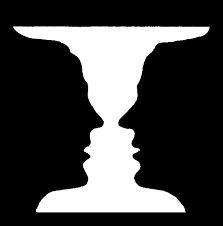
This is my grail image. I can see a chalice against a formless yet shape-creating background, or I can see two beings, with an enabling space between them. Two worlds; one image. Flicking rapidly between them, there comes a point where I can see them both, in the same place, at the same time.

I see the whole as an image of integration. Myth making just a little, I can point to a primal void, from which I am in no way separate, a cosmic mother, from whom I am distinct yet also in no way separate, and the birth of multiple individual forms of which I am one. With individuality comes otherness – and a world of connection/separation, community/exile, love/hate, joy/fear, generosity/contraction, conflict/co-operation, solidarity/predation. By integration I don’t here mean making the bad stuff go away, though efforts in that direction are immensely important. I am pointing, rather, to a capacity to hold all experience in presence and awareness: the deep experiential acceptance that all of the above, right up to void and creation, are happening here and happening now. They are the reality within which I awaken.

The Christian grail quest, which concerns the healing of the soul and its opening into spirit, partly evolved from older stories about the healing of the land, and maintains a wasteland motif. In Mahayana Buddhism enlightenment makes no sense if any sentient being is left behind. The modern Western Mystery tradition provides ways of bringing these stories together, with more of a tilt at this point in our history towards the collective dimension. I have written before that “for me the grail represents the presence and energy of Sophia”*, and has power for me on my Sophian Way. On this way, the ‘inner’ and ‘outer’ work go hand in hand: these are in any case conventional and limiting terms.

I understand the future as demanding cultures of resilience. Because of that I am glad that I have retained a foothold in Druidry and Paganism, because I see them as cultures of possibility in this regard. My Sophian Way has been a personal one, arising unexpectedly within my Druid education, and given some scope for recognition because of the way my Druid education worked. It fits better into the OBOD community, with its Universalist opening and invitation to learn from all traditions, than into any Christian, Gnostic or New Age community that I know of.

Yesterday I made a symbolic re-connection with OBOD (for I had never really left) by taking out a subscription to its magazine Touchstone after a lapse. Here at least I can name the Sophian Way unequivocally as a Goddess devotion without going through flips and twists about what ‘divine feminine’ might mean. At the same time, the name Sophia does reference insights and influences from other traditions, including secular philosophy, as befits a Goddess of Wisdom. For me, this is another kind of integration, whose fruits will manifest over time.

THE FLOW OF INQUIRY

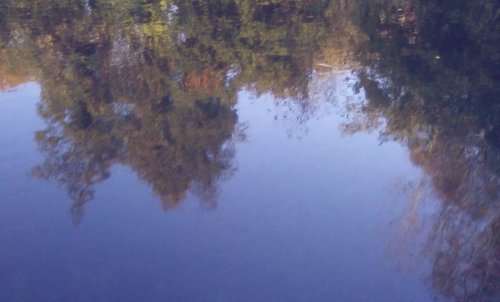
There’s a saying that we never see the same stream twice. It’s true, from a certain perspective. The water is always different. In this recent picture there’s more of it than is usual. The flow is faster and more energised. But in another sense, it is clearly the same stream. There’s a pattern and a placing that make it the same. Not forever. But enough to give it an identity of its own. Enough for us to recognise it, and to be in relationship with it over time.

I think of my inquiry in the same way. It is clearly a process of inquiring, not a thing. It has changed a lot over the years. But I notice, looking back, that it does also have characteristic points of reference and recurring themes. It has its own kind of flow. I see for example that whilst taking up practices of self-inquiry linked to non-dualist movements, I have not embraced the movements. I have gone to them for insight, not belonging. Instead, I have naturalised the insight and reframed it in my own terms – such as stilling into presence, or finding home in the flowing moment. The central focus on Sophia, and the naming of a Sophian Way, has helped here. In my world, contemplative inquiry is a core Sophian practice.

I have also kept a least half a foot in the cultural matrix of modern Druidry, Paganism, animism and eco-spirituality. These movements are closer to my heart and imagination, and feel more like my cultural home. For me, emptiness only has meaning as a home to fullness and and an exuberant multiplicity of forms. The Sophia card (Major Arcana II) in the Byzantine Tarot has a vision of Sophia as present in all of creation and the natural world, and also “watching over the steps of the Holy Fool on his journey and guiding those who seek her blessing to find their own path through the world”*. I am not at all sure about the word ‘holy’, but I see Sophia in the stream, and sense the guidance there.

*John Matthews and Cilla Conway The Byzantine Tarot: Wisdom of an Ancient Empire London: Connections, 2015

EYE OF SPIRIT

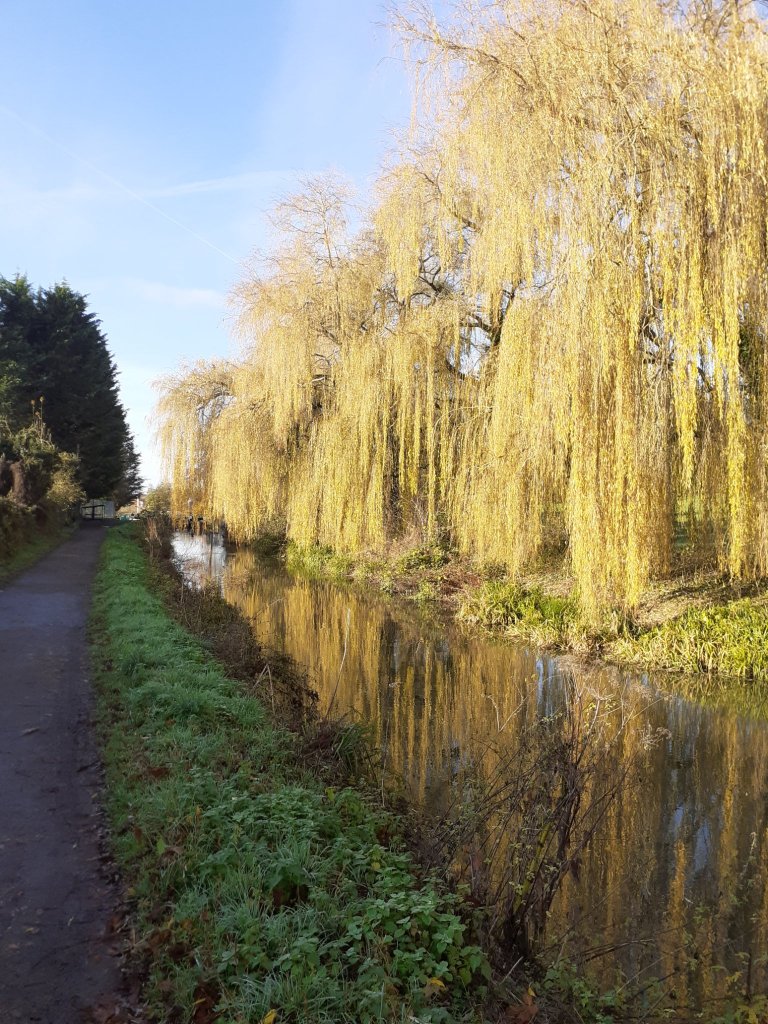
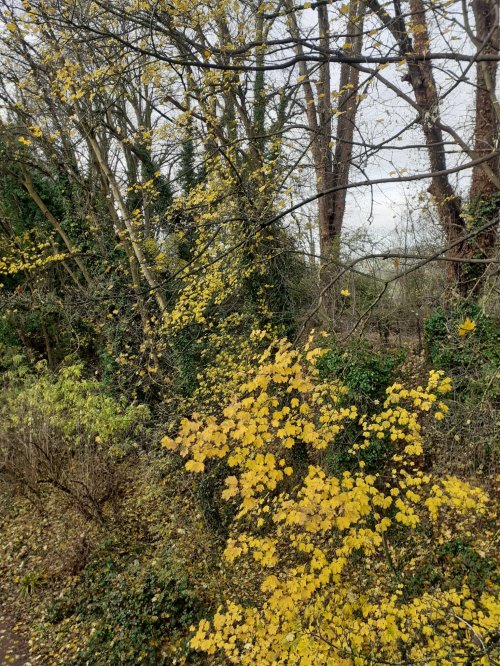
I walk my Sophian Way, seeking imagery for the end of November. The willows provide it. I see a dying back of the year, where the withdrawn and conserved life has a beauty of its own.

Stilling into presence, and holding the trees in loving attention, I act as the eye of spirit. I am aware equally of the uniqueness and otherness of the trees, and of my inter-being with them. I feel love, gratitude and wonder. I also feel a poignancy, and a sense of vulnerability – for them, and me, and everyone else.

I am glad to be taking pictures again after a gap of many years. There are dangers of displacing my attention into the process of photography, or of contracting into a collector’s obsession with ‘capturing’ images. My solution is to be artless and spontaneous in pressing the button – and to leave my phone in my pocket for most of the time. Once at home, I do find myself delighting in the record.

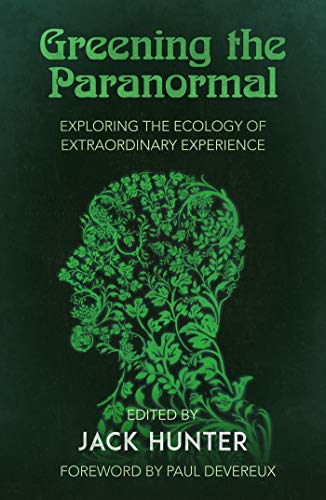
BOOK REVIEW: GREENING THE PARANORMAL

I recommend this book to anyone concerned with deep ecology, animism, or the kinds of phenomena we describe as ‘paranormal’. It opens with two substantial framing pieces, a foreword by Paul Devereux and an introductory chapter by editor Jack Hunter. These are followed by 16 chapters from a diverse range of contributors, mostly seeking to combine direct witness with a workable form of academic analysis. To an extent this book is a story of how to face this difficult challenge. Very early, in his foreword, Paul Devereux shows how the challenge can come from the ‘phenomena’ themselves.

“We were trying to geographically map generations of old accounts of fairy paths we had uncovered in the verbatim records of University College Dublin. Suddenly, standing in the grass, there was a figure, between two and three feet tall. It was anthropomorphic and fully three dimensional (as we could clearly determine while we were drifting slowly past. It had sprung its appearance out of nowhere, and it caught my wife’s and my own transfixed attentions simultaneously.

The figure was comprised of a jumble of very dark green tones, as if composed of a tight dense tangle of foliage rather like the stand of woodland a hundred yards or so beyond the sward of grass. It didn’t seem to quite have a face, just a head with deep set eyes appearing out of the green tangle. It presented a distinctly forbidding appearance. As we crawled past in our car, the figure started to turn its head in our direction, but then vanish.

“Charla called out, ‘Oh, shit!’ We looked at each other, both of us wide-eyed and thoroughly disconcerted. ‘You saw that!’ I asked rhetorically. The whole episode had lasted for only about half a minute or so, but it was unequivocally an actual. if transient, objective observation.”

The running inquiry question throughout the book is, what do we make of experiences like this, if we are determined to honour rather than dismiss them? Devereux senses four major themes in the suggested ‘greening of the paranormal’ in our time. The first is animism, the ‘Big Step for our culture to take’: the sense that the elements of the non-human world are animate in some way – rocks, rivers, soil, as well as plants and living organisms. This involves a deep relationship with the land beyond utility and subsistence. The second theme is the vision quest, a wilderness journey which is more about paying attention and being open to what unfolds, rather than posing questions. The third concerns the ‘liminal’ places that seem to support our breaking through into other-world realms or altered mind states. The fourth is inter-species communion with the animal and plant kingdoms. In the language used by Jack Hunter, we find ourselves dealing with a “profoundly mindful, sentient and agentic world” and the potential re-opening of lost forms of communication and connection.

Many of the contributors believe that we are unlikely to get through the climate crisis if we continue to ignore dimensions of experience from which our cultural filters have exiled us. Some of them live or work in countries that have been colonised by Europeans, but where pockets of traditional indigenous wisdom remain. They recognise that in some cases there are invitations to share in this. There are also concerns about appropriation and the dynamics of the researcher/subject relationship. There is a questioning of the word ‘shamanism’ as currently used – and arguably over-extended and suspect.

This book does not read like a novel. Although I have read it all, there were two or three chapters which didn’t speak to me. Others were riveting. I see it as an excellent book to own and keep for reference. The foreword and first chapter each stand alone and I recommend reading both of them. The other chapters can be cherry picked according to taste or need. Overall there’s a strong invitation to wake up to the aspects of world, life and experience that are being pointed to. The book suggests that they are needed for our personal, social and global healing.


NOVEMBER REFLECTIONS

In recent years, I have experienced November as a special month. Moving on from Samhain, it begins winter, and where I live it sees most of the fall. It is a reorientation towards darkness and inwardness. I began my contemplative inquiry, at first limited to OBOD, then to Druidry more widely, finally becoming universal, in November 2011 following a Samhain ritual.

I find November calmer than December, where I tend to feel jangled by the agitated dominance of capitalist consumerism and its appropriation of a Christian festival, itself the appropriation of a Pagan one. The old festivals had an offer for everyone, at least in principle. Now you have to have money to participate, and increasing numbers of people don’t. So I find December an awkward, uneasy time, a ‘festive season’ that, collectively, doesn’t quite ring true.

This sense of a problematic December has made the whole month of November special to me, and powerful for my inquiry. This year I have rejigged my daily practice and replaced a long morning session with shorter sessions in the morning and evening. In the morning I wake up and greet the day with a slightly ritualised (thanks to Druidry) set of exercises. Before going to bed I do a yoga nidra meditation, listening to an audio download. Both practices are grounded in what I would now call a sacrament of presence, and awareness that every experience points towards a source of being from which I am not separate. In this intersection of time and eternity I find my home. I don’t need special ‘spiritual’ experiences. This spirituality doesn’t require them: the work is to enhance my capacity to welcome any experience, including my resistance to negative ones, and find ways to respond. Hence I look to simple, regular practices that provide pragmatic benefits and also remind me of this core insight.

I find that the inquiry aspect of my contemplative inquiry is shifting its focus to personal life, relationships, culture and nature. What’s going on? How am I placed? How am I responding? What difference does my Sophian Way – with contemplative inquiry as its main expression – actually make? These are my November reflections for 2019.

BOOK REVIEW: Y DAROGAN ANNWN

The image above is the cover for Lorna Smithers’ new collection of poems, Y Darogan Annwn, and it illustrates the themes of the collection. Lorna Smithers explains: “Daronwy, the Brythonic World Tree, is falling. Beneath its boughs appears Y Darogan Annwn, a child-prophet, who prophecies the end of the Age of Man. She must find the source of the poison, outwit the scientists of Gwydion, and release the destructive fury of the spirits of Annwn. Her ultimate decision will be whether to become one with her prophecy.”

Prophecy, like poetry, is a gift of awen, the inspirational energy of Brythonic culture. To be awenydd, open and dedicated to this gift, is to accept its demands. Y Darogan is a child of the gods and a daughter of dragons. She is a shape-shifter who can move through multiple identities, the most poignant of which is that of a little girl. She will never grow up. Her individual life will last for less than a year.

The collection contains 50 poems in all. Two are introductory and the others are arranged in seven sections providing a narrative structure: Lock and Key; The Forest of Daronwy; The Fisher King; The Golden Ring; Doomsday; The End of Days; and The Hereafter. Together they present a wasteland story for our times, drawing on British Celtic and Arthurian themes whilst subverting the patriarchal assumptions of the old texts. The individual poems are each relatively short, and likely to have most impact on people who have some familiarity with the Mabinogion and the Brythonic mythos in which it is embedded. However the wasteland confronted is that of our own times: its military industrial complexes based on a perverted science, and the current slide into climate catastrophe.

For her self-introduction in the first verse, the infant Y Darogan uses pithy lines of power, reminiscent of The Book of Taliesin*, though with updated cultural references.

I have been a fallen star

and a tear in a river of tears

flowing through Annwn.

I have been hydrogen,

oxygen, carbon, nitrogen,

helium burning in the sun.

****

I have been dark matter

I have not been found by

the scientists of Gwydion.

By contrast, Doronwy, the Brythonic World Tree, is introduced in a prose poem, one of the longer individual pieces in the book. Together, these introductory pieces provide a point of departure for the story that builds over the seven main sections. Y Darogan’s mission of cleansing is itself a path of destruction, and “no Champion’s Light stands out on her forehead, just the darkness of the black hole”. Only at the very end is there a regenerative (rather than ‘redemptive’) note. The material demands verbal resilience in the face of multiple and unavoidable stresses, and even at its bleakest, there is power and magic in Lorna Smithers’ writing.

Oh Breath of the Wind

don’t leave me leave me please!”

She does not know how long

she has been wandering Pennant Gofid,

the Valley of Grief through ghosts and mist,

only that she found the treasure, became

the answer, and it’s harder to bear

than the weight of the crow.

The howling of wolves loudens.

The sky blackens with ghost-wings.”

Overall, I believe that Y Dorogan Annwn is a significant contribution to the re-visioning of the world’s great stories as we confront unprecedented challenges on our collective journey. I am grateful for the opportunity to read and review it.

Lorna Smithers’ blogs at https://lornasmithers.wordpress.com/ using the title At Peneverdant. Her About section describes her calling as an awenydd and devotee of Gwyn ap Nudd, God of the Brythonic underworld Annwn, of the dead, and of the Wild Hunt. The Y Darogan Annwn collection is now for sale as a PDF, see link:

https://lornasmithers.wordpress.com/2019/10/12/y-darogan-annwn/

  • The Book of Taliesin in The Four Ancient Books of Wales Forgotten Books, 2007 (Originally published in 1868, when the original material was translated and edited by William F. Skene)

Earth Eclectic

music that celebrates Earth and speaks to the heart

Sarah Fuhro Star-Flower Alchemy

Follow the Moon's Cycle

Muddy Feet

Meeting nature on nature's terms

Rosher.Net

A little bit of Mark Rosher in South Gloucestershire, England

Becoming Part of the Land

A monastic polytheist's and animist’s journal

selkiewife

Selkie Writing…

Charlotte Rodgers

Images and words set against a backdrop of outsider art.

Prof Jem Bendell

living with metacrisis and collapse

Towint

The pagan path. The Old Ways In New Times

The Druids Garden

Spiritual journeys in tending the living earth, permaculture, and nature-inspired arts

The Blog of Baphomet

a magickal dialogue between nature and culture

This Simple Life

The gentle art of living with less

Musings of a Scottish Hearth Druid and Heathen

Thoughts about living, loving and worshiping as an autistic Hearth Druid and Heathen. One woman's journey.

Wheel of the Year Blog

An place to read and share stories about the celtic seasonal festivals

Walking the Druid Path

Just another WordPress.com site

anima monday

Exploring our connection to the wider world

Grounded Space Focusing

Become more grounded and spacious with yourself and others, through your own body’s wisdom

The Earthbound Report

Good lives on our one planet

Hopeless Vendetta

News for the residents of Hopeless, Maine