WOODLAND HAIKU

This lone shape
emerging from under-wood:
Who am I?
This lone shape
emerging from under-wood:
Who am I?

Bright light as a valley experience. Sunlight on trees. February 6, the day I took this picture, provided my first experience of intense sunlight this year. It got through to me even in a shady place. My eyes were dazzled and my head struck by an unexpected warmth.
I noticed mixed feelings. Yes, I celebrated the return of the light. Yes, it was a reference experience for the spring aspect of Imbolc in my part of the world. More visceral than snowdrops, the sun truly reached me and not just my nature-observant sensibilities. It was almost shocking.
Looking out, after that first moment, my world filled up with light on trees. I wondered if they too had any resistance to waking up and being visible and called upon to grow and change and open to the light more fully. I don’t know what it’s like to be a tree. Not really. Withdrawing my projections, I am turned back to my own responses. Parts of me have reservations about immersion in the light. Perhaps they have a wisdom of their own.

Spaces ‘between’ can be numinous. They feed the soul. Imbolc for me is like a pre-dawn light. I am not yet out of winter, but something else is happening, and palpably growing in strength.
The hierophant of the Wildwood Tarot – the Ancestor – is placed as a power of Imbolc. An antlered figure clothed in reindeer skins and evergreen leaves, she has a resonance of Elen of the Ways, the reindeer goddess who stands for the sovereignty of the land. She calls to us from a deep past where Ice Age hunters followed reindeer through ancient forest, “following the deer trods” (1,2) responsive to the herds and attuned to the landscape. They lived with little personal property and without long hours of alienating work. The Ancestor invites us to wonder what these early ancestors might have to teach us under our very different conditions.
On the card, the Ancestor is sounding a drum and calling us into another consciousness – one more open and aware of our place within the web of life. In her world, deer and people are kin. She herself is ambiguous – she might be wearing a mask, or she might be a truly theriomorphic figure. I respond to her call by sinking deeply into my felt sense – the embodied life of sensation, feelings and belly wisdom. The call of the Ancestor is a pathway to greater wholeness and connection, both personally and collectively. As the year wakes up, it is a good call to hear.
(1) Elen Sentier Elen of the Ways: British Shamanism – Following the Deer Trods Arlesford, Hants: Moon Books, 2013 (Shaman Pathways series)
(2) Elen Sentier Following the Deer Trods: A Practical Guide to Working with Elen of the Ways Arlesford, Hants: Moon Books, 2014 (Shaman Pathways series)
See also book review at: https://contemplativeinquiry.blog/2014/06/22/
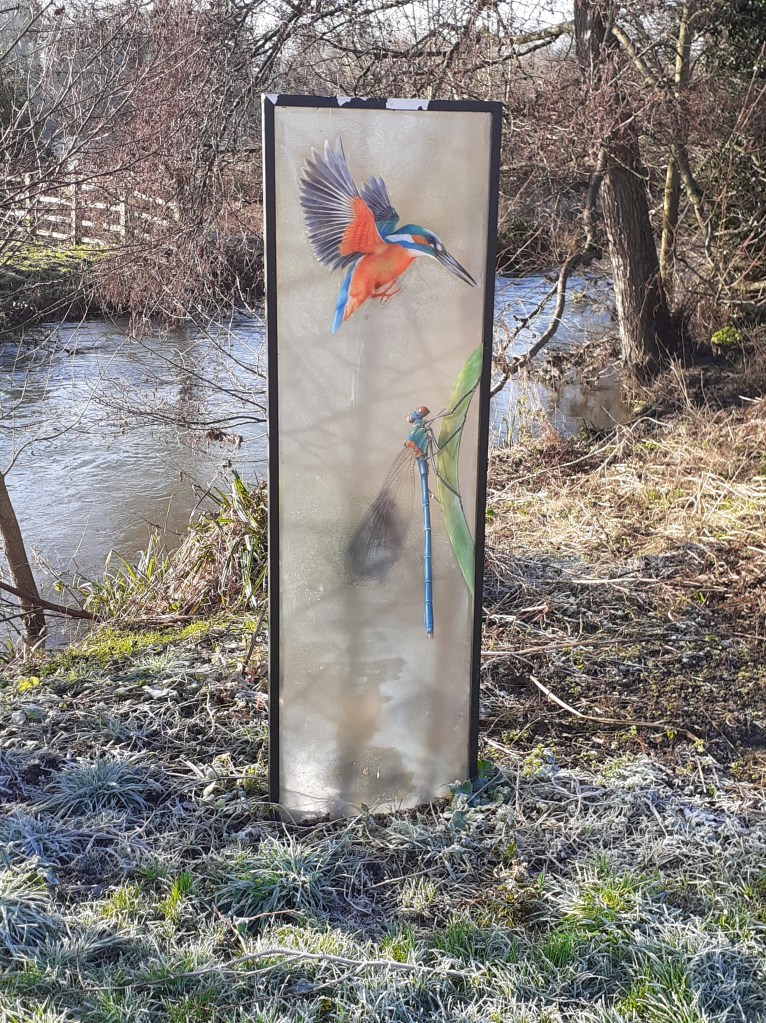
I have never been much of a wilderness person. In times past I have foolishly used this to feel like a lesser Druid. ‘Near nature’ is my habitat. It is a world of parks, streams, canals, accessible hills, woodlands and former rail tracks. Human artefacts of varying vintages are very much part of the scene. These places keep on giving. Over the last couple of days a touch of frost coupled with brighter light has changed the feeling tone of a generally wet and clouded winter. Pictures celebrate this bounty.

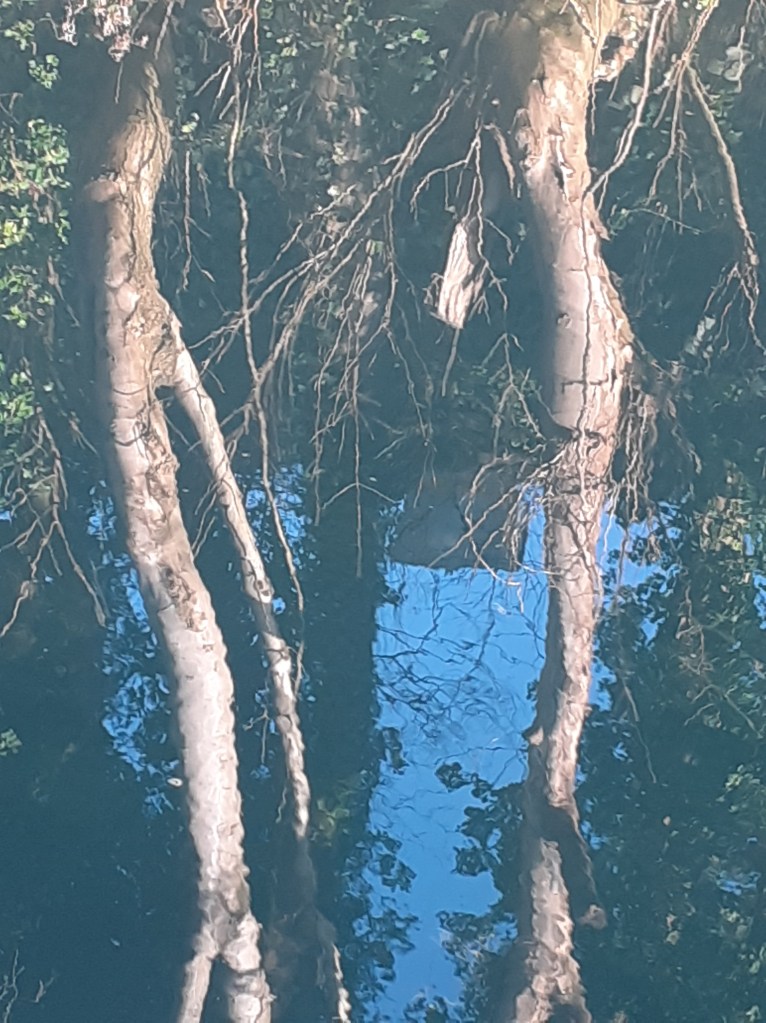
I am conscious now of moving beyond midwinter and towards Imbolc (1 February), the first celebration of returning light. For me, the-mid January period is held in the above image. Tree trunks reflected in water evoke depth rather than height. The image faithfully depicts their withdrawn winter life whilst hinting at other life below the surface, as the world turns over in its sleep.
Winter in the Wildwood Tarot lasts from Samhain (1 November) to Imbolc (1 February), whereupon the spring quarter begins. The hooded man, hermit of this deck, is shown as solstice figure whose influence pervades the whole winter. The image depicts a hooded figure, staff in the left hand and lantern in the right, standing by a great oak tree. The lantern illuminates a door in the tree, which itself suggests, through cracks in its timbers, an illuminated space inside. A wren sits on a stone nearby.
There is power in this image. The world tree, standing for life and wisdom, is both source and refuge. The hooded hermit seems to model intention and training, and his lantern and staff are potent tools. The wren once won a contest to be king of the birds by riding on the back of an eagle and thus flying highest. An animal ally, perhaps.
The face of the hooded hermit is hidden: no visible sign of a forest rebel; no sign, specifically, of a man. Does this suggest a talent for invisibility or shape-shifting? Perhaps. But what I chiefly sense is a Zen emptiness, of which Thich Nhat Hanh (2) says: “At first, we think emptiness is the opposite of fullness but, as we saw earlier, emptiness is fullness. You are empty of your separate self, but full of the cosmos.” According to another Zen writer (3), “the Buddha called himself tathagata or ‘that which is thus coming and going’ …a flowing occurrence, and the outward form ,,, was constant, calm, compassionate availability to people who came to him for help.”
I am not a Buddhist and I do not seek to appropriate the hooded hermit for Buddhism. Similar ideas about the emptying out of personality to make room for a greater life can be found in Taoism (4) and Douglas Harding’s Headless Way (5). There’s a reminder here that path and goal are one, and that an emptied fullness of experiencing is available at any point of the journey.
(1) Mark Ryan & John Matthews The Wildwood Tarot Wherein Wisdom Resides London: Connections, 2011. Illustrations by Will Worthington
(2) Thich Nhat Hanh The Other Shore: A New Translation of the Heart Sutra with Commentaries Berkeley, CA: Palm Leaves Press, 2017
(3) Ben Connelly Inside Vasubandhu’s Yogacara: A Practitioner’s Guide Somerville, MA: Wisdom Publications, 2016
(4) Lao Tzu Tao Te Ching: A Book about the Power and the Way Boston & London: Shambhala, 1998 (A new English version by Ursula K. Le Guin, with the collaboration of J.P. Seaton, Professor of Chinese, University of North Carolina, Chapel Hill)
“Wander over to that oak, or a maple, or a sycamore, reach out your hand to feel the surface of a single many-pointed leaf between your thumb and fingers. Note the coolness of that leaf against your skin, the veined texture your fingertips discover as they roam across it. But notice, too, another slightly different sensation: that you are also being touched by the tree. That the leaf itself is gently exploring your fingers, its pores sampling the chemistry of your skin, feeling the smooth and bulging texture of your thumb even as the thumb moves upon it.
“As soon as we notice than our hands are being included within the tactile world, we are forced to notice this reciprocity: whenever we touch any entity, we are also being touched by that entity.
…..
“Such reciprocity is the very structure of perception. We experience the sensuous world only by rendering ourselves vulnerable to that world. Sensory perception is this ongoing interweavement: the terrain enters into us only to the extent that we allow ourselves to be taken up within that terrain.”
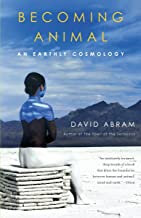
David Abram Becoming Animal: An Earthly Cosmology New York: Vintage Books, 2010

A happy New Year to all readers, as we begin to navigate the 2020’s! May we find compassionate and creative ways to flourish in the days ahead.
As my contemplative inquiry evolves, I update the ‘About’ section for this blog. Below is my revision for the beginning of 2020.
“I am James Nichol and I live in Stroud, Gloucestershire, England. The Contemplative Inquiry blog started in August 2012, and includes personal sharing, discursive writing, poetry and book reviews. I began my contemplative inquiry within modern British Druidry and my book, Contemplative Druidry: People, Practice and Potential, was published in 2014. https://www.amazon.co.uk/contemplative-druidry-people-practice-potential/dp/1500807206/
“Over time my inquiry became a wider exploration of contemplative spirituality, identified for a period as a Sophian Way. It drew on the enduring wisdom of many times and places and I came to experience it as a path of healing, peace and illumination. In particular, my inquiry identified an ‘at-homeness’ in the flowing moment. Such at-homeness is not dependent on belief or circumstance, but on the ultimate acceptance that this is what is given. I have found that, for me, the realisation of this at-homeness has supported a spirit of openness, an ethic of interdependence and a life of abundant simplicity.
“The discovery of at-homeness emerged from an inward inquiry arc: noticing myself perceiving, making meaning, and finding a language to articulate my experience. Now I am on an outward arc. I am turning to a greater focus on relationships, community, culture, and the wider web of life. Druidry, as a modern eco-spirituality receptive to ancient wisdom, is renewing its importance in my life.”
The Wanderer is the Fool of the Wildwood Tarot (1). To become the Wanderer is to let go of formless potential and take on identity and aspiration. Entering the Wildwood world, I find myself at midwinter. As I gradually get my bearings, I lean towards the first signs of a strengthening sun, and the distant promise of spring.
In my first use of the cards, I chose an eight-card spread. Four of the cards belong to Vessels, the water suit (2). They include both ace and king. Where I live, this fits with two or three months of rain and flood, well beyond what used to be normal. The placement of these cards suggests reasons to be hopeful, at a price. Another card, indicated as a helpful resource, is the Pole Star, the name given to Major Trump 17 in this pack.
These results have triggered memories of two Anglo-Saxon poems, often anthologised together: The Wanderer and The Seafarer. Both are voices from a Christianised culture in the old northern world. The first part of The Seafarer, possibly a separate composition from the second, “has variously been regarded as literal or allegorical, and related to such figures as the pilgrim.” (3). The extract below emphasises endurance in the face of adverse conditions. I like the seafarer for being an ordinary man of his time, and not an idealised hero. He does what he needs to, and won’t give up. He can find beauty and communion with bird life, in a harsh and lonely setting. But he also owns feelings of distress, sorrow and complaint. He belongs to history rather than myth.
“I sing my own true story, tell my travels,
How I have often suffered times of hardship
In days of toil, and have experienced
Bitter anxiety. My troubled home
On many a ship has been the heaving waves,
Where grim night-watch has often been my lot
At the ship’s prow as it beat past the cliffs.
Oppressed by cold my feet were bound by frost
In icy bonds, while worries simmered hot
About my heart, and hunger from within
Tore the sea-weary spirit. He knows not,
Who lives most easily on land, how I
Have spent my winter on the ice-cold sea,
Wretched and anxious, in the paths of exile,
Lacking dear friends, hung round by icicles,
While hail flew past in showers. There heard I nothing,
But the resounding sea, the ice-cold waves.
Sometimes I made the song of the wild swan
My pleasure, or the gannet’s call, the cries
Of curlews for the missing mirth of men,
The singing gull, instead of mead in hall.
Storms beat the cliffs, and icy-winged
The tern replied, the horn-beaked eagle shrieked.
No patron had I there who might have soothed
My desolate spirit. He can little know
Who, proud and flushed with wine, has spent his time
With all the joys of life among the cities,
Safe from such fearful venturings, how I
Have often suffered weary on the seas.
(1) Mark Ryan & John Matthews The Wildwood Tarot Wherein Wisdom Resides London: Connections, 2011. Illustrations by Will Worthington
(2) See also https://contemplativeinquiry.wordpress.com/2019/12/30/
(3) Extract from The Seafarer in A Choice of Anglo-Saxon Verse London: Faber & Faber, 1970 (Selected with an introduction and a parallel verse translation by Richard Hamer)
The World Tree stands at 21, as the final trump in the Wildwood Tarot (1). It also has a specific link to wisdom. For some years I’ve thought of my path as a Sophian Way. So I assumed that the Tree would act as a Sophian card. But it doesn’t. The Tree feels fresh and new. For me, as I contemplate it now, it has nothing to do with Sophia. I knew this on my first significant seeing of the image, without needing to check it out any further or even know how I knew.
Then, in my first reading of the cards, I drew the 3 of Vessels (the water suit). Its placement in the western direction was linked to the question, ‘what do you leave behind you?’ The image shows three cranes dancing together in the air, with three vessels (golden, green and white) on the ground. In the narrative of the deck, the card represents joy, especially a familial or communal joy linked to favourable turns in circumstance. My first uncensored response was ‘no-why-me-it’s-not fair’. The second was ‘ah! They mean attachment to joy and not the experience itself. I know what to do about that.’ It didn’t help. Finally, I saw beyond the card and its narrative to my own deeper experience.
This is about letting go of my hitherto guiding archetypal image. This is about letting go of Sophia. Looking again at the card itself: 3, Vessels, West, Cranes, I found as good a Sophian reference as the pack can afford, given that the World Tree is not providing one. Once I recognised this, I started to recall how my recent attempts to articulate what Sophia means for me have become awkward and strained. If I have a sense of guidance from parts of me that my normal consciousness doesn’t seem to register, why not just say so? If my spirituality is about nurturing and developing a creative wisdom of the heart, why not just make that plain? If my contemplative inquiry is my main practice to this end, why don’t I just say that? Why call it a Sophian Way? Why use an image to point to something when I can point to it directly and make more sense?
I have never engaged wholeheartedly in a devotional religion. There have been times when my ama-aima mantra meditation, addressing Sophia as cosmic mother, has had flavour of this. But those times are gone. I have had to recognise that the image of Sophia has lost its power in my life. Right now, I have no sense of what this image is uniquely pointing to. I did not truly grasp this until the Wildwood Tarot showed me. The year’s journey will be taken without Sophia, and it is not what I expected.
(1) Mark Ryan & John Matthews The Wildwood Tarot Wherein Wisdom Resides London: Connections, 2011. Illustrations by Will Worthington
music that celebrates Earth and speaks to the heart
Follow the Moon's Cycle
Meeting nature on nature's terms
A little bit of Mark Rosher in South Gloucestershire, England
A monastic polytheist's and animist’s journal
Selkie Writing…
Images and words set against a backdrop of outsider art.
living purposefully during metacrisis and collapse
The pagan path. The Old Ways In New Times
Spiritual journeys in tending the living earth, permaculture, and nature-inspired arts
a magickal dialogue between nature and culture
The gentle art of living with less
Thoughts about living, loving and worshiping as an autistic Hearth Druid and Heathen. One woman's journey.
An place to read and share stories about the celtic seasonal festivals
Just another WordPress.com site
Exploring our connection to the wider world
Become more grounded and spacious with yourself and others, through your own body’s wisdom
Good lives on our one planet
News for the residents of Hopeless, Maine

