Contemplative Inquiry

This blog is about contemplative inquiry

Tag: Druidry

DEEP REST AND THE MAGIC OF AWEN

2020 is beginning its journey from Beltane to Midsummer in my neighbourhood, and I am feeling the call of Awen. Hence the pendant. I am also looking at the theme of balance (1). There’s a question for me about balancing the call of Awen with my commitment to the deep rest of contemplation and its nourishing effects.

As a fruit of my contemplative inquiry, I found ‘at-homeness in the flowing moment’. This at-homeness nourishes my life. It is not dependent on belief or circumstance, but on the ultimate acceptance that the experienced moment is what is given. Being alive, having experiences, and being aware that I have experiences is an extraordinary set of gifts. But it has taken me a while to find deep rest in simple experiencing, at will.

When I go home to the flowing moment, I slow down the stream of consciousness without attempting either to halt it or to put it to work. A stillness lives within the flow and finds its place there. I experience ‘now’ as state of presence, rather than a unit of time. A pervasive sense of deep rest emerges from ‘just being’. Immersed in being, I can lose my sense of a boundaried, separate self.

But I am also an embodied human, in a perpetual process of becoming, When I hear the call of Awen, I feel as if a larger life is inviting me to share in the magic of creation as a co-creator. It is likely that humans began calling, chanting and music-making before they developed conceptual speech. Awen is close to source, deeply involved in the emergence and flourishing of our collective and personal voices. Gaelic tradition speaks of the Oran Mor as the great song in which all beings have a part.

In this final, dynamic stage of the rising year, I do feel called in this way. My initial response has been to re-incorporate Awen into my practice both as a three-syllable chant (aah-ooo-wen) and as a two-syllable mantra meditation (aah, on the inbreath; wen, on the outbreath). This is already changing the feel of the practice. When chanting this is through the sound, with its distinctive pulse and vibration, and through a strong felt resonance in my body. In the meditation, the awen mantra seems to enliven my breath, making it very real as the breath of life. It also energises my body as a whole, less dramatically but more subtly than the chant. Overall, I sense myself as enlivened, inspired, and activated. Awen is influencing my experience, and my inquiry. I will see where this magic leads me.

(1) https://contemplativeinquiry.blog/2020/04/29/beltane-2020/

BELTANE 2020

Greetings and Blessings for the fast approaching festival of Beltane/Samhain. May we all find ways to stay safe and to flourish! This post focuses on my sense of the Wheel at Beltane – aware also that each season contains the seed of its opposite.

For The Wildwood Tarot, Beltane is the moment when “the polarised energies of the land interweave and intertwine around the staff of the heavens, generating the pulse of life”. It is also concerned with balance, and linked to the traditional trump for temperance. There’s a call to discover what balance, balancing and re-balancing might look like in 2020. Where might different balancing acts take us? How does ‘balance’ apply collectively, with a continuing public health crisis?

In the card, the primal energies of the serpents, echoing both the caduceus symbol and the double helix, are vividly in the foreground. By contrast the mask-like human head towards the bottom of the picture is almost hidden. For me, it is sombre, an image inviting uncertainty and unknowing rather than ‘balance’ or any steady state. Beltane 2020 finds a world in flux. Anything is possible. At the personal level, balance might morph into a kind of poise, without attachment to specific outcomes, yet with a preparedness to navigate uncharted waters.

INWARD TRAINING

The Way fills the entire world

It is everywhere that people are

But people are unable to understand this.

When you are released by this one word:

You reach up to the heavens above;

You stretch down to the earth below;

You pervade the nine inhabited regions.

What does it mean to be released by it?

The answer resides in the calmness of the mind.

When your mind is well ordered, your sense are well ordered.

When your mind is calm, your senses are calmed.

What makes them well ordered is the mind;

What makes them calm is the mind.

By means of the mind you store the mind.

Within the mind there is yet another mind.

That mind within the mind: it is an awareness that precedes words.

Only after there is awareness does it take shape;

Only after it takes shape is there a word.

Only after there is a word is it implemented.

Only after it is implemented is there order.

Without order, you will always be chaotic.

If chaotic, you die. (1)

The early Taoist classic Inward Training (Nei-yeh) (1) comes out of an oral tradition in which teachers gave their pupils verses to learn and study. Hence the emphatic and somewhat repetitive flavour of the text. Teacher pupil relationships of this kind are very ancient in China, likely emerging out of an indigenous Chinese shamanism (2).

Translator and editor Harold Roth suggests that the ‘one word’ that releases people is Tao itself, used as the focus of meditation, somewhat in the manner of mantra work. When the mind is calm, another mind becomes available – the mind within the mind, that precedes words and takes shape prior to their emergence.

Tao, in this understanding, is experienced as a foundational and pervasive cosmic process in which we can centre ourselves. The recommended practice helps us to cleanse the doors of perception, and achieve that centring. My experience of contemplative inquiry, and the Druid training that preceded it, is that ‘inward training’ works.

(1) Roth, Harold D. (1999) Original Tao: ‘Inward Training’ and the foundations of Taoist mysticism New York, NY: Columbia University Press

(2) https://contemplativeinquiry.blog/2014/08/12/

LEARNING FROM THE WATERCOURSE WAY

Alan Watts (1) describes Taoism as the ‘watercourse way’. For him, this ancient philosophy is “a skilful and intelligent following of the course, the current, and grain of natural phenomena – seeing human life as an integral feature of the world process, and not something alien and opposed to it.” It is a point of view that I find of direct relevance to modern Druidry, nature spirituality and ecosophy. (2)

The ancient Taoists themselves said that “true goodness is like water. Water’s good for everything. It doesn’t compete. It goes right down to the low loathly places, and so finds the way”. (3)

Alan Watts continues (1): “Looking at this philosophy with the needs and problems of modern civilisation in mind, it suggests an attitude to the world which must underlie all our efforts towards an ecological technology. The development of such techniques is not just a matter of the techniques themselves, but of the psychological attitude of the technician”.

A detached attitude of objectivity is inadequate for solving the problems we face. Subject and object cannot be separated, for “we and our surroundings are the process of a unified field, which is what the Chinese called Tao”. We have no alternative but to work along with this process by attitudes and methods which could be as technically effective as “judo the ‘gentle Tao’ is effective athletically”. Watts reminds us that human beings have to make the gamble of trusting one another to make any kind of workable community, and concludes that “we must also take the risk of trimming our sails to the winds of nature. For our ‘selves’ are inseparable from this kind of universe, and there is nowhere else to be.”

(1) Alan Watts Tao: the Watercourse Way Souvenir Press: undated Amazon Kindle edition (with the collaboration of Al Chung-Liang Huang ; additional calligraphy by Lee Chih-chang)

(2) Arne Naess Ecology of Wisdom UK: Penguin Books, 2016 (Penguin Modern Classic. First published 2008)

(3) Lao Tzu Tao Te Ching: A Book about the Power and the Way Boston & London: Shambhala, 1998 (A new English version by Ursula K. Le Guin, with the collaboration of J.P. Seaton, Professor of Chinese, University of North Carolina, Chapel Hill)

SAVED FROM TRASH

A murky evening moment at a magical time of year. St. George’s Day coming soon, and then Beltane. A seeming failure to get a good image. Street lights come on just as the picture is taken. Freshly green trees are obscured by gathering darkness, and reduced to silhouettes. I am shooting through a window that needs cleaning. I delete the picture. I send it to trash.

Then I find myself haunted by an after image of those apparent pink clouds in the sky. I rescue them. I have better pictures of clouds, but as I imagine them now, these shapes are no longer clouds for me. I see the courtship – I’m oddly sure it’s a courtship – of two beings. In this liminal twilight sky, in a meeting of air and fire, they are materialising in time-bound 3D reality. I might, doubtless incorrectly, call them dragons in my nervous need for naming. In truth I don’t know who or what they are, or where they come from, or how they got here. This is 2020, a twilight zone in itself.

I see no purpose or plan here, though the courtship of these beings is well synchronised for time and place. They are a sign and a wonder. Though their story is unknown, I welcome these beings who are not of this world. I am touched by their appearance and glad to be sharing it.

CONTEMPLATIVE DRUIDRY: REFLECTING ON THE PROJECT

In his foreword to Contemplative Druidry (1) Philip Carr-Gomm talks about “Nature Mysticism, or Natural Mysticism” in modern Druidry. He suggests that such mysticism is grounded in changes in consciousness, and feelings of bliss or oneness, with no accompanying “separation from the physical world in pursuit of the Divine”. For me, it is especially about meeting the moment within the physical world, including our own body/mind. Sometimes the meeting comes through formal practice. Sometimes it is spontaneous and unannounced.

I built the main body of the text in Contemplative Druidry around a series of interviews with practitioners, which I designed, conducted and transcribed in the spring and summer of 2014. I then identified patterns in what people had been saying and decided on themes for chapters. I wasn’t working in an academic role, so my own linking text was a matter of curation rather than analysis. At that time the notion of a ‘contemplative’ approach to Druidry seemed weird to many people. But it was clear to me from the interview material that all the contributors had relevant experiences to talk about. They seemed to point to what PCG subsequently called ‘natural mysticism’ as a domain of personal and cultural experience readily within reach if people want it to be.

This book itself came out of a project I began working on in 2011, when I was a Bard and Ovate mentor in OBOD. I activated it in 2012, when I began to reach out to people with an offer of contemplative sessions, workshops and retreats – continuing with these until the end of 2016. 2012 also saw the birth of this blog and the Contemplative Druidry Facebook group, which I administered for the first year. Looking back from 2020, I feel that the contemplative meme is established within Druidry. ‘Contemplative’ has become a frequently used term in Druid discourse.

In the early days I thought a specific iteration of contemplative Druidry, launched by the project, might become a distinct Druid brand within and beyond the current Druid communities. From this distance it is easier for me to see that my will and energy were for initiating a conversation and modelling a set of possibilities, rather than working to establish a new sub-tradition. At the same time I continue to invite Druids and fellow travellers to be open to their ‘natural mysticism’ in ways that work for them.

(1) James Nichol , Contemplative Druidry: People, Practice and Potential, Amazon/Kindle, 2014.  https://www.amazon.co.uk/contemplative-druidry-people-practice-potential/dp/1500807206/

LUNAR WISDOM

” The moon was the image in the sky that was always changing yet always the same. What endured was the cycle, whose totality could never be seen at any one moment. All that was visible was the constant interplay between light and dark in an ever recurring sequence. Implicitly however, the early people must have come to see every part of the cycle from the perspective of the whole. The individual phases could not be named, nor the relations between them expressed, without assuming the presence of the whole cycle. The whole was invisible, an enduring and unchanging circle, yet it contained the visible phases. Symbolically, it was as if the visible ‘came from’ and ‘returned to’ the invisible – like being born and dying, and being born again.

“The great myth of the bronze age is structured on the distinction between the ‘whole’, personified as the Great Mother Goddess, and the ‘part’, personified as her son-lover or her daughter. She gives birth to her son as the new moon, marries him as the full moon, loses him to the darkness as the waning moon, goes in search of him as the dark moon, and rescues him as the returning crescent. In the Greek myth, in which the daughter plays the role of ‘the part’, the cycle is the same, but the marriage is between the daughter and a god who personifies the dark phase of the moon. The daughter, like the son, is rescued by the mother. In both variations of the myth, The Goddess may be understood as the eternal cycle s a whole: the unity of life and death as a single process. The young goddess or god is her mortal form in time, which, as manifested life, whether plant, animal or human being – is subject to a cyclical process of birth, flowering, decay, death and rebirth.

“The essential distinction between the whole and the part was later formulated in the Greek language by the two different Greek words for life, zoe and bios, as the embodiment of two dimensions co-existing in life. Zoe is infinite, eternal life; bios is finite and individual life. Zoe is infinite ‘being’; bios is the living and dying manifestation of this eternal world in time.”

(1) Anne Baring Anne and Jules Cashford The Myth of the Goddess: Evolution of an Image London: Penguin, Arkana Books, 1993

INQUIRY NOTE: For me this modern interpretation of Bronze Age myth offers a good Pagan way of talking about ‘non-duality’, a strong thread in my inquiry in recent years. In its Sanskrit origin, advaita simply means ‘not two’. It speaks of a unity that is not exactly oneness in the sense of complete assimilation. It points to the sense that we are bios in our transient personal lives yet also zoe the life eternal, both the wave and the ocean. In Western theistic culture this view seems consistent with either pantheism or panentheism. It also fits modern understandings of animism and biocentrism. While I find it useful to know about these models and frameworks, I avoid strong identification with them. There remains an underlying mystery, which is where myth and imagination come into their own.

SPRING ABUNDANCE AND PUBLIC HEALTH

April growth, when it gets going, is abundant and exuberant. When the days are clear and warm and anticipate summer, I feel a surge of celebration. We are, at last, moving in the direction of Beltane and the merry month.

Since I last wrote, I have recovered my pleasure in outdoor walking. My body’s wish to be outdoors and moving, enjoying the gifts of the season, is stronger than any doubt or anxiety. My pleasure in taking pictures, for the last six months integral to my walks, is part of this. I am glad that my essential phone incorporates a conceivably non-essential camera.

I took the picture above specifically because it shows the lovingly cultivated flower bed in my local public park. This flower bed, and the park itself, exist to be seen and enjoyed, without any entrance charge, by anyone who wants to be there. They are examples of a highly pro-social resource. As we move towards an uncertain future, I hope that we continue to value such spaces, and take collective care to preserve them.

This morning, looking at the news, I see my view supported affirmed by current research. “Meredith Williams, a postdoctoral fellow at the London School of Economics’s school of geography and environment, said access to green space was vital to public health. ‘Even before the pandemic, there was an increasing focus on research on the physical and mental benefits of green space. Having access to nature gives us a sense of calmness and tranquillity … that helps with reducing the stress that comes especially from urban living'” (1). The context is rumours of enhanced lockdown in London’s parks, where the residents of poorer boroughs have less access both to private gardens and public parks, putting more pressure on the public spaces that do exist.

Yesterday I found Stratford Park in Stroud almost deserted, its carefully tended flower beds unobserved and unenjoyed. For me, publishing this picture honours the work of its gardeners. Their creativity deserves to be recorded and shared, both for what it is, and what he stands for, as the wheel of 2020 continues to turn.

(1) Guardian 11 April 2020 Coronavirus park closures hit BAME and poor Londoners most

LOOKING THROUGH WINDOWS

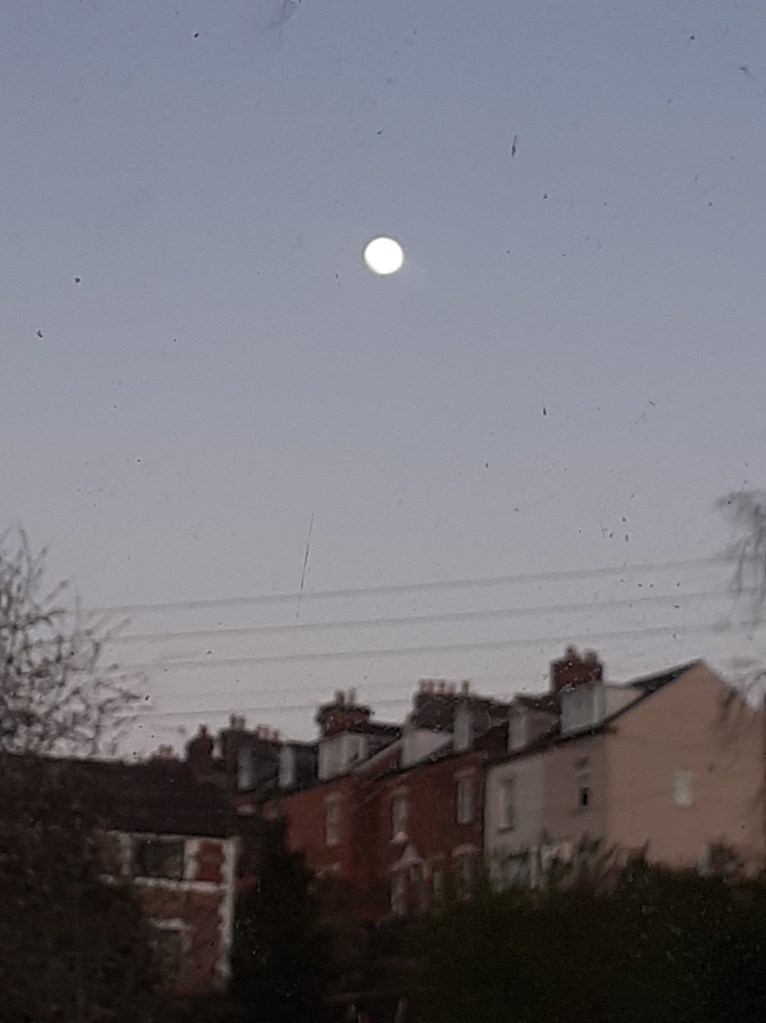
There is a world through my window. April has often been a magical month in my year, and 2020 need not be an exception. I link April with intensified and palpable greening, of soft sunsets at an attractive time of day. It is still happening out there and when I lose myself in the image it is happening in here too. Essentially there’s no difference. It is wonderful. of an evening, to follow the sunset process through its many stages of development.

I notice that, here in the UK, some attitudes to the current lockdown have been utilitarian to the point of puritanism. It is not enough for our behaviours to be safe in relation to Covid-19. They have to be ‘essential’, and it seems that essential activities can’t be tainted with any suggestion of idleness or pleasure. I can jog through a beauty spot, but I’m letting the side down if I sit down to rest or enjoy it – even if there’s no-one else around. This goes against everything we know about mental and emotional wellbeing, where such opportunities can be vital resources in the face of stress and depression.

I don’t like this and I am confident that I am right. Yet something in me has been influenced by this atmosphere and has started to feel that outdoors is a forbidden zone. When I do go out, I have to push against this and feel slightly transgressive. Of course, something else in me quite likes that, too. But it’s not the sort of enjoyment I’m really looking for, and I’m experiencing this whole cultural overlay – one that’s arisen so quickly – as saddening.

I like my home and garden and I can enjoy looking out through upstairs windows. I’m concerned that others don’t have this advantage and may be deprived of a vital safety valve. I am also aware that the lockdown has to work, especially since it was initiated later and more haltingly than the pandemic requires, and not in tandem with the testing and contact tracing that have been working well elsewhere. I understand the public policy difficulties in the place where we are.

One way or another, indoors or out, I will not miss out on the magic month of April and the merry month of May. After a rugged winter, I will open myself to nature’s change of energy.

THE BUBBLING SOURCE

“I am no longer your Master, because you have drunk, and become drunken, from the same bubbling source from which I spring.” From Saying 13, Gospel of Thomas (1).

In the Gospel of Thomas, Yeshua begins to treat Thomas as his peer. Asked by Yeshua “to what would you compare me?”, Thomas has replied, “Master, my mouth could never utter what you are like”. This reply contrasts sharply with Peter’s “you are like a righteous angel” and Matthew’s “you are like a wise philosopher”. Thomas has understood. He has dropped all his presuppositions and expectations. He has been able to meet Yeshua in living presence, at source. Whoever wrote this text is asking us to emulate Thomas, and therefore his teacher Yeshua. We all come from the same bubbling source, and are invited both to recognise this and live from the place of recognition. Peter and Matthew may remain constrained by limiting traditional narratives, but Thomas has understood, and two other disciples, Salome and Mary, are portrayed as being on the way.

Recently re-reading this story, I was moved by the force of the words ‘bubbling source from which I spring’. I am grateful to Jean-Yves LeLoup’s translation for this, because the standard academic translation speaks of the “bubbling spring that I have tended” (2), which for me lacks power in comparison. ‘Bubbling source from which I spring’ exactly describes my felt sense of ‘living presence’, recognising it in myself. In my formal practice, I work within a circle framework and I quickly grasped that it should be recognised as the power at the centre. Liturgically, I now greet it is ‘the bubbling source from which I spring and heart of living presence’. This feels right and good. It helps that ‘bubbling source’ is not specifically a water image in this translation. I am free to experience it internally, through my act of recognition, as a shift in energy and attention.

I feel as if I have integrated, or perhaps re-integrated, a depth dimension into the practice, and it feels richer. Since the Winter Solstice I have been closely following the wheel of the year. It represents the inheritance and continuing life of my Druidry. In many ways this is a naturalistic undertaking. But I am now powerfully reminded that my existing commitment to the flowing moment as my true home, and out of which these recent insights came, is not simply about living a slowed down time in a conventionally naturalistic sense. It is that – but it also allows the taste of timelessness and the sense of a primordial nature. The Thomas text reminds me of it. That I can recognise it is also partly thanks to my work in recent years with the practices of the Headless Way (3), the Direct Path (4,5), and Jeff Foster’s community (6). Ultimately this primordial nature is no-thing, but as no-thing it becomes everything, I discover a ‘bubbling source’. I seem to have reached a point where I can both integrate this learning and keep simple. Indeed the one seems to lead to the other. I am grateful that it is so.

(1) The Gospel of Thomas: the Gnostic Wisdom of Jesus (Translation from the Coptic, introduction and commentary by Jean-Yves LeLoup. English translation by Joseph Rowe. Foreword by Jacob Needleman). Rochester, VT: Inner Traditions, 2005

(2) The Gospel of Thomas: the Hidden Sayings of Jesus (New translation with introduction and notes by Marvin Meyer. Interpretation by Harold Bloom). San Francisco, CA: HarperSanFrancisco, 1992

(3) http://www.headless.org

(4) http://www.rupertspira.com

(5) http://www.greg-goode.com/

(6) http://www.lifewithoutacentre.com/

NOTE: This post continues a discussion begun at https://contemplativeinquiry.blog/2020/3/28/living-presence/ and continued at https://contemplativeinquiry.blog/2020/4/02/wisdom-writing/

Earth Eclectic

music that celebrates Earth and speaks to the heart

Sarah Fuhro Star-Flower Alchemy

Follow the Moon's Cycle

Muddy Feet

Meeting nature on nature's terms

Rosher.Net

A little bit of Mark Rosher in South Gloucestershire, England

Becoming Part of the Land

A monastic polytheist's and animist’s journal

selkiewife

Selkie Writing…

Charlotte Rodgers

Images and words set against a backdrop of outsider art.

Prof Jem Bendell

living with metacrisis and collapse

Towint

The pagan path. The Old Ways In New Times

The Druids Garden

Spiritual journeys in tending the living earth, permaculture, and nature-inspired arts

The Blog of Baphomet

a magickal dialogue between nature and culture

This Simple Life

The gentle art of living with less

Musings of a Scottish Hearth Druid and Heathen

Thoughts about living, loving and worshiping as an autistic Hearth Druid and Heathen. One woman's journey.

Wheel of the Year Blog

An place to read and share stories about the celtic seasonal festivals

Walking the Druid Path

Just another WordPress.com site

anima monday

Exploring our connection to the wider world

Grounded Space Focusing

Become more grounded and spacious with yourself and others, through your own body’s wisdom

The Earthbound Report

Good lives on our one planet

Hopeless Vendetta

News for the residents of Hopeless, Maine