Contemplative Inquiry

This blog is about contemplative inquiry

Tag: Deep Ecology

SACRED SOUNDSCAPES

“Concepts of animism can take many forms. … The idea of the land being capable of speaking to humans was probably widespread in ancient sensibility. Sacred soundscapes were simply a natural corollary.

“The basic notion of the land having speech, or being read like a text, was lodged deeply in some schools of Japanese Buddhism – in early medieval Shingon Esoteric Buddhism, founded by Kukei, for instance. He likened the natural landscape around the Chuzenji temple and the lake at the foot of Mount Nantai, near Nikko, to descriptions in the Buddhist scriptures of the Pure Land, the habitation of the buddhas. Kukei considered that the landscape not only symbolised but was of the same essence as the mind of the Buddha. Like the Buddha mind, the landscape spoke in a natural language, offering supernatural discourse: ‘Thus, waves, pebble, winds, and birds were the elementary and unconscious performers of the cosmic speech of buddhas and bodhisattvas,’ explains Allan Grapard (1994).

” …. ….

“Throat singers in Tuvan, an autonomous republic within the Russian Federation, developed their vocal art originally as a means of communicating with their natural environment, not for entertainment. Throat singing involves the production of resonant sounds, overtones and whistles within the throat, nasal cavities, mouth and lips, and was used to provoke echoes or imitate natural sounds like waterfalls or wind. The master throat singers can select precise locations inside caves where the resonances are exactly right to maximise the reverberations of their songs. They even wait until atmospheric conditions are perfect for the greatest effect. It is in essence a technology of echoes. At one locale, where a singer called Kaigal-ool performed in front of a cliff face, ethnomusicologist Theodore Levin reported that ‘the cliff and surrounding features sing back to the musician in what Kaigal-ool calls a kind of meditation, a conversation I have with nature‘ (Levin & Suzukei, 2006).

“It is only in our modern culture that we have stopped listening to the land within a spiritual context. If we could fashion a modern, suitably culturally-ingrained animistic model, we would treat the environment with much more respect.”

Paul Devereux, in his Foreword to Greening the Paranormal: Exploring the Ecology of Extraordinary Experience August Night Press, 2019. Edited by Jack Hunter. See: http://www.augustnightpress.com

BOOK REVIEW: DRUIDRY AND THE FUTURE

Highly recommended. Druidry and the Future is intended as “antidote to despair” according to author Nimue Brown. She continues:

Druidry & Future 51hWUITk4HL._AC_UY218_ML3_

“This book explores the many ways in which the Druid path can help us to respond to climate chaos, necessary cultural change and political uncertainty. By mixing the spiritual and practical we can be more resilient and resourceful, and aspire to live in regenerative and generous ways.”

An affordably priced and relatively slender volume, Druidry and the Future is full of ideas. It is built around 16 essays covering diverse topics: working with Pagan stories: seasonal living: bardic powers; ‘pragmatic’ animism; working with the elements (three essays); de-colonising your soul; your body is nature; justice and balance; honouring the divine through action; putting ourselves back in the landscape; community solutions; self-care and kindness; trees and wetlands; regeneration and restoration. For me, there is a single overarching theme: enlisting the resources of modern Druid culture to build resilience in the face of climate catastrophe. This resilience includes personal and collective aspects, where humans and their communities are understood as wholly embedded in the wider web of life.

Nimue Brown is clear that “it is not enough to be sustainable”. The crisis invites, or rather requires, a radical change in values and behaviour. Human civilization is ‘just people’ and we have the capacity to live differently. For her, “this is what Druidry means right now. It’s about answering the question of how to put civilization in balance with our living planet. This is Druidry for radical change and I think we’re well placed to take on this work and to inspire others. Philosophy has always been part of Druidry, so has teaching and communication, inspiration and vision. We can, and must make a difference.”

BOOK REVIEW: THIS IS NOT A DRILL, AN EXTINCTION REBELLION HANDBOOK

This post re-blogs a review from The Earthbound Report, where the book is is described and highly recommended by a reviewer currently setting up a local XR group.

It was due in September, but the publisher has taken an ’emergency’ approach to getting the Extinction Rebellion handbook ready. How much of that is a marketing opportunity I really couldn’t say, but it’s welcome and useful. (And I love the subversion of Penguin’s logo on the front cover.) I’m in the middle of helping […]

via Book review: This is Not a Drill, an Extinction Rebellion Handbook — The Earthbound Report

ARNE NAESS AS PHILOSOPHICAL VAGABOND

“Naess embodies the spirit of philosophy in its original sense as being a loving pursuit of wisdom. It is a deep exploration of our whole lives and context in pursuit of living wisely. The essence of Socratic inquiry is to know ourselves. From his work on Pyrrhonian scepticism to his … positive statements on pluralism and possibilism, Naess says he is a ‘philosophical vagabond’ or ‘wandering seeker’, what the ancient Greeks called a zetetic’” (1).

In 1968 Arne Naess (1912-2009) published Scepticism (2) two years before resigning as chair of philosophy at the University of Oslo to devote himself to environmental problems. Part of this book focuses on Sextus Empiricus (150-225 CE), the last recorded Pyrrhonist philosopher in a line going back to Pyrrho of Elis (c360-c272 BCE).

Pyrrhonists, as described by Sextus Empiricus, neither made truth claims nor denied the possibility of making them. Instead, they cultivated a deeply embedded attitude of suspension of judgement (epoche), allowing possibilities to stand open within the process of continuing inquiry. Such a turning away from the drive for intellectual closure enables peace of mind (ataraxia) in our engagement with the richness and diversity of experience. As Naess says, the Pyrrhonist philosopher “leaves questions open, but without leaving the question. He has however given up his original, ultimate aim of gaining peace of mind by finding truth because it so happened that he came by peace of mind in another way.” (2)

Naess was not himself a Pyrrhonist, but clearly valued the Pyrrhonist frame of mind. He took something from it into his later work, as is made clear in Alan Drengson’s introduction to Naess’s Ecology of Wisdom (1):

“… there is never one definitive interpretation of philosophical texts; there is never one description of an event and all processes are complex interactions involving changing forces and relations, internal and external. Experience and the processes around us form changing patterns or gestalts. The nature of reality is multidimensional and creative. … Our spontaneous experience is so rich and deep that we can never give a complete account of it in any language, be it mathematics, science, music or art … As a deep questioner and seeker, Naess remains free of dogmatic and monolithic doctrine about the world … [which]  partly explains why he celebrates a movement supported by diverse people with many world views”.

I enjoy this view of inquiry, and feel inspired to carry it forward more consciously in my own work. My sense is that it will bring my inquiry more into the world, without its losing its contemplative core.

(1) Arne Naess Ecology of Wisdom UK: Penguin Books, 2016 (Penguin Modern Classic. First published 2008)

(2) Arne Naess Scepticism Abingdon, UK: Routledge, 1968

See also:

https://contemplativeinquiry.wordpress.com/2019/04/27/pyrrho-scepticism-arne-naess/

https://contemplativeinquiry.wordpress.com/2019/04/25/spiritual-truth-claims/


PYRRHO, SCEPTICISM, ARNE NAESS

In my last post  https://contemplativeinquiry.wordpress.com/2019/04/25/spiritual-truth-claims/ ‎I introduced Pyrrho of Elis, a Pagan Greek philosopher who, returning from an extended visit to India, sounded a new note in Greek philosophy. In the Greek cultural context, this was heard as a variant form of Scepticism. Originally a skeptikos was “a seeker, one who inquires or examines, considers, deliberates etc.” (1) though over time Scepticism came to signify a kind of compulsive doubting, as it does now. The extract below shows the distinctiveness of Pyrrho’s project, and its likely debt to Buddhist ideas of the time.

“Pyrrhonism is commonly confused with Scepticism in Western philosophy. But unlike Sceptics, who believe there are no true beliefs, Pyrrhonists suspend judgement about all beliefs, including the belief that there are no true beliefs. Pyrrhonism was developed by a line of ancient Greek philosophers, from its founder Pyrrho of Elis in the fourth century BCE through Sextus Empiricus in the second century CE. Pyrrhonists offer no view, theory or knowledge about the world, but recommend instead a practice, a distinct way of life, designed to suspend beliefs and ease suffering. Since beliefs are attachments to what is not evident, they say, and are therefore distorting, uncertain, and subject to challenge and contradiction, they generate anxiety and fear, compounding suffering. By suspending judgement on beliefs, Pyrrhonists seek to liberate themselves from attachment to things nonevident; having achieved this, they claim a certain tranquillity (ataraxia) follows. Only appearances are evident, they say, these being sensations and thoughts which we cannot help having, which are involuntary, and it is by them rather than by our beliefs that we should live.

“Pyrrhonism bears a striking similarity to some Eastern non-dogmatic soteriological traditions, particularly Madhyamaka Buddhism. Indeed, its origins can plausibly be traced to the contacts between Pyrrho and the sages he encountered in India, where he travelled with Alexander the Great. Even though Pyrrhonism went on to develop in a Greek idiom without reference to Eastern traditions, the similarity is remarkable, suggesting a commonality of insight not much explored. Although Pyrrhonism has not been practised in the West since ancient times, its insights occasionally have been independently recovered, most recently in the work of Ludwig Wittgenstein. They remain relevant, perhaps more than ever, as an antidote to today’s cultures of belief.” (1)

Arne Naess, the Norwegian philosopher now associated with the the deep ecology movement and coiner of the term ‘ecosophy’, was a modern admirer of Pyrrhonism and wrote a book about it in 1968 (2). I intend to follow this up in my continuing inquiry, partly to find out how his engagement with Pyrrho and Greek Scepticism may have informed his later development..

  1. Adrian Kuzminski Pyrrhonism: How the Ancient Greeks Reinvented Buddhism New York: Lexington Books, 2008
  2. Arne Naess Scepticism Abingdon: Routledge, 2015 (First published 1968)

See also:

https://contemplativeinquiry.wordpress.com/2019/05/03/arne-naess-as-philosophical-vagabond/


WELL-BEING: CONTEMPLATING ACTION

“In The Spirit Level Richard Wilkinson and Kate Pickett put inequality at the centre of public debate by showing conclusively that less equal societies fare worse than more equal ones across everything from education to life expectancy. The Inner Level explains how inequality affects us individually, how it alters how we think, feel and behave. It sets out the overwhelming evidence that material inequities have powerful psychological effects: when the gap between rich and poor increases, so does the tendency to define and value ourselves and others in terms of superiority and inferiority. A deep well of data and analysis is drawn upon to empirically show, for example, that low social status is associated with elevated levels of stress hormones, and how rates of anxiety and depression are intimately related to the inequality which make that status paramount.” (1)

What links contemplation and action? My answer is creative and powerful ideas. In a recent post (2), I cited Brendan Myers (3) proposition that a flourishing life is ethically desirable and good (a powerful, creative idea), and that it depends on us supporting each other’s well-being and that of the biosphere and the Earth itself (another powerful creative idea). The Spirit Level and The Inner Level concern ‘developed’ countries in the 21st century and to an extent the last two decades of the 20th. They paint a depressing picture, especially for the U.K. and the U.S.A, and for me it shows the need to champion a social ecology that supports health and well-being.

For some years I worked at the interface between public health (i.e. population-based health, largely concerned with prevention work and the creation of more supportive environments) and mental health. So, I am interested in the recent publication of The Inner Level (4) and may write further about it. Thinking about ‘health’ in the bigger picture (with service provision as only one aspect) is a positive way into social justice work, where powerful ideas can (in principle) be realised through ethical passion and political will informed by scientific evidence. It is a notion of how to do public policy that needs to be kept alive.

I know this doesn’t happen much, now, in a culture like ours with high levels of bullying, confusion, distraction and misinformation. We seem to be living with an orchestrated dumbing down of political discourse in the service of oligarchic interests. So, my first action – not always recognised as action – is personal resistance to any onset of cynicism, numbness and despair within myself. My second action – also not always recognised as action – is to work at maintaining an adequate level of knowledge and understanding of what is happening in the world, using the lens of ‘powerful ideas’ to make sense of the information I digest. This includes having an historical perspective – both backwards and forwards – on current events. My third action is to place myself within networks that share my concerns and are responding to them in diverse ways – hopefully modelling cultures of: compassion (including ruthless compassion); openness and creativity; curiosity about the world; and criticality (deconstructive where necessary and appreciative where possible) in the realm of ideas and action. Further developments will come from there, and I will write about them within this blog.

Over time my contemplative life has moved towards a blend of energy work and meditative connection to source, with the practice forms kept simple. It is also the clear, awake space out of which I act in the world.

(1) https://www.equalitytrust.uk/

(2) https://contemplativeinquiry.wordpress.com/2018/07/02/ethics-and-civilization/

(3) Brendan Myers Reclaiming Civilization: A Case for Optimism for the Future of Humanity Winchester, UK & Washington, USA: Moon Books, 2017

(4) Richard Wilkinson and Kate Pickett The Inner Level: How More Equal Societies Reduce Stress, Restore Sanity and Improve Everyone’s Well-being

SACRED ACTIVISM IN A DARK TIME

Book review of Savage Grace: Living Resiliently in the Dark Night of the Globe, by Andrew Harvey and Carolyn Baker. The book has a U.S. centre of gravity and was written in the early months of 2017, triggered by Donald Trump’s assumption of the presidency.

The ‘dark night of the globe’ refers to an increasing risk of a wrecked biosphere (including human extinction) through runaway climate change or nuclear war. In such a scenario, resilience is a key quality demanded of us. They authors define this as a ‘life-giving ability to shift from a reaction of denial or despair to learning, growing and thriving in the midst of challenge’. The emphasis of this book is as much on essential psycho-spiritual resourcing as it is on direct political action. The authors see these as belonging together, recommending a staged strategy of reconnection, resistance, resilience and regeneration to its readers.

‘Reconnection’ is much like the ‘re-enchantment’ we talk about in Druidry. It is a response to disconnection from “our sacred inner wisdom, from all other living beings as a result of our delusional belief in separation, and from Earth and the reality that we are not only inherently connected with Earth, but, that in fact, we are Earth”.

‘Resistance’ is, first, about discerning “the nature of the myriad enemies of the mind, body and spirit with which we are being confronted in the current milieu” and to learn how to stand for “transparency and integrity in the face of massive assaults on our fundamental humanity”.

‘Resilience’ needs to be cultivated physically, emotionally and spiritually as an “essential life skill” in the face of increasing dangers and uncertainties in our communities and world.

‘Regeneration’ is about committing “to living lives of regeneration in all stages, even in what could be the terminal one”. If humanity is destined to vanish, “what matters most is not the outcome of our efforts, but rather, our inmost intention”.

Savage Grace is built around five main chapters. The first, Kali Takes America, explores the image of a country archetypally possessed by the dark side of the destroyer/creator goddess. Here ‘reconnection’ is about finding transformative possibilities within this predicament. The adoption of Savage Grace as the title owes something to this. Here the authors cite the work of Vera de Chalambert, which can also be found on https://youtube.com/results?search_query=vera+de+chalambert+kali/

The second chapter, Resisting the Modern Face of Fascism in the Age of Trump contains most of the social and political analysis offered in this book. It usefully draws on a 14-point list, devised by Umberto Eco in the 1990’s. on what ‘Fascism’ can be usefully thought to mean, and what makes it dangerous and wrong, given that it will look different in every incarnation, depending on time and leadership. (Eco grew up under Mussolini.) For strategies of resistance, they draw on Naomi Klein’s No Is Not Enough*, already published by the time Savage Grace was completed.

The remaining chapters are entitled Living Resiliently Amid Global Psychosis; Regeneration: the Legacy of Love in Action; and Celebrating Reconnection, Resistance, Resilience and Regeneration. These explore the building of psycho-spiritual resources at the personal, interpersonal and collective levels, and can be successfully accomplished only by looking at our own shadow sides. Otherwise we simply project them on to our opponents.

Savage Grace is written with urgency by authors who have been addressing its core themes for many years. I highly recommend it to anyone who acknowledges the personal and political, inner and outer, mundane and spiritual realms as facets of one interconnected life. No convenient compartmentalizing here. Savage Grace is a document for our historical moment. It asks readers to reflect on where we stand and how we are responding.

 Andrew Harvey and Carolyn Baker Savage Grace: Living Resiliently in the Dark Night of the Globe. Bloomington, IN: iUniverse, 2017 . (Foreword by Matthew Fox)

For further information about the authors see: www.andrewharvey.net/sacred-activism/  and https://carolynbaker.net/

*Naomi Klein No Is Not Enough: Defeating the New Shock Politics Penguin Random House UK, 2017

GARY SNYDER: ‘WILD’

“The word wild is like a grey fox trotting off through the forest, ducking behind bushes, going in and out of site. Up close, first glance, it is ‘wild’ – then further into the woods next glance it’s ‘wyld’ and it recedes and it recedes via Old Norse villr and Old Tuetonic wilthijaz into a faint pre-Tuetonic ghweltijos which means, still, wild and maybe wooded (wald) and lurks back there with possible connections to will, to Latin silva (forest, sauvage) and to the Indo-European root ghwer, base of Latin ferus (feral, fierce), which swings us around to Thoreau’s ‘awful ferity’ shared by virtuous people and lovers. The Oxford English Dictionary has it this way:

Of animals – not tame, undomesticated, unruly

Of plants – not cultivated

Of land – uninhabited, uncultivated

Of foodcrops – produced or yielded without cultivation

Of societies – uncivilized, rude, resisting constituted government

Of individuals – unrestrained, insubordinate, licentious, dissolute, loose. “Wild and wanton widowes”, 1614

Of behavior – violent, destructive, cruel, unruly

Of behavior – artless, free, spontaneous. “Warble his native wood-notes wild” – John Milton

Wild is largely defined in our dictionaries by what – from a human standpoint – it is not. It cannot be seen by this approach for what is is. Turn it the other way:

Of animals – free agents, each with its own endowments, living in natural systems

Of plants – self-propagating, self-maintaining, flourishing in accord with innate qualities

Of land – a place where the original and potential vegetation and fauna are intact and in full interaction and the landforms are entirely the result of non-human forces. Pristine.

Of foodcrops – food supplies made available and sustainable by the natural excess and exuberance of wild plants in their growth and in the production of quantities of fruit and seeds

Of societies – societies whose order has grown from within and is maintained by the force of consensus and custom rather than explicit legislation. Primary cultures, which consider themselves the original and eternal inhabitants of their territory. Societies which resist political and economic domination by civilization. Societies whose economic system is in a close and sustainable relation to the local ecosystem

Of individuals – following local custom, style and etiquette without concern for the standards of the metropolis or nearest trading post. Unintimidated, self-reliant, independent

Of behavior – freely resisting any oppression, confinement or exploitation. Far-out, outrageous, ‘bad’, admirable.

Of behavior – artless, free, spontaneous, unconditioned. Expressive, physical, openly sexual, ecstatic

Most of the senses in this second set of definitions come close to being how the Chinese define the term Dao, the way of Great Nature: eluding analysis, beyond categories, self-organizing, self-informing, playful, surprising, impermanent, insubstantial, independent, complete, orderly, unmediated, freely manifesting, self-authenticating, self-willed, complex, quite simple. Both empty and real at the same time. In some cases, we might call it sacred. It is not far from the Buddhist term Dharma with its original senses of forming and firming.”

Gary Snyder The Practice of the Wild Berkeley, CA: Counterpoint, 1990

In a preface to the 2010 edition, Gary Snyder describes his path as “a kind of old time Buddhism which remains connected to animist and shamanist roots. Respect for all living beings is a basic part of that tradition. I have tried to teach others to meditate and enter into the wild areas of the mind. … Even language can be seen as a wild system”.

DOVE ENERGY

Guanyin is the Bodhisattva of compassion, who hears the cries of the world. In Chinese iconography, she is sometimes portrayed as seated on a lotus, holding a jar that contains pure water. It is the divine nectar of life, compassion and wisdom. She also has a small willow branch, to sprinkle on devotees and bless them with spiritual and physical peace. The willow teaches the wisdom of knowing how to bend rather than break, and has a history of use in Chinese shamanic and medical practice.

Often depicted as a woman in white (signifying purity and maternity) Guanyin may also have doves flying towards or around her. Doves are associated with fecundity, marital fidelity and longevity. There was a tradition of awarding a jade sceptre with the figure of a dove to people who reached the age of 70. Ritualized dove releases were used as a means of warding off evil. The Lotus Sutra (1) contains a chapter on the transformations of Avalokitesvara, Guanyin’s male alter-ego, travelling the world and “by resorting to a variety of shapes”, conveying beings to salvation.

I feel increasingly that Guanyin represents the same archetypal energy as Sophia, the Gnostic “mother of angels” (2). In my icon of Sophia, she holds a chalice at heart level, and a dove sits in it, facing out. When I had a Temple of Sophia practice, she often appeared in dove form rather than anthropomorphically. She inherits dove symbolism from the Goddesses of the Eastern Mediterranean, and from Jewish culture, again with dove symbolism, derives the role of revealing God’s inward thought, and communicating insight and knowledge to mankind.

For me it is as if a dove energy has relocated me to a new practice community. The opportunity to work more systematically on lovingkindness and compassion than heretofore, yet in a gentle unforced way. Hence the cultural change of garment from ‘Sophia’ to ‘Guanyin’. Early this year I had two episodes of active imagination (open waking dreams rather than structured guided meditations). In the first, I was a mouse in the talons of an owl, flying over water to an unknown destination. I knew that the owl was Sophia. In the second, I was under the tutelage of Sophia on a small ocean-going yacht. Here too, I didn’t know the destination. I remember her asking me to contemplate my existing resources, and I thought of Russel Williams talking about “stillness, pure consciousness, emptiness of being – based on sense-feeling, and filling the emptiness with lovingkindness” (3).

Some months later I contacted the Community of Interbeing. It’s a Mahayana Buddhist community, and so under the aegis of Guanyin, and is proving a good place to be. Beyond its regular meetings, there have been two spin-offs. The first is my Mindful Self-Compassion course (4). The second is a recent retreat with members and friends of my sangha. The theme was ‘embodiment’. The purpose was to make Buddhist practice more somatically aware and Earth honouring. We spent a significant amount of time outside and making use of local topography. It was very like my outdoor experiences of contemplative Druidry and included the same sensitivity to the politics of Deep Ecology In terms of Dove guidance, I feel that I have landed now, and I simply go on from here.

(1) The lotus sutra: saddharma-pundarika Translated by H. Kern, 1884 (Kindle edition)

(2) Jean-Yves Leloup The gospel of Philip: Jesus, Mary Magdalene, and the gnosis of the sacred union. Rochester, VT: Inner Traditions, 2003 (Translation and commentary from the Coptic. English translation, Joseph Rowe. Forward by Jacob Needleman)

(3) Russel Williams (2015) Not I, Not Other than I: the Life and Spiritual Teachings of Russel Williams (Edited by Steve Taylor) Winchester & Washington: O Books

(4) https://centerformsc.org/

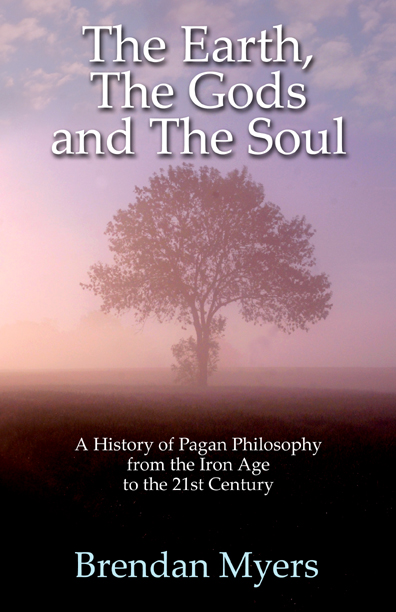
BOOK REVIEW: THE EARTH, THE GODS AND THE SOUL

jhp51efa580a1aafThe Earth, the Gods and the Soul: a History of Pagan Philosophy, from the Iron Age to the 21st Century by Brendan Myers fully justifies the ambition of its title. I see it as a must-read for anyone with an interest in pagan ideas and culture – past and present. Part of the author’s  mission is to demonstrate that “a pagan culture can be artistically vibrant, environmentally conscious, intellectually stimulating, and socially just”.

Myers provides useful working definitions of both ‘pagan’ and ‘philosophy’, whilst also showing the complexities involved in each term. He limits ‘pagan’ to people in the nations of the west and their predecessor societies in Europe and the Mediterranean, whose religion is non-Abrahamic (not Judaism, Christianity and Islam). This may now be complicated by patterns of migration and the Western impact of dharmic religions, but it works well enough if you are looking for a specific pagan tradition and its origins. Modern paganism, according to Myers, is informed by three families of ideas – pantheism, neo-Platonism, and humanism: these address the “immensities”, respectively, of Earth, Gods and Soul.

‘Philosophy’, for Myers, is an intellectual discipline that seeks answers to the ultimate questions about ‘life, the universe and everything’ using reason rather than the authority of dogma or an intuited divine source. He usefully lists 7 branches of this discipline: logic, ethics, epistemology, metaphysics, phenomenology, aesthetics and the history of ideas. Western philosophy’s origins are in Greece, and linked to the ‘know yourself’ injunction outside the temple of the Delphic Oracle. Myers sees this as a basic ethical demand for an honestly examined life, especially when wishing to enter the presence of a god. It leads to a wider view that self-knowledge heals, enlightens and empowers, though it may also at times judge and condemn.

The book is arranged as if musically, in an overture and six movements. The people chosen for inclusion are in many cases neither philosophers not pagans, and in many others only one of the two. But they have helped to define modern pagan ideas, culture and sensibility. Each movement covers a different historical period:

  1. A look at the old northern (‘barbarian’) world includes the Anglo-Saxon poem The Wanderer, Iceland’s Elder Edda, early writings about Druids, Irish wisdom texts and the Pelagian heresy (an early Christian heresy popular in the Celtic lands). There is no direct voice from a pagan culture in north west Europe, so Christians with half a foot in the old pagan world, or (in the case of the Druids) Greek and Roman authors are cited.
  2. A substantial collection of pagan Greek or Greek influenced philosophers from the early pre-Socratic period to the pagan martyr Hypatia of Alexandria. Also included are the Irish Christian neo-Platonist John Scotus Eriugena, and a section on the much later Italian renaissance. The people in this section, up to and including Hypatia, are both pagans (as we use that word today)and philosophers (in the ancient Greek understanding of that term).
  3. This movement is called ‘Pantheism in the Age of Reason’ and includes 18th century figures like John Toland, Edward Williams (aka Iolo Morganwg) and the Platonist and translator Thomas Taylor – as well as the more famous Jean-Jacques Rousseau. For the nineteenth century, we have Emerson, Thoreau, Whitman, Schopenhauer and Nietzsche.
  4. A movement on pagan ‘resurgence, reinvention and rebirth’ begins with Helena Blavatsky and the launch of 19th century Theosophy, going on to include J.G. Fraser of The Golden Bough, Robert Graves of The White Goddess, George William (A.E.) Russell of A Vision and Aleister Crowley. It goes on to look at the background to Gerard Gardner’s work and the Book of Shadows, then at the appearance of American Feminist Witchcraft and also at the separate stream of Eco-Spirituality and Deep Ecology.
  5. The fifth movement comprises ‘living voices’, so Stewart Farrar and Isaac Bonewits are placed at the end of the fourth, whereas Janet Farrar and Gavin Bone appear here. So too do Starhawk, Emma Restall-Orr, John Michael Greer, Vivianne Crowley, Michael York and Gus diZerega. There is also a section on ‘the critique of monotheism’. Myers praises Emma Restall-Orr for her work on ethics, its spirit of critical inquiry and her formal use of philosophical sources.
  6. Here we find Brendan Myers’ personal commentary. He talks about a hoped-for development of a critical tradition on paganism, and the value of ‘institutions’ in maintaining such a tradition. (He acknowledges that this may go somewhat against the grain of paganism as a dissident culture). He talks about modern to paganism’s history of ‘faulty ideas’, and promotes the development of better ideas for the future.  He also celebrates the health of a ‘will to live in an enchanted world’. Myers has ‘no special teachings’ of his own. A declared pagan philosopher, he builds his personal inquiry around four questions: how shall I dwell upon the earth? How shall I converse with all people? How shall I emerge from my loneliness? How shall I face my mortality? He then goes on to discuss what these questions bring up for him.

Myers ends his book by saying: “the best music is made with humanity, integrity and wonder – everyone has instruments to hand … When I hear music I share it … when I make music I share it too … I hope that my people will celebrate with me and play along … when I make dissonant or offending sounds, I trust my people will warm me, so I can make amends … nothing more, perhaps, could be asked of anyone. And, perhaps, nothing less”.

The Earth, the Gods and the Soul is a well-informed and simply written history of pagan ideas, which tells modern pagans a lot about the shoulders we sit on. It is a great reference book. But what it did mostly for me was to get me thinking about my own relationship to philosophy and its working methods. I call my own journey a contemplative inquiry. How could I use tools from philosophy’s  toolkit to improve my own inquiry in service of a pagan critical tradition? That’s where there’s an inspiration for me – because I sense an invitation there, from a professional philosopher, to make use of this toolkit. Myers’ forward includes a reference to Clear and Present Thinking, written by him with support from a number of University colleagues for a general audience, and freely downloadable. It’s another good job, and very useful to have.

Earth Eclectic

music that celebrates Earth and speaks to the heart

Sarah Fuhro Star-Flower Alchemy

Follow the Moon's Cycle

Muddy Feet

Meeting nature on nature's terms

Rosher.Net

A little bit of Mark Rosher in South Gloucestershire, England

Becoming Part of the Land

A monastic polytheist's and animist’s journal

selkiewife

Selkie Writing…

Charlotte Rodgers

Images and words set against a backdrop of outsider art.

Prof Jem Bendell

living with metacrisis and collapse

Towint

The pagan path. The Old Ways In New Times

The Druids Garden

Spiritual journeys in tending the living earth, permaculture, and nature-inspired arts

The Blog of Baphomet

a magickal dialogue between nature and culture

This Simple Life

The gentle art of living with less

Musings of a Scottish Hearth Druid and Heathen

Thoughts about living, loving and worshiping as an autistic Hearth Druid and Heathen. One woman's journey.

Wheel of the Year Blog

An place to read and share stories about the celtic seasonal festivals

Walking the Druid Path

Just another WordPress.com site

anima monday

Exploring our connection to the wider world

Grounded Space Focusing

Become more grounded and spacious with yourself and others, through your own body’s wisdom

The Earthbound Report

Good lives on our one planet

Hopeless Vendetta

News for the residents of Hopeless, Maine