It is very close to the turn of the year. The sun is now setting on 2024. The sunset pictures above and below are from 15 December at 4pm, taken from a balcony window. Vivid imagery after long days of sunless grey. It feels weird and alien, almost as if I’m looking out on another planet. 2024 has often felt like that, at times beautiful, at times scary and disorienting, at times a test of endurance.
Looking back at 2024 in a seasonal but non-festive way, I find a hard year with extraordinary moments. Personally, it was dominated by my wife Elaine’s accident in Gran Canaria and her gradual and ongoing recovery. A roller coaster of a year. Currently I feel good about my spiritual inquiry and practice, which I experience as a great blessing. But I do not want to impose any expectations on 2025. Let the new year be what it will.
Stars in a night sky. Candles in a dark room. Cleverly crafted decorations for Yule. These, for me, are ideal images of light in winter. When I came into Druidry, I was moved by the liturgical use of the phrase ‘the illumination of lights’. In a reality of many lights, which can also be a reality of one light and many lamps, the light is not overwhelming.
Darkness makes light bearable when containing a plurality of lights. There is space for freedom here, and likewise space for relationship and connection. This winter, I am not energetically hibernating, as I sometimes do. I find myself going deeply into Innerworld landscapes and connections in a way I have become unused to in recent years. Yet I do not feel alone or self-absorbed. I feel like a little light in a field of lights, each contributing its own individual illumination to the field, whist nested in a nurturing dark. It feels like the right focus for the time of year, and the end of 2024.
In my Druid circle, I associate the northern quarter with faith. The quality and context of faith are not defined. They could simply mean faith in the practice and path. My contemplative inquiry overall has tended towards a stance of ‘sacred agnosticism’ (1), in which faith is not emphasised. This has served me in many ways. I have avoided mixing up the idea of ‘faith’ with affiliation to authoritarian movements, mandated beliefs, or the surrender of self-responsibility and personal discernment. I have been alert to the metaphysical group think and consensus collusion that can show up in any spiritual movement (other kinds of movement too). I have done my best to gather and evaluate information skilfully, when developing principles about how to live ethically and gracefully in an increasingly scary world.
And yet … this is not the whole story, or I would feel spiritually malnourished. In recent months I have experienced a strong felt sense of the divine. When I describe myself as ‘living presence in a field of living presence in a more than human world’ – an animist identification – the identification now seems more than animist, though the animism is still there. I pray more congruently to the Goddess as Ancient Mother and talk, less anthropomorphically, about the ‘bubbling source from which I spring’. The Divine is beyond name, form or description – and some people prefer a specialist, capitalised use of rather abstract terms like Consciousness, Awareness, Void, Ground of Being. But the ones from my own practice are the ones that work for me. They come from the intuitive heart and the imagination. To me they offer a deeper knowing, though I am personally cautious about the use of the word gnosis. For me, it can reduce the sense of mystery, banishing the creative role of faith itself.
I have become a provisional panentheist, experiencing intimations of a divine which is everywhere and no-where, and from which we are not separate. This partly reprises work I did in the earlier days of my inquiry using the framework of non-duality. Now I find panentheism a better term than non-duality for affirming both the divine and the world. The earth spirituality in the Druid tradition is in no way compromised by a panentheist perspective. If anything it is enhanced.
This post is about Hillfield Gardens (1,2) and the taste of psychic rejuvenation. Just being there, actively opening to the elemental energies of place and time, I felt confident, happy and strong.
The early morning of 20 November was misty and dark in a slushy, miserable kind of way; closed in and confining rather than magical and mysterious. Elaine and I catastrophised together in gloomy harmony about skies made unfriendly by perpetual drizzle and pavements made treacherous by hidden ice. The term stir crazy came up for me. We have begun to expect fresh air and activity outside the home. This time we planned to be in separate spaces. They are good in themselves and healthy for us as a partnership. So the tension of anticipated disappointment was in the air, for a long moment in a dull morning.
Then everything changed, with clear blue sky and sun. After an early lunch, I could wheel Elaine to her creative arts event and then fully stretch my legs in a walk to Hillfield Gardens. When I got there I slowed down again and shifted from a doing mode to a being mode. I became porous to the world – at once disappearing into it and expanding to embrace it. The snow on the ground looked beautiful to me and a crinkly fallen leaf both modified the picture and enhanced the look. William Blake once famously wrote: “if the doors of perception were cleansed, everything would appear as it is, infinite” This brief eternal time (being in two worlds at once) – with the snow on the ground, and the fallen leaf – was like that, or at least something which pointed towards it. I feel tremendous gratitude for the experience. In its afterglow, I found myself feeling confident, happy and strong.
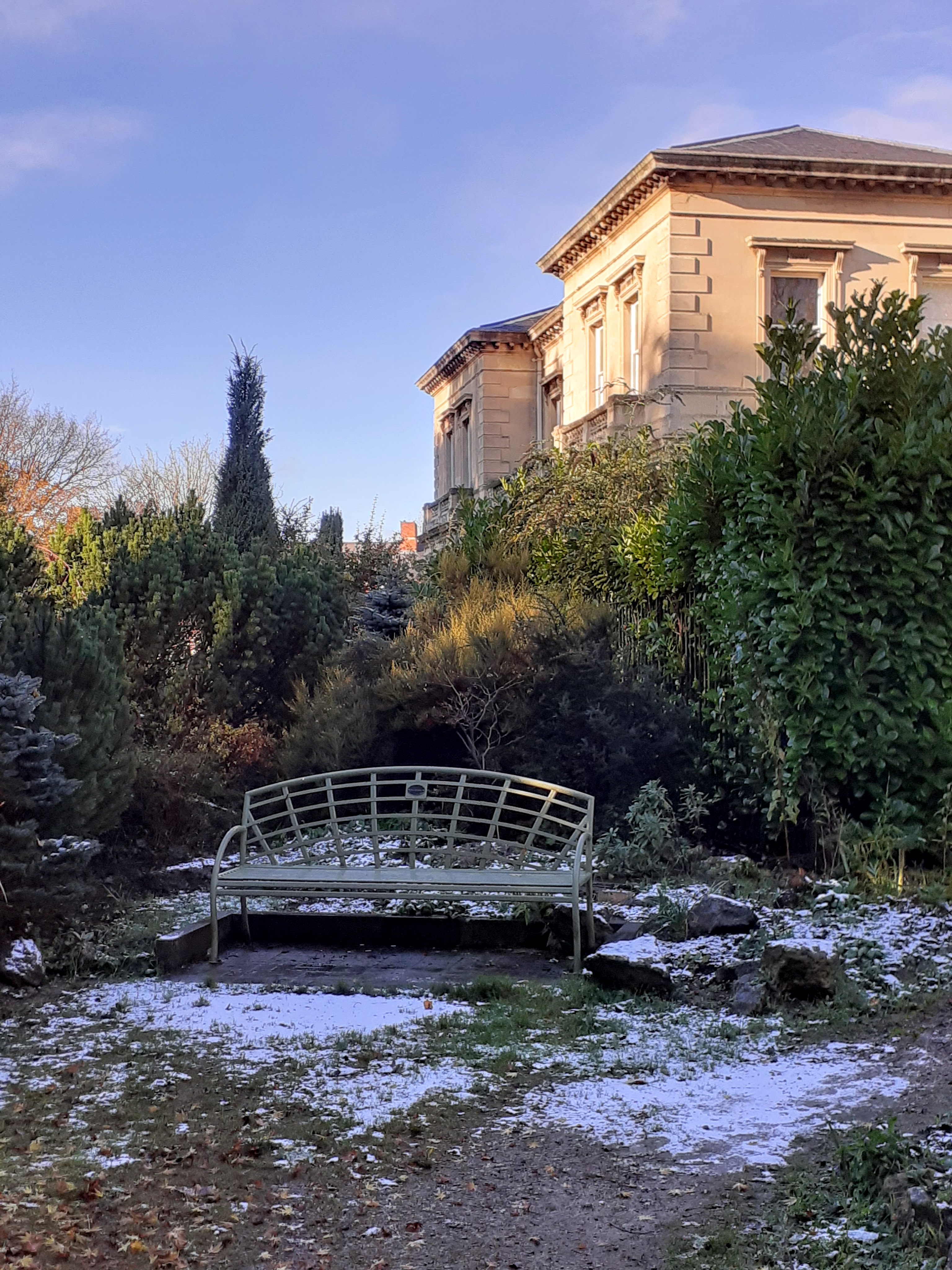
At a reduced level of intensity, I continued my walk. Below, My attention was drawn by a seat, and the snow around it, in a secluded corner of the gardens. Sun shone freely on the buildings, and the bushes, but reached only a small area on the seat.
In the most wooded and unmanicured section of the gardens, I found snow still present on a section of cleared space and pathway. Elsewhere there was no trace of it, even in this relatively shadowed space.
On the buildings below – blue sky, sun and shadow. In the picture below snow is just discernible on a rooftop and in a garden. During the period of my walk (1-1.30 pm) the gardens visibly changed. The snow was retreating and shadows continued to shift.
It wasn’t a long walk – twenty minutes each way for the sake of my legs and thirty in the garden. It was enough. I took away the psychic rejuvenation I named at the beginning of this post. The experience was both mystical and ordinary, a place where the ‘spiritual’ and ‘mundane’ are one – and big part of how I live my Druidry.
(2) NOTE: At the beginning of April 2024 I discovered Hillfield Gardens – a little outside the centre of Gloucester, yet still in easy walking distance (or an easy bus ride) from where I live. Originally the gardens of a large house, Hillfield Gardens are about 1.6 hectares in extent. They are managed by a Friends Group on behalf of Gloucestershire County Council. For me the gardens are a tranquil space, different in feeling-tone from other local parks.
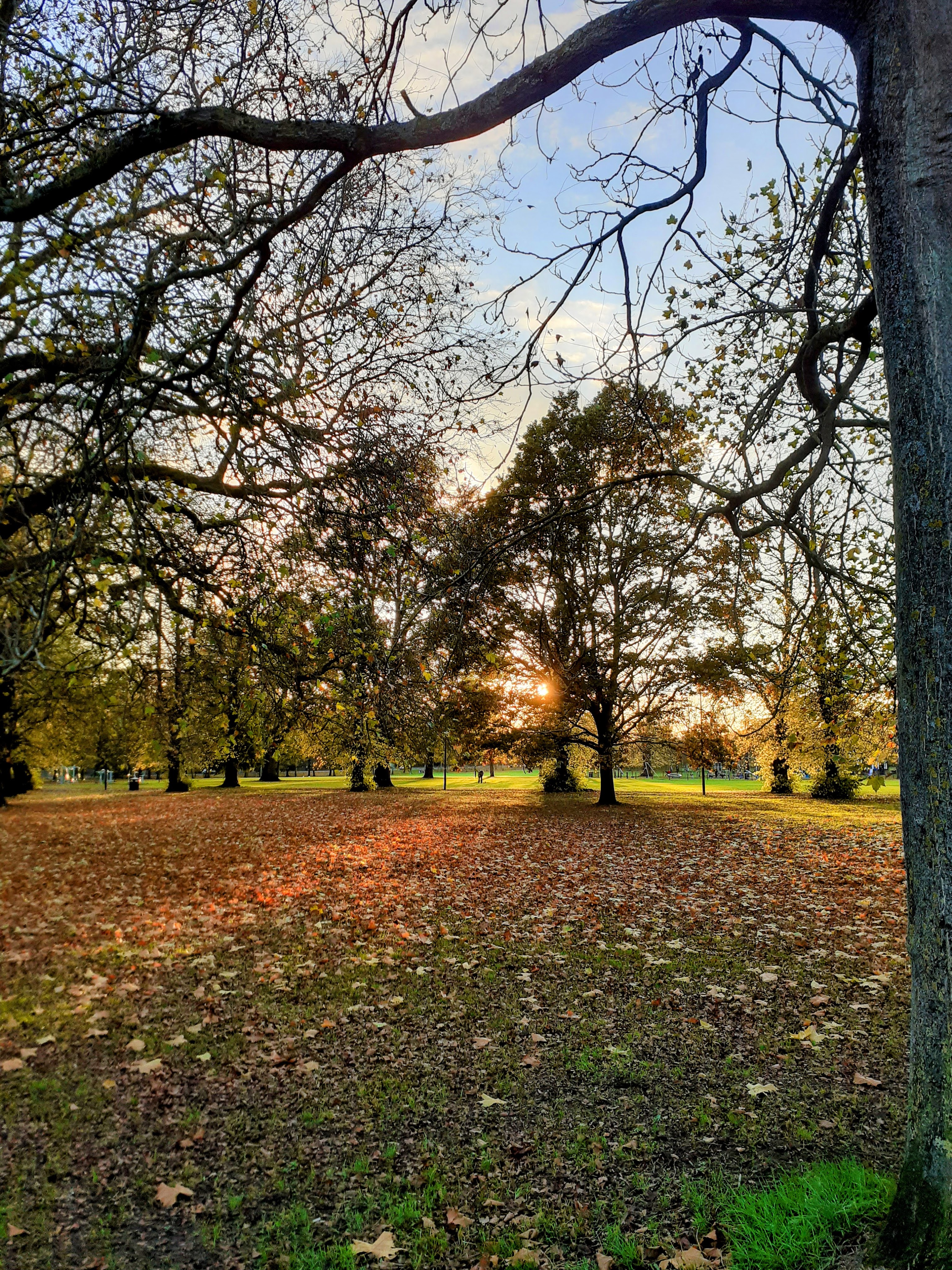
It’s about 3.45 pm on Thursday 14 November. For a few precious days there has been blue sky and a visible sun in my neighbourhood. But the days themselves are short and the sun is already falling in the sky. Its rays are brightly visible and they beautifully catch the leaves – those still on their trees, and those already on the ground. But much of the ground, apart from the carefully tended green lawns, is darker and more shadowy. It feels like a last hurrah of autumn before it gives way to winter.
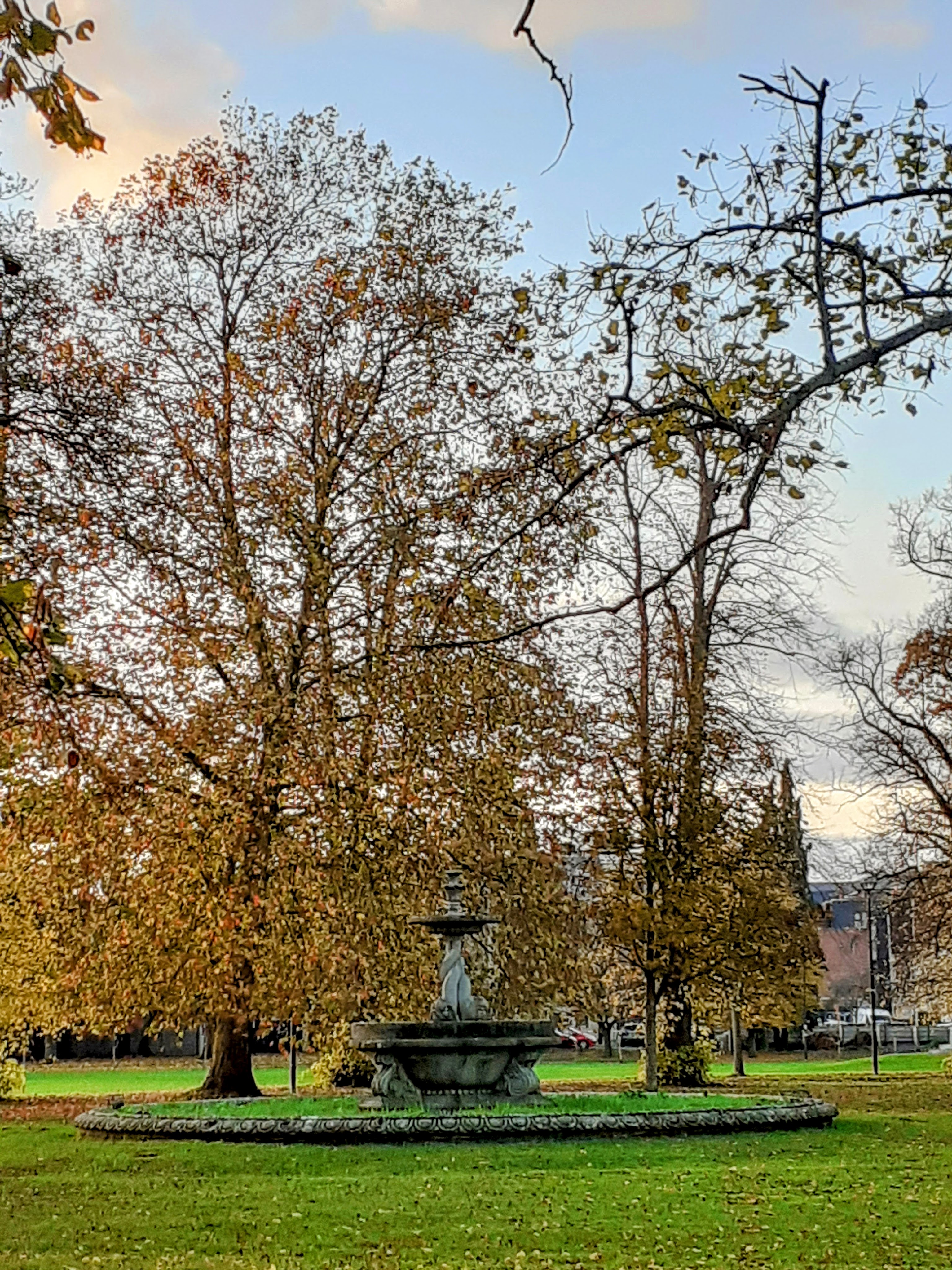
I enjoy the park and the way that it is laid out. It is highly used and valued, and an important lung for the city. I am glad to have it here in Gloucester. Today is a quiet time, good for contemplation. It is easy to walk to from where I live and a good place to be with the land and the trees. My visits don’t require long periods of time or present much physical challenge. This is good for me at a time when I am unavailable for heroic physical journeys but very open to the magic of what is.
“Contrary to the current genetic determinism that sees increased longevity as a wasted aberrance created by civilisation, The Force of Character presents an explosive new thesis: the changes of old age, even the debilitating ones, have purposes and values ordained by the psyche. The older we become, the more our true natures emerge. Thus the final years have a very important purpose: the fulfilment and confirmation of character.” (1)
I have known and walked with James Hillman’s book for a number of years, but only recently have I felt it coming into its own in my life. Hillman, originally a pupil of Carl Jung, went on to found his own school of Archetypal Psychology – a psychology which remembers that ‘psyche’ first meant ‘soul’. He describes his own journey as about challenging what he sees as limiting beliefs that “clamp the mind and heart” (1) into positivistic science, bottom-line capitalism and religious fundamentalism.
I am growing old and experiencing frailties together with a beloved partner in the same position. What is happening in the depths of my psyche? I notice that I do not perceive a single entity here, but multiple aspects, including a dialogue between youth and age. Both have always been present. But their roles have changed. I now find myself seeking them out, engaging with them and listening to them.
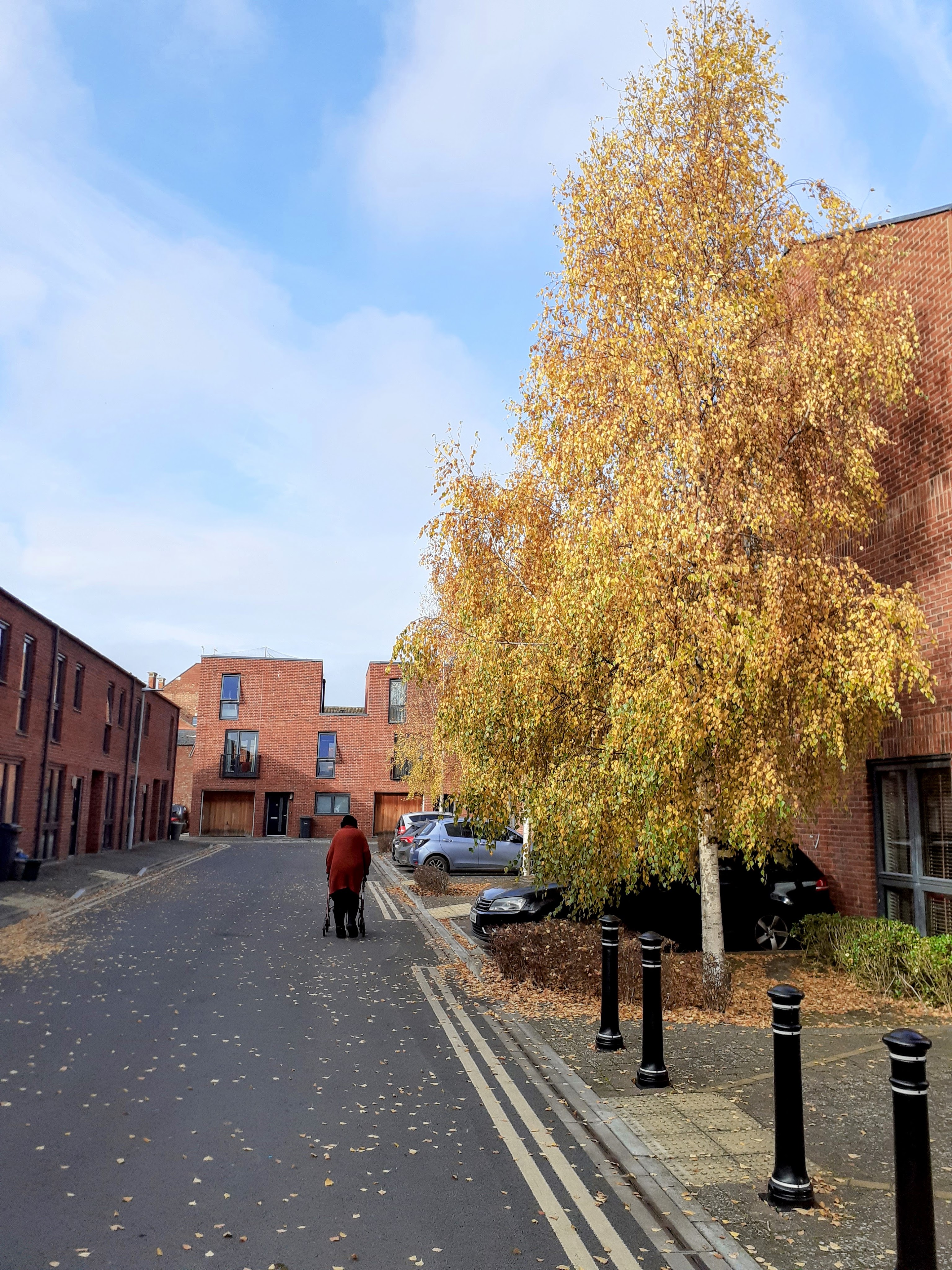
How do I recognise re-enchantment in my everyday life? Simply being open and alert to experiences as they come. On the morning of 10 November there was blue sky for a limited period. We walked around our Greyfriars Estate (once the site of a Franciscan Priory). There was a good-natured Remembrance Parade close-by: a custom beginning in 1919 after Word War I, when people hoped they had been through the war to end all wars. I am not very military minded but I’m glad we have this occasion all the same. I’ve made it to 75. A lot of the people we think about at this time didn’t make to 20 and they shouldn’t be forgotten. Honour was being paid to the dead, and an intentional act like that always changes the space.
Elaine and I however were at some distance from the event so that she could practice her walking. Whilst I was looking at some young birch trees with vigour still in their end-of-autumn leaves, Elaine carried on walking on her own. She didn’t need me hovering around her. It was the first time she’d walked outside on her own since her accident in Gran Canaria six months ago. I had witnessed a wonderful emancipation and, more than that, a fulfilment and confirmation of character.
(1) James Hillman The Force of Character and the Lasting Life Milsons Point, NSW: Random House Australia, 1999. First quote from back of cover blurb, second from main text.
For more than a decade, my spiritual practice has been mobilised around a contemplative inquiry. For me, this has been successful in its own terms, but I’m conscious now of something missing. It’s as if, for earnest, intelligent and ethical reasons, I have whitewashed the walls in the church of me. Now I want my murals back. So, recently I have started a course correction.
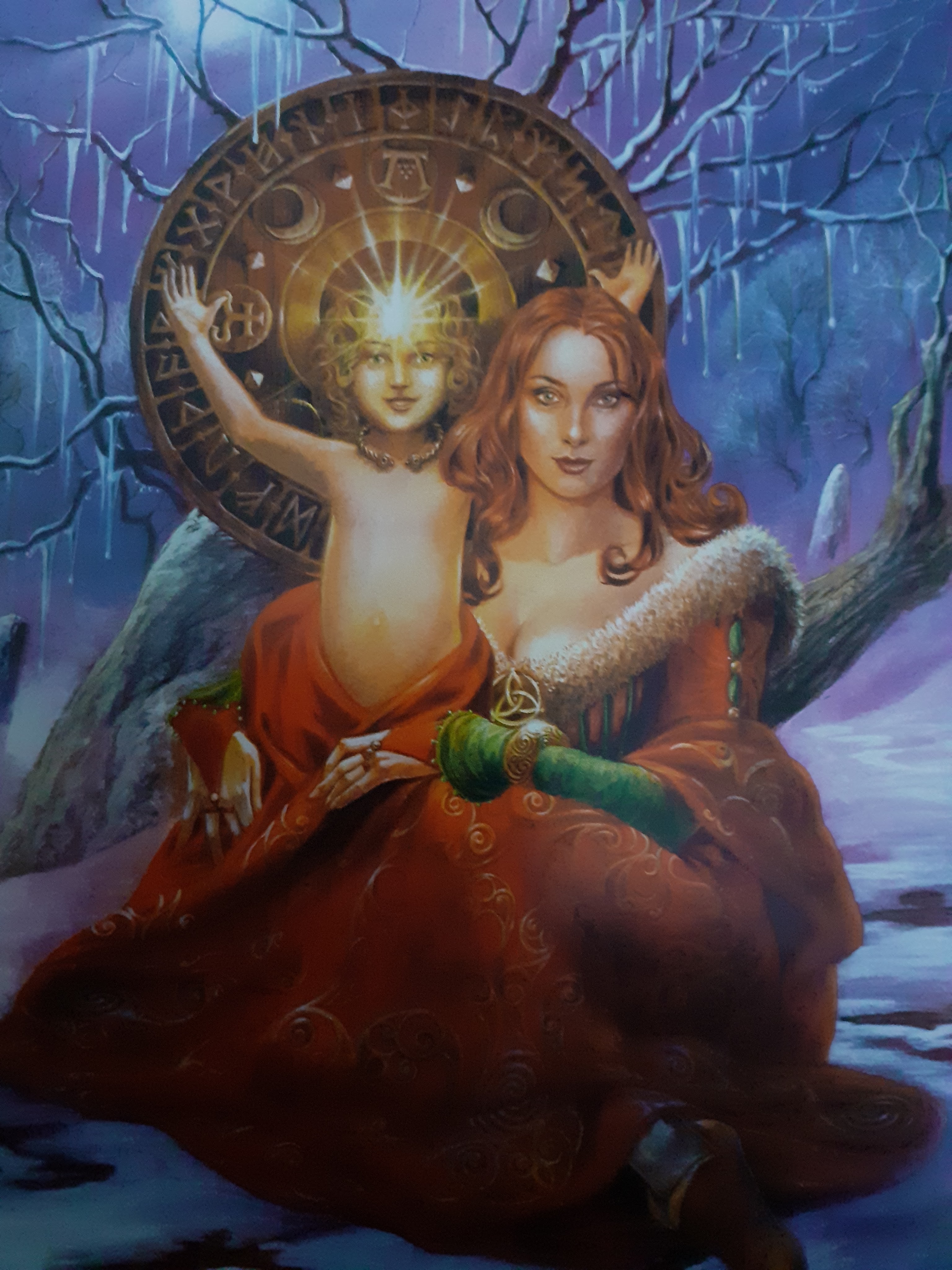
This course correction includes a glance back at my own pre-inquiry practices, happily well documented. The image of Modron and Mabon used to walk with me: Modron as the primal mother and Mabon as the primal child (2). They were archetypal figures, not everyday humans. My understanding was that these names were from a pre-Celtic language, retained in Brythonic speech. I am not sure if this is true, but for me it offered the possibility that even the surviving Celtic stories (3) were not the first. I was free to dream. In this dreaming I was powerfully influenced by the image at the top of this post (received as a midwinter holiday gift from my wife, then partner, Elaine, in 2007) and by the Silver on the Tree song that follows.
I see the child in the image as androgyne, and not in their earliest infancy. In the song, Mabon is not gendered. The mother in the picture is clearly the Goddess as Mother. Different stories can be drawn from this. In my own journey I tilt the child back somewhat to the masculine. In this pairing, She is Zoe, the life eternal. He is Bios, the life that comes and goes and comes again. Like Taliesin (4), transmuting out of his identity as Gwion, Mabon becomes in a sense his own father. So my midwinter picture appears to reference the Christmas story, but in important ways diverges from it. The image shows a magical midwinter child, who will indeed have an illuminating and transformational influence, but who is not exactly a redeemer in the Christian sense. This is drawn out in the Silver in the Tree song, which includes specifically Celtic references and extends beyond them.
Both Mother and Child live strongly within me, in the imaginal realm. I like and use the old language, Modron and Mabon, because of its sense of ancient mystery. But what it points to is universal. Part of my work now is to re-open my contact with them, who after another fashion I also am.
(1) Silver in the Tree in their 1991 album Eye of the Aeon
(2) NOTE: I am aware that there are divergent visions of Mabon. One centred the Autumn Equinox has become powerful and influential in recent years. Happily modern Druidry is not a religion of the Book though it is enriched by its books. This new literature follows the oral tradition practice of allowing stories to evolve and change in divergent directions. I see this as a strength.
(3) Caitlin Matthews Mabon and the Guardians of Celtic Britain: Hero Myths in the Mabinogion Rochester, VT: Inner Traditions, 2002 (Revised edition of Mabon and the Mysteries of Britain, 1987)
(4) If you visit Loch Maben in Dumfriesshire, in south west Scotland, you may find the feeling-tone similar to the much larger Lake Bala, strongly associated with Taliesin, in north Wales.
Last weekend ‘the clocks changed’ as the saying goes in my part of the world. Without any change in the heavens, the dawn and sunset alike were, overnight, officially an hour earlier. It happens every year, as does the reverse process in March. This is now culturally unremarkable. It has been happening for many, many years.
Clock time has had a huge influence in my life, whether I like it or not. I was given my first wrist watch at the age of eight and it seemed like a move toward adult empowerment. I didn’t notice any loss, at first, until it became clear that the empowerment offered was largely a self-regulating capacity for meeting other people’s requirements, especially concerned with some form of work. No actual self-direction was involved.
Since the coming of the mobile phone and its evolution into a multi-purpose device, the regulation of our time has if anything tightened. There is the added sense of being permanently on call and indeed of round the clock surveillance. The wrist watch stands as a quaint form of relative freedom, or at any rate spaciousness. I carry a phone whilst also wearing a wrist watch out of habit, nostalgia and a slight element of defiance.
My watch is old and this year I nearly retired it, in a permanent summer time, to a pleasant space in my home. But I couldn’t do it. I would be losing the companionship it provides. I re-read a poem I wrote some years ago and decided to keep the watch with me on my wrist.
Am I out of date To wear a wrist watch? I carry a phone, after all.
Once you seemed so advanced and ‘digital’, For you did not tick and tick and tick, And I did not wind you up.
Over the years, Batteries have died, and been replaced. Straps have come and gone. But your face, just a little scratched, remains the same, Old friend,
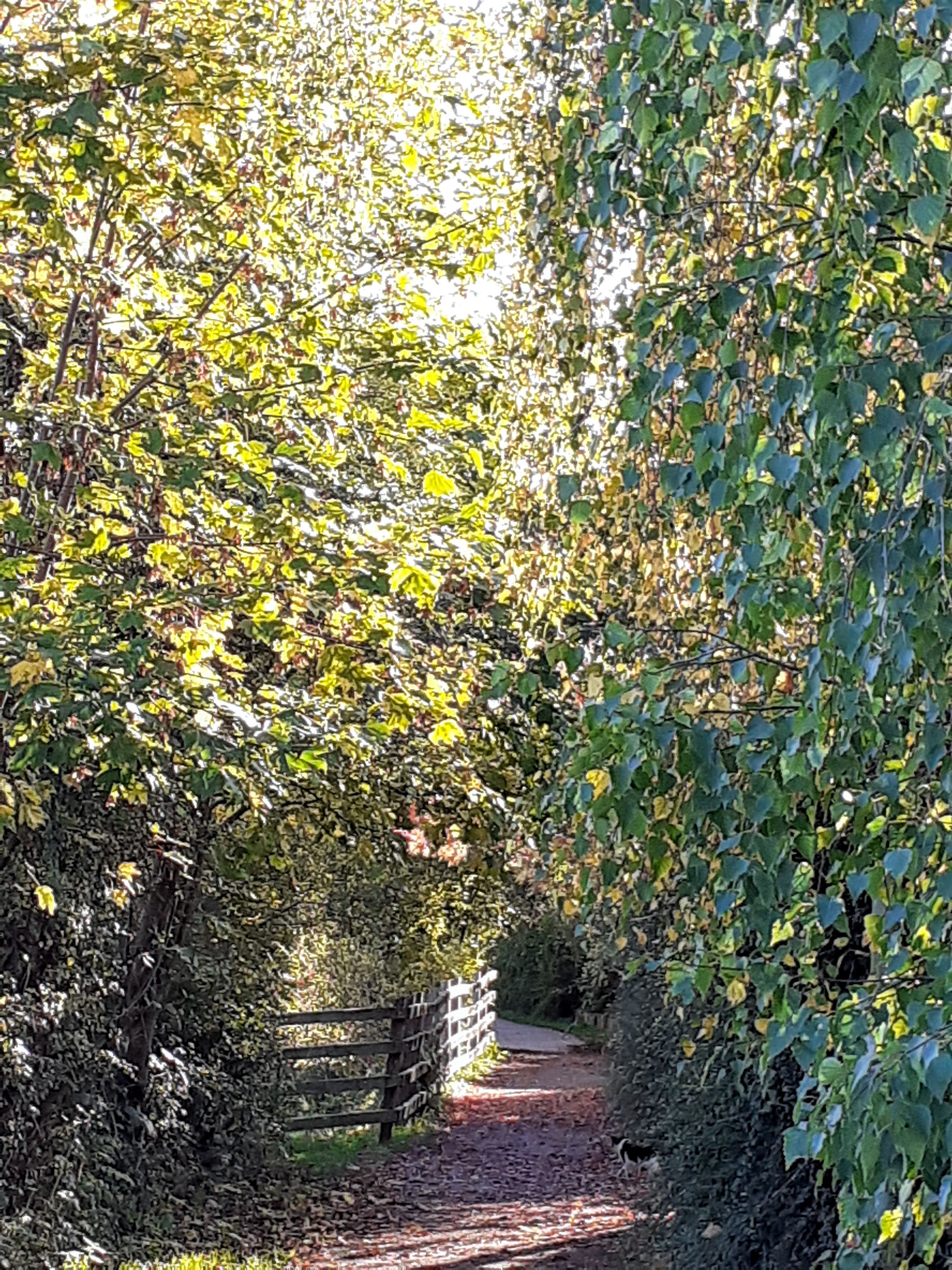
I am walking in woodland beside my local canal. These walks are infrequent now and all the more treasured. I notice how strong mid-afternoon light can be when the sky is clear, even on 22 October. Stepping energetically into its presence, I enter into a kind of communion. The light feels alive and I feel differently alive too – lifted, and touching into joy.
In the picture above, I feel as well as see the effects of the light on trees and water. In the picture below, I both feel and see the living light on leaves which themselves seem to greet me from their horizontal branch. I feel energised by this connection.
Looking up I see blue sky. I do not see the sun, but I can see its effects on the upper branches of trees. both subtle and magical. Looking down, I see a dance of light and shade, with the light present on a fence and on a pathway. A sense of the sacred pervades everything, and I feel blessed.