Contemplative Inquiry

This blog is about contemplative inquiry

Tag: contemplative spirituality

AWE, HEALTH & MINDFULNESS

Good news for Druids, I think, and for all followers of life-affirming paths. A study from the University of California, Berkeley, published in the journal Emotion (1) suggests that “the feeling of awe we may experience during encounters with art, nature and spirituality has an anti-inflammatory effect, protecting the body from chronic disease”. The researchers found a correlation between feelings of awe and lower levels of cytokines, markers that put the immune system on high alert by triggering a defensive reaction known as inflammation. While inflammation is essential to fighting infection and disease when the body is presented with a specific threat, chronically high levels of cytokines have been linked to a number of health problems, including heart disease, Alzheimer’s, depression and autoimmune conditions.

Dacher Keltner, a member of the research team, defines ‘awe as’ being “in the upper reaches of pleasure, on the border of fear”. She says the finding that “awe, wonder and beauty promote healthier levels of cytokines suggests that the things we do to experience these emotions -– a walk in nature, losing oneself in music, beholding art – have a direct influence upon health and life expectancy” (2).

Meanwhile other studies have shed light on the relationship between awe and mindfulness, seen as two of the core elements of many spiritual traditions. Here, awe is defined as a “feeling of fascination and amazement invoked by an encounter with something larger than ourselves that is beyond our ordinary frameworks of understanding”. In one experiment the researchers recruited 64 undergraduate participants to view and respond to a number of images. All of participants were shown two sets of images: one set of images was used to inspire awe (the Grand Canyon, majestic mountains, a view of the Earth from space) while the others were meant to inspire feelings of positivity (kittens, flowers, baby chicks), and asked to rate their awe and positivity responses on a scale of 1 to 7. Prior to viewing the images, half of the participants listened to a 10-minute mindfulness audio tape, while the other half listened to non-mindfulness control audio. The participants who took part in the brief mindfulness exercise experienced a greater awe reaction than the control group in response to the awe-provoking images.

University of Groningen psychologist Dr. Brian Ostafin , quoted in Huffpost Science (3), theorises quite generously from this limited data that  “you can’t digest [the object of awe] with your cognitive structures — it’s too big for you. So there’s a need for accommodation, to change your mental structures to understand what that is. This is the key element of the spiritual experience in a number of different religions. … And mindfulness is a little bit about that too, because you’re paying attention and exercising non-conceptual awareness, so you should be more open to the immensity that’s there. You step out of the small frame that you have and this small idea of what the world is… You’re not stuck in your own story … When we practice mindfulness (the cultivation of a focused, non-judgmental awareness on the present moment), we’re more able to open our mind to make sense of new experiences”.

This research is indicative rather than conclusive, especially it seems to me in the case of the Groningen study.  The research design there seems to me to be based on the offer of rather modest doses of mindfulness and somewhat modest opportunities for awe. Yet there was a real difference in the reported experiences of the mindfulness participants and the control group – so something at least is being suggested about states of attention and experienced quality of response. I find it heartening that this kind of research is going on and intend to keep an eye on it as part of my inquiry.

(1) Stellar, Jennifer E. (et al) Positive affect and markers of inflammation: discreet positive emotions predict lower levels of inflammatory cytokines Emotion Vol 15 (2), April 2015, 129-133

(2) Caroline Gregoire Experiences of Art, Nature, and Spirituality May Help Prevent Disease, Study Finds Huffpost Science, 5 Feb 2015, updated 2 April.

(3) Caroline Gregoire How Meditation Primes the Mind for Spiritual Experiences Huffpost Science 3 January 2015, updated 1 March 2015
CONFERENCE: THE HEART OF SILENCE

OBOD member Siobhan McGee has just alerted me to The Heart of Silence conference on 16-19 April 2016 at Regent’s University London – see www.theheartofsilence.co.uk

The full title is Exploring the Place of Silence in Psychotherapy, Society and our World and the conference is dedicated to the proposition that:

Through Silence we are able to deeply listen to ourselves, one another and our Planet, and from this place we can act.  

 The organizers are the Association of Core Process Psychotherapists, and the event is open to anyone wanting to explore and experience the value of silence. The organizers say:

In Silence we can connect with the heart and during this Conference there will be the opportunity to experience and embody Silence together.   

The speakers and plenaries will focus attention on two central questions: 

What is the nature and role of Silence in relationship?
How can Silence unify us, in the midst of life today?

The keynote speaker is Brian Keenan, who, more than most, has had to confront the reality of enforced silence during his four and a half year incarceration as a hostage in Beirut.

The other speakers are:

Maura Sills, Founder of the Karuna Institute and one of the original mindfulness based psychotherapies, has been teaching mindfulness and silence practices to psychotherapists for more than 30 years.

Rebecca Crane is Director of the Centre for Mindfulness Research and Practice at Bangor University.

Matthew Adams and David Harley are researchers of silence at the University of Brighton.

Catherine McGee is an International Meditation teacher who brings an interest in the silent heart.

Mac Macartney, an author and founder of Embercombe, asks if, through silence, we can remember our humanity.

The workshop leaders are Amaranatho, an ex-Buddhist Monk and Alastair McNeilage, a Core Process Psychotherapist and writer.

The two day conference is fully catered.

BOOK REVIEW: NOT I NOT OTHER THAN I

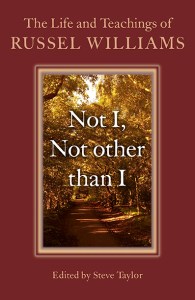
Not INot I, Not Other than I is an inspiring story of spiritual awakening. For me, the book has a skilful balance of biography and wisdom in which each throws light on the other. Highly recommended to people involved or interested in contemplative spiritualities.

Russel Williams left school aged 11. Both of his parents were dead and he was too old for Barnado’s.  So he was licensed to work for a living, though in 1932 and the years that followed it was hard to make ends meet. He describes himself in his teenage years as existing but not living. He was angry and aggressive, with no empathy, a quick temper, and prone to getting into fights. What frustrated him most was a sense of his own ignorance.

In 1939 war broke out and Williams joined the British army. He recalls that being a soldier “saved me from a bad end, kept me out of trouble – and most importantly it took away the worry of keeping myself alive. I had regular food and shelter for the first time since my parents died. It was easy, compared me to the life I had before. It also taught me self-discipline to control my emotions”.

After the war he went “walking, walking …” until he making contact with another man, who was starting up a small circus. Williams accepted the job of looking after the horses, and he began to feel a strong connection with them. He wanted to understand them better. “I set my mind to watching and observing every detail, every moment of the day, for days on end”. This process became “more and more concentrated”. He was “not thinking any more”. His mind had “gone quiet”. He was experiencing states of “spontaneity” and “living in the moment”. He began to “look through the horses’ eyes”, as the boundaries fell away, and he became notable for his calming and healing presence when working with them.

Still in his 20’s, Williams began to discern a path in life. Later he framed his life with the horses – 20 hours a day, 7 days a week, for 3 years – as a naturally occurring education in mindfulness meditation: his life a continual service, “with no thought of myself”. He still experienced frustration and disappointment, because he couldn’t find anyone to talk to about this who seemed willing to treat him seriously. But eventually he ran into a small number of kindred spirits, people with whom he could enter into close rapport, and this led to his joining the Manchester Buddhist Society in 1957.

Although the Society made a connection with Thai Buddhism in 1954 (one of their members trained as a monk) Williams himself has kept a distance from formal Buddhism. He has been President of the Society for over 40 years and he still doesn’t call himself a Buddhist. His life and work has included esoteric Christian influences and a resonance with Ramana Maharshi. One of his sayings is that whereas “Buddhism is a belief system … the way of the Buddha is a recognition system”. Acknowledging that Buddha didn’t go beyond dealing with suffering, never mentioning spiritual worlds as such or communicating with other entities, he added “but we do”. Williams’ way of the Buddha is also a way of the free spirit.

Russel Williams is now 93. He is still going strong. My contemplative Druid companion Rosa Davis mentioned this book at our last group meeting. Williams says that his life experience and practice have led him to a “natural state” of oneness with everything, and with the universe itself. “We are part of the unmanifest. We are part of the pure consciousness which has given rise to the whole universe. That consciousness is our true nature, and, when we rest within it, we feel a powerful sense of ease and contentment”. He believes that this is the only meaningful way of understanding the term ‘God’, and what Jesus of Nazareth meant when declaring “I and the Father are one”. This kind of experience, “stillness, pure consciousness, emptiness of being” is the inheritance of us all, and potentially available to us all. It is based on sense-feeling, and on filling the emptiness with loving-kindness.

Williams doesn’t support long meditation practices, though he does believe in frequent ones. He saying “once you get the process going” 10 or 15 minutes should suffice, and recommends doing it 7 times a day. For him, the way in to a full meditative state is through the realm of subtle feeling, and he invites us in with him about a third of the way through the book:

“Feel down here, a little bit above the navel you’ll find the right place. Centre yourself there, in feeling. Observe your breathing, in the sense of the expansion and contraction of the outer part of the body, as if it were a balloon …” From here we are guided to notice the calming and peaceful effects of this “gentle movement, this comfortable gentle movement … absence of agitation, peacefulness … a kind of heartfelt warmth of feeling … it feels homely, as though you belong there … And as though it were a light”.  We then move outwards from the “balloon” to include the whole physical body and then go beyond it. “It reaches out in all directions … and begins to feel at home with all its surroundings, whether it be animate or inanimate … of the same nature” …. And so on into silence for a few minutes. At the end of the meditation the practitioner is asked to draw back into the “very centre”, making sure it is “still peaceful and warm” before returning to normal consciousness.

What I learned from this was the flavour of ‘sense-feeling’, a specifically located warmth, a sense of quiet movement, qualities of gentleness and peace. Nurturing is another favourite Williams word. These qualities fill the body-mind and move beyond it, filling emptiness, engendering loving-kindness. In a group meditation, they can create a deep rapport and subtle meeting place between participants. The aim is to develop “such gentle perception that you could compare it to a finger, soft and warm, touching a snow flake, but so delicate that the flake doesn’t melt”. From there, we begin to see into the nature of things, becoming aware of a different reality, expanding into it until we become “boundless”. This is achieved not by any great effort, but by simply letting go.

‘Sense-feeling’ has already helped me in my own practice. It enriches my experience of ‘presence’ (a key word for me), placing it more clearly beyond witnessing awareness as normally understood. The meditative experience becomes participatory and nurturing in a more complete way, yet one that also seems easy, obvious, almost remembered rather than newly learned. I’m grateful for the recommendation and glad to be passing it on.

Russel Williams (2015) Not I, Not Other than I: the Life and Spiritual Teachings of Russel Williams (Edited by Steve Taylor) Winchester & Washington: O Books


THE GOLDEN FLOWER


“Naturalness is called the Way. The Way has no name or form; it is just the essence, just the primal spirit.” (1)

The Secret of the Golden Flower is a lay manual of Buddhist and Taoist methods for clarifying the mind. It was first published in China towards the end of the eighteenth century. It is the product of the ‘Complete Reality’ School of Taoism (2), which synthesized the internal alchemical arts of longevity, the meditation techniques of Chan (Zen) Buddhism and Confucian ethics. Its key texts included the Tao Te Ching (3) the Prajnaparamita Heart Sutra (4) and a later Taoist work which translates as Cultivating Stillness (5).

The golden flower itself symbolizes the quintessence of the paths of Buddhism and Taoism, as understood by this school. Gold stands for light, the light of the mind itself; the flower represents the blossoming, or opening up, of the light of the mind. Thus the image evokes the awakening of the real self and its hidden potential. Primal spirit is a mode of awareness subtler and more direct than thought or imagination, and it is central to this blossoming. The Secret of the Golden Flower is devoted to the recovery and refinement of primal spirit in the practitioner.

“The beauties of the highest heavens and the marvels of the sublimest realms are all within the heart: this is where the perfectly open and aware spirit concentrates. Confucians call it the open centre, Buddhists call it the pedestal of awareness, Taoists call it the ancestral earth, the yellow court, the mysterious pass, the primal opening.”

In 1920 a thousand copies were reprinted due to a demand by an “esoteric circle” in Beijing according to Richard Wilhelm, who brought it to Europe in a German edition a few years later with a foreword and commentary by C. G. Jung (6). An English edition translated from the German by Cary F. Baynes appeared in 1929. These editions included fragments from a second work, also from the Complete Reality School, called Hui-Ming Ching (7). This adopted the Chan idea that there is no separation between original nature or wisdom-mind (hui = Sanskrit prajna) and stillness (= Sanskrit Samadhi). At the same time hui-ming means uniting wisdom-mind with the energy of life (ming). Contemplative stillness is to be complemented by a system of energetic movement, drawn from Chinese energy arts (chi gung) – an approach consistent with the Taoist understanding of the Tao as simultaneously the underlying permanent reality and the changing flux of things in transformation.

Modern translators recognize the importance of the pioneering Wilhelm/Jung  work, whilst expressing dismay at its level of inaccuracy and misrepresentation. In relation to the Hui-Ming Ching Eva Wong, who was able to translate a complete copy with illustrations, says: “Baynes’ translation is severely biased by Jungian psychology and does not present the work from a Taoist spiritual perspective … the historical and philosophical connections with its major influences … [are] … ignored … we cannot appreciate the spiritual value of a text if we impose a particular perspective, especially one that comes from a different culture … we need to yield to the text and let it speak on its own terms”. Thomas Cleary is equally unhappy on behalf of The Secret of the Golden Flower, using his own notes on the text to compare the older version unfavourably with his own and asserting that “Wilhelm was not familiar with even the most rudimentary lore of Chan Buddhism”.

In a way, Wilhelm and Jung suffer from the downside of being pioneers. Their successors are bound to know the territory better, partly thanks to them. But they were also men of their time in other ways, in their view of the mystic orient. Jung’s introduction began with a section on Difficulties encountered by a European in trying to understand the East. He expressed admiration for Chinese recognition of the “paradoxes and polarity inherent in what is alive. The opposites always balanced each other – a sign of high culture. One-sidedness, though it lends momentum, is a mark of barbarism”. He also used the opportunity to express pleasure that the West was now learning to value feeling and intuition and thereby widen Western consciousness and culture beyond a narrow “tyranny” of intellect. But he also made (to us) embarrassing statements like “measured by it [Western intellect], Eastern intellect can be described as childish … it is sad indeed when the European departs from his own nature and imitates or ‘affects’ it in any way”.

We are now in a globalizing 21st. century where large numbers of Westerners are working with Buddhist meditation and Chinese energy arts and finding them entirely accessible and transforming. China and its place in the world are also very different. We can let go of any residual notion that East is East and West is West and never the twain shall meet. I’ve had a personal involvement with Buddhist meditation and Tantric traditions that have incorporated chi gung exercises.  I do not find them alien. My Western Way is a result both of a personal choice, and perhaps of a personal call. It could easily have been different.

I can learn directly from the East and I find that Taoism has a particular attraction – both that of the early classics and of the much later Complete Reality School: its attempts at inclusivity, its dialogue with Chan, its cultivation of the energy of life, and a Taoist/Chan sensibility in poetry and painting all speak to me. I am aware of a cultural note that is different to mine, yet I can incorporate key lessons directly into my practice. When working with breath, I have become increasingly conscious of a simultaneous movement of the breath and a stillness in the breath. For me this is both an experience and a metaphor. In my terms it feels very Sophian, and I believe I owe the insight to my acquaintance – however superficial – with Taoist tradition.


  1. The Secret of the Golden Flower: the Classic Chinese Book of Life (1991) Translated by Thomas Cleary, with introduction, notes and commentary New York: HarperCollins
  2. Eva Wong (1997) The Shambhala Guide to Taoism Boston & London: Shambhala
  3. Lao Tzu (1998) Tao Te Ching: a Book about the Way and the Power of the Way New version by Ursula K. Le Guin, with the collaboration of J. P. Seaton Boston & London: Shambhala
  4. The Heart Sutra: the Womb of the Buddhas (2004) Translation and commentary by Red Pine Berkeley, CA: Counterpoint
  5. Cultivating Stillness: a Taoist Manual for Transforming Body and Mind (1992) Translated with an introduction by Eva Wong Boston & London: Shambhala
  6. The Secret of the Golden Flower: A Chinese Book of Life (1962) Translated and explained by Richard Wilhelm with a Foreword and Commentary by C. G. Jung, and part of a Chinese meditation text The Book of Consciousness and Life with a foreword by Salome Wilhelm. London & Henley: Routledge & Kegan Paul (revised edition)
  7. Liu Hua-Yang Cultivating the Energy of Life (1998) A translation of the Hui-Ming Ching and its commentaries by Eva Wong Boston & London: Shambhala

POEM: WATER AND WAVE

I’m sharing this song of Kabir because I enjoyed it and felt cheered by it.  I liked its devotional and ecstatic note – not my usual one.. I have harmonised it with my way of Sophia by changing a ‘his’ to a ‘her’.


I have been thinking of the difference

Between water

And the waves on it. Rising,

Water’s still water, falling back,

It is water, will you give me a hint

How to tell them apart?


Because someone has made up the word

“Wave”, do I have to distinguish it

From water?


There is a Secret One inside us;

The planets in all the galaxies

Pass through her hands like beads.


That is a string of beads one should look at with

Luminous eyes.


A weaver by trade but a poet-singer by calling, Kabir lived in fifteenth century India. His philosophy incorporated various beliefs of both Muslims and Hindus and later became one of the major influences behind Sikhism. Like Rumi, further to the west and generations earlier, his generously devotional and ecstatic path made him a natural bridge builder between traditions.

Kabir Ecstatic poems Boston, MA: Beacon Press, 1992 The English translations are free enough for Robert Bly to call them ‘versions by Robert Bly’. Given Bly’s freedom I have changed a ‘his’ to a ‘her’ above to support the poetry of my own gnosis. There is an earlier set of translations published by MacMillan in New York in 1915 by Rabindranath Tagore assisted by Evelyn Underhill under the title Songs of Kabir. Whilst I don’t follow Bly in calling the English of the earlier work “useless”, I do find that Bly’s interpretation has more passion and power. The Bly work includes an insightful afterword Kabir and the transcendental Bly by John Stratton Hawley.


POEM: THE MOON IN DEWDROPS

Simplicity and complexity, elegance and wisdom combined in the poetry of Japanese Zen. I notice that I respond more strongly to such poetry than I do to didactic texts about meditation and philosophy.


To what shall

I liken the world?

Moonlight, reflected

In dewdrops,

Shaken from a crane’s bill.


I particularly love this poem. The apparent naturalism of the imagery makes it powerful and accessible to anyone. Yet for me, this poem also brings up wider issues about reading and interpretation. The poet’s location in place, time and culture do make a difference. Ehei Dogen (1200-1253) was one of the first to transmit Zen Buddhism from China to Japan and was founder of the Soto School. His poem is a waka – a 31 syllable form predating the invention of haiku. Dogen is a key figure in both Japanese Buddhism and Japanese literature.

In Mahayana Buddhism, the Buddhism of all Japanese schools including Zen, the moon stands for Buddha-nature. So the poem teaches a familiar Mahayana truth that the moon (Buddha-nature) is completely reflected in every one of the countless dew drops (all things) without discrimination, namely one in all, all in one. This understanding is accompanied by a sense of fragility and impermanence within nature – strongly present in Japanese culture independently of Buddhism and reinforced by Buddhist teaching. Dogen gives us elegance and complexity in a 31 syllable form.

Hee-Jin Kim*, a modern Zen scholar, takes this further, bringing out Dogen’s sensitivity to history as well as to nature. He draws attention to the word ‘shaken’: each dew drop holds a full yet shaken reflection of the moon. Dogen lived in what was seen as a dark and ill-starred time in Japanese history. Many Buddhists thought that even their path was compromised and talked of degenerate dharma (mappo). Kim understands Dogen as resisting this ideology of despair whilst fully aware of the collective turmoil. On this reading, the poem asserts that timelessness is experienced within, and only within, momentariness, even when the times are stressed.


To what shall

I liken the world?

Moonlight, reflected

In dewdrops,

Shaken from a crane’s bill.


* Hee-Jin Kim Dogen on meditation and thinking: a reflection on his view of Zen Albany, New York: State University, 2007 (At the time of publication Hee-Jin Kim was Professor Emeritus of Religious Studies at the University of Oregon. He is also the author of Dogen-Kigen: Mystical Realist).

STOCKTAKING

Golden SeedIn 2014 The Order of Bards Ovates and Druids (OBOD) celebrated its 50th anniversary. It’s now just over 22 years since I first joined. Where am I now?

I remember being reassured by the way in which OBOD was able to hold a point of tension between two seemingly competing narratives. The first was the sense of living relationship with the land and the inheritance of ancestral stories. The second was an open and generous universalism. Without the first, the second could be vague and vapid. Without the second, the first could become culturally inward-turning and defensive. I’ve always been grateful for this balance.

As part of the 50th anniversary year, Sharon Zak and Maria Ede-Weaving put together The Golden Seed: Celebrating 50 Years of OBOD as “an anthology of prose, poetry, images and crafts” (including a DVD) created by OBOD members and friends. It is still referenced at http://www.druidry.org though currently unavailable. In my own entry I said I was more comfortable with a language of “practising OBOD Druidry” than “being an OBOD Druid”. That’s how I still see it and I would now want to add that this practice itself sits within a (for me) larger framework that I would name as the Way of Sophia. This has been true for quite a while, and I will write about it more in the future. Here I just want to say where my Druidry continues to fit.

There are two huge lessons that I draw from Druidry. The first is about how to do solo practice. I can’t now imagine a core solo practice that doesn’t take place in a sacred circle, woven of ritual and liturgy. Allowing a slow evolution of movement and liturgy, I gain insight into my purpose and intent in a way that offers both clarity and embodiment. Within that circle, I include body and energy work and also some form of sitting meditation: the precise forms vary. There’s also an aspect of healing and blessing. Thanks to the OBOD distance learning course, this approach to practice has become second nature. Someone could have given me a list of instructions to this effect on the back of an envelope and I might have had a go with different aspects from time to time before coming across something else on the back of another envelope. But I had the chance to build an evolving practice over an extended period, in a way that was both self-directing (I have an allergy to gurus) and within a tradition that made support and guidance available (I also don’t operate brilliantly if unwitnessed and alone). This combination is quite rare in spiritual education, and it’s a great privilege to have a continuing relationship with this work on the mentoring side. The course covers a lot of other ground as well. But this was the piece that was transformational for me.

The second lesson concerns two intertwining challenges. Both are connected to the contemplative inquiry I’ve been involved in for just over four years. One is the challenge of responding to the Order’s invitation to members to take initiatives and offer varying forms of leadership, whilst still (if we so choose) being held within the collective and feeling part of it. The other is the contemplative journey itself. This has involved the further evolution of solo practice, but more importantly to the co-creation of an innovative house-style in group work and in particular of Day Retreats for small groups. I and my colleagues seem to have a good handle on this now, both within our own local group and in the wider community of Druids and fellow travellers.

These lessons are my guide as to where to put my energy within Druidry, offering contexts of connection, service and nourishment.


CONTEMPLATIVE CHANGE

Tides in a life. A sea-change. My contemplative inquiry is gentling, in its fifth and final year. I began with charged and focused intent. Willing a change in self and world, I surrendered to a vision. I accepted the risk of becoming driven, of being one-eyed and obsessional to the point of self-caricature. Mr. Contemplative.

I don’t believe it’s ever been quite that bad. Loving and accepting love matter more to me than seeing through the eye of the divine, to the extent indeed that the two are even different. Contemplative traditions and their practices, even when adequately customised, internalised and working effectively, have never been my absolute priority. Nonetheless the intent to live from a deeper dimension, fed by an inner spring of stillness and spaciousness, has been a key life direction during this period.

I can sense a difference now, a relaxation. For me there’s a point at which enhanced study and practice in any field encounters a law of diminishing returns. I’ve got what I’m going to get out of the exercise. The field itself may be one of infinite possibilities – yet I reach a point of needing to begin a process of detachment where I recognise the fruits of my inquiry and ease in to a new normal.

The new normal incorporates what I need, or can take in, from the inquiry process. I’ve had this experience twice before, in relatively recent years. The first was a doctoral project about a developmental approach to ageing: the idea that later life offered specific potentials for growth and creativity not generally recognised in mainstream culture. As a project, this was summed up in the thesis itself, and I moved on. But the core idea continues to guide me. The second was the current version of the OBOD distance learning course, which also had a specific summation – and also continues to inspire me. I’m not sure whether to document my contemplative inquiry in this kind of way – my book Contemplative Druidry was something different, a collaborative piece which opened up the topic in a Druid context. A more personal piece is something to ponder over the next year.

In terms of fruit, there are a few things that I can say now. The first is that I’ve got a contemplative practice that I’m at ease with. I notice that I’m spending less time on it than at the height of the inquiry period. This feels like a natural adjustment. More importantly, I celebrate finding spiritual companions, with whom I have been able to develop group practices that are both contemplative and relational. For example, we’ve got a tried and tested model for how a local group can work, a model for day retreats, and a model for weekend retreats. These are developments that I expect to take forward. Our local group has a day retreat this Saturday (21 November), and my partner Elaine and I are offering a Dark of the Moon day retreat in London on 7 February 2106 – see http://contemplativedruidrevents.tumblr.com – so I may have more to say about these in future posts. We plan a residential retreat for next April.

I don’t want to get consumed by organising and facilitating small group events. But I certainly expect them to outlive the inquiry, and to make them part of the new normal as I broaden my overall field of attention once more.


SAMHAIN GIFT

Pentacle_background_whiteA Samhain gift from Sophia. Here, the pentagram image stands for a cycle of meditations, a pathway to wisdom. We move from peace (bottom left, the earth position) to joy (right hand, the water position) to love (left hand, the air position) to healing (bottom right, the fire position) to wisdom (top, the spirit position) and back to peace again.

It seems that for me inner peace, as well as being a condition of any real peace, is also the beginning of wisdom. Inner peace is a blessing and it is also a skill. We can learn how to access and develop it, though for many of us it doesn’t come easy.

The learning and practice are likely to involve encounters with distraction, agitation and turmoil. I find that there are two ways of addressing this – one is to have ways of diminishing and dispersing them; the other is to find a still point of peace within the distraction, agitation and turmoil themselves. Peace has its place within aroused states as well as calm ones. Essentially, I experience peace as a fundamental at-homeness, an affirmative being and belonging in the world.

Peace is the bedrock. But it isn’t everything. Rather, it opens possibilities. The first is joy, a kind of joy that comes from within peace. This joy may be still. It may be flowing. It may be calm. It may also be ecstatic. Peace and joy together create a very powerful internal state and in my view form the basis for the outward turn to love and aware engagement. This in turn enables the energy of healing – in relation to self, other and world.

The step to wisdom is next, though it assumes a parallel work of knowledge-building and understanding outside the meditative setting.  Wisdom depends on these, yet is qualitatively different. In my experience it’s the qualities nurtured by intentional contemplative practice that make the difference.

In this view I acknowledge the influence of the Mahayana Buddhist idea of prajna, where wisdom is a union of spiritual knowledge (jnana) and compassion. The core text of Mahayana Buddhism is the Prajnaparamita Heart Sutra (1), with prajnaparamita represented as a deep meditative state and also personified as Prajnaparamita mother of the Buddhas, just as further to the west Sophia has been represented as the mother of angels. In the text of the Heart Sutra the Buddha Gautama Siddhartha provides instruction to his disciple Avolokitesvara, who went on to develop a powerful female alter ego as the great Chinese bodhisattva Guan Yin – another Sophian figure.

The Sophian pentagram first came to me as a compelling image; then as a sequence of words. From there I quickly identified specific practices (already individually familiar) to work with the named qualities and states. It feels as if I’ve been given a direction for the next phase of my personal inquiry and practice, and it’s good to have that direction as a Samhain gift from Sophia.

  1. The Heart Sutra: the Womb of the Buddhas Translation and Commentary by Red Pine. Berkeley, CA, USA: Counterpoint, 2004


CONTEMPLATIVE DRUIDRY IN PAGAN DAWN

PD197-500x500Gratitude and celebrations! The new edition of Pagan Dawn has given me the opportunity to describe contemplative Druid practice, as we have been developing it in recent years, to a wider Pagan and like-minded public.

In the meantime Contemplative Druid Events has arranged three open events for 2016:

7 February Dark of the Moon workshop in central London in Treadwell’s workshop space at 33 Store Street, London, WC1E 7BS. Facilitated by James Nichol and Elaine Knight. We will greet the dark of the moon using contemplative and visionary methods drawn from the evolving tradition of modern contemplative Druidry. Our programme will include contemplative exercises, subtle energy work, animist communion, silent sitting and Awen space group meditation.  Anyone with an interest is welcome to come.

15-17 April Our annual Birchwood Retreat at Anybody’s Barn, Birchwood Hall, Storridge, Nr. Malvern, Worcestershire WR13 5EZ. Facilitated by James Nichol, Karen Webb, Elaine Knight and J.J.Howell. Arrivals from 4.30 p.m. for 6.30 p.m. supper on Friday; departures by 4.30 p.m. on Sunday. Accommodation and full board included. Anyone with an interest is welcome to come.

1 October Contemplative Day in Stroud, from 10.30 a.m. – 4.30 p.m. at the St. Luke’s Medical Centre, 53 Cainscross Road, Stroud GL5 4EX.  Facilitation by James Nichol, Elaine Knight, Nimue Brown and Tom Brown. Anyone with an interest is welcome to come.      At the time of writing there are places on all of these events, though the London one is now filling up. For information on costs please see: http://contemplativedruidevents.tumblr.com or write to grovelight@hotmail.co.uk

For Pagan Dawn, if you’re in the UK, check this link:

https://paganfed.org/shop/pagan-dawn?product_id=96

Earth Eclectic

music that celebrates Earth and speaks to the heart

Sarah Fuhro Star-Flower Alchemy

Follow the Moon's Cycle

Muddy Feet

Meeting nature on nature's terms

Rosher.Net

A little bit of Mark Rosher in South Gloucestershire, England

Becoming Part of the Land

A monastic polytheist's and animist’s journal

selkiewife

Selkie Writing…

Charlotte Rodgers

Images and words set against a backdrop of outsider art.

Prof Jem Bendell

living with metacrisis and collapse

Towint

The pagan path. The Old Ways In New Times

The Druids Garden

Spiritual journeys in tending the living earth, permaculture, and nature-inspired arts

The Blog of Baphomet

a magickal dialogue between nature and culture

This Simple Life

The gentle art of living with less

Musings of a Scottish Hearth Druid and Heathen

Thoughts about living, loving and worshiping as an autistic Hearth Druid and Heathen. One woman's journey.

Wheel of the Year Blog

An place to read and share stories about the celtic seasonal festivals

Walking the Druid Path

Just another WordPress.com site

anima monday

Exploring our connection to the wider world

Grounded Space Focusing

Become more grounded and spacious with yourself and others, through your own body’s wisdom

The Earthbound Report

Good lives on our one planet

Hopeless Vendetta

News for the residents of Hopeless, Maine