Contemplative Inquiry

This blog is about contemplative inquiry

Tag: contemplative spirituality

POEM: LULLABY


River stationed.

the damselfly

has stilled its wings,


blue lace folded

on a hunter’s slenderness.


Perch, slanted from their mouths,

speak to the surface an occasional O.


Lily pads are sunk and curled

by the river’s rub,


Papooses

nodding in the waterlight.


From Colin Oliver High River Sudbury, Suffolk: Downstream Press, 2006


PRAJNAPARAMITA & POEM

Prajnaparamita_Java_Side_DetailPRAJNAPARAMITA AND POEM

Prajnaparamita is the Sophia of the East, her name meaning ‘perfection of wisdom’. My image* is a 13th century stone statue from Singhasari, East Java. The lotus at the right of the image holds a book of sutras. Prajnaparamita’s hands are held in the gesture of ‘wheel-turning’, from a Buddhist perspective the turning wheel of the Dharma, representing the Buddha’s teachings.

The Prajnaparamita Heart Sutra, the best known work associated with her, is a foundational document of Mahayana Buddhism. It suggests that ideas of ‘personal’ enlightenment make no sense, either conceptually or ethically. The emphasis, rather, is on compassion and work towards the awakening of all beings. Vietnamese Zen Buddhist teacher Thich Nhat Hanh (1) offers a translation and interpretation geared to modern westerners, presenting a view of radical interdependence that he calls ‘interbeing’. He has also written a poem about it that movingly illustrates this view. (A friend sent me this poem from a Buddhist magazine many years ago. The specific political references are from the 1980’s, but they apply at least as much today.)


PLEASE CALL ME BY MY TRUE NAMES

Do not say that I’ll depart tomorrow

Because even today I still arrive.


Look deeply: I arrive in every second

To be a bud on a spring branch,

To be a tiny bird, with wings still fragile,

Learning to sing in my new nest,

To be a caterpillar in the heart of a flower,

To be a jewel hiding itself in a stone.


I still arrive, in order to laugh and cry,

In order to fear and to hope,

The rhythm of my heart is the birth and

Death of all that are alive.


I am the mayfly metamorphosing on the

surface of the river,

And I am the bird which, when spring comes,

Arrives in time to eat the mayfly.

I am the frog swimming happily in the

Clear water of a pond,

And I am also the grass-snake who,

Approaching in silence

Feeds itself on the frog.


I am the child in Uganda, all skin and bones,

My legs as thin as bamboo sticks,

And I am the arms merchant, selling

Deadly weapons to Uganda.


I am the 12-year-old girl, refugee

On a small boat,

Who throws herself into the ocean after

being raped by a sea pirate,

and I am the pirate, my heart not yet capable

Of seeing and loving.


I am a member of the politburo, with

Plenty of power in my hands,

And I am the man who has to pay his

‘debt of blood’ to my people,

Dying slowly in a forced labour camp.


My joy is like spring, so warm it makes

Flowers bloom in all walks of life.

My pain is like a river of tears, so full it

fills up the four oceans.


Please call me by my true names,

So I can hear all my cries and my laughs at once,

So I can see that my joy and pain are one.


Please call me by my true names,

So I can wake up,

And so the door of my heart can be left open,

The door of compassion.


*Photographed by Gunawan Kartapranata and reproduced under a Creative Commons licence.


  • Thich Nhat Hanh (1988) The heart of understanding: commentaries on the Prajnaparamita Heart Sutra Berkeley, CA, USA: Parallax Press

 

RE-DEDICATION

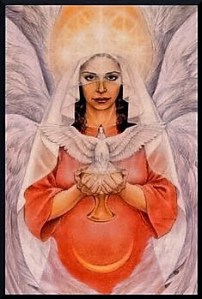
bcf2c26ec7720ed734fccc2b13534310Early this morning, I re-dedicated my contemplative inquiry. Yesterday was my 67th birthday. It seems like a good moment for re-visioning and renewal.  I recently received my Sophia icon from Hrana Janto* and finally understood that my contemplative inquiry is itself my Way of Sophia. I don’t see this as a project – more as an ongoing life practice. My contemplative Druid work and exploration of the Headless Way are aspects of inquiry, and this re-dedication is an integrating move.

The original dedication was at Samhain 2011. It assumed a Druid and specifically OBOD context, and I did see it as a project. I didn’t give it a timescale, but later I thought in terms of 5 years. The re-dedication comes a few months short of that, at a time when – amidst many continuities – there has been a clear shift in focus.

Today I made use of the icon, entered into a reflective space, before deepening into an Innerworld journey. Working with imagery puts me in a realm of what James Hillman (1) understands by ‘soul’ work. For him, soul (or psyche, or anima) is “a perspective, rather than a substance, a view point towards things rather than a thing in itself … by soul, I mean the imaginative possibility in our natures, the experiencing through reflective speculation, dream, image and fantasy – that mode which recognizes all meanings as primarily symbolic or metaphorical”. For Hillman, soul makes meaning possible and turns events into experiences. It is communicated in love, and characteristically has a religious concern.

In my morning ritual, I open my heart to the wisdom of Sophia and gaze at my icon.  I remember and appreciate the initial inquiry – writing articles for OBOD’s member journal Touchstone; gradually bringing people together, holding the first events, launching the Contemplative Druidry Facebook Group, connecting with people in other Druid bodies (The Druid Network and Order of the Sacred Nemeton in particular); developing a monthly meeting cycle for the home group; writing the Contemplative Druidry book, offering contemplative Druid events to the wider Druid and fellow-travelling public, including both day retreats and a residential. This feels good to recall, because sometimes I think that the project hasn’t spread very far or been widely understood, mostly through my own limitations and relative reclusiveness. Here I can focus on what has been achieved, and allow myself to recognize that there is something to appreciate.

Completing this period of reflection, I close my eyes and slip into Sophia’s Innerworld nemeton, which takes the form of a walled garden. At the centre is a fountain surrounded by four rose beds separated by run-offs. Two of the beds hold white roses, and two hold red. There are seats around the fountain, big enough for two people, on all four sides. The rest of the garden is more of an orchard with many kinds of fruit tree, including some trained up the garden walls. These walls are brick, and have an eighteenth century feel.  The orchard isn’t over-manicured. It might indeed be described as slightly unkempt, though not with any sense of neglect. When I visit this garden, the Sophia of the icon may sit opposite or beside me. But she may also take different forms – a dove, a rose, a tree, the fountain itself. She may be another bird or creature that turns up in the space. She may be sunlight in a drop of water. I may also experience her as all of it, so that goddess and nemeton are one. She is always a friend and guide.

This time she is in her icon form, though the dove is in a tree and the chalice by her side as she sits opposite me, in the late May dawn, east facing west. I go into my headless state and know that the same is true of her. But the context (the Innerworld, in this garden, with Sophia) changes the state, making it more intimate, relational and local. I like it. In my heart, I have more care about the particularities, indeed vagaries, of the writing than the pristine emptiness of the paper that holds them, though both perspectives matter and they do belong together. If form is nothing but emptiness, and emptiness nothing but form, then what we always have is paper being written on, and it is the story writing itself that mostly draws a storying monkey like me.

As this thought, within my living dream of the garden, passes through, Sophia comes to sit beside me. We are simply companionable, watching the fountain, as the clear fresh water bubbles up. It is from an inexhaustible spring. In this archetypal garden setting, Sophia renews an eternal pledge – that wisdom’s commitment is to extend and transmute knowledge, and not to repress it. And in this moment the garden, the fountain and Sophia begin to fade …

I came away from my ritual of re-dedication feeling encouraged and refreshed, and a new cycle begins from here.


*http://Hrana.Janto.com

(1) Hillman, James The essential James Hillman: A blue fire London: Routledge, 1990. (Introduced and edited by Thomas Moore)


POEM: THE ONENESS OF THINGS

The sun low over the beach:

shining wires of dune grass,

stones and the shadows of stones.

On the shoreline, the rush of foam

mirrored in the wet sand.

In the oneness of things

I am nowhere in sight.


Colin Oliver Nothing But This Moment: Selected Poems London: Shollond Trust, 2013


CONTEMPLATIVE DRUID PRACTICE: SIMPLE AND PROFOUND?

People of like intent working together. That was an early principle of our Druid contemplative retreat days, when we started in July 2012. We didn’t have to be like-minded, in the sense of having a common doctrine, or even of entering a common spiritual trance. That’s one reason for choosing plain, open and simple practices.

We have carried on in that spirit ever since, and it means that people who have otherwise diverse practices and views can comfortably share our contemplative space. My sense over the years has been that, essentially, this way of working has a restorative and regenerative role for people who live with the pressures of busy and/or challenging lives. That would include most of us, Druids or not.

Then there is the thought of being ‘simple and profound’. The ‘simple’ is easy to describe. We are very sparse in our use of ritual or mythic narrative. Rather, we enter into more conscious relationship with the space we are in and with each other. We are attentive to where we stand in the wheel of the year, what the actual conditions are like, what we notice around us and the effects on us. On retreat days we make sure of including time outdoors. We spend time side by side in solo meditative silence, turning within. We also spend time in a more outwardly attuned collective silence (Awen space), from within which we may speak or sing out. Sometimes we have specific activities like toning, chanting, meditative exercises, or contemplative drawing.

What about the ‘profound’? In Moon Book’s recently published Pagan Planet (1) I wrote a short piece called Living Presence in a Field of Living Presence: Practicing Contemplative Druidry.  For me, being ‘living presence within a field of living presence’, and living this presence more consciously, is the key to any deepening that we may find in our simplicity. It enables both the transformative potential of ‘knowing’ ourselves a little more, and does so within a context of interconnectedness.

I find that when I cut to the chase, and get to this experiential level, I need have no worries about working the Headless Way or how it fits with Druidry. My solo practices and meaning-making have indeed undergone a shift, yet Druid contemplative sessions and retreat days remain a highly appropriate and nourishing vehicle for practice and community.

(1) Nimue Brown (ed.) Pagan Planet: Being, Believing & Belonging in the 21st. Century Winchester, UK & Washington, USA: Moon Books, 2016


ICON

bcf2c26ec7720ed734fccc2b13534310

This is my icon of Sophia. It was created by New York based artist and illustrator Hrana Janto and I am using it with her permission. More of her work can be found at http://hranajanto.com

I like this image. It is both traditional in symbolism and somewhat naturalistic in style. There is an energetic balance of belly, heart and head. Sophia’s gaze is present and level. She has – beautifully – the accoutrements of a celestial being, whilst powerfully suggesting the stance of the realized, self-recollecting human.

Currently I am working with a small print-out pasted on card, but I have arranged to buy a full-sized print from the artist. Since I have been connecting with this image, and working a Sophian practice, my experiential understanding of who she is continues to change and develop.

I encounter Sophia within, as both a voice and a silence, the movement of the breath and a stillness in it. She makes herself known as an access of energy, an opening in the heart, a steadiness at my back. She inspires my glimmers of insight, and nudges my intuition. She calls me to the recollection of my true nature. That is her Wisdom. She will provide a theatre of fall, struggle and ascent if I forget myself and need reminding. She guides me to places where remembering is easy, if I am but willing to allow this.

As such she inhabits, in my subjective life world, what western tradition describes as psychic space, a middle ground between the physical realm of the everyday and the causal realm of luminous emptiness. All of these are known to me and experienced as One when I am truly awake.

HEADLESS TAO

In my last post I said that I was exploring a modern tradition known as the Headless Way. I’ll be mentioning it from time to time in future posts as I go on. So I have looked around for a congenial explanation of what it stands for, written by an experienced practitioner.

Jim Clatfelter’s Headless Dao is a version of the Tao Te Ching modified by a ‘headless’ lens. Each chapter is reinforced by a commentary. It is written in a breezy, jingling verse in some contrast with my favourite free-form version by Ursula K. Le Guin. Yet it is very successful in making its point, and I value it for that – especially appreciating the commentary to the extract from Chapter 42 below. The overall view is one which I essentially share. It makes sense to me and fits my experience.

I’ve chosen extracts from two chapters and their commentaries to offer a taste of Clatfelter’s work. I’ve kept the chapter headings so that readers can compare it with other versions. Ursula Le Guin’s is still the one that I would take to a desert island.


25: BEFORE THE FIRST BEGINNING

Before the first beginning

An emptiness is here

Alone forever and at peace

This side of what appears,

Eternally unchanging

And lacking any limit

The void of all potential

The present ultimate.

It enters all appearance

And then returns to source

It’s ever at your center

Your only true recourse

For here begin the heavens

The earth and humankind

Following this greatest way

You cannot be confined.


“Here Laozi gives us an outline of his view of existence. What appears to us as a void or an absence or emptiness is truly a mystery. It’s the ultimate. The absolute. It’s the source of existence in its infinite potential.

“It’s also a presence, pure and unchanging awareness, the always-so. This presence contains all that comes and goes in the here and now moment. It is your true, unchanging and eternal identity. It is beyond time because it contains time.

“Can you see this Dao first in all things? You are the Dao, the one awareness, the only awareness. This awareness is very close at hand. It’s at your very center, and it’s always available. It’s who you really are, and it’s always at peace and beyond upset.”


42: DAO ENFOLDS A ONENESS

Dao enfolds a oneness

Holds yin and yang as two

Within a single presence

As two sides of the view

With yin upon my shoulders

And yang in my embrace

I live the presence of the Dao

Where all is in its place.

When the two appear as one

It’s wholeness that I see

And balance has to follow

As well as harmony.


“In Laozi’s original, this verse begins: from one comes two, and this makes three, and thus 10,000 come to be. What do these numbers refer to? …. One is Dao, the single presence. Two are yin and yang, the complementary opposites of Dao. Three is the sum, the whole.

“Laozi goes on to locate yin and yang in our direct experience. Just what is Dao?  It is yin on my shoulders and yang in my arms. The three terms Dao, yin and yang are not metaphysical terms. They are not mere words and names. They are concrete, physical and visible. You can literally point to them with a finger. To look at the yin, point to your own faceless awareness. To look at the yang, point your finger to the world of appearances (the 10,000 things) directly in front of you. See that nothing separates this yin and yang. They are two views of your presence, your life in the moment, two views of Dao. Can you see both ways and harmonize and balance the two views? It’s the Way to wholeness.”

Jim Clatfelter Headless Dao London: Shollond Trust, 2015. The Sholland Trust acts as the administrative arm of the Headless Way, which can be found at www.headless.org

WISDOM OF SOPHIA

“I think I’ll go and meet her,” said Alice…
“You can’t possibly do that,” said the Rose, “I should advise you to walk the other way.”
This sounded nonsense to Alice, so she said nothing, but set off at once towards the Red Queen. To her surprise, she lost sight of her in a moment.

Lewis Carrol Through the Looking Glass

A significant thread within ancient Wisdom claims that we are not simply human. Outwardly we are human, but inwardly we are divine. According to this wisdom, the purpose of life is to awaken our divine inner self. If we awaken to who we really are, our lives will be blessed. This wisdom is sometimes known as the Sophia perennis, the eternal wisdom, and the cultural history of Sophia – whether as Goddess or Mother of Angels – is interwoven with it.

This wisdom is not confined to the Western Way or to a theistic use of language. Prajnaparamita (= Great Wisdom) is the Mother of Buddhas in Mahayana Buddhism, and the influential Lankavatara Sutra says: “Pure in its own nature and free from the category of finite and infinite, Universal Mind is the undefiled Buddha womb, which is wrongly apprehended by sentient beings”. Similar ideas, expressed a little differently, are to be found in Taoism.

Perennialism came to wide public notice when Aldous Huxley published The Perennial Philosophy in 1945, and has had a significant influence ever since. At the present time, terms like ‘nondual’ – as at www.scienceandnonduality.com – and ‘integral’ – https://www.integrallife.com –  are used for the current versions. In these, we find a partial shift from finding a common thread in ancient traditions to developing new ones, in some cases backed up by an ‘evolutionary’ narrative. My own active interest has been piqued by the Headless Way developed by Douglas Harding – www.headless.org – and I will be attending their residential workshop in Salisbury (Wiltshire, England) in July.

Colin Oliver is a poet of the Headless Way, and his poem Sea Shell appears on their website.

What secret lies
in the heart of a sea shell
you cannot tell.

But if one day
a shell on a rock should crack
and break its back

your gaze may fall
to find in its secret heart
nothing at all.

Then turning round
to the sea you may wonder
that the waves’ sound
can come from an empty heart.

WESTERN WAYS II: MOVING TOWARDS SOPHIA

In my earlier Western Ways post I talked about a distinction between a ‘Native’ Tradition and a ‘Hermetic’ one, acting as “complementary opposites”. The first was said to be concerned with “ancestral earth-wisdom”, whilst the second was described as a “path of evolving consciousness”. (1)

I am influenced by this idea and the distinction that is being drawn. But I have a different sense of the detail, and a different experience of how these themes have played out in my life. My original choice to ground myself in Native tradition resulted from an experience in the Orkney’s. I was allowed to hold an ancient eagle claw necklace and an extraordinary energy shot through me – ancestral power, certainly, and a lesson in taking the heritage of land and ancestors seriously. However my current  of Druid doesn’t directly follow on from this experience, but is, rather, a contemplative nature mysticism. This is spacious and gentle and from my perspective generally works well in both its personal and collective versions. I feel satisfied with what I am doing and, in a good way, my inquiry energy for it is waning, even as my practitioner energy is present and available..

For me, now, the call of Sophia is more dynamic. It is a call from the other half of the Western Way – though not strictly Hermetic, because not concerned with the Greek-Egyptian figure Hermes Trismegistos. So I have decided to make my Way of Sophia the focus of a new  personal inquiry cycle. It is not like starting something new. It is more about making this aspect of my spirituality more focused and specific.

In my private sacred space I will establish a Temple of Sophia and this will be separate from from my involvement in Druidry. Ultimately there will be an integration and unity, but I’m aiming to craft a coherent overall Way. I’m not happy to treat pick’n’mix eclecticism and pluralism as more than a staging post. I want to give the Goddess her due and discover for myself how these apparently diverse approaches fit together. I hope that this may be of interest to other Druids, since many of us have a simultaneous engagement with other traditions.

I will report developments in this blog, and I will also continue to write posts outside the inquiry, including book reviews, poems, Druid contemplative developments, and other news and events.

  • Caitlin & John Matthews (1986) The Western Way: A Practical Guide to the Western Mystery Tradition: Volume 2 – the Hermetic Tradition London: Arkana

CONTEMPLATIVE INQUIRY IN ACTION

For me, active spirituality is based on inquiry rather than faith. Formal inquiry moves in cycles, and in my experience each cycle has a number of phases:

  • Intuitive musing, gradually distilling into a sense of direction
  • Crystalizing intent, and refining it with the work of preparation
  • Actualizing the intent
  • Relaxing after the intent is achieved
  • Reflection/review on the process and harvesting its fruit
  • Wondering whether the inquiry needs another cycle, which may move me on to more intuitive musing …

I’ve just had a period of down time from intensive practice. For a few weeks I let it go, my attention elsewhere. I’m just beginning to pick the work up again, at a reduced level of intensity. My sense of things after the break is not quite the same as my sense of things before, even though there is a great deal of continuity. Now as I return to the work, I would describe my Druid contemplative inquiry as being in the reflection phase of a long cycle.

Late in 2011 – specifically at Samhain – I was sufficiently prepared and intentional to launch an inquiry into contemplative practice within a Druid setting. This launch was fully ritualized and dedicated to the Goddess in her wisdom aspect. It was both a personal and collective inquiry from the beginning, and in this post I’m thinking mostly about the collective work. From the beginning of 2012 I was reaching out to and involving other people, with the first retreat day in July of that year.

Along the way we have co-created specific forms of group work. By the Spring of 2014 I had enough sense of the work and its direction to devise the questions for the interviews in Contemplative Druidry: People Practice and Potential and in this period I began the interviews themselves. The book was published in the following October. Two years later we have an available and tested means of doing Druid contemplative practice in group settings. Speaking for myself, this has made contemplative Druidry easier to talk about as a community practice, because I have a point or reference which involves things that people do and ways in which we benefit. This helps to keep the conversation grounded.

I now feel confident to let the process evolve by itself. I expect change and development and I expect to have a role in them. I want to reflect on how the process went and draw some conclusions. I will continue to integrate the work into my life. But I don’t think I need another inquiry cycle.

I’m in a parallel process in my personal contemplative practice – also at the reflection/review stage, but I’m not as far on with that and not yet clear about further cycles. More of that later. If there is another cycle I’m not sure that it will be either entirely contemplative or entirely Druid, though it will certainly incorporate elements of both and the learning from them.

Earth Eclectic

music that celebrates Earth and speaks to the heart

Sarah Fuhro Star-Flower Alchemy

Follow the Moon's Cycle

Muddy Feet

Meeting nature on nature's terms

Rosher.Net

A little bit of Mark Rosher in South Gloucestershire, England

Becoming Part of the Land

A monastic polytheist's and animist’s journal

selkiewife

Selkie Writing…

Charlotte Rodgers

Images and words set against a backdrop of outsider art.

Prof Jem Bendell

living with metacrisis and collapse

Towint

The pagan path. The Old Ways In New Times

The Druids Garden

Spiritual journeys in tending the living earth, permaculture, and nature-inspired arts

The Blog of Baphomet

a magickal dialogue between nature and culture

This Simple Life

The gentle art of living with less

Musings of a Scottish Hearth Druid and Heathen

Thoughts about living, loving and worshiping as an autistic Hearth Druid and Heathen. One woman's journey.

Wheel of the Year Blog

An place to read and share stories about the celtic seasonal festivals

Walking the Druid Path

Just another WordPress.com site

anima monday

Exploring our connection to the wider world

Grounded Space Focusing

Become more grounded and spacious with yourself and others, through your own body’s wisdom

The Earthbound Report

Good lives on our one planet

Hopeless Vendetta

News for the residents of Hopeless, Maine