“I have been fascinated and waylaid by abstraction, painting the picture I would rather have instead of living the experience I would rather not have.
“What I abstract never comes to be, or only sometimes flickers into life like a watered-down approximation.
“My abstraction is a smoke-screen born from longing or frustration, and it offers me a holiday of dreams. It is always safe and predictable, and an indulgence in the known.
“When abstraction collapses there is what there is … my bodily sensations, the symphony going on. Not necessarily in tune, but nonetheless constantly changing and moving, coming and going. Something is happening here or there … it evaporates and something else takes its place. There is nothing that I can control or manipulate. It is immeasurable and unknown, being and then not being.
“In the same way, if I seem to let go and listen, touch, taste, smell or see, there is no way of knowing beforehand the exact quality of those sensations. I could say that I can anticipate the sound of a bird singing, but it is only on information based on memory.
“It is not alive, vital and unknown. The sound I actually hear, the sound of what is, will not be the same as my abstraction of it. When I first listen to the sound I will try to grasp it and label it in order to control it. When I apparently let go of that control, there is simply the listener and the sound. When the listener is dropped, there is only the sound. I am no longer there – there is simply the naked and vibrant energy of what is. Nothing is needed. All is fulfilled.
“It is within the very alchemy of this beingness that freedom resides.
“Life beckons me. It whispers, it calls to me and in the end it screams at me. The scream of crisis or disease is often what will bring the rediscovery of what I am, for it is difficult to abstract suffering.”
Tony Parsons The Open Secret Shaftsbury: Open Secret Publishing, 1995 (Updated 2011)
NOTE: Tony Parsons describes The Open Secret as “a book declaring that enlightenment is a sudden, direct and energetic illumination that is continuously available. It is the open secret which reveals itself in every part of our lives. No effort, path of purification, process or teaching of any kind can take us there. For the open secret is not about our effort to change the way we live. It is about the rediscovery of what it is that lives”.
April growth, when it gets going, is abundant and exuberant. When the days are clear and warm and anticipate summer, I feel a surge of celebration. We are, at last, moving in the direction of Beltane and the merry month.
Since I last wrote, I have recovered my pleasure in outdoor walking. My body’s wish to be outdoors and moving, enjoying the gifts of the season, is stronger than any doubt or anxiety. My pleasure in taking pictures, for the last six months integral to my walks, is part of this. I am glad that my essential phone incorporates a conceivably non-essential camera.
I took the picture above specifically because it shows the lovingly cultivated flower bed in my local public park. This flower bed, and the park itself, exist to be seen and enjoyed, without any entrance charge, by anyone who wants to be there. They are examples of a highly pro-social resource. As we move towards an uncertain future, I hope that we continue to value such spaces, and take collective care to preserve them.
This morning, looking at the news, I see my view supported affirmed by current research. “Meredith Williams, a postdoctoral fellow at the London School of Economics’s school of geography and environment, said access to green space was vital to public health. ‘Even before the pandemic, there was an increasing focus on research on the physical and mental benefits of green space. Having access to nature gives us a sense of calmness and tranquillity … that helps with reducing the stress that comes especially from urban living'” (1). The context is rumours of enhanced lockdown in London’s parks, where the residents of poorer boroughs have less access both to private gardens and public parks, putting more pressure on the public spaces that do exist.
Yesterday I found Stratford Park in Stroud almost deserted, its carefully tended flower beds unobserved and unenjoyed. For me, publishing this picture honours the work of its gardeners. Their creativity deserves to be recorded and shared, both for what it is, and what he stands for, as the wheel of 2020 continues to turn.
(1) Guardian 11 April 2020 Coronavirus park closures hit BAME and poor Londoners most
This post looks at two sentences from the Gospel of Thomas and concludes a series of three posts about this text and how I read it.
“Yeshua said: When you bring forth that within you, then it will save you. If you do not, then that will kill you”. (From saying 70)
What is ‘that’? I could jump in and say the experience of ‘living presence’, in contact with the ‘bubbling source’ discussed in earlier posts on this theme, and this feels right to me. But I also find my understanding extended by translator and commentator Jean-Yves LeLoup, who offers two meanings for that, gnosis and love. Although he doesn’t fully spell it out, the sense I get from him is that they are co-arising and belong together. LeLoup understands gnosis, as Yeshua uses this term, to be “a consciousness that arises directly from knowledge of ourselves, of the ‘Living One’ within us”. He also describes it as “a transparency with regard to the ‘One who Is’ in total innocence and simplicity”. He adds: “this is why the qualities of the gnostic are said to be unconditioned, to resemble those of ‘an infant seven days old'”. Without gnosis, “the universe remains radically alien and incomprehensible”. With gnosis, love is free to flourish. LeLoup describes those who live in gnosis and love as “able to marvel at the vast richness in the tiniest manifestation of being”, graced with what seems like “unreasonable abundance”. In the absence of gnosis and love, we are vulnerable to experiencing life as stale, depleted and desolate. Yeshua is uncompromising on this point. This is the core of his teaching.
When encountering the Yeshua of this text, I have tried to let go of all other associations with the names Yeshua or Jesus. I have striven for a pristine response, as if I had not heard of this teacher before and knew nothing of the points of view claimed for him by the Thomas writer vast numbers of other people over the centuries. I haven’t found this easy. When I succeed, at least relatively, and respond to this text alone, I experience a fiercely and impatiently compassionate teacher who wants to shock people into an awakening to that – gnosis and love, in the sense understood in this text.
Yeshua’s compassion lies in his deep appreciation of the benefits of being awake, and the wish that others would share them. The impatience, perhaps a slightly wounded and bewildered one, comes from the way in which most people seem to be finding endless ways of not joining Yeshua in the sweet place where he dwells. So he uses a hyperbolic language in which that will either save you if you take it on or kill you if you don’t. Commentators say that, as a man of his place and time, Yeshua drew both on his Jewish inheritance and a Greek tradition of radical Stoicism, known as Cynicism (the modern definition is misleading) (2). Both had elements of exasperation with the public and lack of deference to the ruling class. People could be wiser and better than they are. So, why aren’t they? – and what can be done?
Hence the gospel of gnosis and love is not all about the inner life. Saying 3 of Thomas says; “the Kingdom is inside you, and it is outside you”. Jean-Yves LeLoup salutes this as “the wisdom of non-dualist language”: ‘inside’ alone “would give one-sided privilege to inner experiences and meditations. This would encourage us to flee the world, to disregard what is going on around us”. But ‘outside’ alone would encourage us to transform the world and convert others at all costs, “and it would be selfishness to sit in silence and listen to the song of the Living One in our heart”. We are asked to work with both dimensions, in this teaching, for gnosis and love to flourish.
(1) The Gospel of Thomas: the Gnostic Wisdom of Jesus (Translation from the Coptic, introduction and commentary by Jean-Yves LeLoup. English translation by Joseph Rowe. Foreword by Jacob Needleman) Rochester, VT: Inner Traditions, 2005
(2) The Gospel of Thomas: the Hidden Sayings of Jesus (New translation with introduction and notes by Marvin Meyer. Interpretation by Harold Bloom). San Francisco, CA: HarperSanFrancisco, 1992. “The Cynics emerged from the philosophical tradition of Socrates as social critics and popular philosophers who lived a simple life and employed sharp, witty sayings in order to make people raise questions about their own lives. The influence of the Cynics and other Hellenistic thinkers is evident in the Galilee of the first century; Jewish wisdom literature itself bears the marks of Hellenistic concerns.”
At this strange moment in my life, I want to make my contemplative work more focused and integrated. Communing with the image above led to a deepening, related to the experience of ‘living presence’, and reported in a recent post (1). The process of writing that post has prompted further developments. One of them is a renewal of engagement with ancient wisdom writing.
My favourite books in this genre are the Tao Te Ching (2) and the Gospel of Thomas (3). My work with them has two aspects. One is to understand their cultural contexts, assisted by editors and commentators and further reading. The other is my direct response to the sayings. I am currently focusing on Thomas because some it its sayings influence my practice. Below I summarise contextual information. Each of my next two posts will cover a specific saying.
As a text, Thomas has more resemblance to ancient Jewish Wisdom literature (Proverbs, Ecclesiastes/Sirach) than either the canonical gospels or most Gnostic literature. Numbers of the sayings do also appear in Matthew, Mark and Luke, and Jesus/Yeshua defends Mary Magdalene against Peter – a common Gnostic trope. So there is some relationship with the canonical and Gnostic literatures. But there is no biographical information and no presentation of the teacher as a saviour from a super-celestial realm. There is no sense of the material world as a fallen or evil creation whether undermined by a cosmic adversary or ruled by a false god. Indeed there is no sense of the ‘kingdom of heaven’ being somewhere else at all: rather, it is “spread out over the whole earth, and people do not see it” – Saying 113 (1). Thomas can be seen as Gnostic in its sense of self-knowledge (gnosis) as transformational and because the individual is asked to identify with Jesus rather than ‘believe in’ him (4). The text is about self-transformation through a wisdom teaching that points us to our true nature. This makes it very different in cosmology and emphasis from the Gnostic movement that coalesced in the decades after Thomas was written.
Thomas was probably written in Edessa (now Urfa, a city of two million people in south east Turkey, close to the Syrian border), with the Coptic Nag Hammadi version (our only complete copy) a translation from a Greek or possibly Aramaic original (4). At the time of writing, thought to be the middle of the second century C.E., it was the capital of a Roman satellite state, not counted as within the borders of the empire. It rivalled Alexandria as a centre for book production, but had a different cultural feel – ascetic, contemplative and devotional, less concerned with creative myth-making. Christianities influenced by a Thomas tradition (though not necessarily this text) looked east and for many centuries flourished in the Middle East, Central Asia, China and India. In contrast to Europe, they were not religions of power and had to negotiate with other faiths – leading to significant cross-pollination in ways unimaginable in Constantinople or Rome. For example, they are said to have been an influence on Islamic Sufism, and as late as the thirteenth century, Rumi enjoyed good relations with a local Nestorian monastery (5). These eastern churches have stood by a view of theosis, full participation in the life of God. This is understood to have three stages: first, the purgative way, purification, katharsis; second, illumination, the illuminative way, the contemplative vision of God, theoria; and third, sainthood, the unitive way, theosis.
Essentially, this is a gradual path non-dualism. The Gospel of Thomas itself reads to me like a direct path non-dualism, as it does to other people at the present time – like Douglas Harding (6) and Francis Lucille. However I wouldn’t want to go too far in appropriating this ancient text for the purposes of a modern movement. It should be met, as far as possible, as what it is. I am concerned to respect and respond to it. I don’t need to agree with it or (worse) to make it agree with me.
The saying I want to look at in my next post is:
“I am no longer your Master, because you have drunk, and become drunken, from the same bubbling source from which I spring.” (from Saying 13)
In the following post, I will turn to:
“Yeshua said: when you bring forth that within you, then that will save you; if you do not, then that will kill you.” (Saying 70)
(2) Lao Tzu Tao Te Ching: A Book about the Way and the Power of the Way (A new English version by Ursual K. Le Guin with the collaboration of J. P. Seaton, Professor of Chinese, University of North Carolina, Chapel Hill) Boston & London: Shambhala, 1998
(3) The Gospel of Thomas: the Gnostic Wisdom of Jesus (Translation from the Coptic, introduction and commentary by Jean-Yves LeLoup. English translation by Joseph Rowe. Foreword by Jacob Needleman) Rochester, VT: Inner Traditions, 2005
(4) Nicola Denzey Lewis Introduction to ‘Gnosticism’: Ancient Voices, Christian Worlds New York & Oxford: OUP, 2013
(5) Philip Jenkins The Lost History of Christianity: The Thousand-Year Golden Age of the Church in the Middle East, Africa and Asia – and How It Died HarperCollins e-books, 2008
(6) Douglas Harding A Jesus for Our Time. Chapter 14 in Look for Yourself: the Science and Art of Self-Realisation London: The Shollond Trust 2015 (first published the The Head Exchange in 1996)
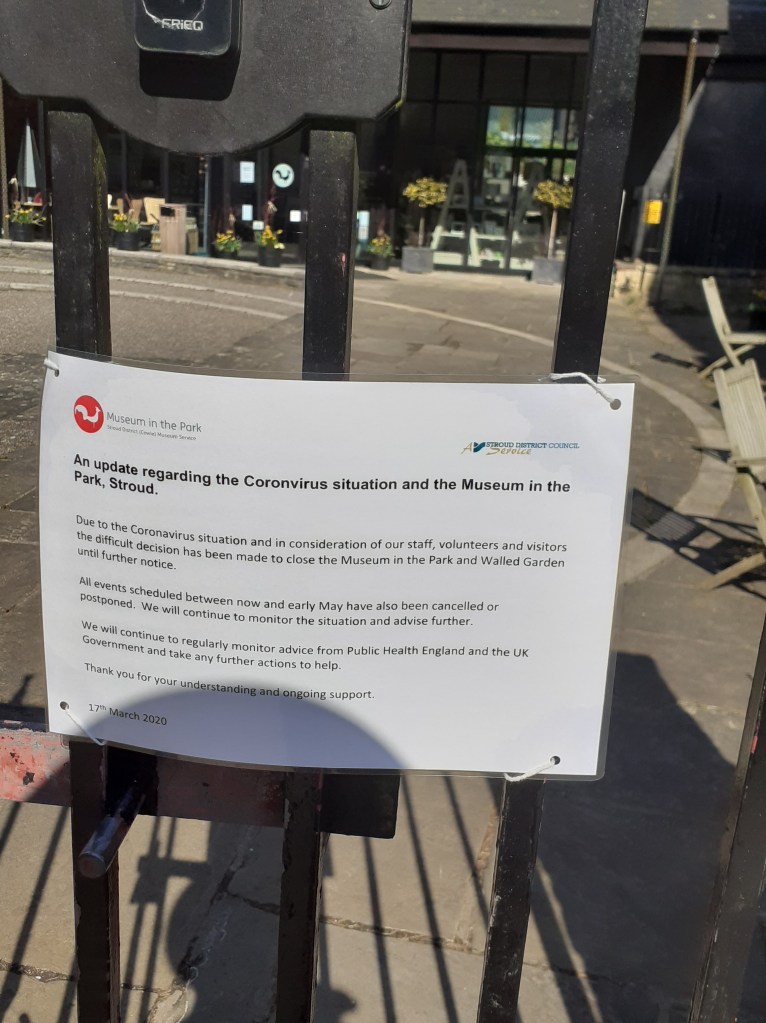
I am still going for walks, though not every day, and not for so long. The pictures I am sharing are from Tuesday 24 March, with a new social reality now firmly in place. The road above is the A46, running through Rodborough Parish into Stroud Town. The time is late morning. Normally, it takes a far greater volume of traffic, including much heavier traffic, than it was built for. It is frequently gridlocked. There are too few crossings, and it is a real obstacle for pedestrians. A mile or so away, close to a large Tesco supermarket, we find a roundabout where much the same could usually be said. Not any more.
Walking right across the middle of the roundabout with ease, I went on to Stratford Park, one of the town’s great amenities. The Museum in the Park in particular is a major cultural hub.
When I got here, I experienced a change of mood. I’d been enjoying the state of the roads. It felt like a holiday. I wish I lived in a world of much lighter traffic. But the museum notice was sobering. I had a real sense of loss.
The park itself felt surreal. It wasn’t quite deserted. There were a few people like me, now careful in keeping a distance from each other, in some cases wryly smiling or gesturing a friendly sense of shared plight in our manoeuvres of avoidance. Major features in the park, like the orangery, and the trees behind it, had an aura of lonely magnificence. The human element was dwarfed.
Entering the orangery, I felt sad that the flower beds laid out there won’t be seen by many people this year. In this bright, sunny day, they were stunning.
This walk was the first on which I felt less relaxed about being out – a little on guard and wary. I was somewhat reassured by the built and cultivated environment I was in. It hadn’t changed and in some ways was easier to enjoy, with fewer people, greatly reduced traffic and little obvious busyness. The people I encountered were clearly doing their best. But I was also conscious that this is an early stage in a process that has a long way to go. There was surface tranquillity on a beautiful spring day. But I was uneasily aware of a great deal going on that I didn’t see, in the many houses I passed by, and which my camera hasn’t captured.
As part of my contemplative inquiry, I have been looking at recent work by Rupert Sheldrake (1, 2). He identifies himself as “not a guru but an explorer”. I like that notion of ‘explorer’, with its sense that there is always space for new learning and development.
Sheldrake’s affirms that spiritual practice and research are “entirely consistent with the scientific method, which involves the formation of hypotheses – guesses about the way the world works – and then testing them experimentally. The ultimate arbiter is experience, not theory. In French, the word experience means both ‘experience’ and ‘experiment’. The Greek word for experience is empeiria, the root of our English word ‘empirical’. The exploration of consciousness through consciousness itself is literally empirical, based on experience. Spiritual practices provide ways in which consciousness can be explored empirically.”
In recent years, Sheldrake (1,2) has written two books based on this approach. Each discusses seven different practices that have been investigated empirically, both by the practitioners themselves and by scientists studying the effects of those practices. Every practice gets a chapter. The first book, Science and Spiritual Practices, offers:
Meditation and the Nature of Minds
The Flow of Gratitude
Reconnecting with the More-Than-Human World
Relating to Plants
Rituals and the Presence of the Past
Singing, Chanting and the Power of Music
Pilgrimages and Holy Places
The second Book, Ways To Go Beyond, covers:
The Spiritual Side of Sports
Learning from Animals
Fasting
Cannabis, Psychedelics and Spiritual Openings
Powers of Prayer
Holy Days and Festivals
Cultivating Good Habits, Avoiding Bad Habits, and Being Kind
Sheldrake’s choices are all practices he has taken part in, which have also been studied scientifically. He looks at both the ‘subjective’ experience and the ‘objective’ evidence and discusses the ways in which the practices seem to work. He also offers guidance to readers about engaging with the practices. He is very clear that the two books “do not constitute a comprehensive survey of all spiritual practices, emphasising his point by listing others that have been left out: “yoga, service to others, tai chi, chi gong, devotional worship or bhakti, tantric sex, caring for dying people, dream yoga, and the practices of the arts”. He makes it clear that “some practices are better at some times of life than others, and all religious traditions have their own combinations”. I have already discussed Sheldrake’s work on gratitude at www.contemplativeinquiry.blog/2020/03/14/ and will discuss others in future posts.
Sheldrake’s overall purpose is “to show that there is a wide variety of ways to connect to greater conscious realities, however we conceive of them, and that the effects of these practices can be investigated empirically”. Sheldrake is an optimist about the possibilities of science and spirituality working together in the service of human flourishing. “We are on the threshold of a new era of the exploration of consciousness, both through a revival of spiritual practices and also through the scientific study of them. After several generations in which science and spirituality seemed to be in opposition, they are becoming complementary. Together they are contributing to an unprecedented phase of spiritual evolution, beginning now.”
(1) Rupert Sheldrake Science and Spiritual Practice: Reconnecting Through Direct Experience Coronet, 2017
(2) Rupert Sheldrake Ways to Go Beyond, and Why They Work Coronet, 2019
NOTE: Rupert Sheldrake is a biologist and author of more than eighty technical papers and ten books, including A New Science of Life. He was a Fellow of Clare College, Cambridge, where he was Director of Studies in cell biology, and was also a Research Fellow of the Royal Society.
From 2005-2010 he was the Director of the Perrott-Warwick Project for research on unexplained human abilities, funded from Trinity College, Cambridge. He is currently a Fellow of the Institute of Noetic Sciences in California, and a Visiting Professor at the Graduate Institute in Connecticut.
A lone fawn protected by a dolmen. Boxing hares. A drill bow kindles a flame. As I move beyond the equinox into the second quarter of the year, what are these images telling me?
I am working with the Wildwood Tarot* as a resource for my journey through the wheel of the year. I’ve done a three card reading to intuit themes for the three months ahead. Each card is a lens on the whole period, revealing different aspects of the year’s second quarter, perhaps with an element of progression.
The key word for the 4 of stones, the one with the fawn, is ‘protection’. The supporting Wildwood text is largely a reflection on spiritual warriorship, with themes of testing, endurance, ethics and compassion. They help me to understand our public health crisis as also a spiritual crisis. Fortunately, the dolmen holding the fawn in immobilised physical safety can also be a space for spiritual renewal.
The 2 of stones, with its boxing hares, is another earth card and stereotypically seasonal. Its key word is ‘challenge’. In the traditional universe of the Tarot, One becomes two, and then three, and then the multitude. The opportunity for I-Thou relationship, diversity and the world of interbeing have been created. At the same time stress, tension and potential conflicts of interest have been born along with them. Interconnectedness sounds rich, creative and dynamically supportive. So it can be. Yet relationships involving dominance, submission, predation and parasitism are also forms of interconnection. Viruses too.
I don’t know what it’s like to be a hare. I have been told by other humans that boxing hares are playing a mating game, enacting a mating ritual, or demonstrating that female hares are capable of seeing off unwanted advances from males. Perhaps all of the above. They certainly demonstrate the complexities of interconnection. Currently I describe myself as ‘self-isolating’, and this is likely to go on for at least the whole quarter. Actually, I am self-isolating with my wife Elaine, and we are very conscious of needing to take active care of our own relationship and to maintain good distance links with others. The health of the interconnectedness within which we live is more important than ever. I take some comfort here from the boxing hares. Their energies are successfully held in balance. Their collective life and its continuation over the years are enabled. They are resourceful creatures and our traditional lore about them speaks of shape shifting capabilities and closeness to the Otherworld. They are survivors.
The key words for my third card, the Ace of Bows, are ‘spark of life’. In a reading without major trumps or court cards, this stands out as the fountainhead of the fire suit and in the Wildwood Tarot it points to the later stages of this quarter, from Beltane to the Summer Solstice and indeed beyond. It introduces human agency and technology, and is associated with creativity, enterprise and science: “The drill bow suggests the human element, our partnership with the environment in which we live and the mastery of its gifts”. I find myself placed in a somewhat passive position, but I am part of a wider community. I do have confidence that creatively scientific and genuinely enterprising efforts will be brought to bear on the current health crisis. ‘Spark of life’ resonates favourably for me, without saying anything specific about my individual future.
The three cards together encourage a strong focus on my contemplative inquiry, including this blog. The inquiry is personal, and in the language of Wildwood maintains my link to the Otherworld. It is also public, because of the blog, and can therefore play a role in a larger effort to use blogging and social media in the service of healthy interconnection. Wildwood’s suit of bows talks of ‘philosophical and esoteric pursuits’ as a form of “skilful ability fuelled by will”, along with the creativity, science and enterprise already noted. I would like to think of my contemplative inquiry as a manifestation of this, and I hope that it can be a form of service in the forthcoming quarter and beyond.
*Mark Ryan & John Matthews The Wildwood Tarot Wherein Wisdom Resides London: Connections, 2011. Illustrations by Will Worthington
I began closely following the wheel of the year – not only the festivals – just before the winter solstice. I wrote then that “my current warm up process is already changing the way I think and feel about contemplative inquiry and will re-shape how I do it”*. How has the first quarter been?
I’ve been outside, taking pictures, concerned with visual images and the stories they tell. There’s been some tension between communing with nature and being a self-conscious observer, actively selecting images. But on the whole it works. Taking pictures slows down my walks, opening up opportunities for stillness and mindful micro movement. Special moments come by themselves – or not. In sharing my experience, the process offers the opportunity to show as well as tell.
The quarter has been very wet – the picture above, taken on 15 March – shows a continuing abundance – to the point of excess – of water. It is beautiful and entirely natural, but for me also part of a story of times out of joint, and the increasing impact of the climate crisis. The picture below, also taken on 15 March, adds to this story in two ways. One is the suggestion of dank fecundity in the abundance of moss on a branch. The second is the indication of a lost branch from the same tree. High winds have caused considerable destruction in the woods in my neighbourhood. In both pictures, there are cues for appreciation and tranquillity, whilst also an indication that significant other things are going on. My current approach to contemplative inquiry has helped me to notice this and pay greater attention to it than I might otherwise have done.
The second quarter of the year will be different. I have self-isolated in response to Covid-19 though I am still going out on walks. I am likely to double down on contemplative practice and inquiry at home. I strongly believe in contemplative practice as, among other things, a resiliency factor in personal wellbeing, enhancing my experienced quality of life. I will talk more about this in future posts.
On Friday 13 March I tasted spring in its fullness. I was flooded with gratitude. Yet ‘gratitude’, especially in religious settings, was for a long time a tainted term in my life.
Growing up, I faced demands to be grateful whether I felt it or not. Over time I came to link this idea to formal performance and competitive public piety: being seen to be ‘good’. It also left my natural feelings of gratitude, when they came up, unrecognised and untended. In this stunted state I developed a cynicism about how language is used, rather than finding ways about how, authentically, to identify and cultivate my own sense of gratitude.
I am sad about this, because, even from a self-referential perspective, the capacity for gratitude is linked to wellbeing, happiness, self-acceptance and a sense of purpose in life. Psychological studies (1) show that gratitude is an active agent and not simply the result of already existing wellbeing. Exercises in gratitude work for many people, for much of the time. There are now considerable academic and self-help literatures on the subject.
Most spiritual traditions recommend gratitude, and for many of them this is linked to a sense of the divine, or some other ultimate point of reference. But this isn’t necessary. Gratitude is named as the third of thirteen principles in Atheopaganism (2), which is based on an entirely naturalistic, science-based cosmology. Here too, gratitude is seen as a habit that has to be learned and practised. The practice can alter both our internal dialogue and our behaviour. “It is good for ourselves, our relationships, our society and our world”.
I came late to gratitude, in the sense being discussed. But I’m a convert now. Being older has somehow helped. There was a decisive moment just under fifteen years ago, when I was 56 years. I was diagnosed with a cancer that might have killed me and I started to ask myself how I was going to maintain my quality of life remaining if I found myself on a downward slope.
I concluded that I would need to do what I could to count my blessings whilst I still lived. I recovered – with the insight still in place. I have built on that with greater awareness over the years, especially since beginning my contemplative inquiry. Now I’m nudged by the coronavirus and the same principles apply. I’m enjoying the experience of spring, usefully aware of my mortality, and grateful to be here, now.
(1) Rupert Sheldrake Science and Spiritual Practices Coronet, 2017
(2) Mark A. Green Atheopaganism: an Earth-Honoring Path Rooted in Science Green Daragon Publishing, 2019 (Foreword by John Halstead)
In my world, early March is a pre-equinoctial period of its own. In the emergence from winter, it manifests both resilience and regeneration. This year I have experienced an elephant’s ears plant (bergenia cordifolia) as an marker for resilience. This evergreen lives close to our back garden gate. It has been flowering, and it leaves have kept shiny, for most of 2020 so far. It has given me a lift every time I have walked past it, in all manner of weather. I feel grateful to it just for being there.
Why have I noticed it this year in particular? In the past I’ve taken this plant for granted. I’ve walked past without seeing it. I’ve only paid attention when the leaves need pruning, having strayed onto a path. Yet now this plant feels like a friend and nourishes me with its presence. It doesn’t just demonstrate its own resilience. It supports mine. I’ve been experiencing 2020 as tough and likely to stay that way, so I suppose that something in me has been looking for ways of feeling resilient. As a result, I’ve been able to notice something that’s been there all along, though largely neglected.
As well a resilience, I’ve been having a sense of regeneration, though the dynamics are a little different. One difference is that I expect to be leaning into regeneration at this time because it’s part of my wheel of the year narrative. I also expect it to be linked to the presence of willow trees (see picture below) because I befriended one many years ago. I have stayed in touch even after moving to a different town. The early re-greening of willow trees is part of my direct experience, and also part of my myth. It feels as if I am being taken by the hand and led towards the equinox.
I don’t want to get there prematurely. A patient, attentive journey emphasises the freshness and novelty of each year. I took the photograph below a couple of days ago on impulse, and it felt like a nudge into a process of renewal that I don’t want to undertake too quickly and don’t want to make assumptions about. Regeneration happens. Although I’m starting to feel my age, I’m still part of it. Let’s see how it goes in 2020.