Contemplative Inquiry

This blog is about contemplative inquiry

Tag: contemplative spirituality

TASTING SOLITUDE

“Three months after becoming a monk, I took off to the Himalayan foothills behind Dharamsala. I was 21 years old. My backpack contained a sleeping bag, groundsheet, towel, kettle, bowl, mug, two books, some apples, dried food and a 5-liter container of water. Monsoon had just ended: the sky was crystalline, the air cleansed, the foliage luxuriant. After 3 or 4 hours, I left the well-trodden footpath and followed animal trails up the steep, sparsely forested slope until I reached the grassy ledge hidden by boulders and sheltered by branches that I had identified earlier on an earlier foray.

“Inspired by stories of Indian and Tibetan hermits, I wanted to know what it would be like to be cut off from all human contact, alone and unprotected. I would stay here as long as my meager supply of food and water permitted. No one knew where I was. If I fell and broke my leg, was bitten by a cobra or mauled by a bear, I was unlikely to be found. High in this aerie, I could still hear the distant horn blasts and grinding gears of buses and trucks below, which I regarded as an affront.

“I would wake with my sleeping bag covered in dew. After peeing and meditating, I would light a fire, boil water, make tea, then mix it with roasted barley flour and milk powder to form a lump of dough. This was breakfast and lunch – following the monastic rule, I did not eat in the evening.

“My meditations included the sadhanas into which I had been initiated, where I visualised myself either as the furious bull-headed, priapic Yamantaka or the naked, menstruating red goddess Vajrayogini. I alternated these tantric practices with an hour of mindfully ‘sweeping’ my body from head to foot, noticing with precision the transient sensations and feelings that suffused it. When not eating or meditating, I intoned a translation of Santideva’s Compendium of Training, an 8th century Sanskrit anthology of Mahyana Buddhist discourses, which I had vowed to recite in its entirety while up there.

……….

“What remains of that solitude now is my memory of the sweeping panorama of the plains of the Punjab, the immense arc of the heavens, and the embrace of the mountains that harbored this fragile dot of self-awareness. Once, a fabulous multi-colored bird that launched itself from the cliff beneath, floated for an instant in the air, then disappeared from view. A herdsman and his goats came close to discovering me one afternoon. I peeked at them through a lattice of leaves as the animals grazed and the wiry, sun-blackened man in a coarse wool tunic lay on a rock.

“Supplies exhausted and text recited, I trekked back to my room in McLeod-ganj below. During my five days on the mountain I had acquired a taste for solitude that has been with me ever since.”

Stephen Batchelor The Art of Solitude: A Meditation on Being Alone with Others in This World New Haven, CT & London, England: Yale University Press, 2020

EVENING LIGHT IN APRIL

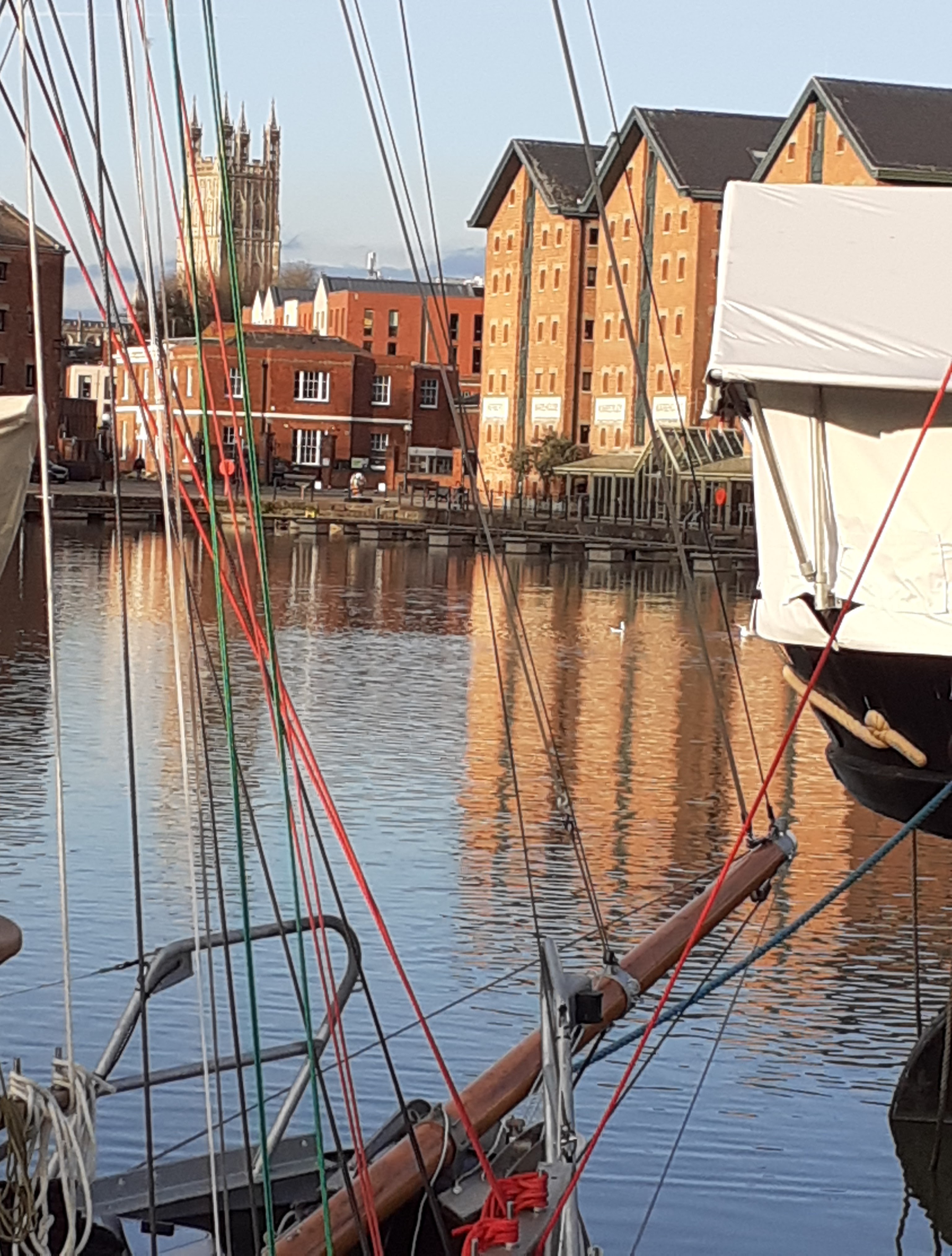
In Gloucester, England, we are entering the four lightest months of the year. The pictures above and below were taken after 7 pm. This lightness, and the long evening twilight that follows, still feel novel. The day-to-day weather here has been volatile, making evening sunshine all the more precious when it comes. I feel naturally enlivened and blessed, somehow shifted into a more immersive experience of the world around me.

I live in a flat where I have good views of the sky, the sun, the moon and their changes from indoors. This has subtly altered my experience of daily life from before dawn until after sunset – following the wheels both of day and year from a slightly elevated level. But there’s something also in experiencing the effects of April evening light at ground level. It’s an urban, curated landscape and I am (mostly) an urban Druid. I am fond of such spaces when they are done well and preserve a human scale.

In the docks I notice rigging on a sailing boat at rest and brick warehouses reflected in tranquil sunlit water. The cathedral tower is in the distance, still the tallest building in sight. On Brunswick Road, I look into the grassy city garden of Brunswick Square, mostly in sunlight, partly in shade. Immediately in front of me there’s a cherry tree in blossom. Across the square, I enjoy an 1820’s terrace. At this moment in the year, I discover both freshness and familiarity. For me, the experience of an evening like this is an ideal way of being and belonging in place.

CONTEMPLATION AS SERVICE

“They also serve who only stand and waite” (1) wrote the naturally activist poet John Milton. He was coming to terms with his loss of sight and significant worldly defeat. For him, waiting means waiting upon God, as a servant, rather than waiting for an appointment, waiting for salvation, or stuck in the wounded forever-waiting enacted in Samuel Beckett’s play Waiting for Godot. For Milton, waiting, being available, is a form of engagement and of service.

Contemplative living can be understood as service, even without Milton’s theology or master-servant relationship with the Divine. For contemplative life is more than ‘just being’. It asks us to stay present in the activities of daily life and and in our interactions with others. When present, ideally, we bring spacious stillness into the world. With consciousness comes quality. Every task is sacred. Every event is full of meaning. When we are alive to the experience we are having, we feel our oneness with the whole and the Source. Then we can “affect the world much more deeply than is visible on the surface” of our lives (2).

(1) John Milton When I Consider How My Light Is Spent In Delphi Complete Works of John Milton Delphi Classics, 2012 (e-book)

(2) Eckhart Tolle A New Earth: Create Your Better Life Today London: Penguin Books, 2016 (First Edition 2005). My second paragraph above draws on this source whilst somewhat modifying the message.

WILD WRITING

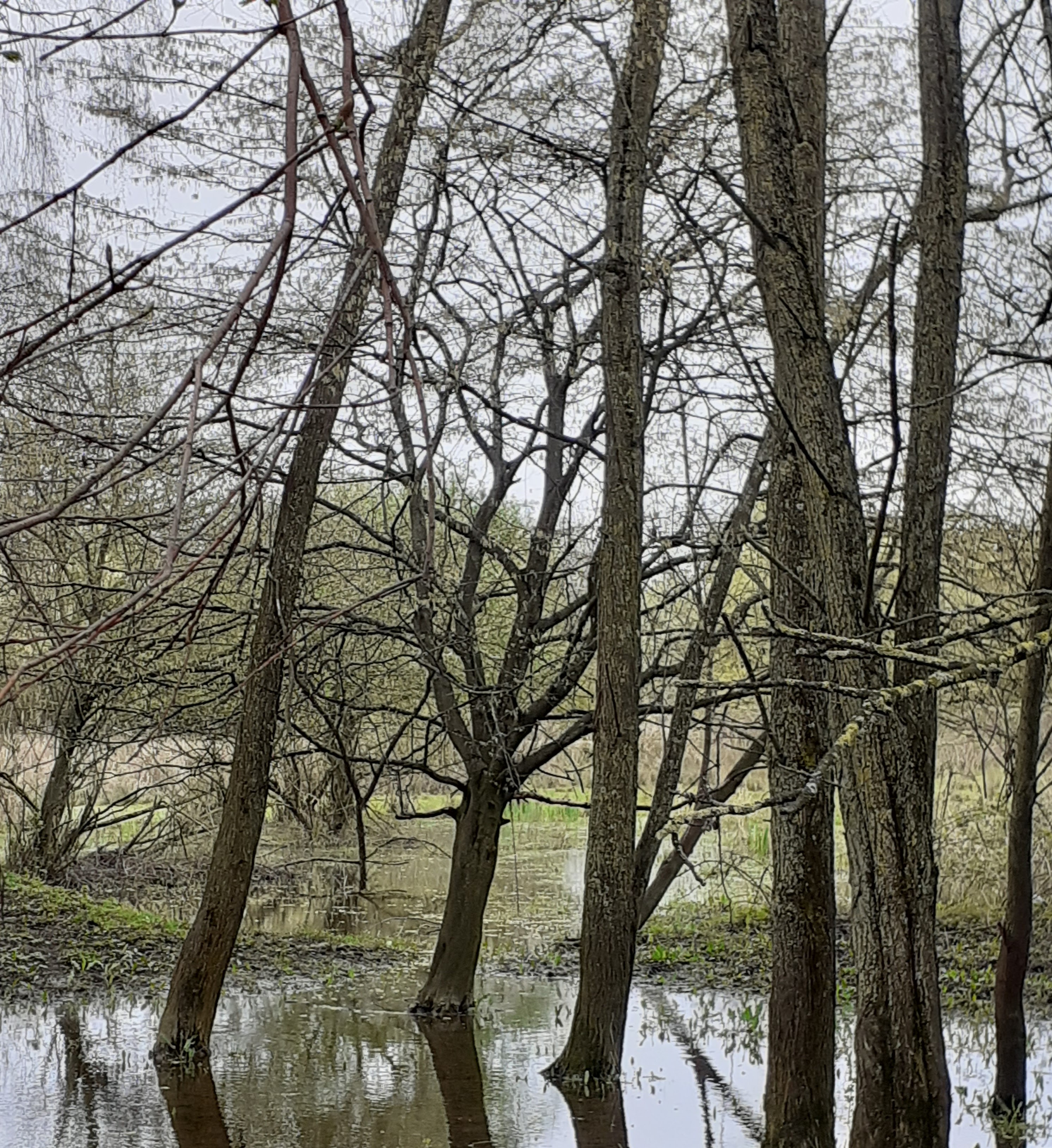
I look at the picture with fresh eyes. It is already a record of the past, and it is much too still. Yet I feel drawn towards this image. I enjoy the tree shapes in their starkness. I sense resilience in the plant life pictured here. I am writing now with sunlight intermittently on my shoulder, and the sounds of wind and rain beyond my strong glass doors.

I am also reflecting on writing as a practice. Natalie Goldberg (1,2) writes books about this and her description of ‘writing practice’ seems to me to have two entirely compatible meanings. The first is that it trains people for the writing of poems, stories and novels. The second points to a form of life practice flowing from the view that “writing is the crack through which you can crawl into a bigger world, into your wild mind” (1).

In Wild Mind: Living the Writer’s Life Natalie Goldberg compares writing practice with journaling. “Journal writing has a fascination with the self, with emotion and situation. It stops there. Writing practice lets everything else run through us; in writing practice, we don’t attach to any of it. We are aware that the underbelly of writing is non-writing. Journal writing seems to be about thought, about rumination and self-analysis. … We want to get below discursive thought to the place where mind – not your mind or my mind but mind itself – is original, fresh. It’s not you thinking. Thoughts just arise impersonally from the bottom of our minds. That is the nature of mind – it creates thoughts. It creates them without controlling them or thinking them … Writing practice knows this, knows how we are not our thoughts, but lets the thoughts, visions, emotions run through us and puts them on the page.” (1)

In her earlier book, Writing Down the Bones: Freeing the Writer Within, Natalie Goldberg quotes Jack Kerouac as saying that a writer should be ‘submissive to everything, open, listening’. She also recommends that “we stay in the trenches with attention to detail”, avoiding escape into abstraction. She points to poetry in particular, “because it brings us back to where we are. It asks us to settle inside ourselves and be awake”. She reproduces the famous William Carlos Williams poem:

“So much depends

upon

a red wheel

barrow

glazed with rain

water

beside the white

chickens.”

I remember this poem from my childhood. I liked it a lot, but couldn’t find anything to say about it in the class room when it was expected that I would. I was embarrassed then. I wouldn’t be now.

Natalie Goldberg also practices Zen Buddhism, with Katagiri Roshi until his death and more recently as an ordained member of the Order of Interbeing founded by Thich Nhat Hanh. She acknowledges the role of Zen in developing her insights into the creative process. I find her approach, including her practical exercises, very helpful.

(1) Natalie Goldberg Wild Mind: Living the Writer’s Life New York, NY: Open Road Integrated Media, 2011 (first published 1990)

(2) Natalie Goldberg Writing Down the Bones: Freeing the Writer Within Boulder, CO: Shambhala, 2016 (30th anniversary edition)

BLUEBELLS BEFORE BELTANE

Seeing bluebells

In verdant grass.

Will summer really come?

ME AND MY INQUIRY

My inquiry moves slowly. But it doesn’t stand still. So from time to time I update the ABOUT section of my blog. Sometimes I discuss my changes in a post. Occasionally it seems as if the blog has its own life and writes itself through me. I’m not sure that I would claim the word Awen here, but I can end up surprised at what appears.

This time there seems to be a settling, an emphasis on continuity. I recommit to a contemplative inquiry, grounded in modern Druidry and with the inquiry process itself as my core practice. I am now assuming that this will be lifelong. In the past I have tended to believe that the inquiry would eventually lead to a conclusion of some kind, or become redundant for other reasons. Another project would then emerge – or maybe I would retire from projects and put my feet up. That belief has gone, for my inquiry is no longer a ‘project’.

As I was writing this morning, I became conscious of the change. ‘My inquiry’, I wrote ‘has shifted from a focused experiential investigation into a more relaxed, at times meandering process that brings illumination, healing and peace’. I have always had, in the back of my mind, prestigious models of both academic and spiritual inquiry that do not encourage relaxed meandering. In the academic models, results like ‘illumination, healing and peace’ are beside the point. In the spiritual ones, they are mostly reckoned to be very hard-won. But there it is. I am moving into a life-lived-as-inquiry space by softening and reframing my idea of inquiry. I seek support and nourishment rather than new and different ‘results’. Looking at these words now, they seem obvious, not even new – but I’ve only just caught up. It does seem, experientially, as if the blog has become the voice (spirit?) of the inquiry and intervened to educate me. It’s an odd feeling.

Here is the new ABOUT text:

“I am James Nichol and I live in the city of Gloucester, England. My contemplative inquiry began in 2012. It is grounded in modern Druidry, though I have drawn on the enduring wisdom of many times and places. I am also influenced by the current turn towards an eco-spirituality that meets our own historical moment. The inquiry itself is my core practice. I see it as a lifelong journey. In my blog I include personal sharing, discursive writing, photographs, poetry, and book reviews.

“Over the years, my inquiry has shifted from a focused experiential investigation into a more relaxed, at times meandering process that nonetheless brings illumination, healing and peace. In the contemplative moment,  I am living presence in a field of living presence, at home in a living world. This is not dependent on belief or circumstance, but on the recognition of what is given, in joy and sorrow alike. I find that this simple recognition encourages a spirit of openness, the acceptance that nothing stays the same, an ethic of interdependence and a life of abundant simplicity.

“My book, Contemplative Druidry: People, Practice and Potential, was published in 2014. It includes a foreword, Deep Peace of the Quiet Earth, by Philip Carr-Gomm. There are major contributions in the main text from 14 other Druids offering diverse perspectives on the topic: https://www.amazon.co.uk/contemplative-druidry-people-practice-potential/dp/1500807206/

APRIL AND ‘DRUID MINDFULNESS’

Where I live, April 2023 brings qualities and freshness and new growth. My heart meets the moment as I walk in the bracing breeze. Sunny and overcast periods succeed each other. Moving through this enlivening space, I naturally welcome the energy of change it embodies.

But it’s not quite that simple. There’s an underlying turbulence too, which can easily challenge my balance. Slogans like ‘I am the sky. Everything else is weather’ aren’t enough. I, as natural man, have to ground and embody them. They have be be aligned with my felt sense.

I wasn’t sure how to talk about this when I discovered that someone else had done it for me. Philip Carr-Gomm, who until recently led OBOD (Order of Bards, Ovates and Druids), offers a regular podcast: Tea with a Druid. No 249 is about ‘finding calm in chaos’. It is up on YouTube as: https://www.youtube.com/watch?v=Ew4pD3OJen8

Philip suggests that the best way to deal with chaos, turbulence, or the everyday stress of modern life, is to turn to the stillness inside. Then it becomes possible to stay in the moment whilst expecting nothing. It takes work to get there – to identify ways of finding stability and calm even when all around is unstable and unpredictable.

Philip understands modern Druidry as a tradition of ‘mindfulness in natural settings’, whether real or visualised. The stillness found in those settings isn’t a dead stillness but a living one – leaves rustle, waves crash. The refreshment is somewhat different from that of a more abstract meditation where we sit with thoughts and feelings, finding the space beyond. In the podcast, Philip takes us through a meditation of the kind he describes. I thoroughly recommend it to anyone, whether or not involved in Druidry.

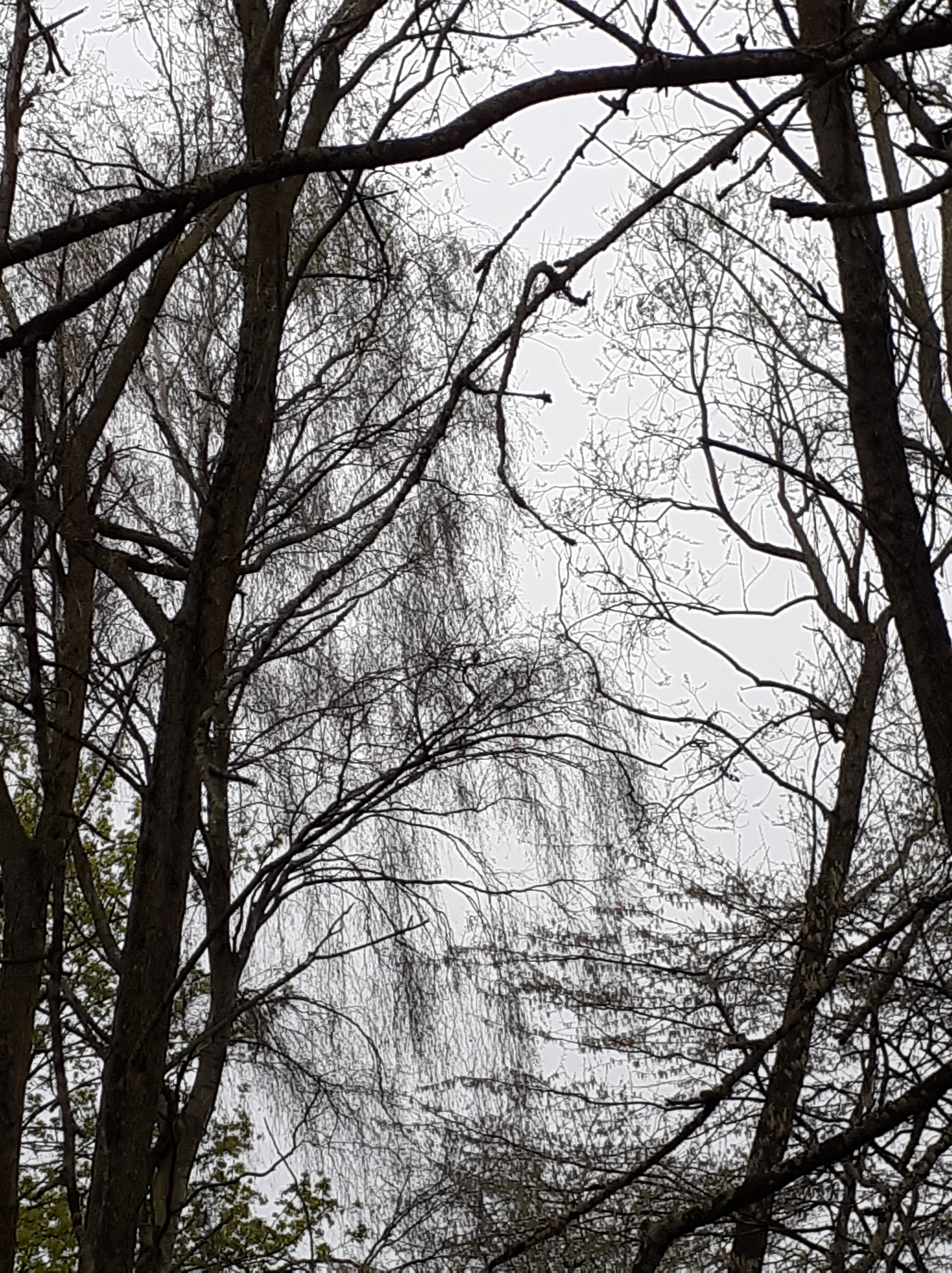
Returning to my recent walk, and the record of it, I see branches, buds and sky. I remember the movement in the sky, and a slight quivering of the wood. Records have their limitations. The stillness wasn’t one of complete stasis, as it may appear below. My current response is complicated by the human gift of memory, which is not the original experience. I am also absorbing someone else’s input. I am in a completely different here and now. But I am held within an enlivened tranquility, not at all that of the ‘tranquiliser’, and this is certainly a wonderful resource. Gratitude to the culture that has enabled it.

GREENING

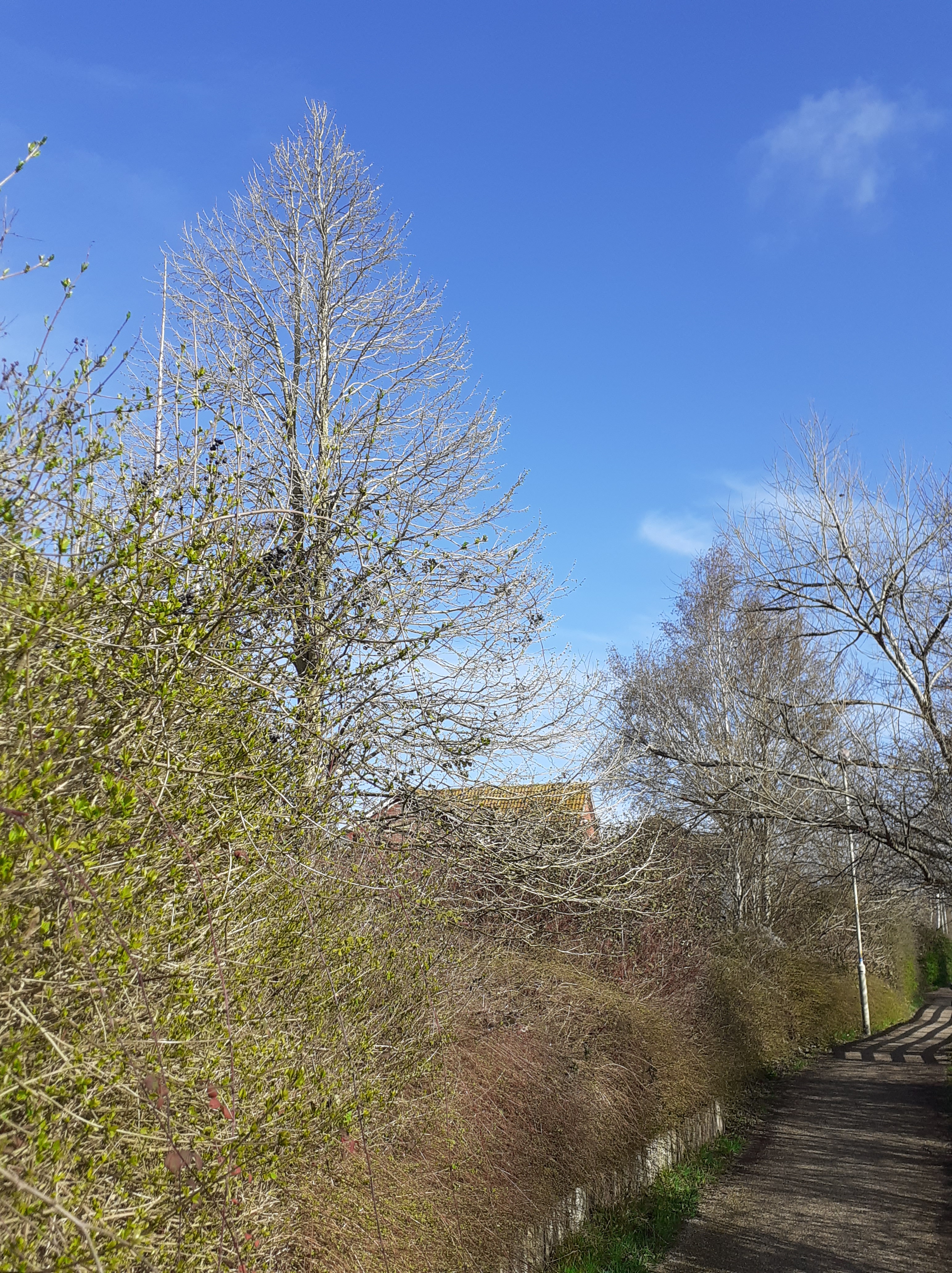
Lately I have been seeing more catkins and leaves amongst the elegant branches of their trees. A vivid green is present on the ground. As yet the changes are tentative. But they hold the promise of new life and growth. There’s a freshness here, enhanced by strong breeze. I notice and feel energised, walking down the path.

The changes have not gone very far, but the trend is now clear. For me, it shows up well against a blue sky. In this changeable season, I see possibilities for my own life, now that I am settled and in good health. These too are in their early stages, showing signs of promise more than accomplishment. My inner wisdom warns me not to move past ‘promise’ into ‘accomplishment’ too speedily or strivingly. Promise has its own season.

EMERSON: ‘IMMORTAL BEAUTY’

“Crossing a bare common, in snow puddles, at twilight, under a clouded sky, without having in my thoughts any occurrence of special good fortune, I have enjoyed a perfect exhilaration. I am glad to the brink of fear. In the woods too, a man casts off his years, as the snake his slough, and at what period soever of life, is always a child. In the woods, is perpetual youth.

“Within these plantations of God, a decorum and sanctity reign, a perennial festival is dressed, and the guest sees not how he should tire of them in a thousand years. In the woods, we return to reason and faith. There I feel that nothing can befall me in life, – no disgrace, no calamity, (leaving me my eyes), which nature cannot repair.

“Standing on the bare ground, – my head bathed by the blithe air, and uplifted into infinite space, – all mean egotism vanishes. I become a transparent eye-ball; I am nothing; I see all; the currents of the Universal Being circulate through me; I am a part or particle of God. The name of the nearest friend sounds then foreign and accidental: to be brothers, to be acquaintances, – master or servant, is then a trifle and a disturbance. I am the lover of an uncontained and immortal beauty.” (1)

In the first paragraph above, I hear my own experience, described in a mid 19th century American voice. I share the sense that the exhilaration comes partly from the land, woods and sky themselves and partly from the continuing life of the child within us.

In the second paragraph, I feel at home with with the overall sentiment, whilst having to work a little with Emerson’s terminology. At the beginning I am not sure what he means by ‘God’. I do understand that ‘plantations of God’ restores innocence, as well as wildness, to the term ‘plantation’. (Emerson was a notable abolitionist.) I also note that the woods are a domain where reason and faith are brought together, in a time and culture where they seemed to be in conflict. Nature isn’t just a word for material reality. Nature is a source of protection and healing that goes beyond the mundane.

The third paragraph makes Emerson’s transcendentalism clear, and with it the true power of contemplation. ‘Standing on the bare ground … uplifted into infinite space – all mean egotism vanishes. I become a transparent eyeball. I am nothing: I see all”. God and Nature become Universal Being, from which ‘I’ am not separate. To be simply present in this space, with no agenda and nothing in mind, is to be “the lover … of an uncontained and immortal beauty”. The nature of our experience is a living nature we perceive, are part of, and relate to – not a reified externality. An open, enlivened receptivity to this reality can allow a deeper awareness (for Emerson, that of the Divine in us) to declare its presence.

(1) Ralph Waldo Emerson Nature Boston, Mass: Thurston, Torry and Company, 1849

NOTE: According to Wikipedia, Ralph Waldo Emerson (1803-82) “was an American essayist, lecturer, philosopher, abolitionist and poet who led the transcendentalist movement of the mid-19th century” who gradually moved away from the religious and social beliefs of his contemporaries, formulating and expressing the philosophy of transcendentalism in his 1836 essay Nature”. He wrote most of his important essays as lectures first and then revised them for print. “Emerson’s ‘nature’ was more philosophical than naturalistic. … Emerson is one of several figures who took a more pantheist or pandeist approach by rejecting the view of God as separate from the world”.
MARCH 2023: WINTER PUSHES BACK

Where I live, March has so far been a contest between the coming of spring and a winter that won’t let go. The city of Gloucester has been relatively insulated, but we have still had sub zero nights and low day time temperatures. There has been snow that didn’t settle, cold hard rain and occasional high winds. There have also been frequent periods of sunshine – still cold, still rainy, yet a joy to be out in. Underneath this changeability, the period of daylight grows longer.

A canal side walk shows a more subdued world than last year, and a sense of latency, as though life is waiting to see what will happen next. The wheel of the year turns as ever. What to expect on the ground has become less certain. The climate crisis is visibly in process, with the consequence of vast changes in the arctic now making themselves felt here. We could say that the Cailleach is angry and mobilising. But what this means for our day-to-day weather isn’t always clear.

As I experience these shifts (not so dramatic in themselves in the here and now) I can’t help thinking about culture as well as nature. Climate has moved down the formal political agenda – again. Outright denialism and repression of information about relevant topics still aren’t over. Sir David Attenborough, who has been making nature programmes since the beginning of broadcast TV, will not be having his most recent one (6th and last of a new series) shown live by the BBC. It will be available only on iPlayer.

Supported by groups like WWF (World Wildlife Federation) and RSPB (Royal Society for the Protection of Birds), this programme highlights the destruction of nature in Britain and looks at rewilding as part of the solution. There are allegations that the restricted availability of this content stems from a fear of offending Conservative politicians and the right wing press. The BBC has issued denials but I have not seen any other plausible reason put forward. Yet this is about conservation: in older meanings of ‘conservative’, the protection of nature and the exploration of rewilding could readily have become a conservative cause. They have been, in the past – think about Theodore Roosevelt and the National Parks movement in the USA.

From a Druid and Earth spirituality perspective, the desacralisation of nature, and the emergence of a wasteland culture, lie at the heart of this problem. This is not new. It has being going on for a long time, for many reasons – religious, economic and political – driven by people with widely different projects and motivations. I know that there is much creative work going on to develop better understandings and positive projects. But it still saddens me that the balance of power and resources, especially in a renewed time of wars and the threat of wars, remains so troubling.

In my personal life I am happy and optimistic. I can feel sad about what is going on around me without being defined or disabled by my grief. Moments of fear and sparks of anger, too. They need not be driven away. They too have an honoured place at the table. They are part of the larger whole, and, lived with emotional intelligence, a way of bearing witness and a spur to action in the world.

Earth Eclectic

music that celebrates Earth and speaks to the heart

Sarah Fuhro Star-Flower Alchemy

Follow the Moon's Cycle

Muddy Feet

Meeting nature on nature's terms

Rosher.Net

A little bit of Mark Rosher in South Gloucestershire, England

Becoming Part of the Land

A monastic polytheist's and animist’s journal

selkiewife

Selkie Writing…

Charlotte Rodgers

Images and words set against a backdrop of outsider art.

Prof Jem Bendell

living with metacrisis and collapse

Towint

The pagan path. The Old Ways In New Times

The Druids Garden

Spiritual journeys in tending the living earth, permaculture, and nature-inspired arts

The Blog of Baphomet

a magickal dialogue between nature and culture

This Simple Life

The gentle art of living with less

Musings of a Scottish Hearth Druid and Heathen

Thoughts about living, loving and worshiping as an autistic Hearth Druid and Heathen. One woman's journey.

Wheel of the Year Blog

An place to read and share stories about the celtic seasonal festivals

Walking the Druid Path

Just another WordPress.com site

anima monday

Exploring our connection to the wider world

Grounded Space Focusing

Become more grounded and spacious with yourself and others, through your own body’s wisdom

The Earthbound Report

Good lives on our one planet

Hopeless Vendetta

News for the residents of Hopeless, Maine