Contemplative Inquiry

This blog is about contemplative inquiry

Tag: Contemplative inquiry

ROWAN

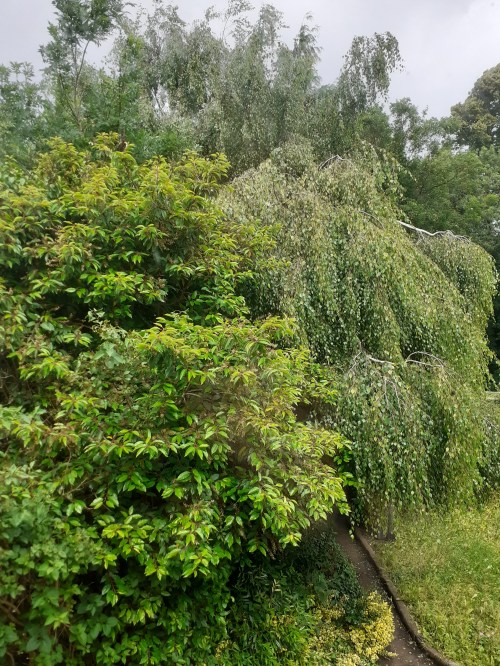
Walking in the woods yesterday, I was struck by the vitality of rowan leaves and berries. I haven’t done this walk for a while, so I’m not quite sure when the berries became so vivid. All I can say is that they powerfully drew my attention. They were just what I needed, in this time of tentative emergence from Covid-19 lockdown. I look forward to their companionship as the high summer leans into autumn and beyond.

Sometimes I feel ambivalent about tree lore. Too much lore can get in the way of living connection with a tree, or even displace it. But in this case it seems to fit. To me, rowan does look magical, and feels potentially protective. I am not surprised that our ancestors planted it for this use down the ages – to guard stone circles, sacred groves, churchyards and houses. The very name rowan is linked to the Norse runa, meaning ‘charm’. In Ireland, rowan was considered a Druid tree and linked to the blackbird as a Druid bird. The berries themselves present a pentagram image, linking us to notions of magical protection.

Rowan is said to be concerned with wisdom and foresight. Breathing in smoke from the burning wood was an aid to foreseeing danger. Rowan is associated with solar goddesses of wisdom, skill and fire energy: in Ireland, Brigid; and in Britain, Brigantia. Both are said to have possessed arrows of rowan, which could catch fire if necessary.

I find the presence of rowan subtly morale boosting as I negotiate a new normal with my wife Elaine and, together, with the wider world. We work with the knowledge that Covid-19 is not going away and that we do need to re-engage more directly with that world. The very physicality of the rowan tree is an invitation to step out, whilst also encouraging a sense of what to look out for, and how the next phase is likely to be.

FROM LACK TO ABUNDANCE

“Try to get

what you want,

and it’s already

far away.

Be what you want,

know it in your heart,

and it’s already yours.

The rest is details.

The rest,

you never really wanted anyway.

From lack to abundance,

in a heartbeat.” (1)

There is wisdom in this slender poem. Mediating wisdom is a traditional task of the Druid. This includes recognising wisdom in others and passing it on. For my own Druid path, the invitation to “be what you want, know it in your heart” has always had a resonance. The poem as a whole points to a more grounded stance in our lives.

Jeff Foster’s words are the product of recovery journey that led him out of debilitating levels of depression and suicide risk. This involved in inward turn, away from external markers for success in the wider world, that paradoxically enabled his true ability to connect. Hence his complete reframe of ‘abundance’. Elsewhere in the same book (1) he says: “abundance is your connection to each breath, how sensitive you are to every flicker of sensation and emotion in your body … the feeling of the afternoon breeze on your cheeks, the sun warming your face. It is meeting others in the field of honesty and vulnerability, connecting beyond the story, sharing what is alive”.

He also says that it is “knowing yourself as presence, the power that creates and moves worlds”. This has become a crucial understanding within my renewed and consolidated practice of Druidry. It is an insight common to the perennial wisdom traditions, and so a place where many paths converge. It aligns Jeff Foster with R. J. Stewart’s view, recently explored in this blog, that “we are the tree of life” and “the stars are within us” (2,3).

(1) Jeff Foster The Way of Rest: Finding the Courage to Hold Everything in Love Boulder, CO: Sounds True, 2016

(2) R. J. Stewart The Miracle Tree: Demystifying the Qabalah Franklin Lakes, NJ: New Page Books 2003

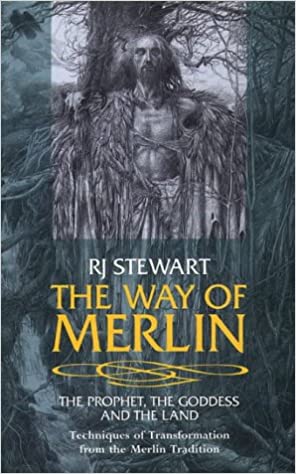
(3) R. J. Stewart The Way of Merlin: the Prophet, the Goddess and the Land London: The Aquarian Press, 1991

MERLIN AND THE MIRACLE TREE

This is the last post in a series offering an overview of R. J. Stewart’s Merlin-related work. The Complete Merlin Tarot  (1) in the picture is the companion book to The Merlin Tarot (2). Together I find them a good way to engage with the images that Stewart derived from Geoffrey of Monmouth’s introduction of Merlin to twelfth century readers. For me it is an example of what Joseph Campbell (3) calls ‘creative mythology’, a feature of Western European culture from Geoffrey’s time onward. Creative mythology drew on traditional Celtic and Germanic stories, the classical inheritance of Greece and Rome, and elements from Gnosticism and Islam. It gave imaginative depth and freedom in an era of constraining religious formalism.

Geoffrey, specifically, made wide use of classical and British Celtic sources. In The Life of Merlin (4) both the wild man of the woods section and the contemplative observatory section point to something beyond the conventional spirituality of the day. Its cultural frame of reference is broader – the observatory motif points back to Stonehenge and east to the proto-modern observatories in Damascus and Baghdad.

In The Merlin Tarot, R. J. Stewart places Merlin imagery within a Kabbalist Tree of Life framework. His commitment to the Tree goes beyond simple observance of the Tarot’s structural conventions. Stewart affirms that Kabbalah essentially means “whispered wisdom, mouth to ear” (5). He talks of three streams of Kabbalah, Jewish, Sufi and Western. All, he suggests, predate the Abrahamic orthodoxies of the Middle East and Europe, whilst being influenced by them. Ultimately, the Tree of Life is “not a set of symbols, not a system of meditation and vision … not even a tradition … we are already the Tree of Life”. It is a Tree of Life, not a Tree of Literature, a Miracle Tree that can change us “from a false and imbalanced state to our real and eternal Being”.

From an historical, record examining perspective, Kabbalists became visible in the urban Jewish communities of Languedoc, in South Western France (6), also during the twelfth century of Campbell’s creative mythology. Indeed, other Jewish scholars and mystics frowned on their eclecticism. Languedoc’s vibrant culture included the then flourishing Gnostic Cathars and was the heartland of the widely travelling troubadours. This was the day of the crusader kingdom in Jerusalem, and the partial adoption of local lifestyles by its own permanent military residents – next door to an Islamic world which tolerated religious minorities. It is a moment in the domains of the Latin Church, not destined to last, that was friendly to new ways of thinking and feeling. For me, there are sufficient cultural resonances  here to make a Kabbalistic framework for the Merlin Tarot images feel both appropriate and celebratory.

The tree is imprinted imaginatively within my body. I use now it in subtle healing and light energy work – choosing it over other systems like the three cauldrons of poesy or the chakras of kundalini yoga. The major trumps are likewise imprinted and related to the pathways between sephira. They will always be part of my spiritual story, thanks to an early, intense relationship with the deck and the understandings behind it. As part of my current consolidation, I have begun to use The Merlin Tarot again within my contemplative work, given its place in my history and its for me enabling association with creative mythology.

(1) R. J. Stewart The Complete Merlin Tarot: Images, Insight and Wisdom from the Age of Merlin London: The Aquarian Press, 1992 . Illustrated by Miranda Grey ISBN 1 85538 091 9 No cards, but a full explanation and discussion of the system and its imagery.

(2) R. J Stewart The Merlin Tarot London: Element, 2003. Illustrated by Miranda Grey ISBN 000 716562 5 (First published by London: The Aquarian Press, 1992). Cards, handbook and notebook for record keeping.

(3) Joseph Campbell The Masks of God 4: Creative Mythology Harmondsworth: Penguin, 1976 (Original U.S. edition published in 1968)

(4) R. J. Stewart The Way of Merlin: the Prophet, the Goddess and the Land London: The Aquarian Press, 1991

(5) R. J. Stewart The Miracle Tree: Demystifying the Qabalah Franklin Lakes, NJ: New Page Books 2003

(6) Gershom Scholem Origins of the Kabbalah The Jewish Publication Society & Princeton University Press, 1987 (edited by R. J. Zwi Werblowsky; translated from the German by Allan Arkush. Original German publication Berlin: Walter de Gruyter & Co., 1962)

HONOURING ‘THE WAY OF MERLIN’

The Way of Merlin came into my hands at the right time. It seeded a number of key understandings, which nudged me onto a Druid path in October 1993. The first is that “sacred space is enlivened by consciousness. Let us be in doubt that all space is sacred, all being. Yet if human beings dedicate and define a zone, a location, something remarkable happens within that defined sphere of consciousness and energy. The space talks back”. Author R. J. Stewart backed this up with the further declaration that “The mystery of Merlin is a backyard mystery, for it declares the smallest, most local space to be sacred, to be alive, to be aware.” I was living in South London at the time and remember being challenged in this book to befriend a spring and a tree. At first, I thought, ‘what?’. Then I found them both, on the day I started looking, in a local park.

Such activities went with the view, “yourself and the land are one”, and that this apparently humble work has a larger context of “holism … identical to the deepest perennial magical and spiritual arts”. Magic is seen as a process of having intent and applying energy and imagery in service to it. Working within mythic frameworks asks for an enabling suspension of disbelief rather than a dogmatic literalism.

I did not work with the suggested programme of visualisations and rituals concerning Merlin, the weaver goddess Ariadne, and other scenes drawn largely from Geoffrey of Monmouth’s Life of Merlin. As practices they seemed too long and formal. But reading Stewart’s text was psychoactive in itself. The weaver goddess Ariadne is a key figure, and the vision of Ariadne reveals a cosmic mother at the threshold of Being and Unbeing. She draws us into the empty silence of the Void, out of which emerges the sound of breath – our own breath and at the same time the breath of all Being. Being breathes through us, “and we realise that we have a body that is the body of all Being. The stars are within us. We are formed of the weaving”.

The specific image of Ariadne never took root in my imagination. But I acknowledged the power of this Pagan Gnostic creation myth. Its sense of our reality emerging from empty potential at the behest of a cosmic mother has stayed with me. My work with Sophia earlier in this inquiry pointed in the same direction. So does my recent post about Dancing Seahorses and Modron (2). I am happiest with the Modron image, because it is less defined and anthropomorphised than those of Ariadne and Sophia. At at the threshold of being and unbeing, she shows us that we are not separate from the divine breath that forms us, or from the creation that is formed. The stars are indeed within us, whether we know it or not.

The Way of Merlin has something like an ancestral role in my spiritual life. R. J. Stewart and I were born in the same year, but he was doing this pioneering work in the 1980’s when I was busy with other things. He influenced me in the period immediately before I embarked on a Druid path, and I have revisited his work over the years. It still has riches to offer.

(1) R. J. Stewart The Way of Merlin: the Prophet, the Goddess and the Land London: The Aquarian Press, 1991

(2) https://contemplativeinquiry.blog/2020/06/25/dancing-seahorses/

ELAINE’S CAULDRON: BURNING DEAD LEAVES

My wife Elaine created this midsummer cauldron fire, now ten days ago. It was fuelled in part by dry dead leaves. She chose the evening of the day itself rather than the traditional eve. The point about midsummer (24 June) is that the sun is on the move again after its moment of stasis, clearly beginning its decline. It acts as the polar opposite of the Sol Invictus or Christmas festival in late December. The Church gives 24 June to John the Baptist, decapitated at the wish of his nemesis Salome.

In our neighbourhood, there is a paradox about July. It is the quintessential summer month, in which the light begins to diminish. At the moment, sunrise is at about 4.50 am., with sunset at 9.20 pm. By Lughnasadh, it will be rising at 5.25 am and setting before 8.50 pm. In August, the process will accelerate while the earth and sea remain warm by North Atlantic standards. Getting up an hour or so after sunrise I am tending to find a dull and cloudy sky. There can be a stillness in the air, disturbed perhaps by blackbird pair flying low amongst the trees. I have a sense of latency.

The inquiry phase beginning at the 2019 winter solstice has settled a number of issues. I am re-confirmed in a modern Druid practice that is held within a circle and seven directions (E, S, W, N, below, above, centre), and is mindful of the wheel of the year. I also settled my approach to ethics at the beginning of this inquiry year (1) drawing on the work of modern Pagan philosopher Brendan Myers with his re-visioning of ancient Greek ‘virtue’ ethics (2). I have deepened in my experience of an at-homeness in the flowing moment, and its therapeutic benefits, which I wrote about last year (3). Fully established in my life, these are no longer fundamental inquiry issues. The uncertainties I formerly had with them are like dead leaves, now safe to burn.

For all that I have gained from other paths – Tantra, Tao, Zen, other forms of Buddhism, and Christian Gnosticism – I know that I will not be practising or following them. I will continue to appreciate their literatures and cite them in this blog, but this will be from the perspective of the appreciative outsider. Here too the active inquiry is over. Uncertainties have shrunken into dead leaves, and are safe to burn.

I know that, in the turbulent, airy mental realm, I have contending gnostic and agnostic energies. They are co-arising twins, and neither is going away. I still have work to do to find a settled home for them both. I am also concerned about how, more elegantly, to fit an ‘emptiness’ understanding into an earth pathway. A feeling about myth, and the truth and beauty of myth, is tied up with this. In the coming phase, I will look again at R. J. Stewart’s Merlin work for help with these questions. This reprise is also part of my older person’s looking back, recalling what I have valued, and asking what role it can still play. It sets my direction for the second half of the year.

(1) https://contemplativeinquiry.blog/2019/12/27/values-for-2020/

(2) https://contemplativeinquiry.blog/2018/07/02/ethics-and-civilization/

(3) https://contemplativeinquiry.blog/2019/06/30/meditation-and-healing/

BOOK REVIEW: SCOTLAND’S MERLIN

Scotland’s Merlin: A Medieval Legend and its Dark Age Origins, by Tim Clarkson Edinburgh: John Donald, 2016. I find this book a useful resource. Author Tim Clarkson says of Merlin that, “like King Arthur and Robin Hood, he is both familiar and mysterious – an enigmatic figure who seems to stand on the shadowy frontier between history and myth”. Clarkson is firmly on the historical side of that frontier, working clearly and accessibly through the early literature as he quests for the source of the legend. Some of it is a proto-Merlin literature in which the central figure bears other names: Lailoken for the wild man of the Caledonian woods; Emrys for the young prophet of Snowdonia. Myrddin Wyllt is the name given in a group of early Welsh poems to the Scottish Lailoken, and Geoffrey of Monmouth goes on to create the medieval Merlin out of these and other disparate sources. Clarkson provides extensive extracts from the literature, showing how the Merlin of Arthurian literary legend was able to emerge.

Clarkson’s main interest is in the Merlin who, traumatised by his experience of the Battle of Arfderydd, flees to the forest. The battle was an historical event, was fought in C. E. 573 and is well covered by Clarkson, who earned his PhD with a study of warfare in early historic (i.e ‘dark age’) northern Britain. Historically, there is real difficulty in knowing who was fighting against whom, and what their motivations were. In a Scottish hagiography of St. Kentigern, Lailoken is simply a veteran of the battle. Its context is not discussed, and little is said about Lailoken himself, beyond describing his broken wildness. He has occasional encounters with St. Kentigern, who eventually blesses him. Shortly after this he suffers a threefold death, as he himself had prophesied, by falling down the banks of the Tweed onto a sharp stake with his head bent into the water. Everyone praises St. Kentigern for enabling Lailoken’s salvation by blessing him in time.

By contrast, Geoffrey’s Merlin (1) recovers, and he becomes a contemplative forest hermit together with his sister Ganieda. His madness has been a journey, not just a torment. A threefold death is prophesied by Merlin, and occurs. But it is not his own death. Instead, Merlin gets a new lease of life revolving around summers in the woods and winters in an observatory that has been built for him. He is able to have erudite and wide-ranging conversations with his visitor Taliesin, presented as a colleague and peer. But the setting is the same, a specific landscape in south west Scotland, where early British place names are still found – Loch Mabon, the River Nith and Caer Laverock (on Solway Firth at the mouth of the Nith) being three of them, with two ancient god forms thereby remembered. For me, the written records are a demonstration of how culture, and cultural agendas, change over time. Fragments of stories are pressed into the service of new cultural imperatives. The deeper past keeps its secrets, even whilst new understandings are crafted around its after-image.

There is no sense here of the what R. J. Stewart calls the Mystery of Merlin (2) – no suggestion of a local connection with the youthful prophet, though local Mabon names point to one. The Romano-Celtic world (including this region, immediately north of the wall) had Apollo Maponus as a significant deity. Clarkson is good at orienting readers to the general culture of early historic Scotland, and relating his Merlin story to a specific local landscape – with a good selection of maps and plates. He explains that, in the context of the sixth century, ‘Britain’ names an island without any political connotations. The terms ‘British’ or ‘Britons’ describe the native Celtic people who once inhabited the whole island. The story is set in what later Welsh literature described as Hen Ogledd (The Old North), which Clarkson takes to be southern Scotland below the Forth Clyde isthmus, “together with some adjacent parts of what is now England”. He notes that, by 800 C.E., on the eve of the Viking invasions, the British ruled in only three areas: Cornwall, Wales and the Valley of the Clyde.

Clarkson is the author of The Men of the North (4) and The Picts (5) which between them cover much of Scotland in the early historic period. He believes that a kernel of the Merlin/Lailoken story – about battle trauma and flight to the woods – is about an historic individual who took part. He also acknowledges that the story may preserve a memory of early shamanic practices in the locality. Merlin lives on in many different ways.

(1) Mark Walker Geoffrey of Monmouth’s Life of Merlin: A New Verse Translation Stroud: Amberley, 2011

(2) R. J Stewart The Way of Merlin: the Prophet, the Goddess and the Land London: The Aquarian Press, 1991

(3) Tim Clarkson The Men of the North: The Britons of Southern Scotland Edinburgh: Birlinn, 2010

(4) Tim Clarkson The Picts: A History Edinburgh: Birlinn, 2012

LIVING WITH EASE

By simply looking out from my bedroom window, I can enjoy the abundance of high summer, as the year moves on from the solstice. The lush foliage speaks of ease and fulfilment. ‘Summertime and the living is easy’, says the old song. In a customised version of the Buddhist lovingkindness meditation, I say: ‘A blessing on my life. May I be free from harm; may I be healthy; may I be happy; may I live with ease’ … gradually extending the circle of care through my loved ones through wider circles of acquaintance, eventually including all beings throughout the cosmos. But what does living with ease add to freedom from harm, or to health and happiness?

In my experience, this comes from my experience of ‘at-homeness in the flowing moment’. I treat the flowing moment as a quality of experience rather than a unit of time. Otherwise I might be tempted to measure the right length of a moment’ to be ‘present’ or ‘flow’ in. It would have to be brief, but long enough to register experientially. Even so, I would probably find myself lying in wait for such a moment in the hope of catching one before it went. This would not be a skilful means of living with ease.

Instead, I enter the flowing moment, intentionally, by slowing down and taking notice. Eyes open, I take in the world visually, in all its riches, and check out my sensations, feelings, thoughts and any internal imagery that might override the physical view. I am not identified with any of these experiences. They are not me. I am empty and at home in the flow of sensation and perception. In this state, I ideally avoid stories like ‘there are trees on the other side of this window’. If I enter such a story, that is just another passing experience, a bubble in the flowing moment. It is in my empty core that the flowing moment becomes my home. In a sense, it is the emptiness itself that is the home. But it feels most like home when a world of sensation and perception appears to fill the space. Emptiness and form are interdependent. They need each other to flourish.

The flowing moment is not my default setting in daily life. Other states of attention come to the fore. The flowing moment, which I can enter and leave at any time, is available as a home to go to when I want or need it: hence my phrase ‘at-homeness in the flowing moment’. Entering and leaving is a conscious, careful decision, though it does not require retreat conditions or labelling as a formal spiritual practice.

‘At-homeness in the flowing moment’ can work in bad times as well as good. For the emptiness at my core can also be full and loving. It does not judge distressed and negative reactions. It does not try to smooth over feelings of dismay about the wider world. It holds them in peace and lovingkindness. In my morning circle, I ask for peace in the four directions, in the below, the above and throughout the world. But the centre is different. I stand in the peace of the centre, at the heart of living presence. This is the source of my ease, the nurturing emptiness that stands behind my at-homeness in the flowing moment .

DANCING SEAHORSES

This painting, Dancing Seahorses, is by Edinburgh-based artist Marianne Lines. I bought it in 1992 to support a growing interest in Celtic spirituality. The image is taken from a Pictish standing stone in Aberlemno in the county of Angus (1). To this day, the beings portrayed are well-known to Scottish folklore as sea horses, water horses, kelpies or each-uisge. They are also found in Ireland, the Isle of Man, Wales, Brittany and Cornwall. Manifesting in slightly different forms, they can appear in the sea, lakes, rivers and waterfalls.

For me, the painting evokes the primal energies of water, as embodied in these otherworldly seeming beings, who nonetheless might show up from time to time. The pair in the picture are entwined in ways that suggest many possible forms of connection – dancing, embracing, lovemaking, playing, fighting, competing, joining together in tranquillity, or a combination of the above.

I had owned the painting for some while before I began to see a second image, in a sense behind and containing the immediately apparent one. The space where the horses legs are raised defines a shape, suggesting a head. The very emptiness there is a paradoxical mark of presence. To me it became the head of a goddess, with the seahorses then becoming her body. Still clearly appearing as a water being, her arms – if they are arms – are raised in blessing.

The sea-horse image is clear and naturalistic, though stylised and showing creatures we strongly imagine but rarely meet. By contrast, the goddess image needs more work. I see her as Modron, the primal mother, in a marine guise. She seems to come out of a remote past with little story beyond her parenting of Mabon. I am glad not to have inherited too much lore about her. A sense of unfilled space and of mystery is part of what makes her numinous.

I did not make these connections as part of a plan. They grew up over time, feeling increasingly right. They are my own myth-making. I realise that, for me, meeting with an image is simpler and more direct than meeting with a fully developed narrative. There is an immediate impact, followed by a growing familiarity and a fuller relationship. From this, a story may grow, even one about a relative absence of story that points towards silence. Such images can have a lasting power, as this one has certainly had for me.

(1) There are four such stones from different periods. This is from the one listed as ‘Aberlemno 2’, where this image is on the lower right hand side of the front face. The stone is now thought of as being from the mid-ninth century C. E. – rather later than previously believed. The custodians of the stones place it in a genre of ‘zoomorphic designs’ also found in other Celtic Christian art of the time that draws on indigenous themes – for example in the Book of Kells, and in Celtic influenced Northumbrian work. This is in contrast to many Pictish standing stone images, which seem unique to that culture.

CREATIVE MYTHOLOGY

Joseph Campbell names ‘creative mythology’ as a way of “opening … one’s own truth and depth to the truth and depth of another in such a way as to establish an authentic community of existence.” He goes on to explain that such mythology “springs from individual experience, not dogma, learning, political interests, or programmes for the renovation of society; … but faith in one’s own experience, whether of feeling, fact, reason or vision.” (1)

Campbell thought that, in the context of European culture, a move towards creative myth making became visible in the twelfth century. Western Christendom was established from Scandinavia to the crusader territories in the Holy Land. It was a period of cultural curiosity and expansiveness, now known as the ‘twelfth century renaissance’. (2) There was an appetite for new stories, and Campbell names the sources drawn on to create them: the pre-Christian heritage of the old Greek and Roman worlds; the pre-Christian heritage of the Celtic and German worlds; and influences from Gnosticism and Islam.

But sources and influences do not define, or confine, the resulting developments. Rather, they provide material for the creation of new culture. “Materials carried from any time past to a time present, or from one culture to another, shed their values at the culture portal and thereafter become mere curiosities, or undergo a sea-change through a process of creative misunderstanding. … For the shaping force of a civilisation is lived experience … and the manner of this inwardness differs not only in differing civilisations, but also in the differing periods of a single civilisation. It is not a function of any ‘influence’ from without, however great and inspiring. Consequently, when historians confine their attention to the tracing and mapping of such ‘influences’, without due regard for the inward, assimilating, and reshaping force of the local, destiny-making readiness for life, their works inevitably founder in secondary details. (1)

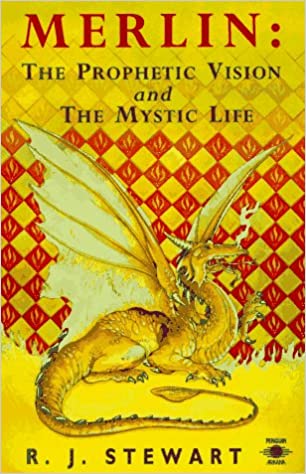
One of the influences that nudged me towards Druidry was R. J. Stewart’s body of work concerned with Merlin, itself stimulated by the work of the twelfth century scholar Geoffrey of Monmouth. Stewart wrote two books about this (3,4) and then produced the Merlin Tarot (5) which, with its companion volume The Complete Merlin Tarot (6) is a workable esoteric system in itself. Geoffrey’s work revisions older Celtic/Classical material in a culture thirsty for it. He introduces mainstream European culture to Merlin, Arthur, and Morgan. Shape-shifting through cultural fashions over the centuries, they are still with us. In the later twentieth century, R. J. Stewart drew on Geoffrey’s work for creative myth-making of his own.

As part of my current inquiry, I am revisiting this work to see how it might, with an element of further revisioning, contribute to my Druid practice. I will expand on this in future posts.

(1) Joseph Campbell The Masks of God 4: Creative Mythology Harmondsworth: Penguin, 1976 (Original US edition published in 1968)

(2) Mark Walker Geoffrey of Monmouth’s Life of Merlin: A New Verse Translation Stroud: Amberley Publishing, 2011

(3) R. J. Stewart The Prophetic Vision of Merlin: Prediction, Psychic Transformation and the Foundation of the Grail Legends in an Ancient Set of Visionary Verses Arkana: London & New York, 1986

(4) R. J. Stewart, The Mystic Life of Merlin Arkana: London & New York, 1986

(5) R. J. Stewart & Miranda Grey (illustrator) The Merlin Tarot London: The Aquarian Press, 1992

(6) R. J. Stewart & Miranda Grey (illustrator) The Complete Merlin Tarot: Images, Insight and Wisdom from the Age of Merlin London: The Aquarian Press, 1992

A TURNING POINT

On a recent evening I watched lightning, heard thunder, and waited for the rain. It came quickly, fast and hard. It changed my sense of the year. It was as if, at least for some part of me, the blessings of the solstice moment were threatened with cancellation. I remembered autumn and winter last year, and what seemed like relentless wetness. Was our sun kissed respite, itself made strange by Covid-19 and the lockdown, to be so brief?

The wheel of the year, moving through familiar seasons, was once a comfort. Bad things could and did happen. There were big variations from year to year. Yet on a human timescale there seemed to be a pattern. The ritual year told us that nature was reliable within certain limits. The gathering pace of climate change has undermined this perception. In different ways, throughout the globe, the old patterns are being disrupted without settling into new ones – greater changes are to be expected.

The sun will rise at the solstice as it always does. Here in England, I would never have expected to predict the weather of the day. But this year I do feel a raw anxiety about the future. Happily, my at-homeness in the flowing moment is strong enough to hold this anxiety. I accept and welcome it as the experience I am given, mine to live even within the act of resistance itself. Self-compassion and thence a wider compassion arise from this. Yet, as I link my contemplative inquiry to the theme of ageing, I wonder about harvesting and legacy in my own life. Do such notions even make sense?

For the last six months I have rebuilt a specifically Druid practice, restoring the pattern of the circle and four directions, restoring height and depth dimensions, affirming a strong centre. I am working with levels of experience I describe as physical, psychic and causal. I want my spiritual life, which is all my life, to be a coherent witness to my experience and values. In spite of threatening clouds, I remain fired up for this, by an ever rejuvenating sun within, as I approach the decline of the year.

Image from R. J. Stewart’s The Merlin Tarot, illustration by Miranda Grey Aquarian Press, 1992

Earth Eclectic

music that celebrates Earth and speaks to the heart

Sarah Fuhro Star-Flower Alchemy

Follow the Moon's Cycle

Muddy Feet

Meeting nature on nature's terms

Rosher.Net

A little bit of Mark Rosher in South Gloucestershire, England

Becoming Part of the Land

A monastic polytheist's and animist’s journal

selkiewife

Selkie Writing…

Charlotte Rodgers

Images and words set against a backdrop of outsider art.

Prof Jem Bendell

living with metacrisis and collapse

Towint

The pagan path. The Old Ways In New Times

The Druids Garden

Spiritual journeys in tending the living earth, permaculture, and nature-inspired arts

The Blog of Baphomet

a magickal dialogue between nature and culture

This Simple Life

The gentle art of living with less

Musings of a Scottish Hearth Druid and Heathen

Thoughts about living, loving and worshiping as an autistic Hearth Druid and Heathen. One woman's journey.

Wheel of the Year Blog

An place to read and share stories about the celtic seasonal festivals

Walking the Druid Path

Just another WordPress.com site

anima monday

Exploring our connection to the wider world

Grounded Space Focusing

Become more grounded and spacious with yourself and others, through your own body’s wisdom

The Earthbound Report

Good lives on our one planet

Hopeless Vendetta

News for the residents of Hopeless, Maine