HAIKU BY BUSON
A Summer Haiku by the 18th century Japanese poet Buson from the collection Zen Haiku, selected and translated by Jonathan Clements. London: Frances Lincoln, 2000
Across the summer stream
With such joy
My sandals in my hand

A Summer Haiku by the 18th century Japanese poet Buson from the collection Zen Haiku, selected and translated by Jonathan Clements. London: Frances Lincoln, 2000
Across the summer stream
With such joy
My sandals in my hand
 Highly recommended. Nature Mystics: the Literary Gateway to Modern Paganism is a new and refreshing departure in Moon Books’ Pagan Portals series. It introduces readers to some of the literature that many modern Pagans perceive to have influenced the culture of their spiritual family. It will be published at the end of this month (31 July 2015) and author Rebecca Beattie dedicates it “to all those Nature Mystics who have come before and continue to inspire us to a spiritual path with their words”.
Selection has clearly been an issue and the author has both used her own judgement and consulted with associates in a ‘Nature Mystic’ blog. Her centre of gravity is England in the closing decades of the nineteenth century and, more particularly, the opening decades of the twentieth. She has chosen five women and five men to represent a place, a time, and a suggested sensibility. There are outliers – John Keats from an earlier time and W. B. Yeats from Ireland – but Beattie shows in her introduction how they fit within the selection. The full list is: John Keats, Mary Webb, Thomas Hardy, Sylvia Townsend Warner, D. H. Lawrence, Elizabeth von Arnim, W. B. Yeats, Mary Butts, J. R. R. Tolkien and E. Nesbit. Each author has a dedicated chapter describing their life, work and cultural setting; exploring specific works in some depth; and discussing both their declared or implied spirituality and ways in which it may inspire modern Pagans. Each is given a remarkably thorough treatment for an introductory book that addresses a larger theme.
I grew up with some of these writers and went on to study English literature for my first degree in the final years of the 1960s. It’s been interesting for me to check back on the writers I knew and those I didn’t, at that time, as a way of checking out how the world has moved on. Four of the men – Keats, Hardy, Lawrence and Yeats – were an important part of my life; Tolkien not so much, though I had read both The Hobbit and Lord of the Rings. E. Nesbit I knew as author of The Railway Children and connected with the Fabian Society, the intellectual voice of respectable British Socialism at the time. Thanks to Nature Mystics, I’ve enjoyed being introduced to her The Accidental Magic: or Don’t Tell All You know and The Story of the Amulet, works for children penned by the Nesbit who was involved, as I knew that Yeats was, with the Hermetic Order of the Golden Dawn. I discovered Mary Webb later, when I went to live in Shropshire where she was remembered. By then I was able to read Precious Bane and Gone to Earth in Virago editions and I later found Sylvia Townsend Warner and Lolly Willows in the same way. I still see these powerful and highly relevant books through a sort of feminist ally lens, as primarily about free-spirited women in outsider positions navigating gender and sexuality in a largely hostile and uncomprehending world, and looking for oases of safety and possible flourishing. Beattie’s book adds to the picture by spelling out Pagan tinged nature mysticism as a spirituality that is congruent with this quest, and also informed by it. I have still not read anything by Elizabeth von Arnim or Mary Butts, and before getting my review copy of this book, knew of them only through their links with other people. Now I’m encouraged to look at their work.
I’ve been delighted to read a work that offers new information and a new lens. The writers concerned are a diverse and free-spirited group. I’m not entirely convinced that they either could or should be enrolled in a league of “properly proto-Pagan” Nature Mystics. It is my belief that most of them would resist the identification. Beattie herself says that Tolkien was dismayed by some of the responses to his work in his own life-time. At the same time I do see a common tendency, in this group, to find the numinous in natural settings and the spirit of place, “that sense of bliss and divine communion that is gained from time spent absorbed in the natural world” as Beattie puts it. I’m sure, too, that there will be a ready assent among many readers to the suggestion that “where Woolf said every woman needed a room of her own, von Arnim would have said every woman needed a garden”.
I will leave the last word to Thomas Hardy, in a brief passage from Tess of the D’Urbervilles, quoted in Nature Mystics. It is about Tess herself, and evokes a moment when a sensitive human consciousness is more fully awakened by a moment in the cycle of the day: “She knew how to hit to a hair’s breadth that moment of evening when the light and darkness are so evenly balanced that the constraint of day and the suspense of night neutralise each other, leaving absolute mental liberty”.
Words, single words, can have a tremendous power in me whether I want them to or not. They have a hinterland of feeling, imagery an atmosphere. They are linked to memories and associations – indeed their use comes to have a memory trail, and the triggering effects that go with that. Sometimes this seems independent of their plain meaning or general use.
Grace is like that. It’s the theological, redemptive meaning that has stuck. Yet it is independent of the received theology, or almost so. I notice that when President Obama spoke the eulogy for the late Rev. Clementa Pinckney in Charleston recently, he made use of the popular hymn Amazing Grace. It was written by the Englishman John Newton, an 18th century slave ship captain who eventually became a clergyman and prominent campaigner for the abolition of the slave trade. As such it suited Obama’s point about how a shocking terrorist assassination can open up possibilities for learning and doing better. The first verse runs:
Amazing Grace (how sweet the sound!)
That saved a wretch like me.
I once was lost, but now I’m found,
Was blind but now I see.
Now this is a very simple and classically evangelical verse. The very simplicity of language and thought is part of its power. As it happens, I am not aligned to the specific religious narrative that stands behind it. I understand it very clearly – and I’m not aligned.
And yet … that’s not the whole story of what happens for me when I hear this verse, especially sung to the tune it acquired in the USA in the 1830’s. I cannot help being moved by ‘Grace’, and when I’m told that it makes a sweet sound, I’m completely with the hymn. In a certain mood I have no problem in thinking of myself as wretched. It isn’t exactly a moral terms, more about being alienated and out of reach to self and others. Modern English (British English anyway, in its polite form) is a softened, evasive language which generally doesn’t run to terms like ‘wretch’ – too strident and extreme; almost comical. But I know experiences that fit.
It’s also true that in the verse, an experience, described in the sweet sounding word ‘Grace’ has become available. Free and regardless of merit, it seems to have the power to change the quality and direction of a life. So the verse ends: ‘I once was lost, but now I’m found, was blind but now I see’. The brief four line verse frames the experience of Grace as a single turn-around moment, a very specific reference experience of spiritual rebirth. Life is a bit different. John Newton’s life changed in slow and gradual steps. But it changed, and eventually it changed radically.
Just as I have personal reference experiences for ‘wretch’, I also have personal reference experiences for ‘Grace’. The Cosmos includes Grace. In my universe of meaning I don’t know how to account for Grace – what it is, how it works, what it means. As an experience it begins as a powerful feeling/sensation in the belly and heart centres, more emotional than physical, that extends through and beyond my whole body. I have known it come within a formal practice, or through another trigger, but most likely it comes out of the blue. I’m clear that it isn’t ‘just’ a feeling, though it contains a strong feeling element. It’s more like an energetic, emotional and spiritual cleansing. It creates a spaciousness, and an expanded sense of being though not of personality. I’m left in a heightened state in which a lightness and clarity emerge. The world looks and feels different. I feel more compassionate towards myself and others. I am less interested in problems and events, and more resilient. There’s an element of drama and energetic arousal that gradually dies down and I find myself calm and at peace – in communion with what is. I do not have any sense of personal deity or energetic emanation from a higher realm, or of benefitting from a cosmically warranted plan of salvation or enlightenment. What I experience is a re-arrangement of my life as is, my place within it and my relationship with the whole. I am connected to the other dictionary meanings of ‘grace’ – smoothness and elegance of movement, courteous goodwill in speech, a ‘grace’ period given before favours are called in or debts have to be repaid. There’s a spirit of ease and generosity in the air.
The effects aren’t permanent. I can go down again – stiffen up, contract. But I notice that the downs and diminutions are not what they were before I became aware of Grace, or began to remember its possibility a bit more consistently. ‘Grace’ is indeed mysterious. I have not incorporated it into a coherent world view. I simply know that it’s a powerful word, matched with a powerful experience, and I’m grateful for it. My instinct is simply to stay open and to let it be.
I’ve just had a couple of lazy summer days and I feel all the better for them. They’ve been interwoven with a relaxed stocktaking about contemplative Druidry and my part in it. I notice that my main focus is on small groups.
As I write, I’m at peace with my personal life and practice. At the collective level, I’ve had recent good news. My friend and colleague JJ Howell has let me know the specific roles that my partner Elaine Knight and I will be playing at Druid Camp in four weeks’ time. Druid Camp – www.druidcamp.org.uk – is a large group (200-300 people), but we’ll be working with small groups, offering contemplative sessions from the repertoire built up by our local group over the last year. Meanwhile I also know that an open contemplative day in Stroud, organised by our own outreach arm Contemplative Druid Events – http://contemplativedruidevents.tumblr.com – is now viable and will go ahead on 3 October. We have seven people fully booked and three more with strong expressions of interest, with 15 being our max.
The overall position is that we have a flourishing local group, now three years old; a book largely though not exclusively based on the thoughts of its members; and an outreach arm able to offer an annual residential retreat (The Birchwood Retreat) every April and an open contemplative day in October 2015, which might become annual too. In all cases the events concerned will have no more than 15 participants. We could do a little bit more – providing small group sessions at other larger events, or offering more contemplative days either locally or elsewhere. But my sense is that we need to respect limitations in our capacity, stick to the small group approach, and make sure that all our work is experiential and not simply discursive. People need to taste it.
For me perhaps the greatest value of the small group is the opportunity for all participants to introduce ourselves and be heard. For that to work fully, we need a quality of listening which itself becomes a practice and part of our culture, and whose intention is to ensure that no one is either misrecognised or ignored. This in itself is counter to mainstream communication, including ours, and needs conscious practice. It will include mis-steps from time to time within our own groups. So it’s not about ‘getting it right’ all the time: the point is to be conscious. In a contemplative context, we can hope to go further: establishing a level of trust that opens the door to deeper I-Thou recognition and communion. It’s a different opportunity to those provided when large numbers of people become immersed together in prayer, song, ritual or formal meditation. It’s more personal, in the best sense of that term. I find it both more challenging and rewarding, whilst believing that all of these approaches have their honoured place.
Small groups have other advantages too. It is easier to be flexible on programming within the event. It is easier to offer activities which demand time for reflection and debriefing. It is easier to become aware of other people as spiritual companions, even if we have not met them before or do not know them well. I think, too, that it’s easier to learn, not least when in a facilitative role, because the style of the event can be person centred rather than goal centred. Activities are designed to support us in our human, and therefore spiritual, flourishing. They are not Everests to be climbed so we can say that we ‘knocked the bastard off’.
I think this is why we have not oriented our contemplative Druidry around long meditations or meditation training. It was one way to go, and in some ways the obvious one. It would certainly be the most traditional one and my solo practice is very much tilted that way. But the group context changes things. Pragmatically, our local group is about evenly divided between people who gain from long meditations and those who don’t. We would lose people by taking this approach. More importantly, the group is co-creating a culture in which the blessing of space and silence is received differently – through short meditations, attunement to the seasonal moment, silent walks, or activities like ‘Awen space’ in which we sit with each other, open to spirit, and can speak, chant or sing into the silence when so moved. We can also explore co-creation from silence into sound and story, or find different ways of awakening to the fields of energy and presence within us, between us, and around us. It’s a subtle and sensitive kind of work. It needs times of stillness and silence. It also needs times of movement, sound and speech. It needs times of reflection and relaxation.
In my view, we are still at an early stage of this exploration. We have a name – Contemplative Druidry – to hold us. We have literature – Contemplative Druidry and also Nimue Brown’s Druidry and Meditation – to support us. We have a dedicated group and an outreach arm. The small group approach has evolved quite naturally and I see it as a critically important aspect of how we work.
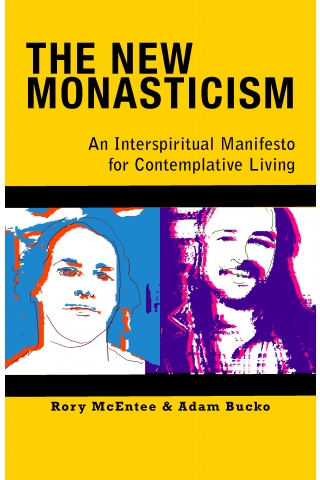 Highly recommended. I knew I would be in business with this book as soon as I got wind of it, and it will take further contemplation and inward digestion before I fully understand my relationship with it. I believe that this is the kind of effect that what The New Monasticism: an Interspiritual Manifesto for Contemplative Living intends to create.
‘Monasticism’ is refreshingly used here “simply to denote a level of commitment to a spiritual life”. It is not about specific beliefs or a specific lifestyle. It asks us to free ourselves from our cultural conditioning and an unquestioning and un-questing life. Avoiding identification with material success, living in the midst of a contemporary society that does not support such a calling, we may enter a space of “radical profundity and divine transformative energy”. We seek simplicity not through renunciation but through ‘integration’. We do need retreat space, so some people will indeed be called as specialists to hold the “containers of silence”. But most will pursue vocation in the world, in a life made up of contemplative practice, heartfelt conversation and sacred activism.
Authors Rory McEntee and Adam Bucko are situated within the Roman Catholic tradition, in an emancipatory strand which is reaching out to others and hoping to transcend itself. The term ‘interspirituality’ was coined by Brother Wayne Teasdale, an ordained Christian Sannyasin who presided over an ashram in India. The authors see interspirituality as “humbly placing itself in partnership and collaborative discernment with our time-honoured religious traditions”. In the last decade we have also seen the linking of Father Thomas Keating (who developed ‘centering prayer’ as a Christian answer to Buddhist-style meditation) with Ken Wilber’s Integral Life project, which is itself increasingly seeking alliance with like-minded Christian communities. Indeed a lot of the philosophy, psychology and social science in this book comes straight from Ken Wilber and the stance of the Integral movement. The authors come from a collectively confident and mature spiritual base, and there are advantages in that. The book is rich with specific suggestions about life and practice in the new monasticism, drawing for its core inspiration on an ‘Interspiritual Manifesto for Contemplative Life in the 21st. Century’ following a week long dialogue with Father Thomas Keating at his monastery in Colorado in 2012.
McEntee and Bucko are both “under 40” and feel a connection with the younger generation now coming into adulthood. Bucko works with young homeless men in New York City. They see a potentially emergent spiritual culture that is: “spiritual not religious”; this worldly and concerned with nature and the fate of the earth; has (post) modern commitments to personal ‘authenticity’; and finds the sacred in the secular. They believe that these values can be championed within a further development of their own tradition, transforming the tradition itself. For them the path is as much about the life and health of the earth as it is with an individual communion with the Divine: indeed, it is false to separate the two. Realisation is less a “gnostic quest for truths beyond the world” than “a reflection on certain processes taking place within the world”. Interspirituality wants to be the midwife of this, and in doing so become attractive to people, especially young people, who would not be drawn to more traditional approaches.
The New Monasticism is a valuable contribution to the re-visioning of spirituality and concomitant life practices. Given its provenance, it is not surprising that the reaching out to other traditions is quite selective. Beyond Christianity, the traditions being engaged with are neo-Vedanta, Tibetan Buddhism and to a lesser extent Zen, modern Sufism and to some degree the Hasidic movement in Judaism and Martin Buber. ‘Indigenous religions’ are mentioned in two inclusivity lists, without definition or description. Shamanism is mentioned as a particular model of spiritual service. There is nothing specific from the Western Way outside Christianity. Within Christianity, much is drawn from the contemplative strand in Orthodoxy, including an understanding of theosis (or divinisation) and the role of Sophia as guide. This is accompanied by an intent to “claim the wisdom dimension of all traditions and let the wisdom guide you” – a view which they attribute to Matthew Fox. Ethics is seen as “the call to active co-operation with the sophianic transfiguration of the world”. Quaker processes also get a mention because of their democratic and dialogical way of bringing people into Presence with each other. Since I am personally positioned in modern Druidry, Paganism and Earth Spirituality I have to express some disappointment here. However I don’t feel deliberately excluded. It’s just that these authors have their attention focused elsewhere.
I do have a worry, all the same, an area where I think that Earth and Goddess traditions could do with being heard. This is when McEntee and Bucko talk about ‘axial ages’, a view of spiritual/religious history once again taken from Ken Wilber. It depends on an evolutionary view of human culture as an aspect of a Divine awakening. In this view, the first axial age, from 800 BCE – 200 CE was a time of radical transformation marked by the appearance of great teachers who catalysed major literatures: Lao-Tzu, Confucius, Buddha, Mahavir (of the Jains), Zoroaster, the Jewish prophets and Greek philosophy, as well as Jesus and the gospels. These people could stand apart from the tribe, question the worldview they had been given, and think for themselves. They could also wake up from the trance of complete immersion in nature and objectify it – seen here as a positive step, albeit one with a shadow side. They represented the coming of reflexive subjectivity and the technology (writing) that made it sustainable. Admittedly, the narrative goes, this tended to take world denying, sex denying, misogynist and more generally oppressive forms. But overall it is read as a cultural gain. Now we are seen to be in a second axial age where the perceived challenge is to transcend the limitations of the first whilst preserving the gains, and thus renew our overall movement onward. “We need both our individuality … and an understanding of our intrinsic belonging within a vast Kosmos”. I’ve been aware of Wilber’s position on this since he wrote Up from Eden in the mid 1980’s. It has always read to me as a one-eyed narrative, the mirror image of the primitive matriarchy still espoused by many Pagans. One of its effects has been to offer a language of canny and limited concession by hitherto dominant traditions as they respond to an unstoppable shift in culture. Here is where the Earth traditions could have a role in the dialogue, to support a view of individuality and inter-connectedness, indeed, but which is less masculinist in language (I’m thinking about how the book suggests “dialogical sophiology” as the way of meeting with the divine feminine), more open, and more widely informed than this.
I am glad to be living in a time of spiritual ferment. It breathes life and hope in an otherwise darkening time. I acknowledge and celebrate the achievement of The New Monasticism and am already involved in exploring contemplative life in Druidry. I notice that I, and others who I have been linked with, have in some ways come to similar conclusions about life and practice, if not entirely of view. This book, although from a very different background, has stimulated and encouraged me. I hope it has this role for many other readers.
 Highly recommended. Pagan Dreaming: The Magic of Altered Consciousness, to give it its full title, is an informed and thought provoking introduction to dreams and dream work. Although tailored specifically to a Pagan-oriented audience, it will be of interest to many other people as well.
Author Nimue Brown follows her familiar path of avoiding hackneyed or formulaic approaches to the subject. Instead, she draws on a rich variety of sources including her own experience of dreaming and working with dreams to ask fruitfully open questions and invite dreamers to explore this territory for themselves. She says of herself: “I am not a scientist or psychologist. I have not trained as a counsellor or psychoanalyst. … I am simply a Druid who has always worked with dreams, and I am sharing what I have. There is no dogma here, just ideas”. Whilst being clear that she is not writing as a therapist, she does indicate that dream work can have triggering (and therefore potentially therapeutic) effects, so that people doing it may want professional support in some circumstances.
The book discusses the physical, emotional and meaning-making aspects of dreams, emphasising how dreams work differently for different people – suggesting that standard schema for interpretation are of very limited use. Everyone has their own dream language and needs first to listen in to this. Only then are they in a position to interpret their own dream symbolism and develop their own dream work. The author includes a chapter on ‘Exploring a Dream Diary’ where she shares extensively from her own, and shows how to assess and draw conclusions from the material presented by the recorded dreams. She includes “daydreaming … along the edges of sleep” within the overall umbrella of dream work, and identifies this as a significant and creative state for her.
After a chapter on ‘Dreams and Magic’ (though “not the kind of magic that leads to definite outcomes”) the book concludes with ‘Into the Wilderness’, which explores the idea of “re-wilding your sleep” – physically, mentally, spiritually and socially. She moves on to speculation about where dreams come from – products of our own minds? The universe whispering to us as we sleep? The gods of dreaming as they carry us into other-worlds? Ancestral memories? She ends by saying: “none of these explanations is any less miraculous than any of the others”. That sense of an open and affirmatively questioning stance towards the ‘miraculous’ is for me the defining feature of this book: a refreshing treatment of a fascinating topic.
 24 June is a special day for me. When I was quite small, someone told me that it was Old Midsummer’s Day without telling me when the new one was. So it was Midsummer’s Day for me. ‘Old’ just gave it depth and perspective in my imagination. I was told in the presence of oak trees too, in a sun-ripened afternoon , sultry like high summer. Old.
A year or two later I found out that it was St. John the Baptist’s Day too. I had two vivid images of him at the time. The slightly less vivid one was of him baptising Jesus, the anointed one who was to follow him. The slightly more vivid one was a version of Andrea Solari’s depiction above (1507): John beheaded as requested by Salome, at the command of King Herod. It is a strange story in some ways, for Salome means ‘peace’ in Semitic languages and she’s not depicted in an obviously peaceful light.
In any event, the church awarded John the Baptist 24 June as his day, placed at the opposite end of the year to Christmas, days which are in each case placed at a time when the sun has just started moving again. The old story about the conflict of a winter and summer king alternating in their mirror image enjoyment of dominance and death is now somewhat discredited as a universal theme. But it is clearly a strong part of our cultural inheritance, just like our experience of the changing seasons themselves.
Old Midsummer’s Day is a time when the sundered halves of the western way come together, with a common theme handled in different ways and with different understandings. That, and the fact that the day has been present in my imagination since I was very young, give this day a special kind of magic. I was glad to mark it today with my partner Elaine, in a completely informal way.
Exploring ethics through contemplative trance and active imagination
In Clear and Present Thinking (1) a book about logic, Brendan Myers includes a Chapter on Moral Reasoning. In this chapter he talks about Virtue Theory as one “where the weight of moral concern is on the character and identity of the person who acts and chooses, as well as the habits he or she develops and discharges through her actions and their consequences”.
Some days after reading this, I found myself in my inner sacred space, a heart space, the garden of the Goddess. I was not doing any formal practice. I was just there. When the garden first emerged, it was specifically as Sophia’s garden. And so it was this time.
There was a banner hanging from a tree branch, hawthorn I think. It was red, with a gold pentangle inscribed on it. I recognised it as the heraldic emblem from Gawain’s shield in Sir Gawain and the Green Knight (2). In this 14th century English poem the pentangle is introduced as a token of fidelity first devised by King Solomon. It is unbroken anywhere, and known in England as the ‘endless knot’. The poem involves an interrogation of ‘virtue’ as understood both in King Arthur’s Camelot and in the older world of the Green Knight far to the north. Gawain will have to navigate both physical perils and moral ambiguities.
Why did I find this device, as a spontaneously emerging image, in Sophia’s Garden? Firstly, I had been thinking about virtue ethics as described by Brendan Myers. Secondly, the pentangle in this form has been a significant image for me ever since I encountered the poem in my late teens. I’ve revisited it from time to time ever since, and this includes the reading of John Matthews’ Sir Gawain: Knight of the Goddess (3) which makes the link with Sophia. “In the Gnostic system, Sophia, the divine emanation of the Godhead, would not permit anyone to enter her Realm of Light, unless they were in complete balance, and bore the sign of the pentangle upon them”.
The offered meaning, as I see it, is that when addressing virtue ethics, I can’t rely on reason alone. Virtue ethics is up close and personal, more than an abstract principle or set of rules. I need to mobilise more of myself. In Sophia’s Garden I’m in a deepened form of awareness, and can contemplate the imagery using heart and intuition as well as rationality. They all work together.
Allowing the vision, I entered a light trance, with the image firmly in mind. I lay down with pen and paper near. I fell asleep for a short period – not part of the plan, but cleansing and useful. On waking I had words: Love/Wisdom. Sophia is Goddess of Love/Wisdom. The love is the greater quality, and it is an Eros fuelled love, for Sophia is the emanation of the Divine who ‘fell’ and then recovered (4). There must an opening up and movement towards someone or something, however slight and tentative, for it to be ‘love’. Whereas I owe justice and a pre-supposition of basic good will towards sentient beings, love is in my experience beyond command and does not result from a conscious act of will – though I can certainly work at expanding my potential to be a conduit. Wisdom is connected to this love, acting as a detector of distortions – empty or ungrounded sentiment, unaware compulsion, possessive attachment, ‘spiritual’ love as world rejecting flight, or driven and reckless forms of generosity lacking in self-care.
But love modifies wisdom too. Wisdom here is too energised to be altogether prudential. Counting the cost may make sense, but it’s not the only criterion. Wisdom uses the head yet is lodged in the heart. At the same time, wisdom also knows that ‘Love’ and ‘Wisdom’ as words can begin to solidify into things, always a problem with ‘nouning’. They can become wooden idealisations devoid of context and process, accessories to self-image, identity performance and external reputation. They can become alienated and commodified. They can even turn and be turned against us. So wisdom guards herself and love by guarding against too much reference to ‘Wisdom’ and ‘Love’.
At this stage I’m thinking again of the pentangle and wanting to use it to bring the virtues into relationship with each other rather than separating them out. I’m feeling happy about using this traditional framework so long as I can be playful with it. For I understand this to be the Sophian Way – with solemnity seen as having a stupefying effect, anaesthetising awareness. So in this ethics of the endless knot, I place love at the apex of the pentangle as I look at the banner, I move down to the base on my right, igniting the love/wisdom link.
Then, moving diagonally up left from the base I come to justice, for love and wisdom need justice in the world for the sake of their own flourishing: injustice inhibits the free flow of love and wisdom. I’ve already named justice, and fairness, as something I owe to all on a personal level, based on a presupposition of basic good will. I’m also clear about the need to work for justice in the wider world. On this, my vision is of a justice is careful of its methods, or it risks licensing revenge, both in power and opposition. Care about language and imagery are themselves a work for justice. Injustice wants to constrain and police these great resources. It seeks to close down their emancipatory magic. Working for justice is rational activity in service to love and wisdom. Sophia has always cried out against injustice, false justice and no justice. She has an ambivalent relationship with the law.
The classical virtue following on from justice, as I move in a straight line from left to right, is courage. What kind of courage am I looking at? For me it’s not about ‘warriorship’, with its theatricality and somewhat militaristic associations, however reframed for current values and conditions. (Perhaps that’s why my pentangle is inscribed on a banner rather than a shield.) Rather, it combines resilience with witnessing. Early Taoism captures the resilience aspect: “true goodness is like water … it goes right down to the low loathsome places, and so finds the way” and “the hard sword fails, the stiff tree’s felled. The hard and great go under. The soft and weak stay up” (5). I understand witnessing in a ‘truth to power’ sense and link it to my notion of care about emancipatory, life and world-expanding language and imagery and the need to guard them. This witnessing courage, to be honourable, may involve the willing loss of recognised honour and standing in a world that is formally virtuous. So it depends on a strong inner authority and a willingness to go against tribal custom. This is the courage I would tie in with love, wisdom and justice.
Moving down diagonally from courage, we come to the base of the golden pentangle on the left hand side, where I place temperance. In the course of its long history, ‘temperance’ has tended to shift from ideas of moderation to ideas of abstinence, as culture and religion have changed. Here and now, I have a resonance of ‘treading lightly on the earth’, in two senses. One is about limiting demands on material resources for the health and flourishing of the earth and its inhabitants. The other is about an ultimate non-attachment to material goods, contents of consciousness and the self-image they create. For me, there is a balance here which is why the word temperance comes in. I can love my possessions, my ideas and visions, my loved ones, my neighbours and my sense of who I am. But I am not fundamentally identified, not wholly immersed, in them. For these forms of love, if they are to flourish, demand some space around them, and there is a sense in which I am alone even within these nourishing interconnections. In another sense I am not. For I can go back to the simplicity of aware being and loving, timelessly arising from the fertile latency of the void. In this way I complete the endless knot.
This vision and reflection are only a beginning. I intend to continue engaging with this ethical approach, integrating it into my contemplative inquiry.
References
music that celebrates Earth and speaks to the heart
Follow the Moon's Cycle
Meeting nature on nature's terms
A little bit of Mark Rosher in South Gloucestershire, England
A monastic polytheist's and animist’s journal
Selkie Writing…
Images and words set against a backdrop of outsider art.
living with metacrisis and collapse
The pagan path. The Old Ways In New Times
Spiritual journeys in tending the living earth, permaculture, and nature-inspired arts
a magickal dialogue between nature and culture
The gentle art of living with less
Thoughts about living, loving and worshiping as an autistic Hearth Druid and Heathen. One woman's journey.
An place to read and share stories about the celtic seasonal festivals
Just another WordPress.com site
Exploring our connection to the wider world
Become more grounded and spacious with yourself and others, through your own body’s wisdom
Good lives on our one planet
News for the residents of Hopeless, Maine
 Contemplative Inquiry