Alan Watts (1) describes Taoism as the ‘watercourse way’. For him, this ancient philosophy is “a skilful and intelligent following of the course, the current, and grain of natural phenomena – seeing human life as an integral feature of the world process, and not something alien and opposed to it.” It is a point of view that I find of direct relevance to modern Druidry, nature spirituality and ecosophy. (2)
The ancient Taoists themselves said that “true goodness is like water. Water’s good for everything. It doesn’t compete. It goes right down to the low loathly places, and so finds the way”. (3)
Alan Watts continues (1): “Looking at this philosophy with the needs and problems of modern civilisation in mind, it suggests an attitude to the world which must underlie all our efforts towards an ecological technology. The development of such techniques is not just a matter of the techniques themselves, but of the psychological attitude of the technician”.
A detached attitude of objectivity is inadequate for solving the problems we face. Subject and object cannot be separated, for “we and our surroundings are the process of a unified field, which is what the Chinese called Tao”. We have no alternative but to work along with this process by attitudes and methods which could be as technically effective as “judo the ‘gentle Tao’ is effective athletically”. Watts reminds us that human beings have to make the gamble of trusting one another to make any kind of workable community, and concludes that “we must also take the risk of trimming our sails to the winds of nature. For our ‘selves’ are inseparable from this kind of universe, and there is nowhere else to be.”
(1) Alan Watts Tao: the Watercourse Way Souvenir Press: undated Amazon Kindle edition (with the collaboration of Al Chung-Liang Huang ; additional calligraphy by Lee Chih-chang)
(2) Arne Naess Ecology of Wisdom UK: Penguin Books, 2016 (Penguin Modern Classic. First published 2008)
(3) Lao Tzu Tao Te Ching: A Book about the Power and the Way Boston & London: Shambhala, 1998 (A new English version by Ursula K. Le Guin, with the collaboration of J.P. Seaton, Professor of Chinese, University of North Carolina, Chapel Hill)
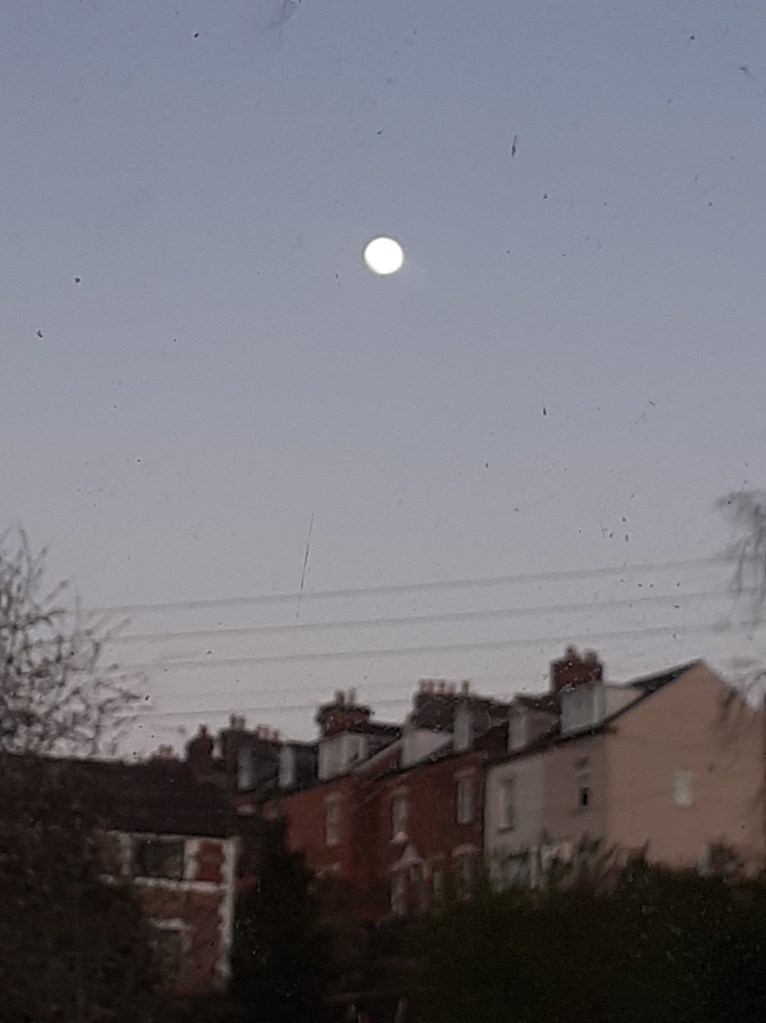
A murky evening moment at a magical time of year. St. George’s Day coming soon, and then Beltane. A seeming failure to get a good image. Street lights come on just as the picture is taken. Freshly green trees are obscured by gathering darkness, and reduced to silhouettes. I am shooting through a window that needs cleaning. I delete the picture. I send it to trash.
Then I find myself haunted by an after image of those apparent pink clouds in the sky. I rescue them. I have better pictures of clouds, but as I imagine them now, these shapes are no longer clouds for me. I see the courtship – I’m oddly sure it’s a courtship – of two beings. In this liminal twilight sky, in a meeting of air and fire, they are materialising in time-bound 3D reality. I might, doubtless incorrectly, call them dragons in my nervous need for naming. In truth I don’t know who or what they are, or where they come from, or how they got here. This is 2020, a twilight zone in itself.
I see no purpose or plan here, though the courtship of these beings is well synchronised for time and place. They are a sign and a wonder. Though their story is unknown, I welcome these beings who are not of this world. I am touched by their appearance and glad to be sharing it.
In his foreword to Contemplative Druidry (1) Philip Carr-Gomm talks about “Nature Mysticism, or Natural Mysticism” in modern Druidry. He suggests that such mysticism is grounded in changes in consciousness, and feelings of bliss or oneness, with no accompanying “separation from the physical world in pursuit of the Divine”. For me, it is especially about meeting the moment within the physical world, including our own body/mind. Sometimes the meeting comes through formal practice. Sometimes it is spontaneous and unannounced.
I built the main body of the text in Contemplative Druidry around a series of interviews with practitioners, which I designed, conducted and transcribed in the spring and summer of 2014. I then identified patterns in what people had been saying and decided on themes for chapters. I wasn’t working in an academic role, so my own linking text was a matter of curation rather than analysis. At that time the notion of a ‘contemplative’ approach to Druidry seemed weird to many people. But it was clear to me from the interview material that all the contributors had relevant experiences to talk about. They seemed to point to what PCG subsequently called ‘natural mysticism’ as a domain of personal and cultural experience readily within reach if people want it to be.
This book itself came out of a project I began working on in 2011, when I was a Bard and Ovate mentor in OBOD. I activated it in 2012, when I began to reach out to people with an offer of contemplative sessions, workshops and retreats – continuing with these until the end of 2016. 2012 also saw the birth of this blog and the Contemplative Druidry Facebook group, which I administered for the first year. Looking back from 2020, I feel that the contemplative meme is established within Druidry. ‘Contemplative’ has become a frequently used term in Druid discourse.
In the early days I thought a specific iteration of contemplative Druidry, launched by the project, might become a distinct Druid brand within and beyond the current Druid communities. From this distance it is easier for me to see that my will and energy were for initiating a conversation and modelling a set of possibilities, rather than working to establish a new sub-tradition. At the same time I continue to invite Druids and fellow travellers to be open to their ‘natural mysticism’ in ways that work for them.
” The moon was the image in the sky that was always changing yet always the same. What endured was the cycle, whose totality could never be seen at any one moment. All that was visible was the constant interplay between light and dark in an ever recurring sequence. Implicitly however, the early people must have come to see every part of the cycle from the perspective of the whole. The individual phases could not be named, nor the relations between them expressed, without assuming the presence of the whole cycle. The whole was invisible, an enduring and unchanging circle, yet it contained the visible phases. Symbolically, it was as if the visible ‘came from’ and ‘returned to’ the invisible – like being born and dying, and being born again.
“The great myth of the bronze age is structured on the distinction between the ‘whole’, personified as the Great Mother Goddess, and the ‘part’, personified as her son-lover or her daughter. She gives birth to her son as the new moon, marries him as the full moon, loses him to the darkness as the waning moon, goes in search of him as the dark moon, and rescues him as the returning crescent. In the Greek myth, in which the daughter plays the role of ‘the part’, the cycle is the same, but the marriage is between the daughter and a god who personifies the dark phase of the moon. The daughter, like the son, is rescued by the mother. In both variations of the myth, The Goddess may be understood as the eternal cycle s a whole: the unity of life and death as a single process. The young goddess or god is her mortal form in time, which, as manifested life, whether plant, animal or human being – is subject to a cyclical process of birth, flowering, decay, death and rebirth.
“The essential distinction between the whole and the part was later formulated in the Greek language by the two different Greek words for life, zoe and bios, as the embodiment of two dimensions co-existing in life. Zoe is infinite, eternal life; bios is finite and individual life. Zoe is infinite ‘being’; bios is the living and dying manifestation of this eternal world in time.”
(1) Anne Baring Anne and Jules Cashford The Myth of the Goddess: Evolution of an Image London: Penguin, Arkana Books, 1993
INQUIRY NOTE: For me this modern interpretation of Bronze Age myth offers a good Pagan way of talking about ‘non-duality’, a strong thread in my inquiry in recent years. In its Sanskrit origin, advaita simply means ‘not two’. It speaks of a unity that is not exactly oneness in the sense of complete assimilation. It points to the sense that we are bios in our transient personal lives yet also zoe the life eternal, both the wave and the ocean. In Western theistic culture this view seems consistent with either pantheism or panentheism. It also fits modern understandings of animism and biocentrism. While I find it useful to know about these models and frameworks, I avoid strong identification with them. There remains an underlying mystery, which is where myth and imagination come into their own.
April growth, when it gets going, is abundant and exuberant. When the days are clear and warm and anticipate summer, I feel a surge of celebration. We are, at last, moving in the direction of Beltane and the merry month.
Since I last wrote, I have recovered my pleasure in outdoor walking. My body’s wish to be outdoors and moving, enjoying the gifts of the season, is stronger than any doubt or anxiety. My pleasure in taking pictures, for the last six months integral to my walks, is part of this. I am glad that my essential phone incorporates a conceivably non-essential camera.
I took the picture above specifically because it shows the lovingly cultivated flower bed in my local public park. This flower bed, and the park itself, exist to be seen and enjoyed, without any entrance charge, by anyone who wants to be there. They are examples of a highly pro-social resource. As we move towards an uncertain future, I hope that we continue to value such spaces, and take collective care to preserve them.
This morning, looking at the news, I see my view supported affirmed by current research. “Meredith Williams, a postdoctoral fellow at the London School of Economics’s school of geography and environment, said access to green space was vital to public health. ‘Even before the pandemic, there was an increasing focus on research on the physical and mental benefits of green space. Having access to nature gives us a sense of calmness and tranquillity … that helps with reducing the stress that comes especially from urban living'” (1). The context is rumours of enhanced lockdown in London’s parks, where the residents of poorer boroughs have less access both to private gardens and public parks, putting more pressure on the public spaces that do exist.
Yesterday I found Stratford Park in Stroud almost deserted, its carefully tended flower beds unobserved and unenjoyed. For me, publishing this picture honours the work of its gardeners. Their creativity deserves to be recorded and shared, both for what it is, and what he stands for, as the wheel of 2020 continues to turn.
(1) Guardian 11 April 2020 Coronavirus park closures hit BAME and poor Londoners most
There is a world through my window. April has often been a magical month in my year, and 2020 need not be an exception. I link April with intensified and palpable greening, of soft sunsets at an attractive time of day. It is still happening out there and when I lose myself in the image it is happening in here too. Essentially there’s no difference. It is wonderful. of an evening, to follow the sunset process through its many stages of development.
I notice that, here in the UK, some attitudes to the current lockdown have been utilitarian to the point of puritanism. It is not enough for our behaviours to be safe in relation to Covid-19. They have to be ‘essential’, and it seems that essential activities can’t be tainted with any suggestion of idleness or pleasure. I can jog through a beauty spot, but I’m letting the side down if I sit down to rest or enjoy it – even if there’s no-one else around. This goes against everything we know about mental and emotional wellbeing, where such opportunities can be vital resources in the face of stress and depression.
I don’t like this and I am confident that I am right. Yet something in me has been influenced by this atmosphere and has started to feel that outdoors is a forbidden zone. When I do go out, I have to push against this and feel slightly transgressive. Of course, something else in me quite likes that, too. But it’s not the sort of enjoyment I’m really looking for, and I’m experiencing this whole cultural overlay – one that’s arisen so quickly – as saddening.
I like my home and garden and I can enjoy looking out through upstairs windows. I’m concerned that others don’t have this advantage and may be deprived of a vital safety valve. I am also aware that the lockdown has to work, especially since it was initiated later and more haltingly than the pandemic requires, and not in tandem with the testing and contact tracing that have been working well elsewhere. I understand the public policy difficulties in the place where we are.
One way or another, indoors or out, I will not miss out on the magic month of April and the merry month of May. After a rugged winter, I will open myself to nature’s change of energy.
“I am no longer your Master, because you have drunk, and become drunken, from the same bubbling source from which I spring.” From Saying 13, Gospel of Thomas (1).
In the Gospel of Thomas, Yeshua begins to treat Thomas as his peer. Asked by Yeshua “to what would you compare me?”, Thomas has replied, “Master, my mouth could never utter what you are like”. This reply contrasts sharply with Peter’s “you are like a righteous angel” and Matthew’s “you are like a wise philosopher”. Thomas has understood. He has dropped all his presuppositions and expectations. He has been able to meet Yeshua in living presence, at source. Whoever wrote this text is asking us to emulate Thomas, and therefore his teacher Yeshua. We all come from the same bubbling source, and are invited both to recognise this and live from the place of recognition. Peter and Matthew may remain constrained by limiting traditional narratives, but Thomas has understood, and two other disciples, Salome and Mary, are portrayed as being on the way.
Recently re-reading this story, I was moved by the force of the words ‘bubbling source from which I spring’. I am grateful to Jean-Yves LeLoup’s translation for this, because the standard academic translation speaks of the “bubbling spring that I have tended” (2), which for me lacks power in comparison. ‘Bubbling source from which I spring’ exactly describes my felt sense of ‘living presence’, recognising it in myself. In my formal practice, I work within a circle framework and I quickly grasped that it should be recognised as the power at the centre. Liturgically, I now greet it is ‘the bubbling source from which I spring and heart of living presence’. This feels right and good. It helps that ‘bubbling source’ is not specifically a water image in this translation. I am free to experience it internally, through my act of recognition, as a shift in energy and attention.
I feel as if I have integrated, or perhaps re-integrated, a depth dimension into the practice, and it feels richer. Since the Winter Solstice I have been closely following the wheel of the year. It represents the inheritance and continuing life of my Druidry. In many ways this is a naturalistic undertaking. But I am now powerfully reminded that my existing commitment to the flowing moment as my true home, and out of which these recent insights came, is not simply about living a slowed down time in a conventionally naturalistic sense. It is that – but it also allows the taste of timelessness and the sense of a primordial nature. The Thomas text reminds me of it. That I can recognise it is also partly thanks to my work in recent years with the practices of the Headless Way (3), the Direct Path (4,5), and Jeff Foster’s community (6). Ultimately this primordial nature is no-thing, but as no-thing it becomes everything, I discover a ‘bubbling source’. I seem to have reached a point where I can both integrate this learning and keep simple. Indeed the one seems to lead to the other. I am grateful that it is so.
(1) The Gospel of Thomas: the Gnostic Wisdom of Jesus (Translation from the Coptic, introduction and commentary by Jean-Yves LeLoup. English translation by Joseph Rowe. Foreword by Jacob Needleman). Rochester, VT: Inner Traditions, 2005
(2) The Gospel of Thomas: the Hidden Sayings of Jesus (New translation with introduction and notes by Marvin Meyer. Interpretation by Harold Bloom). San Francisco, CA: HarperSanFrancisco, 1992
In my part of the world, we have begun the greening of the year. But I can’t go out to meet it, or if so, only a little. I can’t go out, so I have to go in. In the greening of my contemplative life, a sense of ‘living presence’ has been the key.
My bespoke liturgy speaks to me and at times asks for change. A section of my morning practice, an affirmation of ‘at-homeness in the present moment’, wants to expand into a ‘celebration of living presence’. At-homeness stood for a place of safety and regeneration. ‘Living presence’ includes that and points to more. In the celebration, I affirm myself as ‘living presence in a field of living presence: here, now and home’. I’ve added a period of walking meditation (20 minutes or so), mindful to breath and footfall and also including liv-ing pres-ence as a mantra over two full breaths.
The Phrase ‘living presence’ came up spontaneously but realising that I didn’t actually make it up, I checked up on where I first came across it. It comes from the Sufi teacher Kabir Edmund Helminski (1). “Presence signifies the quality of consciously being here … the way in which we occupy space. Presence shapes our self-image and emotional tone. Presence determines the degree of our alertness, openness and warmth. Presence decides whether we leak and scatter our energy or embody and direct it”.
For Helminski, presence is also our link to the divine. since in the bigger picture it is “the presence of Absolute Being reflected through the human being. We can learn to activate this presence at will. Once activated, we can find this presence both within and without. Because we find it extending beyond the boundaries of what we thought was ourselves, we are freed from separation, from duality. We can then speak of being in this presence”.
My picture of leaves in light against a darker background is, for me, an image of living presence. It wasn’t intended to look like this, but I’m glad that it does. It said ‘living presence’ to me as soon as I saw it. Each leaf grows out of the tree and is extended by the light of the sun. All are enabled and nourished by ‘interbeing’, the Buddhist teacher Thich Nhat Hanh’s (2) reframe of ‘dependent origination’. But the elements of darkness and shade, whilst delineating the tree trunk, also suggest the mystery of a primordial nature, no-thing in itself yet making everything possible. The picture seems to be saying that the potential for greening is everywhere, outside and within.
(1) Kabir Edmund Helminski Living Presence: A Sufi Way to Mindfulness & the Essential Self New York, NY: Jeremy P. Tarcher/Putnam, 1992
(2) Thich Nhat Hanh The Other Shore: A New translation of the Heart Sutra with Commentaries Berkeley, CA: Palm Leaves Press, 2017
I am still going for walks, though not every day, and not for so long. The pictures I am sharing are from Tuesday 24 March, with a new social reality now firmly in place. The road above is the A46, running through Rodborough Parish into Stroud Town. The time is late morning. Normally, it takes a far greater volume of traffic, including much heavier traffic, than it was built for. It is frequently gridlocked. There are too few crossings, and it is a real obstacle for pedestrians. A mile or so away, close to a large Tesco supermarket, we find a roundabout where much the same could usually be said. Not any more.
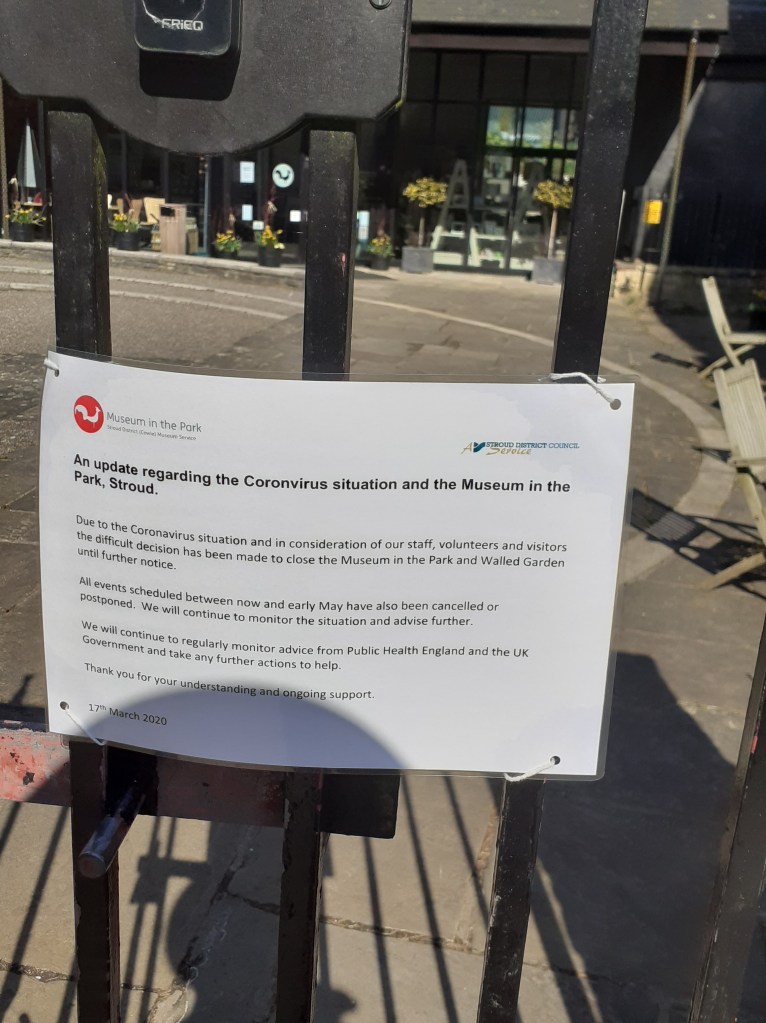
Walking right across the middle of the roundabout with ease, I went on to Stratford Park, one of the town’s great amenities. The Museum in the Park in particular is a major cultural hub.
When I got here, I experienced a change of mood. I’d been enjoying the state of the roads. It felt like a holiday. I wish I lived in a world of much lighter traffic. But the museum notice was sobering. I had a real sense of loss.
The park itself felt surreal. It wasn’t quite deserted. There were a few people like me, now careful in keeping a distance from each other, in some cases wryly smiling or gesturing a friendly sense of shared plight in our manoeuvres of avoidance. Major features in the park, like the orangery, and the trees behind it, had an aura of lonely magnificence. The human element was dwarfed.
Entering the orangery, I felt sad that the flower beds laid out there won’t be seen by many people this year. In this bright, sunny day, they were stunning.
This walk was the first on which I felt less relaxed about being out – a little on guard and wary. I was somewhat reassured by the built and cultivated environment I was in. It hadn’t changed and in some ways was easier to enjoy, with fewer people, greatly reduced traffic and little obvious busyness. The people I encountered were clearly doing their best. But I was also conscious that this is an early stage in a process that has a long way to go. There was surface tranquillity on a beautiful spring day. But I was uneasily aware of a great deal going on that I didn’t see, in the many houses I passed by, and which my camera hasn’t captured.
As part of my contemplative inquiry, I have been looking at recent work by Rupert Sheldrake (1, 2). He identifies himself as “not a guru but an explorer”. I like that notion of ‘explorer’, with its sense that there is always space for new learning and development.
Sheldrake’s affirms that spiritual practice and research are “entirely consistent with the scientific method, which involves the formation of hypotheses – guesses about the way the world works – and then testing them experimentally. The ultimate arbiter is experience, not theory. In French, the word experience means both ‘experience’ and ‘experiment’. The Greek word for experience is empeiria, the root of our English word ‘empirical’. The exploration of consciousness through consciousness itself is literally empirical, based on experience. Spiritual practices provide ways in which consciousness can be explored empirically.”
In recent years, Sheldrake (1,2) has written two books based on this approach. Each discusses seven different practices that have been investigated empirically, both by the practitioners themselves and by scientists studying the effects of those practices. Every practice gets a chapter. The first book, Science and Spiritual Practices, offers:
Meditation and the Nature of Minds
The Flow of Gratitude
Reconnecting with the More-Than-Human World
Relating to Plants
Rituals and the Presence of the Past
Singing, Chanting and the Power of Music
Pilgrimages and Holy Places
The second Book, Ways To Go Beyond, covers:
The Spiritual Side of Sports
Learning from Animals
Fasting
Cannabis, Psychedelics and Spiritual Openings
Powers of Prayer
Holy Days and Festivals
Cultivating Good Habits, Avoiding Bad Habits, and Being Kind
Sheldrake’s choices are all practices he has taken part in, which have also been studied scientifically. He looks at both the ‘subjective’ experience and the ‘objective’ evidence and discusses the ways in which the practices seem to work. He also offers guidance to readers about engaging with the practices. He is very clear that the two books “do not constitute a comprehensive survey of all spiritual practices, emphasising his point by listing others that have been left out: “yoga, service to others, tai chi, chi gong, devotional worship or bhakti, tantric sex, caring for dying people, dream yoga, and the practices of the arts”. He makes it clear that “some practices are better at some times of life than others, and all religious traditions have their own combinations”. I have already discussed Sheldrake’s work on gratitude at www.contemplativeinquiry.blog/2020/03/14/ and will discuss others in future posts.
Sheldrake’s overall purpose is “to show that there is a wide variety of ways to connect to greater conscious realities, however we conceive of them, and that the effects of these practices can be investigated empirically”. Sheldrake is an optimist about the possibilities of science and spirituality working together in the service of human flourishing. “We are on the threshold of a new era of the exploration of consciousness, both through a revival of spiritual practices and also through the scientific study of them. After several generations in which science and spirituality seemed to be in opposition, they are becoming complementary. Together they are contributing to an unprecedented phase of spiritual evolution, beginning now.”
(1) Rupert Sheldrake Science and Spiritual Practice: Reconnecting Through Direct Experience Coronet, 2017
(2) Rupert Sheldrake Ways to Go Beyond, and Why They Work Coronet, 2019
NOTE: Rupert Sheldrake is a biologist and author of more than eighty technical papers and ten books, including A New Science of Life. He was a Fellow of Clare College, Cambridge, where he was Director of Studies in cell biology, and was also a Research Fellow of the Royal Society.
From 2005-2010 he was the Director of the Perrott-Warwick Project for research on unexplained human abilities, funded from Trinity College, Cambridge. He is currently a Fellow of the Institute of Noetic Sciences in California, and a Visiting Professor at the Graduate Institute in Connecticut.






 Contemplative Inquiry