Contemplative Inquiry

This blog is about contemplative inquiry

Tag: contemplation

GROUNDED WISDOM FROM KABIR

I read the songs of Kabir, partly for their power and beauty, partly for their touching humanity and partly to learn something as a contemplative practitioner. The songs themselves, according to John Stratton Hawley, have survived in late manuscripts from different parts of India, modified over time by the region, religion and caste position of their listeners. When it comes to translation, Hawley notes that Robert Bly presents a Kabir who stands for self-reliance (like Emerson), principled disobedience (like Thoreau) “and a set of practices that honors the meeting of mind and body and celebrates the intense emotions that connect them (like Bly himself?)”

So I feel I’m in good company when putting two songs together in a way that makes the second answer the first, in the pursuit of my own inquiry. It’s about this: how do I avoid the trap of working on my small personal narcissism only to embed a larger spiritual narcissism?

Here is the first, scene-setting song.

Friend, please tell me what I can do about this world

I hold to, and keep spinning out!

I gave up sewn clothes, and wore a robe,

But I noticed one day the cloth was well woven.

So I bought some burlap, but I still

Throw it elegantly over my left shoulder.

I pulled back my sexual longings,

And now discover that I’m angry a lot.

I gave up rage, and now I notice

That I am greedy all day.

I worked hard at dissolving the greed

And now I am proud of myself.

When the mind wants to break its link to the world

It still holds on to one thing.

Kabir says: Listen my friend,

There are very few that find the path.

Here, in the second poem, I find a way through – by not going anywhere. I read the “wanting-creature” below to be bound up in ‘Spiritual’ wanting, rather than the average sensual kind.

I said to the wanting-creature inside me:

What is this river you want to cross?

There are no travellers on the river-road, and no road.

Do you see anyone moving about on that bank, or resting?

There is no river at all, and no boat, and no boatman.

There is no tow rope either, and no one to pull it.

There is no ground, no sky, no time, no bank, no ford!

And there is no body, and no mind!

Do you believe that there is some place that will make the soul less thirsty?

In that great absence you will find nothing.

Be strong then, and enter into your own body;

There you have a solid place for your feet.

Think about it carefully!

Don’t go off somewhere else!

Kabir says this: just throw away all thoughts of imaginary things,

And stand firm in that which you are.

Kabir Ecstatic poems Boston, MA: Beacon Press, 1992 (The English translations are free enough for Robert Bly to call them ‘versions by Robert Bly’. There is an earlier set of translations published by MacMillan in New York in 1915 by Rabindranath Tagore assisted by Evelyn Underhill under the title Songs of Kabir. Whilst I don’t follow Bly in calling the English of the earlier work “useless”, I do find that Bly’s interpretation has more passion and power. The Bly work includes an insightful afterword Kabir and the transcendental Bly by John Stratton Hawley).

UPDATE ON CONTEMPLATIVE DRUID EVENTS

After the publication of Contemplative Druidry last October, I set up Contemplative Druid Events together with my partner Elaine Knight, supported by other members of our local group – particularly Nimue Brown, Julie Bond, JJ Middleway and Karen Webb. Our main purpose is to organise, publicise and run a limited number of contemplative Druid events for the wider Druid community and others of like intent. We will also respond to inquiries from people wishing to join a Druid contemplative group or start one of their own.

We have arranged three events for 2015:

  1. A half day introduction to contemplative Druidry in London on Sunday 22 February
  2. A weekend retreat near Malvern from Friday 17- Sunday19 April
  3. A contemplative Druid day in Stroud on Saturday 3 October

For more information, or to arrange a booking please go to our dedicated blog at http://contemplativedruidevents.tumblr.com/

These events are all in southern England. I am open to going further afield, and other colleagues might be. In this regard I am happy to hear proposals from people who are willing to gather together their own group and to negotiate times, programme and costs.

Overall our vision for the contemplative thread in Druidry is that it will develop organically, with initiatives coming from different sources and taking different forms. We don’t seek to own or manage this development under the banner of Contemplative Druid Events, though we do see a value in offering programmes of our own on a modest scale.

POEM: STOLEN SECONDS

Romany Rivers is my sixth and final poet from the collection ‘Moon Poets: Six Pagan poets’ published by Moon Books and edited by Trevor Greenfield. This poem concerns the struggle of a mother to find space for her own personhood. She is “a British born Witch, Reiki Master and Artist living in Canada, exploring a life of personal passion, spirituality and creativity … When not writing, creating or running around after two energetic children, Romany turns her hand to individual healing sessions and community projects that provide family support”. The collection as a whole also includes work by Beverley Price, Martin Pallot, Tiffany Chaney, Lorna Smithers, and Robin Herne.

Stolen Seconds

Sometimes I steal into the garden

And stand by the washing line

Laundry forgotten in my hands as my eyes search the skies

Looking for something

Seeing everything

Noticing nothing

I breathe deeply

And release one long shuddering sigh

A breath held without conscious thought

Waiting for just a few minutes peace to fly free from the constricted chest

I look down

At my trembling hands

Clutching my clothes

Representations of the miniature people

Who take up enormous space within my daily life

Leaving little room for me as I shrink and shrivel to give them more room

I let go

Of the laundry

Of the breath

Of the stress

Of the tiredness

Of the constant needing, feeding, reading, singing, sighing, playing and praying for peace

I let go

And close my eyes

Wondering if tears will kiss my cheeks in gratitude

For the silent still moments

Stolen swiftly

Beside the washing line.

CONSIDERING KARMA

I’ve been wondering about the traditional doctrine of karma and rebirth, and what place it now has. Both Paganism and the New Age inherit a nineteenth century Theosophical version of this doctrine, positing a personal soul journey, a movement through time in successive incarnations, depending on track record and learning needs. It is somewhat different from the Buddhist view (and also the one attributed by classical writers to the ancient Druids) but my sense is that it still has considerable authority. It was treated as a given by my mentors at the London Centre of Transpersonal Psychology, when I studied with them in the late 80s and early 90s.

But it’s never been universal and as part of my own inquiry I present two other perspectives from within the Asian traditions themselves. One is from the late Tantric Master Osho and the other from the Buddhist scholar Stephen Batchelor. I particularly like Steven Batchelor’s statement that “shifting concern away from a future life and back to the present … demands an ethics of empathy rather than a metaphysics of fear and hope.” This to him is more important than the truth or otherwise of the doctrine itself. However I start with Osho, in an iconoclastic mood.

OSHO

“You live encapsulated inside your buffers, philosophies, consolations. Life ends one day – you can console yourself. … You can start believing in the theory of reincarnation: that you will be reborn and the soul is eternal … Or you can think that it is only the body that dies. And what is a body? Nothing but bones, marrow, flesh, blood; it is nothing of worth, it is useless, a dirty bag – so let it die. But your pure soul is going to be forever and ever – a buffer is created. These buffers don’t allow you to see what reality is; they are the way to console yourself.

“Yes. There is misery, but one can protect oneself from misery by creating conceptions, rationalizations. … For example in the East … they say … if you are miserable, you must have done something wrong in the previous life. Something has gone wrong in your past, you have done some wrong karma; hence you are miserable. Now things are explained, so no one has to suffer. … The whole philosophy of karma is that you have sown already, now you are reaping; you have done, so it is a natural consequence. It consoles you. So nobody is doing anything unjust to you. God is not unjust, fate is not unjust, the world is not unjust, the society is not unjust, it is your own karma.

So what to do? One has to pass through it, and one has to keep one’s equanimity, one’s equilibrium. And don’t do such a thing again, otherwise in the next life you will suffer again. So that is the only thing that can be done: you cannot change the past, but you can still manage the future … a beautiful consolation”.

Osho (1990) Tao: the pathless path New York: St. Martin’s Griffin


STEPHEN BATCHELOR

“It is often claimed that you cannot be a Buddhist if you do not accept the doctrine of rebirth. From a traditional point of view, it is indeed problematic to suspend belief in the idea of rebirth, since many basic notions then have to be rethought. But if we follow the Buddha’s injunction not to accept things blindly, then orthodoxy should not stand in the way of forming an understanding.

“A difficulty that has beset Buddhism from the beginning is the question of what it is to be reborn. Religions that posit an eternal self distinct from the body-mind complex escape this dilemma – the body and mind may die but the self continues. A central Buddhist idea, however, is that no such intrinsic self can be found through analysis or realized in meditation. Such a deep-seated sense of personal identity is a fiction, a tragic habit that lies at the root of craving and anguish. How do we square this with rebirth, which necessarily entails the existence of something that not only survives the death of the body and brain but somehow traverses the space between a corpse and a fertilized ovum?

“Different Buddhist schools have come up with different answers to this question, which in itself suggests their views are based on speculation. Some claim that the force of habit-driven craving immediately reappears in another form of life; others posit various kinds of non-physically based mental consciousness that may spend several weeks before locating a suitable womb.

“The idea of rebirth is meaningful in religious Buddhism only insofar as it provides a vehicle for the key Indian metaphysical doctrine of actions and their results known as ‘karma’. While the Buddha accepted the idea of karma as he accepted the idea of rebirth, when questioned on the issue he tended to emphasize its psychological rather than its cosmological implications. “Karma”, he often said, “is intention” i.e. a movement of the mind that occurs each time we think, speak or act. By being mindful of the process, we come to understand how intentions lead to habitual patterns of behaviour, which in turn affects the quality of our experience. In contrast to the view often taught by religious Buddhists, he denied that karma alone was sufficient to explain the origin of individual experience.

“Where does this leave us? It may seem that there are two options: either to believe in rebirth or not. But there is a third alternative: to acknowledge in all honesty that I do not know. … Regardless of what we believe, our actions will reverberate beyond our deaths. Irrespective of our personal survival, the legacy of our thoughts, words and deeds will continue through the impressions we leave behind in the lives of those we have influenced or touched in any way.

“If our actions in the world are to stem from what is central in life, they must be unclouded by either dogma or prevarication. Agnosticism is no excuse for indecision. If anything, it is a catalyst for action; for in shifting concern away from a future life and back to the present, it demands an ethics of empathy rather than a metaphysics of fear and hope.”

Stephen Batchelor (1997) Buddhism without beliefs: a contemporary guide to awakening London: Bloomsbury


POEM: WINTER IS …

Beverley Price is my fifth poet from the collection ‘Moon Poets: Six Pagan poets’ published by Moon Books and edited by Trevor Greenfield, and she continues a northern winter theme.   Beverley “is a weaver of dark prose and poetry, dreamer of Gothic imagery, cat lover and nature worshipper. Her work deals with the bitter fact that love is not always chocolate boxes and roses mixed in with the imagery of her pagan roots and love of mythology”. The collection as a whole also includes work by Martin Pallot, Tiffany Chaney, Lorna Smithers, Robin Herne and Romany Rivers.

Winter Is …

Winter, the trees stand bare.

Snow covers the ground.

A secret message, just for me to share.

It died on the breeze, not making a sound.

Blunted by the whitewash.

Reinforcing my desire.

Whisper leaves, the story told.

The urge to feel and enquire.

The winter wolves are coming.

I would love to be there.

And round about, the waste of time.

This winter is usual and rare.

Now, winter time is full of light.

Winter had become my lover.

Hot with your love, and summer to discover.

FAIRY TALES, ANIMAL HELPERS AND ‘THE PROBLEM OF GOOD’

Recently I came across an article about fairy tales, which included brief reviews of several books and some general observations. The author was Rowan Williams, the former Archbishop of Canterbury and head of the Anglican Communion. Below, and without further comment from me, I include an extract which caught my attention.

“There is a clear strand of social resistance running through much of the old material, a strand repeatedly weakened, in not denied, by nervous rewriting. But this depends on the conviction underlying all this sort of storytelling: that the world is irrationally generous as well as unfairly hurtful. There is no justice but there is a potentially hopeful side to anarchy, and we cannot tell in advance where we will find solidarity. Or, to put it in more theological terms, there is certainly a problem of evil in the way the world goes. Yet there is also a ‘problem of good’ – utterly unexpected and unscripted resources in unlikely places. And at the very least this suggests to the audience for the tale a more speculatively hopeful attitude to the non-human environment as well as to other people. Just be careful how you treat a passing fox, hedgehog or thrush.”

See also http://www.newstatesman.com/culture/2014/12/rowan-williams-why-we-need-fairy-tales-now-more-ever


POEM: WOLF VOICE

Happy New Year to all readers of this post! My very best wishes for 2015. I offer a poem by Martin Pallot, a wolf’s life-world in the northern winter.

Martin is my fourth poet from the collection ‘Moon Poets: Six Pagan poets’ published by Moon Books and edited by Trevor Greenfield. Martin has been writing poetry since the early 1980s, mainly inspired by Nature and his pagan beliefs. He admires the early poets and story tellers and the way they engaged the ear, as well as the mind of their audience, and encourages people to say his poetry as well as just reading it. The collection as a whole also includes work by Tiffany Chaney, Lorna Smithers, Robin Herne, Romany Rivers and Beverley Price.

Wolf Voice

Wolf, howling to the moon,

The wind hears your words,

The earth feels your voice,

Sending out your spirit sound,

Calling to the great She wolf

Who shakes the stars from her fur.

Loping in the light of her one great eye,

Silver, shadowing the pack path,

Snow, scented by the passing prey,

Guides you on your killing way.

The trackless whiteness,

Sculpted by spirits of the air,

Into shape of deer and bison.

These insubstantial ghosts,

A pulsating presence in your

Preternatural eye.

When the kill is made,

The pack song rises,

To thank the She Wolf

For her gift of life,

To the den of generations.

And the moon,

Resting on a bed

Of winter branches,

Smiles, to hear

The voice of Wolf.

‘CELEBRATE … MORE THAN’: SHARING A PRACTICE

Earlier in December I shared ‘Awen space’, a Druid contemplative practice from my local group. Today I’m sharing something from my solo morning practice. It’s a set of statements that originally grew out of a traditional ‘who am I?’ inquiry but have now morphed into something else. They are partly a means of scanning and personal review  – and partly a celebration or even re-enchantment of identity, supporting a gradual shift in my experienced centre of gravity.

The specific statements may look fixed but in practice they are in process: they shift and evolve over time. My rule of thumb is that they have to describe experiences I live and embody, or have at least touched into. I can borrow other people’s language, but I can’t use anything here on a purely liturgical or aspirational basis.  I find this a dynamic and valuable way of working, I think largely because tailored to my emergent experience and understanding. If taken off the shelf, as a formula, these statements might not have had so much power. I suspect that this is a form of practice that has to be customised by the individual practitioner to work well, despite (or even because of) its transpersonal direction.

I celebrate my body and my senses – and I am more than my body and my senses.

I celebrate my life energy – and I am more than my life energy.

I celebrate my feelings, thoughts and images – and I am more than these.

I celebrate my everyday self-sense and the web of story it weaves – and I am more than that everyday self-sense.

I am the song in the heart; I am the healer in the heart; I am the wisdom in the heart.

I am the space inside the breath, and the stillness in that space.

Living presence, in a field of living presence.

Already enough and already at home. Awen.

UNCONQUERED SUN

Yesterday’s post from the Antinous for Everybody blog,

M.T.'s avatarAntinous for Everybody

The obscure, mysterious Mother

bears the radiant, obvious Son.

He is glorious in His self-giving,

triumphant sacrifice, but She

is the necessary ground

of His being and of ours.

View original post

ELAINE KNIGHT – ESOTERIC ART AT I:MAGE

Image1horizontalflipsat2imagetal 006ps

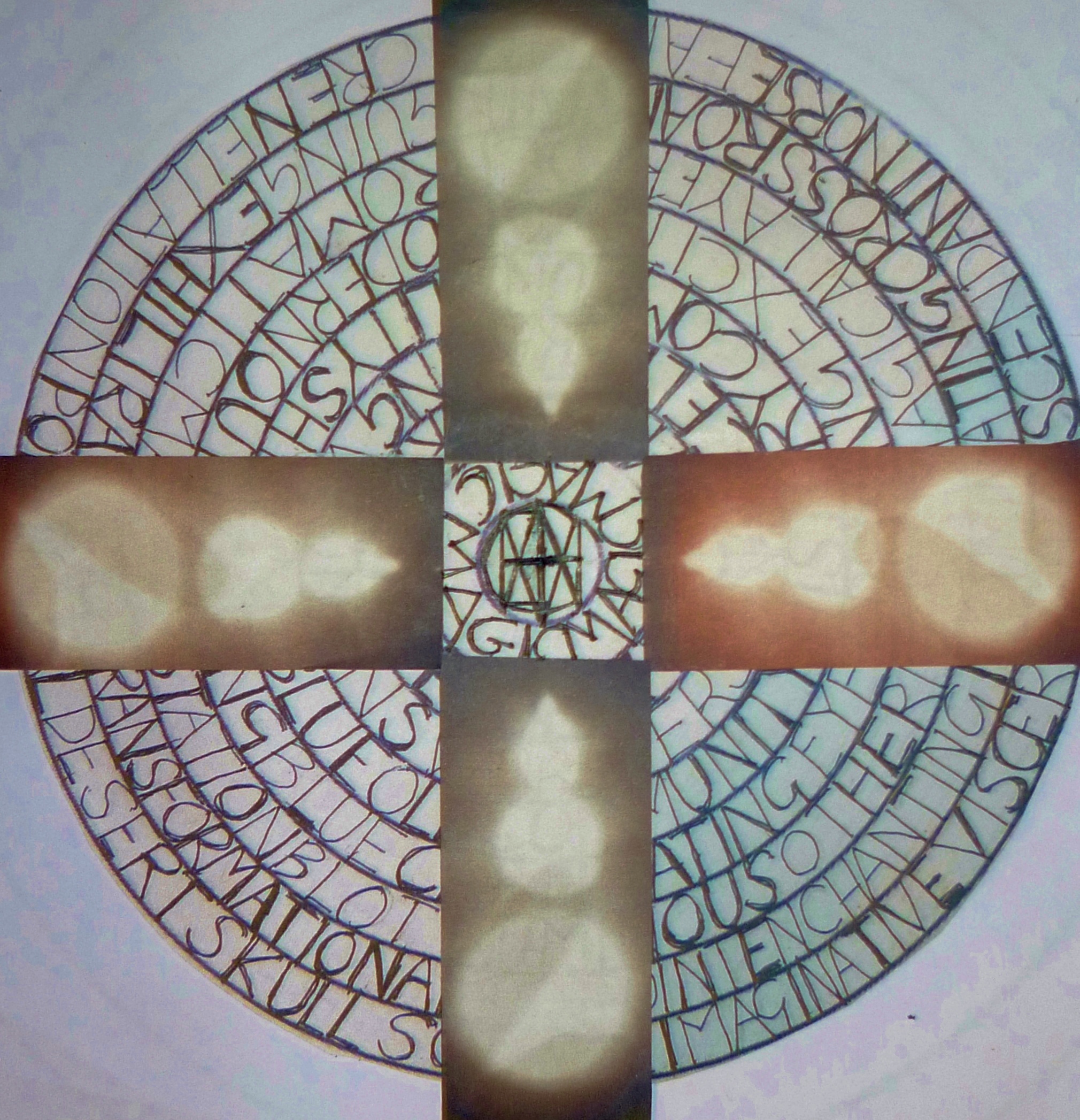
This post is about the esoteric art of my partner Elaine Knight, and in particular her work as artist-in-residence for the I:MAGE 2014 held in October/November this year. Elaine writes:

I want to thank Robert Ansell and FULGUR ESOTERICA  for the vision and creation of I:MAGE and the opportunity to be artist in residence during I:MAGE 2014. http://fulgur.co.uk/

I:MAGE 2014 explored what it means to communicate with spirits through art. It sought to glimpse a unifying theme across different esoteric practices. I had been commissioned to produce a talismanic piece for the journal Abraxas and I used my I:MAGE residency to do this.

Here are the words given to me by my some of my fellow travellers with unfamiliar spirits at I:MAGE 2014.

MAGIC MAGIC MAGIC WILL FIRE EVOLVE WHITE FIRE CELEBRATING WOMENS WORK PERSONAL SHINING BLUE OLD COMMUNITY HISTORY COMMUNALITY  MODERN OUTPOURING BLUE CAPTIVATING EYEOPENING EXCITING MAGICAL LAYERED CHROMATIC MANIFESTATION BLOT NUMINOUS OTHERNESS ENCHANTING ILLUMINATING CROSSROADS INTRIGUING EXHILARATING TRANSFORMATIONAL PINPOINT SQUARE IMAGINATIVE VISCERAL TRANSCENDANT NORSE FAMILIAR CRENELLATION POTENTIAL DESERT SKULL

48 words.

A mere homeopathic sample from the various throngs of people who attended the I:MAGE event over these two weeks.

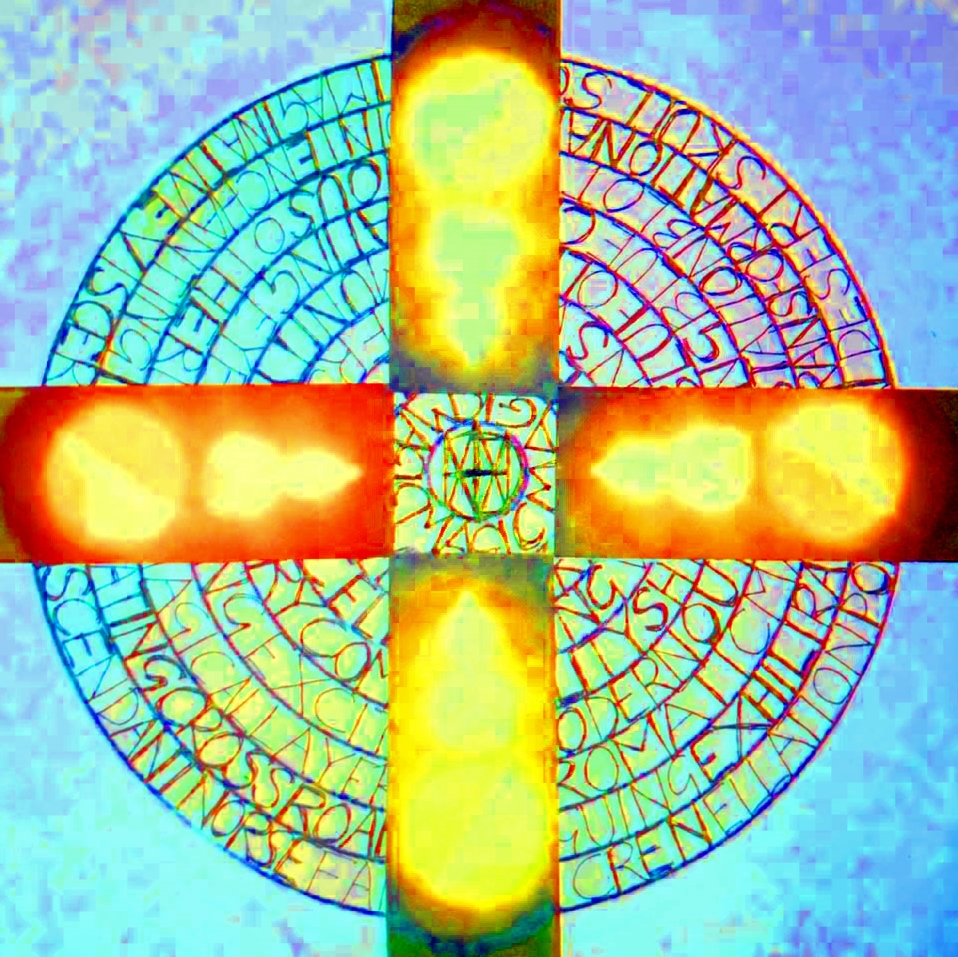
9 circles for these words and the central circle contains the I:MAGE bind rune.

The 9 circles are a homage to the nine worlds of Norse mythology.

The spirit of I:MAGE is a wonderful picture taken by Robert Ansell’s co curator Livia Filotico and used with her permission in the the arms of the equal and balanced cross.

I sought to gather and unify in the creation of my talismanic design generated by the event.

The Cross and the Circle.

The nine circles.

Energised from the four directions with the spirit of I:MAGE.

Gifted words to the power of three and one Rune to bind them.

Here is the heiros gamos, spirit and matter combine, each fertilises the other.

Recently I lit five candles to sit and contemplate in the fading light of a midwinter day. This arrangement was an echo of this talisman’s design.

The Concept

http://fulgur.co.uk/image/concept/

My Proposal

Here too is a link to pages 118-119 in the exhibition catalogue which explains a bit about me and what I am doing on this residency.

http://issuu.com/fulguresoterica/docs/image_2014/119?e=6507208/9770393

My dedicated residency websitewww.image2014twus.tumblr.com

My art blog at http://elaineknight.tumblr.com/

P1020465 (3)P1020559

Earth Eclectic

music that celebrates Earth and speaks to the heart

Sarah Fuhro Star-Flower Alchemy

Follow the Moon's Cycle

Muddy Feet

Meeting nature on nature's terms

Rosher.Net

A little bit of Mark Rosher in South Gloucestershire, England

Becoming Part of the Land

A monastic polytheist's and animist’s journal

selkiewife

Selkie Writing…

Charlotte Rodgers

Images and words set against a backdrop of outsider art.

Prof Jem Bendell

living with metacrisis and collapse

Towint

The pagan path. The Old Ways In New Times

The Druids Garden

Spiritual journeys in tending the living earth, permaculture, and nature-inspired arts

The Blog of Baphomet

a magickal dialogue between nature and culture

This Simple Life

The gentle art of living with less

Musings of a Scottish Hearth Druid and Heathen

Thoughts about living, loving and worshiping as an autistic Hearth Druid and Heathen. One woman's journey.

Wheel of the Year Blog

An place to read and share stories about the celtic seasonal festivals

Walking the Druid Path

Just another WordPress.com site

anima monday

Exploring our connection to the wider world

Grounded Space Focusing

Become more grounded and spacious with yourself and others, through your own body’s wisdom

The Earthbound Report

Good lives on our one planet

Hopeless Vendetta

News for the residents of Hopeless, Maine