Contemplative Inquiry

This blog is about contemplative inquiry

Tag: contemplation

ATLANTIC ANCESTORS

I am beginning to feel the pull of Samhain. It is not here yet, but its themes are drawing my attention. One of these is the remembrance of ancestors.

A recent post by poet and awenydd Lorna Smithers (1) has prompted me to look again at Barry Cunliffe’s work, and the book I have to hand is Facing the Ocean (2). It is about early human history in Atlantic maritime Europe. including Britain and Ireland. One of its threads concerns living with the ocean. Another, related to the first, looks at communication by sea at a time when land travel was difficult. I will follow up these threads in future posts. In the meantime, Cunliffe’s sense of the interaction between nature and culture is shown in the extract below.

“To stand on a sea-washed promontory looking westwards at sunset over the Atlantic is to share a timeless human experience. We are in awe of the unchanging and unchangeable as all have been before us and all will be. Wonder is tempered with reassurance: it is an end, but we are content that the cycle will reproduce itself the sun will reappear. The sea below creates different, more conflicting, emotions. True, there is the comfortable inevitability of the tides, but there is also an unpredictability of mood, the sea constantly changing, sometimes erupting in crescendos of brute force destroying and remoulding the land and claiming human life. The sea is a balance of opposites. It gives and takes. It can destroy quickly and build new; it sustains life and it can kill. Small wonder that through time communities have sought to explain these forces in terms of myth and have attempted to gain some puny influence over them through propitiation.

“Nowhere is this relationship more apparent than in the legends and folk traditions of Brittany. In the howl of the wind can be heard the screams and laments of those drowned at sea, and much of human life – birth and the gender of the newborn and death – was believed to be conditioned by the tides. Below a thin veneer of Christianity lie beliefs deeply rooted in time. A century ago, in the parish of Ploulec’h on the north Breton coast, the first Sunday in May saw the people in procession climb to La Croix du Salut – an isolated landmark that could be seen from far out to sea offering assurance of the approach to a safe haven. Here the sailing community gave thanks for their safe returns before descending to the chapel of Notre-Dame across the bay on the headland of Le Yaudet. In the church today, fine model sailing ships hanging from the roof beams are among the more evocative offerings made to the Virgin by grateful mariners. The deep underlying awe of the ocean is poignantly expressed by the Breton poem

War vor peb ankenn

War vor peb peden

(Sur la mer toute angoisse, sur mer toute priere

At sea all is anguish, all is prayer).”

(1) https://lornasmithers.wordpress.com/2020/10/04/britain-begins-debunking-the-myth-of-celtic-invasions/

(2) Barry Cunliffe Facing the Ocean: The *Atlantic and Its Peoples 8000 BC-AD 1500 Oxford: the University Press, 2001

*NOTE: I wish the subtitle had specified ‘eastern Atlantic’, since every corner of the Americas has been populated for periods ranging from 12,000-24,000 years. The western Atlantic coastal people amongst them are not my focus, but in a post about ancestors I don’t want them to be implicitly erased.
A CONTEMPLATIVE LENS

As the autumn deepens, I find that my canal walking has slowed down and detached itself from notions of exercise. It has become spontaneously and informally meditative. I am simply noticing what is available, rather than striving to get to some other place in myself or in the world. Followers of the Headless Way (1) describe such attention as ‘being capacity for the world’, since the world knows itself through this awareness. One of the Headless Way’s poets, Colin Oliver, has the lines (2) “In the oneness of things/ I am nowhere in sight”. I am like that with my phone/camera. I rarely have it in the selfie mode, so it is a good device for the purpose.

My combined walking and photography have become a contemplative opportunity, an informal opening to the magic of what is given, here and now, which I sometimes refer to as ‘at-homeness in the flowing moment’. They have taken their place, unplanned, at the heart of my contemplative Druidry. They enable immersion in the apparent world, and provide a setting for what I like to call valley experiences, to distinguish them from the peak experiences more often discussed. I notice also an aversion to calling this activity a ‘spiritual practice’, a feeling that comes with the image of a caged bird. Not right for the context. Not right for that in me which does this.

Through this contemplative lens I can be appreciatively open even to appearances of dereliction and decay. They are simply part of what is. When I see an old and roofless building without this accepting contemplative gaze, I can become irritated and grumpy. Why isn’t it being renovated or pulled down, one or the other? Who is responsible? But in my picture taking mode, through the lens of contemplation, I am entirely at ease. The building has its place, just the way it is.

My meditative walk can highlight processes as well as still images. A decaying rose becomes a rose hip. The dying flower makes way for fruit, which will die back in its turn after seeding the next generation. ‘Decay’ is relative.

The lens of contemplation makes space for things that would be easy to miss otherwise. A waning moon, for example at 8 a.m. …

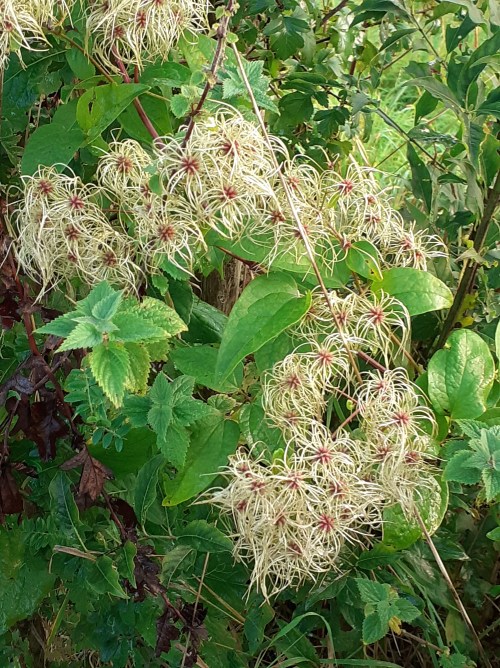
… or the delicacy, close-up, of old man’s beard …

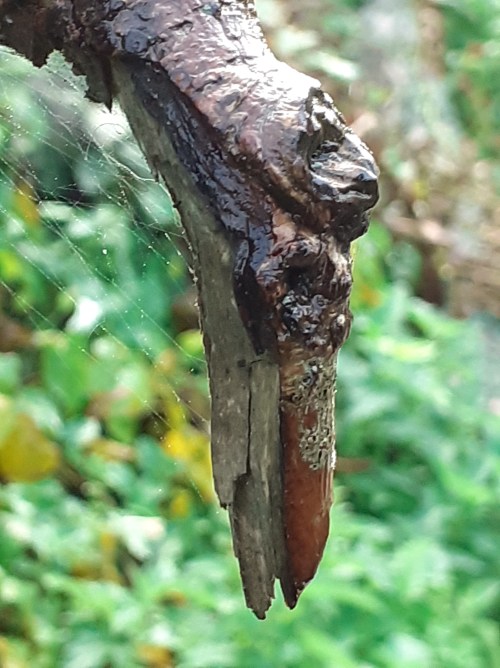
… or a naturally sculpted head of an unknown bird or reptile, which also offers space for a cobweb …

These walks have taught me a lot. There must have been a gestation period between the time I gave them up – what with Covid-19 and my concerns about narrow paths and passing – and the time I resumed them. Along the way I’ve gained a different perspective on their role in my contemplative life. I used to see them as ancillary. Now they seem central.

(1) http://www.headless.org/

(2) https://contemplativeinquiry.blog/2016/04/28/poem-the-oneness-of-things/

DRAGONS, ARCHETYPES & STORYTELLING

Extract in which Ursula K. Le Guin looks at the creative evolution of her six Earthsea books. The focus is on new perspectives in the fourth book, Tehanu.

“In Tehanu, Tenar is brushing her hair on a windy dry morning, so that it crackles and makes sparks, and the one-eyed child Therru is fascinated, seeing what she calls ‘the fire flying out all over the sky’.

“At that moment, Tenar first asked herself how Therru saw her – saw the world – and knew that she did not know; that she could not know what one saw with an eye that had been burned away. And Ogion’s words – ‘they will fear her’ – returned to her, but she felt no fear of the child. Instead, she brushed her hair again, vigorously, so the sparks would fly, and once again, she heard the little husky laugh of delight.

“Soon after this scene, Tenar herself has a moment of double vision, seeing with two different eyes. An old man in the village has a beautiful painted fan; on one side are figures of lords and ladies of the royal court, but on the other side, usually hidden against the wall:

Dragons moved as the folds of the fan moved. Painted faint and fine on the yellowed silk, dragons of pale red, blue, green moved and grouped, as the figures on the other side were grouped, among clouds and mountain peaks.

‘Hold it up to the light’, said old Fan.

She did so, and saw the two sides, the two paintings, made one by the light flowing through the silk, so that the clouds and peaks were the towers of the city, and the men and women were winged, and the dragons looked with human eyes.

‘You see?’

‘I see,’ she murmured.

“What is this double vision, two things seen as one? What can the blinded eye teach the seeing eye? What is the wilderness? Who are the dragons?

“Dragons are archetypes, yes; mind forms, a way of knowing. But these dragons aren’t St. George’s earthly worm, nor are they the Emperor of China’s airy servant. I am not European, not Asian, and I am not a man. These are the dragons of a new world, and the visionary forms of an old woman’s mind. The mythopoeticists err, I think, in using the archetype as a rigid, filled mold. If we see it only as a vital potentiality, it becomes a guide into mystery. Fullness is a fine thing, but emptiness is the secret of it, as Lao Tze said. The dragons of Earthsea remain mysterious to me.”

(1) Ursula K. Le Guin Earthsea Revisited In Books of Earthsea: The Complete Illustrated Edition London: Gollanz, 2018 Illustrated by Charles Vess.

Earthsea Revisited is a printed version of a lecture delivered in 1992, in which Ursula K. Le Guin described the lifelong revisioning of gender and culture which changed her approach to storytelling. This evolution moved her decisively away from the traditional, masculine, ‘hero’s journey’ framework with which she started. Books of Earthsea brings together all six books, with additional stories and authorial reflections from different periods. Some of this work has been familiar to me for a long time, and some is new. I found it helpful to have all of the material collected in one volume.

EXPERIENCING LATE SEPTEMBER

I tend to feel thrown around energetically over two or three days during the autumn equinox period, and then a new calm takes over. I have crossed into the darker half of the year. I reached that place this year on 25 September and went out for a walk at 7.15 a.m., about 20 minutes after sunrise. The temperature was 8 degrees (46.4 F), not exactly cold, but enough to indicate a change in the year. I was glad to be wearing gloves. They demonstrated my acceptance of a new seasonal identity. There have been still lower morning temperatures in more recent days.

Walking by my local canal, I could see that 2020 has been a good year for its swans. I saw ten near-grown cygnets in a 3-4 mile stretch of water: the group of five in the picture, a group of three a couple of miles away, and two others on their own. I’m inclined to think that the full lockdown from late March until early June has played a role in making the swan population safer. A happy thought and a sad one at the same time.

I walked further out of town this time than I had since the beginning of the Covid-19 crisis and went past more open fields. The grass was green but not growing wildly. I saw only subtle signs of a turn in these distant trees, and none really of a fall. The horses were contentedly outside: no need even for coats. It was dry. By this stage of my walk it was a little warmer, though never beyond 10 degrees (50F). The edge created by a cold breeze had gone. For me this image captures a tranquil moment, that represents my sense of this post-harvest moment in the year. The weather is adequately benign. The energy of nature feels partly withdrawn, into a subterranean state of latency.

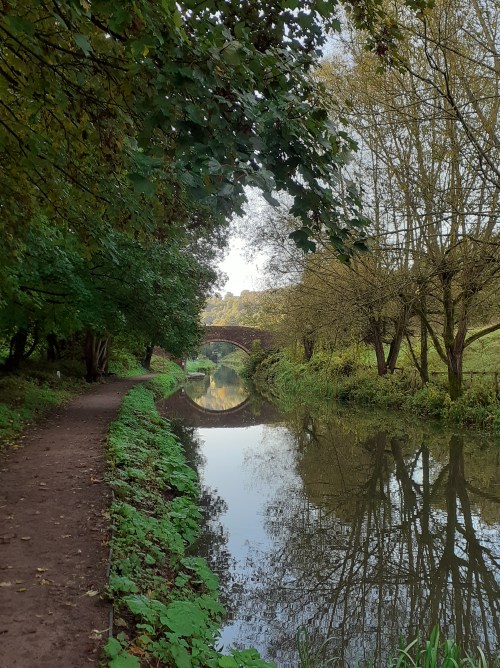
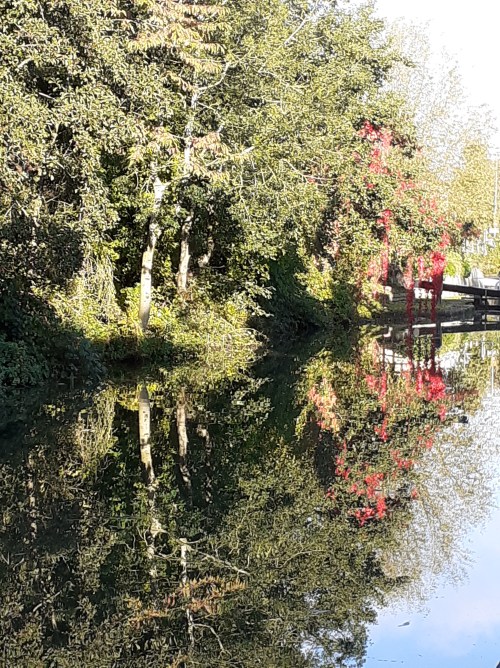
Among the trees on the canal bank, I found much greater evidence of a turn. This is one of the times when I become particularly drawn to reflections in water, and the way in which they to an extent mirror the world above whilst also offering something of their own. The much quoted phrase, ‘as above, so below’ is altogether too neat and formulaic to describe a living world.

POEM: SENT TO A HUA MOUNTAIN MONK

I do not know of a Druid or Pagan currently living contemplatively in a mountain cave. But I would not be surprised to learn of one, somewhere in the world. The poem below comes from the contemplative culture of ancient China, where the Taoist and Ch’an Buddhist traditions, in some ways rivals, developed in a mutually influencing way. I believe that there is something for contemplatively inclined Druids and Pagans to appreciate and learn from these traditions. I like this poem because it is a nature poem as much as a contemplative one. Even the meditative turn towards mind is embedded in its natural setting, as the distinction between ‘inner’ and ‘outer’ is softened to the point of vanishing.

“From afar,

I know your white-rock hermitage,

hidden in a haze

of evergreen trees.

When the moon sets,

it’s mind-watching time;

clouds rise

in your closed eyes.

Just before dawn, temple bells

sound from neighbouring peaks;

waterfalls hang thousands of feet

in emptiness.

Moss and lichen

cover the cliff face;

a narrow, indistinct path

leads to you.”

Poem Sent to a Hua Mountain Monk from When I find you again, it will be in mountains: selected poems of Chia Tao (2000) Somerville, MA, USA: Wisdom Publications. English translation by Mike O’Connor.

Chia Tao (779 – 843) an erstwhile Ch’an monk, became a poet during China’s Tang Dynasty. Ch’an was the Chinese predecessor of Japanese Zen.

MOR HAFREN

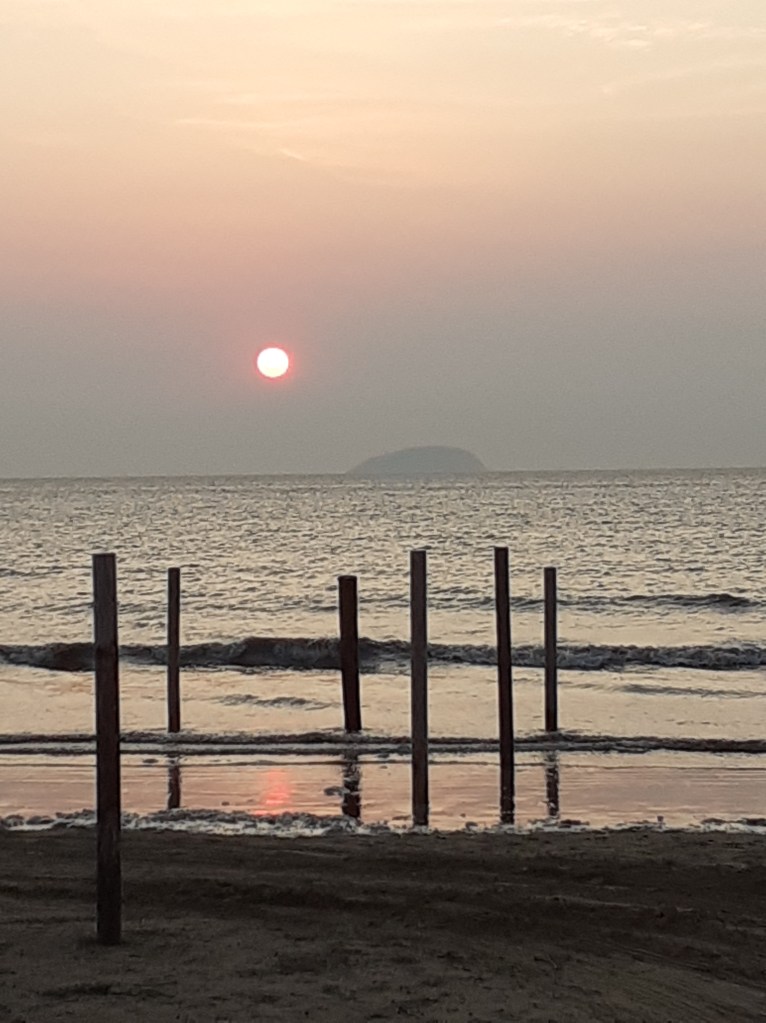
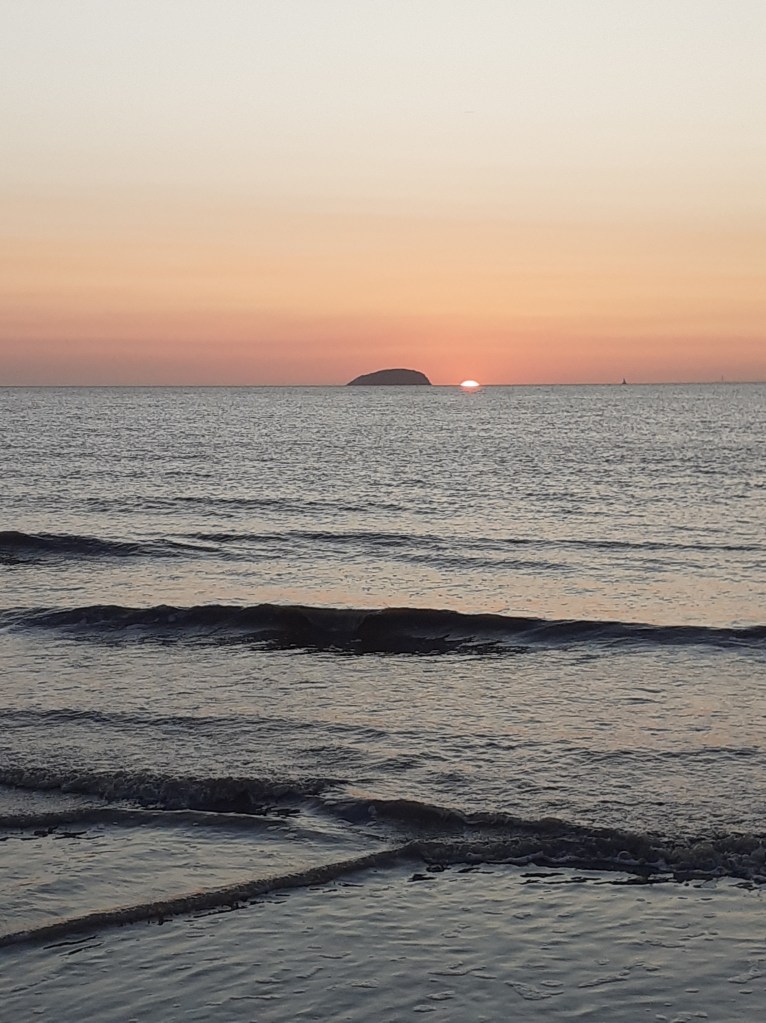
I took this picture on 17 September at Weston-super-Mare, a seaside town located where the Severn estuary becomes what is now called, in English, the Bristol Channel. Weston faces Cardiff, the Welsh capital, on the other shore (too far away to see in the picture). Looking at it gives me a sense of tranquillity whilst also showing clearly the major forces in play. We notice the descent of the sun, as if into the water. A change in the light is linked with this process. In the near distance, not far from our feet, the tide is coming in – rapidly, as it turns out just a little later.

Until Tudor times this stretch of water was known as the Severn Sea in line with the Welsh name Mor Hafren (Cornish Mor Havren). For me, the name ‘Bristol Channel’ makes a claim as much as it describes a place. It disrupts my sense of psychogeography and I am drawn to the Welsh ‘Mor Hafren’ as a name to connect me to these waters. It is older, naturalistic and retains a link with the river.

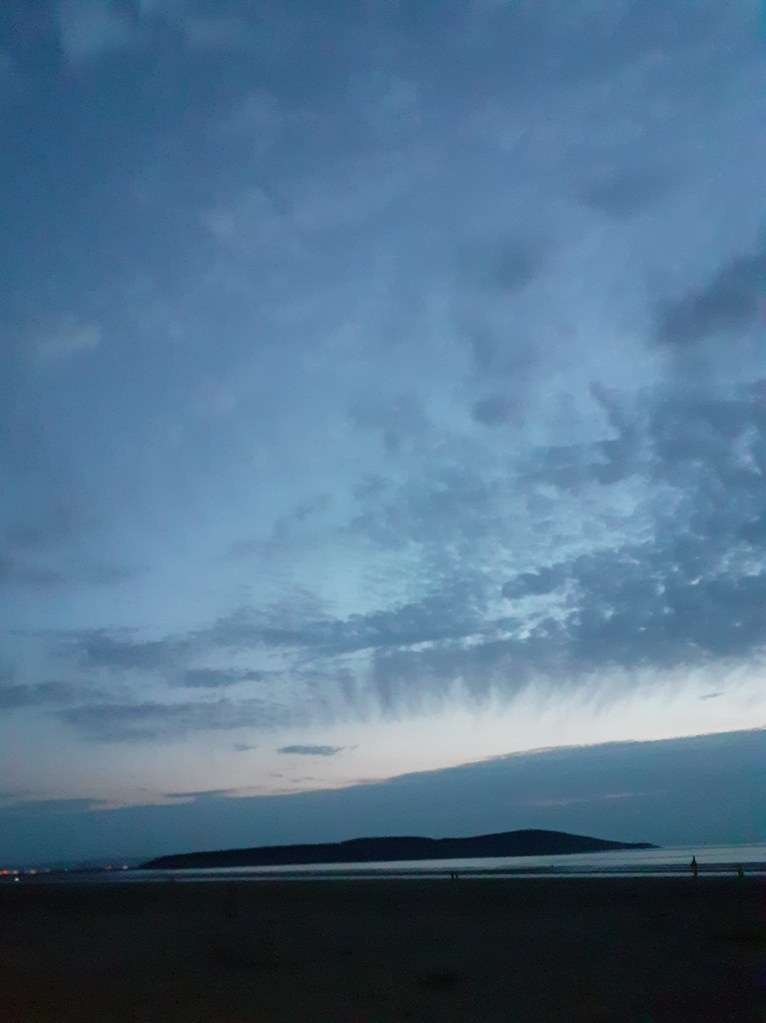
Weston-super-Mare is, by nature, a liminal space, not least of an autumn evening. The picture below is of Brean Down – brilliantly used in Dion Fortune’s occult novel The Sea Priestess – and the sky above it, a little after sunset.

Sky, sea, land. From this distance, the head, like many coastal promontories, has a slightly serpentine or dragon-like look. You half expect it to rear up and move. But it doesn’t. It remains quiescent, power in potential. The active power, here and now, is in the clouds and the afterglow of the sun.

On this visit, I discovered the cycle track, also a pedestrian path, that allows improved access to Brean Down from the Weston side. This helped me to revive a connection to Brean Down which I had allowed to lapse over recent years.

My final picture gives more space to the water element as an incoming tide, whilst recording the sun sinking below the horizon near the island of Steep Holm. The name is of Norse derivation (‘holm’ referring to an island in an estuary). The Welsh name is Ynys Rhonech and the early English called it either Ronech or Steopanreolice – ‘reolice’ being derived from an Irish word referring to a church yard or graveyard, suggesting a sense of a one-time sacred space. These names give a sense of the different peoples who took an interest in this stretch of water in early times. Steep Holm is in England, although Flat Holm, Ynys Echni, a little closer to the opposite shore, is in Wales.


AUTUMN EQUINOX 2020: HAZEL, SALMON, AWEN

In the outer circle of my mandala of the year (1), hazel presides over the days from 16 September to 8 October.

In the middle circle, divided into quarters, the one beginning at Lughnasadh/Lammas is represented by a salmon.

In the inner circle, where there is no sub-division, I have three seed pearls standing for the Awen. The Autumn Equinox is a time when images from the three layers of the mandala line up particularly well. (See NOTE below)

The lore and legend surrounding hazel have a stronger hold on me than the physical tree, though I do find hazels in my locality. For the ancient Celts, the tree was linked with wisdom and known as the food of the gods. Irish tradition (2,3) speaks of the sacred salmon who swim in a pool surrounded by nine hazel trees. This pool was known as Conla’s Well or the Well of Segais and it is the source of the River Boyne. When the trees drop their nuts into the water below, the salmon eats them and so carries them into the sea and back in their annual spawning run. “The cycle was seen as a metaphor for the passing of wisdom from age to age and from person to person” (2). The ancient Druid temples of Newgrange, Knowth and Dowth are to be found in the Boyne Valley.

Ireland and Western Britain are watery places, well-located for intimations of wisdom in watery forms. In modern Druidry, circle work makes links between the west, water and autumn, understood as the quarter following Lughnasadh/Lammas. There are suggestions, too, of love and intuition flowing together in harmony. The Autumn Equinox stands at the point where the light half of the year gives way to the dark half – not suddenly, or violently, but as part of a gentle transition, where the qualities are more or less balanced on both sides of the divide. Tradition also gives us the image of the Well of Segais  as “a shining fountain, with five streams flowing out of it” (3). Here, the invitation, at least for ‘the folk of many arts’, is to drink from the five streams (the five senses) and from the fountain itself (the source of life). In a nutshell, our wisdom is best served by drawing on both the life of the senses and on the flow of inner inspiration (Awen). Neither needs to be sacrificed to the other.

(1) See the ‘house’ section of: https://contemplativeinquiry.blog/2020/08/12/meditation-wisdoms-house/

(2) John Matthews & Will Worthington The Green Man Oracle London: Connections, 2003. Also source of the image at the top.

(3) Philip and Stephanie Carr-Gomm The Druid Animal Oracle: Working with the Sacred Animals of the Druid Tradition London: Fireside, 1994 (Illustrated by Will Worthington)

NOTE The two pictures below give a rough sense of the mandala, and of relationships at the Autumn Equinox, though not the way it looks as a mosaic in my innerworld. The tree images are taken from The Green Man Tree Oracle (2). They stand in for the ones in my mandala, which are more naturalistic and sometimes involve more than one plant: hazel, west; rowan, west-north-west, yew, north-west; elder, north-north-west; holly, north; alder, north-north-east; birch, north-east; ash & ivy, east-north-east; willow, east; blackthorn, east-south-east; hawthorn, south-east; beech & bluebell, south-south-east; oak, south; gorse, south-south-west; apple, south-west; blackberry & vine, west-south-west. The selection as a whole is based on my personal experience of trees in the neighbourhood as well as traditional lore. The elemental images are from R. J Stewart The Merlin Tarot London: Element, 2003. Illustrated by Miranda Grey.

THE SPACE BETWEEN BREATHS

“When a pendulum swings, there is a fraction of a moment at the end of each swing when the movement stops, before the pendulum starts to swing back. That moment of pause is the madhya, the central still point out of which the pendulum’s movement arises. All movement – whether the swing of an axe, the movement of the breath, or the flow of thought – arises out of such a point of stillness.

“That still point is an open door to the heart of the universe, a place where we can step into the big Consciousness beyond our small consciousness. As the medieval English saint Julian of Norwich wrote, ‘God is at the midpoint between all things’.

“… Such points exist at many different moments. One of these is the pause between sleeping and waking, the moment where we first wake up before we become fully conscious. Another is the moment before a sneeze or at the high point of a yawn. Another is the space between thoughts.” (1)

For Sally Kempton, this is the inner realm that mystics and sages have called the Heart – not the physical heart, or even the heart chakra, but “the Great Heart that contains All-that-is … the consciousness that underlies all forms”. Her recommendation to meditators is to follow the breath, and to enter the madhya in the spaces between the inhalation and the exhalation, and between the exhalation and the inhalation. Focusing on the sound of the breath with a subtle and relaxed attention, we find the gaps and over time, without forcing the process, we find them expanding.

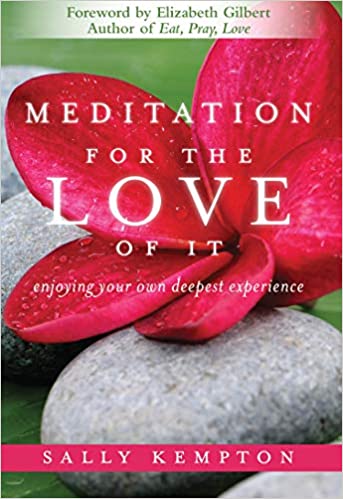
Sally Kempton’s Meditation for the Love of It has companioned me for the better part of a decade, and I am grateful for her influence on me as a contemplative practitioner. I do not follow her path of Kashmir Shaivism and the Tantric philosophy that underpins it. But I have always liked her framing of ‘meditation for the love of it’, which I see as a Druid and Pagan friendly approach. I also like the quality of her writing, and many of her practical recommendations.

In the present instance, I have found that the space between breaths is indeed a portal – placing me, in my own language, as ‘living presence in a field of living presence’. My experience is that the discovery of the space between breaths can lead on to a discovery of stillness even within the breath as it rises and falls. Stillness in the breath, co-existent with the movement of the breath, is potentially available at all times. It is largely through Sally Kempton’s work that I learned this lesson, and I am grateful to her for the experience and insight that I have gained.

(1) Sally Kempton Meditation for the Love of It: Enjoying Your Own Deepest Experience Boulder, CO: Sounds True, 2011

EXPERIENCING EARLY SEPTEMBER

Months, and moments within them, have their own atmosphere and meaning for me. I try to indicate these through pictures. Where I live, early September takes us fully into autumn, and the fruiting of the horse chestnut tree (above) is a marker for the transition.

Early in the month, the sun sets a little after 7.30 p.m. and reminds us that the nights are drawing in more quickly. It still seems early for sunset, but I notice that my sense of ‘evening’ is adjusting to a more autumnal perspective. The picture below was taken on September 3rd.

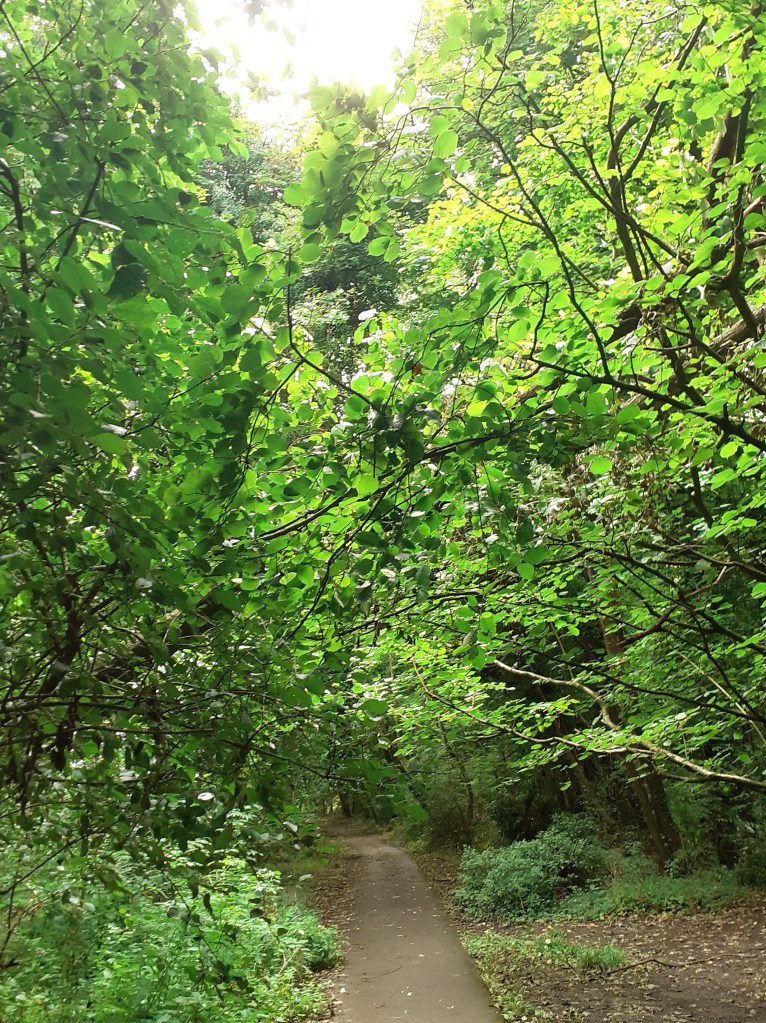
The feeling-tone of this period is not yet equinoctial. Wooded spaces are still vigorously green, still majestic, still imaging what my heart wants more of the world to look like. The light of day remains strong, even though temperatures are characteristically lower. There is a lingering aftertaste of summer at the beginning of the new season.

Nonetheless, it is easy to find muted colours leaning in to decay. These have their own fragile and poignantly fleeting beauty, as the alchemy of the waning year does its work. Early September has a character of its own, to be enjoyed while it lasts, as the wheel continues to turn.

A VISION

I look into the emptiness of the hooded one, no longer expecting to see a face or head. I know the hooded one only as the being who ferries me to Wisdom’s Island, each journey an Imramm in itself. That is all. No context or history for the hooded one. Just a tightly delimited contact.

Nevertheless, the question I have carefully not asked is telepathically answered. The voice in my head, which I know to be the voice of the hooded one, tells me: “whatever can be imagined has a form of existence – for better and for worse, as blessing and as curse”.

“Slightly theatrical” I think, as I stand in the rain and, already soaked, scan the sky for thunder. The lake, however, is not especially turbulent. I have no good reason to avoid the crossing. I take my seat. I sense the water getting deeper and see the island drawing nearer. I am committed, now.

The cliffs, usually nominal, rear above me. The path up is not merely steep but slippery. The actual ascent is almost as anxious making as the anticipation. I do not know whether the hooded one is watching me, but I like to think not. I certainly do not look down to check it out.

The woods at the top, a joy to reach, are dense and tangled in a way I have not experienced before. But they readily grant me passage into the sheep pasture beyond them. The sheep look stoical and accepting in the still driving rain.

The door in the wall is, as ever, open. It is good to be in the orchard, even in the rain. I feel warmer and easier inside. I begin to relax. But as I enter Wisdom’s House, I find the interior unlit. I can barely see the mosaic floor or the Rose Chapel opposite. The only light is on the stairs to the Upper Room. I take the hint.

A force like the wind, but subtler, thrusts me into a chair and puts a chalice into my hands. I cannot do other than drink from it, and so I am taken to the deeper interiority of Wisdom’s Garden. I am not an observer here. I become the fountain at the centre, which is the wellspring of the world. Rivers flow from me in each cardinal direction. As this vision fades, I become the tree of life, with roots extending deep into the underworld and branches reaching up to the stars.

Then I become the primal human pair, in an embrace that maintains aspects of union, brings the gift of relationship, and also introduces a new note of separation. At this point I am restored to the everyday world with a heightened, and perhaps more compassionate, sense of its challenges.

None of these images stay with me for long. They flash by with great intensity, leaving a strong imprint in my senses, mind and imagination. It is as if I have visited the place where the rich latency of unbeing starts to be. I see this as a current reality, always and everywhere, with the the journey and its metaphors as a useful aid to awareness. Whatever can be imagined has a form of existence, for better or worse, as blessing or as curse.

NOTE: this vision arose within my ‘wisdom’s house’ meditation practice. See: https://contemplativeinquiry.blog/2020/08/12/meditation-wisdoms-house/

Earth Eclectic

music that celebrates Earth and speaks to the heart

Sarah Fuhro Star-Flower Alchemy

Follow the Moon's Cycle

Muddy Feet

Meeting nature on nature's terms

Rosher.Net

A little bit of Mark Rosher in South Gloucestershire, England

Becoming Part of the Land

A monastic polytheist's and animist’s journal

selkiewife

Selkie Writing…

Charlotte Rodgers

Images and words set against a backdrop of outsider art.

Prof Jem Bendell

living with metacrisis and collapse

Towint

The pagan path. The Old Ways In New Times

The Druids Garden

Spiritual journeys in tending the living earth, permaculture, and nature-inspired arts

The Blog of Baphomet

a magickal dialogue between nature and culture

This Simple Life

The gentle art of living with less

Musings of a Scottish Hearth Druid and Heathen

Thoughts about living, loving and worshiping as an autistic Hearth Druid and Heathen. One woman's journey.

Wheel of the Year Blog

An place to read and share stories about the celtic seasonal festivals

Walking the Druid Path

Just another WordPress.com site

anima monday

Exploring our connection to the wider world

Grounded Space Focusing

Become more grounded and spacious with yourself and others, through your own body’s wisdom

The Earthbound Report

Good lives on our one planet

Hopeless Vendetta

News for the residents of Hopeless, Maine