Contemplative Inquiry

This blog is about contemplative inquiry

Tag: Consciousness

SCIENCE AND SPIRITUAL PRACTICE

As part of my contemplative inquiry, I have been looking at recent work by Rupert Sheldrake (1, 2). He identifies himself as “not a guru but an explorer”. I like that notion of ‘explorer’, with its sense that there is always space for new learning and development.

Sheldrake’s affirms that spiritual practice and research are “entirely consistent with the scientific method, which involves the formation of hypotheses – guesses about the way the world works – and then testing them experimentally. The ultimate arbiter is experience, not theory. In French, the word experience means both ‘experience’ and ‘experiment’. The Greek word for experience is empeiria, the root of our English word ‘empirical’. The exploration of consciousness through consciousness itself is literally empirical, based on experience. Spiritual practices provide ways in which consciousness can be explored empirically.”

In recent years, Sheldrake (1,2) has written two books based on this approach. Each discusses seven different practices that have been investigated empirically, both by the practitioners themselves and by scientists studying the effects of those practices. Every practice gets a chapter. The first book, Science and Spiritual Practices, offers:

  1. Meditation and the Nature of Minds
  2. The Flow of Gratitude
  3. Reconnecting with the More-Than-Human World
  4. Relating to Plants
  5. Rituals and the Presence of the Past
  6. Singing, Chanting and the Power of Music
  7. Pilgrimages and Holy Places

The second Book, Ways To Go Beyond, covers:

  1. The Spiritual Side of Sports
  2. Learning from Animals
  3. Fasting
  4. Cannabis, Psychedelics and Spiritual Openings
  5. Powers of Prayer
  6. Holy Days and Festivals
  7. Cultivating Good Habits, Avoiding Bad Habits, and Being Kind

Sheldrake’s choices are all practices he has taken part in, which have also been studied scientifically. He looks at both the ‘subjective’ experience and the ‘objective’ evidence and discusses the ways in which the practices seem to work. He also offers guidance to readers about engaging with the practices. He is very clear that the two books “do not constitute a comprehensive survey of all spiritual practices, emphasising his point by listing others that have been left out: “yoga, service to others, tai chi, chi gong, devotional worship or bhakti, tantric sex, caring for dying people, dream yoga, and the practices of the arts”. He makes it clear that “some practices are better at some times of life than others, and all religious traditions  have their own combinations”. I have already discussed Sheldrake’s work on gratitude at www.contemplativeinquiry.blog/2020/03/14/ and will discuss others in future posts.

Sheldrake’s overall purpose is “to show that there is a wide variety of ways to connect to greater conscious realities, however we conceive of them, and that the effects of these practices can be investigated empirically”. Sheldrake is an optimist about the possibilities of science and spirituality working together in the service of human flourishing. “We are on the threshold of a new era of the exploration of consciousness, both through a revival of spiritual practices and also through the scientific study of them. After several generations in which science and spirituality seemed to be in opposition, they are becoming complementary. Together they are contributing to an unprecedented phase of spiritual evolution, beginning now.”

(1) Rupert Sheldrake Science and Spiritual Practice: Reconnecting Through Direct Experience Coronet, 2017

(2) Rupert Sheldrake Ways to Go Beyond, and Why They Work Coronet, 2019

NOTE: Rupert Sheldrake is a biologist and author of more than eighty technical papers and ten books, including A New Science of Life. He was a Fellow of Clare College, Cambridge, where he was Director of Studies in cell biology, and was also a Research Fellow of the Royal Society.

Sheldrake resigned his position at Clare and went to work on the physiology of tropical crops in Hyderabad, India, as principal plant physiologist at the International Crops Research Institute for the Semi-Arid Tropics (ICRISAT) from 1974 to 1978. There he published on crop physiology] and co-authored a book on the anatomy of the pigeonpea. Sheldrake left ICRISAT to focus on writing A New Science of Life, during which time he spent a year and a half in the Saccidananda Ashram of Bede Griffiths, a Benedictine monk.

From 2005-2010 he was the Director of the Perrott-Warwick Project for research on unexplained human abilities, funded from Trinity College, Cambridge. He is currently a Fellow of the Institute of Noetic Sciences in California, and a Visiting Professor at the Graduate Institute in Connecticut.

His website is www.sheldrake.org/
BIOCENTRISM

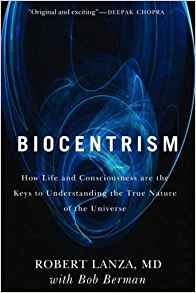
Biocentrism (1) and the follow-up Beyond Biocentrism (2) are science-referenced explorations of cosmos and consciousness. Unusually, they present a ‘consciousness first’ view. In the first book authors Robert Lanza and Bob Berman work through the evidence and identify seven principles of biocentrism.

“If one removes space and time as actual entities rather than subjective, relative and observer-created phenomena, it pulls the rug from the notion that an external world exists within its own independent skeleton. Where is this external objective existence if it has neither time nor space? we can, at this point formulate seven principles:

“First Principle of Biocentrism: What we perceive as reality is a process that involves our consciousness. An ‘external’ reality if it existed, would – by definition – have to exist in space. But this is meaningless, because space and time are not absolute realities but rather tools of the human and animal mind.

“Second Principle of Biocentrism: Our external and internal perceptions are inextricably intertwined. They are different sides of the same coin and cannot be divorced from one another.

“Third Principle of Biocentrism: The behaviour of subatomic particles – indeed all particles and objects – is inextricably linked to the presence of an observer. Without the presence of a conscious observer, they at best exist in an undetermined state of probability waves.

“Fourth Principle of Biocentrism: without consciousness, ‘matter’ dwells in an undetermined state of probability. Any universe that could have preceded consciousness only existed in a probability state.

“Fifth Principle of Biocentrism: the structure of the universe is explainable only through biocentrism. The universe is fine-tuned for life, which makes perfect sense as life creates the universe, not the other way around. The ‘universe’ is simply the complete spatio-temporal logic of the self.

“Sixth Principle of Biocentrism: Time does not have a real existence outside of animal-sense perception. It is the process by which we perceive changes in the universe.

“Seventh Principle of Biocentrism: Space, like time, is not an object or a thing. Space is another form of our animal understanding and does not have an independent reality. We carry space and time around with us like turtles with shells. Thus, there is no absolute self-existing matrix in which physical events occur independent of life.”

Beyond Biocentrism summarises and extends Biocentrism. It does not repeat the principles, but elegantly summarises the perspective of biocentrism and takes the argument into new territory. An appendix to the book lists its major topics as: the exploration of time; the unreality of death; the nonreality of space; the nature of consciousness; science proofs of biocentrism; asking about awareness in machines (probably no) and plants (certainly yes).

When I contemplate biocentric thinking, I feel engaged and intrigued – without taking a stance on its truth claims. I can see how the universe of the space/time continuum, and within it the earth that I love, may be but a bubble of local, provisional reality. In the light of this narrative, simply experiencing life, being part of it, feels vividly magical. The effect is to ground me even more in my earth spirituality, gratefully celebrating the experienced here and now.

(1) Robert Lanza, MD, with Bob Berman Biocentrism: How Life and Consciousness are the Keys to Understanding the True Nature of the Universe Dallas, TX: Benbella Books, 2009

(2) Robert Lanza, MD, with Bob Berman Beyond Biocentrism: Rethinking Time, Space, Consciousness, and the Illusion of Death Dallas, TX: Benbella Books, 2016

WORLD TREE: A HOLOTROPIC VISION

“The unified field of cosmic energy that I had experienced before now became a massive tree of radiant energy suspended in space. Larger than the largest galaxy, it was composed entirely of light. The core of the tree was lost to the brilliant display but limbs and leaves were visible around its edges. I experienced myself as one of the leaves, the lives of my family and close friends were clustered around me on a small branch. All of our distinguishing characteristics, what made us the individuals we were, appeared from this perspective to be quite minor, almost arbitrary variations of this fundamental energy.

“I was taken around the tree and shown how to move from one person’s experience to another and it was ridiculously easy. Different lives around the globe were simply different experiences the tree was having. … At this point, I was the tree. Not that I was having the full range of its experience, but I knew myself to be this single, encompassing Consciousness. I knew that its identity was my true identity. … To experience my true Identity filled me with a profound sense of numinous encounter”.

The above experience is reported by one of Stanislav Grof’s research subjects in his inquiry into “non-ordinary states of consciousness”. As a young psychiatrist in Soviet era Czechoslovakia Grof pioneered the therapeutic use of LSD. The authorities welcomed ‘progressive’ chemical treatments as an alternative to the bourgeois introspection of psychoanalysis. Seeking greater freedom, and given an opportunity to work in the USA, Grof became a Professor in the John Hopkins University School of Medicine. He continued his clinical and research work until it was banned in 1967 due to a moral panic about psychotropic drugs. His response was to invent holotropic breathing, a ‘natural’ and legal method of giving people access to the same states. Grof became a founder of the Transpersonal Association, which affirmed the place of spirituality in the therapeutic domain. Grof also developed a close association with the Esalen Institute in Big Sur, California, and became a leading figure in the counter-culture of the day.

Grof disliked the limitations he perceived in conventional scientific culture, in particular the view that “our boundaries were defined by the surface of the skin, and consciousness was seen as nothing more than the product of that thinking organ known as the brain”. He thought that scientific culture had developed in an ethnocentric way and was irrationally closed to information gained in non-ordinary states. For him, there was a limiting conflation of ‘objective reality’ and ‘consensus reality’. Anything referenced beyond this was open to dismissal “as the product of an overly active imagination or a mental disorder”, and thus delegitimised in conventional scientific discourse. Grof became interested in archetypal images like the world or cosmic tree because he found them coming up frequently in sessions, as phenomena inviting “numinous encounter”.

For me, reports of this kind add strength to the image of the world tree, though my personal experience of it is different. Some images, like that of the the world (or cosmic) tree, or tree of life, appear in many different cultures and historical periods. They are widely thought of as universal. But the specific ways in which they appear, and the meanings ascribed to them, vary with place, time and culture.

Stanislav Grof The Holotropic Mind: the Three Levels of Human Consciousness and How They Shape Our Lives San Francisco, CA: HarperSanFrancisco, 1993 (Written with Hal Zena Bennett)

INQUIRY AND HEART

Recently I have noticed a change in my notion of inquiry. I experience, at the same time, both a greater precision and a softening in my understanding of ‘inquiry’. Rupert Spira (1) makes a helpful point.

“This path is sometimes referred to as self-inquiry or self-investigation. However, these terms – translations of the Sanskrit term atma vichara – are potentially misleading. They imply an activity of the mind rather than, as Ramana Maharshi described it, a sinking or relaxing of the mind into ‘the heart’, that is, into its source of pure Awareness and Consciousness. The term may, therefore, be more accurately be described as ‘self-abiding’ or ‘self-resting’, and is the essence of what is known in various spiritual and religious traditions as prayer, mediation, self-remembering, Hesychasm in the Greek Orthodox Church, or the practice of the presence of God in the mystical Christian tradition.”

At the time of writing, I have three means of heart inquiry by this definition. The first is quintessentially Sophian – a repetition, synchronised with the breath, of the name Ama-Aima (pronounced ahh-mah-ahee-mah). In its tradition of origin (2). this Aramaic name for the Divine Mother brings together Her transcendental and immanent aspects, and the repetition of the name invokes Her light energy and presence, which is the light energy and presence of the cosmos. As I breathe the name, entering into its pulse and vibration, I begin to find that this presence-energy is breathing me, until the distinctions themselves disappear. I treat this work formally, as a sacrament or mystery, and part of a daily practice.

The second is Seeing, and the practices of the Headless Way, described as ‘experiments’ in that family. – see www.headless.org/. I use a variety of these practices depending on the circumstances. The advantage of Seeing is that I can drop into it at any time during the day.

The third is the rawer approach laid out by Jeff Foster (https://lifewithoutacentre.com/ ), which turns the ‘Light of Oneness’, back onto the experience of the struggling human. It flows from his own journey of “venturing into the darkness of myself” (3), before “breaking through the veil of dualistic mind to a   Light that had been there all along”. Here, we enter into a loving encounter with whatever experience is happening and finding a way to accept  – not the content of the experience itself, which may be horrible and need resisting – but the reality that this is the experience that is happening, the one demanding attention. Loving attention to our struggles may not stop suffering but can make them more workable. As with Seeing, I can drop into this meditation at any time – by slowing down, breathing and just being there, with loving curiosity and attention. It works with mixed and good experiences too.

I find that a combination of these practices serves me well. Reading, writing and digital media of relevance to the practices support my sense od direction and my understanding.

(1) Rupert Spira Transparent Body, Luminous World: The Tantric Yoga of Sensation and Perception Oxford: Sahaja Publications, 2016

(2) Tau Malachi Gnosis of the Cosmic Christ: a Gnostic Christian Kabbalah Saint Paul, MN: Llewellyn Publications, 2005

(3) Jeff Foster The Joy of True Meditation: Words of Encouragement for Tired Minds and Wild Hearts Salisbury, UK: New Sarum Press, 2019

CARLO ROVELLI ON TIME

“We are time. We are this space, this clearing opened by the traces of memory inside the connections between our neurons. We are memory. We are nostalgia. We are longing for a future that will not come.”

Carlo Rovelli is a theoretical physicist working on the physics of space and time, currently directing the quantum gravity research group of the Centre de physique theoretique in Marseille, France.   In his The Order of Time (1), he is writing for a lay readership, offering a naturalist view of time and what it means to us. His reflections draw both on his professional work and his easy familiarity with art, literature, philosophy and music.

In the first section of this book, he deconstructs the time of common-sense. “Not only is there no single time for different places – there is not even a single time for any particular place. A duration can only be associated with the movement of something, with a given trajectory”. Rovelli’s Cosmos shows itself through change, events and processes – not through entities or things. We can know it only through what happens, interacts and evolves; through becoming rather than being. The notion that the present is ‘real’, while the past and future are not, only works if we define ‘present’ locally and in an approximate way.

From the standpoint of quantum mechanics, time is ‘granular’ and not continuous. (The Goddess is a pointillist). Grains, or quanta, of time last for a hundred millionth of a trillionth of a trillionth of a trillionth of a second. “In other words, a minimal interval of time exists. Below this, the notion of time does not exist, even in its most basic meaning”. Quanta of time, like other quanta, are ‘indeterminate’. “The substratum that determines the duration of time is not an independent entity different from the others that make up the world; it is an aspect of a dynamic field. It jumps, fluctuates, materializes only by interacting, and is not to be found beneath a minimum scale”. Yet the absence of time does not mean that everything is frozen and unmoving. It is, rather, “a boundless and disorderly network of quantum events.”

Having arrived at this point in his narrative, Rovelli begins to play with different uses of temporal language in the same space and restores our sense of having ground to stand on. He tells the story of how, in 1967, physicists Bryce de Witt and John Wheeler developed an equation accounting for quantum gravity without any time variable. Rovelli first makes the appropriate science related point: “there is nothing mysterious about the absence of time in the fundamental equation of quantum gravity. It is only the consequence of the fact that, at the fundamental level, no special variable exists”. Then he starts talking personally – with a long passage of reminiscence about how he knew and valued de Witt and Wheeler as his “spiritual fathers” early in his career. He is signaling that the warmth of human subjectivity, kept alive in memory, and allowing for a sense of cultural ancestry, is not after all under threat. Professionally he inhabits a world of loop quantum gravity, where time and space “are approximations of a quantum dynamic that in itself knows neither space nor time”. Personally, he relishes human life and values his human sense of time.

Rovelli then asks: what is going on that allows us even to experience such a life and sense, if time isn’t, in fact, fundamental to it? He responds by talking about ‘emergence’. He reminds us that we see the sky turning around us every day, but we are the ones who are turning. “Is the daily spectacle of a revolving universe ‘illusory’?” he asks. “No, it is real, but it doesn’t involve the cosmos alone. It involves our relation with the sun. We understand it by asking ourselves how we move. Cosmic movement emerges from the relation between the cosmos and ourselves.”. In the case of time, we inhabit a cosmic niche that depends on low entropy, which in turn depends on a forward moving time. We earthlings have a source of low entropy – the sun, which sends us hot photons. The earth radiates heat towards the black sky, emitting colder photons, increasing the level of entropy. We hold that the entropy of the early universe was very low, eventually creating the conditions for our relationship with the sun to happen. But, as with the wheel of the day, this may not reflect the precise state of the universe: “The initial low entropy of the universe, and hence the arrow of time, may be more down to us than the universe itself”. For we observe the universe from within it, interacting with a minuscule proportion of the innumerable particles of the cosmos. What we see is a blurred image. In every experience, we are situated in the world: within a mind, a brain, a position in space, a moment in time”. Our lived experience shapes our understanding, including our experience of time.

In this sense, time as we know it is our invention, with our brain’s capacity for foresight and recollection the consequence of an evolutionary advantage within our inherited habitat. Rovelli is fine with that. It is truly the time of our experience, our hopes, our memories, our awareness of our own mortality, and much of our philosophy, poetry and music. Rovelli concludes the book with an elegant reflection:

“Song, as Augustine observed, is the awareness of time. It is time. It is the hymn of the Vedas that is itself the flowering of time. In the Benedictus of Beethoven’s Missa Solemnis the song of the violin is pure beauty, pure desperation, pure joy. We are suspended, holding our breath, feeling mysteriously that this must be the source of meaning, that this is time.

“Then the song fades and ceases. ‘The silver thread is broken, the golden lantern is shattered, the amphora at the fountain breaks, the bucket falls into the well, the earth returns to dust.’ And it is fine like this. We can close our eyes, rest. This all seems fair and beautiful to me. This is time.”

Carlo Rovelli The Order of Time Allen Lane, UK: 2018 Translated by Erica Segre and Simon Carnell. (Allen Lane is an imprint of Penguin Books)


STILL POINT

My last post developed out of the phrase: the movement of the breath and stillness in the breath. My wondering about ‘stillness’ began when I was introduced to T.S. Eliot’s Four Quartets at the age of about sixteen,  finding its language and imagery clear and strong. They were a little beyond my reach, but continued to haunt me.

“At the still point of the turning world. Neither flesh nor

fleshless.

Neither from not towards; at the still point where the dance

Is,

But neither arrest or movement. And do not call it fixity,

Where past and future are gathered.

“Time past and time future

Allow but a little consciousness.

To be conscious is not to be in time

But only in time can the moment in the rose-garden,

The moment in the arbour where the rain beat,

The moment in the draughty church at smokefall

Be remembered; involved with past and future.

Only through time time is conquered.”


1) https://contemplativeinquiry.wordpress.com/2018/06/23/pneuma-the-divine-breath/

2) T. S. Eliot Four Quartets London: Faber & Faber, 1946 (Extract from Burnt Norton, the first quartet)

PANPSYCHISM: A NOTE

Non-dualist author Peter Russell is happy to use the Western terms ‘panpsychism’ and ‘panexperientialism’ when discussing what he calls the “mystery of consciousness”. These terms are both modifications of ‘pantheism’ and the ideas have a kinship with those of modern animism. From a Druid perspective, I find it valuable to see this kind of connection being made with the non-dualist systems of Indian origin – whether Tantric, Vedantic, Buddhist or Jain. Challenging our modern mainstream culture’s assumptions about consciousness, Russell says:

“The underlying assumption of the current meta-paradigm is that matter is insentient. The alternative is that the faculty of consciousness is a fundamental quality of nature. Consciousness does not arise because of some particular arrangement of nerve cells or processes going on between them, or from any other physical features. It is always present.

“If the faculty of consciousness is always present, then the relationship between consciousness and nervous systems needs to be rethought. Rather than creating consciousness, nervous systems may be amplifiers of consciousness, increasing the richness and quality of experience. In the analogy of a film projector, a nervous system is like having a lens in the projector. Without the lens there is still a light on the screen, but the image is much less sharp.

“In philosophical circles the idea that consciousness is in everything is called panpsychism, from the Greek pan, meaning all, and psyche, meaning soul or mind. Unfortunately, the words soul and mind suggest that simple life forms may possess qualities of consciousness found in human beings. To avoid this misunderstanding, some contemporary philosophers use the term panexperientialism – everything has experience.

“Whatever name this position is given, its basic tenet is that the capacity for inner experience could not evolve or emerge out of entirely insentient, non-experiencing matter. Experience can only come from that which already has experience. Therefore, the faculty of consciousness must be present all the way down the evolutionary tree.

“We know that plants are sensitive to many aspects of their environment – length of daylight, temperature, humidity, atmospheric chemistry. Even some single-celled organisms are sensitive to physical vibration, light and heat. Who is to say that the do not have a corresponding glimmer of awareness?

“According to this view, there is nowhere we can draw a line between conscious and nonconscious entities; there is a trace of experience, however slight, in viruses, molecules, atoms and even elementary particles.”

Peter Russell From Science to God: a Physicist’s Journey into the Mystery of Consciousness Novato, CA: New World Library, 2002

A WAGER

“In the words of Shakespeare, ‘And as imagination bodies forth the forms of things unknown, a poet’s pen turns to shape them and gives to airy nothing a local habitation and a name’. All thought, feeling, sensation and perception give to airy nothing – this full, empty, luminous loving substance – a temporary name and form.

“The finite mind – thought, feeling, sensation and perception – is a temporary localization of infinite Consciousness, love and beauty. The three forms or three activities of the finite mind – thinking, feeling and perceiving – clothe this airy nothing, this luminous, empty, loving Presence, with their own particular qualities and limitations, making this airy nothing, this luminous, empty, loving substance, appear as thoughts, feelings, sensations and perceptions

“But in doing so, this luminous, empty, loving substance never ceases to be itself. It never becomes anything other than itself, such as an object, person, self or world. It simply modulates itself within its own infinite being, knowing itself in and as the forms of all experience, but never ceasing to be and know itself alone”. (1)

This is the proposition, or invitation, of The Direct Path, as presented by the teacher I am attending to most. The resource I am using has audio and book versions in one package. Passages like the one above are interwoven with guided meditations designed to reframe our experience through a careful introspection that is both precise and gentle. When listening, I am more focused on the meditations. When reading I am more focused on the passages, which work like a Lectio Divina – words to read, mark, learn and inwardly digest. Looking at key words closely, I can appreciate Shakespeare’s use of ‘imagination’ as a light-touch anticipation of Coleridge’s: “the primary imagination I hold to be the living power and prime agent of all human perception, and as a repetition in the finite mind of the eternal act of creation in the infinite I AM. The secondary I consider as an echo of the former, co-existing with the conscious will, yet still as identical with the primary in the kind of its agency, and differing only in degree, and in the mode of its operation” (2).

At the level of the finite mind I have reached a stage of provisional assent to the Direct Path view. I don’t want to drown out any doubt with the urgent, monological discourse of a new ideology. I notice this tendency in the non-dual community, and I suspect it comes from an impatience with ambiguity and difficulties in holding a point of tension. For me, that would indicate a covert lack of confidence in my inquiry process. At the same time, I want to live from this kind of understanding. In my version, I feel like the Taoist sage Chuang Tzu, with the equivalent dilemma of wondering whether he was a man dreaming he was a butterfly or a butterfly dreaming he was a man. I would say ‘both’ – not holding this view in a fundamentalist way, but strongly enough to live from.

So, I’m adopting the strategy of Blaise Pascal*, who in seventeenth century France decided to make a wager about God: “if God exists, he is infinitely incomprehensible. So human reasoning has no way of determining whether or not he exists. We cannot make up our minds on the basis of reasoning. But we must make up our minds. How is it to be done? Pascal suggests that adopting belief in God, and leading a Christian life, is the soundest bet. In event of winning the bet, an eternity of bliss is gained. In the event of losing the bet, the loss incurred is utterly insignificant. The alternative, – i.e. unbelief – can at best incur an utterly insignificant gain, at worst an immense loss.” (3)

I do not see myself facing the same consequences as Pascal, either in Earth or Heaven, from making a ‘wrong’ choice. But I adopt the strategy: making my existential choice and embracing what flows it.

*Blaise Pascal (1623-62) French mathematician, physicist, religious thinker and philosopher.

(1) Rupert Spira Transparent Body, Luminous World – The Tantric Yoga of Sensation and Perception Oxford: Sahaja Publications, 2016

(2) Samuel Taylor Coleridge Biographia Literaria: Or Biographical Sketches of My Literary Life and Opinions Dent: London, 1906 & 1956 (Everyman’s Library. Edited and with an introduction by George Watson)

(3) Thomas Mautner The Penguin Dictionary of Philosophy London: Penguin, 1996


INTENSIVE INQUIRY

Over the past two years, I have worked with three traditions apart from Druidry. These are Sophian Gnosticism, The Headless Way, and the Vietnamese Zen of Thich Nhat Hanh. Diverse as they are, they have all valuably nudged me in my current direction, which is one of intensive inquiry.

Through this inquiry, I am finding that what I call the Direct Path* is uniting the concerns of these three traditions, in a way that resolves the difficulties they raise for me, described below:

WAY OF SOPHIA To the extent that it is connected to a method, the Sophian (or Magdalenian) journey is a Christian Kabbalist one, a Jacob’s ladder from the apparent world to a Void beyond describable divinity and back again to a new experience of the world as kingdom, transfigured by a super-celestial vision. To the extent that I find a problem with this method, it is a tendency for the reality of my true nature to seem remote and hidden, obscured by a too-vivid myth making. The spirit gets drowned in the cocktail. When working with the image of Sophia, I found a more playful and free-spirited energy, not fitting easily in formal Gnostic Christian tradition. So, the system, as a system, doesn’t quite work for me.

HEADLESS WAY Richard Harding’s Headless Way – http://www.headless.org/ – is apparently non-mythic, and a variant, home-grown form of the Direct Path, or at least its first half. It is based on a set of experiments, which kick-start a non-dual recognition from the visual perception/brief shock of ‘not having a head’, and go on to further to develop the implications of this perspectival shift. The exercises worked brilliantly for me when I first did them. I experienced a powerful figure/ground shift, with the cultural common sense of subject-verb-object language very briefly driven out of me as the world sat on my shoulders. This then became narratized as the opening into an I AM, an ultimate identity of ‘clear awake space, and capacity for the world’.

Precisely this narrative brought about my fall. I could feel the counter coup of my demoted ‘third person’ as it happened. The Monkey King learned to become the Monkey Emptiness and take up a geographically familiar position in the vacant space above my neck. I ended with a sense of ‘fool’s gold’, though in retrospect this seems unfair. I had an important shaking up because of not having a head. Returning to the same territory through different means, I now resonate with Rupert Spira’s understanding that Consciousness cannot know itself as an object. I had tried to become, as a sentient being in the apparent world, absolutely the eye of spirit and although I AM the eye of spirit, I could not become it in that way, because becoming it makes it a conceivable object in the finite mind. I can only enact it through what I call the sacrament of the present moment. It is more as if the finite mind – not separate, yet also not identical – offers itself as a vehicle.

MAHAYANA BUDDHISM: After an interval, I turned to Buddhism, in the form of Thich Nhat Hanh’s Community of Interbeing, – https://coiuk.org/ – which renewed an occasional relationship with one or another Buddhist sangha going back for over twenty years. This time round the wheel I made sure that I studied the Emptiness teachings directly and wasn’t satisfied with meditation manuals and the modern version of Buddhist psychology. My study included Thich Nhat Hanh’s 2014 commentary on the Heart Sutra, (1) Jay Garfield’s translation of and commentaries on Nagarjuna’s Fundamental Wisdom of the Middle Way (2) and Vasubandhu’s Thirty Verses on Consciousness Only, (3) a Yogacara practitioner text presented by Ben Connelly with a new translation by Weijen Teng. I didn’t, this time, work with the Zen literatures of China and Japan.

The result of my study was that in meditation I got a much fuller sense of consciousness being the underlying reality, which thoughts, feelings, perceptions and sensations passed through. This pointed beyond ‘no separate self-nature’ in the sense of Thich Nhat Hanh’s psycho-social-ecological view of ‘Interbeing’, to a fuller sense of Consciousness Only. This experience, a fruit both of study and of practice, helped warm me up to my present encounter with the Direct Path.

I consulted the Science And Non-Duality (SAND) website – https://www.scienceanndnonduality.com/ – since I knew that many Direct Path teachers are linked to that network. First, I took a brief online meditation course with Peter Russell – www.peterrussell.com/ – to find out what basic breath meditation would feel like in an Advaita context rather than a Buddhist one. It felt soft and spacious. But my main concern was with the kinds of inquiry into core identity associated with the Advaita approach, having run into problems with the Headless Way experiments and traditional self-inquiry (‘Who am I?), since I could quickly come up with a rhetorically ‘right answer’ without it meaning very much experientially. I soon came across a new work by Stephan Bodian – https://www.stephanbodian.org/ (4), a former Zen monk, who went on to train in Western psychotherapy and became a student of Direct Path teacher Jean Klein*. He provides a bridge from Zen to the Direct Path and his book is rich in carefully crafted practice suggestions. I also worked with the inquiry suggestions in Greg Goode’s Direct Path (5). Greg Goode – https://greg-goode.com/  is a student of Francis Lucille, himself a student of Jean Klein.

Now I am working with Rupert Spira’s – https://non-duality.rupertspira.com/ Transparent Body, Luminous World (6) contemplations, clear that the Direct Path is the centre of my inquiry. Rupert Spira is another pupil of Francis Lucille, and for me does most to bring out the Tantric as well as Advaita aspects of Klein’s teaching. For him, Direct Path realization is just as much about finding love in sensation and feelings, or beauty in perception, as it is about finding truth in inquiry. All is held in Consciousness. Once we know this, really feeling and tasting the understanding, the question becomes: how do we celebrate and live from this reality? This is the point at which the sense of an embodied spirituality, animist, Earth honouring, with a view of deep ecology, indeed Druidry, come back into their own, held within a Tantric understanding.

I’m moving towards a decision about whether to anchor myself in this world view. Once that decision is made (if it is made), my primary attention will move to the outward arc – here called the Tantric one. This will likely change my practice. The intensive contemplative inquiry will burn itself out, leading to a new spiritual centre of gravity that includes contemplation and inquiry but is no longer defined by them.

*DIRECT PATH: I am specifically referring to the lineage begun by Jean Klein, combining Advaita Vedanta, India’s classical renunciate spirituality, with Kashmir Shaivism, a form of Tantra. The Direct Path is an exploration of objective experience in the light of our enlightened understanding, rather than a turning away from our experience in favour of its background of pure Awareness, as is the case of the Vedantic approach. If the Vedantic path is the path from ‘I am something’ – a body and a mind – to ‘I am nothing’, the Tantric path could be said to be the path from ‘I am nothing’ to ‘I am everything’. If the Vedantic path is one of exclusion and discrimination, the Tantric path is one of inclusion or love. The Direct Path brings them together.

(1) Thich Nhat Hanh The Other Shore: A New Translation of the Heart Sutra with Commentaries Berkeley, CA: Parallax Press, 2017

(2) Nagarjuna The Fundamental Wisdom of the Middle Way: Nagarjuna’s Mulamadhyamakakarika New York & Oxford: Oxford University Press, 1995

(3) Ben Connelly Inside Vasubandhu’s Yogacara: A Practitioner’s Guide Somerville, MA: Wisdom Publications, 2016

(4) Stephan Bodian Beyond Mindfulness: The Direct Approach to Lasting Peace, Happiness and Love Oakland, CA: Non-Duality Press, 2017

(5) Greg Goode The Direct Path Salisbury: Non-Duality Press, 2012

(6) Rupert Spira Transparent Body, Luminous World – The Tantric Yoga of Sensation and Perception Oxford: Sahaja Publications, 2016


FINDING PEACE AND HAPPINESS

“The dissolution of the mind’s limitations, which is itself the experience of peace or happiness … takes place momentarily on the fulfilment of a desire, when the mind’s activity of seeking comes briefly to an end, and, as a result the mind plunges into its source and briefly tastes the unconditional peace and inherent fulfilment of its true nature. After this experience of peace or happiness, the mind, on rising again within the ocean of consciousness, usually attributes the fulfilment that it experienced to the object, substance, activity or relationship that preceded it, and therefore seeks the same experience again.

“Although these brief moments give the mind samples of the lasting peace and happiness it desires, they never fully satisfy it. At some point it begins to dawn on the mind that it is seeking peace and happiness in the wrong place. This intuition may occur spontaneously as a result or repeatedly failing to secure happiness in objective experience, or as a result of a moment of despair or hopelessness when the mind, having exhausted the possibilities of finding fulfilment in objective experience, finds itself at a loss and, with no known direction in which to turn, stands open, silent and available. In this availability the mind is receptive to the silent attraction of its innermost being, drawing it backwards, inwards and selfwards, a call that is always present but usually obscured by the clamour of its own seeking.

The unwinding of the mind may also be effected in more extreme moments of great fear, sorrow or loss, when the coherence of the mind is temporarily disturbed, and it is ‘thrown back’ into its original condition, a fact that the Tantric traditions have developed into a series of formal practices in which the mind surfs intense emotion back to the shore of awareness. It can also be brought about by moments of heightened pleasure, such as sexual intimacy, when the mind is expanded beyond its customary confines by the intensity of the experience and, as a result, tastes the nectar of its own immortality.

“In fact, from this perspective, the experience of pleasure, normally the enemy of spiritual realisation in the religious traditions, is considered a taste of pure consciousness. In the moment of aesthetic pleasure, the wandering mind is brought to bear so intimately on the object of perception as to merge with it. In this merging the mind briefly loses its limitations, and in essence of pure consciousness shines. That is the experience of beauty. It is the experience that the artist seeks to evoke, and to which Paul Cezanne referred when he said he wanted to give his art to give people a sense of nature’s eternity.

…..

“This dissolution can also be solicited, invoked or fostered in meditation or prayer; likewise, through a conversation or a passage in a book, through words that are informed by and infused with its silence. Or it may be precipitated by a question such as

“’Are you aware?

“’What is the nature of the one you call I?

“’What is the nature of the knowing with which you know experience?

“Likewise, the mind may be drawn spontaneously into its source of unlimited consciousness simply by the silent presence of a friend in whom the recognition of their true nature has taken place, without the need for conversation.”

Rupert Spira The Nature of Consciousness: Essays on the Unity of Mind and Matter Oxford: Sahaja Press, 2017

Earth Eclectic

music that celebrates Earth and speaks to the heart

Sarah Fuhro Star-Flower Alchemy

Follow the Moon's Cycle

Muddy Feet

Meeting nature on nature's terms

Rosher.Net

A little bit of Mark Rosher in South Gloucestershire, England

Becoming Part of the Land

A monastic polytheist's and animist’s journal

selkiewife

Selkie Writing…

Charlotte Rodgers

Images and words set against a backdrop of outsider art.

Prof Jem Bendell

living with metacrisis and collapse

Towint

The pagan path. The Old Ways In New Times

The Druids Garden

Spiritual journeys in tending the living earth, permaculture, and nature-inspired arts

The Blog of Baphomet

a magickal dialogue between nature and culture

This Simple Life

The gentle art of living with less

Musings of a Scottish Hearth Druid and Heathen

Thoughts about living, loving and worshiping as an autistic Hearth Druid and Heathen. One woman's journey.

Wheel of the Year Blog

An place to read and share stories about the celtic seasonal festivals

Walking the Druid Path

Just another WordPress.com site

anima monday

Exploring our connection to the wider world

Grounded Space Focusing

Become more grounded and spacious with yourself and others, through your own body’s wisdom

The Earthbound Report

Good lives on our one planet

Hopeless Vendetta

News for the residents of Hopeless, Maine