Contemplative Inquiry

This blog is about contemplative inquiry

Tag: Christianity

THOMAS TRAHERNE DAY

Two months ago I wrote a about Thomas Traherne (1), pointing out an unexpected resonance between this seventeenth century English clergyman and the ideas of Douglas Harding (2). Only later did I discover that such parallels had already been noted – particularly by Alan Mann (3) and also The Incredible String Band, way back in the 1960’s (4).

Thanks to Alan Mann, I subsequently found my way to the Thomas Traherne Association (5) and attended the Traherne’s Day Celebrations on 10 October at Hereford Cathedral. These were built around a choral Evensong followed by a lecture. The speaker was the Revd Dr Paul Fiddes, Professor of Systematic Theology at Oxford University. Prof Fiddes has a particular interest in the relations between theology and literature, and his topic was The Poetics of Desire in Thomas Traherne and C. S. Lewis.

Lewis admired Traherne, especially the Centuries of Meditations, though he felt that Traherne was insufficiently concerned with original sin and too ready to find heaven in the here and now. For Traherne wrote that every person “is alone the Centre and Circumference of [Infinity]. It is all his own, and so Glorious, that it is the Eternal and Incomprehensible Essence of the Deitie.” (6). He also wrote at the time when the Royal Society was founded and what we now call Science became respectable. Traherne followed progress with the telescope and microscope and the worlds they were beginning to reveal. Perhaps such developments and the inquiries they opened up encouraged him to write the lines:

“Heaven surely is a State and not a Place

To be in Heaven’s to be full of Grace.

Heaven is where’re we see God’s face.” (6)

and

“This busy, vast, enquiring Soul

Brooks no Controul,

No limits will endure,

Nor any Rest: It will all see

Not Time alone, but ev’n Eternity”. (6)

At the same time, Prof. Fiddes’ lecture showed how Lewis was at one with Traherne in apprehending a God who is present in human imagination and creativity – Traherne’s words being, “for God hath made you able to Creat Worlds in your own mind, which are more Precious unto Him that those which He created”. Perhaps reflections like this freed Lewis’ own imagination in his fiction:

“Each grain is at the centre. The dust is at the centre. The Worlds are at the centre. The beasts are at the centre. The ancient peoples are there. The race that sinned is there… Blessed be He! Where Maleldil is, there is the centre. He is in every place … Because we are with him, each, each of us is at the centre … there seems no centre because it is all centre … “(7)

“I have come home at last! This is my real country! … This is the land I have been looking for all my life, though I never knew it till now.” (8)

It was C.S. Lewis who helped Douglas Harding find a publisher for The Hierarchy of Heaven and Earth and wrote the introduction to it. My knowledge of this link was a prompt to attend the Traherne Day lecture, though I might have gone any way. I was brought up in the Church of England, and C.S. Lewis had a place in my imaginative hinterland. So did metaphysical poetry (though not especially Traherne’s), before I parted ways. I enjoyed Evensong last Monday, especially hearing the choir. Whilst feeling no pull to re-communicate, I felt very much at peace both with the aspect of heritage and that of spiritual community. This was a blessing in itself, and I am grateful for the occasion and to the people who made it happen.

(1) https://contemplativeinquiry.wordpress.com/2016/08/16/seeing-thomas-traherne

(2) headless.org

(3) capacitie.org

(4) https://www.youtube.com/watch?v=AK2m7rYjZ54

(5) thomastraherneassociation.org

(6) Denise Inge (ed.) Happiness and Holiness: Thomas Traherne and his writings Norwich: Canterbury Press, 2008

(7) C.S. Lewis, Perelandra London: Bles, 1943

(8) C.S. Lewis The Last Battle London: Collins, 1956

(9) Douglas Harding The Hierarchy of Heaven and Earth: a new diagram of man in the universe London: Faber and Faber, 1952 (Introduction by C.S. Lewis)
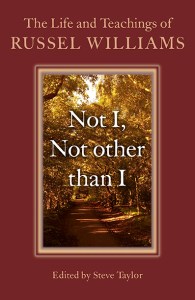
 

BOOK REVIEW: NOT I NOT OTHER THAN I

Not INot I, Not Other than I is an inspiring story of spiritual awakening. For me, the book has a skilful balance of biography and wisdom in which each throws light on the other. Highly recommended to people involved or interested in contemplative spiritualities.
Russel Williams left school aged 11. Both of his parents were dead and he was too old for Barnado’s.  So he was licensed to work for a living, though in 1932 and the years that followed it was hard to make ends meet. He describes himself in his teenage years as existing but not living. He was angry and aggressive, with no empathy, a quick temper, and prone to getting into fights. What frustrated him most was a sense of his own ignorance.

In 1939 war broke out and Williams joined the British army. He recalls that being a soldier “saved me from a bad end, kept me out of trouble – and most importantly it took away the worry of keeping myself alive. I had regular food and shelter for the first time since my parents died. It was easy, compared me to the life I had before. It also taught me self-discipline to control my emotions”.

After the war he went “walking, walking …” until he making contact with another man, who was starting up a small circus. Williams accepted the job of looking after the horses, and he began to feel a strong connection with them. He wanted to understand them better. “I set my mind to watching and observing every detail, every moment of the day, for days on end”. This process became “more and more concentrated”. He was “not thinking any more”. His mind had “gone quiet”. He was experiencing states of “spontaneity” and “living in the moment”. He began to “look through the horses’ eyes”, as the boundaries fell away, and he became notable for his calming and healing presence when working with them.

Still in his 20’s, Williams began to discern a path in life. Later he framed his life with the horses – 20 hours a day, 7 days a week, for 3 years – as a naturally occurring education in mindfulness meditation: his life a continual service, “with no thought of myself”. He still experienced frustration and disappointment, because he couldn’t find anyone to talk to about this who seemed willing to treat him seriously. But eventually he ran into a small number of kindred spirits, people with whom he could enter into close rapport, and this led to his joining the Manchester Buddhist Society in 1957.

Although the Society made a connection with Thai Buddhism in 1954 (one of their members trained as a monk) Williams himself has kept a distance from formal Buddhism. He has been President of the Society for over 40 years and he still doesn’t call himself a Buddhist. His life and work has included esoteric Christian influences and a resonance with Ramana Maharshi. One of his sayings is that whereas “Buddhism is a belief system … the way of the Buddha is a recognition system”. Acknowledging that Buddha didn’t go beyond dealing with suffering, never mentioning spiritual worlds as such or communicating with other entities, he added “but we do”. Williams’ way of the Buddha is also a way of the free spirit.

Russel Williams is now 93. He is still going strong. My contemplative Druid companion Rosa Davis mentioned this book at our last group meeting. Williams says that his life experience and practice have led him to a “natural state” of oneness with everything, and with the universe itself. “We are part of the unmanifest. We are part of the pure consciousness which has given rise to the whole universe. That consciousness is our true nature, and, when we rest within it, we feel a powerful sense of ease and contentment”. He believes that this is the only meaningful way of understanding the term ‘God’, and what Jesus of Nazareth meant when declaring “I and the Father are one”. This kind of experience, “stillness, pure consciousness, emptiness of being” is the inheritance of us all, and potentially available to us all. It is based on sense-feeling, and on filling the emptiness with loving-kindness.

Williams doesn’t support long meditation practices, though he does believe in frequent ones. He saying “once you get the process going” 10 or 15 minutes should suffice, and recommends doing it 7 times a day. For him, the way in to a full meditative state is through the realm of subtle feeling, and he invites us in with him about a third of the way through the book:

“Feel down here, a little bit above the navel you’ll find the right place. Centre yourself there, in feeling. Observe your breathing, in the sense of the expansion and contraction of the outer part of the body, as if it were a balloon …” From here we are guided to notice the calming and peaceful effects of this “gentle movement, this comfortable gentle movement … absence of agitation, peacefulness … a kind of heartfelt warmth of feeling … it feels homely, as though you belong there … And as though it were a light”.  We then move outwards from the “balloon” to include the whole physical body and then go beyond it. “It reaches out in all directions … and begins to feel at home with all its surroundings, whether it be animate or inanimate … of the same nature” …. And so on into silence for a few minutes. At the end of the meditation the practitioner is asked to draw back into the “very centre”, making sure it is “still peaceful and warm” before returning to normal consciousness.

What I learned from this was the flavour of ‘sense-feeling’, a specifically located warmth, a sense of quiet movement, qualities of gentleness and peace. Nurturing is another favourite Williams word. These qualities fill the body-mind and move beyond it, filling emptiness, engendering loving-kindness. In a group meditation, they can create a deep rapport and subtle meeting place between participants. The aim is to develop “such gentle perception that you could compare it to a finger, soft and warm, touching a snow flake, but so delicate that the flake doesn’t melt”. From there, we begin to see into the nature of things, becoming aware of a different reality, expanding into it until we become “boundless”. This is achieved not by any great effort, but by simply letting go.

‘Sense-feeling’ has already helped me in my own practice. It enriches my experience of ‘presence’ (a key word for me), placing it more clearly beyond witnessing awareness as normally understood. The meditative experience becomes participatory and nurturing in a more complete way, yet one that also seems easy, obvious, almost remembered rather than newly learned. I’m grateful for the recommendation and glad to be passing it on.

Russel Williams (2015) Not I, Not Other than I: the Life and Spiritual Teachings of Russel Williams (Edited by Steve Taylor) Winchester & Washington: O Books


HOLY SOPHIA

I have been on holiday, kissed by a Mediterranean of blue skies, extended midwinter daylight and temperatures into the 20’s. Sparsely populated beaches and warm sand. Water to walk through in lazy delight. The sensuous geometry of Moorish architecture in southern Spain.

I have felt dislocated in a good way, and still do. I’ve been treading an unfamiliar path through this season, this year. It has been accompanied by a contemplative text, which I read and marked before leaving home. It was posted earlier in the month by Rosamonde Ikshvaku Miller in her Gnostic Sanctuary group on Facebook.

“WithIn the depths of the abyss, we find the fountainhead and matrix of the Holy Sophia, pregnant with infinite possibilities. Divinity pours out Its life through her.

“In her womb, Wisdom-Sophia carries the blueprint of all prototypes before matter ever came into being.

“She remains with us in our exile, for She is the tender mother of mercy, great redeemer, and revealer of the mysteries concealed. She is the beginning and she is the end.”

Learning and inwardly digesting these words became the gentle spiritual task of the holiday. I found that the place suited the task, for the words belong to a Mediterranean and Levantine tradition, in which Greek, Jewish and other cultures interweave.

I made my task one of immersion and awareness rather than opinion forming and allegiance. There’s an image of a cosmic goddess (not the same as an earth mother) and a meeting becomes available in the ‘abyss’. The seasonal reference comes through Sophia’s being “pregnant with infinite possibilities … Divinity pours out its life through her”, here understood as a cosmic event in the eternal present. Then there are references to exile, redemption and revelation – not much present in our northern Paganisms. They do of course feature in the mainstream Judeo-Christian tradition that has been profoundly influential for us over a long period of time. They are also classically Gnostic.

I have noticed that I resonate with this text more than I might have expected to. I need to sit with this and explore it further, and really sense into what the attraction is: a direction for my contemplative inquiry.


THE PEACE OF SOPHIA REVISITED

The peace of Sophia, given a chance, heals the violence within. This violence can be obvious and crying out to be worked with. It can also be hidden, unawarely latent, insidiously shaping both words and actions. In Thomas Keating’s language, such violence “reduces and can even cancel the effectiveness of the external works of mercy, justice and peace” (1). It is an argument he uses for promoting contemplative practice within the Catholic Church and Christian communities more widely.

In my exploration of contemplative traditions, Cynthia Bourgeault is the Christian writer to whom I have paid the most attention. An Episcopalian priest based in the USA, she is a long-term associate of Father Keating in the development and teaching of centering prayer. This is a modern contemplative practice modelled partly on Theravadin Buddhist insight meditation, and partly on the contemplative approach recommended in The Cloud of Unknowing, an English text from the later fourteenth century. “For heaven ghostly is as nigh down as up, and up as down: behind as before, before as behind, on one side as other. Insomuch that whoso had a true desire for to be at heaven, then that same time he were in heaven ghostly. For the high and the next way thither is run by desires and not by paces of feet” (2).

I think of Bourgeault as a Sophian teacher working within a Christian framework. I get this sense through a reading of three of her books: The Meaning of Mary Magdalene, The Wisdom Jesus and Centering Prayer and Inner Awakening. She has incorporated ‘Gnostic’ Nag Hammadi texts into her recommended sacred literature, especially The Gospel of Thomas, The Gospel of Philip and The Gospel of Mary Magdalene. In her references to what Christians call ‘The Old Testament’ I see a leaning towards The Psalms, The Book of Proverbs and The Song of Solomon. I am neither qualified nor inclined to discuss her theology. But I do get the flavour of a Sophian sensibility that seems to me to inform her view and practice of (to use my language) meditation.

Bourgeault speaks of “a warm practice, a bit sloppier and dreamier than the classic methods of attention and awareness practices. You lose some time in day-dreaming, at least at the start, and that vibrant tingling sense of ‘I am here’ prized in so many meditation practices is not really a goal in Centering Prayer” (2). The key word is intention rather than attention, and the specific intention is to be deeply available – Bourgeault would say to God, I would say to a deeper nature. This means “available at the depths of being, deeper than words, memories, emotions, sensations, deeper even than your felt sense of ‘I am here’”.

Bourgeault counsels against the aim of making ourselves empty or still, saying that it is “like trying not to think of an elephant” and pretty much assures a constant, non-stop stream of thoughts. Instead, once the intent is established, it is a surrender method, “not working with mind at all, but going straight to the heart”. She says that “for most people, a typical Centering Prayer period looks like a sine wave: lots of ups and downs. There are moments when the mind is more restless and jumpy and thoughts come one on top of another. There are also moments of stillness, sometimes very deep stillness. You won’t be able to retrieve these moments of stillness directly, of course, because as soon as you start thinking about them they’re gone. But you will ‘remember’ them through a certain quiet gathered-ness that accompanies you as you get up and move about your day. Through the cumulative energy of this gathered stillness, Centering Prayer gradually imprints itself upon the heart”.

I’ve been drawn back to Cynthia Bourgeault’s work because of my inner promptings about peace, and the peace of Sophia. I will continue my exploration of her work. Whilst engaging I will of course be conscious of her theistic and Christocentric framework and the knowledge that I do not share it. This I think will make the experience all the richer, because it will include the challenge of fully accepting difference, and fully accepting the gift within it.

References:

  1. Cynthia Bourgeault Centering Prayer and Inner Awakening Lanham, MD, USA: Cowley Publications, 2004 (from the Foreword by Thomas Keating)
  2. A Book of Contemplation the which is called The Cloud of Unknowing, in which the Soul is Oned with God Anonymous (edited from the British Museum MS. Harl. 674 with an introduction by Evelyn Underhill) London: John M. Watkins, 1922
  3. Cynthia Bourgeault Wisdom Jesus: Transforming Heart and Mind – a New Perspective on Christ and His message Shambhala: Boston & London, 2011

SOPHIA, GNOSTICISM AND CONTEMPLATION

When I wrote Contemplative Druidry I said that “in many ways this is a story of neo-Pagan sensibility and its growth since World War Two”. In addition to their Druidry, many of the book’s contributors reported involvement in Witchcraft and/or the indigenous Shamanism of other lands.

I also said in many cases this sensibility was modified by other influences, “most notably Buddhist philosophy and meditation, Christian mysticism and other Western Way paths with Gnostic and Hermetic traditions specifically mentioned”. I made the point that such influences are significant for contemplative practice, because to an extent they provide models. In the book I mostly focused on Buddhist influences, because they were the most common. I also paid  attention to the Christian ones, notably the Ceile De, Anglican mysticism in the tradition of Evelyn Underhill, and the partly Franciscan inspiration behind the (Druid and Pagan) Order of the Sacred Nemeton. I didn’t say much about other Western Way traditions, though I mentioned R. J. Stewart as a personal influence on me and also my training at the London Transpersonal Centre. This was essentially Jungian and thus based on a modern Gnostic psychology.

The key images from my last post, Sailing to Byzantium, were images of Sophia and the Holy Fool from The Byzantine Tarot. They made an intense and (in common sense terms) disproportionate impact on me. For they reminded me of my own Gnosticism, a current that qualifies and modifies my Druidry. I am talking about modern Gnosticism, “based in an affirmation of nature and the world and a positive relationship to embodiment, not the classical Gnosticism of world-denial or pure transcendentalism.  It is a gnosis based on bringing the world fully to life, while also enjoying the state of embodiment and sensual pleasure, without excess or obsessive appetite”*.  Thus far, I could be talking about modern Druidry without any need to look elsewhere.

But, to follow Irwin further, Gnosticism also talks of “visionary awakening” through the power of archetypal imagery. From such a perspective, affirmation of the world also requires an affirmation of the World-Soul as “the primary ground of a living and animate nature”. This can inspire “states of unity and participation in the creative founding of human experience”. The key is the “animating vitality” of images, which can arouse “a cascade of energy and potential surpassing the image and leading into a more luminous condition of being and seeing”.

According to Irwin, the traditional fields for study and practice in Western Gnosticism are neo-Platonism, hermetics, alchemy, kabbalah, mystical theology, comparative theology and meditative disciplines: quite a curriculum. But the essence is quite simple. We are invited to work with Being as embodied (through exercise, body awareness and energy work), imaginal (connected to the mundus imaginalis, open to its power) and illuminated (through contemplative practice and insight).  Much of this is offered within Druidry – for example, to anyone who takes full advantage of the OBOD distance learning course. Yet for me, here and now, once again, it is the image and name of Sophia that gives me my orientation and guides me on my path. I’ll explain that resonance and consequences more fully in later posts. In practical terms, for now, I’ve made two small adjustments in my morning practice. One is to cast my circle specifically in the sacred grove of Sophia. The other is to begin sitting meditation, or contemplative communion, by saying “I open my heart to the Light of Sophia”. It doesn’t seem much, but it shifts my centre of gravity to a place where a feel more empowered and more at home.

  • Irwin, Lee Gnostic Tarot: Mandalas for Spiritual Transformation York Beach, ME, USA, 1998 (There is no pack of cards with this book. It’s a set of interpretations emphasising “spiritual transformation and illumined states of awareness”. The Universal Waite Deck and the Ravenswood Tarot Deck have been used as points of reference.)

SAILING TO BYZANTIUM

This post is inspired by The Byzantine Tarot, a collaboration between two notable talents – John Matthews as writer and Cilla Conway as artist. It’s an excellent piece of work, but this post is not a review. It’s about two of the major trumps and their effect on me.

I impulse-bought the pack about a month ago. I didn’t get it for divination. I wanted it for the iconography of the major trumps, though in fact all the cards are carefully chosen and beautifully rendered. Part of the integrity of this tarot is that the images are drawn from the culture they reference – a culture itself very busy with sacred images, though at times its ruling circles reacted against them. Cilla Conway’s work is a wonderful evocation of this culture and its imagery, an imagery consciously crafted in the service of Christian Orthodoxy*.  It’s an interesting subject for a tarot pack, since the tarot form itself introduces an element of gnostic subversion into the work.

In the Byzantine Tarot, Sophia appears as the Papesse/High Priestess. She mediates “between the higher and lower realms of creation, watching over the Holy Fool on his journey and guiding those who seek her blessings to find their own path through the world”. In the apparent world, Byzantine Orthodoxy had no vacancy for a Papesse/High Priestess, and was not in business to encourage people to find their own way unless it was also the Churches’ way. The Fool of this tarot is a Holy Fool and draws on the history of the Desert Fathers, though the specific image is from Moscow, for the Slav world inherited the Orthodox tradition and the role of the Holy Fool. There is a happy reframing of these formidable world-renouncing ascetics in the text. A naked, haloed man steps outside his cell raising his hands towards the dove of the Holy Spirit and “prepares to step off into the air above the sea, asking without words to be allowed to access the joy and wonder of the world”. He is said to represent ‘crazy wisdom’, also known to Sufi and Buddhist tradition.

I feel engaged with these images, but not close to the Orthodox Church. Fortunately good images transcend doctrine. They have a larger suggestive power. I see a Goddess, depicted in one card as an angelic intercessor and in the other as a dove. I see a devotee who is a completely opened up. I’m learning how development works in spirals. A few years ago I was taken up with the image of Sophia and this modified my experience of Druidry. It was initially her influence that got me to explore meditative disciplines and see through the eye of contemplation more systematically. When my exploration took me further East, my specific sense of Sophia began to diminish.

Two tarot images have brought her back into my life. Now that she’s in my life, I have to move on from the specific images, for all their potent catalyst role. In relation to my life and practice, the Sophia depicted is too hierophantic and static. I like the Holy Fool icon, but the ‘Crazy Wisdom’ references in the text open up unwelcome possibilities of dogmatic intuitionism and licensed abuse-by-Guru that we find in Crazy Wisdom Masters from many traditions.

If I want to orient myself to the ‘Holy Fool’ archetype, there are lines within W. B. Yeats’ poem Sailing to Byzantium, which act as a better guide. He starts with the complaint “That is no country for old men” – Ireland, but more essentially the world of “whatever is begotten, born and dies, caught in … sensual music”. Then he says:

“An aged man is but a paltry thing,

A tattered coat upon a stick, unless

Soul clap its hands and sing, and louder sing

For every tatter in its mortal dress.”

On my reading the world of begetting, birthing and dying – with all its sensual music – is absolutely fine and to be celebrated. It’s the being “caught” in it that’s the problem. For there is another dimension. The seven directions operate vertically as well as horizontally, with eternity at the centre, within, around and throughout.  Sophia reminds me of this, and it changes everything.

* Early in the 4th century C.E. the Roman Emperor Constantine began the Christianisation of the Empire and moved the capital eastwards from Rome to the old Greek city of Byzantium which he rebuilt and modestly renamed Constantinople. Two hundred years later when Orthodox Christianity was dominant and enforceable, a new Cathedral of Hagia Sophia (Holy Wisdom) became the greatest building of the city. It still is in some ways, having survived two conversions since the fall of the city in 1453, first into a mosque and later into a museum in today’s Istanbul.

Matthews, John & Conway, Cilla The Byzantine Tarot: Wisdom from an Ancient Empire London: Connections Book Publications, 2015

Yeats, W. B. Poems of W. B. Yeats London: MacMillan & Co, 1964 (Selected with an introduction and notes by A. Norman Jeffares)

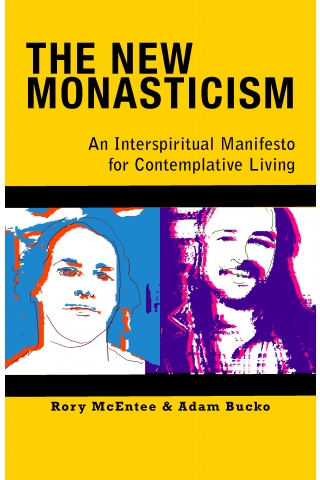
BOOK REVIEW: THE NEW MONASTICISM

New_MonasticismHighly recommended. I knew I would be in business with this book as soon as I got wind of it, and it will take further contemplation and inward digestion before I fully understand my relationship with it. I believe that this is the kind of effect that what The New Monasticism: an Interspiritual Manifesto for Contemplative Living intends to create.

‘Monasticism’ is refreshingly used here “simply to denote a level of commitment to a spiritual life”. It is not about specific beliefs or a specific lifestyle. It asks us to free ourselves from our cultural conditioning and an unquestioning and un-questing life. Avoiding identification with material success, living in the midst of a contemporary society that does not support such a calling, we may enter a space of “radical profundity and divine transformative energy”. We seek simplicity not through renunciation but through ‘integration’.  We do need retreat space, so some people will indeed be called as specialists to hold the “containers of silence”. But most will pursue vocation in the world, in a life made up of contemplative practice, heartfelt conversation and sacred activism.

Authors Rory McEntee and Adam Bucko are situated within the Roman Catholic tradition, in an emancipatory strand which is reaching out to others and hoping to transcend itself. The term ‘interspirituality’ was coined by Brother Wayne Teasdale, an ordained Christian Sannyasin who  presided over an ashram in India. The authors see interspirituality as “humbly placing itself in partnership and collaborative discernment with our time-honoured religious traditions”.  In the last decade we have also seen the linking of Father Thomas Keating (who developed ‘centering prayer’ as a Christian answer to Buddhist-style meditation) with Ken Wilber’s Integral Life project, which is itself increasingly seeking alliance with like-minded Christian communities. Indeed a lot of the philosophy, psychology and social science in this book comes straight from Ken Wilber and the stance of the Integral movement. The authors come from a collectively confident and mature spiritual base, and there are advantages in that. The book is rich with specific suggestions about life and practice in the new monasticism, drawing for its core inspiration on an ‘Interspiritual Manifesto for Contemplative Life in the 21st. Century’ following a week long dialogue with Father Thomas Keating at his monastery in Colorado in 2012.

McEntee and Bucko are both “under 40” and feel a connection with the younger generation now coming into adulthood. Bucko works with young homeless men in New York City. They see a potentially emergent spiritual culture that is: “spiritual not religious”; this worldly and concerned with nature and the fate of the earth; has (post) modern commitments to personal ‘authenticity’; and finds the sacred in the secular. They believe that these values can be championed within a further development of their own tradition, transforming the tradition itself. For them the path is as much about the life and health of the earth as it is with an individual communion with the Divine: indeed, it is false to separate the two. Realisation is less a “gnostic quest for truths beyond the world” than “a reflection on certain processes taking place within the world”. Interspirituality wants to be the midwife of this, and in doing so become attractive to people, especially young people, who would not be drawn to more traditional approaches.

The New Monasticism is a valuable contribution to the re-visioning of spirituality and concomitant life practices. Given its provenance, it is not surprising that the reaching out to other traditions is quite selective. Beyond Christianity, the traditions being engaged with are neo-Vedanta, Tibetan Buddhism and to a lesser extent Zen, modern Sufism and to some degree the Hasidic movement in Judaism and Martin Buber. ‘Indigenous religions’ are mentioned in two inclusivity lists, without definition or description. Shamanism is mentioned as a particular model of spiritual service. There is nothing specific from the Western Way outside Christianity.  Within Christianity, much is drawn from the contemplative strand in Orthodoxy, including an understanding of theosis (or divinisation) and the role of Sophia as guide. This is accompanied by an intent to “claim the wisdom dimension of all traditions and let the wisdom guide you” – a view which they attribute to Matthew Fox. Ethics is seen as “the call to active co-operation with the sophianic transfiguration of the world”. Quaker processes also get a mention because of their democratic and dialogical way of bringing people into Presence with each other. Since I am personally positioned in modern Druidry, Paganism and Earth Spirituality I have to express some disappointment here. However I don’t feel deliberately excluded. It’s just that these authors have their attention focused elsewhere.

I do have a worry, all the same, an area where I think that Earth and Goddess traditions could do with being heard. This is when McEntee and Bucko talk about ‘axial ages’, a view of spiritual/religious history once again taken from Ken Wilber. It depends on an evolutionary view of human culture as an aspect of a Divine awakening. In this view, the first axial age, from 800 BCE – 200 CE was a time of radical transformation marked by the appearance of great teachers who catalysed major literatures: Lao-Tzu, Confucius, Buddha, Mahavir (of the Jains), Zoroaster, the Jewish prophets and Greek philosophy, as well as Jesus and the gospels. These people could stand apart from the tribe, question the worldview they had been given, and think for themselves. They could also wake up from the trance of complete immersion in nature and objectify it – seen here as a positive step, albeit one with a shadow side. They represented the coming of reflexive subjectivity and the technology (writing) that made it sustainable. Admittedly, the narrative goes, this tended to take world denying, sex denying, misogynist and more generally oppressive forms. But overall it is read as a cultural gain. Now we are seen to be in a second axial age where the perceived challenge is to transcend the limitations of the first whilst preserving the gains, and thus renew our overall movement onward. “We need both our individuality … and an understanding of our intrinsic belonging within a vast Kosmos”. I’ve been aware of Wilber’s position on this since he wrote Up from Eden in the mid 1980’s. It has always read to me as a one-eyed narrative, the mirror image of the primitive matriarchy still espoused by many Pagans.  One of its effects has been to offer a language of canny and limited concession by hitherto dominant traditions as they respond to an unstoppable shift in culture. Here is where the Earth traditions could have a role in the dialogue, to support a view of individuality and inter-connectedness, indeed, but which is less masculinist in language (I’m thinking about how the book suggests “dialogical sophiology” as the way of meeting with the divine feminine), more open, and more widely informed than this.

I am glad to be living in a time of spiritual ferment. It breathes life and hope in an otherwise darkening time. I acknowledge and celebrate the achievement of The New Monasticism and am already involved in exploring contemplative life in Druidry. I notice that I, and others who I have been linked with, have in some ways come to similar conclusions about life and practice, if not entirely of view. This book, although from a very different background, has stimulated and encouraged me. I hope it has this role for many other readers.

OLD MIDSUMMER’S DAY

485px-Andrea_Solari_Salomè_riceve_la_testa_di_Giovanni_Battista24 June is a special day for me. When I was quite small, someone told me that it was Old Midsummer’s Day without telling me when the new one was. So it was Midsummer’s Day for me. ‘Old’ just gave it depth and perspective in my imagination. I was told in the presence of oak trees too, in a sun-ripened afternoon , sultry like high summer. Old.

A year or two later I found out that it was St. John the Baptist’s Day too. I had two vivid images of him at the time. The slightly less vivid one was of him baptising Jesus, the anointed one who was to follow him. The slightly more vivid one was a version of Andrea Solari’s depiction above (1507): John beheaded as requested by Salome, at the command of King Herod. It is a strange story in some ways, for Salome means ‘peace’ in Semitic languages and she’s not depicted in an obviously peaceful light.

In any event, the church awarded John the Baptist 24 June as his day, placed at the opposite end of the year to Christmas, days which are in each case placed at a time when the sun has just started moving again. The old story about the conflict of a winter and summer king alternating in their mirror image enjoyment of dominance and death is now somewhat discredited as a universal theme. But it is clearly a strong part of our cultural inheritance, just like our experience of the changing seasons themselves.

Old Midsummer’s Day is a time when the sundered halves of the western way come together, with a common theme handled in different ways and with different understandings.  That, and the fact that the day has been present in my imagination since I was very young, give this day a special kind of magic. I was glad to mark it today with my partner Elaine, in a completely informal way.

BOOK REVIEW: CELEBRATING PLANET EARTH A PAGAN/CHRISTIAN CONVERSATION

61CwdX9mE3L__AA160_Highly recommended and available for pre-order via Amazon.  This blog is an enthusiastic early alert concerning Celebrating Planet Earth, edited by Denise Cush The book comes out of a weekend ‘conversation’ held at the Ammerdown Centre near Radstock, Somerset, England, from 31 January-2 February. Originally devised as a Druid/Christian event, it was widened to include other Pagans and was intended to generate “dialogue, reconciliation and renewal”. The hope was that the participants could explore their prejudices and preconceptions, learn more about each other, and find common ground in ‘Celebrating Planet Earth’, as the event was called. The book’s contributors were all involved in the conversation.

The book is aimed at Pagans and Christians interested in making connections; academics and undergraduate students in Study of Religions taking courses on inter-faith dialogue, Paganism and Christianity; and anyone with an interest in inter-faith activities. Some of the contributors are academics in the field, but as well as academic input, there is a practical emphasis on personal spirituality and ritual practice.

I’m part of the core audience. Whereas I experience the spiritual path as ultimately beyond names and forms, I stand in the world as a Pagan Druid. I had a Christian upbringing and in recent years I have learned from the Buddhist tradition, as well as Christian-based movements such as Sophian Gnosticism and the Ceile De. All of these have supported me in my own practice and in my personal concern with developing a stronger contemplative current within Druidry. So I’m at ease with what Philip Carr-Gomm, Chosen Chief of the Order of Bards, Ovates and Druids (OBOD), calls “fusion paths” in his chapter in this book.

From where I stand the ‘Celebrating Planet Earth’ more than meets its aims. It’s a feast. I felt that each contributor had thoroughly earned their place in it. It is divided into three parts, before moving on to editor’s reflections and conclusions. I want to say something about one chapter that spoke to me particularly strongly from each of the parts, as the best way in a short space of honouring the collection as a whole.

The first part is about ‘Addressing Our Fears and Prejudices’ and for this I pick out Graham Harvey’s chapter, ‘Fears and prejudices: a Pagan view’. For me, he has a very helpful analysis of what the task is and how to accomplish it. He makes it clear that “not everyone thinks alike” or should be expected to and that diversity has room for healthy opposition – properly handled, this can be a real gift. He makes the subtle point that the negotiation of difference is not just about fear and prejudice. It is also about avoiding the presupposition that “others are like us but not quite … that other people mean what we would mean when we say or do things”. Hence we need a refined quality of listening to avoid “talking past each other”.  On the question of fear and prejudice specifically, he suggests that the two things to remember are that we should indeed “resist and challenge the small visions and petty fantasies that are imposed on others” and that “when we talk about what people do, rather than what systems are alleged to do, we will keep diversity in clear view”. He usefully writes down polarised lists of what ‘Christians’ and ‘Pagans’ are contrastingly stereotyped as standing for – and invites us to make a reality check on the items in the list. It’s a very useful way of opening the reader up to the actual experiences of individuals and groups in later chapters.

The second part is about ‘Possibilities for Co-operation’ and for this I pick out Tess Ward’s chapter, ‘Better together: transformation through encounter’. Early in her life as an ordained priest, Tess Ward went into her own version of Dante’s ‘dark wood’, a wilderness in which she needed to die to one life so as to be born into another. She lost her existing theological frameworks and says of that time: “in that wilderness, what sustained me was not theology, but poetry, silence and nature”. Without leaving her Church, she found pointers in Buddhist ideas (Anthony Gormley, Pema Chodron), Earth paths and feminist spirituality. She quotes Carol Christ as saying: “awakening suggests that the self needs to notice what is already there … the ability to know is within the self, once the sleeping draft is refused … for women, awakening is not so much a giving up as a gaining … a grounding of selfhood … rather than a surrender of self”. She also quotes Kenneth White’s poem ‘Labrador’ – “I was loathe to name it too soon – simply content to use my senses – feeling my way – step by step – into the new reality”. As, renewed, she moves back into the world and her role, she knows that interventions in the world only have value when they come from personal experience. She shares with Matthew Fox the view that the result of such a crisis is not to abandon one’s own tradition “but to demand more of it”. She now leads celebrations of the Celtic Wheel of the Year as an affirmation of her transmutation of faith within a Christian framework. Partly this is an enhanced appreciation of being grounded in the natural world and its cycles. Partly it is an appreciation of the place that resources outside her traditional faith have had in deepening her journey.

The third part is about ‘The role of ritual practice, myth, music and for poetry in each tradition and in inter-faith encounter’. For this I pick out Alison Eve-Cudby’s chapter: ‘Woven together: can Christians and Pagans engage in shared ritual?’ The author has a leading role in the Ancient Arden Forest Church in a burgeoning movement of Forest Churches. She describes this movement as “a small and growing number of Christians responding to the Call of the Earth”. Ancient Arden has an emphasis on ritual and her formal answer to the question she poses is a carefully contextualised ‘yes’. She says: “if we take earth celebration, care and connection as our basis for doing ritual together, to contribute towards re-enchanting the land in this time of ecological crisis then I think that shared ritual is possible”. She offers a fresh and energised discussion of ritual and its purpose. She describes ritual as an embodied event, and a process of framing in which dramaturgy, rather than theology, is the organising principle. Whereas logocentric approaches assume that the symbolic system expressed in ritual must be coherent, performance as an unfolding event lays out symbols in a way that reveals their inconsistencies and contradictions. The work therefore involves negotiating and holding these within the ritual container. We fashion rituals that enable liveable, regenerated worlds. Ritual is a transformative process, “the pattern of actions is designed to synchronise the awareness of the different participants – human, non-human and other than human”.

The book’s conclusions suggest that meeting itself was of great benefit, and make it clear that the people involved want to continue their work in some way (topic based subgroups are mentioned). I would simply add that this book is a gift to us all, and that I am grateful for it.

DRUID CONTEMPLATION AS PAGAN RELIGION?

Up until recently I’ve practised Druidry as a ‘spiritual path’ rather than religion, and I’ve not strongly identified as Pagan. On launching my contemplative inquiry at the end of 2011, I assumed that this stance would be reinforced through the adoption of practices more widely associated with other spiritual families.

Now I’m taking stock. I begin to see my contemplative work as a Pagan religious practice. Three developments in the past year have made a difference. One is the consolidation of the Gloucestershire contemplative group within a regular and more committed meeting cycle. The second is the work of gathering contributions for the ‘Contemplative Druidry’ book due to appear later this year, which I will talk about in later posts. The third is my personal contemplative practice, my main focus in this one. Overall I’m finding a specific Pagan Druid note and seeing it mirrored in others.

Practices change their meaning according to the tradition in which they are located. Meaning-making is as much cultural as personal, though cultures – and particularly sub-cultures – are also influenced by persons.  When a group of contemplative Christians adopted a version of vipassana (insight or mindfulness) meditation from Theravadin Buddhism in the 1970’s, they looked deeply into their own tradition and called the practice ‘centering prayer’.  This was not just a re-branding, but a re-framing. Christian contemplative prayer is a “blind intent stretching to God” according to the English 14th Century ‘Cloud of Unknowing’ (1), a favourite text of centering prayer practitioners. It is a devotional theism, a focused synthesis of love and will. By contrast the Insight Meditation Society, from whom Father Thomas Keating got the practice, talks about “fundamental techniques for sharpening your awareness and releasing painful mental habits” (2), and thereby loosening the hold of pervasive underlying unease (dukka).

The procedure is much the same for both traditions– silent sitting whilst the restless surface mind is asked to attend to the breath and so undergoes an attentional training. But the larger aims are not the same. Christian contemplatives indeed sharpen awareness and release painful habits on the way to more directly encountering the Divine: they call it divine therapy. Buddhist meditators may enter the state of ‘bodhicitta’, the awakened heart – a space that becomes available when enough of this work has been done. Yet at a more fundamental level one tradition holds Deity as central and the other is not concerned with it. Theravadins are strict about this. They do not share the view of ‘Buddha nature’ or ‘original face’ found in Mahayana and Tantric traditions.

So what about me working specifically as a Druid, and not just someone with a background in Druidry who also meditates?  I prefer to talk of meditation rather than prayer, though I like the sense of dedicating the meditation (and myself) as an offering. In my Pagan Druid universe, where logos and mythos work together, the offering is to the Goddess, as the generativity, energy and consciousness of the cosmos.

I like ‘centering’ as an idea – establishing a centre, drawing myself into the still point, almost a vanishing point, at the centre, and radiating out again into 3D reality, bringing some of the stillness with me. For me the still point at the centre is within the heart, making a link to heart awakening (bodhicitta) and heart wisdom, a term used by some champions of centering prayer (3). The heart sits between the belly and sexual/sacral centres below, and the head, the place of reflexivity and self-awareness, above. Heart wisdom draws both into itself, validating and balancing them. For it is a wisdom of organic life in nature, as lived by a human – the life of extended sensory perception and reflective consciousness, always responsively in relationship of some kind, both without and within. In doing this, drawing energy and attention to the centre, heart wisdom contradicts archaic transcendentalist notions of a stairway to heaven.

I think that’s enough to give my practice a distinctive Pagan Druid note, though it’s still a work in progress. I share the work of attentional training, sharpening awareness and releasing painful habits that gets done, within the process, whoever does it. But it’s in the context of a specific and developing view, or meta-narrative.

That being the case, why not call it part of a religion? The core meaning of religion, like yoga, is about being tied or yoked to a discipline: connection to theistic beliefs is secondary. Religion has a tougher and more intentional ring than ‘spirituality’, and now sounds appropriate to me.  So I now call my contemplative practices – solo meditation included – both religious and Pagan. I will continue to learn from any source I value. But my personal inquiry is focused on deepening within my chosen path – deepening in experience and deepening in understanding.

1: Anonymous (late 14th century) A book of contemplation which is called the Cloud of Unknowing, in the which a soul is oned with God. (Edited from the British Museum MS. Harl. 674 with an introduction by Evelyn Underhill) London: John M. Watkins, 1924

2: Salzberg, Sharon & Goldstein, Joseph (1996) Insight Meditation: an in-depth correspondence course Boulder, CO: Sounds True

3: Bourgeault, Cynthia (2011) The Wisdom Jesus: transforming heart and mind – a new perspective on Christ and his message Boston & London: Shambhala

Earth Eclectic

music that celebrates Earth and speaks to the heart

Sarah Fuhro Star-Flower Alchemy

Follow the Moon's Cycle

Muddy Feet

Meeting nature on nature's terms

Rosher.Net

A little bit of Mark Rosher in South Gloucestershire, England

Becoming Part of the Land

A monastic polytheist's and animist’s journal

selkiewife

Selkie Writing…

Charlotte Rodgers

Images and words set against a backdrop of outsider art.

Prof Jem Bendell

living with metacrisis and collapse

Towint

The pagan path. The Old Ways In New Times

The Druids Garden

Spiritual journeys in tending the living earth, permaculture, and nature-inspired arts

The Blog of Baphomet

a magickal dialogue between nature and culture

This Simple Life

The gentle art of living with less

Musings of a Scottish Hearth Druid and Heathen

Thoughts about living, loving and worshiping as an autistic Hearth Druid and Heathen. One woman's journey.

Wheel of the Year Blog

An place to read and share stories about the celtic seasonal festivals

Walking the Druid Path

Just another WordPress.com site

anima monday

Exploring our connection to the wider world

Grounded Space Focusing

Become more grounded and spacious with yourself and others, through your own body’s wisdom

The Earthbound Report

Good lives on our one planet

Hopeless Vendetta

News for the residents of Hopeless, Maine