Contemplative Inquiry

This blog is about contemplative inquiry

Tag: Celtic mythology

THE MYTH OF THE JOURNEY AND THE MYTH OF THE NOW

I use the word ‘myth’ in a positive sense. Myth is a gift of imagination. It is a way of seeing beyond the limiting horizons of everyday life and culture. We can intuit a fuller, more spacious and generous reality, a reality with multiple dimensions. The specific myth of the journey, or quest, has had a powerful role in human history at both the personal and collective levels.

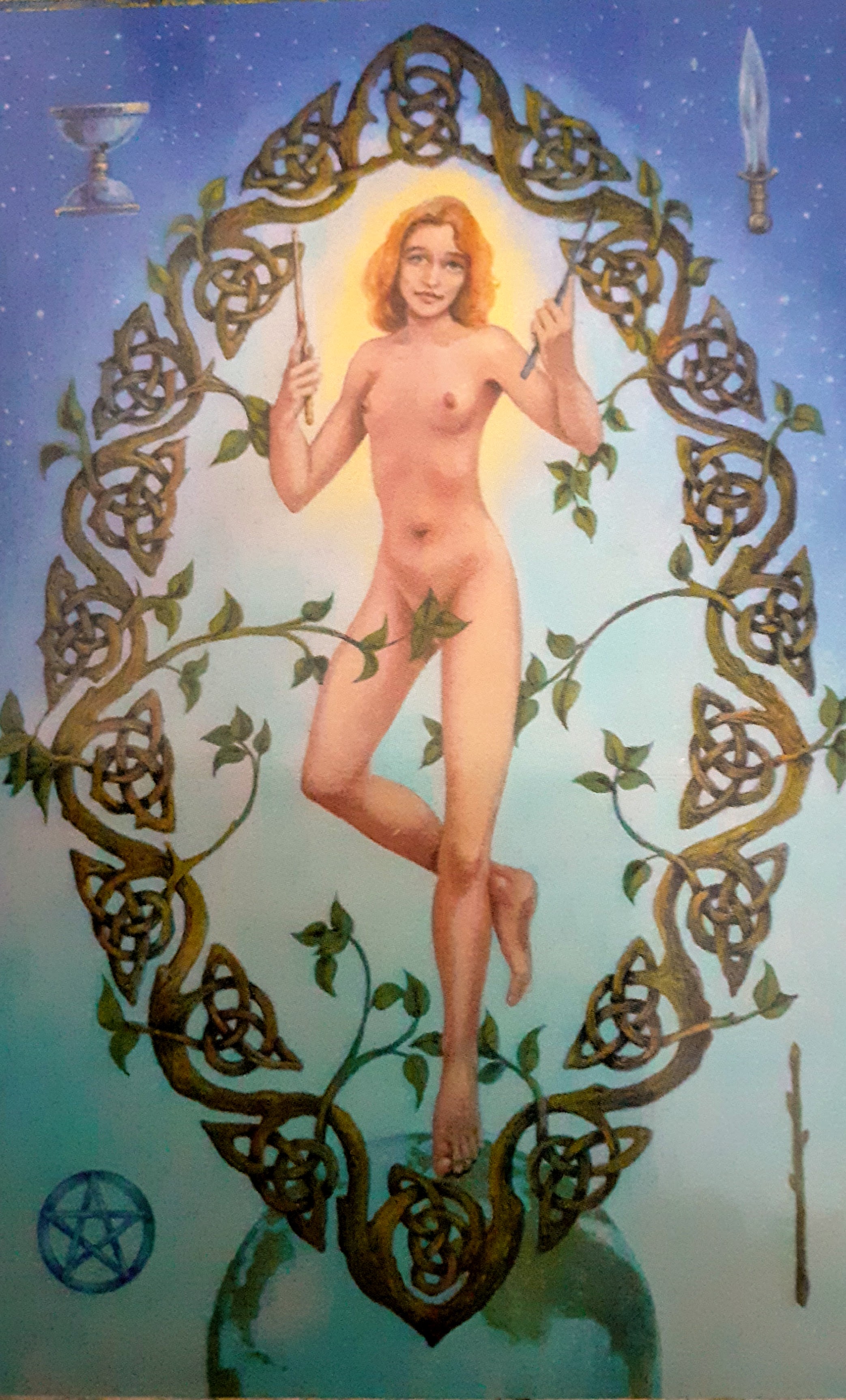
The picture above is the Fool, or innocent, as depicted the The Druidcraft Tarot (1). Trusting their inner knowing, the Fool steps over a cliff. It is a spring dawn, and a new beginning. The major Arcana are a map of the journey, which in essence, here, is seen as a refinement of the soul to the point where union with the divine is a lived experience. This experience is available here, in the world, and so the card indicating the completion of the journey (see picture below) is here called The World.

The mythology of the deck draws on the Welsh Celtic story of Taliesin and Ceridwen as well as the pan-European Arthurian grail quest, and broader Western Mysteries understandings derived from the Hermetic Order of the Golden Dawn. But any individual journey is its own new beginning and its fruits depend of making the journey in real time, and not clinging too tightly to traditional understandings.

In my own spiritual life, I have drawn both on the myth of the journey and another, apparently contradictory myth – that of the eternal moment, the transfigured here-and-now. Again, I find no disparagement in the word myth. This says that non-separation from the divine is a given. There is nowhere to go and nothing to do. Ultimately, there is no ontological difference in being awake to this reality than in being asleep to it. Yet lived experience is transformed by being awake to this reality and living from the awareness.

From a human perspective, coming to this awareness and then living it are, experientially, a journey in themselves. Another way of looking at it would be to say that I am the Fool and the Universe (my preferred term for the final card) at the same time, every day. In this way, I reconcile the myth of the journey with the myth of the now, and draw strength from both.

(1) Philip & Stephanie Carr-Gomm The Druidcraft Tarot: Using the Magic and Wicca and Druidry to Guide Your Life London, UK: Connections, 2004 (Illustrations by Will Worthington)

THE IMAGE AND THE SONG

“I am the Mabon. I am the child.

I am YR, the Golden Bough.

I am the dart that the yew lets fly

Three pure rays, the pillars of life.

I am the wren, the King of Birds.

I am the Bard and the teller of lies.

I am a song within the heart.

I am the light that will never die.

I am stars within the Void.

I am the eye of the Aeon.” (1)

For more than a decade, my spiritual practice has been mobilised around a contemplative inquiry. For me, this has been successful in its own terms, but I’m conscious now of something missing. It’s as if, for earnest, intelligent and ethical reasons, I have whitewashed the walls in the church of me. Now I want my murals back. So, recently I have started a course correction.

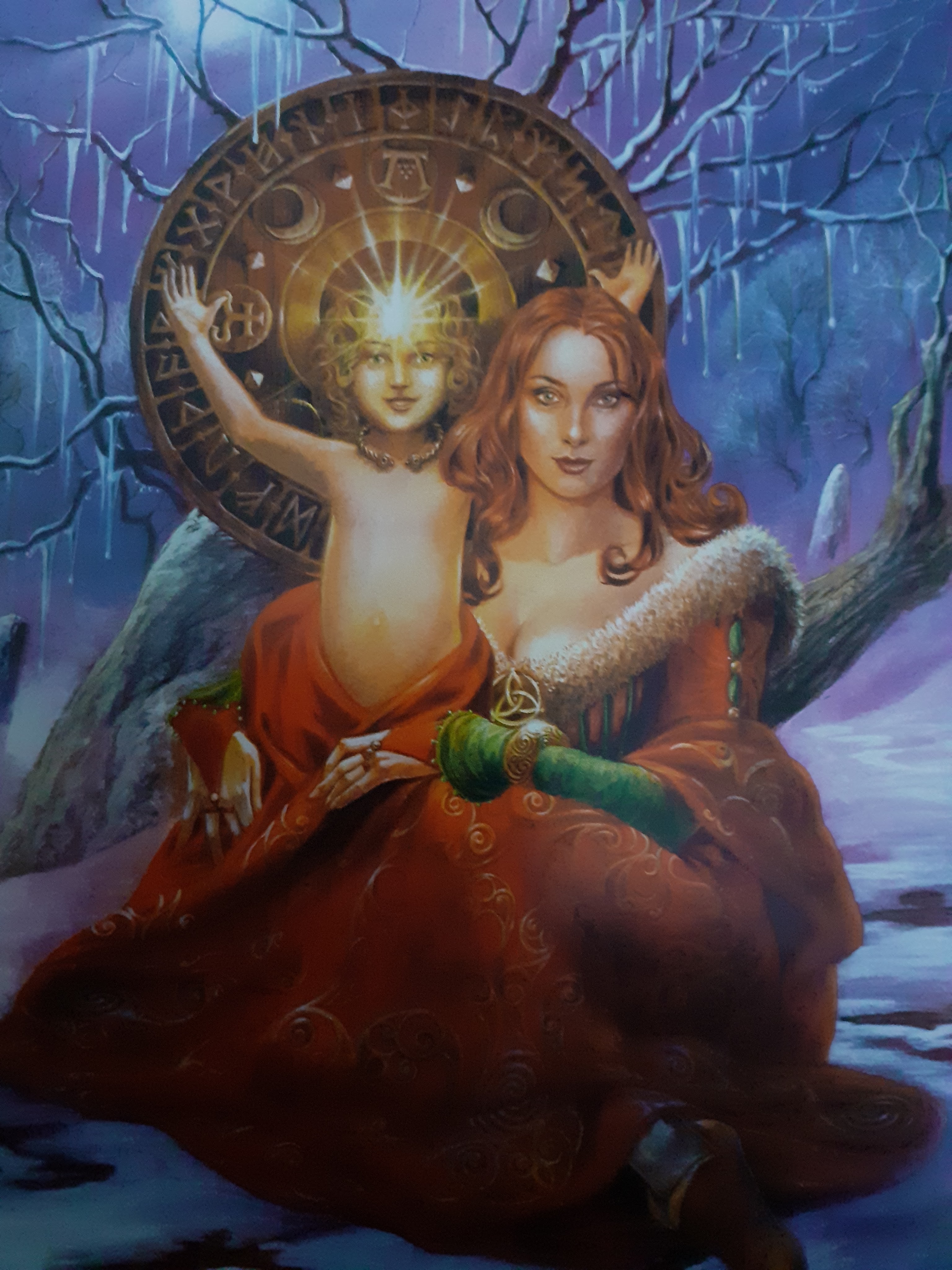
This course correction includes a glance back at my own pre-inquiry practices, happily well documented. The image of Modron and Mabon used to walk with me: Modron as the primal mother and Mabon as the primal child (2). They were archetypal figures, not everyday humans. My understanding was that these names were from a pre-Celtic language, retained in Brythonic speech. I am not sure if this is true, but for me it offered the possibility that even the surviving Celtic stories (3) were not the first. I was free to dream. In this dreaming I was powerfully influenced by the image at the top of this post (received as a midwinter holiday gift from my wife, then partner, Elaine, in 2007) and by the Silver on the Tree song that follows.

I see the child in the image as androgyne, and not in their earliest infancy. In the song, Mabon is not gendered. The mother in the picture is clearly the Goddess as Mother. Different stories can be drawn from this. In my own journey I tilt the child back somewhat to the masculine. In this pairing, She is Zoe, the life eternal. He is Bios, the life that comes and goes and comes again. Like Taliesin (4), transmuting out of his identity as Gwion, Mabon becomes in a sense his own father. So my midwinter picture appears to reference the Christmas story, but in important ways diverges from it. The image shows a magical midwinter child, who will indeed have an illuminating and transformational influence, but who is not exactly a redeemer in the Christian sense. This is drawn out in the Silver in the Tree song, which includes specifically Celtic references and extends beyond them.

Both Mother and Child live strongly within me, in the imaginal realm. I like and use the old language, Modron and Mabon, because of its sense of ancient mystery. But what it points to is universal. Part of my work now is to re-open my contact with them, who after another fashion I also am.

(1) Silver in the Tree in their 1991 album Eye of the Aeon

(2) NOTE: I am aware that there are divergent visions of Mabon. One centred the Autumn Equinox has become powerful and influential in recent years. Happily modern Druidry is not a religion of the Book though it is enriched by its books. This new literature follows the oral tradition practice of allowing stories to evolve and change in divergent directions. I see this as a strength.

(3) Caitlin Matthews Mabon and the Guardians of Celtic Britain: Hero Myths in the Mabinogion Rochester, VT: Inner Traditions, 2002 (Revised edition of Mabon and the Mysteries of Britain, 1987)

(4) If you visit Loch Maben in Dumfriesshire, in south west Scotland, you may find the feeling-tone similar to the much larger Lake Bala, strongly associated with Taliesin, in north Wales.

‘I SWIM WITH THE SALMON’

“The hazels are rocking the cups with their nuts

As the harvesters shout when their last leaf is cut;

‘I swim with the salmon says the Green Man,

‘I swim with the salmon’, says he.” (1)

‘I swim with the salmon’ is a bold, clear statement. It evokes powerful images that leap out of their place in the flow of William Anderson’s poem. Green Man as a whole takes us on a wheel-of-the-year journey beginning on 22 December, successively featuring thirteen trees for four weeks each. The hazel is the ninth tree, whose time runs from 3-30 August. As the poem indicates, this is a harvest period, and the last month that fully belongs to the summer. It is also a time when you may find Atlantic salmon swimming home to spawn, though spawning doesn’t begin until October.

In this post I celebrate salmon naturalistically, through an account of their extraordinary life cycle. I am especially aware of the River Tay in Scotland, mostly thanks to a 90 minute documentary The River: a Year in the Life of the Tay (2). My personal experience of the Tay is limited to visits to Dunkeld, Perth and Dundee, where I nonetheless fell in love with the river and its powerful energy.

Salmon begin their lives in mountain streams, as far upstream as their parents have been able to reach in their autumn/early winter spawning period. The new generation undergoes a remarkable series of transformations (3), hatching as alevin or sac fry when the water warms in spring, and growing into parr with camouflaging vertical stripes. They remain in the same environment for two or more years, by which time, as smolts, they have developed a bright silvery colour with scales that easily rub off. Driven by growth hormones, the 10% of smolts who survive to this stage experience the mutations necessary to become salt water fish and make their journey to the ocean.

They spend another two or more years in the North Sea, travelling north into Norwegian waters, becoming sexually mature, with a darkening of the silvery scales, before embarking on their homewards 120 mile journey up the river to its headwaters. They are much larger than they were when on their way out. The largest salmon ever caught in the Tay, in the 1920’s, was over five feet long.

To return to their own birth-place (remembering exactly where they come from) they have to navigate waters that include rapids and waterfalls, evade osprey and human anglers, and achieve the feats of leaping for which they are famous. “The salmon is able to jump upstream not by fighting against the current, but by utilizing its knowledge of the reverse current which flows beneath the surface current” (4). They are returning to their native headwaters in order to spawn and begin the cycle again. 98% of Atlantic salmon spawn only once and die soon afterwards: their adult bodies, equipped for a salt water life, never fully re-adapt to fresh water and this makes them vulnerable.

Swimming with the salmon is not for the faint-hearted. At the present time the population of Tay salmon is in severe decline (70% in the 30 years to 2019) although the river is relatively clean and is now managed to prevent over-fishing. The effects of the climate crisis in the Atlantic are the most likely cause for the decline of Tay salmon, as for Atlantic salmon in general. Yet even in decline they remain magnificent. Long before the Celtic Iron Age, during it, and for long afterwards, they were abundant in the rivers of Britain, Ireland, and other Atlantic maritime countries. With their complex shape-shifting capacity, their far-journeying years at sea, their uncanny homecoming knowledge and their extraordinary leaps, they seem marked out for another life, in human song and story. I would like to think that the salmon’s mythic reputation can help to save it in this interconnected world.

”’I swim with the salmon says the Green Man,

‘I swim with the salmon’, says he.”

(1) From:  William Anderson Green Man: Archetype of our Oneness with the Earth Harper Collins: London & San Francisco, 1990 See also: https://contemplativeinquiry.blog/2017/05/11/poem-green-man/

(2) The River: A Year in the Life of the Tay 90 minute documentary made for BBC4 in 2019. Presented by writer and naturalist Helen MacDonald. See: https://youtu.be/ZEmAXQIrDeg?si=wlaI0bNtM6YWevAf The film is well worth watching, covering the journeys of the salmon and much more.

(3) Salmon Wikipedia

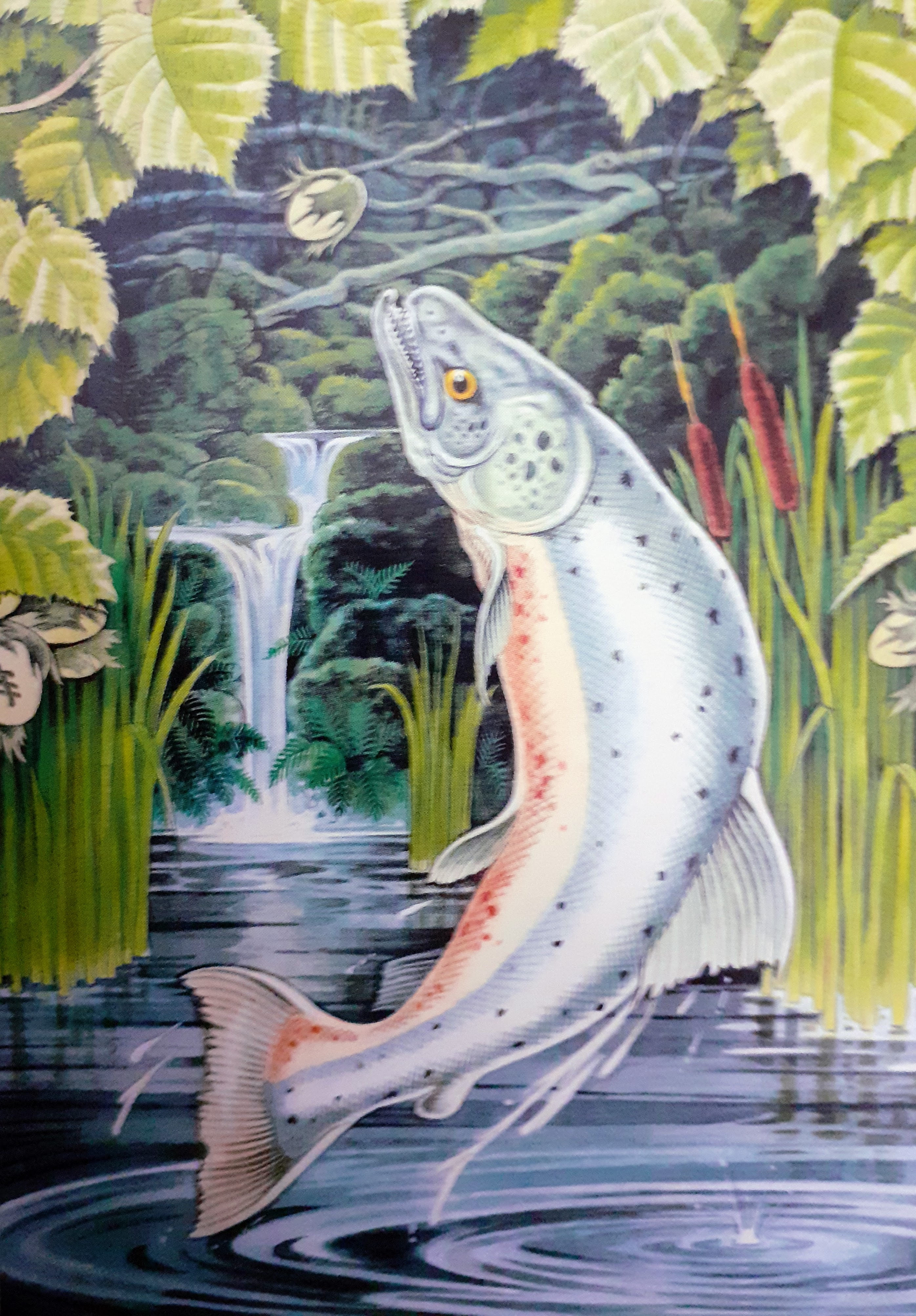
(4) Philp and Stephanie Carr-Gomm The Druid Animal Oracle: Walking with the Sacred Animals of the Druid Traditions Fireside: London, 1994 Illustrated by Will Worthington. The face of their salmon card is pictured at the top of this blog.

FINDING LOST GODS IN WALES

Professor Ronald Hutton’s fifth lecture in the Gresham College series on early Pagan history in Britain (1) is called Finding Lost Gods in Wales. Hutton’s main focus is on medieval Welsh literature. The language used is a 5th/6th century CE mutation of the Brythonic speech once used throughout Britain, further developed for literary purposes by court bards in the 6/7th century. Hutton describes it as “made for poetry” because of the concentration of meaning in the words. He gives as an example in a literal English translation:

‘Colour light waves spread boiling billows

‘Flood-tide river mouth on sea where nothing waits.’

He contrasts this with an English translation for English ears, demanding more words whilst sacrificing impact and immediacy.

‘Bright as the light that falls on the waves, where the boiling billows spread

That flashes a moment from the meeting of river flood and sea.’

This language was the public voice of a consciously dispossessed people, creating a new sense of Welsh Celtic nationhood in the 9th and 10th centuries, when the English, Scottish Gaels and Vikings had reduced their territory to less that 10% of Britain. It led to a flowering of Bardic culture throughout the medieval period.

Taliesin was celebrated as Wales’ greatest Bard. There is no certainty that he existed, though poems surviving from the 6th century have been attributed to him. There are no recorded statements of his pre-eminence before the 10th century. Later poets inspired by him continued to write in his name for a further 300 years. His link with Awen as the source of inspiration reveals the mystical roots of the whole Bardic tradition. But for instances or echoes of specifically Pagan motifs we are largely reliant on a small group of texts from the 11th -13th centuries: The Black Book of Carmarthen, The White Book of Rhydderch, the Red Book of Hergest, the Book of Taliesin and the Mabinogion, a collection of prose stories. (The full prose Hanes Taliesin is from a much later date.)

In contrast to Irish medieval literature, we do not find Goddesses, Gods or explicitly Pagan characters in these Welsh texts, even in the four branches of the Mabinogi, though these do seem to be set in Pagan times. Several characters have superhuman abilities, without being presented as Gods. However, we do have Annwn, an otherworldly realm of human-like beings who interact with ordinary humans. We also find shape-shifting abilities – people change into animal forms and back again; humans change their appearance; objects change their form.

There is certainly magic and magical poetry, as in the Preiddeu Annwn (The Lute of the Otherworld). This poem, though hostile to monks and their pretensions to scholarship, is overtly Christian. According to Hutton, poems of this kind delight in being difficult, allusive and packed with metaphor, references and wordplay. No one now can say with any certainty what they were originally intended to mean. But this, suggests Hutton, is a gift and invitation to the poets, story tellers and artists of later generations including our own.

On the specific question of deity, Hutton discusses Rhiannon, Cerridwen, Gwyn ap Nudd, and Arianrhod. None is described in this literature as divine and, according to Hutton, we do not find them in that role in Celtic antiquity.

Rhiannon is superhuman and comes from an enchanted world to find a husband of her own choosing. She stays the course despite horrible experiences. She has been thought of as a horse goddess, but this is not suggested in the Mabinogion and there is no indication of a horse Goddess in the archaeology of Iron Age Britain or in Romano-British inscriptions. She has also been seen as a Goddess of Sovereignty, but she does not confer sovereignty on either of her husbands, and there is no record of any sovereignty Goddess in Europe outside Ireland.

Cerridwen begins as a mother skilled in sorcery trying to empower her son but actually empowering a lowly servant boy instead. By the 13th century she has, through her association with Awen, become the muse of the Bards, giver of power and the laws of poetry. In 1809 the scholar Edward Davies made her the great Goddess of ancient Britain and many people have Iolo seen her in that light ever since.

In 11th and 12th century texts Gwyn ap Nudd was one of King Arthur’s warriors, imbued with a degree of magic power. By the 14th century, poets are making him a mighty power of darkness, enchantment and deception. In the 1880’s the scholar Sir John Rhys made him the Celtic God of the dead and leader of the Wild Hunt. This is largely how he is seen today.

In the fourth branch of the Mabinogi, Arianrhod is a powerful, beautiful and selfish enchantress with the capacity to make unbreakable curses. By the 13th and 14th centuries her magical powers are much increased. She can cast a rainbow about a court, and the Corona Borealis is called the Fortress or Arianrhod. In the 20th century she began to be seen as a Star Goddess.

Professor Hutton’s lecture includes a discussion of the Welsh Bardic revival at the end of the eighteenth century, inspired largely by Iolo Morgannwg, here presented as a mixed blessing given his willingness to forge ‘ancient’ documents to advance his cause. Hutton ends with a section on the legend placing Glastonbury as the site of King Arthur’s final refuge and eventual burial, and also the place in which the Holy Grail was buried. Both of these were concocted by the later medieval monks of Glastonbury Abbey as a potential source of patronage and a pilgrimage income. At the same time, post holes linked to a neolithic structure have recently been found near Chalice Well – which may well be a numinous site of great antiquity. Artefacts have also been recently found in the area, including the Abbey itself, from the early post-Roman period in which Arthur’s career has been set. We weave our stories from a mixture of fact, fiction, speculation and deep intuition. Being conscious of this circumstance may make them all the richer.

(1) https://www.youtube.com/watch?v=NTmIEE91D-k

See also: https://contemplativeinquiry.blog/2021/03/26/ for my review of Cerridwen Celtic Goddess of Inspiration by Kristoffer Hughes as an in-depth account of the Goddess and her evolution. He also discusses the Welsh Bardic tradition and the later work of Iolo Morgannwg

BENDIGEIDFRAN (BRAN THE BLESSED)

Bendigeidfran, Bran the Blessed, is a legendary King of the Britons. He is best known to us through the medieval Welsh text The Second Branch of the Mabinogi (1). The primary theme is hope betrayed, most chillingly by Efnysien, Bran’s “brother on his mother’s side”. A marriage feast ends in a series of disasters. But this is not the whole story.

The marriage is between Bran’s sister Branwen and Matholwch the King of Ireland, intended to bring the two kingdoms together in peace and amity. But Efnysien mutilates the Irish party’s horses at the celebration hosted by Bran. It is among the worst things he could do.

In one savage, impulsive act, Efnysien opens the space for an outpouring of resentment, suspicion and hostility – eventually, from both the Irish and the British people. Bran’s efforts to resolve the situation through explanation, consultation and negotiation end in failure. The level of compensation and apology he offers is too much for the British and too little for the Irish. The time comes when Branwen is seriously abused in Ireland. The absolute breakdown of trust between the two countries leads to a bitter, brutal war.

After the war, Bran returns from Ireland with seven surviving companions, his only victory being that he has got them home. Ireland is completely devastated. Bran has been wounded in the foot by a poisoned spear, probably a mortal wound. Bran makes a radical decision, leading to a period of healing and renewal for his companions and a new protective role for his country. “Bendigeidfran ordered his head to be cut off. ‘And take my head’, he said, ‘and carry it to the Gwynfryn in London (the White Mount, now the Tower of London) and bury it with its face towards France. And it will take you a long time; you will feast in Harlech for seven years, with the birds of Rhiannon singing to you. And you will find the head to be as good company as it ever was when it was on me. And you will stay for eighty years in Gwales in Penfro. And so long as you do not open the door to Aber Henfelin, facing Cornwall, you can remain there, and the head will not decay. But as soon as you open that door you can stay no longer. Make for London and bury the head. And now set off across the sea”.

Bran has never been an average human. Too big “to fit inside any house”, he wades across the sea to Ireland “carrying all the stringed instruments on his back”. Later, he bridges the River Liffey by lying down across the river: “hurdles were placed on him, and his men walked on top of him to the other side”. Bran is more than a physical giant. There is something numinous and otherworldly about him, built into his name Bendigeidfran, Bran the Blessed.

The term ‘blessed’ points to something other than it would in the life of a Celtic saint. Caitlin & John Matthews call Bran the Blessed a “titanic god of the Celts … a god of earth and mountain” (2). R. J. Stewart and Robin Williamson describe him as a “primal guardian deity” (3) enacting a role of sacred king traditionally concerned with music, poetry and bridging. In the narrative world of the The Second Branch, such roles are alluded to rather than fully described, but the world is full of magic and spiritually ambiguous, with formal religion little mentioned.

The decapitation of Bran is a magical act. It has two successive effects, both of them benign. The first is when the presence of the head enables an extended period of protected respite for Bran’s companions: the seven years when they feast and hear the birds of Rhiannon (4), and then eighty years as “the Assembly of the Noble Head”. During this time, they forget “all the sorrow they had themselves seen and suffered, [and] … any grief in the world”. Life is pleasurable and delightful and no one seems to age.

It has to end, for the story to continue. The western door is opened, by Heilyn son of Gwyn, driven by curiosity. Grief, loss and ageing return to the companions’ world. They hasten to London to complete their destined task. As long as the head remains buried, no enemy can conquer the kingdom. This is where The Second Branch story ends. Bran, through the agency of his buried head, is confirmed as enduring protector of the land.

There is a coda. It is said that King Arthur dug the head up in later days in the belief that no one but he should protect the country, and that subsequently the head was lost. In later days, the power of the head was transferred to the presence of resident ravens. Bran’s name means raven (also crow), which allows the ravens to take on his power. He is them. They are him. Ravens are kept in the Tower of London to this day, a practice insisted on by Charles II, concerned for the preservation of his country as a kingdom. During World War II the ravens fled after a bombing raid, and every effort was made to ensure that they were swiftly replaced. Seven ravens, the responsibility of Ravenmaster Chris Skaife, live in the Tower now. (5).

(1) The Mabinogion Oxford: the University Press, 2007. (Translated with an introduction by Sioned Davies)

(2) Caitlin & John Matthews The Western Way: A Practical Guide to the Western Mystery Tradition London: Arkana, 1985 (Foreword by Gareth Knight)

(3) R. J. Stewart & Robin Williamson Celtic Bards, Celtic Druids London: Blandford/Cassell plc, 1996 (Colour illustrations by Chris Down)

(4) https://contemplativeinquiry.blog/2017/8/4/a-bird-of-rhiannon

(5) https://www.hrp.org.uk/tower-of-london/whats-on/the-ravens

BOOK REVIEW: CERRIDWEN CELTIC GODDESS OF INSPIRATION

Highly recommended. Cerridwen: Celtic Goddess of Inspiration (1) is by Kristoffer Hughes, Chief of the Anglesey Druid Order (2) and a prominent figure in modern Druidry and Paganism. His aim in this book is to “provide you an in-depth exploration of Cerridwen, where she came from, the landscape and peoples that perpetuated her, and who she is today”.

Hughes, born in Anglesey and a first language Welsh speaker. is a scholar and practitioner of his inherited tradition. He has also embraced Druidry as an international movement within modern Paganism. He is at ease, too, with the Cerridwen of modern witchcraft. His whole stance is one of cultural generosity and active support for “appropriate appropriation”.

In its quest for Cerridwen, the book combines close reading of Bardic texts dated from the post-Roman period to early modernity; personal sharing of Hughes’ own path; and opportunities for experiential work. Like many people, my introduction to Cerridwen was through Charlotte Guest’s English version of the late-appearing Hanes Taliesin (Hughes provides his own version early in the book). This shows Cerridwen as a noblewoman skilled in the magical arts, not a Goddess. Like many people, I assumed that this was a demotion going back to the Roman period or the coming of Christianity. Hughes does not share this view. He cannot find Cerridwen among the goddesses of Celtic antiquity, but he welcomes her recent apotheosis within neo-Paganism and witchcraft. He is a devotee himself, and writes: “the New Age traditions, whilst inspired by the distant times, do not need or require to be authenticated by the past; it is a living, breathing spirituality … if it works, keep doing it, and the more you do it, the more life you breath into it”.

Hughes sketches out Cerridwen’s history in the early written material. Sometimes her presence is only implicit – glimpsed, perhaps, as the Annuvian sow (hwch) who guides the magician Gwydion to the base of the world tree in the fourth branch of the Mabinogion. Sometimes we find her lauded and identified as the Mam yr Awen (mother of the Awen). Later, after Wales’ loss of independence and the decay of the Bardic tradition, we find her stigmatised as an evil hag with her connection to Awen erased. But when we come to the Hanes Taliesin, her connection to Awen, and to the initiation of Taliesin (radiant brow) is plain and clear. Her best time is now, though her modern strength lies largely outside her country of origin.

For Hughes, Cerridwen (pronounced Ker ID ven) is a goddess “of angular, bending magic”, and her cauldron is “a vessel of inspiration, a transformative device, a vessel of testing”. This Cerridwen is “the divine conduit of transformative, creative, magical inspiration gleaned from the cauldron of Awen”. Awen itself is “the creative, transformative force of divine inspiration that sings in praise of itself; it is the eternal song that sings all things into existence, and all things call to Awen inwardly”. Gwion, who tastes the three drops distilled from the cauldron in Hanes Taliesin, after a series of further trials becomes Taliesin, “the outward expression of the power, magic and action of the Awen”, indicated by his radiant brow. The final section of the book, Stirring the Cauldron: Ritual and Practise, offers readers a chance to meet Cerridwen and work with her Bardic mysteries themselves.

As issues relevant to Cerridwen and what she stands for, the book looks at the meaning of annwfn and its denizens the andedion. ‘Underworld’ and ‘Otherworld’ are not quite accurate as descriptors, and the andedion, though different from us, are not best thought of as ‘supernatural’. Hughes also explains that medieval Wales, except to a limited extent in the border counties, did not share in the English and continental persecution of witches. Swyngyfaredd (enchantment/sorcery/magic) was part of life and its practitioners respected. This changed only with the early modern Anglicisation of culture. Hughes also includes a chapter on Iolo Morganwyg (Edward Williams, 1747-1826) and his ‘awen-filled legacy’. It was he who invented the awen symbol /|\ and much else in modern Druid and Bardic culture. He is often remembered as a literary forger because he presented his contributions as a rediscovery of lost texts. They nonetheless revitalised a dying culture at a time when sensibilities were changing again, and becoming more receptive to the value of old traditions.

With all these riches, Cerridwen: Celtic Goddess of Inspiration is a must-read for anyone with a serious interest in modern Druidry.

(1) Kristoffer Hughes Cerridwen: Celtic Goddess of Inspiration Woodbury, MN: Llewellyn Publications, 2021

(2) http://www.angleseydruidorder.co.uk/

BOOK REVIEW: SCOTLAND’S MERLIN

Scotland’s Merlin: A Medieval Legend and its Dark Age Origins, by Tim Clarkson Edinburgh: John Donald, 2016. I find this book a useful resource. Author Tim Clarkson says of Merlin that, “like King Arthur and Robin Hood, he is both familiar and mysterious – an enigmatic figure who seems to stand on the shadowy frontier between history and myth”. Clarkson is firmly on the historical side of that frontier, working clearly and accessibly through the early literature as he quests for the source of the legend. Some of it is a proto-Merlin literature in which the central figure bears other names: Lailoken for the wild man of the Caledonian woods; Emrys for the young prophet of Snowdonia. Myrddin Wyllt is the name given in a group of early Welsh poems to the Scottish Lailoken, and Geoffrey of Monmouth goes on to create the medieval Merlin out of these and other disparate sources. Clarkson provides extensive extracts from the literature, showing how the Merlin of Arthurian literary legend was able to emerge.

Clarkson’s main interest is in the Merlin who, traumatised by his experience of the Battle of Arfderydd, flees to the forest. The battle was an historical event, was fought in C. E. 573 and is well covered by Clarkson, who earned his PhD with a study of warfare in early historic (i.e ‘dark age’) northern Britain. Historically, there is real difficulty in knowing who was fighting against whom, and what their motivations were. In a Scottish hagiography of St. Kentigern, Lailoken is simply a veteran of the battle. Its context is not discussed, and little is said about Lailoken himself, beyond describing his broken wildness. He has occasional encounters with St. Kentigern, who eventually blesses him. Shortly after this he suffers a threefold death, as he himself had prophesied, by falling down the banks of the Tweed onto a sharp stake with his head bent into the water. Everyone praises St. Kentigern for enabling Lailoken’s salvation by blessing him in time.

By contrast, Geoffrey’s Merlin (1) recovers, and he becomes a contemplative forest hermit together with his sister Ganieda. His madness has been a journey, not just a torment. A threefold death is prophesied by Merlin, and occurs. But it is not his own death. Instead, Merlin gets a new lease of life revolving around summers in the woods and winters in an observatory that has been built for him. He is able to have erudite and wide-ranging conversations with his visitor Taliesin, presented as a colleague and peer. But the setting is the same, a specific landscape in south west Scotland, where early British place names are still found – Loch Mabon, the River Nith and Caer Laverock (on Solway Firth at the mouth of the Nith) being three of them, with two ancient god forms thereby remembered. For me, the written records are a demonstration of how culture, and cultural agendas, change over time. Fragments of stories are pressed into the service of new cultural imperatives. The deeper past keeps its secrets, even whilst new understandings are crafted around its after-image.

There is no sense here of the what R. J. Stewart calls the Mystery of Merlin (2) – no suggestion of a local connection with the youthful prophet, though local Mabon names point to one. The Romano-Celtic world (including this region, immediately north of the wall) had Apollo Maponus as a significant deity. Clarkson is good at orienting readers to the general culture of early historic Scotland, and relating his Merlin story to a specific local landscape – with a good selection of maps and plates. He explains that, in the context of the sixth century, ‘Britain’ names an island without any political connotations. The terms ‘British’ or ‘Britons’ describe the native Celtic people who once inhabited the whole island. The story is set in what later Welsh literature described as Hen Ogledd (The Old North), which Clarkson takes to be southern Scotland below the Forth Clyde isthmus, “together with some adjacent parts of what is now England”. He notes that, by 800 C.E., on the eve of the Viking invasions, the British ruled in only three areas: Cornwall, Wales and the Valley of the Clyde.

Clarkson is the author of The Men of the North (4) and The Picts (5) which between them cover much of Scotland in the early historic period. He believes that a kernel of the Merlin/Lailoken story – about battle trauma and flight to the woods – is about an historic individual who took part. He also acknowledges that the story may preserve a memory of early shamanic practices in the locality. Merlin lives on in many different ways.

(1) Mark Walker Geoffrey of Monmouth’s Life of Merlin: A New Verse Translation Stroud: Amberley, 2011

(2) R. J Stewart The Way of Merlin: the Prophet, the Goddess and the Land London: The Aquarian Press, 1991

(3) Tim Clarkson The Men of the North: The Britons of Southern Scotland Edinburgh: Birlinn, 2010

(4) Tim Clarkson The Picts: A History Edinburgh: Birlinn, 2012

DANCING SEAHORSES

This painting, Dancing Seahorses, is by Edinburgh-based artist Marianne Lines. I bought it in 1992 to support a growing interest in Celtic spirituality. The image is taken from a Pictish standing stone in Aberlemno in the county of Angus (1). To this day, the beings portrayed are well-known to Scottish folklore as sea horses, water horses, kelpies or each-uisge. They are also found in Ireland, the Isle of Man, Wales, Brittany and Cornwall. Manifesting in slightly different forms, they can appear in the sea, lakes, rivers and waterfalls.

For me, the painting evokes the primal energies of water, as embodied in these otherworldly seeming beings, who nonetheless might show up from time to time. The pair in the picture are entwined in ways that suggest many possible forms of connection – dancing, embracing, lovemaking, playing, fighting, competing, joining together in tranquillity, or a combination of the above.

I had owned the painting for some while before I began to see a second image, in a sense behind and containing the immediately apparent one. The space where the horses legs are raised defines a shape, suggesting a head. The very emptiness there is a paradoxical mark of presence. To me it became the head of a goddess, with the seahorses then becoming her body. Still clearly appearing as a water being, her arms – if they are arms – are raised in blessing.

The sea-horse image is clear and naturalistic, though stylised and showing creatures we strongly imagine but rarely meet. By contrast, the goddess image needs more work. I see her as Modron, the primal mother, in a marine guise. She seems to come out of a remote past with little story beyond her parenting of Mabon. I am glad not to have inherited too much lore about her. A sense of unfilled space and of mystery is part of what makes her numinous.

I did not make these connections as part of a plan. They grew up over time, feeling increasingly right. They are my own myth-making. I realise that, for me, meeting with an image is simpler and more direct than meeting with a fully developed narrative. There is an immediate impact, followed by a growing familiarity and a fuller relationship. From this, a story may grow, even one about a relative absence of story that points towards silence. Such images can have a lasting power, as this one has certainly had for me.

(1) There are four such stones from different periods. This is from the one listed as ‘Aberlemno 2’, where this image is on the lower right hand side of the front face. The stone is now thought of as being from the mid-ninth century C. E. – rather later than previously believed. The custodians of the stones place it in a genre of ‘zoomorphic designs’ also found in other Celtic Christian art of the time that draws on indigenous themes – for example in the Book of Kells, and in Celtic influenced Northumbrian work. This is in contrast to many Pictish standing stone images, which seem unique to that culture.

CREATIVE MYTHOLOGY

Joseph Campbell names ‘creative mythology’ as a way of “opening … one’s own truth and depth to the truth and depth of another in such a way as to establish an authentic community of existence.” He goes on to explain that such mythology “springs from individual experience, not dogma, learning, political interests, or programmes for the renovation of society; … but faith in one’s own experience, whether of feeling, fact, reason or vision.” (1)

Campbell thought that, in the context of European culture, a move towards creative myth making became visible in the twelfth century. Western Christendom was established from Scandinavia to the crusader territories in the Holy Land. It was a period of cultural curiosity and expansiveness, now known as the ‘twelfth century renaissance’. (2) There was an appetite for new stories, and Campbell names the sources drawn on to create them: the pre-Christian heritage of the old Greek and Roman worlds; the pre-Christian heritage of the Celtic and German worlds; and influences from Gnosticism and Islam.

But sources and influences do not define, or confine, the resulting developments. Rather, they provide material for the creation of new culture. “Materials carried from any time past to a time present, or from one culture to another, shed their values at the culture portal and thereafter become mere curiosities, or undergo a sea-change through a process of creative misunderstanding. … For the shaping force of a civilisation is lived experience … and the manner of this inwardness differs not only in differing civilisations, but also in the differing periods of a single civilisation. It is not a function of any ‘influence’ from without, however great and inspiring. Consequently, when historians confine their attention to the tracing and mapping of such ‘influences’, without due regard for the inward, assimilating, and reshaping force of the local, destiny-making readiness for life, their works inevitably founder in secondary details. (1)

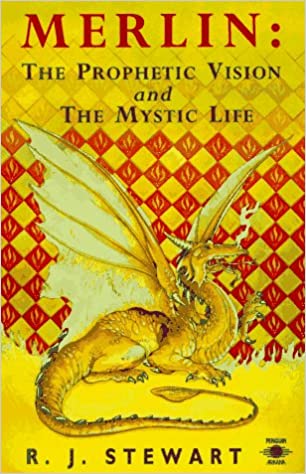
One of the influences that nudged me towards Druidry was R. J. Stewart’s body of work concerned with Merlin, itself stimulated by the work of the twelfth century scholar Geoffrey of Monmouth. Stewart wrote two books about this (3,4) and then produced the Merlin Tarot (5) which, with its companion volume The Complete Merlin Tarot (6) is a workable esoteric system in itself. Geoffrey’s work revisions older Celtic/Classical material in a culture thirsty for it. He introduces mainstream European culture to Merlin, Arthur, and Morgan. Shape-shifting through cultural fashions over the centuries, they are still with us. In the later twentieth century, R. J. Stewart drew on Geoffrey’s work for creative myth-making of his own.

As part of my current inquiry, I am revisiting this work to see how it might, with an element of further revisioning, contribute to my Druid practice. I will expand on this in future posts.

(1) Joseph Campbell The Masks of God 4: Creative Mythology Harmondsworth: Penguin, 1976 (Original US edition published in 1968)

(2) Mark Walker Geoffrey of Monmouth’s Life of Merlin: A New Verse Translation Stroud: Amberley Publishing, 2011

(3) R. J. Stewart The Prophetic Vision of Merlin: Prediction, Psychic Transformation and the Foundation of the Grail Legends in an Ancient Set of Visionary Verses Arkana: London & New York, 1986

(4) R. J. Stewart, The Mystic Life of Merlin Arkana: London & New York, 1986

(5) R. J. Stewart & Miranda Grey (illustrator) The Merlin Tarot London: The Aquarian Press, 1992

(6) R. J. Stewart & Miranda Grey (illustrator) The Complete Merlin Tarot: Images, Insight and Wisdom from the Age of Merlin London: The Aquarian Press, 1992

LADY OF WOODS AND MISTRESS OF WILD THINGS: MARY MAGDALENE IN PROVENCE

“In the new land, Mary loved to go into the woods for prayer and meditation, just as, in the Holy Land, she had enjoyed retreats into the wilderness of the desert”. Today, 22 July, is St. Mary Magdalene’s day. To honour this, I have chosen to focus on an old tradition that she went to in southern Gaul (France) sometime after Jesus was gone.

The suggestion is that she needed to get away from people in power and a section of the new movement that didn’t want her to teach. It seems she went to Massilia (modern Marseilles). Like Alexandria, the city was a significant Mediterranean port, a Greek foundation with a thriving Jewish community, now under Roman rule. It explains why the Celtic Druids of the region wrote commercial correspondence in Greek, the common language of Mediterranean trade at the time. The city is an entirely plausible choice for an exile in Mary’s position at that time.

Legend says that Mary did not stay in the city but went out into the Gallic hinterland and began a teaching and healing mission. It is not surprising that her lore has incorporated indigenous themes (1):

“One time a young disciple followed her into the woods, wishing to be near her and to see what she was doing. When she passed through a clearing and went into the treeline on the other side, the disciple lost site of her. He ran to catch up, and just as he entered among the trees he found himself surrounded by a pack of wolves, each wolf staring at him in silence. He was frozen with fear and dare not move for fear the wolves would swiftly be upon him. The Lady Mary appeared and said to him, ‘I did not ask for your company. Why are you following me?’ He responded, ‘My Lady I sought only to be near you and see what you were doing’. She said to him, ‘it is dangerous to draw near to a queen without the permission of the king or the queen herself, for her guards are likely to kill a man intruding on her privacy. I go out to meet with my Beloved and it is a private matter. It is unbecoming that you have followed me. Return to your place, and do not come out or go in unless the Spirit of the Lord moves you. Having said this, Lady Mary vanished into the woods. The wolves vanished with her, leaving the young man in awe. Needless to say, the young disciple never followed the Lady Mary into the woods again.

“There were many times the disciples saw wolves going along with the Holy Bride in the woods, as well as other wild beasts. …. There were so many stories of people seeing Our Lady with wild creatures in the woods that many called her the Lady of the Forest, others called her the Mistress of Wild Things and sometimes Lady of the Beasts.”

(1) Tau Malachi St. Mary Magdalene: The Gnostic Tradition of the Holy Bride Woodbury, MN: Llewellyn Publications, 2006

A modern naturalistic account of Mary’s life, including later years in southern France, can be found in: Michele Roberts The Secret Gospel of Mary Magdalene London: Vintage Books, 2007 (originally published by Methuen is 1984 as The Wild Girl)

Earth Eclectic

music that celebrates Earth and speaks to the heart

Sarah Fuhro Star-Flower Alchemy

Follow the Moon's Cycle

Muddy Feet

Meeting nature on nature's terms

Rosher.Net

A little bit of Mark Rosher in South Gloucestershire, England

Becoming Part of the Land

A monastic polytheist's and animist’s journal

selkiewife

Selkie Writing…

Charlotte Rodgers

Images and words set against a backdrop of outsider art.

Prof Jem Bendell

living with metacrisis and collapse

Towint

The pagan path. The Old Ways In New Times

The Druids Garden

Spiritual journeys in tending the living earth, permaculture, and nature-inspired arts

The Blog of Baphomet

a magickal dialogue between nature and culture

This Simple Life

The gentle art of living with less

Musings of a Scottish Hearth Druid and Heathen

Thoughts about living, loving and worshiping as an autistic Hearth Druid and Heathen. One woman's journey.

Wheel of the Year Blog

An place to read and share stories about the celtic seasonal festivals

Walking the Druid Path

Just another WordPress.com site

anima monday

Exploring our connection to the wider world

Grounded Space Focusing

Become more grounded and spacious with yourself and others, through your own body’s wisdom

The Earthbound Report

Good lives on our one planet

Hopeless Vendetta

News for the residents of Hopeless, Maine