Contemplative Inquiry

This blog is about contemplative inquiry

AGNOSTIC BUDDHA: NATURALIST DRUID

“Suppose, Malunkyaputta, a man were wounded by an arrow thickly smeared with poison, and his friends and companions brought a surgeon to treat him, The man would say, ‘I would not pull out the arrow until I know the name and clan of the man who wounded me; whether the bow that wounded me was a long bow or a crossbow; whether the arrow that wounded me was hoof-tipped or curved or barbed’.

“All this would still not be known to that man and in the meanwhile he would die. So too, Maunkyaputta, if anyone should say: ‘I will not lead the noble life under the Buddha until the Buddha declares to me whether the world is eternal or not eternal, finite or infinite; whether the soul is the same as or different from the body; whether an awakened one continues or ceases to exist after death,’ that would still remain undeclared by the Buddha and meanwhile that person would die.” (1)

The Buddhist scholar and teacher Stephen Batchelor, quoting these early words, affirms a Buddha committed to “an existential, therapeutic and liberating agnosticism” concerned “with anguish and the ending of anguish”. He laments the historical tendency of Buddhism to lose this agnostic dimension and to become an institutionalised religion. He believes that “this transformation of Buddhism into a religion obscures and distorts the encounter of the dharma with contemporary agnostic culture. … The dharma in fact might well have more in common with Godless secularism than with the bastions of religion.”

At the same time, the force of the word ‘agnosticism’ has been lost in modern secular culture, becoming complicit with “the attitude that legitimises an indulgent consumerism and and the unreflective conformism dictated by mass media”. T. H. Huxley, who coined the term in 1869, understood agnosticism as “a method realised through the rigorous application of a single principle”. This was to follow our reason as far as it will take us, and not to pretend that conclusions are certain which are not demonstrated or demonstrable. It is a principle that runs through western culture from Socrates to the axioms of modern science. Buddha and Huxley both advocate a method rather than a creed, opening the possibility of a conversation between them.

What does this tell me about my own path now? Contemplative inquiry is a method. It is based on phenomenology as a subjective life-world investigation, and mine tells me that fruitful spiritual practices do not depend on the metaphysical views that are often linked to them. I can interpret and value everything that I have done within a naturalistic framework. It is a significant conclusion for my inquiry.

This does not in itself invalidate the metaphysical views. I have simply withdrawn from my personal engagement with them, except to the extent that they are embedded in the authentic experiences and stories of other people, past and present. I can still value and learn from those. I find imaginative engagement with other points of view quite easy. But in my own spiritual understanding, I seem now to be with Huxley and the Buddha.

Contemplative inquiry is a valued method but I would not call it my path. My path is Druidry, and I have been re-establishing this consciously since the Winter Solstice of 2019. The default position of the Druidry I was trained in is a romantic theosophy, though one in active evolution, rich in variation and re-imagining. In my personal journey, I am now clearly in a naturalistic and secular space, animist in a sense (2) that is “‘naturalist’ rather than metaphysical.” As a result of my inquiry, my Druid note is different than it was before I began.

I am clearer, lighter, more alive. It feels easier to experience the abundance in simplicity that I value. By letting the mystery be, I can immerse myself more deeply in the textured life of the world. Leaning in to naturalistic world view, I expand my sense of ‘at-homeness in the flowing moment’, and my Druid path feels stronger.

(1) Stephen Batchelor Buddhism Without Beliefs: A Contemporary Guide to Awakening London: Bloomsbury, 1998 (First published in the USA in 1997 by Riverhead Books)

(2) Graham Harvey (ed.) The Handbook of Contemporary Animism London & New York: Routledge, 2014 (First published by Acumen in 2013) see also: https://contemplativeinquiry.blog/2020/02/22/
Share this:

GREEN MAY

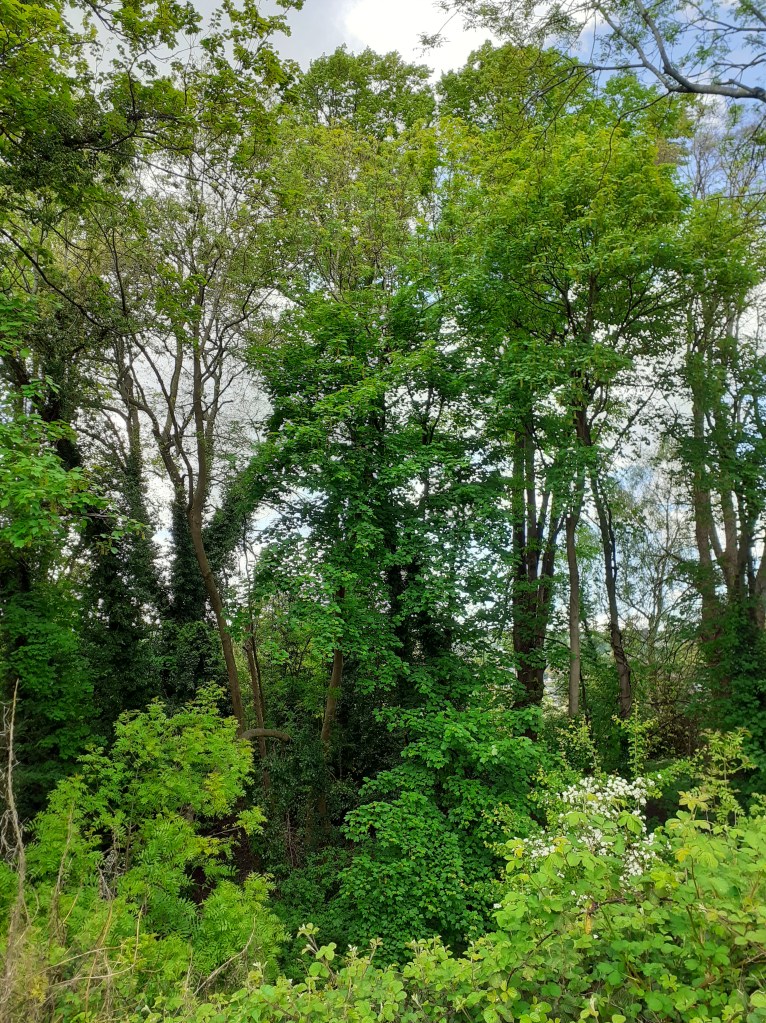
On 1 May I strode out with a spring in step, for my statutory walk. I was stir crazy and determined to meet the day. I made sure to take my camera with me. I wanted both to savour and record the fresh abundance of the green. Although I was in a familiar landscape, both the look and the feel of it had changed. I was in places I hadn’t been in for a week or more, and the world seemed dynamically verdant with a new intensity. I had a transformative hour of it before returning home.

In his Green Man (1), William Anderson reminds us that the Green Man utters life through his mouth. “His words are leaves, the living force of experience … to redeem our thought and our language”. Anderson’s Green Man speaks for the healthy renewing of of our life in and as nature.

He also suggests that the emerging science of ecology – the study of the house-craft of nature – is one such form of utterance. It gives us a language of inquiry into the interdependence of living things. My sense is that 1960’s images of Earth from space have also provided support to concepts like that of a planetary biosphere, and for the revival of Gaia as an honoured name. As a species, quality knowledge, rooted in quality imagination, is our greatest resource. Anderson’s book was published in 1990, based on ideas that had already been maturing over many years. I am sad that we are where we are in 2020. But the message of hope still stands, and the energy of a green May bears witness to it.

(1) William Anderson Green Man: the Archetype of Our Oneness with the Earth London & San Francisco: HarperCollins, 1990 (Photography by Clive Hicks)

DEEP REST AND THE MAGIC OF AWEN

2020 is beginning its journey from Beltane to Midsummer in my neighbourhood, and I am feeling the call of Awen. Hence the pendant. I am also looking at the theme of balance (1). There’s a question for me about balancing the call of Awen with my commitment to the deep rest of contemplation and its nourishing effects.

As a fruit of my contemplative inquiry, I found ‘at-homeness in the flowing moment’. This at-homeness nourishes my life. It is not dependent on belief or circumstance, but on the ultimate acceptance that the experienced moment is what is given. Being alive, having experiences, and being aware that I have experiences is an extraordinary set of gifts. But it has taken me a while to find deep rest in simple experiencing, at will.

When I go home to the flowing moment, I slow down the stream of consciousness without attempting either to halt it or to put it to work. A stillness lives within the flow and finds its place there. I experience ‘now’ as state of presence, rather than a unit of time. A pervasive sense of deep rest emerges from ‘just being’. Immersed in being, I can lose my sense of a boundaried, separate self.

But I am also an embodied human, in a perpetual process of becoming, When I hear the call of Awen, I feel as if a larger life is inviting me to share in the magic of creation as a co-creator. It is likely that humans began calling, chanting and music-making before they developed conceptual speech. Awen is close to source, deeply involved in the emergence and flourishing of our collective and personal voices. Gaelic tradition speaks of the Oran Mor as the great song in which all beings have a part.

In this final, dynamic stage of the rising year, I do feel called in this way. My initial response has been to re-incorporate Awen into my practice both as a three-syllable chant (aah-ooo-wen) and as a two-syllable mantra meditation (aah, on the inbreath; wen, on the outbreath). This is already changing the feel of the practice. When chanting this is through the sound, with its distinctive pulse and vibration, and through a strong felt resonance in my body. In the meditation, the awen mantra seems to enliven my breath, making it very real as the breath of life. It also energises my body as a whole, less dramatically but more subtly than the chant. Overall, I sense myself as enlivened, inspired, and activated. Awen is influencing my experience, and my inquiry. I will see where this magic leads me.

(1) https://contemplativeinquiry.blog/2020/04/29/beltane-2020/

BELTANE 2020

Greetings and Blessings for the fast approaching festival of Beltane/Samhain. May we all find ways to stay safe and to flourish! This post focuses on my sense of the Wheel at Beltane – aware also that each season contains the seed of its opposite.

For The Wildwood Tarot, Beltane is the moment when “the polarised energies of the land interweave and intertwine around the staff of the heavens, generating the pulse of life”. It is also concerned with balance, and linked to the traditional trump for temperance. There’s a call to discover what balance, balancing and re-balancing might look like in 2020. Where might different balancing acts take us? How does ‘balance’ apply collectively, with a continuing public health crisis?

In the card, the primal energies of the serpents, echoing both the caduceus symbol and the double helix, are vividly in the foreground. By contrast the mask-like human head towards the bottom of the picture is almost hidden. For me, it is sombre, an image inviting uncertainty and unknowing rather than ‘balance’ or any steady state. Beltane 2020 finds a world in flux. Anything is possible. At the personal level, balance might morph into a kind of poise, without attachment to specific outcomes, yet with a preparedness to navigate uncharted waters.

INWARD TRAINING

The Way fills the entire world

It is everywhere that people are

But people are unable to understand this.

When you are released by this one word:

You reach up to the heavens above;

You stretch down to the earth below;

You pervade the nine inhabited regions.

What does it mean to be released by it?

The answer resides in the calmness of the mind.

When your mind is well ordered, your sense are well ordered.

When your mind is calm, your senses are calmed.

What makes them well ordered is the mind;

What makes them calm is the mind.

By means of the mind you store the mind.

Within the mind there is yet another mind.

That mind within the mind: it is an awareness that precedes words.

Only after there is awareness does it take shape;

Only after it takes shape is there a word.

Only after there is a word is it implemented.

Only after it is implemented is there order.

Without order, you will always be chaotic.

If chaotic, you die. (1)

The early Taoist classic Inward Training (Nei-yeh) (1) comes out of an oral tradition in which teachers gave their pupils verses to learn and study. Hence the emphatic and somewhat repetitive flavour of the text. Teacher pupil relationships of this kind are very ancient in China, likely emerging out of an indigenous Chinese shamanism (2).

Translator and editor Harold Roth suggests that the ‘one word’ that releases people is Tao itself, used as the focus of meditation, somewhat in the manner of mantra work. When the mind is calm, another mind becomes available – the mind within the mind, that precedes words and takes shape prior to their emergence.

Tao, in this understanding, is experienced as a foundational and pervasive cosmic process in which we can centre ourselves. The recommended practice helps us to cleanse the doors of perception, and achieve that centring. My experience of contemplative inquiry, and the Druid training that preceded it, is that ‘inward training’ works.

(1) Roth, Harold D. (1999) Original Tao: ‘Inward Training’ and the foundations of Taoist mysticism New York, NY: Columbia University Press

(2) https://contemplativeinquiry.blog/2014/08/12/

LEARNING FROM THE WATERCOURSE WAY

Alan Watts (1) describes Taoism as the ‘watercourse way’. For him, this ancient philosophy is “a skilful and intelligent following of the course, the current, and grain of natural phenomena – seeing human life as an integral feature of the world process, and not something alien and opposed to it.” It is a point of view that I find of direct relevance to modern Druidry, nature spirituality and ecosophy. (2)

The ancient Taoists themselves said that “true goodness is like water. Water’s good for everything. It doesn’t compete. It goes right down to the low loathly places, and so finds the way”. (3)

Alan Watts continues (1): “Looking at this philosophy with the needs and problems of modern civilisation in mind, it suggests an attitude to the world which must underlie all our efforts towards an ecological technology. The development of such techniques is not just a matter of the techniques themselves, but of the psychological attitude of the technician”.

A detached attitude of objectivity is inadequate for solving the problems we face. Subject and object cannot be separated, for “we and our surroundings are the process of a unified field, which is what the Chinese called Tao”. We have no alternative but to work along with this process by attitudes and methods which could be as technically effective as “judo the ‘gentle Tao’ is effective athletically”. Watts reminds us that human beings have to make the gamble of trusting one another to make any kind of workable community, and concludes that “we must also take the risk of trimming our sails to the winds of nature. For our ‘selves’ are inseparable from this kind of universe, and there is nowhere else to be.”

(1) Alan Watts Tao: the Watercourse Way Souvenir Press: undated Amazon Kindle edition (with the collaboration of Al Chung-Liang Huang ; additional calligraphy by Lee Chih-chang)

(2) Arne Naess Ecology of Wisdom UK: Penguin Books, 2016 (Penguin Modern Classic. First published 2008)

(3) Lao Tzu Tao Te Ching: A Book about the Power and the Way Boston & London: Shambhala, 1998 (A new English version by Ursula K. Le Guin, with the collaboration of J.P. Seaton, Professor of Chinese, University of North Carolina, Chapel Hill)

SAVED FROM TRASH

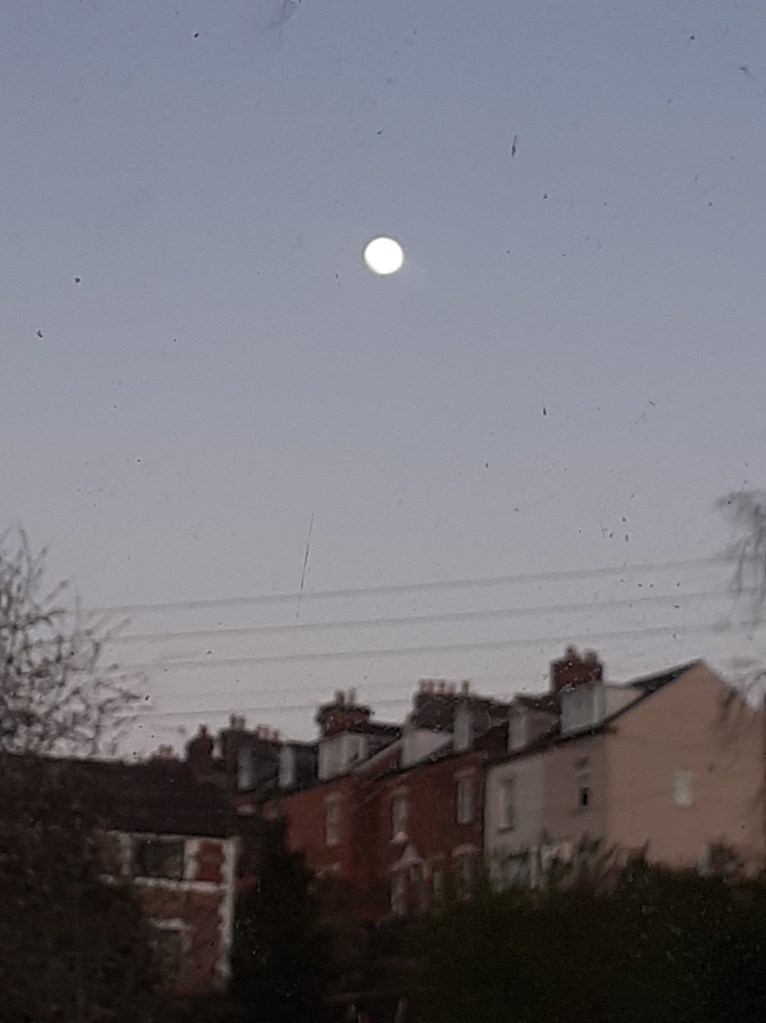
A murky evening moment at a magical time of year. St. George’s Day coming soon, and then Beltane. A seeming failure to get a good image. Street lights come on just as the picture is taken. Freshly green trees are obscured by gathering darkness, and reduced to silhouettes. I am shooting through a window that needs cleaning. I delete the picture. I send it to trash.

Then I find myself haunted by an after image of those apparent pink clouds in the sky. I rescue them. I have better pictures of clouds, but as I imagine them now, these shapes are no longer clouds for me. I see the courtship – I’m oddly sure it’s a courtship – of two beings. In this liminal twilight sky, in a meeting of air and fire, they are materialising in time-bound 3D reality. I might, doubtless incorrectly, call them dragons in my nervous need for naming. In truth I don’t know who or what they are, or where they come from, or how they got here. This is 2020, a twilight zone in itself.

I see no purpose or plan here, though the courtship of these beings is well synchronised for time and place. They are a sign and a wonder. Though their story is unknown, I welcome these beings who are not of this world. I am touched by their appearance and glad to be sharing it.

CONTEMPLATIVE DRUIDRY: REFLECTING ON THE PROJECT

In his foreword to Contemplative Druidry (1) Philip Carr-Gomm talks about “Nature Mysticism, or Natural Mysticism” in modern Druidry. He suggests that such mysticism is grounded in changes in consciousness, and feelings of bliss or oneness, with no accompanying “separation from the physical world in pursuit of the Divine”. For me, it is especially about meeting the moment within the physical world, including our own body/mind. Sometimes the meeting comes through formal practice. Sometimes it is spontaneous and unannounced.

I built the main body of the text in Contemplative Druidry around a series of interviews with practitioners, which I designed, conducted and transcribed in the spring and summer of 2014. I then identified patterns in what people had been saying and decided on themes for chapters. I wasn’t working in an academic role, so my own linking text was a matter of curation rather than analysis. At that time the notion of a ‘contemplative’ approach to Druidry seemed weird to many people. But it was clear to me from the interview material that all the contributors had relevant experiences to talk about. They seemed to point to what PCG subsequently called ‘natural mysticism’ as a domain of personal and cultural experience readily within reach if people want it to be.

This book itself came out of a project I began working on in 2011, when I was a Bard and Ovate mentor in OBOD. I activated it in 2012, when I began to reach out to people with an offer of contemplative sessions, workshops and retreats – continuing with these until the end of 2016. 2012 also saw the birth of this blog and the Contemplative Druidry Facebook group, which I administered for the first year. Looking back from 2020, I feel that the contemplative meme is established within Druidry. ‘Contemplative’ has become a frequently used term in Druid discourse.

In the early days I thought a specific iteration of contemplative Druidry, launched by the project, might become a distinct Druid brand within and beyond the current Druid communities. From this distance it is easier for me to see that my will and energy were for initiating a conversation and modelling a set of possibilities, rather than working to establish a new sub-tradition. At the same time I continue to invite Druids and fellow travellers to be open to their ‘natural mysticism’ in ways that work for them.

(1) James Nichol , Contemplative Druidry: People, Practice and Potential, Amazon/Kindle, 2014.  https://www.amazon.co.uk/contemplative-druidry-people-practice-potential/dp/1500807206/

LUNAR WISDOM

” The moon was the image in the sky that was always changing yet always the same. What endured was the cycle, whose totality could never be seen at any one moment. All that was visible was the constant interplay between light and dark in an ever recurring sequence. Implicitly however, the early people must have come to see every part of the cycle from the perspective of the whole. The individual phases could not be named, nor the relations between them expressed, without assuming the presence of the whole cycle. The whole was invisible, an enduring and unchanging circle, yet it contained the visible phases. Symbolically, it was as if the visible ‘came from’ and ‘returned to’ the invisible – like being born and dying, and being born again.

“The great myth of the bronze age is structured on the distinction between the ‘whole’, personified as the Great Mother Goddess, and the ‘part’, personified as her son-lover or her daughter. She gives birth to her son as the new moon, marries him as the full moon, loses him to the darkness as the waning moon, goes in search of him as the dark moon, and rescues him as the returning crescent. In the Greek myth, in which the daughter plays the role of ‘the part’, the cycle is the same, but the marriage is between the daughter and a god who personifies the dark phase of the moon. The daughter, like the son, is rescued by the mother. In both variations of the myth, The Goddess may be understood as the eternal cycle s a whole: the unity of life and death as a single process. The young goddess or god is her mortal form in time, which, as manifested life, whether plant, animal or human being – is subject to a cyclical process of birth, flowering, decay, death and rebirth.

“The essential distinction between the whole and the part was later formulated in the Greek language by the two different Greek words for life, zoe and bios, as the embodiment of two dimensions co-existing in life. Zoe is infinite, eternal life; bios is finite and individual life. Zoe is infinite ‘being’; bios is the living and dying manifestation of this eternal world in time.”

(1) Anne Baring Anne and Jules Cashford The Myth of the Goddess: Evolution of an Image London: Penguin, Arkana Books, 1993

INQUIRY NOTE: For me this modern interpretation of Bronze Age myth offers a good Pagan way of talking about ‘non-duality’, a strong thread in my inquiry in recent years. In its Sanskrit origin, advaita simply means ‘not two’. It speaks of a unity that is not exactly oneness in the sense of complete assimilation. It points to the sense that we are bios in our transient personal lives yet also zoe the life eternal, both the wave and the ocean. In Western theistic culture this view seems consistent with either pantheism or panentheism. It also fits modern understandings of animism and biocentrism. While I find it useful to know about these models and frameworks, I avoid strong identification with them. There remains an underlying mystery, which is where myth and imagination come into their own.

LIVING OUR EXPERIENCE

“I have been fascinated and waylaid by abstraction, painting the picture I would rather have instead of living the experience I would rather not have.

“What I abstract never comes to be, or only sometimes flickers into life like a watered-down approximation.

“My abstraction is a smoke-screen born from longing or frustration, and it offers me a holiday of dreams. It is always safe and predictable, and an indulgence in the known.

“When abstraction collapses there is what there is … my bodily sensations, the symphony going on. Not necessarily in tune, but nonetheless constantly changing and moving, coming and going. Something is happening here or there … it evaporates and something else takes its place. There is nothing that I can control or manipulate. It is immeasurable and unknown, being and then not being.

“In the same way, if I seem to let go and listen, touch, taste, smell or see, there is no way of knowing beforehand the exact quality of those sensations. I could say that I can anticipate the sound of a bird singing, but it is only on information based on memory.

“It is not alive, vital and unknown. The sound I actually hear, the sound of what is, will not be the same as my abstraction of it. When I first listen to the sound I will try to grasp it and label it in order to control it. When I apparently let go of that control, there is simply the listener and the sound. When the listener is dropped, there is only the sound. I am no longer there – there is simply the naked and vibrant energy of what is. Nothing is needed. All is fulfilled.

“It is within the very alchemy of this beingness that freedom resides.

“Life beckons me. It whispers, it calls to me and in the end it screams at me. The scream of crisis or disease is often what will bring the rediscovery of what I am, for it is difficult to abstract suffering.”

Tony Parsons The Open Secret Shaftsbury: Open Secret Publishing, 1995 (Updated 2011)

NOTE: Tony Parsons describes The Open Secret as “a book declaring that enlightenment is a sudden, direct and energetic illumination that is continuously available. It is the open secret which reveals itself in every part of our lives. No effort, path of purification, process or teaching of any kind can take us there. For the open secret is not about our effort to change the way we live. It is about the rediscovery of what it is that lives”.

See: www.theopensecret.com/

Earth Eclectic

music that celebrates Earth and speaks to the heart

Sarah Fuhro Star-Flower Alchemy

Follow the Moon's Cycle

Muddy Feet

Meeting nature on nature's terms

Rosher.Net

A little bit of Mark Rosher in South Gloucestershire, England

Becoming Part of the Land

A monastic polytheist's and animist’s journal

selkiewife

Selkie Writing…

Charlotte Rodgers

Images and words set against a backdrop of outsider art.

Prof Jem Bendell

living with metacrisis and collapse

Towint

The pagan path. The Old Ways In New Times

The Druids Garden

Spiritual journeys in tending the living earth, permaculture, and nature-inspired arts

The Blog of Baphomet

a magickal dialogue between nature and culture

This Simple Life

The gentle art of living with less

Musings of a Scottish Hearth Druid and Heathen

Thoughts about living, loving and worshiping as an autistic Hearth Druid and Heathen. One woman's journey.

Wheel of the Year Blog

An place to read and share stories about the celtic seasonal festivals

Walking the Druid Path

Just another WordPress.com site

anima monday

Exploring our connection to the wider world

Grounded Space Focusing

Become more grounded and spacious with yourself and others, through your own body’s wisdom

The Earthbound Report

Good lives on our one planet

Hopeless Vendetta

News for the residents of Hopeless, Maine