
POEM: IN REPLY TO COMMISSIONER TA’UI
‘A courtyard of bamboo and late night snow
A lone lantern a book on the table
If I hadn’t encountered the teaching of no-effort
how else could I have gained this life of leisure?’ (1)
Wei Ying-Wu (737-791 CE) wrote this brief poem in 780 at whilst staying at Shanfu Temple. It is addressed to Ts’ui Cho, who was married to one of Wei’s cousins, and worked as a Commisioner in the Chinese Directorate of Waterways. Ts’ui practised Taoism, sometimes called the Watetercourse Way. It seems like an appropriate role.
On the surface, the poem seems plain and simple, with clear, resonant images in the first two lines followed by an apparent endorsement of Taoism and the Taoist way of life. But the third and fourth lines, as translated, are ironic. Indeed they include a guardedly critical reference to the Emperor Hsuan-tsung’s framing of his reign in Taoist terms.
Whether it was due to the Emperor’s Taoism, or the way he understood the teaching of no-effort, his seeming inattention to government affairs was widely blamed for the devastating An Lushan rebellion (755-763). This rebellion, launched by a general in the Imperial service, is said to have cost millions of lives and brought about the near collapse of the Chinese census and tax administration. This chaotic period included two sackings of Chang’an, the Imperial seat – by the rebels in 756 and the Tibetans in 763. In 750 the city had 800,000 inhabitants inside its walls and some two million in the wider metropolitan area. It was the largest city in the world. The sackings damaged and reduced it. Although Chang’an, and China, gradually recovered, the glory days of the T’ang dynasty were over.
Wei was a member of the palace guard when the rebellion began, and served the government in different roles beyond the rebellion into its heart-breaking and difficult aftermath. He thought deeply about what had gone wrong. He was personally guided both by Confucian and Buddhist philosophy, and somewhat torn between the call of state service and a life of contemplative retreat. His poem In Reply to Commissioner Ts’ui needs to be read in this context. Wei did not favour Taoism, and he is not praising the ‘teaching of no-effort’ in this poem. (2)
‘A courtyard of bamboo and late night snow
A lone lantern a book on table
If I hadn’t encountered the teaching of no-effort
how else could I have gained this life of leisure?’
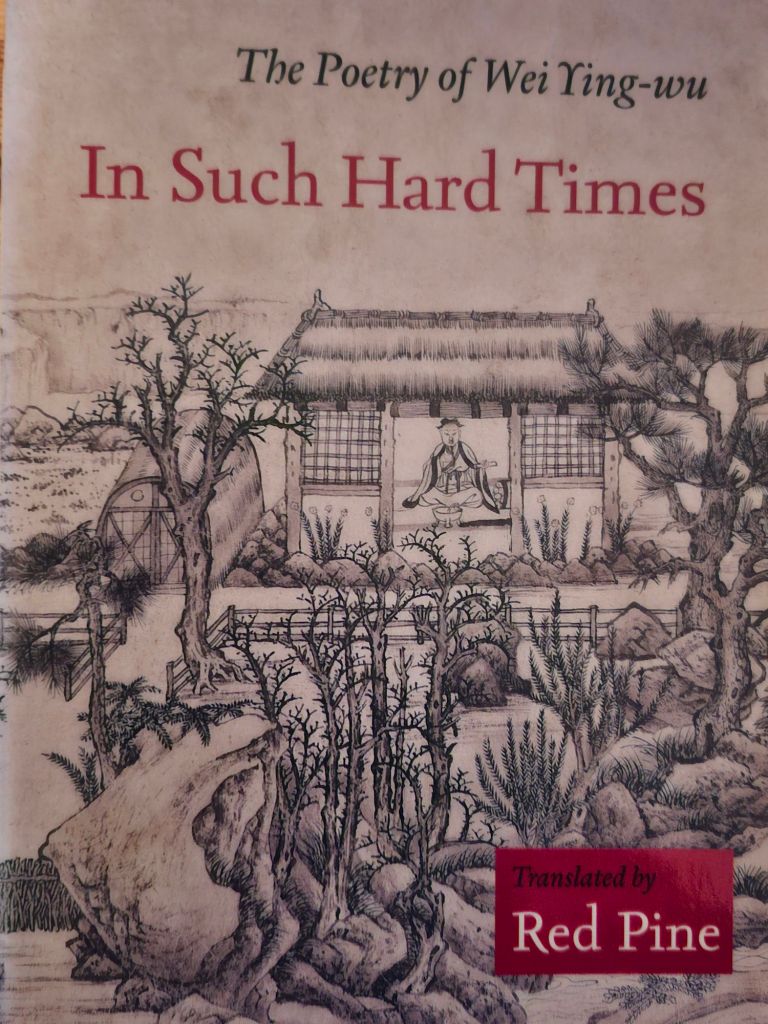
(1) From: In Such Hard Times: the Poetry of Wei-Ying-wu Red Pine, (Translator) Port Townsend, WA, Cooper Canyon Press, 2009
(2) See also: https://contemplativeinquiry.blog/2024/03/09/ for an account of the same events by Du Fu (712-770) an older contemporary and better known civil servant/poet.
For other poems by Wei Ying-Wu, see
https://contemplativeinquiry.blog/2015/02/26/ and https://contemplativeinquiry.blog/2023/11/14

