An Interview with Frank McEowen (1) is the latest offering in Philip Carr-Gomm’s This Magical Life podcast. The overall aim of This Magical Life is to explore the intersection of Druidry, Psychology and Wisdom. Philip is a clinical psychologist and led OBOD (the Order of Bards, Ovates and Druids) for some 30 years. Frank is the author of, among other works, The Mist-Filled Path: Celtic Wisdom for Exiles, Wanderers and Seekers.
This wide-ranging interview covers three main topics: Celtic bards, Chinese hermit poets and politics in America today. All of these are tied into Frank’s journey and service. He was born in Mississippi, USA, of Irish, Scottish, Welsh and English ancestry. At an early age he experienced mystical encounters with the other world. These later prompted him to work with indigenous elders in North America, and later with teachers in Britain and Ireland, especially Ireland, opening himself also to the spirit(s) of place. He speaks of his journey as a whole as one of ‘soul retrieval’. His early books – The Mist-Filled Path, Meditations on the Irish Sprit Wheel, and The Spiral of Memory and Belonging, come out of this experience.
For reasons explained in the interview, Frank then made a decision to ‘disappear inward’, becoming a hermit and poet. As well as working in Celtic spirituality, Frank was also a student of Zen. He had a natural attraction to Chinese and Japanese wayfaring hermit poetry and modelled the life style as well as the art, adjusted to a different time and culture. This period led to three books of poetry published under the name of Frank LaRue Owen: The School of Soft Attention,The Temple of Warm Harmony and Stirrup of the Sun and Moon.
Like Philip, part of Frank’s service is in the field of psychological healing and personal development, principally as a student of Arnold Mindell. Mindell coined the term ‘Dream Body’ – a psycho-spiritual approach that is also Earth reverencing. It is within this framework that they talk about American politics today. First they identify distressed energies within the national psyche which the current President has uncorked and used in a darkly charismatic and disinhibited way. The discussion takes off from there, looking at issues of grief, loss (of democracy) and possible hope. Connecting this predicament to the bard/poet vocation, Frank quotes Ukrainian poet Ilya Kaminski: “the project of Empire is to dull the senses. The project of the poet is to wake up the senses”. Projects of Empire are not unique to the USA. There is something to reflect on for us all.
I recommend this podcast as a rich and varied conversation, covering a lot of ground in its 36 minutes.
(1) The YouTube post spells Frank’s surname as McEowen and the covers of his early books use MacEowen. I don’t know if he has altered the spelling over time.
This post looks at Animism as the guiding principal of my Druidry. The term itself comes from nineteenth century anthropology, and is somewhat problematic. Scholars from European and North American backgrounds , formed by a mix of Christian and secular ideas, were studying, and labelling, the traditional practices of other people. The people themselves were mostly in the process of becoming colonial subjects and living in cultures under stress. So ‘Animism’ started out as a top-down classification, which gave Animists a lowly position in the hierarchy of cultural and spiritual life. A stigma persists to this day.
Despite this dubious history, the word ‘Animism’ is now being turned around by people from the global north itself, spiritually hungry in our now palpably faltering 21st century world. Some years ago, research by Graham Harvey distinguished two positive uses of the term Animism among modern western Pagans. “Some Pagans identified Animism as a part of their religious practice or experience which involved encounters with tree-spirits, river-spirits or ancestor-spirits. This Animism was metaphysical. … Other Pagans seemed to use ‘Animism’ as a short-hand reference to their efforts to re-imagine and re-direct human participation in the larger-than-human, multi-species community. This Animism was relational, embodied, eco-activist and often ‘naturalist’ rather than metaphysical” (1).
My Animism draws primarily on the second of the two accounts above. But it is deepened by a Buddhist influence, especially that of the Vietnamese Zen Master Thich Nhat Hanh: “There is no absolute dividing line between living matter and inert matter. If we took the so-called inanimate elements out of you and me, we would not be able to live. We are made of non-human elements. This is what is taught in the Diamond Sutra, an ancient Buddhist text that could be considered the world’s first treatise on deep ecology. We cannot draw a hard distinction between human beings and other living beings, or between living beings and inert matter. There is vitality in everything. The entire cosmos is radiant with vitality. If we see the Earth as a block of matter lying outside of us, then we have not yet truly seen the Earth. The Earth is also alive” (2).
Thich Nhat Hanh follows an old tradition. In thirteenth century Japan, Zen Master Eihei Dogen had taught that enlightenment is just ‘intimacy with all things’. Elsewhere in his own text, Thich Nhat Hanh says: “Just as a wave doesn’t need to go looking for water, we don’t need to go looking for the ultimate. The wave is the water. You already are what you want to become. You are made of the sun, moon and stars. You have everything inside you”. Thich Nhat Hanh explains that a flower is made only of non-flower elements. We can say that the flower is empty of separate self-existence. But that doesn’t mean that the flower is not there. “When you perceive reality in this way, you will not discriminate against the garbage in favour of the rose” (2).
This Buddhist wisdom doesn’t seem to me to come directly out of the four noble truths or eightfold path. The Buddhists of south-east and east Asia were at ease with the traditional Animism of their cultures, and the views expressed above appear to me to be at least partly a cultural gift from the Animists. Japan, for example, was intensely influenced by Buddhism without any thought of displacing Shinto, and the traditions readily interwove.
It was otherwise in the west. Already, In the first century CE, the Roman philosopher Plutarch wrote of the death of Great Pan, after the time of Jesus but before the rise of Christianity. James Hillman comments: “With Pan dead, so was Echo; we could no longer capture consciousness through reflecting within our instincts. … The person of Pan the mediator, like an ether who invisibly enveloped all natural beings with personal meaning, with brightness, had vanished. Stones became only stones – trees, trees; things, places, animals no longer this god or that, but became ‘symbols’, or were said to ‘belong’ to one god or another. When Pan is alive, then nature is too – the owl’s hoot is Athena and the mollusc on the shore is Aphrodite … Whatever was eaten, smelled, walked upon or watched, all were sensuous presences of archetypal significance”.” (3).
James Hillman, after service as Director of Studies as the Jung Institute in Zurich, went on to develop his own form of archetypal psychology. He was a strong proponent of Panpsychism, a world view very similar to forms of Animism being articulated today. Panpsychism literally means the ensoulment of everything (from the Greek), though the sound ‘Pan’ also associates us with the god. At the same time this view broadly fits with the understanding of Zen Buddhist Thich Nhat Hanh, described above.
‘Animism’ is for me a word, not a thing, or a another religious banner to raise. It points to a wide range of experiences, understandings, and articulations. Pinned down to a single, dictionary definition, it would lose its power and energy. Yet Animism has become the word that best describes my way of being a modern Druid, both as view and as practice. I find it grounding and regenerative to have decisively adopted this word.
(1) Graham Harvey (ed.) The Handbook of Contemporary Animism London & New York: Routledge, 2014 (First published by Acumen in 2013)
(2) Thich Nhat Hanh The Art of Living London: Rider, 2017 (Rider is part of Penguin Random House)
(3) James Hillman The Essential James Hillman: A Blue fire London: Routledge, 1989 (Introduces and edited by Thomas Moore in collaboration with the author)
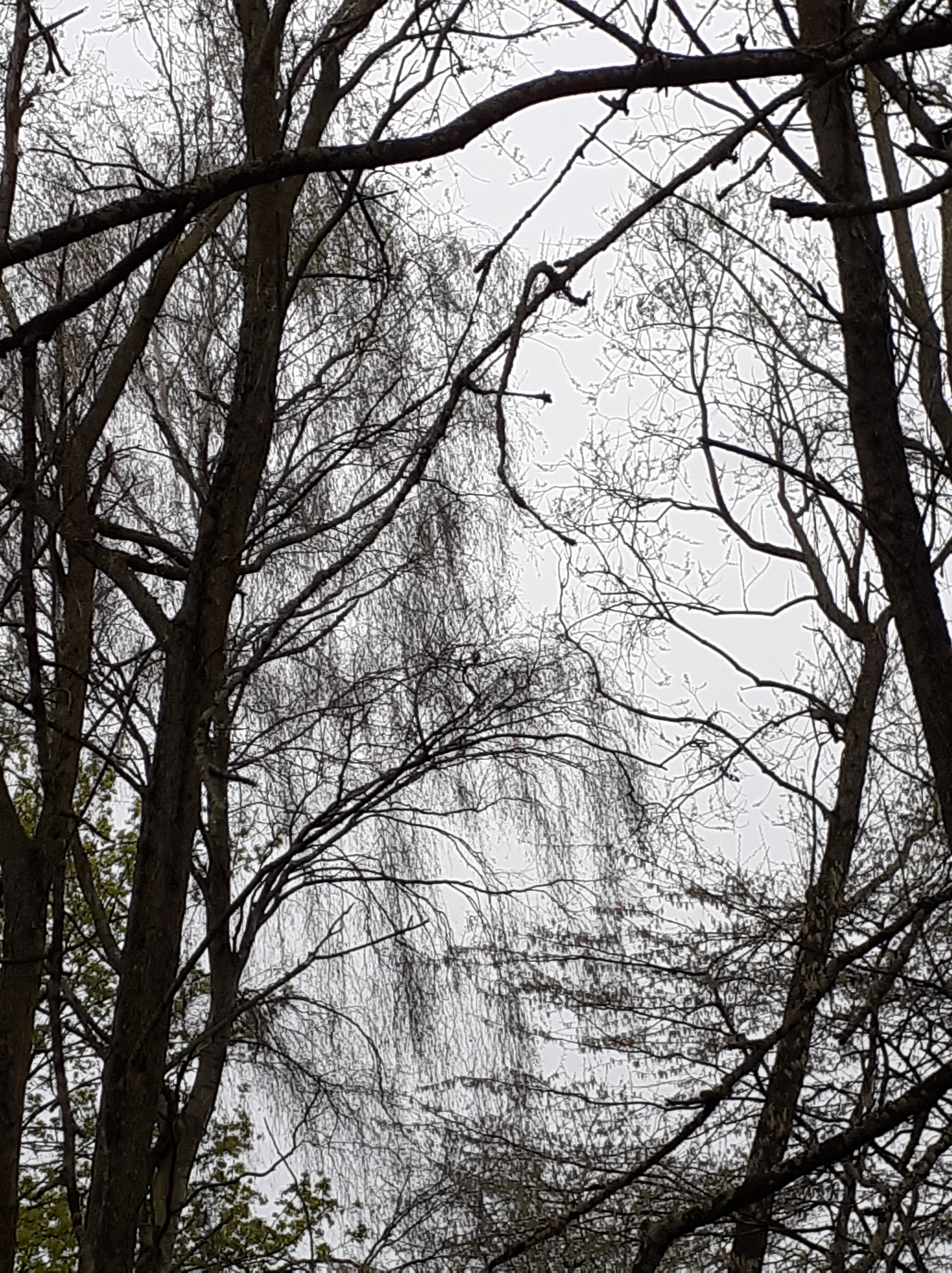
I look at the picture with fresh eyes. It is already a record of the past, and it is much too still. Yet I feel drawn towards this image. I enjoy the tree shapes in their starkness. I sense resilience in the plant life pictured here. I am writing now with sunlight intermittently on my shoulder, and the sounds of wind and rain beyond my strong glass doors.
I am also reflecting on writing as a practice. Natalie Goldberg (1,2) writes books about this and her description of ‘writing practice’ seems to me to have two entirely compatible meanings. The first is that it trains people for the writing of poems, stories and novels. The second points to a form of life practice flowing from the view that “writing is the crack through which you can crawl into a bigger world, into your wild mind” (1).
In Wild Mind: Living the Writer’s Life Natalie Goldberg compares writing practice with journaling. “Journal writing has a fascination with the self, with emotion and situation. It stops there. Writing practice lets everything else run through us; in writing practice, we don’t attach to any of it. We are aware that the underbelly of writing is non-writing. Journal writing seems to be about thought, about rumination and self-analysis. … We want to get below discursive thought to the place where mind – not your mind or my mind but mind itself – is original, fresh. It’s not you thinking. Thoughts just arise impersonally from the bottom of our minds. That is the nature of mind – it creates thoughts. It creates them without controlling them or thinking them … Writing practice knows this, knows how we are not our thoughts, but lets the thoughts, visions, emotions run through us and puts them on the page.” (1)
In her earlier book, Writing Down the Bones: Freeing the WriterWithin, Natalie Goldberg quotes Jack Kerouac as saying that a writer should be ‘submissive to everything, open, listening’. She also recommends that “we stay in the trenches with attention to detail”, avoiding escape into abstraction. She points to poetry in particular, “because it brings us back to where we are. It asks us to settle inside ourselves and be awake”. She reproduces the famous William Carlos Williams poem:
“So much depends
upon
a red wheel
barrow
glazed with rain
water
beside the white
chickens.”
I remember this poem from my childhood. I liked it a lot, but couldn’t find anything to say about it in the class room when it was expected that I would. I was embarrassed then. I wouldn’t be now.
Natalie Goldberg also practices Zen Buddhism, with Katagiri Roshi until his death and more recently as an ordained member of the Order of Interbeing founded by Thich Nhat Hanh. She acknowledges the role of Zen in developing her insights into the creative process. I find her approach, including her practical exercises, very helpful.
(1) Natalie Goldberg Wild Mind: Living the Writer’s Life New York, NY: Open Road Integrated Media, 2011 (first published 1990)
(2) Natalie Goldberg Writing Down the Bones: Freeing the Writer Within Boulder, CO: Shambhala, 2016 (30th anniversary edition)
Matsuo Basho The Narrow Road to the Deep North and Other Travel Sketches London: Penguin Books, 1966 (translated with an introduction by Nobuyuki Yuasa)
The introduction names Matsuo Basho (1644-94) as one of the greatest figures in Japanese literature, and describes his life and work. A younger son of a minor samurai family, at nine years old he was sent to the Todo family as page and study-mate for Yoshitada, its eleven year old heir. Yoshitada, born with a delicate constitution, was more interested in literary than in military arts, and he and Basho studied the fashionable art of linked verse under the poet Kigin.
When Yoshitada died at the age of 25, Basho left the service of the Todo family by running away to Kyoto where he spent five years studying Japanese and Chinese classics at Buddhist temples. Later he based himself in the younger city of Edo (now Tokyo) where he felt greater freedom to find his own direction as a poet.
Dissatisfied with the, to him, superficial culture of Edo’s ‘floating world’, Basho turned to Zen and learned meditation from the Zen priest Buccho. Poetry still came first for Basho, but his understanding and practice changed. He wrote of his own work: “What is important is to keep our mind high in the world of true understanding, and returning to the world of our daily experience to seek therein the truth of beauty. No matter what we may be doing at a given moment, we must not forget that it has a bearing upon our everlasting self which is poetry”. Basho is a pen name, and the name of a species of banana tree about which Basho said: “the big trunk of the tree is untouched by the axe, for it is utterly useless as building wood. I love the tree, however, for its very uselessness … I sit underneath it, and enjoy the wind and rain that blow against it”.
Discussing the relationship between the poet and nature, he wrote: “go to the pine if you want to learn about the pine, or to the bamboo if you want to learn about the bamboo. And in doing so, you must leave your subjective pre-occupation with yourself. Otherwise you impose yourself on the object and do not learn. Your poetry issues of its own accord when you and the object have become one – when you have plunged deep enough into the object to see something like a hidden glimmering there. However well phrased your poetry might be – if the object and yourself are separate – then your poetry is not true poetry but merely your subjective counterfeit.”
By the time Basho came to write travel sketches, mixing haiku and prose in the genre known as haibun, he had spent some years casting away his material attachments. Now he had “nothing else to cast away but his own self which was in him as well as around him. He had to cast this self away, for otherwise he was not able to restore his true identity (what he calls ‘the everlasting self which is poetry’ in the passage above). … He left his house ‘caring nought for his provisions in the state of sheer ecstasy'”.
I love the haiku at the top of this post. I love the freshness and naturalness of the priest’s encounter with a flower that is steeped in the formal (and auspicious) symbolism of both Buddhist tradition and Japanese national culture, but is offered here in its simple yet extraordinary essence.
I cannot claim real understanding of traditional Japanese Zen culture and its relationship to creative arts. I have a smattering of knowledge and an awareness of some principles. But I am sure that much is lost in translation. What I do have is the capacity to open myself up to the words and images. Here I find the resonance of a richer experience of being, better grounded whilst also more spacious.
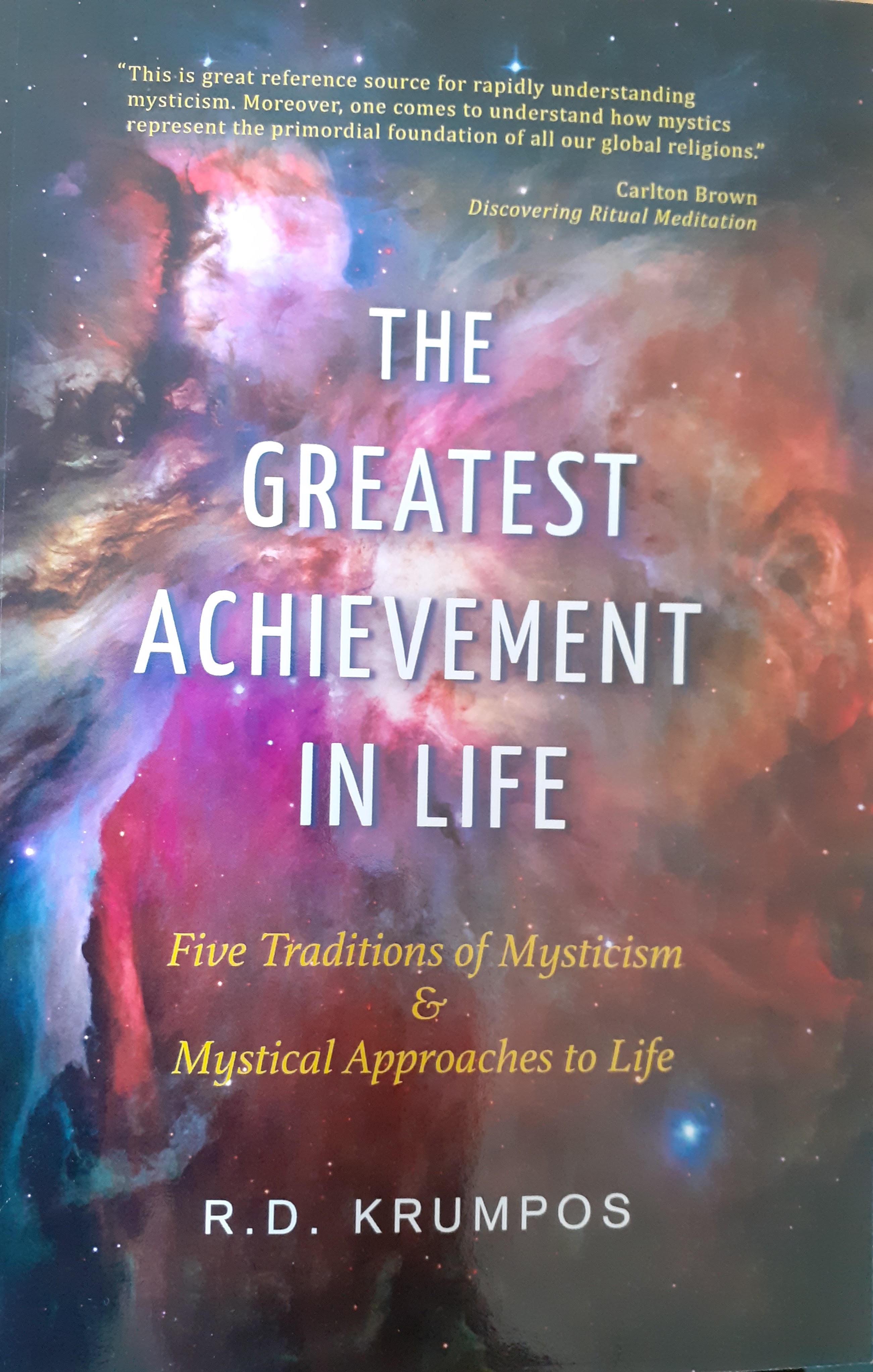
Highly recommended for anyone drawn to contemplative and mystical traditions. R. D. Krumpos’ The Greatest Achievement in Life: Five Traditions of Mysticism & Mystical Approaches to Life (1) is now available in print, in a new revised edition. I like having it now as an old-fashioned physical book that I can leaf through easily both for reference and for inspiration.
The book explores the mystical traditions embedded within Hinduism (Vedanta, Tantra), Buddhism (Zen, Vajrayana), Judaism (Hasidism, Kabbalah), Christianity (Gnostic and Contemplative currents) and Islam (Sufism). Krumpos shows how, underneath their manifold differences, they share an understanding of mysticism as the direct intuition or experience of God, or of an ultimate Reality not conceived as God.
Mystics are described as people whose spiritual lives are grounded “not merely on an accepted belief and practice, but on what they regard as first-hand knowledge”. Krumpos spells out the uncompromising idealism of this project. “Mysticism is the great quest for the ultimate ground of existence, the absolute nature of being itself. True mystics transcend apparent manifestations of the theatrical production called ‘this life’. Theirs is not simply a search for meaning, but discovery of what is i,e, the Real underlying the seeming realities. Their objective is not heaven, gardens, paradise or other celestial places. It is not being where the divine lives, but to be what the divine essence is here and now”.
The book is divided into two main sections: Five Traditions of Mysticism and Mystical Approaches to Life. Within these sections there is a further division into short essays, which can be read either in sequence or independently of the whole. The essays are based both on conversations with mystics and engagement with mystical literatures. Krumpos draws directly on the words of well-known mystics themselves, with 120 quotations interspersed with the essays. He also offers his own commentary and reflections. The book can either be seen as a source and reference book, or as a practitioner aide. It includes sentences and paragraphs that can themselves be used as a basis for formal contemplation. It is not just an ‘about’ book, though it serves that purpose well.
The traditions presented are seen as having much in common at the core, and The Great Achievement bears witness to that commonality. Yet there is enough interior diversity to make it clear that mystics in these traditions are not all the same, or saying the same thing, in the way that is sometimes lazily claimed. Overall Ron Krumpos’ sense of ‘direct experience’ and his definition of gnosis describe a gold standard for what ‘the greatest achievement’ is, based on the accounts of the mystics cited and discussed. In the second half of this book, the focus valuably shifts from the nature of mystical experience itself, to a consideration of its implications for how to live and serve.
For me, the cultural moment in which The Great Achievement has been offered is significant one. Perennialism’s ideas have been popularised and repackaged over the period since World War II at an ever increasing rate. There is now an extraordinary global spiritual hunger at least partly influenced by the spiritual paths that it includes – some, indeed, speak of a ‘spiritual market place’. This is a promising development, yet one with its downside. Krumpos’ work reminds us what these older traditions are and where they stand. For readers in new (or new-old) spiritual traditions with a different approach, the book offers opportunities for comparing and contrasting the fruits of the five traditions with those of their own chosen paths. Krumpos does acknowledge the value of shamanic and indigenous traditions, and practitioners within these traditions, reading this book, might be inspired to develop this conversation further.
(1) R. D. Krumpos The Greatest Achievement in Life: Five Traditions of Mysticism & Mystical Approaches to Life Tucson, AZ: Palomar Print Design, 2022. (Originally a free e-book available from http://www.suprarational.org/ as a printable pdf, published in 2012).
NB This review is a revision of my review of the original edition. See:
“Just as a wave doesn’t need to go looking for water, we don’t need to go looking for the ultimate. The wave is the water. You already are what you want to become. You are made of the sun, moon and stars. You have everything inside you.”
If I had authored the words above, they would be a clear statement of my stance as a modern Druid. In fact they were written by the Vietnamese Zen monk and peace activist Thich Nhat Hanh, who has spent the latter part of his life making Buddhism accessible to westerners. For me, this shows the wider resonance of his core understanding. Indeed he continues by using the language of a third tradition – the best known to most westerners – to develop his theme.
“In Christianity there is the phrase, ‘resting in God’. When we let go of all seeking and striving, it is as if we are resting in God. We establish ourselves firmly in the present moment; we dwell in the moment. We rest in our cosmic body. Dwelling in the ultimate doesn’t require faith or belief. A wave doesn’t need to believe it is water. The wave is already water in the very here and now.
“To me, God is not outside us or outside reality. God is inside. God is not an external entity for us to seek, for us to believe in or not to believe in. God, nirvana, the ultimate, is inherent in every one of us. The Kingdom of God is available in every moment. The question is whether we are available to it. With mindfulness, concentration and insight, touching nirvana, touching our cosmic body or the Kingdom of God, becomes possible with every breath and every step.”
Thich Nhat Hanh The Art of Living London: Penguin Random House UK, 2017
Shakuhachi flute music is a meditation for players and listeners alike. It is dance of sound and silence, of movement and stillness. Some people call it, ‘blowing Zen’. In this music, a rise and fall of notes gives way to space and stillness, which in turn give way to a rise and fall of notes. Eckhardt Tolle identifies shakuhachi flute music as a portal to the experience of consciousness being conscious of itself – and so a direct realization of what he calls the Deep I.
Bamboo flutes first came to Japan from China in the 7th century CE (1). The current shakuhachi was developed in Japan in the16th century. It is called fuke shakuhachi because of the instrument’s role in the Fuke sect of Japanese Zen Buddhism. Monks known as komusu (priests of nothingness, or emptiness monks) who used the shakuhachi as a spiritual tool. Their songs were paced according to the players’ breathing and were considered meditation as much as music.
Their spiritual practice required them to move from place to place playing the shakuhachi and begging for alms. The monks wore wicker baskets over their heads, as a symbol of their detachment from the world. But the world being the place that it is, it was more like a semi-detachment. Travel around Japan was restricted by the Shogunate at that time, and the Fuke only got their exemption by agreeing to spy for the authorities and allowing the Shogun to send out his own spies in the guise of Fuke monks. In response to these developments, several particularly difficult shakuhachi pieces became known as tests. If you could play them, you were a real Fuke. If you couldn’t, you were probably a spy and might very well be killed in unfriendly territory. With the Meiji Restoration, beginning in 1868, the Fuke sect was abolished along with the Shogunate itself, and shakuhachi playing was banned for a number of years.
The Wikipedia article on shakuhachi (1) provides information about the instrument and its capabilities, as well as its current international popularity and the formal link with Zen broken.. There is an International Shakuhachi Society which maintains a directory of notable professional, amateur and teaching shakuhachi players.
The Greatest Achievement in Life is a free e-book available from http://www.suprarational.org/ as a printable pdf, published in 2012. Author R. D. Krumpos looks at five traditions of mysticism, in which mysticism is understood as a direct intuition or experience of God, or of an ultimate Reality not conceived as God. Mystics are described as people whose religion and life are grounded “not merely on an accepted belief and practice, but on what they regard as first-hand knowledge”. Krumpos himself speaks of finding that “preeminent Reality is the holy One in All and All in the wholly One”.
The five mystical traditions examined are those embedded within Hinduism (e.g. Vedanta, Tantra), Buddhism (Zen, Vajrayana), Judaism (e.g. Hasidism, Kabbalah), Christianity (e.g. Gnostic and Contemplative currents) and Islam (e.g. Sufism). I imagine that many people reading this blog will be working outside these traditions. But I recommend the book to anyone with a serious interest in mysticism, however you define it, given that the influence of these traditions is pervasive to the point where it can be virtually unconscious. As a person on a modern Druid path committed to inquiry and with a leaning towards mysticism, I have found Krumpos’ work very helpful in reminding myself of what the ‘five traditions’ are pointing to.
The book is brief and divided into two main sections: Five Traditions of Mysticism and Mystical Approached to Life. Within these sections there is a further division into short chapters, which can be read either in sequence or independently of the whole. Krumpos draws heavily on the words of well-known mystics themselves, as well as offering his own commentary and reflections. The book can either be seen as a source and reference book, or as a practitioner aide. It includes sentences and paragraphs that can themselves be used as a basis for formal contemplation. It is not just an ‘about’ book, though it serves that purpose well.
The traditions presented are seen as having much in common at the core, and The Great Achievement bears witness to that commonality. Yet there is enough interior diversity to make it clear that mystics in these traditions are not all the same, or saying the same thing, in the way that is sometimes lazily claimed. Overall Ron Krumpos’ sense of ‘direct experience’ and his definition of gnosis describe a gold standard for what ‘the greatest achievement’ is, based on the accounts of the mystics cited and discussed. In the second half of this book, the focus valuably shifts from the nature of mystical experience itself, to a consideration of its implications for how to live and serve.
For me, the cultural moment in which The Great Achievement has been offered is significant one. Perennialism’s ideas have been popularised and repackaged over the period since World War II at an ever increasing rate. There is now an extraordinary global spiritual hunger at least partly influenced by the spiritual paths that it includes – some, indeed, speak of a ‘spiritual market place’. This is a promising development, yet one with its downside. Krumpos’ work reminds us what these older traditions are and where they stand. For readers in new (or new-old) spiritual traditions with a different approach, the book offers opportunities for comparing and contrasting the fruits of the five traditions with those of their their own chosen paths. Krumpos does acknowledge the value of shamanic and indigenous traditions, and practitioners within these traditions, reading this book, might be inspired to develop this conversation further.
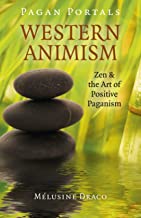
Western Animism: Zen and the Art of Positive Paganism. Highly recommended.
Melusine Draco is an established Pagan author, here writing mostly about Japanese culture. She draws on her Shinto upbringing by her father, a martial arts instructor and countryman. She contrasts the Abrahamic stigmatisation of Paganism and Animism in the West with the peaceful co-existence of Buddhism and Shinto in Japan, to the point where the line between them can be “decidedly hazy”. She suggests that the Japanese approach makes positive spirituality and living easier. All it really takes is “time to appreciate white clouds against the bright blue of a winter sky; the whisper of falling rain; the aroma of freshly baked bread … if we make a practice out of seeking out the positive, we tend to find it everywhere – even on ‘bad, black dog days’ when we can still hear water dreaming, or listen to the stones growing”.
In five relatively brief chapters, Melusine Draco covers a great deal of ground. She discusses Ki, “the unseen life force in our body and everywhere”, and the sense that there is no dividing line between the divine and human. She describes Kami, “the most ambiguous of spirits” and talks of “sermons in nature”. She describes a Zen teacher who, at the beginning of a lecture, paused to listen to a songbird outside the window, and then dismissed the class. She explains Kensho moments, sudden insights and awakenings that help us on our way. Exercises to facilitate such moments are scattered through the book.
Draco evokes a culture that celebrates life and its transience; stylises and thus sacralises everyday skills and activities; and pays respectful attention to nature, including Kami. Religion itself is based on respect rather than faith. Drawing on these riches, Draco suggests an alternative wheel of the year inspired by Japanese festivals and adapted for the West. A chapter on the Zen garden includes a wider discussion of sacred space and the use of plants. Her final chapter looks at Zen arts and aesthetics – including wabi-sabi, “defined as the beauty of things ‘imperfect, impermanent and incomplete’”. It also covers a Japanese view of concentration, meditation, contemplation, and the differences between them. For Draco, “contemplation is that state of consciousness which brings clairvoyant power. It must, because the basis of contemplation is a clairvoyant perception, a kind of spiritual intuition”.
Anyone interested in Japanese spirituality, and willing to be inspired by it, would benefit from reading this book.
Melusine Draco Western Animism: Zen and the Art of Positive Paganism Winchester UK & Washington USA: Moon Books, 2019 (Pagan Portals series)
Winter in the Wildwood Tarot lasts from Samhain (1 November) to Imbolc (1 February), whereupon the spring quarter begins. The hooded man, hermit of this deck, is shown as solstice figure whose influence pervades the whole winter. The image depicts a hooded figure, staff in the left hand and lantern in the right, standing by a great oak tree. The lantern illuminates a door in the tree, which itself suggests, through cracks in its timbers, an illuminated space inside. A wren sits on a stone nearby.
There is power in this image. The world tree, standing for life and wisdom, is both source and refuge. The hooded hermit seems to model intention and training, and his lantern and staff are potent tools. The wren once won a contest to be king of the birds by riding on the back of an eagle and thus flying highest. An animal ally, perhaps.
The face of the hooded hermit is hidden: no visible sign of a forest rebel; no sign, specifically, of a man. Does this suggest a talent for invisibility or shape-shifting? Perhaps. But what I chiefly sense is a Zen emptiness, of which Thich Nhat Hanh (2) says: “At first, we think emptiness is the opposite of fullness but, as we saw earlier, emptiness is fullness. You are empty of your separate self, but full of the cosmos.” According to another Zen writer (3), “the Buddha called himself tathagata or ‘that which is thus coming and going’ …a flowing occurrence, and the outward form ,,, was constant, calm, compassionate availability to people who came to him for help.”
I am not a Buddhist and I do not seek to appropriate the hooded hermit for Buddhism. Similar ideas about the emptying out of personality to make room for a greater life can be found in Taoism (4) and Douglas Harding’s Headless Way (5). There’s a reminder here that path and goal are one, and that an emptied fullness of experiencing is available at any point of the journey.
(1) Mark Ryan & John Matthews The Wildwood Tarot Wherein Wisdom Resides London: Connections, 2011. Illustrations by Will Worthington
(2) Thich Nhat Hanh The Other Shore: A New Translation of the Heart Sutra with Commentaries Berkeley, CA: Palm Leaves Press, 2017
(3) Ben Connelly Inside Vasubandhu’s Yogacara: A Practitioner’s Guide Somerville, MA: Wisdom Publications, 2016
(4) Lao Tzu Tao Te Ching: A Book about the Power and the Way Boston & London: Shambhala, 1998 (A new English version by Ursula K. Le Guin, with the collaboration of J.P. Seaton, Professor of Chinese, University of North Carolina, Chapel Hill)


 Contemplative Inquiry