Contemplative Inquiry

This blog is about contemplative inquiry

Tag: Witchcraft

BOOK REVIEW: SULIS, SOLAR GODDESS OF THE SPRING WATERS
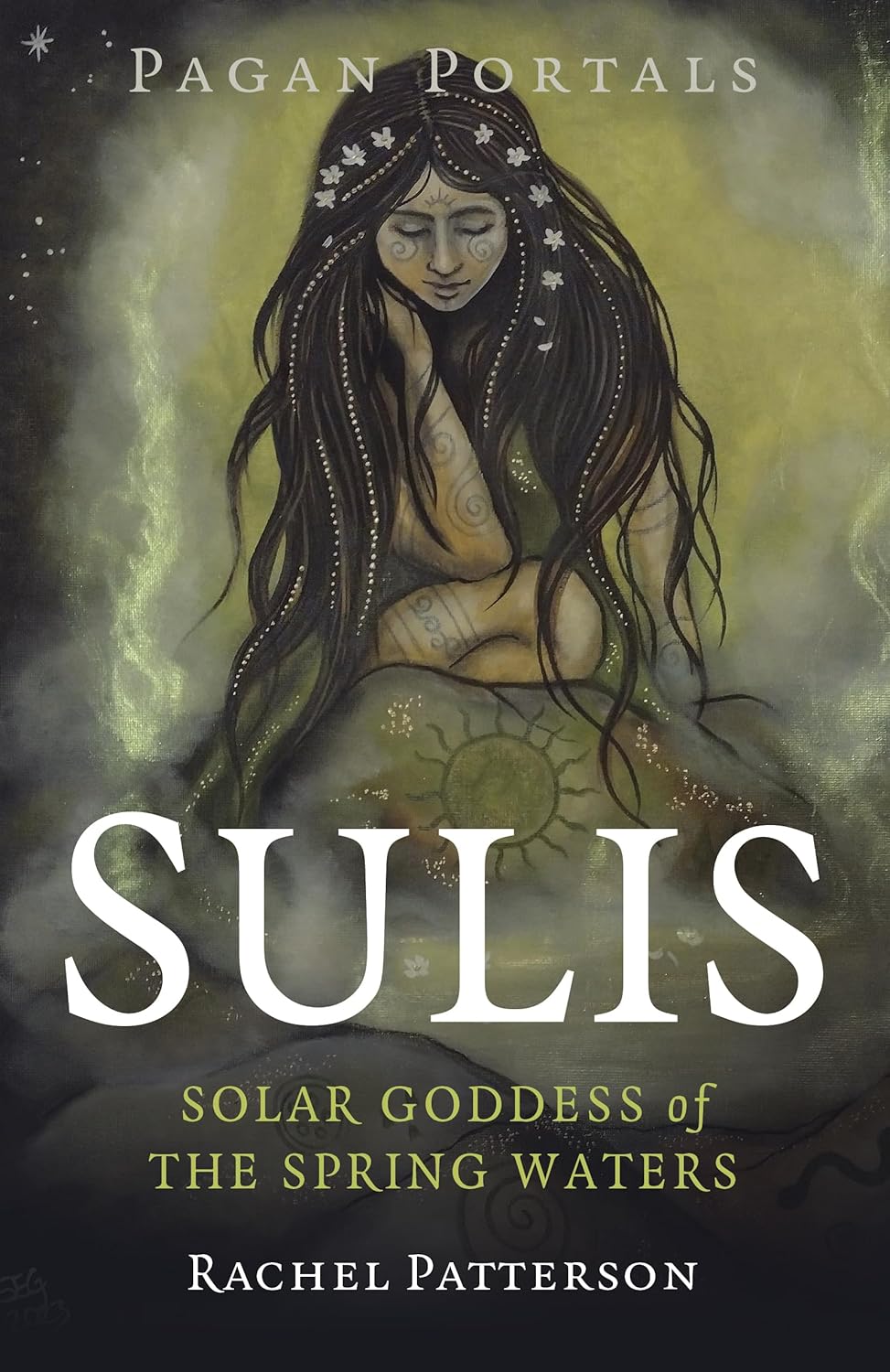
Recommended especially to two overlapping groups: first, readers interested in Sulis (later Sulis-Minerva) the presiding deity of the hot springs at Bath, UK; second, readers interested in polytheist Paganism in Britain, both ancient and modern. Author Rachel Patterson describes her heart as that of an English Kitchen Witch and her craft “a combination of old religion witchcraft, Wicca, hedge witchery and folk Magic”. Hence in this book she focuses not only on the history of Sulis and her springs but also on how to work with Sulis today.

The hot springs at Bath are the only ones in the country, appearing after the last Ice Age around 12,000 years ago. The people who re-settled the land as hunter gatherers began leaving offerings at the springs around 9,500 years ago. They continued to do so for several thousand years until the appearance of farming. We have no record of their beliefs, but for them the numinous power may well have been the living presence of the springs themselves, rather than a presiding deity.

The farmers, when they came, seem to have left the springs alone. But early in the first century CE a causeway of gravel and mud was placed in the main spring pool. Offerings were made, principally of coins minted by the local Celtic tribe, the Dobunni. Pottery was also found but there were no buildings. In 43 CE the Romans invaded Britain and quickly established themselves in the south. The Dobunni chose peace and an accommodation with the Romans, who soon created a spa, building on top of the natural springs. They adopted the local goddess Sulis, now to be known as Sulis Minerva. A town gradually grew up, named Aquae Sulis (The Waters of Sulis). A temple and sanctuary began to be built in 70 CE. The baths are now well-kept after an up-and-down history, and are open to visitors. See http://www.romanbaths.co.uk.

Rachel Patterson describes how the temple worked in the Roman period. Many of the extant records are written curses from people whose clothes and possessions were stolen while they bathed. They asked the Sulis for retributive action in return for offerings and the lost possessions themselves (1). Patterson also describes the decoration of the temple and artifacts from it. The best known was once called the gorgon’s head but is clearly the head of a male figure. He seems to be associated with a god named Belenus, who may in turn be connected with the legendary King Bladud included in Geoffrey of Monmouth’s History of the King’s of Britain (2,3).

The second half of Rachel Patterson’s book is about working with Sulis. It is a thorough and practical guide for readers who may want to go down that path. It includes sections on making candles and altars dedicated to Sulis; on finding Sulis; building a relationship with her; advice on oath-taking; and the development of rituals and meditations dedicated to her. There is relevant advice on the use of herbs, crystals, forms of divination, petitions and curses. There are sections on animal companions and (pigs and wild boar as the Celtic contribution, owls and dolphins related to Minerva). As a Kitchen Witch, Rachel Patterson also provides a number of recipes.

I have lived both the first and most recent 20 years of my life within a forty mile radius of Bath. I don’t go there very often. But I have known it from an early age and bathed in the waters during the more recent period. There is indeed something magical about them. So I’m glad to see Sulis taken more seriously. There is a familiar problem about limited information from the past and Rachel Patterson discusses this in her book But for me there is enough resonance from the old times, here, to dream the myth onwards. I can’t assess the practical guidance offered in Sulis: Solar Goddess of the Spring Waters because I don’t work in the same way. But I do know it is comprehensive and comes from a seasoned practitioner. It feels to me like a timely addition to the Pagan Portals series, and I am grateful to have it.

(1) Further information about religion in Roman Britain, and its rather transactional nature, can be found in Prof- Ronald Hutton’s Gresham College lecture on Paganism in Roman Britain. See https://contemplativeinquiry.blog/22/12/12/paganism-in-roman-britain/ – where a link to the lecture is provided,

(2) see picture and narrative at https://contemplativeinquiry.blog/2021/03/23/the-sacred-head-of-bladud/

(3) For creative treatments of the story of Bladud and the Goddess Sulis, see Kevan Manwaring’s account in The Bardic Handbook and two novels by Moyra Caldecott: The Winged Man and The Waters of Sul

HOW PAGAN WAS MEDIEVAL BRITAIN?

How Pagan Was Medieval Britain? is the sixth and final lecture in Professor Ronald Hutton’s Gresham College series on early Pagan history in Britain (1). The simple answer, according to Hutton, is: not as much as was widely believed in the twentieth century, by scholars and the lay public alike. Some thought that full medieval Christianity was an upper class faith, with commoners, especially in the countryside, being ‘cheerful semi-Pagans’, Christian by day and following the old ways by night. Others thought that the two religions ran in parallel, with the latter being necessarily clandestine whilst some of its iconography was visible. Green Man and Sheela na Gig images, often present in the churches themselves, seemed to indicate the survival of a Pagan sensibility at the very least – canny concessions by the Church to the people. Witch persecutions were seen as evidence of an active, surviving woman centred nature religion. Indeed, such ideas influenced cultural and religious developments in the twentieth century itself – specifically, the rise of neo-Paganism; more broadly, the Feminist and Green movements that were dynamically emerging at the time.

However, turning to the medieval period itself, Hutton, does not find evidence of actually existing Pagan religion in the available sources. Witch trials have been carefully examined in recent years, and the victims don’t fit the profile. In Anglo-Saxon times, the legal codes and church councils stopped bothering to forbid Christian converts their old ways by 800 CE. The prohibitions reappeared in the tenth century, in relation to Viking settlers, but ceased again by 1030 CE. In the later middle ages there was serious concern over Christian heretics (Lollards) and some concern over ale-house cynics expressing anti-religious views. In medieval society people tended be nosy about other people’s business and there was social pressure to conform. There are court cases that draw on this kind of informal surveillance, but none concerned with Pagan religious practice. Hutton traces Sheela Na Gig images to the Church in France, saying that they had an anti-erotic intent. Likewise, Green Man, Wild Man and Jack in the Green figures have specific historical origins not concerned with any Pagan deity. Hutton quite reasonably offers no comment on their widely perceived role as archetypal images, because these are outside the remit of the empirical historian. His focus is on self-defined and organised Pagan religion during a specific period in Britain.

But it is true, according to Hutton, that the medieval church offered religious continuity in other ways. The veneration of saints, who were very diverse and numerous, allowed polytheist habits of mind to continue, especially in the realm of petitionary prayer. Individual saints might be local, or specialists in specific forms of help. For many people they seemed more approachable than the persons of the trinity. However in Britain there seem to have been no saints who had themselves once been gods*. Likewise Christians had holy wells, but they were different from the old Pagan ones, rather than the same ones repurposed. The temple of Sulis Minerva at Bath, for example, was left alone. Few temples or ancient religious sites became churches, even though Pope Gregory had recommended this approach when he sent his mission to Kent in 597 CE.

Church attendance was not compulsory in the middle ages. It is estimated that only around 50% of parishioners attended regularly, though they did turn up in much larger numbers for the major festivals. During these, ‘secular revelry’ was allowed, even encouraged, and the festivals raised a lot money for Parish churches, enabling them at times to abolish Parish rates. This widely beneficial outcome was seen as ‘cheating the Devil’. Even on normal days, the Church offered spectacle – with the mass, libations and incense. Local priests came from the people, didn’t have to be literate, and didn’t have to preach. That was done by specialist friars with notable performance skills, often very popular. Additionally, many people belonged to guilds linked to their churches, usually focused around a saint. There were lay religious guilds for both women and men, which had a variety of purposes, officered by their own lay members. Craft guilds performed plays at festival times. This form of Christian culture lasted in Britain until the middle of the sixteenth century, when the old church fragmented into a plurality of new ones over hard-fought time. Different kinds of Christian culture, generally even less Pagan friendly, emerged.

(1) https://www.gresham.ac.uk/watch-now/medieval-pagan/

* An exception would be the Gaelic speaking areas in Scotland and Brighid

BOOK REVIEW: CERRIDWEN CELTIC GODDESS OF INSPIRATION

Highly recommended. Cerridwen: Celtic Goddess of Inspiration (1) is by Kristoffer Hughes, Chief of the Anglesey Druid Order (2) and a prominent figure in modern Druidry and Paganism. His aim in this book is to “provide you an in-depth exploration of Cerridwen, where she came from, the landscape and peoples that perpetuated her, and who she is today”.

Hughes, born in Anglesey and a first language Welsh speaker. is a scholar and practitioner of his inherited tradition. He has also embraced Druidry as an international movement within modern Paganism. He is at ease, too, with the Cerridwen of modern witchcraft. His whole stance is one of cultural generosity and active support for “appropriate appropriation”.

In its quest for Cerridwen, the book combines close reading of Bardic texts dated from the post-Roman period to early modernity; personal sharing of Hughes’ own path; and opportunities for experiential work. Like many people, my introduction to Cerridwen was through Charlotte Guest’s English version of the late-appearing Hanes Taliesin (Hughes provides his own version early in the book). This shows Cerridwen as a noblewoman skilled in the magical arts, not a Goddess. Like many people, I assumed that this was a demotion going back to the Roman period or the coming of Christianity. Hughes does not share this view. He cannot find Cerridwen among the goddesses of Celtic antiquity, but he welcomes her recent apotheosis within neo-Paganism and witchcraft. He is a devotee himself, and writes: “the New Age traditions, whilst inspired by the distant times, do not need or require to be authenticated by the past; it is a living, breathing spirituality … if it works, keep doing it, and the more you do it, the more life you breath into it”.

Hughes sketches out Cerridwen’s history in the early written material. Sometimes her presence is only implicit – glimpsed, perhaps, as the Annuvian sow (hwch) who guides the magician Gwydion to the base of the world tree in the fourth branch of the Mabinogion. Sometimes we find her lauded and identified as the Mam yr Awen (mother of the Awen). Later, after Wales’ loss of independence and the decay of the Bardic tradition, we find her stigmatised as an evil hag with her connection to Awen erased. But when we come to the Hanes Taliesin, her connection to Awen, and to the initiation of Taliesin (radiant brow) is plain and clear. Her best time is now, though her modern strength lies largely outside her country of origin.

For Hughes, Cerridwen (pronounced Ker ID ven) is a goddess “of angular, bending magic”, and her cauldron is “a vessel of inspiration, a transformative device, a vessel of testing”. This Cerridwen is “the divine conduit of transformative, creative, magical inspiration gleaned from the cauldron of Awen”. Awen itself is “the creative, transformative force of divine inspiration that sings in praise of itself; it is the eternal song that sings all things into existence, and all things call to Awen inwardly”. Gwion, who tastes the three drops distilled from the cauldron in Hanes Taliesin, after a series of further trials becomes Taliesin, “the outward expression of the power, magic and action of the Awen”, indicated by his radiant brow. The final section of the book, Stirring the Cauldron: Ritual and Practise, offers readers a chance to meet Cerridwen and work with her Bardic mysteries themselves.

As issues relevant to Cerridwen and what she stands for, the book looks at the meaning of annwfn and its denizens the andedion. ‘Underworld’ and ‘Otherworld’ are not quite accurate as descriptors, and the andedion, though different from us, are not best thought of as ‘supernatural’. Hughes also explains that medieval Wales, except to a limited extent in the border counties, did not share in the English and continental persecution of witches. Swyngyfaredd (enchantment/sorcery/magic) was part of life and its practitioners respected. This changed only with the early modern Anglicisation of culture. Hughes also includes a chapter on Iolo Morganwyg (Edward Williams, 1747-1826) and his ‘awen-filled legacy’. It was he who invented the awen symbol /|\ and much else in modern Druid and Bardic culture. He is often remembered as a literary forger because he presented his contributions as a rediscovery of lost texts. They nonetheless revitalised a dying culture at a time when sensibilities were changing again, and becoming more receptive to the value of old traditions.

With all these riches, Cerridwen: Celtic Goddess of Inspiration is a must-read for anyone with a serious interest in modern Druidry.

(1) Kristoffer Hughes Cerridwen: Celtic Goddess of Inspiration Woodbury, MN: Llewellyn Publications, 2021

(2) http://www.angleseydruidorder.co.uk/

BOOK REVIEW: WITCHCRAFT TODAY – 60 YEARS ON

jhp530b85f08e66fThis is a timely addition to Pagan literature, highly recommended to anyone interested in the modern heritage of witchcraft, paganism and new (or new old) spiritual movements more generally. This book celebrates the 60 years since the publication of Gerald Gardner’s Witchcraft Today in 1954, affirming the confidence, dynamism and increasing openness of this growing tradition from a diverse range of insider perspectives.

The book is divided into two parts. The first, ‘Forms, Themes and Values’, begins with an account by Philip Heselton of how Gardner came to write Witchcraft Today. It goes on to look at ten specific forms of modern witchcraft that diverge from Gardner’s own, starting with Alex Sanders and going on to look at more radical departures like  Seax Wica and the feminist Dianic tradition. Some of the other paths described are less formal and ceremonial than the original models. Some are group based and others solitary.

Some can be distinguished from witchcraft altogether (the Egyptian Magical Tradition and Hekatean practice based on the approach of the Chaldean Oracles, to name two). The same issue arises at the end of the book, where a contributor talks about a journey through an Ovate Grade training in the Order of Bards, Ovates and Druids (OBOD).  In each case, it matters to the practitioner that they are practising these traditions as a form of witchcraft.  Their inclusion in the book affirms the value of self-identification in spirituality and adds to an overall feel of inclusiveness. Any question would be about the potential weakening of the term witchcraft itself, in a context of such porous boundaries.

Part 1 also includes a chapter on the male experience of witchcraft and ends with one on ‘Witchcraft Tomorrow’ by David Salisbury, which demonstrates optimism about future possibilities and explores the issues of community building and leadership. Common themes in Part 1 include tensions between ‘preservation’ and ‘invention’ in lineage development, and ways of reconciling them. Common values include an avoidance of evangelism and a commitment to the ultimate autonomy of the practitioner.

Part 2, ‘Journey on a Crooked Path’, presents ten personal journeys.  It is particularly good at describing the ways in which people sense unmet spiritual needs in early life and make the connections (through reading, significant life events or personal encounters) that lead them on to their chosen paths. Throughout the book, there’s the sense of person and path choosing each other. They know when it’s right – and often have to go to some trouble to find their home.  The finding is reflected in the enthusiasm and commitment of the many people who have contributed to this valuable book.

Earth Eclectic

music that celebrates Earth and speaks to the heart

Sarah Fuhro Star-Flower Alchemy

Follow the Moon's Cycle

Muddy Feet

Meeting nature on nature's terms

Rosher.Net

A little bit of Mark Rosher in South Gloucestershire, England

Becoming Part of the Land

A monastic polytheist's and animist’s journal

selkiewife

Selkie Writing…

Charlotte Rodgers

Images and words set against a backdrop of outsider art.

Prof Jem Bendell

living with metacrisis and collapse

Towint

The pagan path. The Old Ways In New Times

The Druids Garden

Spiritual journeys in tending the living earth, permaculture, and nature-inspired arts

The Blog of Baphomet

a magickal dialogue between nature and culture

This Simple Life

The gentle art of living with less

Musings of a Scottish Hearth Druid and Heathen

Thoughts about living, loving and worshiping as an autistic Hearth Druid and Heathen. One woman's journey.

Wheel of the Year Blog

An place to read and share stories about the celtic seasonal festivals

Walking the Druid Path

Just another WordPress.com site

anima monday

Exploring our connection to the wider world

Grounded Space Focusing

Become more grounded and spacious with yourself and others, through your own body’s wisdom

The Earthbound Report

Good lives on our one planet

Hopeless Vendetta

News for the residents of Hopeless, Maine