Contemplative Inquiry

This blog is about contemplative inquiry

Tag: Wisdom

DEEP AUTUMN 2025

“All things ripen and rot that rose up at first,

And so the year runs away in yesterdays many,

And here winter wends again, as by the way of the world it ought,

Until the Michaelmas moon has winters boding brought.” (1)

Even today, deep autumn opens the door to winter. This was even more the case in the North Staffordshire and Derbyshire regions of 14th century England, where Sir Gawain and the Green Knight was written. Even in castles, people were less sheltered from the growing cold and damp than we are. So readers and listeners of the period are reminded that the coming of winter is both natually and divinely ordained.

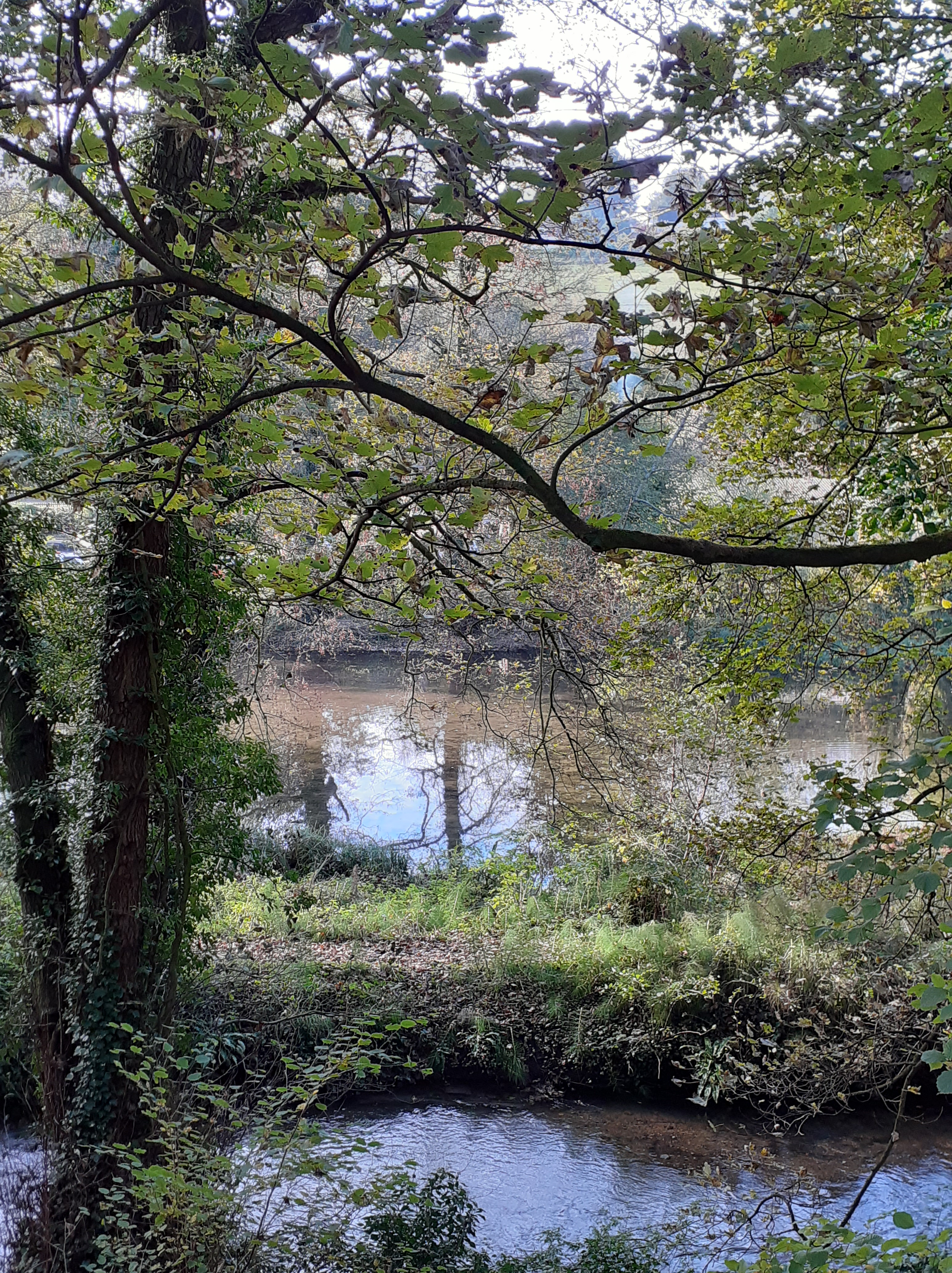
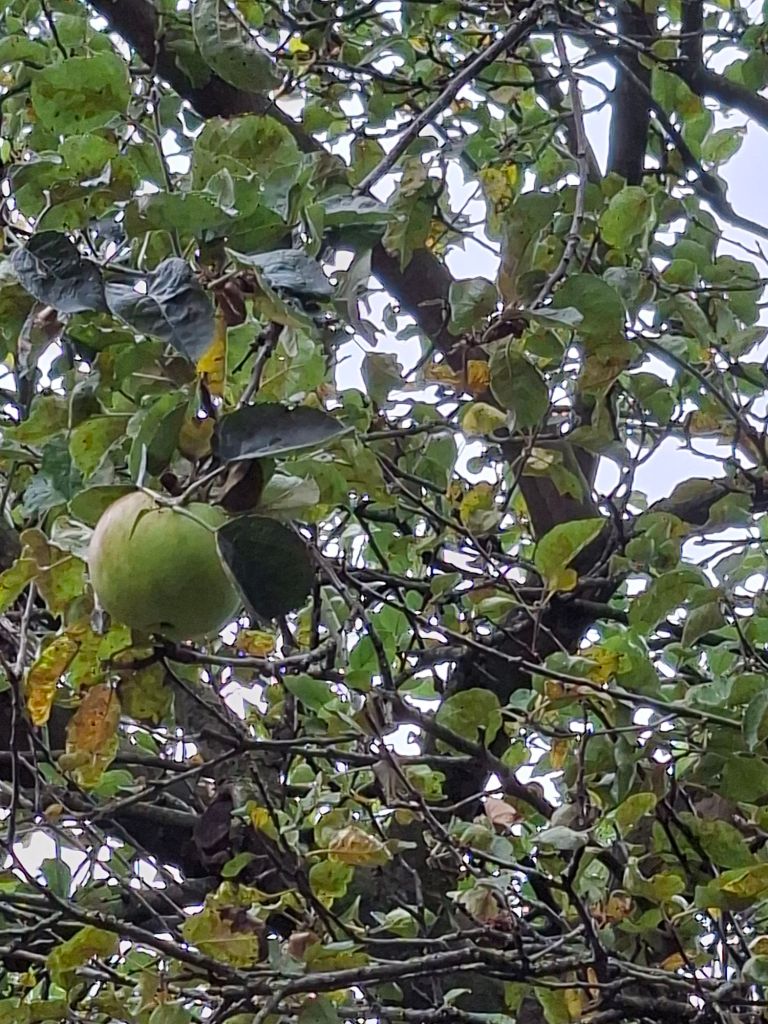
Here and now, the sight of the apple harvest in its later stages (pictured above) seems quite different than in the early ones (2) – less bright, less novel, less shiny. Rotting apples lie on the ground, now fallen outside the wall of  Gloucester Cathedral’s orchard. From Nature’s exuberant perspective, this is all part of the plan.  Waste is built in.

This time draws me further into the declining year. I am in the cathedral’s  grounds, now looking at a yew tree and its associations with death. I’m thinking of the approach of Samhain (aka Halloween/All Hallows) at the turn of the month. Once it marked the 3rd harvest of the year – the blood harvest, where animals were slaughtered in preparation for winter. Now it is more a time to remember our ancestors, and our dead more widely.

Yet the seasonal moment, and the yew, can also be linked to wisdom and transformative change in life. I launched my contemplative inquiry at Samhain 2011. Like many people, I find that this period can be a resonant and creative time.

Below the yew, I have included a section of the cathedral itself. I have old personal associations linking medieval Gothic architecture with the feeling-tone of the declining year. I am also aware that this building is linked to the trees I picture and discuss. Gloucester Cathedral was a monastery when Sir Gawain and the Green Knight was written but many of its features were already in place.
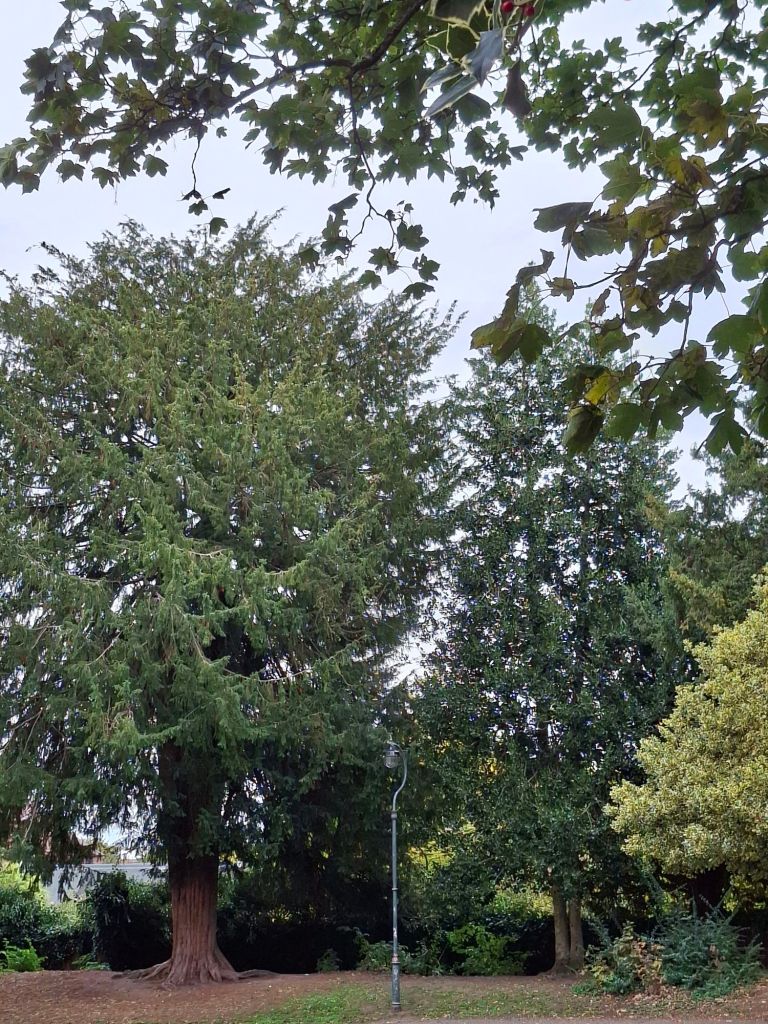
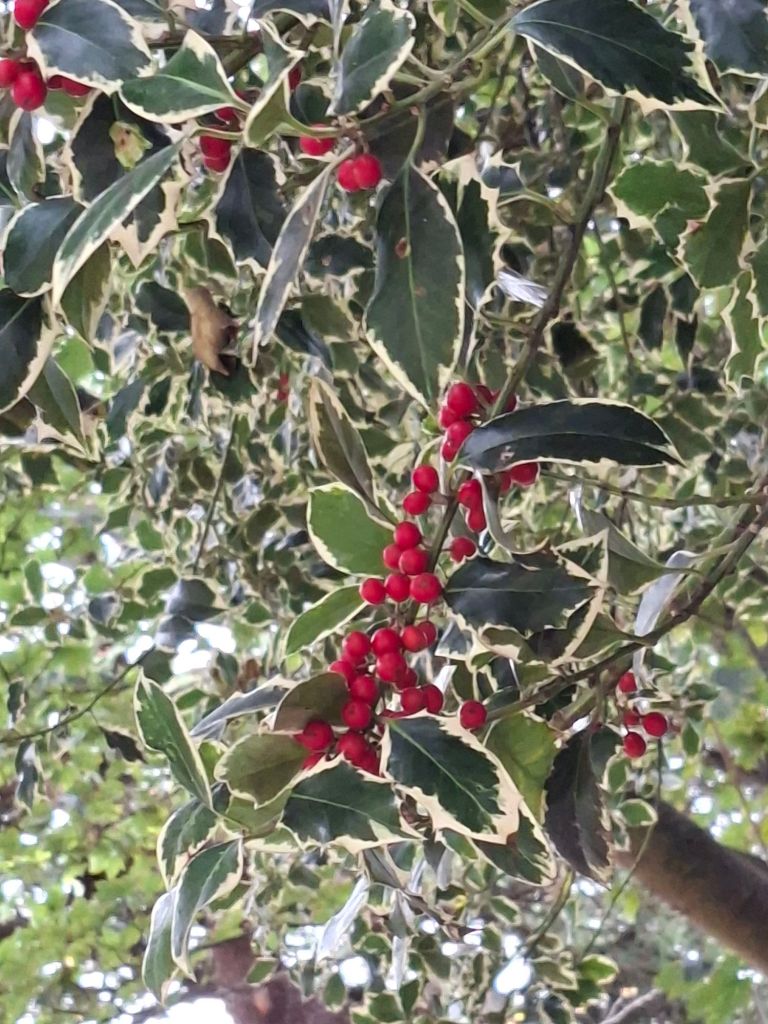
In the same space, I find both holly and ivy, with berries on the holly tree.  I immediately thought of the Christmas carol The Holly and the Ivy. It is an ancient folk carol, which interweaves Christian themes and others that belong with the land. The version which is now popular was collected by Cecil Sharp in 1909 in Gloucestershire from Mary  Clayton.

Many people think that the indigenous Pagan themes are the oldest, and that the central focus here is on the holly. The authors of The Green Man Tree Oracle say: “Holly’s connection with the Green Man is especially strong. In his guise as the Holly King – an ancient giant and symbol of fertility – the Green Man makes a notable appearance in the 14th century poem Gawain and d the Green Knight. Here he takes the form of a fearsome knight, who comes to King Arthur’s court to offer a midwinter challenge, carrying a club of holly and wearing a holly crown (as symbols of his true identity).” This challenge happens every year, where the Green Man/Holly King demands that we encounter him through our dealings with the natural world.

Elaine and I went to the Gloucester Cathedral Close and its surroundings on Saturday afternoon 18 October to outrun an  extended period of gloom, wind and rain. We are now in it, so the lessons of the trees in deep autumn, anticipating the coming of winter, are not lost on us. The dark of the year is on its way.
(1) J.R R. Tolkien (translation of anonymous texts) Sir Gawain and the Green Knight, Pearl, Sir Orfeo New York: Ballantine Books, 1980.

(2) https://contemplativeinquiry.blog/2025/08/22/ (3rd photo)

(3) John Matthews & Will Worthington The Green Man Tree Oracle: Ancient Wisdom from the Greenwood London: Connections, 2003

EQUINOX TRANSITIONS 2023

I am grateful to the Druid community for its varied ways of working with the 8-fold wheel of the year – especially when the festivals are placed in the context of the gradually turning wheel. Within that patterning of both nature and experience, I find the equinoctial periods and my response to them the least predictable of times.

The picture above shows a pre-equinoctial evening in Weymouth harbour, Dorset, England, round about 6 pm. I found this moment gentle and relaxing. The soft sunlight on the houses, boats and water seemed like a welcome home. I was born only 30 miles from Weymouth and it is part of my childhood landscape, my motherland. I took the picture on 18 September, the first day of my first visit for decades. I felt as if I was in a final afterglow of summer, content on familiar ground.

My wife Elaine and I spent only four days in Weymouth. Even over this brief period, we both had a strong sense of the advancing dark, in the mornings and the evenings alike, a shifting alternation of night and day that increasingly favoured night. One of our days was also dominated by high winds and driving rain, followed by a night in which we felt damp and chilled to the bone, unused as we now are to old buildings.

That night I had a rare experience of broken sleep and uncanny dreams. Eventually I woke up fully to a startling level of condensation on old window panes, obscuring an otherwise stunning view. For me this equinoctial period has, at least psychically, emphasised a shift towards the dark rather than a moment of poise and balance. Not a full dark, perhaps, but drained of colour, direction unknown.

The turning of the wheel never stops. On 23 September, the morning of the equinox, I felt the pleasure that can come from enjoying home after a break. I also noticed that the world beyond our many balcony doors was very clearly proclaiming a victory for the darker half of the year. This will be the setting for my journey for some time to come.

Whereas in the world I feel currently secure, I am conscious of uncertainties within. I do not quite see my critical-creative direction. In my 75th year, I wonder about ‘creative ageing’ (an old catch-phrase for me) and ‘critical wisdom’ (a new one). Hot air? Or genuine signposts? The Weymouth visit has stirred me up, but to what specific purpose I don’t yet know.

DEEP ADAPTATION AND CRITICAL WISDOM

In recent months I have felt an increasing pull towards better understanding our current ecological, cultural and political crises. From a Druid perspective, I am mindful of my commitments to nature and all beings, and accountability to all our ancestors and descendants. From a contemplative perspective, I am bearing witness to the world in which I breathe: any ‘beyond’ is accessible only from within. From an inquiry perspective there is much to inquire about.

So Jem Bendall’s new book, Breaking Together: a Freedom Loving Response to Collapse (1), is important for me both to learn from and to write about. In this post I describe two concepts that I see as driving the book: ‘deep adaptation’ and ‘critical wisdom’. Bendall explains these concepts in a way that gives me questions to ask and tools to use. Boiled down, they are not complicated. The words that follow are his, not mine.

Deep Adaptation

“Deep Adaptation refers to the personal and collective changes that might help us to prepare for – and live with – a collapse of the societies we live within. Unlike mainstream work on adaptation to ecological and climate change, it doesn’t assume that our current economic, social and political systems can be resilient in the face of rapid climate change. The ethos is one of curious and compassionate engagement with this new reality, seeking to reduce harm and learn from the process, rather than turn away from the suffering of others and nature.

“There is an emphasis on dialogue, with four questions to help people explore how to be and what to do if they have this deep outlook on the future.

“What do we want to keep and how is a question of resilience.

“What do we need to let go of, so as not to make matters worse, is a question of relinquishment.

“What could we bring back to help us with these difficult times, is a question of restoration.

“With what and who shall we make peace as we awaken to our mutual mortality, is a question of reconciliation.”

Critical Wisdom

“What I term ‘critical wisdom’ is the elusive capability for understanding oneself in the world that combines insight from mindfulness, rationality, critical literacy, and intuition.

“A capability for mindfulness involves our awareness of the motivations for our thought, including our mind states, emotional reactions and why we might want to ‘know’ about phenomena.

“A capability for rationality involves an awareness of logic, logical fallacies and forms of bias.

“A capability for critical literacy involves awareness of how the tools by which we think, including linguistically constructed concepts and stories, are derived from, and reproduce, culture, including relationships of power.

“A capability for intuition involves awareness of insights from non-conceptual experiences including epiphanies and insights from non-ordinary states of consciousness.”

For me, Jem Bendall provides an invaluable set of questions to ask and tools to use under the headings of Deep Adaptation and Critical Wisdom. The questions refine my understanding of Deep Adaptation. The combination of understandings that lead to wisdom are, as a set, new to me, though I was already aware of the individual elements. ‘Critical Wisdom’ reframes my sense of wisdom, more clearly experienced as a dynamic processes of wise-ing.

(1) Jem Bendell Breaking Together: A Freedom-Loving Response to Collapse Bristol: Good Works, 2023 (Good Works is an imprint of the Schumacher Institute – see also https://www.schumacherinstitute.org.uk). I can certainly recommend this book now, on the grounds of both its wide knowledge and deep wisdom. I may write a full review in future.

NB: Jem Bendell is a world-renowned scholar on the break-down of modern societies due to environmental change. A full Professor with the University of Columbia, he is a sociologist specialising in critical integrative interdisciplinary research analysis on topics of major social concern. His Deep Adaptation paper influenced the growth of the EXtinction Rebellion movement in 2018, and he created a global network to reduce harm in the face of societal collapse (the Deep Adaptation Forum). Although recognised as a Young Global Leader by the World Economic Forum in 2012, Bendell has been increasingly critical of the globalist agenda on sustainable development.”

‘SOLITUDE: SEEKING WISDOM IN EXTREMES’: SHAPING THE STORY

This post is a continuation of the last (1). During his experimental year of radical wilderness solitude in Patagonia, Robert Kull maintained a journal. The complete journal was 900 pages long, and he had not only to review it but also to write an edited version. Both the original writing and the editing involved a careful process of selection. Even the original entries told only “one among many possible tales”. Kull says: “I have, though, both in the original journal entries and in the editing process, tried to tell my truth as I lived it”. He is very conscious of the way in which “the magic of words”, and cultural expectations about narratives, including the motif of the ‘hero’s journey’, can come between the experience and the record. These considerations influence what he brings back from his year, and what we can learn from it. I feel moved by, and respectful of, the way he works through these concerns.

“In the journal, a saga of physical adventure and spiritual transformation runs parallel to and weaves through the drifting account of daily life – the autobiographical quest of the hero. This is a recognized, even expected, storytelling mode for someone spending a year alone in the wilderness, and I could have enhanced the heroic saga during editing. But instead I’ve allowed that tidy narrative to remain interrupted over and over by the unruly wildness of the ‘hero’s’ soul.

“In the messier story, the hero’s cultural ideals of personal success, social progress, and free will are questioned in view of the cyclic storms of depression, rage, fear, and doubt about his place in society and a felt lack of spiritual development. Despite differences in theology, moral orientation and self-discipline, the man in that pedestrian tale may have more in common with St. Augustine and his surrender of personal agency to Divine Will than with the stereotypical self-oriented striving of modern culture’s secular hero.

“My goal in the wilderness was not to conquer either the external world or my own inner nature, but to give up the illusion of ownership and control and to experience myself as part of the ebb and flow of something greater than the individual ego. But the goal of attaining enlightenment was elusive – except when it was not. Through a shift in consciousness, my quest came to an end as I realized there was nowhere to go and nothing to get. The notion of a holy grail out there – or even within – was illusory, and what I was seeking I always already had: I was not a special hero, but simply a speck of life like all other specks – unless I was not. Personal agency always reasserted itself, and these two aspects of my being struggled and then tentatively began to dance together.

“Stories of spiritual seekers or solitaries in the wilderness are often portrayals of heroic adventure. It’s difficult not to slip into this mode, but I’ve tried. We already have enough of such writing, and in its most blatant form it’s little better than checkout-counter publications flaunting the amazing lives of superhuman ‘stars’. When I read such stories and compare them to my own actual life, I feel diminished. ‘That’s not how my life is. What’s wrong with me?’ I’m also pulled out of my own life and into vicariously living the imaginary life of another. What I offer instead is a more human account so perhaps we can wander the spaces and silences of wilderness solitude together.” (1)

(1) https://contemplativeinquiry.blog/2023/05/23/radical-wilderness-solitude-an-experiment/

(2) Robert Kull Solitude: Seeking Wisdom in Extremes – A Year Alone in the Patagonian Wilderness Novato, CA: New World Library, 2008

GREENING

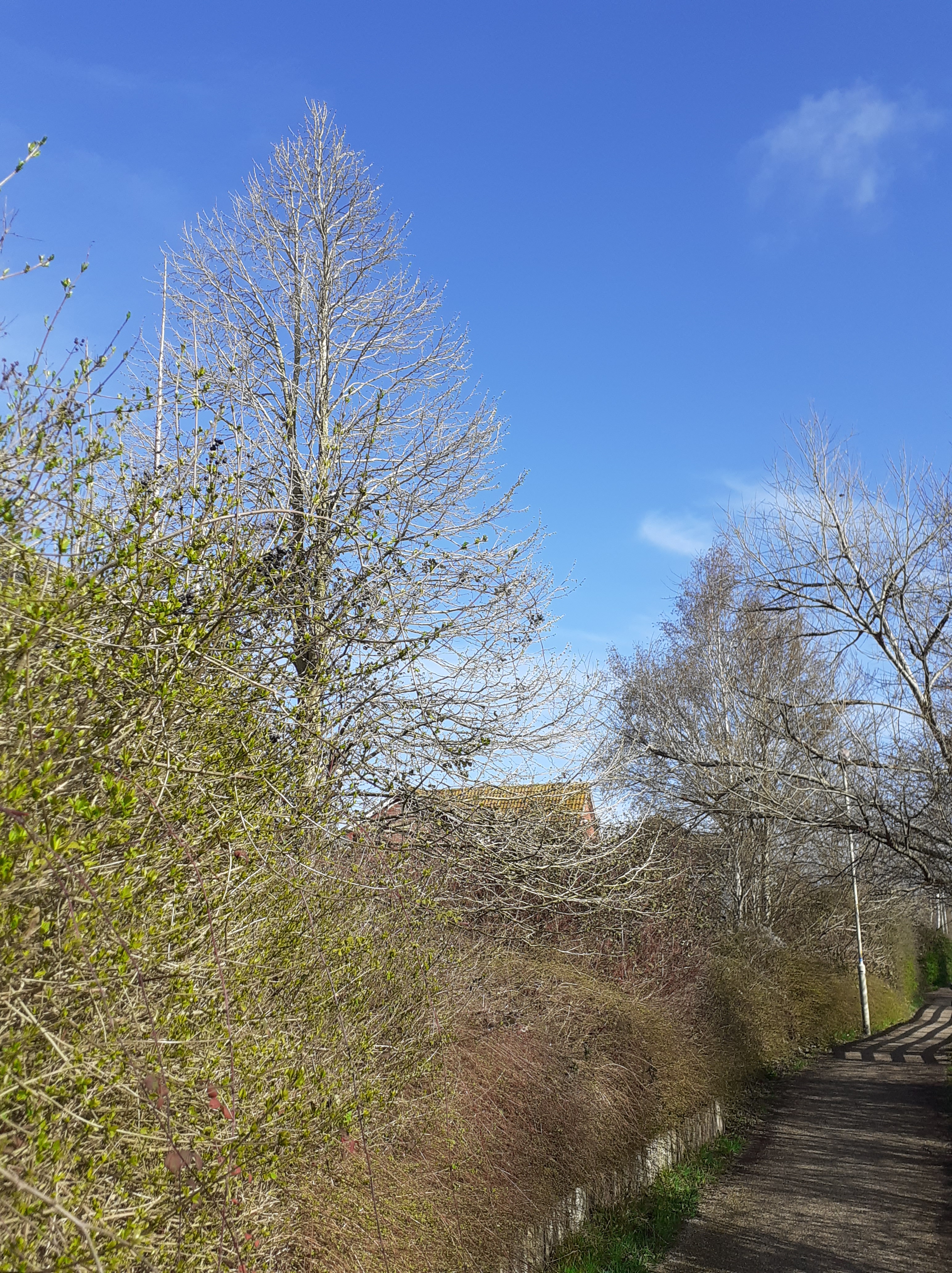
Lately I have been seeing more catkins and leaves amongst the elegant branches of their trees. A vivid green is present on the ground. As yet the changes are tentative. But they hold the promise of new life and growth. There’s a freshness here, enhanced by strong breeze. I notice and feel energised, walking down the path.

The changes have not gone very far, but the trend is now clear. For me, it shows up well against a blue sky. In this changeable season, I see possibilities for my own life, now that I am settled and in good health. These too are in their early stages, showing signs of promise more than accomplishment. My inner wisdom warns me not to move past ‘promise’ into ‘accomplishment’ too speedily or strivingly. Promise has its own season.

‘MAGIC/DELIGHT’

“When we see a magic trick – or anything else that catches us off guard in a magical way – in the moment of surprise our mind stops, and there is a flash of delight. We are in a state of mute wonder.

“The same bliss of wonder, delight, and amazement is the focus of this meditation. We use our response to propel ourselves into a state beyond the mind, a state where we see the magical nature of life.

Our delight in what we are seeing, coupled with an amazed mind, become a doorway into an intuitive flash in which we remember that life itself is like a magic show, a dream – and not at all what our worries little self was thinking it to be!

“This meditation encourages us to attend to all the moments of surprise and delight that occur throughout our day.

“The following contemplation can help prepare us to take full advantage of these moments.

Practice thinking of delight

“Bring to mind a memory of a time when you experienced surprise and delight;

“Focus on your reaction – feel fully your surprise and the wonderful sensation of your delight;

“In this thought-free moment, let the great bliss remind you of the true nature of reality;

“Remain alert for these moments as they occur throughout the day.” (1)

(1) Meditation 43 from: Lee Lyon The 112 Meditations from the Book of Divine Wisdom: the Meditations from the Vijnana Bhairava Tantra with Commentary and Practice Santa Fe, NM: Foundation for Integrative Meditation, 2019. See http://www.integrativemeditation.org

Lee Lyon’s introduction describes the Vijnana Bhairava Tantra as “a compendium of meditations from the 8th century Shaivite tradition in Kashmir. Acknowledged as one of the supreme jewels of the Tantric tradition of northern India, this much loved text had remained largely obscure until its rediscovery last century. … One of the great hallmarks of this tradition is its … enthusiastic engagement with all aspects of our life experience, even the ‘unspiritual’, as wonderful, natural gateways into our true nature”.

The basic teaching is to move through the surface appearance of our lives into “the pure energy behind form”. It is through engaging “the deeper energy in any experience, pleasurable or difficult, ecstatic or terrifying, that we move through the appearance of separation into the ever present Oneness.”

A CONTEMPLATIVE PERSPECTIVE ON WISDOM

For me, wisdom can take many forms. Below, Eckhardt Tolle emphasises contemplative process over cognitive product. I don’t treat this as an exclusive definition of the word wisdom. But I have certainly been nourished by taking Tolle’s understanding to heart and learning how to let the process unfold.

“Wisdom is not a product of thought. The deep knowing that is wisdom arises through the simple act of giving someone or something your full attention. Attention is primordial intelligence, consciousness itself. It dissolves the barriers created by conceptual thought, and with this comes the recognition that nothing exists in and by itself. It joins the perceiver and the perceived in a unifying field of awareness. It is the healer of separation.” (1)

(1) Eckhardt Tolle Stillness Speaks Vancouver, Canada: Namaste Publishing, 2003

EUDAIMONIA: WISDOM AND HAPPINESS

“Aristotle made a crucial distinction between two forms of happiness: Hedonia and Eudaimonia” (1). Hedonia is a transient state of happiness brought about by pleasurable stimuli. Eudaimonia, literally, means the satisfaction of living in harmony with our guardian spirit (daimon in ancient Greek). We can think of it in a similar way, varied according to our specific beliefs and commitments. We can also frame it in terms of fulfilling our true nature, or, more simply, as living with a sense of meaning, purpose and integrity. In any of these senses, eudaimonia allows us to flourish even in the face of adversity. We have made ourselves present to something greater than our own limited existence. I see my contemplative inquiry as a eudaimonic process.

Carolyn Baker (2) says: “Meaning-making is far more than parroting glib slogans like ‘everything happens for a reason’ , or ‘God moves in mysterious ways’. It is the sense that meaning making is not just something I do but is, in fact, part of who I am, and that life is asking me to commit to the task, particularly with regard to all my unwanted and uninvited life experiences”. I began working with Carolyn Baker’s book at the same time as I was reading a novel that, for me, offers a powerful evocation of eudaimonia, beyond conceptual formalism.

In her semi-autobiographical novel Alberta Alone (3) Cora Sandel describes her heroine’s discovery of her vocation as a writer, and of the values that will drive her. Alberta is a young woman who has left her native Norway to live independently in the Paris of the early twentieth century, eking out an existence as an artist’s model and occasional contributor to Norwegian journals on the subject of life in Paris. She lives precariously on the fringes of the creative arts community, without material resources or confidence in her own capacity. She reaches the point of giving up, when on a lonely late winter’s day, she sees unexpected possibilities in some writing she’d played around with but not taken seriously. The moment then comes when, holding “her bundle of papers”, she rests her head on the window sill, beginning to relax in a warm gleam of unexpected February sunshine.

“And something dawned on her. All the pain, all the vain longing, all the disappointed hope, all the anxiety and privation, the sudden numbing blows that result in years going by before one understands what has happened – all this was knowledge of life. Bitter and difficult, exhausting to live through, but the only way to knowledge of herself and others. Success breeds arrogance, adversity understanding. After all misfortune perhaps there always comes a day when one thinks: It was painful, but a kind of liberation all the same; a rent in my ignorance, a membrane split before my eyes. In a kind of mild ecstasy Alberta suddenly whispered up to the sun: Do what you will with me life, but give me understanding, insight and perception”.

(1) Jeremy Lent The Web of Meaning London: Profile Books, 2021 (Cited by Carolyn Baker in Undaunted, below)

(2) Carolyn Baker Undaunted: Living Fiercely into Climate Meltdown in an Authoritarian World Hannacroix, NY: Apocryphile Press, 2022

(3) Cora Sandel Alberta and Freedom London: Peter Owen, 2008 (Peter Owen Modern Classics edition, with a forward by Tracy Chevalier. First English edition 1963. Translated from the Norwegian Alberta og Friheten by Elizabeth Rokken. Original Norwegian publication in 1931.)

INNERWORLD HARVESTING

The Innerworld has its own times and seasons. When I attune myself carefully, it speaks to me through images in the DruidCraft Tarot (1). Today (20 July) I encountered the 7 of Pentacles (above), with its image of winter harvest. A Druid, equipped with a golden sickle, takes mistletoe from a tree. Where is the wisdom here? What am I being told?

‘Take note of the obvious’ is an early thought. ‘Be willing to state it’. After ten years of contemplative inquiry, I am still anchored in Druidry. Yes: my practice forms are idiosyncratic and contemplatively inclined. Yes: my inquiry process is personal and self-directing. Yes: I continue to learn from other traditions and sources outside the traditions. But what I do comes out of an immersive OBOD training of many years and would not be the same without it. I continue to belong to the Order and identify with the modern Druid tradition. Being clear about this is a fruit of my inquiry.

The form of words that we know as the St. Patricks’ Prayer, alternatively as the Cry of the Deer, runs: “I arise today through the strength of heaven, light of sun, radiance of moon, splendour of fire, speed of lightning, swiftness of wind, depth of sea, stability of earth and firmness of rock”. In my own usage I think of ‘heaven’ simply as a sky or firmament word, majestically naturalistic. But my greatest sense of support comes from the words ‘stability of earth and firmness of rock’. The 7 of Pentacles Tarot image includes seven pentacle signs carved on to mossy rock. It is a strongly earth-related image. I feel grounded and affirmed by this powerfully Pagan imagery.

There is much more to be learned from the 7 of Pentacles image, but these obvious recognitions, easily taken for granted and thus overlooked, are a good place to start. They have allowed me to identify some fundamental understandings that my inquiry has provided, and to clarify its direction for the future.

(1) Philip and Stephanie Carr-Gomm The DruidCraft Tarot: Use the Magic of Wicca and Druidry to Guide Your Life London: Connections, 2004 (Illustrated by Will Worthington)

WISDOM’S HOUSE

Two people hold each other in mutual gaze. Both their mutuality and their individuality are very clear. The space between them defines a chalice, or grail. In stillness they are present to each other, within a dynamic field of I-Thou relationship. The gestalt is one of communion. Their world has come alive.

Eckhart Tolle speaks of a wisdom that is not the product of thought, and which comes with the ability to be still. “Just look and listen. No more is needed. Being still, looking and listening activates the non-conceptual intelligence within you. Let stillness direct your words and actions” (1).

He goes on: “wisdom is not the product of thought. The deep knowing that is wisdom arises through the simple act of giving someone or something your full attention. Attention is primordial intelligence, consciousness itself. It dissolves the barriers created by conceptual thought, and with it comes the recognition that nothing exists in and by itself. It joins the perceiver and the perceived in a unifying field of awareness. It is the healer of separation”.

I think of wisdom, in this sense, as the healer in the heart. Not the organ that continues to pump at a not-too-elevated rate when my blood oxygen declines, and therefore a resiliency factor for my physical health. It is, rather, the heart of awareness – personified again as it has been before by a Goddess of Wisdom. She came to me, at night, at a wakeful time when my breathing was particularly laboured and I felt like a freshly landed fish. She acted as a discreetly background presence, pointing me to the vision of a radiant grail, palpably emanating the energy and resources of all four elementary powers.

Pragmatically I felt empowered to weather a challenging experience. Beyond that, the Goddess invites me to let go of identification with the mind-made ‘little me’ as a limited and confining construct. The reward is an expansion into love, joy, creativity and inner peace. I have bounced back from my COPD flare-up in the last few days and will do what I can to rebuild my physical capacity. But the lesson, that healing is not the same as being physically fixed, and asks for a different kind of commitment, applies both in bad times and good.

(1) Eckhart Tolle Stillness Speaks Novato, CA, USA: New World Library & Vancouver, BC, Canada: Namaste Publishing, 2003

Earth Eclectic

music that celebrates Earth and speaks to the heart

Sarah Fuhro Star-Flower Alchemy

Follow the Moon's Cycle

Muddy Feet

Meeting nature on nature's terms

Rosher.Net

A little bit of Mark Rosher in South Gloucestershire, England

Becoming Part of the Land

A monastic polytheist's and animist’s journal

selkiewife

Selkie Writing…

Charlotte Rodgers

Images and words set against a backdrop of outsider art.

Prof Jem Bendell

living with metacrisis and collapse

Towint

The pagan path. The Old Ways In New Times

The Druids Garden

Spiritual journeys in tending the living earth, permaculture, and nature-inspired arts

The Blog of Baphomet

a magickal dialogue between nature and culture

This Simple Life

The gentle art of living with less

Musings of a Scottish Hearth Druid and Heathen

Thoughts about living, loving and worshiping as an autistic Hearth Druid and Heathen. One woman's journey.

Wheel of the Year Blog

An place to read and share stories about the celtic seasonal festivals

Walking the Druid Path

Just another WordPress.com site

anima monday

Exploring our connection to the wider world

Grounded Space Focusing

Become more grounded and spacious with yourself and others, through your own body’s wisdom

The Earthbound Report

Good lives on our one planet

Hopeless Vendetta

News for the residents of Hopeless, Maine