Recently I’ve been unwell and housebound, hardly even watching the world go by. But there came a day when I could go out again, a day that was blessed with sun. It seemed bright and new. I was almost blinded by its luminous presence on a white tree-patterned wall. I had entered late fall, a season with both autumnal and winter features.
The sun shone on trees in Gloucester City Park which retained some of their foliage, but in an end-of-season way that signals austere changes to come. Leaves showed a fragile, lingering beauty, prior to their necessary descent.
The Brunswick Gardens, sitting under a clear blue sky, were home to trees where the leaves had already fallen, leaving the branches as patterns of quiescent arboreal bones. The leaves were on the lawn. Other, managed, flora continued to flourish.
In visual and tactile ways, after an indoor confinement, the neighbourhood was full of reward for me. But I felt cold, and it was indeed the coldest it’s been for many many months. I could not stay out for long. But I had encountered a moment in the year, of interbeing, of living presence – where the wheel is visibly and palpably turning. I was glad to be there, however briefly, available for a nurturing and healing experience.
Where I live, March has so far been a contest between the coming of spring and a winter that won’t let go. The city of Gloucester has been relatively insulated, but we have still had sub zero nights and low day time temperatures. There has been snow that didn’t settle, cold hard rain and occasional high winds. There have also been frequent periods of sunshine – still cold, still rainy, yet a joy to be out in. Underneath this changeability, the period of daylight grows longer.
A canal side walk shows a more subdued world than last year, and a sense of latency, as though life is waiting to see what will happen next. The wheel of the year turns as ever. What to expect on the ground has become less certain. The climate crisis is visibly in process, with the consequence of vast changes in the arctic now making themselves felt here. We could say that the Cailleach is angry and mobilising. But what this means for our day-to-day weather isn’t always clear.
As I experience these shifts (not so dramatic in themselves in the here and now) I can’t help thinking about culture as well as nature. Climate has moved down the formal political agenda – again. Outright denialism and repression of information about relevant topics still aren’t over. Sir David Attenborough, who has been making nature programmes since the beginning of broadcast TV, will not be having his most recent one (6th and last of a new series) shown live by the BBC. It will be available only on iPlayer.
Supported by groups like WWF (World Wildlife Federation) and RSPB (Royal Society for the Protection of Birds), this programme highlights the destruction of nature in Britain and looks at rewilding as part of the solution. There are allegations that the restricted availability of this content stems from a fear of offending Conservative politicians and the right wing press. The BBC has issued denials but I have not seen any other plausible reason put forward. Yet this is about conservation: in older meanings of ‘conservative’, the protection of nature and the exploration of rewilding could readily have become a conservative cause. They have been, in the past – think about Theodore Roosevelt and the National Parks movement in the USA.
From a Druid and Earth spirituality perspective, the desacralisation of nature, and the emergence of a wasteland culture, lie at the heart of this problem. This is not new. It has being going on for a long time, for many reasons – religious, economic and political – driven by people with widely different projects and motivations. I know that there is much creative work going on to develop better understandings and positive projects. But it still saddens me that the balance of power and resources, especially in a renewed time of wars and the threat of wars, remains so troubling.
In my personal life I am happy and optimistic. I can feel sad about what is going on around me without being defined or disabled by my grief. Moments of fear and sparks of anger, too. They need not be driven away. They too have an honoured place at the table. They are part of the larger whole, and, lived with emotional intelligence, a way of bearing witness and a spur to action in the world.
I shall not be put in a cell, I shall not be wounded …
No fire, no sun, no moon shall burn me,
No lake, no water, no sea shall drown me.” (1)
Brigid has a long history, stretching back in Gaelic traditions to at least the pagan Celtic iron age. The words above come from the Western Highlands of Scotland, in this form probably dating to the traumatising early modern period. Caitlin Matthews suggests that, even though the the words are addressed to ‘St. Bride’ rather than the Goddess of poets, they still have the talismanic power to preserve life.
More recently, Brigid has been successfully revived as a Pagan Goddess, where, according to an affirming Imbolc self-dedication story by Morgan Daimler (2) she has lost none of her capacity to protect her devotees.
“When I decided that it was essential for me a self-dedication to the pagan path, just like all my books talked about, I chose Imbolc to do it on. At that point the holiday to me was on the 2nd, the same day as America celebrated Groundhog Day, and was about cleansing and blessing of the self, so it seemed ideal for a self-dedication. I got everything together and when the night of the ritual arrived I was excited to take such a life changing step. At 13, coming from a non-religious background, doing something like this was momentous and I felt like I was ready to commit myself to the spirituality I had been studying.
“I went out alone into the bitter cold, without a winter coat on, and tried to do the ritual the way I had learned how to, but it was hard to focus. February in Connecticut is frigid and the darkness on that particular night was total, without any moon to light my way. It was Brigid’s holiday, so I automatically started calling on her, asking for her help, for the strength to do what I planned to do. At the same time it was almost a reflex to call on a Goddess I associated with warmth a light under those circumstances. It was important to me to make a declaration of my religious path, the books I’d read at that point had emphasized the need to be outdoors, and I was too stubborn to let the cold weather stop me. So I prayed to Brigid.
“It’s funny the way, as children, we simply take experiences in our stride, without considering them at all out of the ordinary. I don’t remember ever feeling Brigid’s presence or having a sense of the numinous, but I prayed and then I was warm. The cold simply ceased to be something I noticed, as if everything around me had become an indoor room temperature. I took the usual half hour or so kneeling on the cold ground to do my ritual, dedicating myself to the Irish Gods and to pagan spirituality. And then I got up, collected my supplies and went back inside, feeling euphoric.
“At the time it never even registered that what I did was dangerous or that I was risking frostbite and hypothermia. And I never stopped and thought that it should seem at all remarkable to pray to Brigid for warmth and then be warm. It all seemed entirely natural and normal.
“We speak, and the Gods really do listen. Sometimes they even answer.” (2)
(1) Alexander Carmichael Carmina Gadelica Edinburgh: Scottish Academic Press, 1972 (Cited in Caitlin Matthews The Element of the Celtic Tradition Shaftesbury: Element Books, 1989)
(2) Morgan Daimler Pagan Portals – Brigid: Meeting the Celtic Goddess of Poetry, Forge, and Healing Well Winchester UK & Washington USA: Moon Books, 2016. Daimler identifies as a reconstructionist polytheist pagan working in the Irish tradition.
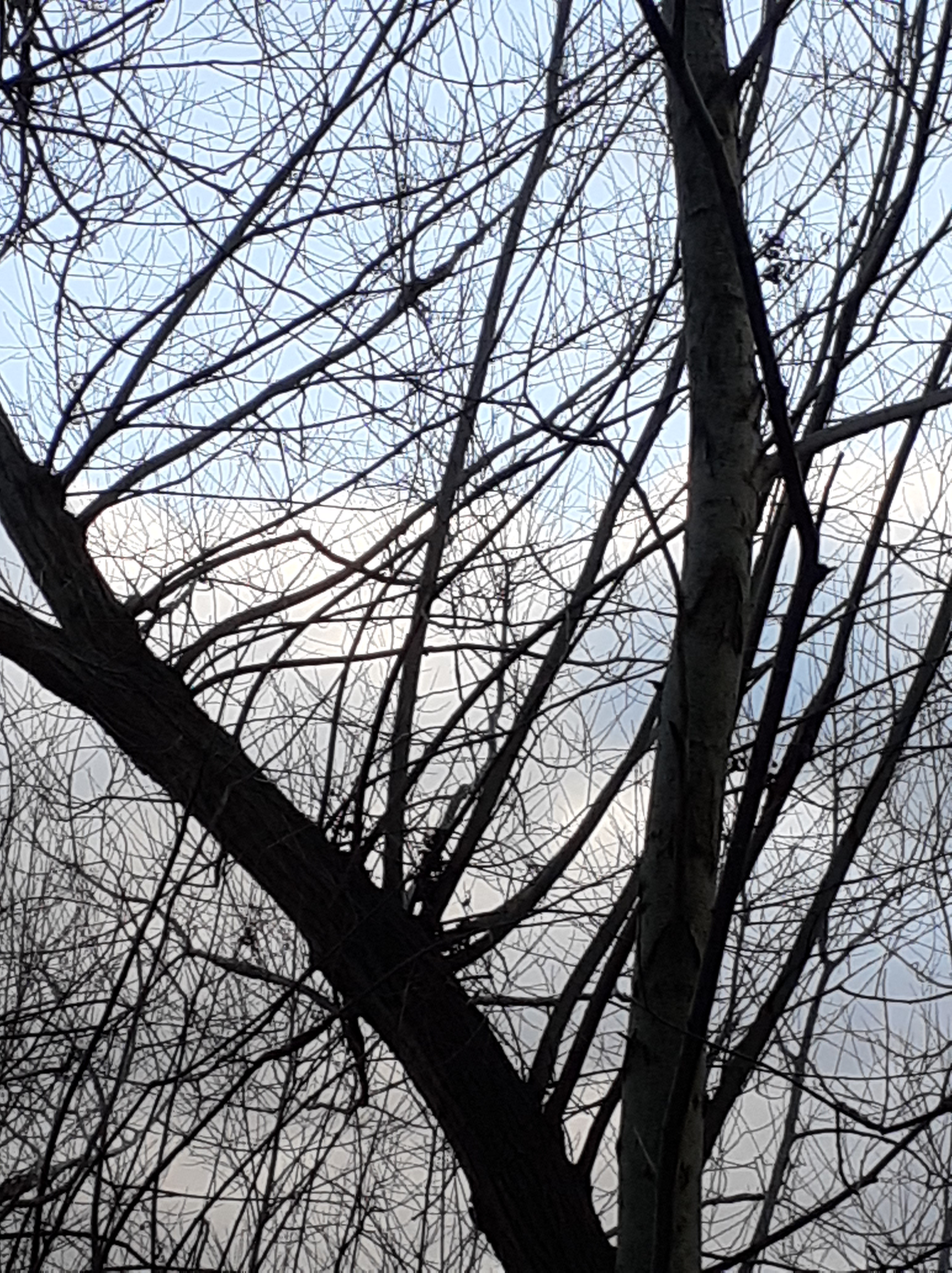
My sense of January this year is one of bleakness qualified by promise. I spent the first week of the year grounded by back pain. So it was a pleasure, when the time came, to walk once more among trees. Their very bareness has a certain majesty. Their simple presence suggests the prospect of transformation as the year goes on.
Here, at 3.30 pm on January 9th,, I am noticing the slow lengthening of the day. It would have been twilight at this time three weeks ago. The change has an expansive note. A new lightness and colour are suggested below. They lead me further from the lassitude and brain fog of recent days. They make the world a genuinely felt privilege to be in.
Yet a taste of disenchantment does have its value. More than once, I have experienced it shortly in advance of a creative shift in energy and direction. My wife Elaine and I will soon be moving to the long=term home we have been working towards for some time. We will be setting it up, not just chasing after it, over the coming weeks. Without quite seeing the future, I do feel a returning zest and optimism.
It was 26 November 2022, 11 a.m. I was at the Gloucester end of the Gloucester-Sharpness canal. I found myself accepting the arrival of winter. I was observing three cygnets, now without their parents but still keeping company with each other. The underlying temperature was around 7 C (44.6 F) and good for walking, But I was feeling the pinch of a cold wind. In memory I am feeling it now. The water and sky looked grey. The trees were starting to feel skeletal, whilst still retaining some leaves. My lingering sense of autumn had finally drained away.
To accept winter’s arrival in the presence of swans felt numinous. Swans are otherworldly birds in Celtic tradition. The three together, not yet in their full adult plumage, seemed auspicious. They suggested coming opportunities for creativity, love and celebration. Winter can be a preparation for renewal, both as season and as state of mind. My acceptance goes with a faith in winter’s regenerative darkness, and the riches this can bring.
Winter shows itself though early twilight. The pictures above and below were taken at about 5 pm (GMT, now, with summer time a fading memory). The sky retains a certain diversity of colour – clouds are still visible. But there is a leaning towards indigo. St. Mary le Crypt sits in stillness and tranquillity.
For me, the artificial lighting behind the stained glass is just right for supporting these qualities. It illuminates but does not glare. It feels homely and welcoming. The heavy stone of this medieval church is softened by dusk. Christmas is coming – a friendly period in the church calendar.
Twilight makes space as well for another, more carnival mood. Gloucester holds a lantern procession and Christmas light switch-on every year at approximately this time and date (19 November). It winds through the old town, lights switched on overhead as it passes, to the Cathedral where a carol service is held. This year’s event was very well supported, with large numbers of people either following the procession or lining the route. It was as if everyone was ready for a festive moment, a chance for celebration and fun in a generally tough time.
Local artists had teemed up with local schools to work on an Alice in Wonderland theme for 2022. Hence the Mad Hatter in the shifting and slightly out of focus picture below. I think the makers have successfully created a Tricksterish image for him. Not entirely safe or bland.
In Lewis Carroll’s 1865 book, Alice is annoyed by the twilight zone of the Mad Hatter’s language. It seems to have “no sort of meaning” and yet be “certainly English”. He boasts about the great concert given by the Queen of Hearts, where he sang: “twinkle, twinkle little bat/How I wonder what you’re at/ Up above the world you fly/ Like a tea tray in the sky”.
What is the Mad Hatter bringing to the streets of Gloucester on this early winter’s evening? He is certainly a presence here, if hard to read, for the brief time it takes him to pass through. Winter twilight offers spaces for healing and festivity. As a liminal time, it is an arena for Tricksters too. Many possibilities are latent under this enigmatic sky.
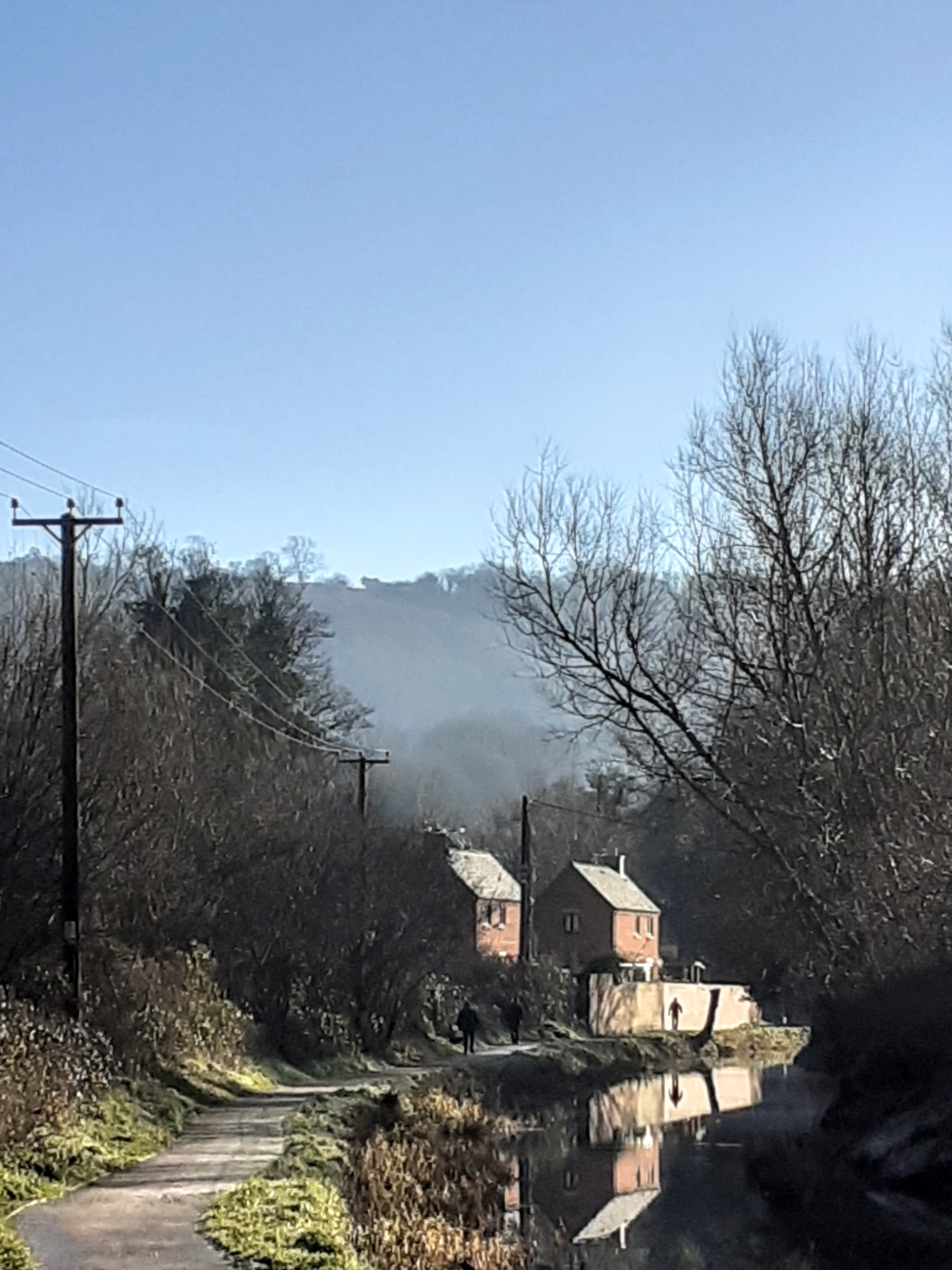
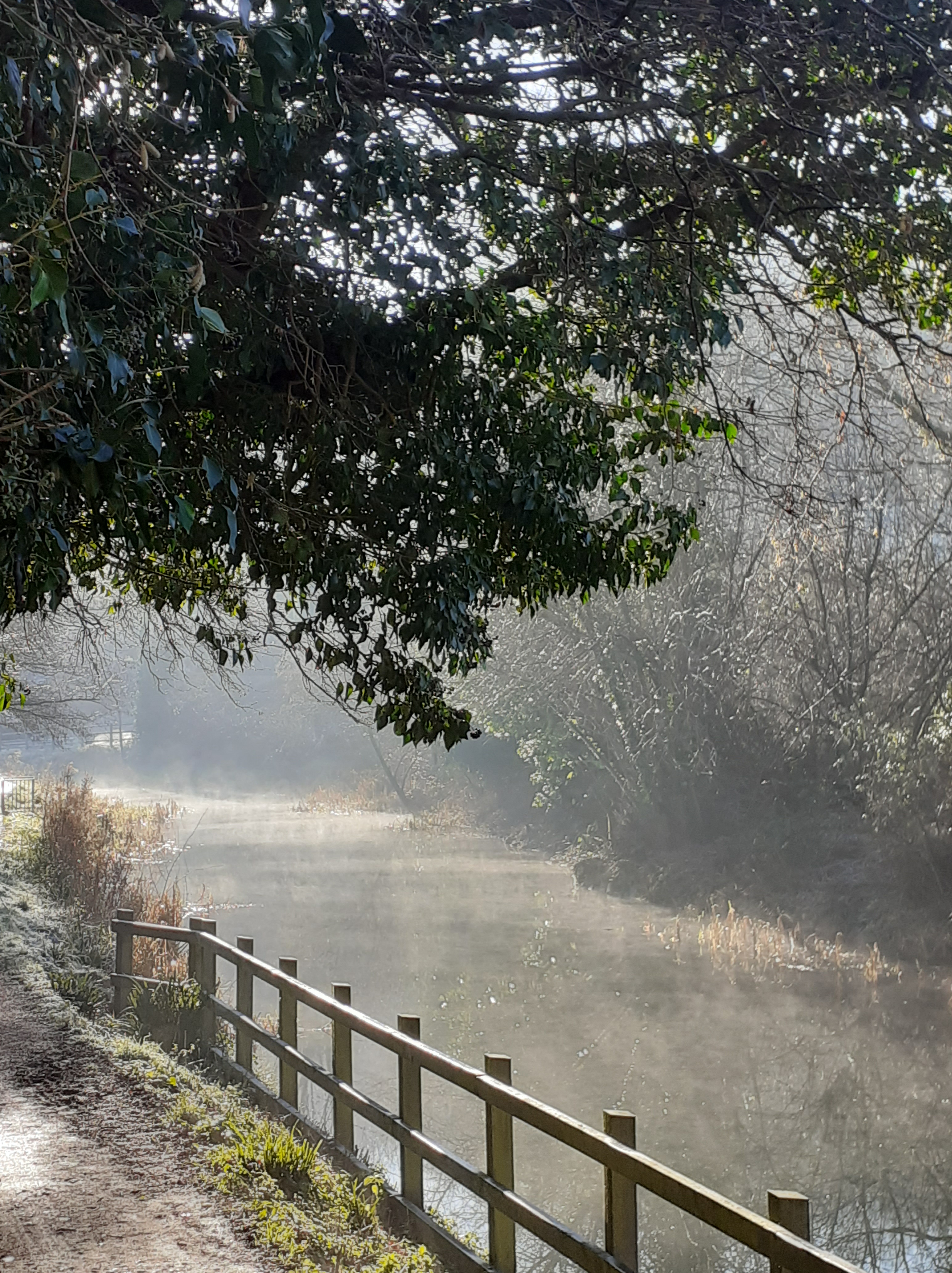
A winter morning walk with the temperature gently rising above freezing. Internally I’m here, now and at home, as the world changes around me. Walking outside becomes a meditation without effort or solemnity.
It feels good to be reminded, on the cusp of a house move, that at-homeness is portable, embracing variety and change. Light dances with shade. Mist gradually disperses into a blue sky. Still images can point to the process of growth, as with the red berries below, which startled me with their vividness when I saw them.
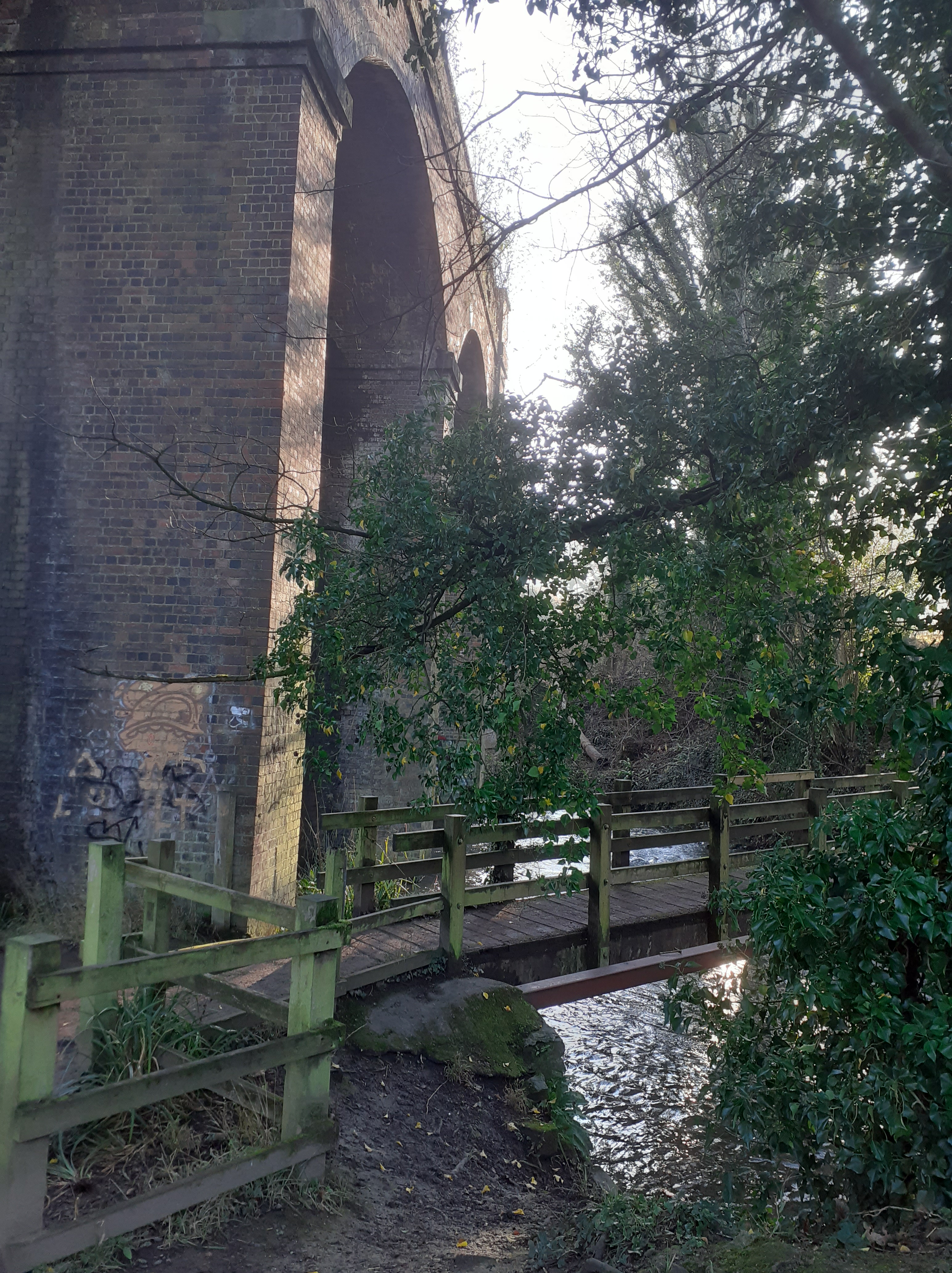
I find it a comforting, simple pleasure to observe the changes in familiar spaces throughout the day and the year. Because I am leaving the locality, I am delighting in the images I take away from this day’s walk – the land, the water, sunlight and mist; a quietly decaying building and its reflection; railway arches, a footbridge over a stream. Soon, a new landscape will take on its own familiarity.
Finally, I am moved by the light and shade on our garden path, such a good way to end a walk.
I will be moving house very soon. This will no longer be the view from my bedroom window. My gaze today is tinged with premature nostalgia.
This gaze shows continuity and slow, gradual change in the world outside. This world wears its winter look, with bare branches and extensive views. At other times of the year, both are covered by foliage. But the solstice darkness has already withdrawn from the mid-afternoon. Today is blessed with strong sunlight and blue sky. The year is turning again, now towards the light.
The house move feels more abrupt. I have lived here for longer than anywhere else in my adult life. Chiefly it has been the hallowed setting for my life with Elaine (1). Whilst living here, I completed my OBOD training, later beginning a self-directed exploration of contemplative Druidry, including a 4 year project within the Druid community (2). For a while, contemplative inquiry – within and beyond Druidry – became the guiding principle of my spirituality. Now it is more like an influential thread within my Druid practice.
I wonder what changes life in another location will make, as Elaine and I continue our journey together. There will be only a limited break from the past. We will be in the same county, though not the same town. But there will be differences too. The psychogeography will be different. The spirits of place will be different. The world beyond our windows will be new.
I was on a train and had reached my destination. Descending onto the platform at 5.30 pm, I found myself in complete darkness. It might as well have been midnight. I understood that winter had come.
The Goddess in her cailleach, or crone, aspect presides over this time. She it is who determines the length and severity of winter. She is also embodied in the dark woman of knowledge who facilitates both death and transformation (1).
In the context of my contemplative inquiry/blog, I am experiencing a process of this kind, seemingly in a minor key. I want to call it ‘hibernation and renewal’, though I cannot predict how it will really be. In any event, I have decided to do no more posting until the new year. What happens then depends on what I am inspired to do at the time. But now is a time for surrender to endarkenment and sleep.
(1) Philip and Stephanie Carr-Gomm The DruidCraft Tarot: Use the Magic of Wicca and Druidry to Guide Your Life London: Connections, 2004. Illustrated by Will Worthington.
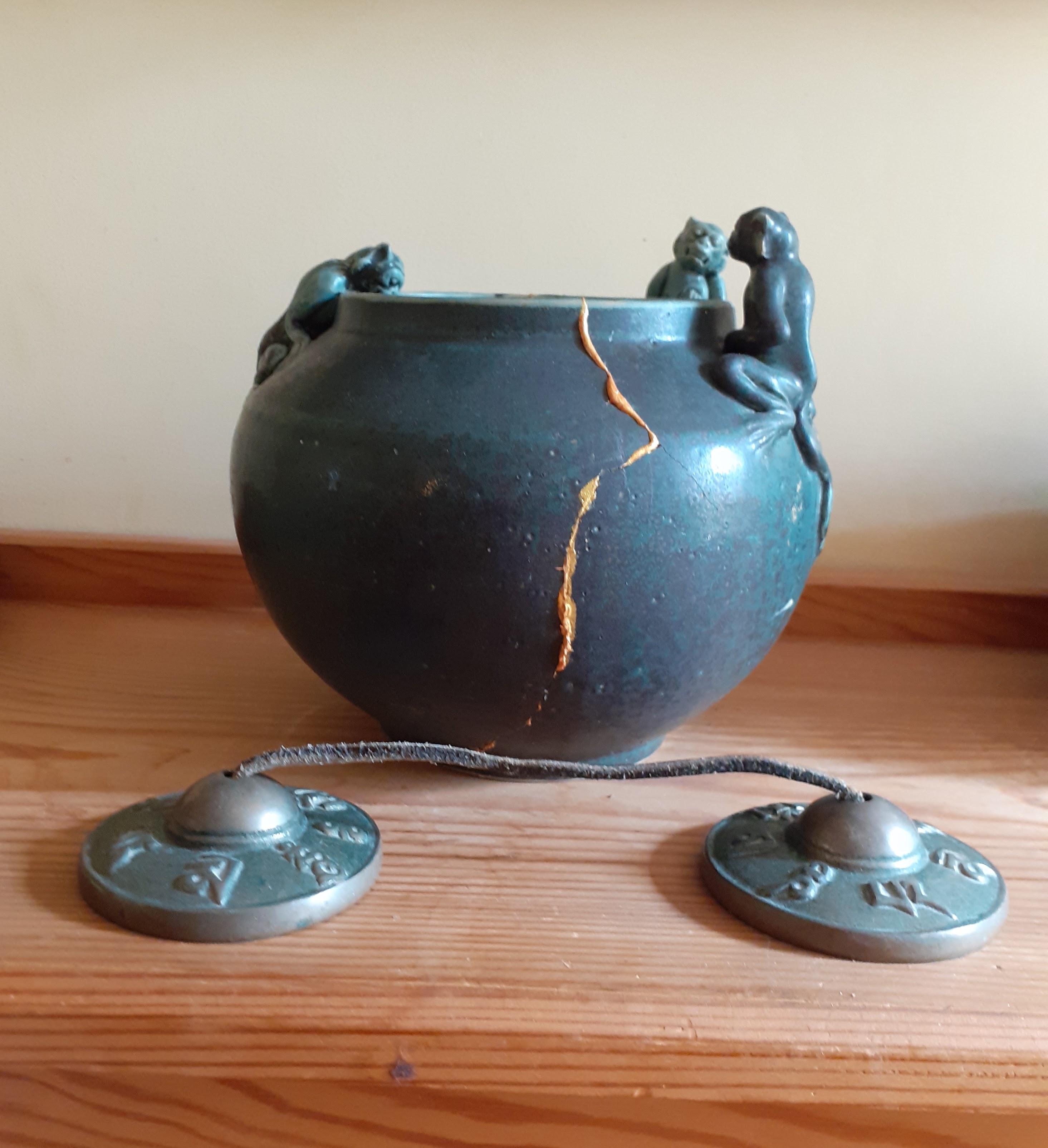
The pot belongs to my wife Elaine*, and used to live outdoors. Late in the winter it filled with rain. Then there were days of frost and the water turned into ice. The ice needed more room, and pushed against the sides of the pot. When the ice melted the pot fell apart in two neat halves. Nature in action, over time.
As part of her work, Elaine knows something about kintsugi, which literally means “golden joinery”. This treats breakage and repair as part of the history of an object, rather than something to disguise. Culturally, the approach is an aspect of wabi-sabi, the acceptance of transience and imperfection. Elaine’s repair, applying kintsugi, is literally illuminated.
The result reminds me of the refrain in Leonard Cohen’s Anthem.
“Ring the bells that still can ring.
“Forget your perfect offering.
“There is a crack in everything.
“That’s where the light gets in.”
After some hesitation, I added my Tibetan bells to the picture above. The cord attaching the two bells is about half its original length due to wear and tear. But the bells still ring. My ownership of them, here and now, is almost certainly the result of Tibet’s collective disaster and the resultant Tibetan diaspora. In the world of biological life and time, disaster and repair are a common theme. If the crack is where the light gets in, the work of repair is sacred.








 Contemplative Inquiry