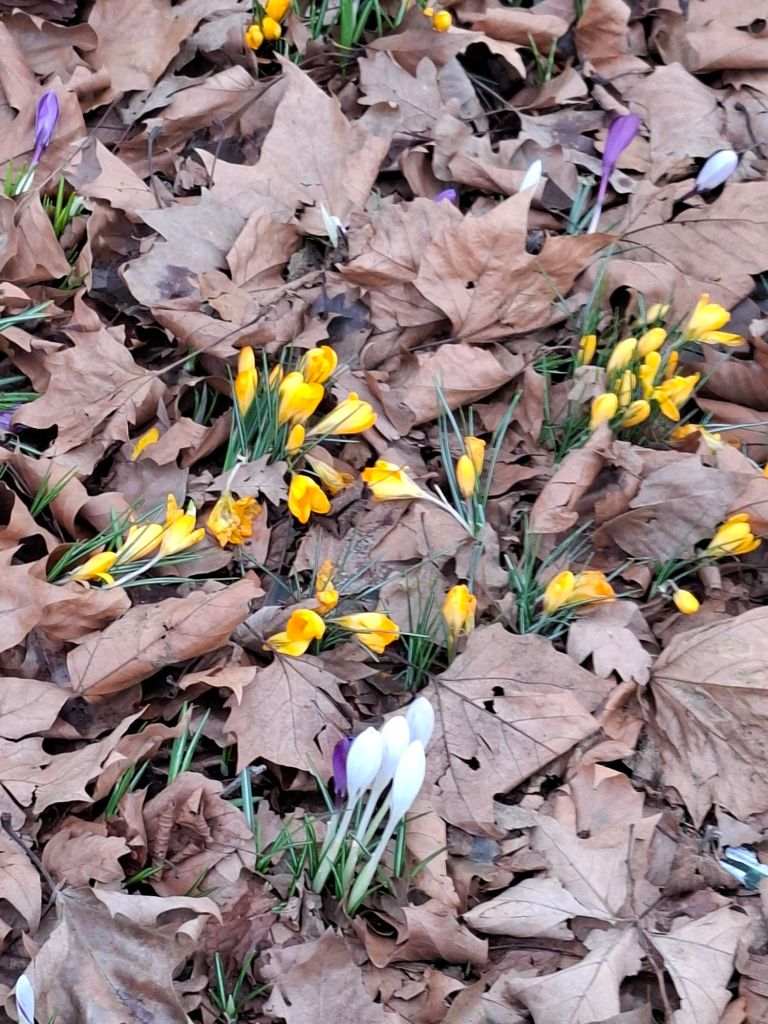
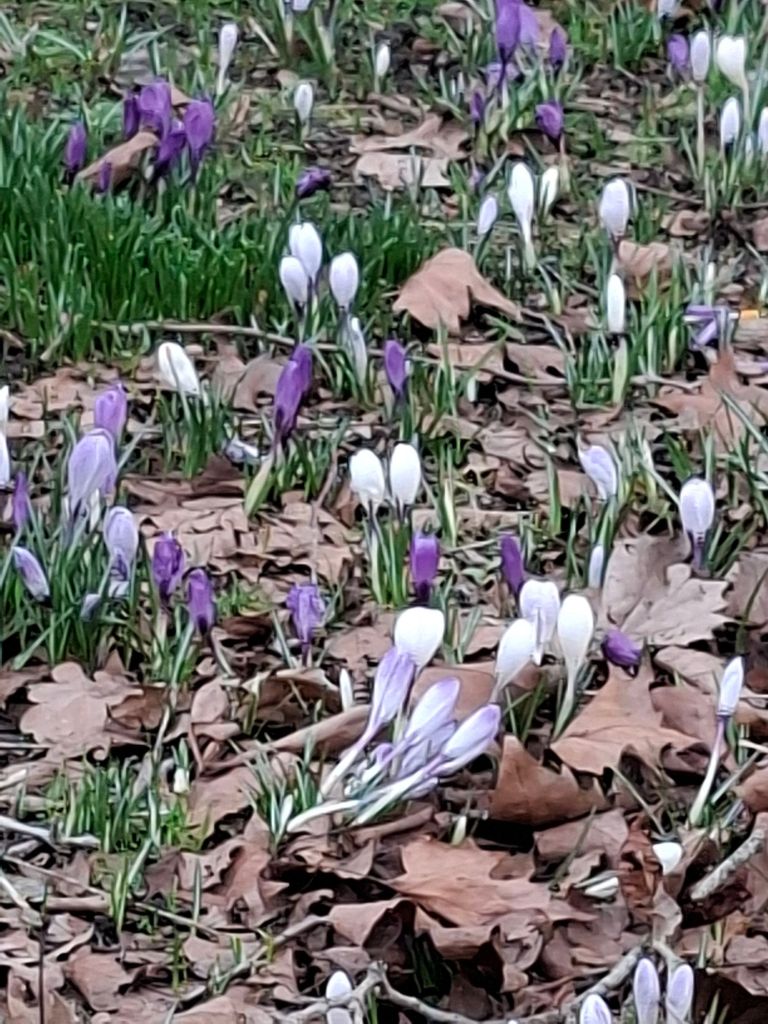
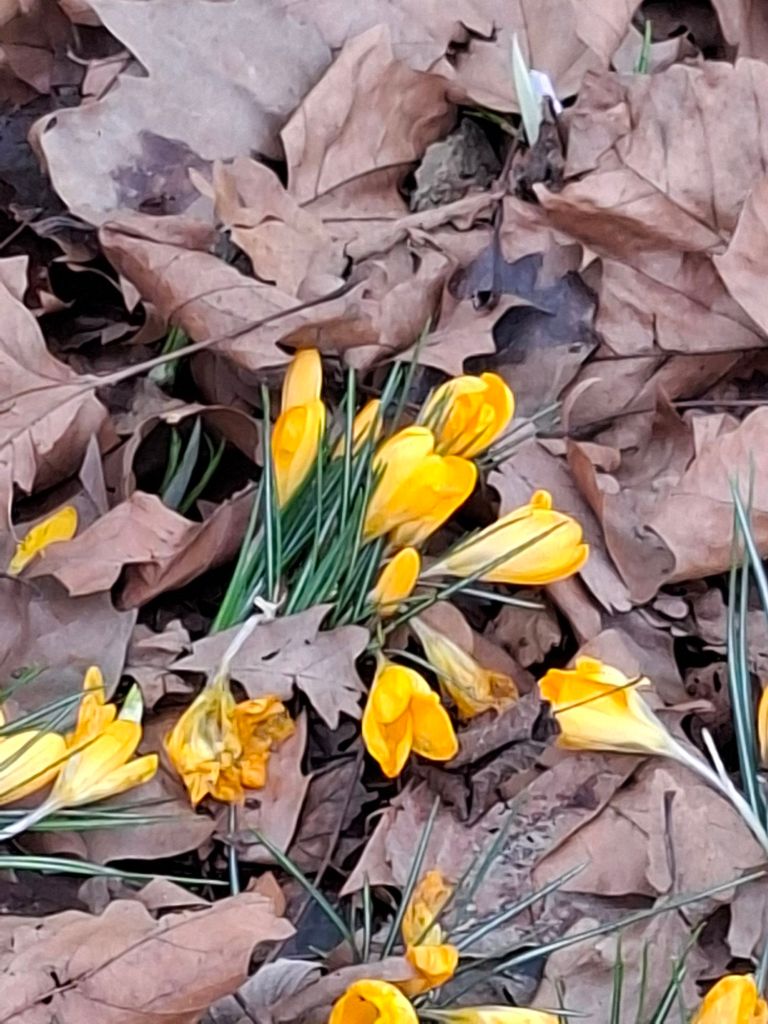
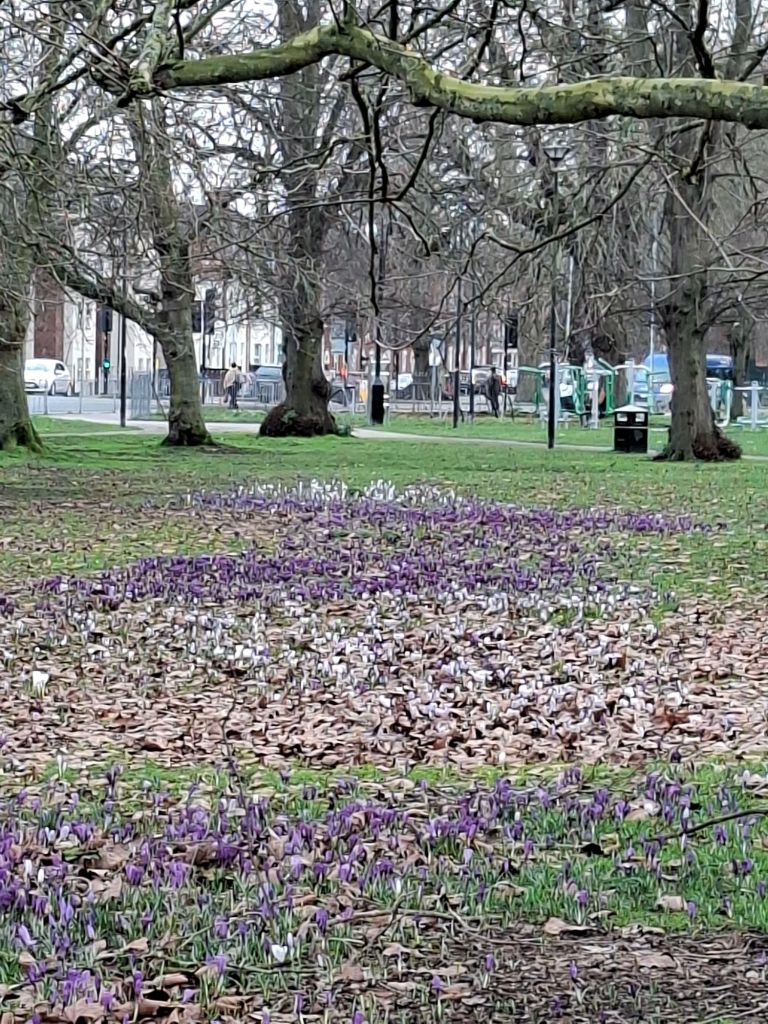
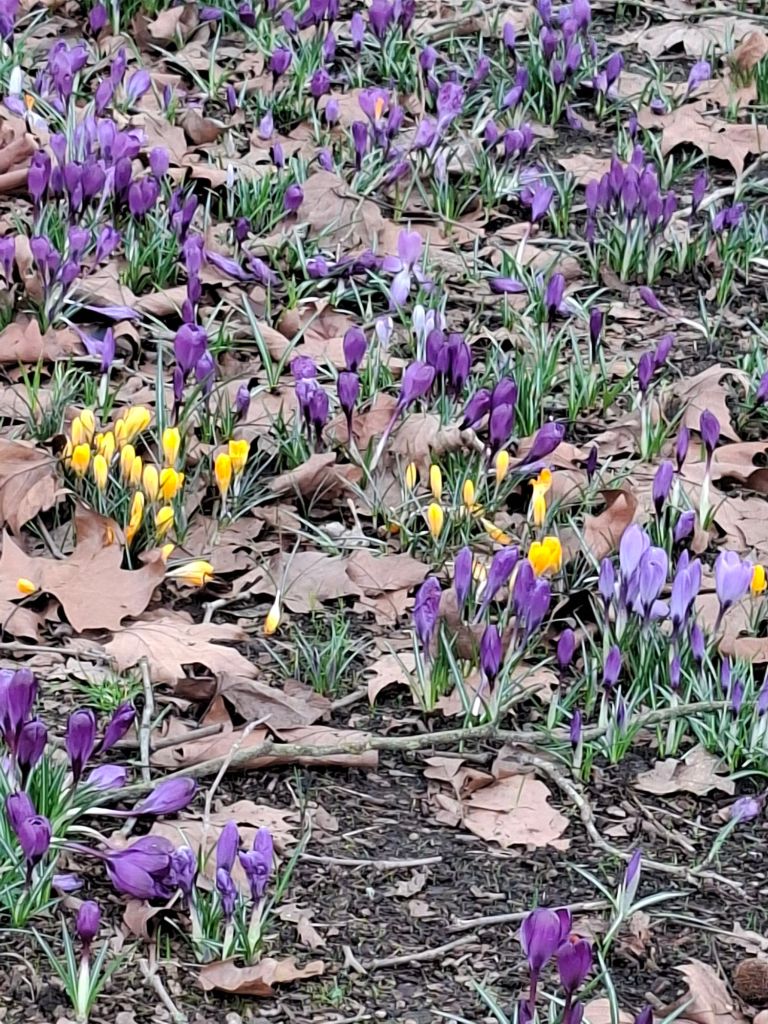
4pm, 9 February, Gloucester Park. I notice the ground in front of my feet. New life is emerging, pushing through last year’s fallen leaves. Crocuses – yellow, white, mauve – are making themselves known. Recent rain gives the blades of new green grass a fresh vitality. Feeling curious and energised, I enjoy an extended moment of contemplation on this small patch of land.
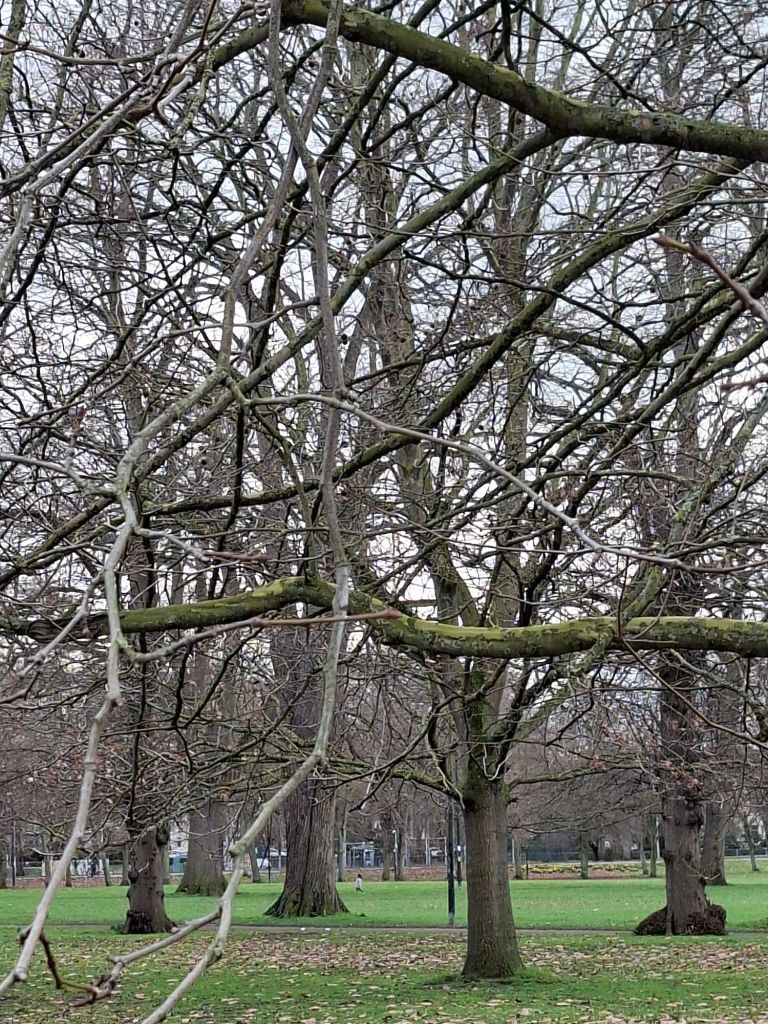
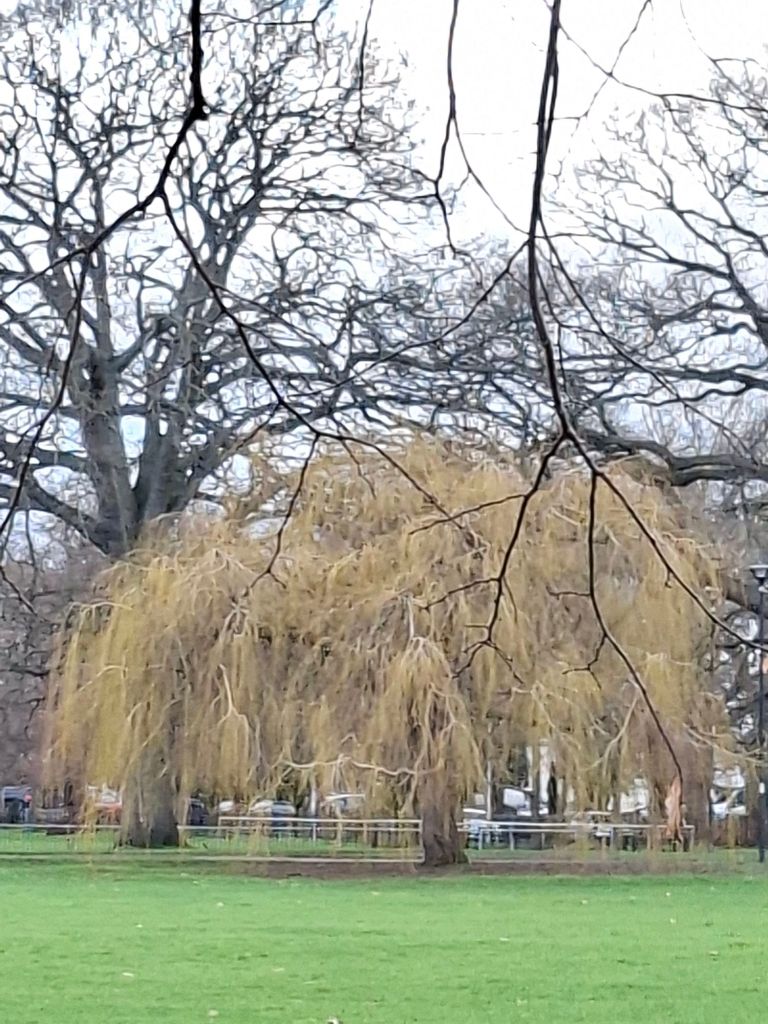
Then, looking around me, I find a contrast between the ground – active, emergent, blooming – and the trees, with their skeletal branches and latent potential. The exceptions are the willows, already moving towards spring.
I reflect on my different states of attention. If I walk briskly through the park, the flowers in particular are easy to miss. They are small and not immediately arresting. To appreciate them, I have to decide to stop and look, emptying my mind of other concerns. Then I can become truly present to the world in front of me, a living world that wants to survive and thrive. Contemplating these flowers, I feel a strong sense of kinship and belonging. The same world is their home and mine: I feel grateful for being born into it. May the abundance of our world be protected and preserved in the days and years ahead.
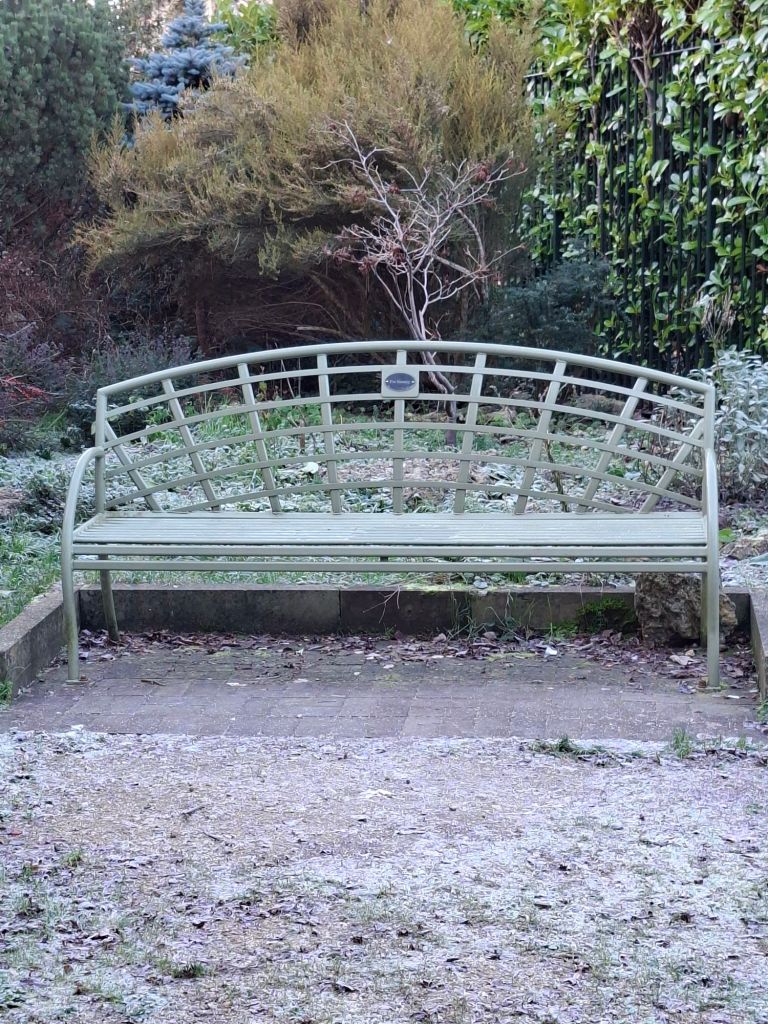
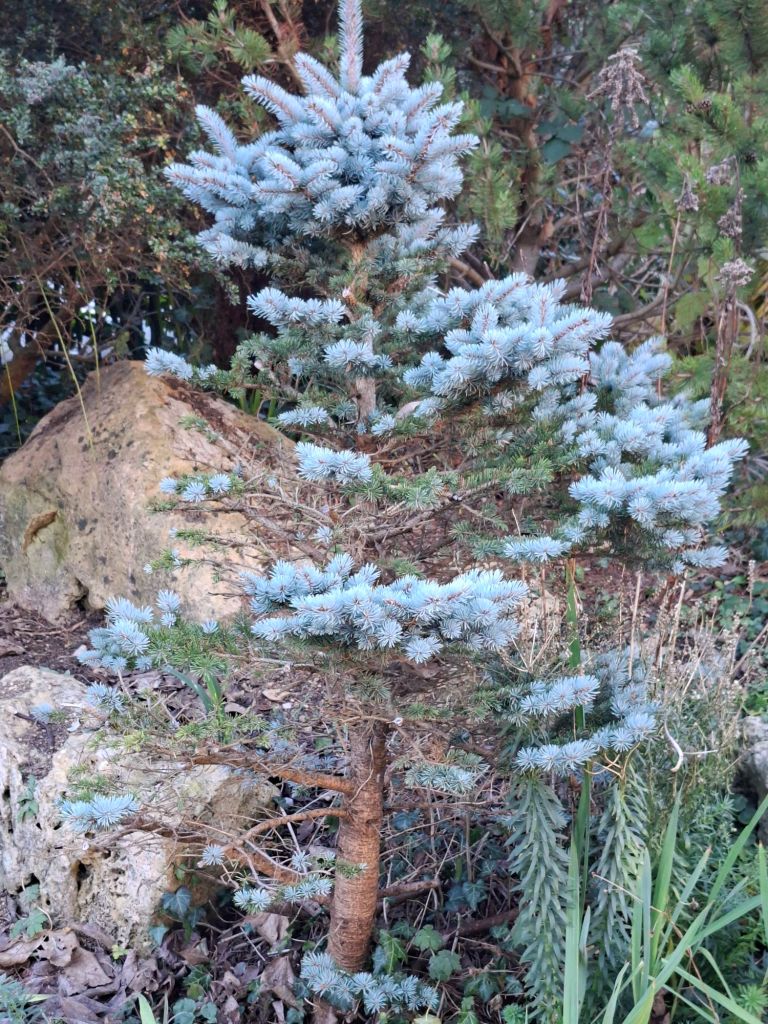
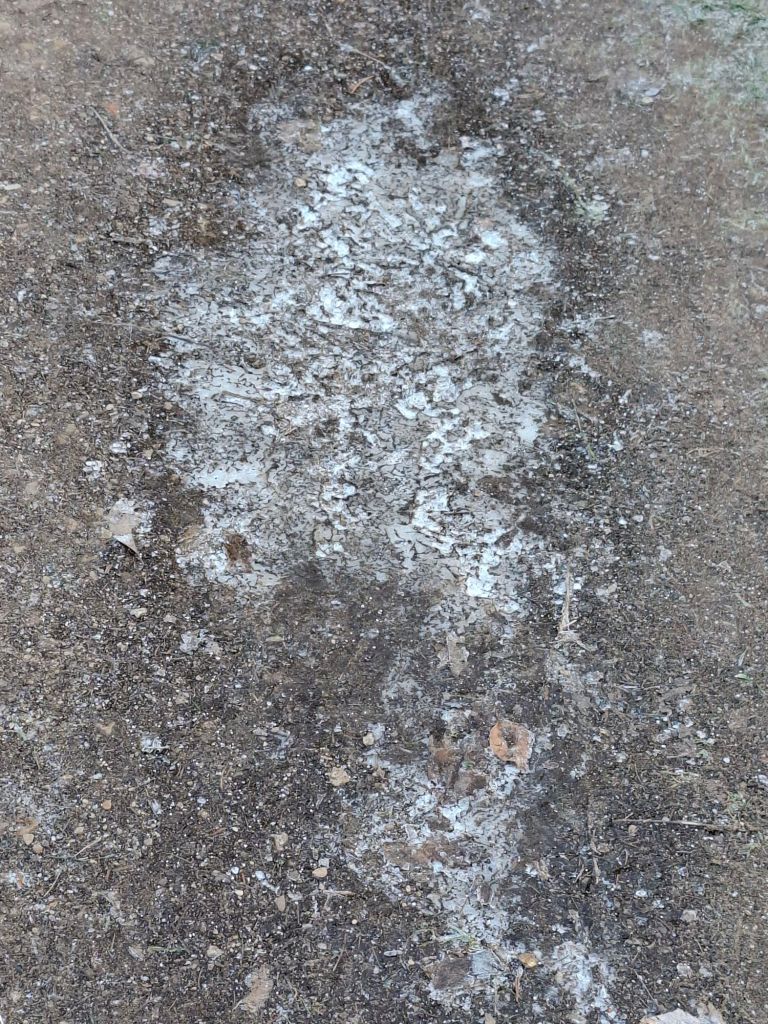
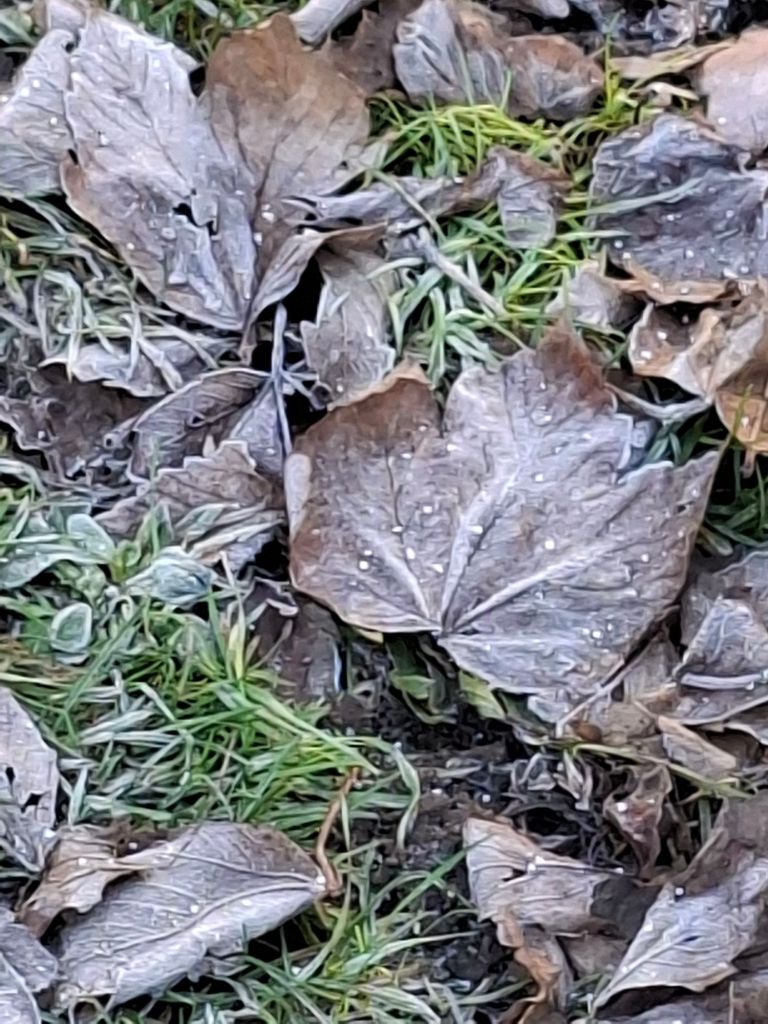
Yesterday, 5 January, I walked in Hillfield Gardens, Gloucester, in the early afternoon. Overall it was bright and sunny, despite being cold. But in shady spaces there were residues of frost.
I noticed how they changed the look and feel of these spaces for me. They became quietly exotic, as if differently blessed than the green grass in the sunlit areas. A light dusting was enough to make a difference. The three pictures below show the effects of the frost’s magic dust on a small tree, an old puddle on the path and fallen leaves on grass. All very ordinary. But the touch of frost had made them special to me in that moment. They held my attention, and enriched my day. It was an instance of re-enchantment.
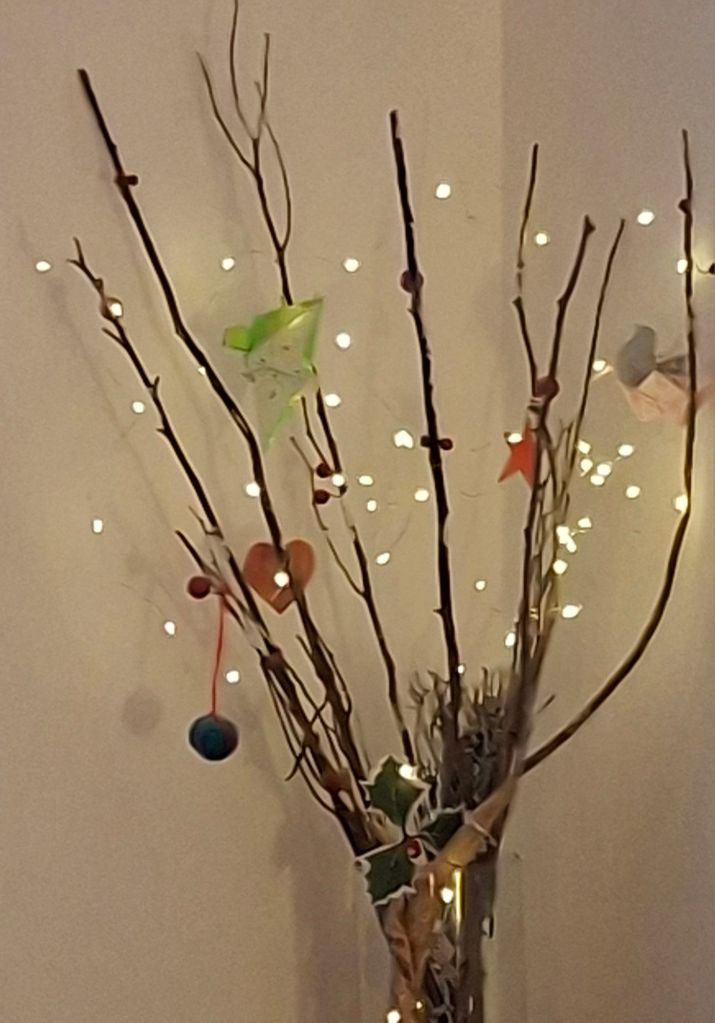
Monday 29th December. It is a normal working day here, in this period between the Christmas holiday and the new year. It is still dark outside, at 6.30 am, and likely to remain grey after sunrise at 8.15. Indoors, our minimalist decorations still proclaim a festive season. For us, this lasts from the Winter Solstice on 21 December until the Christian Epiphany on 6 January.
I’ve been experiencing an energy of latency throughout this period. I live in a place of winter gestation. In the natural world, birth doesn’t come quite yet. In this quiet in-between moment of a conceivably nondescript day, I can’t see 2026. I do not discern its likely shape or character.
That’s OK. I find that I don’t do want to strain at foreknowledge or resort to divination. A day-at-a-time approach, being alert and ready for anything, seems best. I know I want to be more open to the pleasure in simple things. I want to look for spontaneous festive moments that don’t depend on custom or calendar. They are part of my resilience. They make it easier for me, alone or with others, to face the challenges that come. In good heart, I am bracing for 2026.
There is rain on the window pane, and bleakness beyond: the closing in of early winter, with more closing in to come. It is not yet the festive season.
But the geraniums are heralds of change. Leaves may turn brown. Petals may be shed. But the insistent continuity of these flowers is a bright blessing in a grey moment, a vivid affirmation of the life force itself.
Contemplating these geraniums marks for me a distinctive point in the wheel of time, and the timeless Now that holds it.
A Scots pine in Hillfield Gardens (1), 28 November, 10.32 am. It stands out both as a tall tree and an evergreen. It asks me to look up and pay attention to it, and beyond it, almost losing sight of its deciduous neighbour. For me, this representative of the ‘eternal green’ has a commanding presence.
The Scots pine is one of the oldest trees native to Britain. It is also one of the trees associated with ogham lore (2), where the Scots pine is linked to the wisdom of overview. According to The Green Man Tree Oracle, ancient shamans of many traditions would literally climb to the top of a central tent pole or tree and “from this vantage point they could see clearly into the spirits’ inner world and come back with knowledge for the tribe or family they served” (2).
For me as for many people, the end of the calendar year is a time for reflection and taking stock. New year resolutions are a possible modern version of this process, but mine never really worked. They were overprescriptive and a way of setting myself up to fail.
‘Overview’ asks for a less driven and more contemplative approach, one more connected with Spirit. This is a good reminder as I start to wonder about how I am going to navigate 2026: divining what my contributions and satisfactions might look like as the Wheel continues to turn.
And here winter wends again, as by the way of the world it ought,
Until the Michaelmas moon has winters boding brought.” (1)
Even today, deep autumn opens the door to winter. This was even more the case in the North Staffordshire and Derbyshire regions of 14th century England, where Sir Gawain and the Green Knight was written. Even in castles, people were less sheltered from the growing cold and damp than we are. So readers and listeners of the period are reminded that the coming of winter is both natually and divinely ordained.
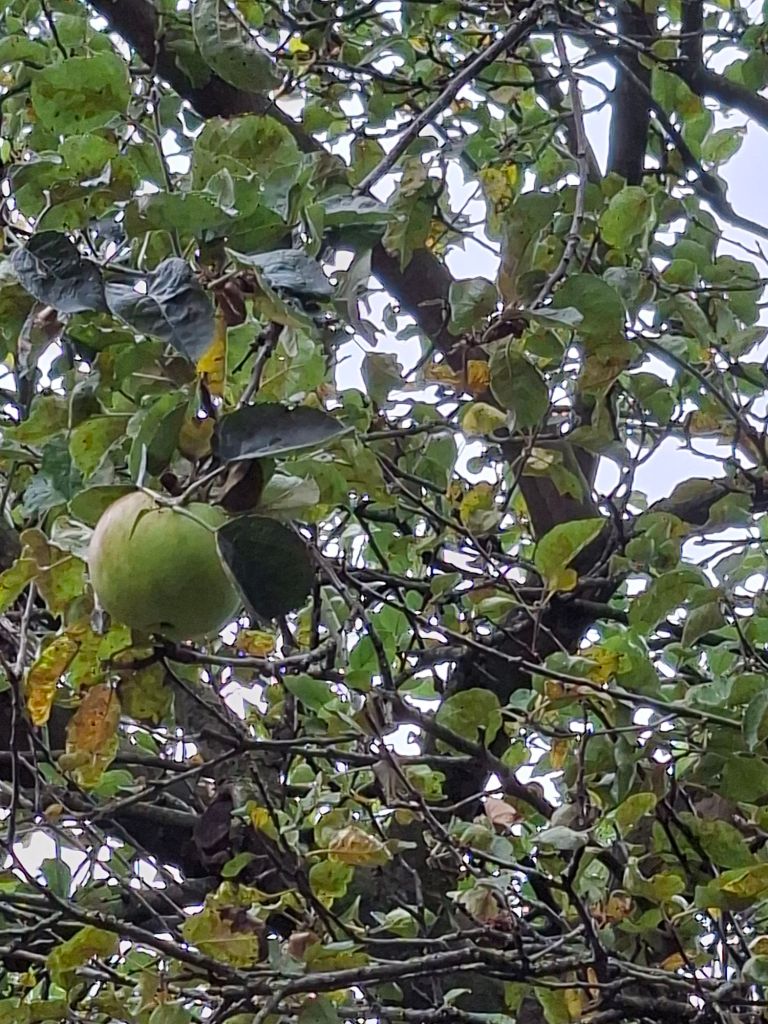
Here and now, the sight of the apple harvest in its later stages (pictured above) seems quite different than in the early ones (2) – less bright, less novel, less shiny. Rotting apples lie on the ground, now fallen outside the wall of Gloucester Cathedral’s orchard. From Nature’s exuberant perspective, this is all part of the plan. Waste is built in.
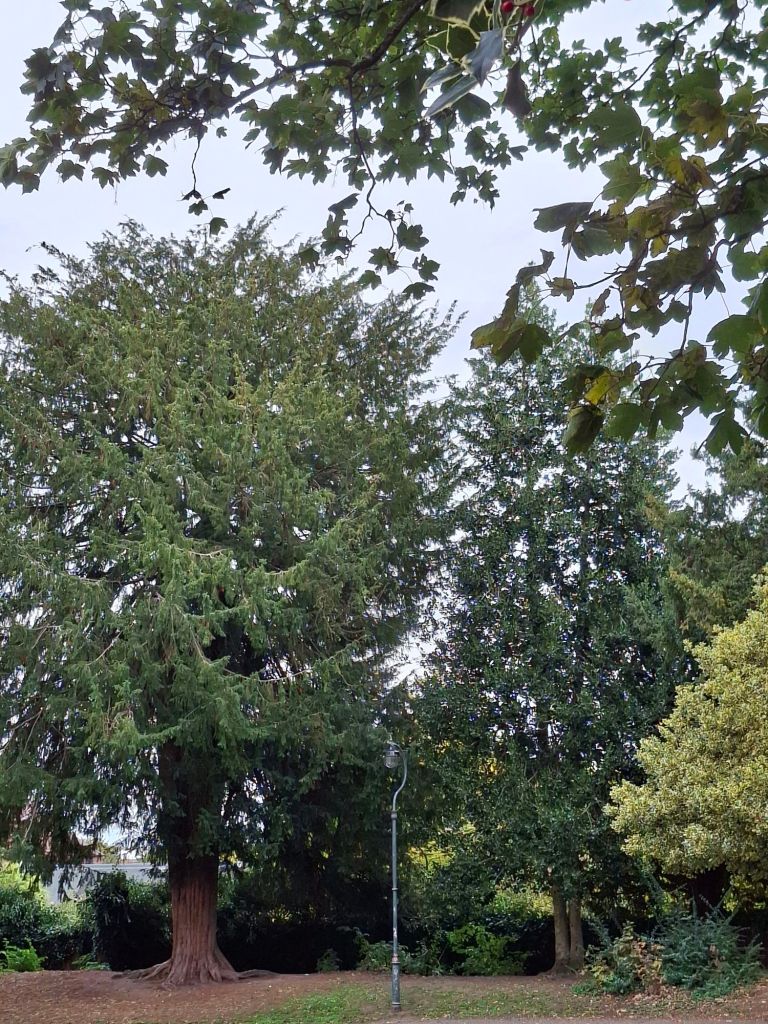
This time draws me further into the declining year. I am in the cathedral’s grounds, now looking at a yew tree and its associations with death. I’m thinking of the approach of Samhain (aka Halloween/All Hallows) at the turn of the month. Once it marked the 3rd harvest of the year – the blood harvest, where animals were slaughtered in preparation for winter. Now it is more a time to remember our ancestors, and our dead more widely.
Yet the seasonal moment, and the yew, can also be linked to wisdom and transformative change in life. I launched my contemplative inquiry at Samhain 2011. Like many people, I find that this period can be a resonant and creative time.
Below the yew, I have included a section of the cathedral itself. I have old personal associations linking medieval Gothic architecture with the feeling-tone of the declining year. I am also aware that this building is linked to the trees I picture and discuss. Gloucester Cathedral was a monastery when Sir Gawain and the Green Knight was written but many of its features were already in place.
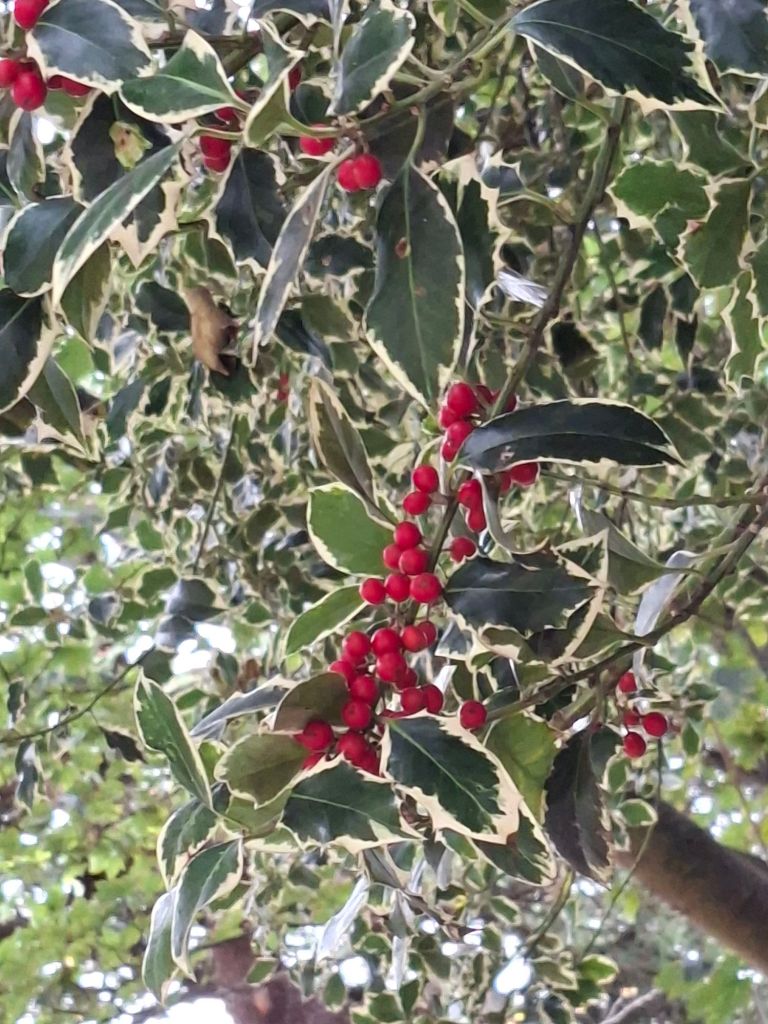
In the same space, I find both holly and ivy, with berries on the holly tree. I immediately thought of the Christmas carol The Holly and the Ivy. It is an ancient folk carol, which interweaves Christian themes and others that belong with the land. The version which is now popular was collected by Cecil Sharp in 1909 in Gloucestershire from Mary Clayton.
Many people think that the indigenous Pagan themes are the oldest, and that the central focus here is on the holly. The authors of The Green Man Tree Oracle say: “Holly’s connection with the Green Man is especially strong. In his guise as the Holly King – an ancient giant and symbol of fertility – the Green Man makes a notable appearance in the 14th century poem Gawain and d the Green Knight. Here he takes the form of a fearsome knight, who comes to King Arthur’s court to offer a midwinter challenge, carrying a club of holly and wearing a holly crown (as symbols of his true identity).” This challenge happens every year, where the Green Man/Holly King demands that we encounter him through our dealings with the natural world.
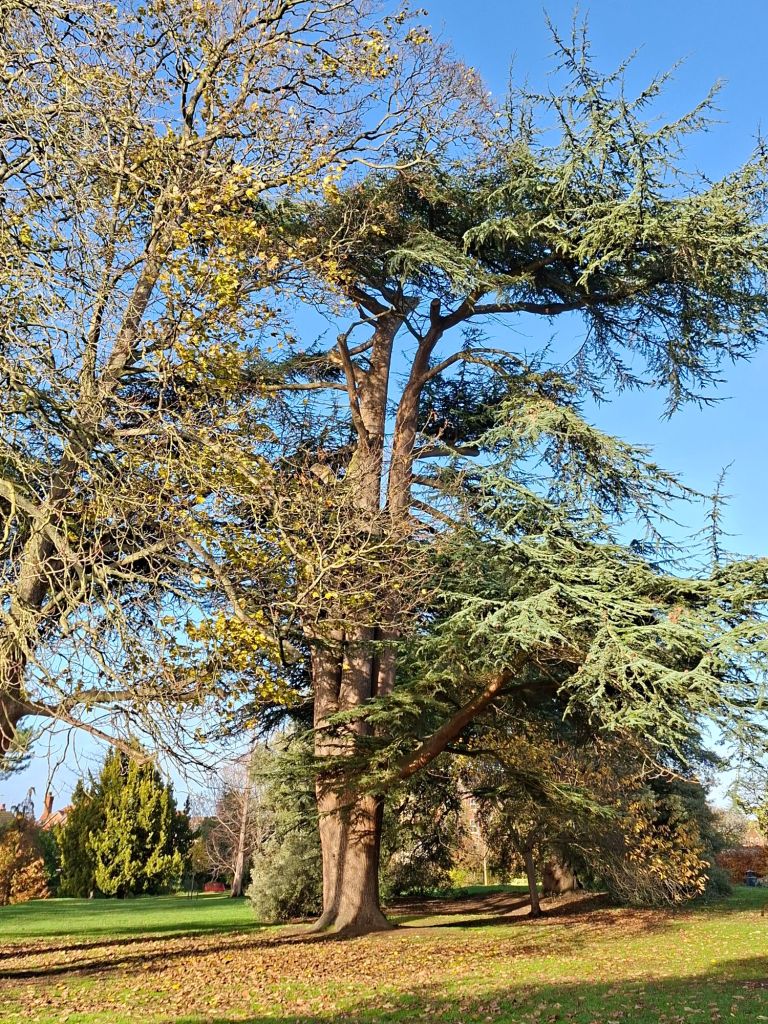
Elaine and I went to the Gloucester Cathedral Close and its surroundings on Saturday afternoon 18 October to outrun an extended period of gloom, wind and rain. We are now in it, so the lessons of the trees in deep autumn, anticipating the coming of winter, are not lost on us. The dark of the year is on its way.
(1) J.R R. Tolkien(translation of anonymous texts) Sir Gawain and the Green Knight, Pearl, Sir Orfeo New York: Ballantine Books, 1980.
4.30 pm, 25 February 2025. Sunrays are caught in willow branches. The sun is a little stronger today than it was in full winter. The willows have begun a tentative greening. But there is much shadow in this picture. The day has begun its decline.
The world retains a winter feel for me. I aware of the change in my local park, but I do not altogether trust this spring. In the moment of taking this picture, I see a world in shadow, softly darkened. This is partly because of where I have chosen to stand. It is the image I seem to want.
In the brighter picture below, I show daffodils growing among dead leaves. Daffodils are iconic harbingers of spring, yet not my sole focus. Both pictures were taken intuitively and without any mentally registered intent. It seems as if something in me wanted to make a statement.
I know and accept that I am in the winter of my life. In the wheel of my own life, I can’t quite see how my winter will move into spring, certainly in any personal sense. Dissolving into interbeing is easier to imagine.
My customised Druid liturgy names winter as the season of dying and regeneration. It has associations with law and faith. I understand law in a karmic or ‘natural law’ sense. But it can also be an acknowledgement of the nature we see around us. Faith, in part, concerns the willingness to accept dying and regeneration without knowing what they are like. In my last post, I discussed (1) ‘being nobody’. My current reflections take this suggestion a step further. Evidently, I still have much to learn.
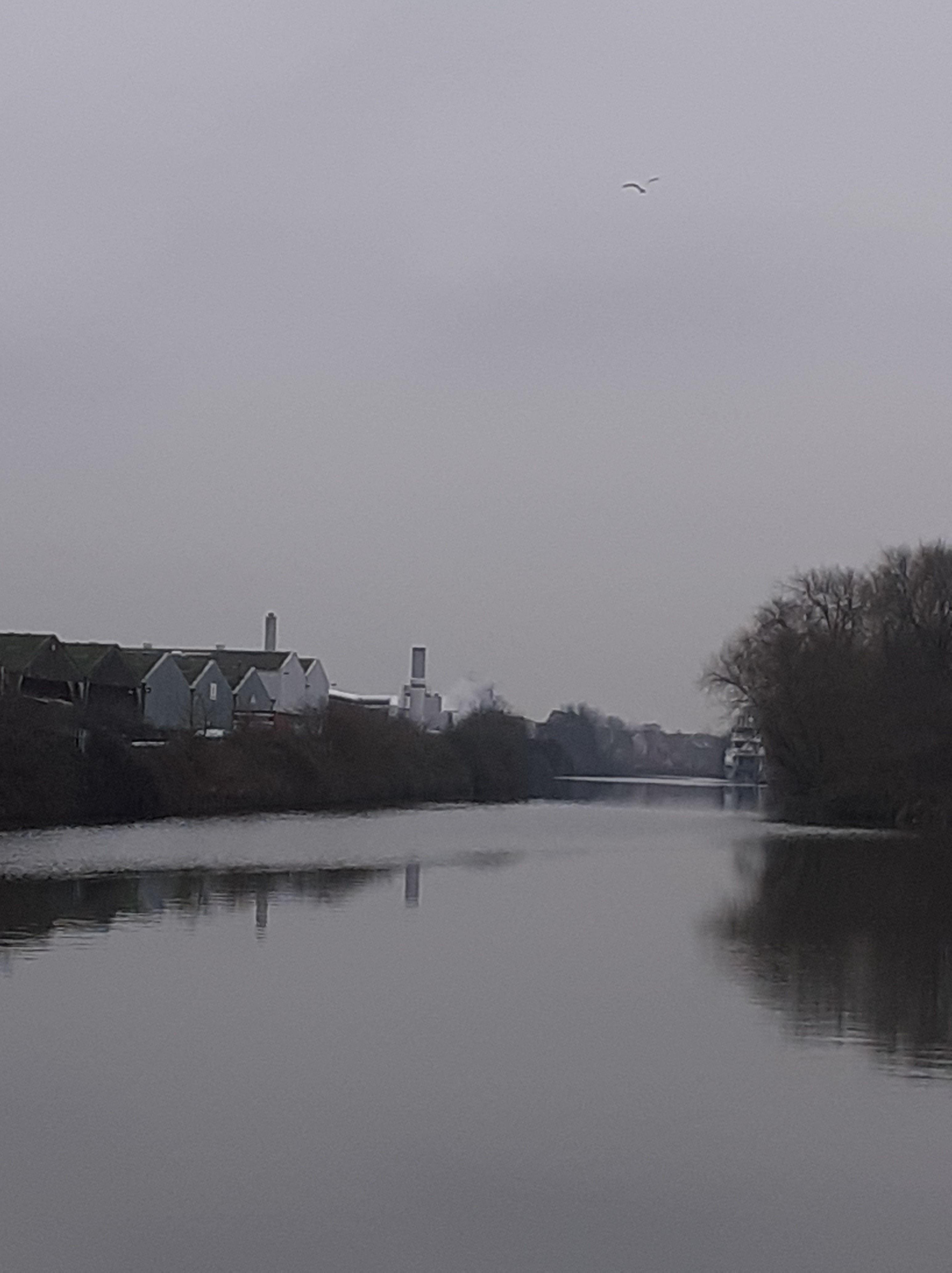
I am standing in a favourite spot, enjoying the expanse of water in front of me. I am missing the sun. I have been missing it for awhile, as the bright days of early February disappear into memory. I am living among shades of grey.
Standing in this space, I feel both sadness and reassurance. The late winter has turned gloomy and I am somewhat depleted. Not much energy or bounce. At the same time I continue to feel held, powerfully, within this landscape and my life.
Looking now at my apparently monochromatic picture, I see subtle variations within the grey. I am drawn to the ripples and reflections in the water. I am aware of the shapes of buildings and trees against a background leaden sky in which a seagull is flying. There are life and movement here, and their promise that the wheel of the year will continue to turn.
This morning, 2 February, sunlight streamed into our flat. Soon we realised that warmth was coming in along with the light. There was no need for artifical heating.
This may not yet be spring, by most people’s reckoning. But the day has had a spring- like quality. Elaine and I both felt lifted. For me, it was as if a weight had come off my shoulders: a weight to which I had become acclimatised. I had stopped even noticing it until it was so gloriously removed.
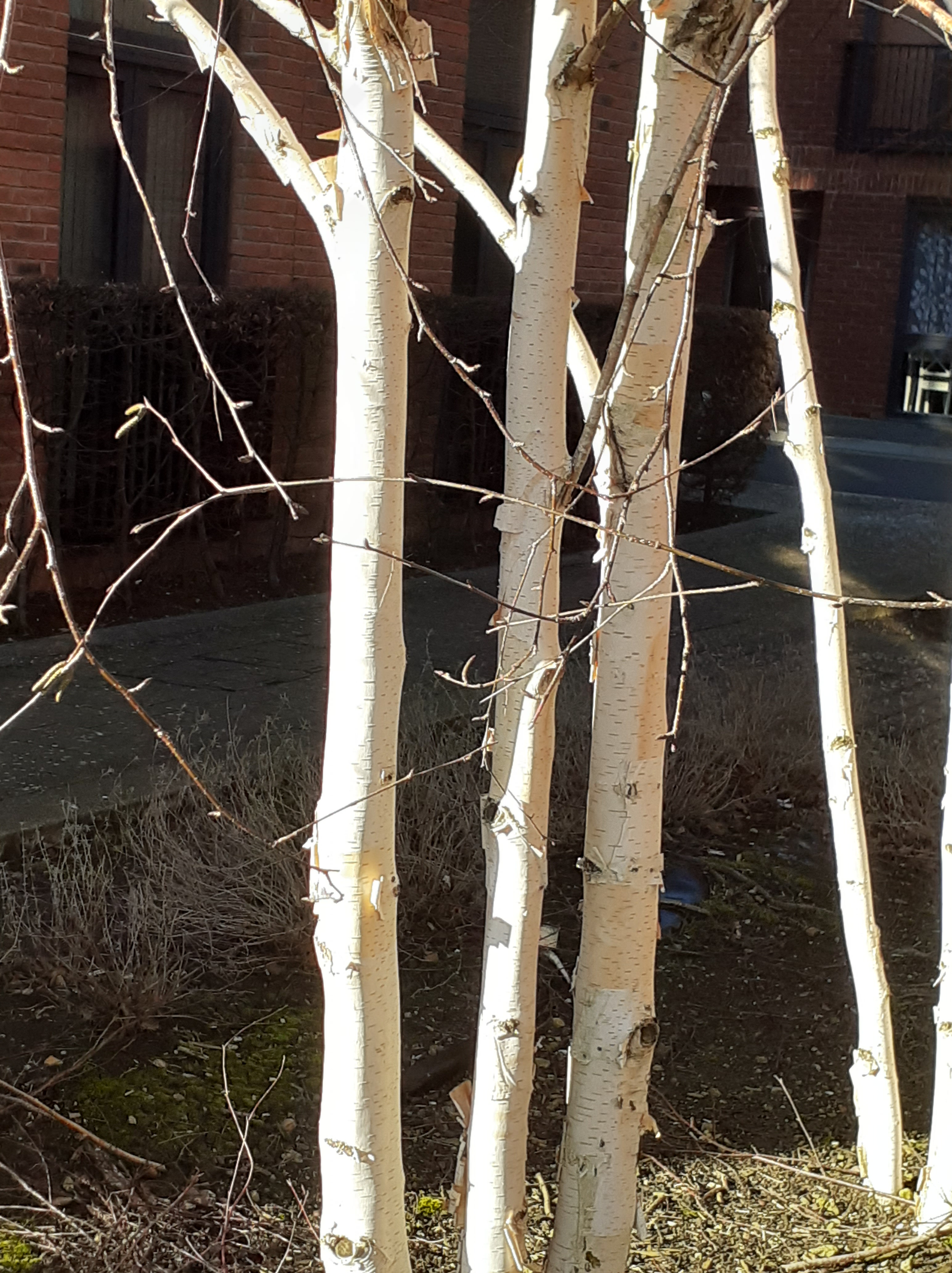
We made two trips out during the day. In the later morning we stayed near home. Elaine walked using her rollater and spent welcome time sitting in the sun. The same sun also shone on our adopted birches. Though it’s not shown in the picture below, the catkins are greener now.
In the afternoon, using the wheelchair, we visited Gloucester docks and sat there until not long before 4 pm. The heat was beginning to drain away by the time we left, and shadows were lengthening. Yet the two pictures below show, respectively, the dazzle of sunlight on water, and a canal barge lifting its solar panels to the sun.
A great day for a festival of lights, and a welcome opportunity for exuberance.










 Contemplative Inquiry