Contemplative Inquiry

This blog is about contemplative inquiry

Tag: Willow

SIMPLE PLEASURE IN AUTUMN LEAVES

Recently, Elaine and I walked to our local park after a  considerable absence. We were both adequately bold and mobile at the same time. We found a park very different, at least visually, to the sad, dried-up space of late  August and its premature turn.

Here, above, is lush life against a background suggestive of mist. Close up, we enjoy the patterns and colours of the leaves. They seem fresh, radiant and alive.

Below, the distinctive yellow of the tree of heaven, and its fern-like leaves, provide a powerful contrast that adds to our enjoyment.
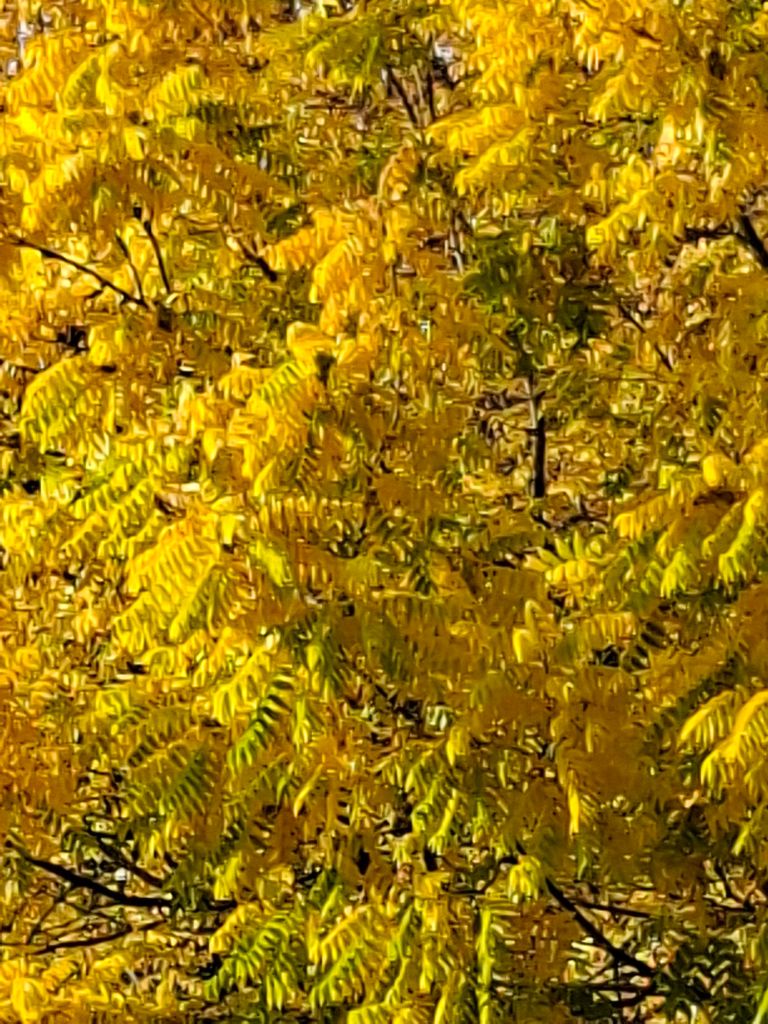
Looking from a somewhat greater distance, below, I experience a sense of majesty in seeing the whole tree (right) leaning into blue sky. Its slightly closer neighbour (left) provides a subtle colour contrast with a deep green intermingled with brown leaves ready to fall.

Below, I have stepped back further from the trees. My picture is of a clump of trees in the park. They are largish trees. The person walking past them is dwarfed. But I’m still enjoying leaves. I like the reddish brown emerging from residual green. I see Nature at work in a way that is both understated and beautiful. I know also that it can be a sheltering space within a generally flat and open park.

I still have a particular affection for willow, going back 20 years when I was studying Druidry. I was in Bristol and befriended a willow on the banks of the Bristol Avon, where it moves out from the old city towards the Clifton suspension bridge and the gorge. I became a literal tree hugger. It was part of a process that indeed changed my life. Hence my affection for willow. I am glad that there are willows in the Gloucester  City park.

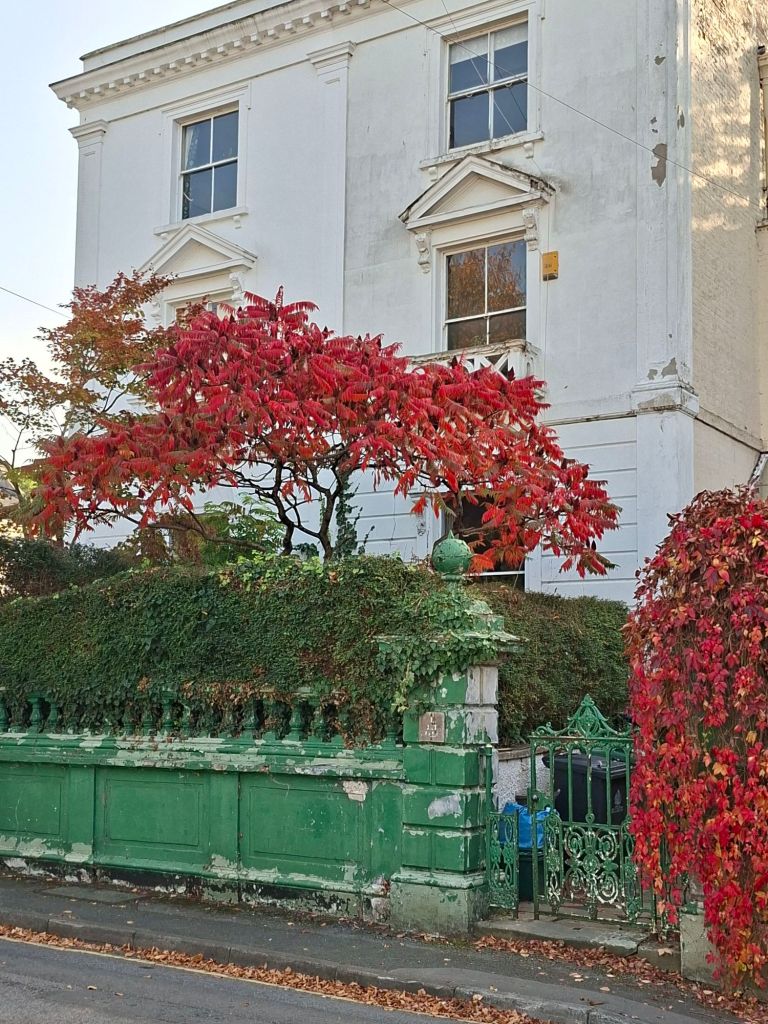
The road we took to and from the park offered leaves of autumnal red. I  believe that the tree in the front garden is a stagshorn sumac. When I walk past the tree I get a little distracted by the property’s obvious  need for a little tlc. Elaine however celebrates the opportunity taken by the Virginia creeper, as seen particularly in the second of the pictures below. It is great to see such abundance in this unpromising space.
For me, the great virtue of simple pleasures is their simplicity itself. Paying attention to the everyday  Nature around us can be deeply nurturing and involves little risk. Yet for some, it can be a portal to re-enchantment in a largely disenchanted world.
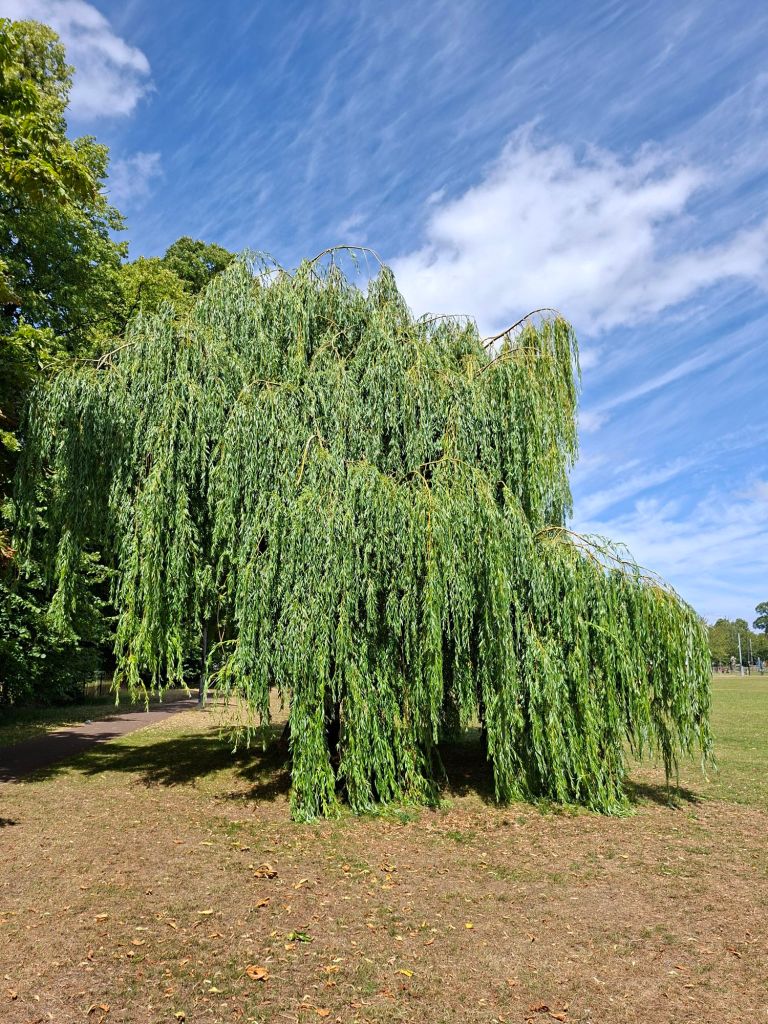
A WILLOW OFFERS SHADE

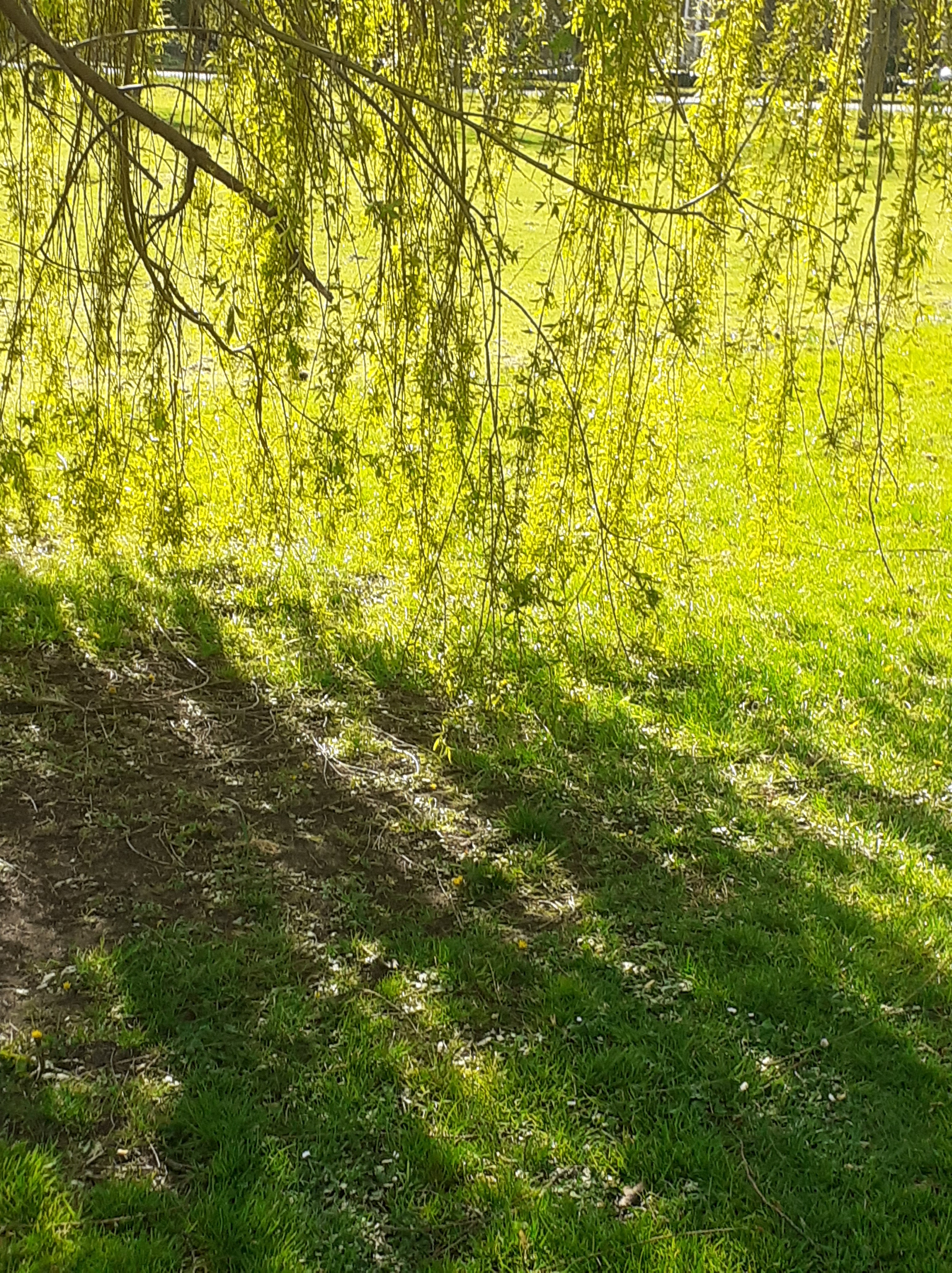
It’s a warm afternoon. The sun is strong. The park is parched. I could do with some moments of shelter. I walk towards a welcome willow tree.

I feel different under the tree’s lush canopy, as if in a benignly altered world. Its sturdy trunk upholds this precious space, embracing both light and shade. Although this space is small, I experience, here, more variety than in the expanse  of park immediately surrounding it.

For awhile I cling to the cool softness of this world within the tree, feeling as well as seeing what the branches and leaves of a weeping willow can do. A taste of Nature’s magic. Then I return to the world of the park.

WINTER’S END

4.30 pm, 25 February 2025. Sunrays are caught in willow branches. The sun is a little stronger today than it was in full winter. The willows have begun a tentative greening. But there is much shadow in this picture. The day has begun its decline.

The world retains a winter feel for me. I aware of the change in my local park, but I do not altogether trust this spring. In the moment of taking this picture, I see a world in shadow, softly darkened. This is partly because of where I have chosen to stand. It is the image I seem to want.

In the brighter picture below, I show daffodils growing among dead leaves. Daffodils are iconic harbingers of spring, yet not my sole focus. Both pictures were taken intuitively and without any mentally registered intent. It seems as if something in me wanted to make a statement.

I know and accept that I am in the winter of my life. In the wheel of my own life, I can’t quite see how my winter will move into spring, certainly in any personal sense. Dissolving into interbeing is easier to imagine.

My customised Druid liturgy names winter as the season of dying and regeneration. It has associations with law and faith. I understand law in a karmic or ‘natural law’ sense. But it can also be an acknowledgement of the nature we see around us. Faith, in part, concerns the willingness to accept dying and regeneration without knowing what they are like. In my last post, I discussed (1) ‘being nobody’. My current reflections take this suggestion a step further. Evidently, I still have much to learn.

(1) https://contemplativeinquiry.blog/2025/02/21/being-nobody

MOMENTS OF CALM

We have had a lot of wind and rain in recent days. Saturday was an exception. The sky was clear, vividly blue. The air seemed cleansed and fresh. I stood at the back of St. Mary de Crypt, above, and understood the sensibility that reaches up, aspirationally, to heaven. I could empathise with the yearning that goes with that, looking for something clear and bright and pure. It’s as if such a sky might hold a promise of peace, a peace that was alive and able to nurture beauty.

I am also glad that, by the standards of medieval churches (including others within walking distance) this St. Mary’s is modest and balanced in its upwards aspiration. It aspires, but does not run away from the earth. The picture below shows it as solidly grounded, and not altogether dwarfing the buildings that have been its neighbours for many years. The church is still consecrated and holds services from time to time. But now it functions largely as a busy community centre with a strong continuing role in Gloucester’s life. A solid presence in the heart of the city.

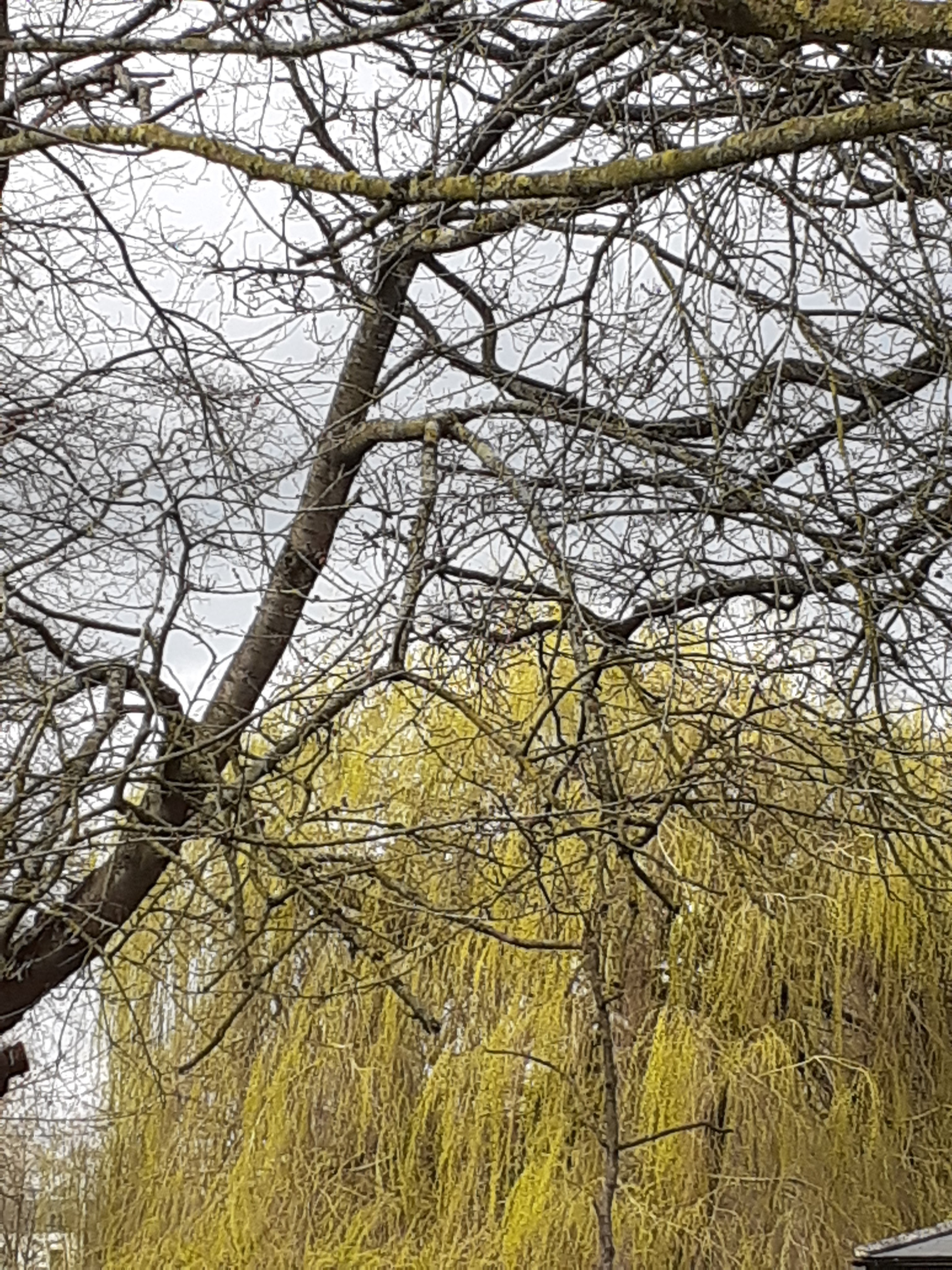
Looking in on the city park, I welcomed the same clear blue sky. But my eye was mostly drawn to the trees that it framed. Although this is still a winter scene, the colour of the willow suggests a strong presence of male catkins and the cycle of growth and change that is under way.

Leaving the park I made my way to the still living garden of the ruined Llanthony Secunda Priory, once the monks’ physic garden. It still feels like a place of healing and the present version is well maintained.

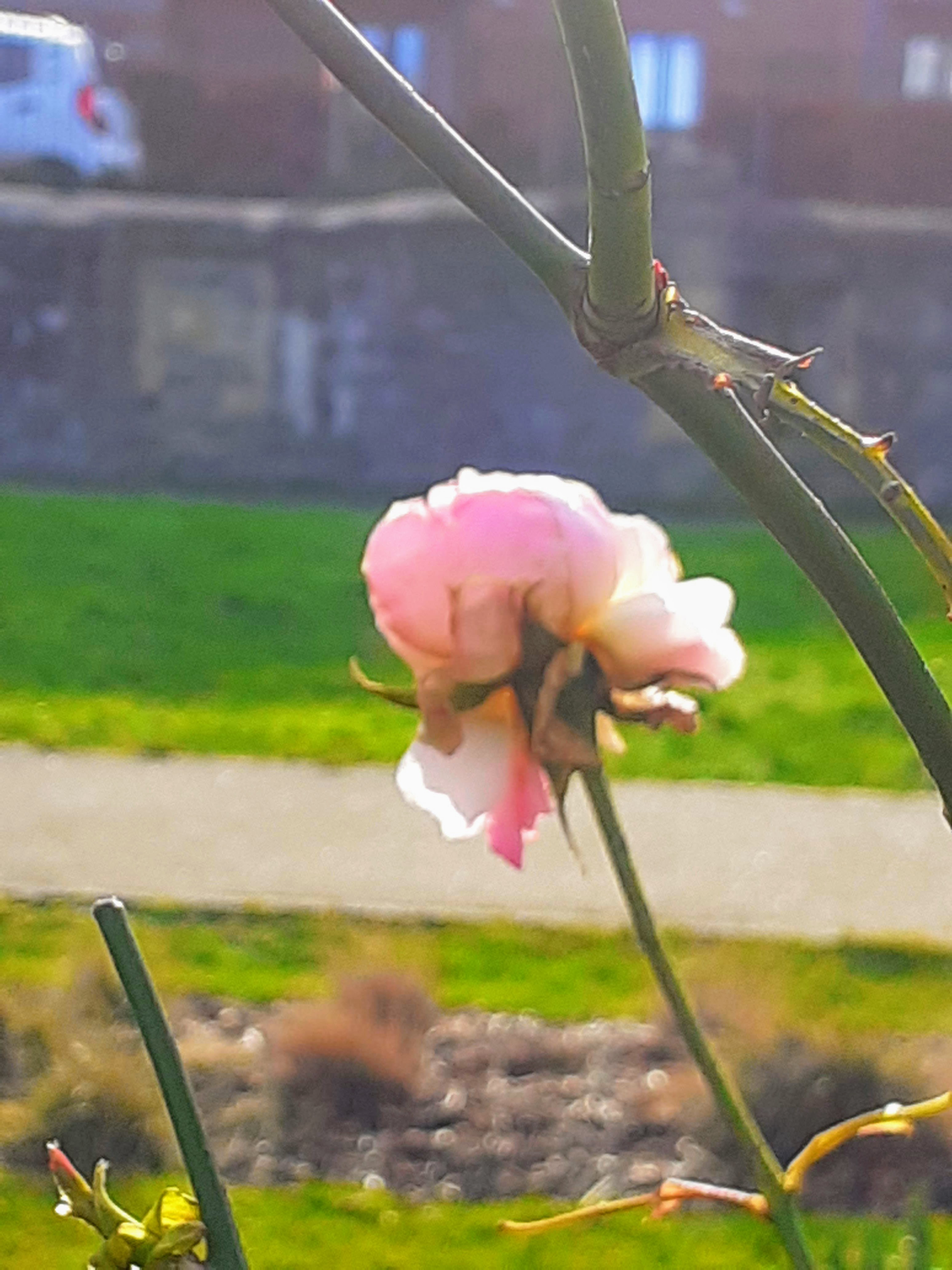
I was both surprised and delighted to see a rose in bloom. Roses have for a long time been a heart symbol for me, but I have generally associated them with summer and especially midsummer. I became aware of winter roses quite late last year and they were shop bought. I loved them but had some misgivings about their production. So I felt blessed to see one growing in the physic garden last Saturday. There’s no traditional link between Imbolc and roses that I know of. But seeing this rose in the ground, sunlight glinting on both petals and thorns, I had an Imbolc kind of feeling, as we approach the first festival of the rising year.

MARCH 2024: WIND IN THE WILLOWS

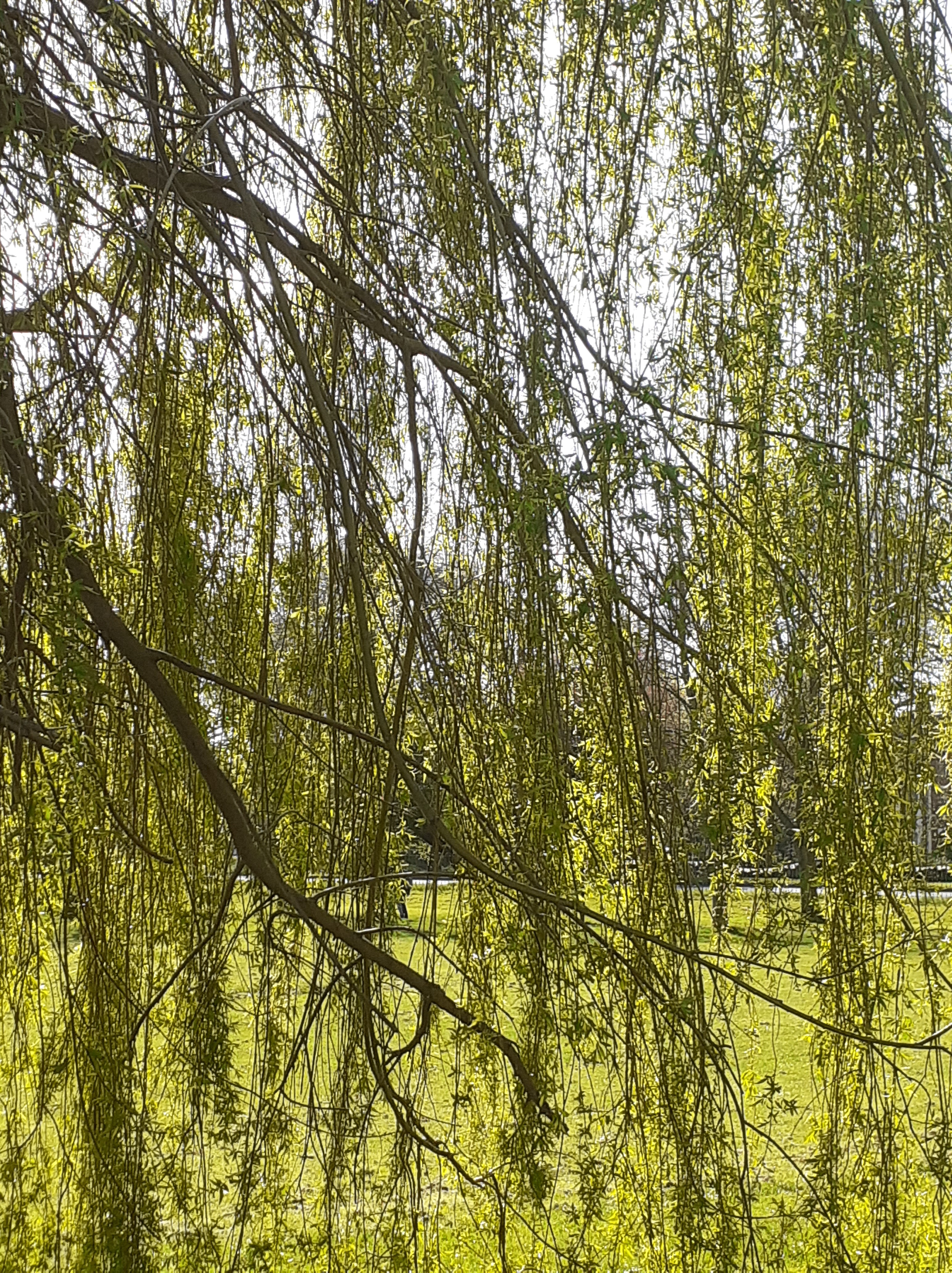
I’m walking in my local park. It’s a dull day in the first half of March. There have been many such days, and I could do with more sun. I certainly feel lifted when it comes. At the same time the days are longer and Mother Nature is busy with the work of spring: an abundance of willow catkins is testament to this.

I get my strongest impression of the strength and fecundity of willow when close up. The individual catkins are clearer, more prominent. The colours are stronger. There’s the sense of a rich and vibrant ecosystem, powerfully alive.

Still images don’t provide movement and sound, or indicate the presence of the March wind. I have tried to capture this in my short video below, illustrating another aspect of this moment in the year. It brought up fond childhood memories of Kenneth Grahame’s The Wind in the Willows which begins with spring cleaning and includes the gently Pagan chapter The Piper at the Gates of Dawn.

Willow became important to me in my early study and practice of Druidry. I began a special relationship with a particular willow in Bristol for many years (2), which continued after I left the city and continues sporadically to this day. I also developed a private tradition of following the wheel of the year through a mandala based on 16 trees, all in easy distance of where I lived, with Willow the focus from 17 March to 7 April, hence presiding over the spring equinox (3). Checking in with the willows is a continuing feature of my walks, though I was a little early this year.

(1) Kenneth Grahame The Wind in the Willows London: Dean, in association with Methuen’s Children’s Books, 1991. (Ist ed. 1908. Illustrated by E. H. Shepard)

(2) https://contemplativeinquiry.blog/2013/1/31/willow/

(3) https://contemplativeinquiry.blog/2021/03/17/tree-mandala-willow/

LIMITS AND BLESSINGS

In my world, this is a time of laboured breath and limited capacity for walking. While medical investigations are underway, I am constrained in what I can do. But walking outside, taking slow deep breaths, and drinking plenty of water are medically and spiritually recommended. Today I went outside for the first time in some days, water bottle to hand, and a rhythm of slow, deep breathing established.

I walked in my neighbourhood and a nearby local park. The picture above is a treescape from that park. For me, it is images solidity and endurance alongside blue sky and spring growth. In itself, it occupies a unique niche in the web of life. I enjoy its company, and the opportunity to record its presence here.

My world may seem, at least for the time being, to have shrunken. My own presence in it, and my perceptions when present to it, do not have to shrink along with the physical distance I can cover. A necessary slowing down contains it own opportunities. I have space and time to enjoy the willows here, their leaves, and the shadows of their leaves. I am constrained to take notice. I appreciate the experience of noticing. I am reminded that I am just outside the period assigned to willow in my personal tree mandala (1,2), but of course it is not too late to connect and commune. There are compensations nested in my unwanted condition.

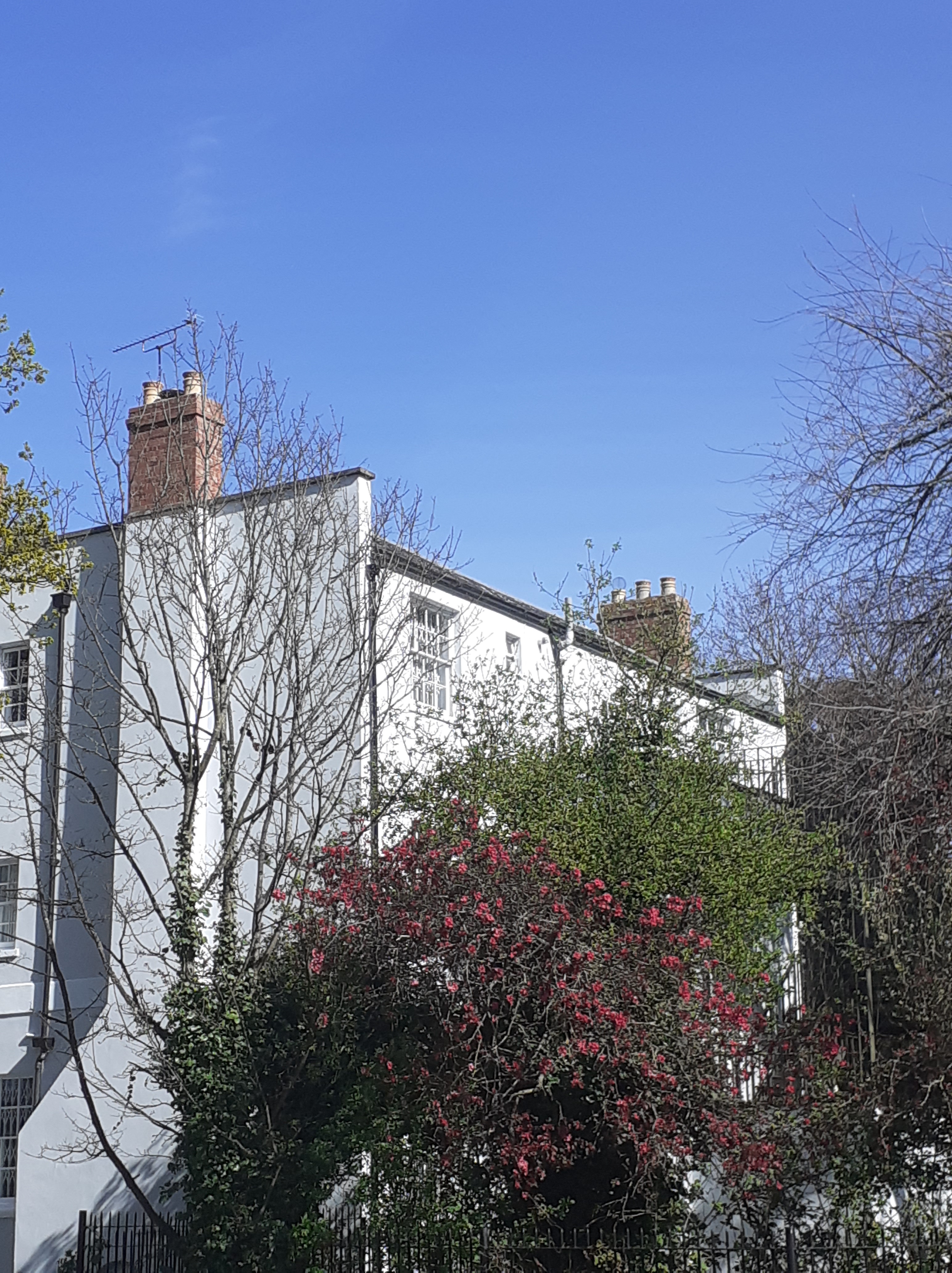
I find the houses and their surrounding plant life photogenic, not least under a blue April sky. The season has been advancing, the equinox now well past. Around me, I find an energetic acceleration towards summer. Hildegard von Bingen called this kind of natural power viriditas. I can recognise and enjoy it even when I’m lagging behind.

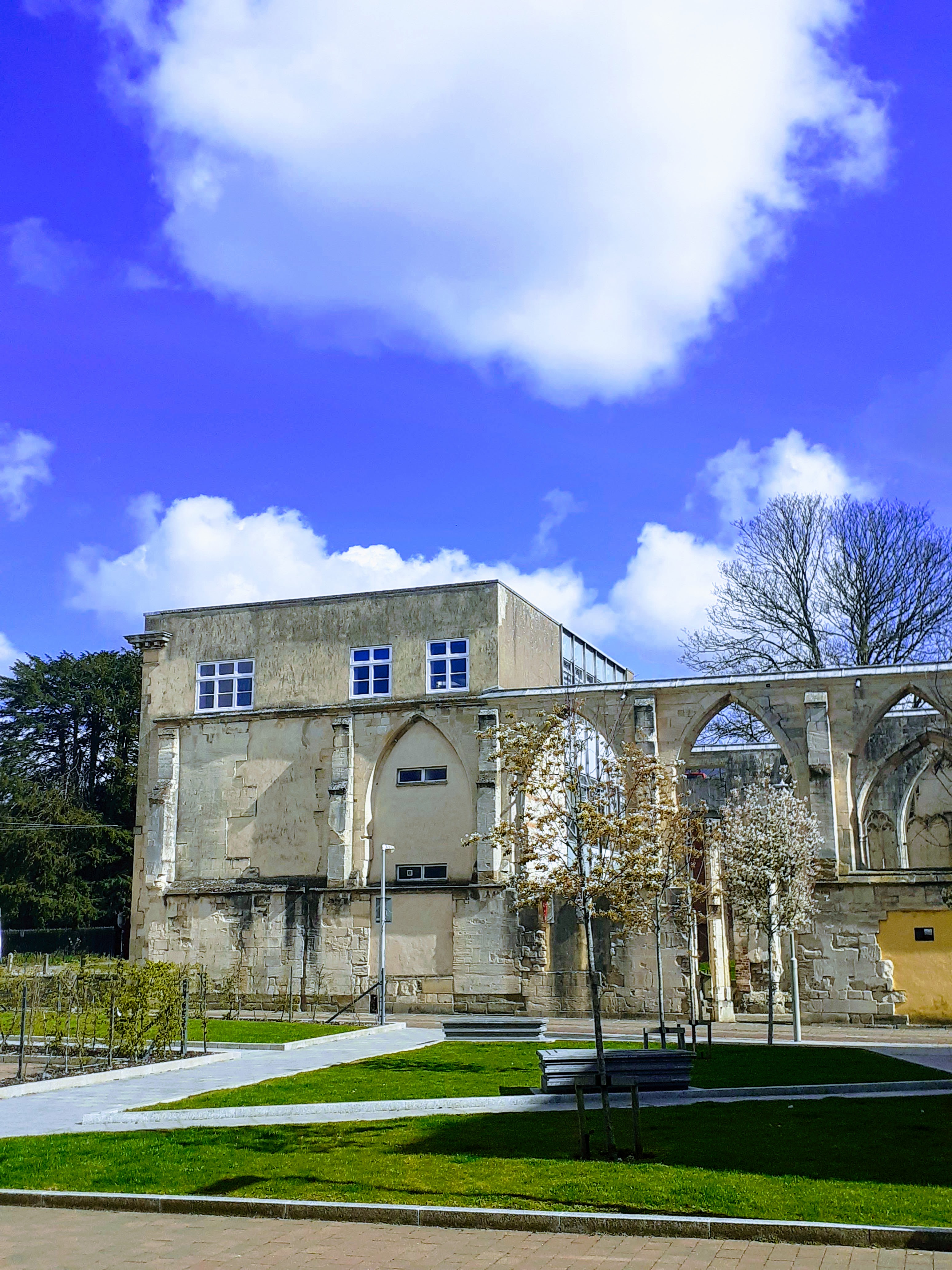
Very close to home I encounter the ruins of Gloucester’s Franciscan Priory, sadly with a nondescript mid C20th building tacked on behind them. They are a landmark for me on my return. I’m tired. I’ve about reached my limit. Although I’m sad that my walking distance is so limited, I feel blessed and nourished by what I find within the limitations. I am also glad to sit down and recognise feeling at once refreshed and exhausted.

(1) https://contemplativeinquiry.blog/2021/tree-mandala/willow/

(2) The mandala is based on my personal experience of trees in the neighbourhood as well as traditional lore. Moving around the spring quarter from 1 February, the positions and dates of the four trees for this quarter are: Birch, north-east, 1-22 February; Ash & Ivy, east-north-east, 23 February – 16 March; Willow, east, 17 March – 7 April; Blackthorn, east-south-east, 8 – 30 April. The summer quarter then starts with Hawthorn at Beltane. For a complete list of the sixteen trees, see https://contemplativeinquiry.blog/2020/autumn-equinox-2020-hazel-salmon-awen/

TREE MANDALA: WILLOW

I walk past these willows and they awaken my joy in natural beauty. Their full splendour may yet be to come, but they are already abundant with new life and growth. I am lifted by the promise that’s in them.

In my mandala of the year (1), willow presides over period from 17 March to 7 April. Working with trees in my Druid training, I developed a close contact with a willow near to where I then lived in Bristol. I also made a willow wand, from a dead branch I found lying around in another part of town.

In the course of this work I developed a sense of willow that does not exactly match our inherited lore. My records tell me that my main personal impressions concerning willow were of “resilience and generativity” and of “vibrancy in early spring”. Those impressions still stand. I don’t link myself so much to associations with the dark side of the moon (and moon goddess) or the many uses of wicker.

I do make connections between willow and the energy of water, and I can know of willow as a portal to gently magical experiences. Below, I offer a digitised picture of my Bristol tree, taken on 21 March 2007, and an account of time spent with it that afternoon. I enjoy the chance to share this fourteen year old memory, and bring a small piece of my personal Druid history into the present. Intentional reminiscence can be a deeply satisfying here-and-now experience.

“This afternoon I went out to see the trees – beautiful sunshine. The willow I’ve connected with looked very willowy – buds, leaves, catkins. It seemed solid, vibrant, pulsing. Leaning against the trunk from shoulder to hip, I sensed a resonance connected to the contact. Tuning in, I began to make a sound. The note that developed was light and optimistic, but strong enough fully to reach me in the belly. It had a potency that surprised me. I felt carefree, I could take in the cool equinoctial breeze with the warm equinoctial sun and enjoy a moment of holy idleness after a time of rushing around and work.”

I avoid talking about this experience in the language of relationship with the tree, though part of me would like to. I do not know what it is like to be a willow tree, but I am sure it is like something. I know of no way to check in with the tree that allows it to contradict my own precious intimations of communion, should it want to. I suspect that it barely noticed me. Yet the experience felt healing, and I have never forgotten it.

(1) This mandala is based on my personal experience of trees in the neighbourhood as well as traditional lore. Moving around the spring quarter from 1 February, the positions and dates of the four trees are: Birch, north-east, 1-22 February; Ash & Ivy, east-north-east, 23 February – 16 March; Willow, east, 17 March – 7 April; Blackthorn, east-south-east, 8 – 30 April. The summer quarter then starts with Hawthorn at Beltane. For a complete list of the sixteen trees, see https://contemplativeinquiry.blog/2020/autumn-equinox-2020-hazel-salmon-awen/

CONTINUITY AND CHANGE

IMG_20191001_124254

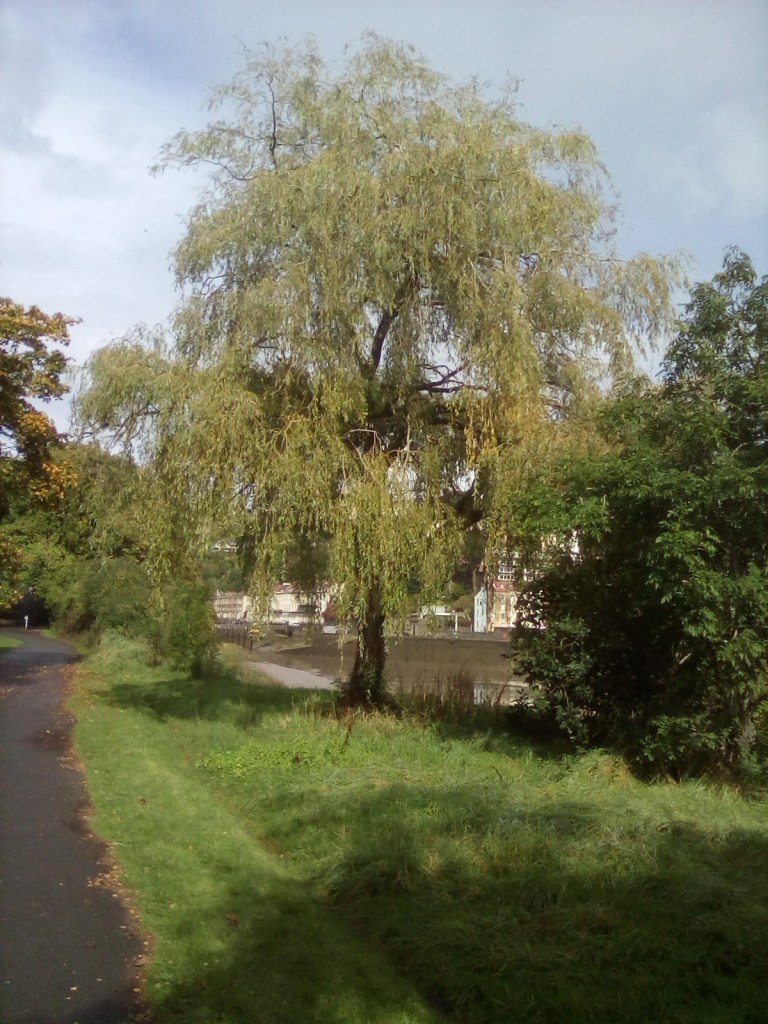
I took this picture on 1 October this year. The subject is a willow tree I befriended many years ago as part of my Druid training. It lives in Bristol beside the Avon as the river begins to leave the city, passing through the Clifton gorge and under the suspension bridge. The path, here at the edge of a park, is also a cycle track and continues towards the Severn estuary beside the river. Although I no longer live in Bristol, I continue to visit the willow from time to time and renew the contact.

My strongest link with the tree was in early spring. where I got the most powerful sense of its pulse and vibration, felt especially whilst touching the trunk with the palms of my hands. But I was careful to follow it through a year of regular communion during which it lost a substantial branch to a violent storm. I learned to associate this tree with regeneration, resilience and  generativity. The tree re-established its balance. The dead branch rotted gently in the ground, and contributed to other forms. Nothing was lost.

I’m about to go on a rare visit to my home town, partly to contemplate the continuities and discontinuities of my life and consider future directions. The image of the willow is with me.


Earth Eclectic

music that celebrates Earth and speaks to the heart

Sarah Fuhro Star-Flower Alchemy

Follow the Moon's Cycle

Muddy Feet

Meeting nature on nature's terms

Rosher.Net

A little bit of Mark Rosher in South Gloucestershire, England

Becoming Part of the Land

A monastic polytheist's and animist’s journal

selkiewife

Selkie Writing…

Charlotte Rodgers

Images and words set against a backdrop of outsider art.

Prof Jem Bendell

living with metacrisis and collapse

Towint

The pagan path. The Old Ways In New Times

The Druids Garden

Spiritual journeys in tending the living earth, permaculture, and nature-inspired arts

The Blog of Baphomet

a magickal dialogue between nature and culture

This Simple Life

The gentle art of living with less

Musings of a Scottish Hearth Druid and Heathen

Thoughts about living, loving and worshiping as an autistic Hearth Druid and Heathen. One woman's journey.

Wheel of the Year Blog

An place to read and share stories about the celtic seasonal festivals

Walking the Druid Path

Just another WordPress.com site

anima monday

Exploring our connection to the wider world

Grounded Space Focusing

Become more grounded and spacious with yourself and others, through your own body’s wisdom

The Earthbound Report

Good lives on our one planet

Hopeless Vendetta

News for the residents of Hopeless, Maine