Contemplative Inquiry

This blog is about contemplative inquiry

Tag: William Anderson

ROWAN’S LATE SUMMER SIGN

Where I live, late summer is often the warmest time of year, and the driest. This is likely to be the case in 2025, already a warm dry year. But in the sun’s apparent annual journey, it is also a time of waning. Sunrise is an hour later than at the solstice, and sunset is forty-five minutes earlier. This change will accelerate from now on.

I do not see waning as negative. There is power and beauty in this ‘waning’. In the rowan (aka mountain ash) picture above, the berries are moving from tentative orange to bright scarlet, an effect of the seasonal changes in the light. Rowan is an ogham tree, linking a group of indigenous Irish and British trees to an ancient Irish alphabet. Its Gaelic name luis means bright or flame.

Looking at the year as a whole, some of the berries will still be holding on beyond midwinter, by which time the tree, which can live for up to 200 years, will be making its annual comeback. At that time, as described in William Anderson’s justly venerated in Green Man poem (1):

The hungry birds harry the last berries of rowan

But white is her bark in the darkness of rain

‘I rise with the sap’, says the Green Man

‘I rise with the sap’ says he. (1)

The resilience of the tree runs throughout its year and lifetime. In  late summer specifially, this resilience is manifested in berries at their brightest, against the backdrop of a still blue evening sky.

Traditionally Rowan has strong associations with protection, spiritual  protection not least. According to The Green Man Tree Oracle (2), ‘it can also offer insight into danger through the invocation of higher wisdom’. Ancient Druid shamans were said to breathe in the smoke from rowan fires to initiate a trance state that allowed them to predict coming danger.

The Druids also planted rowan, as well as oak and ash, in their sacred groves. But Celtic Druids were not the only people to place a high value on the rowan tree. Our modern word rowan is probably descended from the Norse runas – narrowly translated as ‘charm’ but in fact bringing the wider runic and Norse traditions with it.

When I encountered the rowan I was strongly moved by it. It stood out from everything else.   I had previously decided not to take pictures on my walk, but felt compelled to change my mind. I didn’t need ancient lore to feel more alert and heartened. It’s just that the framing it provides added cultural depth.  The encounter with rowan put a spring in my step and was a highlight of my evening.

(1) William Anderson Green Man: archetype of our oneness with the Earth Harper Collins: London & San Francisco, 1990

(2) John Matthews & Will Worthington The Green Man Tree Oracle: ancient wisdom from the greenwood  London: Connections, 2003
‘I SWIM WITH THE SALMON’

“The hazels are rocking the cups with their nuts

As the harvesters shout when their last leaf is cut;

‘I swim with the salmon says the Green Man,

‘I swim with the salmon’, says he.” (1)

‘I swim with the salmon’ is a bold, clear statement. It evokes powerful images that leap out of their place in the flow of William Anderson’s poem. Green Man as a whole takes us on a wheel-of-the-year journey beginning on 22 December, successively featuring thirteen trees for four weeks each. The hazel is the ninth tree, whose time runs from 3-30 August. As the poem indicates, this is a harvest period, and the last month that fully belongs to the summer. It is also a time when you may find Atlantic salmon swimming home to spawn, though spawning doesn’t begin until October.

In this post I celebrate salmon naturalistically, through an account of their extraordinary life cycle. I am especially aware of the River Tay in Scotland, mostly thanks to a 90 minute documentary The River: a Year in the Life of the Tay (2). My personal experience of the Tay is limited to visits to Dunkeld, Perth and Dundee, where I nonetheless fell in love with the river and its powerful energy.

Salmon begin their lives in mountain streams, as far upstream as their parents have been able to reach in their autumn/early winter spawning period. The new generation undergoes a remarkable series of transformations (3), hatching as alevin or sac fry when the water warms in spring, and growing into parr with camouflaging vertical stripes. They remain in the same environment for two or more years, by which time, as smolts, they have developed a bright silvery colour with scales that easily rub off. Driven by growth hormones, the 10% of smolts who survive to this stage experience the mutations necessary to become salt water fish and make their journey to the ocean.

They spend another two or more years in the North Sea, travelling north into Norwegian waters, becoming sexually mature, with a darkening of the silvery scales, before embarking on their homewards 120 mile journey up the river to its headwaters. They are much larger than they were when on their way out. The largest salmon ever caught in the Tay, in the 1920’s, was over five feet long.

To return to their own birth-place (remembering exactly where they come from) they have to navigate waters that include rapids and waterfalls, evade osprey and human anglers, and achieve the feats of leaping for which they are famous. “The salmon is able to jump upstream not by fighting against the current, but by utilizing its knowledge of the reverse current which flows beneath the surface current” (4). They are returning to their native headwaters in order to spawn and begin the cycle again. 98% of Atlantic salmon spawn only once and die soon afterwards: their adult bodies, equipped for a salt water life, never fully re-adapt to fresh water and this makes them vulnerable.

Swimming with the salmon is not for the faint-hearted. At the present time the population of Tay salmon is in severe decline (70% in the 30 years to 2019) although the river is relatively clean and is now managed to prevent over-fishing. The effects of the climate crisis in the Atlantic are the most likely cause for the decline of Tay salmon, as for Atlantic salmon in general. Yet even in decline they remain magnificent. Long before the Celtic Iron Age, during it, and for long afterwards, they were abundant in the rivers of Britain, Ireland, and other Atlantic maritime countries. With their complex shape-shifting capacity, their far-journeying years at sea, their uncanny homecoming knowledge and their extraordinary leaps, they seem marked out for another life, in human song and story. I would like to think that the salmon’s mythic reputation can help to save it in this interconnected world.

”’I swim with the salmon says the Green Man,

‘I swim with the salmon’, says he.”

(1) From:  William Anderson Green Man: Archetype of our Oneness with the Earth Harper Collins: London & San Francisco, 1990 See also: https://contemplativeinquiry.blog/2017/05/11/poem-green-man/

(2) The River: A Year in the Life of the Tay 90 minute documentary made for BBC4 in 2019. Presented by writer and naturalist Helen MacDonald. See: https://youtu.be/ZEmAXQIrDeg?si=wlaI0bNtM6YWevAf The film is well worth watching, covering the journeys of the salmon and much more.

(3) Salmon Wikipedia

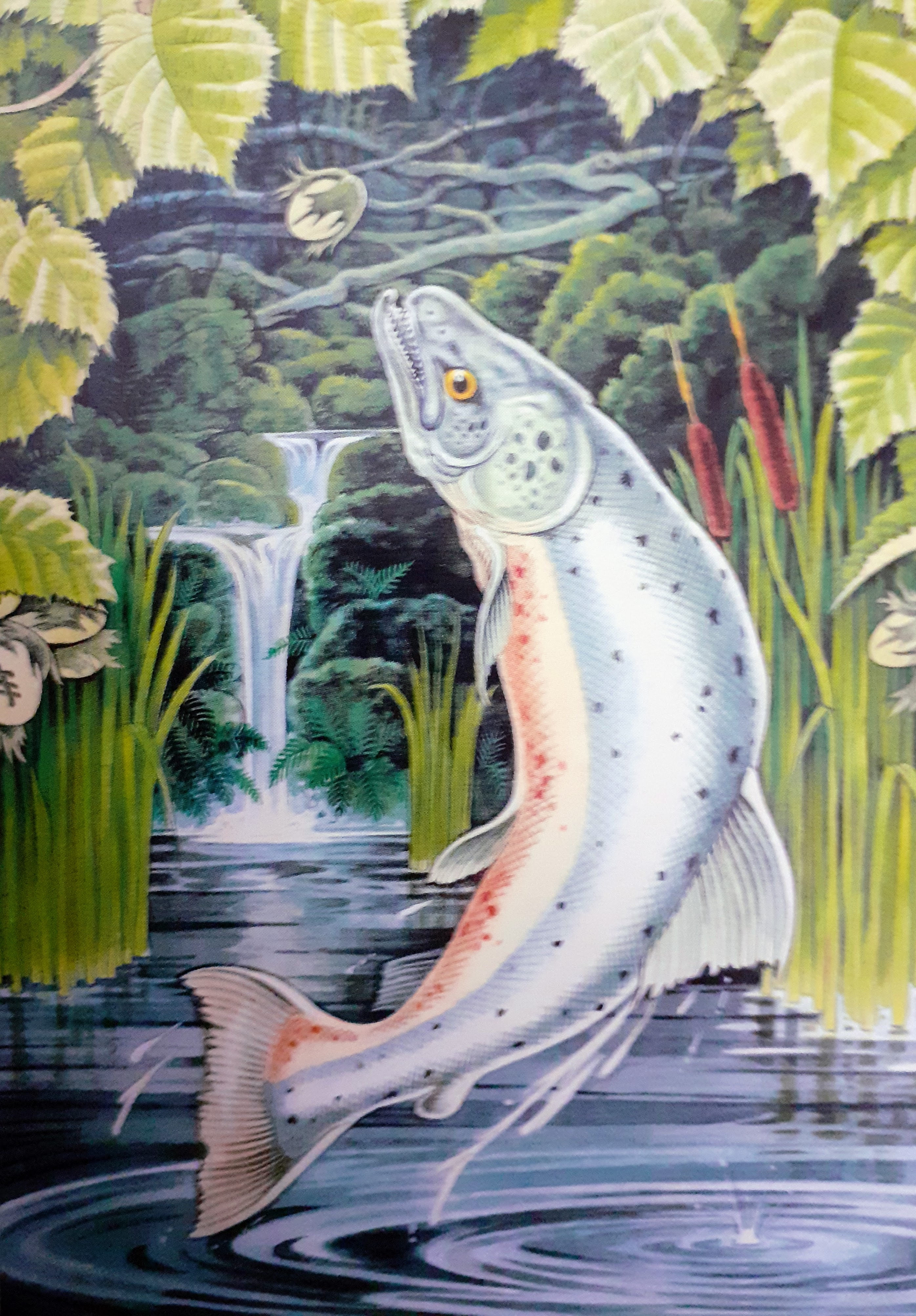
(4) Philp and Stephanie Carr-Gomm The Druid Animal Oracle: Walking with the Sacred Animals of the Druid Traditions Fireside: London, 1994 Illustrated by Will Worthington. The face of their salmon card is pictured at the top of this blog.

OLD MIDSUMMER’S EVE 2024

23 June 2024, around 8.15 pm. I’m enjoying my first contemplative walk for some days. I’m looking at an old wall, once part of the Llanthony Priory estate in Gloucester. The day has been one of rising temperatures and humidity. Even now, as the shadows deepen, I feel an energy and expectancy in the evening light.

The Priory here was for a time the largest landlord in the city and its surrounding district. In those days, midsummer was celebrated on 23/24 June. The Church celebrated the birth of John the Baptist, at the opposite end of the year from that of Jesus. (His beheading is remembered on 29 August). Popular celebrations on the evening/night of 23 June involved bonfires, and local festivities could be attributed to the saint, the season, or both.

In many cultures, the year has been divided into two contending halves, whether at the solstices, the equinoxes, or with the Beltane/Samhain division. Traditional Christianity flirts with this theme. I might think of summer and winter kings, king-slaying and the Goddess. I might also think of John, Jesus, and their respective human fates. In the case of John, Salome and her royal mother Herodias are a presence, along with their fateful demand for his head. These stories are not the same, but in the European Christian imagination they have at times been interwoven.

I might also think of the Green Man maturing to the point where he can “speak through the oak”, as “its crown forms his mask and its leafage his features” (1). To speak through the oak is to speak at another level, or from another dimension, a developmental moment that occurs at the year’s zenith (life’s zenith?) This maturation flows from from a willingness to surrender to a greater power. The purely personal direction can only be towards winter and death. But that’s not the whole story, even to a ‘sacred agnostic’ like me (2.) This is the midsummer evening’s tale that intrigues me the most.

The image below comes from a small patch in Llanthony Priory’s current garden, on the site of the original physic garden. I simply found it beautiful.

(1) Green Man Poem In:  William Anderson Green Man: archetype of our oneness with the Earth Harper Collins: London & San Francisco, 1990 See: https://contemplativeinquiry.blog/2017/05/11/poem-green-man

(2) https://contemplativeinquiry.blog/2024/02/16/sacred-agnosticism

INQUIRY, IDENTITY AND COMMUNITY

I am looking downwards into water, identifying patterns, on a surface that swirls and moves and changes. I have the same impulse to identify patterns in my contemplative life. In essence, contemplative experience is simple, still, and drawn from wordless depths. But there’s a surface swirl that’s more agitated, largely driven by worries over naming and explaining, clarifying where my inquiry sits within human communities, and accurately representing spiritual philosophies. Here too, I am giving the surface swirl the attention it seeks. I do not ask the swirl to stop swirling, because swirling is what it does. There is value in the swirl.

I centre myself in modern Druidry, but my self-presentation from 2012 as a ‘contemplative Druid’ is slightly misleading – too narrow. I champion the value of a contemplative current within Druidry, and I am happy to describe my blog as a contemplative inquiry. But I also have a strong commitment to the life of the world and opportunities for the flourishing of all beings, within both the constraints and the opportunities of our interconnectedness. I am concerned with our planet and its biosphere; with human history and culture; with ethics and engagement; with beauty as well as truth and goodness; and with issues of wounding and healing. They are part of my inquiry. I cannot separate them from my contemplative commitment.

I also celebrate the influence of ‘nondual’ currents outside Druidry. Nondual is a translation of advaita (not-two) in classical Sanskrit philosophy. It describes the divine/human relationship. Its original home is the Advaita Vedanta path in India, but there are nondualists in other world religions, including the Abrahamic ones: Sufi currents in Islam, Jewish Kabbalah, contemplative Christianity. In Christian terms, you would say that we are all essentially Christs – in a creation of one Light and many lamps. In some interpretations, nonduality does not apply only to humans, but to all lives in the cosmos. Some iterations of nonduality – Mahayana Buddhist and Taoist in particular – avoid the language of divinity, preferring terms like ‘true nature’ or the deliberately undefinable ‘Tao’.

I have engaged with current nondualist teachings for some years, most recently with the Eckhart Tolle community – https://www.eckharttolle.com. I have learned a lot from them. In this blog’s About section, I say: “My inquiry process overall has helped me to discover an underlying peace and at-homeness in the present moment, which, when experienced clearly and spaciously, nourishes and illuminates my life. It is not dependent on belief or circumstance, but on the ultimate acceptance that this is what is given”.

I could maintain this stance as a humanist or existentialist, but my deepest intuition is that the ‘present moment’ (or eternal now), fully experienced, links my passing personal identity to a cosmic one, a ground of being that is my true nature. Belief has come in: ‘willingness to follow one’s deepest intuition’ is one definition of faith, and I have surprised myself by becoming a person of faith in this sense. The purpose of continuing inquiry is to keep me open to new experiences, understandings, and connections, as well as teaching me how best to live from the peace and at-homeness of the centre.

My inquiry is a self-directed enterprise that welcomes input from multiple sources. But I draw on two main centres of community wisdom and support. The first is OBOD Druidry (https://www.druidry.org), with its embrace of the earth and its loyalty to the world of space and time, nature and culture. For many of us this includes the sense of a living cosmos and a divine ground. The second is the specifically nondualist Headless Way, based on the work of the late Douglas Harding (https://www.headless.org). I have started to think of myself as a Headless Druid, in a modern kind of way, whilst also aware of older traditions in which decapitation is indeed the gateway to a larger life:

‘It’s off with my head’, says the Green Man,

‘It’s off with my head’, says he.

Green Man becomes grown man in flames of the oak

As its crown forms his mask and its leafage his features;

‘I speak through the oak’, says the Green Man.

‘I speak through the oak’, says he.

William Anderson Green Man: Archetype of Our Oneness with the Earth Harper Collins: London & San Francisco, 1990.

See also: https://contemplativeinquiry.blog/2021/6/14/tree-mandala-oak and https://contemplativeinquiry.blog/2017/05/11/poem-green-man

TREE MANDALA: OAK

“Green man becomes grown man as flames of the oak

As its crown forms his mask and its leafage his features;

‘I speak through the oak’, says the Green Man.

‘I speak through the oak says he'” (1)

In my wheel of the year tree mandala (2), oak covers the period from 16 June-8 July and thus includes Alban Hefin, the summer solstice. I am starting to bring it in. The oak has many associations – regal strength, for example – but for me the sense of the green man, the archetype of our oneness with the earth, speaking through the oak, is the most numinous. At Dodona in ancient Greece (3) an oak shrine was “guarded by priestesses who interpreted the future from the rustling of leaves on the great tree, the voice of the sacred spring that rose at its root and the behaviour of birds in its branches”. Celtic tradition describes a number of sacred oak trees, themselves roosting places for sacred birds. I like the sense that the oak does not stand alone and autonomous in these stories. For leaves to rustle, the wind is needed. Birds and springs may also participate in the ecology, of a distributed wisdom – a wisdom of interdependence, of interbeing. The oak’s great branches are matched by still greater roots, and therefore an underground network of communication and exchange that we now know sustains a mature forest (4).

The ogham name for oak, duir, means door in both Sanskrit and Gaelic (5). This can bespeak solidity and protection, for the oak can survive lightning. It was sacred to Taranis, the Celtic god of lightning and storms, to Thor in the Nordic pantheon. and to Zeus among the Greeks. But a door isn’t just defensive. It is there to be opened as well, with a sense of welcome and relationship. Dagda, father god of Ireland, was associated with the oak and never failed to give hospitality to those who asked for it.

For Druids (whose name means ‘oak wisdom’) oak was the central tree in their mysteries. There is a theme, in these mysteries, of communication between worlds, with a sensed Otherworld being less than a heart beat away. The power of the oak combines strength and sensitivity. My mandala links oak to the period in which the light has its greatest expression, and then gives way, at first very slowly, to its necessary descent into the dark. The tree bears witness as the wheel continues to turn.

(1) William Anderson Green Man: Archetype of Our Oneness with the Earth Harper Collins: London & San Francisco, 1990.

(2) This mandala is based on my personal experience of trees in the neighbourhood as well as traditional lore. Moving around the summer quarter from Beltane, 1 May, the positions and dates of the four trees are: Hawthorn, south-east, 1-23 May; Beech & Bluebell, south-south-east, 24 May – 15 June; Oak, south, 16 June – 8 July; Gorse, south-south-west, 9 – 31 July. The autumn quarter then starts with Apple at Lughnasadh/Lammas. For a complete list of the sixteen trees, see https://contemplativeinquiry.blog/2020/autumn-equinox-2020-hazel-salmon-awen/

(3) John Matthews & Will Worthington The Green Man Tree Oracle London: Connections, 2003.

(4) https://contemplativeinquiry.blog/2021/05/23/suzanne-simard-finding-the-mother-tree/

(5) Liz & Colin Murray The Celtic Tree Oracle: a System of Divination London: Eddison/Sadd Editions, 1988 (Illustrated by Vanessa Card)

PATTERNS OF MIND

William Anderson’s Green Man poem (1) describes winter branches as like “veins in the brain” making “patterns of mind” on the sky. This is the bleak beauty I see through my bedroom window. Anderson uses imagery of this kind to affirm an aspect of his Green Man’s identity.

“I am thought of all plants”, says the Green Man.

“I am thought of all plants”, says he.

I am experiencing a beautiful bleakness right now, grounded, lethargic, and shut away from the world – yet keenly sensitive to “patterns of mind”, or rather bodymind. As I wrote in my last post (2) I strained my back two weeks ago, without any obvious triggering event, and have only just recovered my normal mobility. My recovery process has been slower, with more setbacks, than similar processes in the past, in part I am sure as a consequence of ageing. My sleeping patterns have been disrupted and not well calibrated to times of night and day. Within a weatherperson’s ‘dry spell’ on Wednesday, I found that simply being able to leave the house and sweep leaves off a garden path gave me a great sense of pleasure and accomplishment. I began to feel confident of recovery, and my recovery has gathered pace from that time.

At the same time, I believe there is a larger context for my sense of vulnerability to stresses and strains. My contemplative life is centrally about giving myself to the flowing moment, as living presence in a field of living presence. The moment holds everything. If the Green Man is ‘thought of all plants’, we as humans hold the life of the world, and its collective stresses and strains, within our extended sensitivities. At the personal level I ask myself, how much can I hold? Intuitively I answer that I am already holding more, like it or not, than I allow myself to realise. ‘Can’ doesn’t come into it. I speak from a place, individually, of relative safety and security, for which I am very grateful. But this personal life is only part of the story. I am involved, too, in a larger life. My current vulnerabilities have their own unique features, and also reflect the vulnerabilities of the world. I don’t feel alone in this experience. I believe that I share it with many other people, each with their own story about how it presents itself.

(1) William Anderson Green Man: archetype of our oneness with the Earth Harper Collins: London & San Francisco, 1990. See:

POEM: GREEN MAN

(2) https://contemplativeinquiry.blog/2020/11/10/bare-bones-bare-experience/

WISDOM AT MIDSUMMER

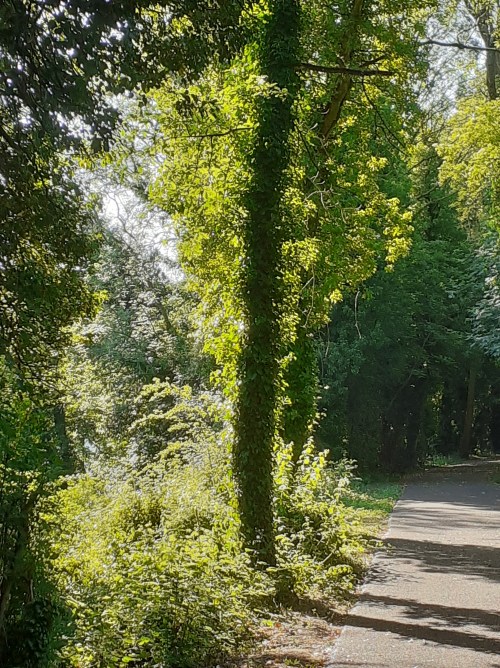
The picture shows the power of sunlight on trees to an observer – me, using my sight and my phone camera. I am not sure what it is like for the trees themselves, but I imagine it to be a positive experience.

This post is about the effects of the same power in my own psychic life. In a personal meditation, “I find myself in a walled garden. It has a fountain at the centre, surrounded by four flower beds of alternating red and white roses. There are fruit trees, apple, pear and plum, trained around the walls. It is a warm and radiant midsummer morning. The full bright sunlight strikes the dazzling water of the fountain, warming and illuminating each drop as it falls. I can hear the plashing of the fountain, and birdsong a little further off. My bare feet are on the lush grass. The air is sweet. The sun is at my back, recharging my energy, in particular activating the sun in my heart”. From that point, the meditation can continue and deepen in a number of ways.

This  garden is the Garden of Wisdom, the Wisdom of William Anderson’s Green Man poem (1), a poem of 13 four-line verses, where each line covers a week. Though the Green Man has a lover in the spring, Wisdom is named, as Wisdom, in only one verse.

26 Oct-1 Nov:  The reedbeds are flanking in silence the islands

2 Nov–8 Nov: Where meditates Wisdom as she waits and waits.

9 Nov-15 Nov: ‘I have kept her secret’, say the Green Man.

16 Nov -22 Nov: ‘I have kept her secret’, says he.

But at the present time of year, the focus is on the transformation of the Green Man himself, his head having been offed between 25 May and 7 June.

8 June – 14 June: Green Man becomes grown man in flames of the oak

15 June-21 June: As its crown forms his mask and its leafage his features

22 June -28 June: ‘I speak through the oak’, says the Green Man,

29 June – 5 July:  ‘I speak through the oak’, says he.

Late in 2019, I stopped calling my inquiry path a ‘Sophian Way’ and re-centred it in Druidry. It was the right decision, and I have found it very fruitful. But at the psychic, Innerworld level, I have experienced a sense of loss concerning aspects of the Sophian Way, especially the space I called Sophia’s Garden. Now, thankfully, I have found that a simple re-naming as Wisdom’s Garden has been enough to re-integrate it within my current Druid practice. A more specific link with William Anderson’s Pagan, earth-centred poem also helps. Wisdom speaks through the wheel of the year, and acts as a companion and guide within my Druid path, on both the physical and psychic levels. She is also Zoe, the life beyond time, and the Green Man Bios, the life which is born, dies and is born again. It seems to me that we are both of them. Perhaps that is Wisdom’s secret.

(1) William Anderson Green Man: Archetype of Our Oneness with the Earth: London and San Francisco: HarperCollins, 1990 (Photography by Clive Hicks)

See also: https://contemplativeinquiry.blog/2017/05/11/poem-green-man/

GREEN MAY

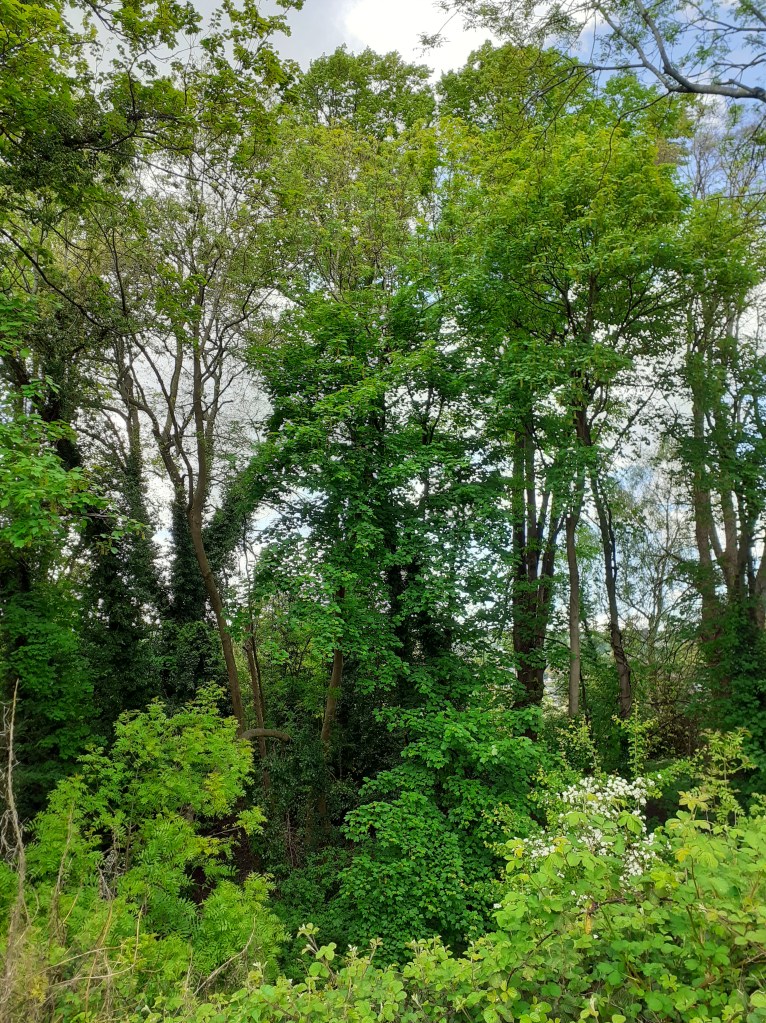
On 1 May I strode out with a spring in step, for my statutory walk. I was stir crazy and determined to meet the day. I made sure to take my camera with me. I wanted both to savour and record the fresh abundance of the green. Although I was in a familiar landscape, both the look and the feel of it had changed. I was in places I hadn’t been in for a week or more, and the world seemed dynamically verdant with a new intensity. I had a transformative hour of it before returning home.

In his Green Man (1), William Anderson reminds us that the Green Man utters life through his mouth. “His words are leaves, the living force of experience … to redeem our thought and our language”. Anderson’s Green Man speaks for the healthy renewing of of our life in and as nature.

He also suggests that the emerging science of ecology – the study of the house-craft of nature – is one such form of utterance. It gives us a language of inquiry into the interdependence of living things. My sense is that 1960’s images of Earth from space have also provided support to concepts like that of a planetary biosphere, and for the revival of Gaia as an honoured name. As a species, quality knowledge, rooted in quality imagination, is our greatest resource. Anderson’s book was published in 1990, based on ideas that had already been maturing over many years. I am sad that we are where we are in 2020. But the message of hope still stands, and the energy of a green May bears witness to it.

(1) William Anderson Green Man: the Archetype of Our Oneness with the Earth London & San Francisco: HarperCollins, 1990 (Photography by Clive Hicks)

Earth Eclectic

music that celebrates Earth and speaks to the heart

Sarah Fuhro Star-Flower Alchemy

Follow the Moon's Cycle

Muddy Feet

Meeting nature on nature's terms

Rosher.Net

A little bit of Mark Rosher in South Gloucestershire, England

Becoming Part of the Land

A monastic polytheist's and animist’s journal

selkiewife

Selkie Writing…

Charlotte Rodgers

Images and words set against a backdrop of outsider art.

Prof Jem Bendell

living with metacrisis and collapse

Towint

The pagan path. The Old Ways In New Times

The Druids Garden

Spiritual journeys in tending the living earth, permaculture, and nature-inspired arts

The Blog of Baphomet

a magickal dialogue between nature and culture

This Simple Life

The gentle art of living with less

Musings of a Scottish Hearth Druid and Heathen

Thoughts about living, loving and worshiping as an autistic Hearth Druid and Heathen. One woman's journey.

Wheel of the Year Blog

An place to read and share stories about the celtic seasonal festivals

Walking the Druid Path

Just another WordPress.com site

anima monday

Exploring our connection to the wider world

Grounded Space Focusing

Become more grounded and spacious with yourself and others, through your own body’s wisdom

The Earthbound Report

Good lives on our one planet

Hopeless Vendetta

News for the residents of Hopeless, Maine