Contemplative Inquiry

This blog is about contemplative inquiry

Tag: Wicca

BOOK REVIEW: SULIS, SOLAR GODDESS OF THE SPRING WATERS
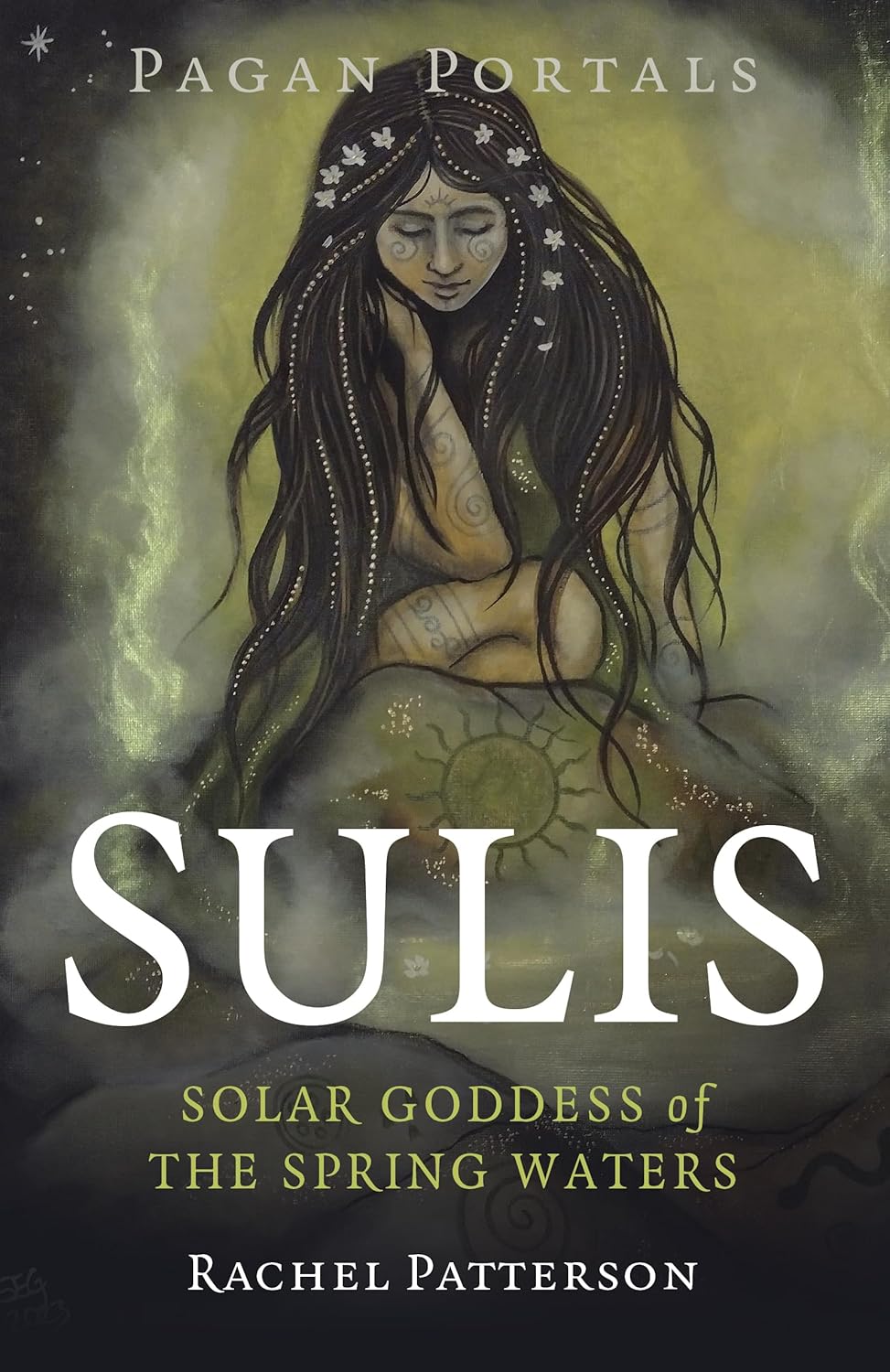
Recommended especially to two overlapping groups: first, readers interested in Sulis (later Sulis-Minerva) the presiding deity of the hot springs at Bath, UK; second, readers interested in polytheist Paganism in Britain, both ancient and modern. Author Rachel Patterson describes her heart as that of an English Kitchen Witch and her craft “a combination of old religion witchcraft, Wicca, hedge witchery and folk Magic”. Hence in this book she focuses not only on the history of Sulis and her springs but also on how to work with Sulis today.

The hot springs at Bath are the only ones in the country, appearing after the last Ice Age around 12,000 years ago. The people who re-settled the land as hunter gatherers began leaving offerings at the springs around 9,500 years ago. They continued to do so for several thousand years until the appearance of farming. We have no record of their beliefs, but for them the numinous power may well have been the living presence of the springs themselves, rather than a presiding deity.

The farmers, when they came, seem to have left the springs alone. But early in the first century CE a causeway of gravel and mud was placed in the main spring pool. Offerings were made, principally of coins minted by the local Celtic tribe, the Dobunni. Pottery was also found but there were no buildings. In 43 CE the Romans invaded Britain and quickly established themselves in the south. The Dobunni chose peace and an accommodation with the Romans, who soon created a spa, building on top of the natural springs. They adopted the local goddess Sulis, now to be known as Sulis Minerva. A town gradually grew up, named Aquae Sulis (The Waters of Sulis). A temple and sanctuary began to be built in 70 CE. The baths are now well-kept after an up-and-down history, and are open to visitors. See http://www.romanbaths.co.uk.

Rachel Patterson describes how the temple worked in the Roman period. Many of the extant records are written curses from people whose clothes and possessions were stolen while they bathed. They asked the Sulis for retributive action in return for offerings and the lost possessions themselves (1). Patterson also describes the decoration of the temple and artifacts from it. The best known was once called the gorgon’s head but is clearly the head of a male figure. He seems to be associated with a god named Belenus, who may in turn be connected with the legendary King Bladud included in Geoffrey of Monmouth’s History of the King’s of Britain (2,3).

The second half of Rachel Patterson’s book is about working with Sulis. It is a thorough and practical guide for readers who may want to go down that path. It includes sections on making candles and altars dedicated to Sulis; on finding Sulis; building a relationship with her; advice on oath-taking; and the development of rituals and meditations dedicated to her. There is relevant advice on the use of herbs, crystals, forms of divination, petitions and curses. There are sections on animal companions and (pigs and wild boar as the Celtic contribution, owls and dolphins related to Minerva). As a Kitchen Witch, Rachel Patterson also provides a number of recipes.

I have lived both the first and most recent 20 years of my life within a forty mile radius of Bath. I don’t go there very often. But I have known it from an early age and bathed in the waters during the more recent period. There is indeed something magical about them. So I’m glad to see Sulis taken more seriously. There is a familiar problem about limited information from the past and Rachel Patterson discusses this in her book But for me there is enough resonance from the old times, here, to dream the myth onwards. I can’t assess the practical guidance offered in Sulis: Solar Goddess of the Spring Waters because I don’t work in the same way. But I do know it is comprehensive and comes from a seasoned practitioner. It feels to me like a timely addition to the Pagan Portals series, and I am grateful to have it.

(1) Further information about religion in Roman Britain, and its rather transactional nature, can be found in Prof- Ronald Hutton’s Gresham College lecture on Paganism in Roman Britain. See https://contemplativeinquiry.blog/22/12/12/paganism-in-roman-britain/ – where a link to the lecture is provided,

(2) see picture and narrative at https://contemplativeinquiry.blog/2021/03/23/the-sacred-head-of-bladud/

(3) For creative treatments of the story of Bladud and the Goddess Sulis, see Kevan Manwaring’s account in The Bardic Handbook and two novels by Moyra Caldecott: The Winged Man and The Waters of Sul

DION FORTUNE: THE SEA PRIESTESS

I like to attune myself, imaginally, to significant moments in time, place and culture. I have always done this but I now think of it as an aspect of my Druidry. I have become more conscious about it.

Here I am contemplating an alignment of 1930’s Britain, Brean Down on the North Somerset coast (Bell Head in the book), and the occultist Dion Fortune. I am especially thinking of her determination to “bring back into modern life something that has been lost and forgotten and that is badly needed”. Rather than being a review of her book The Sea Priestess (1), this post is a reflection on spiritual ancestry, and an acknowledgement of her project’s success. As the publisher of the 2003 edition happily notes, “The Sea Priestess is a classic occult teaching novel with romantic overtones, and a foundation work for modern Wicca, paganism, and ritual magic”.

Gareth Knight outlines the main theme in his foreword to the 2003 edition. “The story concerns a high initiate, Vivien Le Fay Morgan – or Morgan Le Fay as she comes to be called – who is about to undertake a major work of sea and moon magic for which purpose she needs to find a suitable location upon which to build a temple complete with living accommodation. At the same time she needs to find a man suitable to train as her assistant in the magical work. With commendable economy of means, she kills two birds with one stone by selecting a local real estate agent, Wilfred Maxwell, who has the necessary professional contacts to find a location, together with sufficient skills to help her refurbish and redecorate it appropriately. He also has the temperament and personal circumstances that can make him a capable, if unlikely, magical apprentice.”

Wilfrid and Morgan get to know each other at weekends where he is busy turning an old army fort at the point of Bell Head, named Bell Knowle, into Morgan’s temple. They become close. But Morgan’s purpose is not personal. Working under the aegis of the Priest of the Moon, a discarnate being, she seeks to connect herself to “the ultimate spiritual source, known to Qabalists as the Great Unmanifest, the formless power behind the fount of creation itself. This in turn relates to the great zodiacal tides of the precession of the equinox, whereby in the coming Age of the Aquarius the old gods will be coming back, after another manner. Her own part in this is to make the way clear for the realization of the divine feminine as part of the cult of the Great Goddess, who, as our Lady Isis, comprises all goddesses – of the corn, of the dead, of the sea, of the moon”.

Morgan needs Wilfrid’s help in performing a ritual that depends on an exchange of sexual energy without involving physical sex. He needs to be in love with her, or at least infatuated, for the ritual to work. But there is to be no relationship thereafter. Morgan is completely honest about this with Wilfrid, but he finds it too difficult to take in. After the ritual, and the great storm and destruction of the temple that follows, Morgan disappears. Wilfrid is left with a brief letter re-emphasising that there is to be no further contact between them. There is no forwarding address. Wilfrid falls to pieces.

But this is not the end. Morgan has scrupulously adhered to an ethic of reciprocity in work of this kind. She has subtly nudged events so that he makes a connection with a young woman – his secretary at the estate agency – and they marry. There are pragmatic reasons for this too. Molly needs to escape from a violent and chaotic step father. Wilfrid (now aged 36) needs to stop living with his mother and older sister; he also needs to sort out his post-ritual depression and alcohol problems. Marriage as a solution is enabled by Wilfrid’s domestic neediness and Molly’s compulsive care-giving, shaky emotional foundations for a life-partnership. Morgan’s contribution is to lay the ground work for greater possibilities. She has already arranged to leave her magically imbued sapphires for Wilfrid’s wife to be.

After their marriage, the newly weds move out of town to Bell Head, where Morgan’s caretakers had kept a small farm. Morgan’s temple is ruined, but they inherit her books and magical working records. These influences inspire Molly to start “talking to the moon”. She begins to take on her own priestess role. Wilfrid recollects: “it was all different here from the fort, and yet it was taking on a life of its own. There was more of earth and less of the sea than out on the point, just as there was more of earth in Molly than in Morgan; yet it was cosmic earth, and I remember that the Great Goddess ruled both moon and earth and sea. Molly would never be a Sea Priestess, like Morgan, but there was awaking in her something of the primordial woman, and it was beginning to answer to the need in me.”

At the end of the book, on a midsummer’s night, the couple light a fire of cedar, sandalwood and juniper. Such a fire is known as a Fire of Azrael, first prepared by Wilfrid when working with Morgan. It enables trance states and communication with the ‘inner planes’, especially if blended with moonlight. Molly receives an extended transmission from the Priest of Moon, and her subtle sexual energies are enlivened. For “the Astral plane is ruled by the moon and the woman is her priestess; and when she comes in her ancient right, representing the moon, the moon-power is hers and she can fertilise the male with vitalising magnetic force”. Molly initiates the consummation of the couple’s magical relationship. They have now received the touch of Isis and the gates of the inner life are open.

I experience The Sea Priestess now, on the third of three readings separated by many years, as a voice from long ago. In some ways it isn’t. My parents were born within a few years of the fictional Molly, and had nowhere near this sense of gender, sexuality or spirituality, let alone magic. I suppose my own sense of temporal distance is partly due to the dynamic evolution of her influence, and that of others like her, in successive generations – not least in the thirty years since I first read The Sea Priestess. If she now seems old-fashioned, it is a back-handed tribute to the creative power she helped to unleash. Before we think of her being old-fashioned even today, we have to ask ourselves: compared to whom?

(1) Dion Fortune The Sea Priestess Boston, MA & York Beach, ME: Weiser, 2003 (Copyright 1935 Society of the Inner Light)

DANCING SEAHORSES II

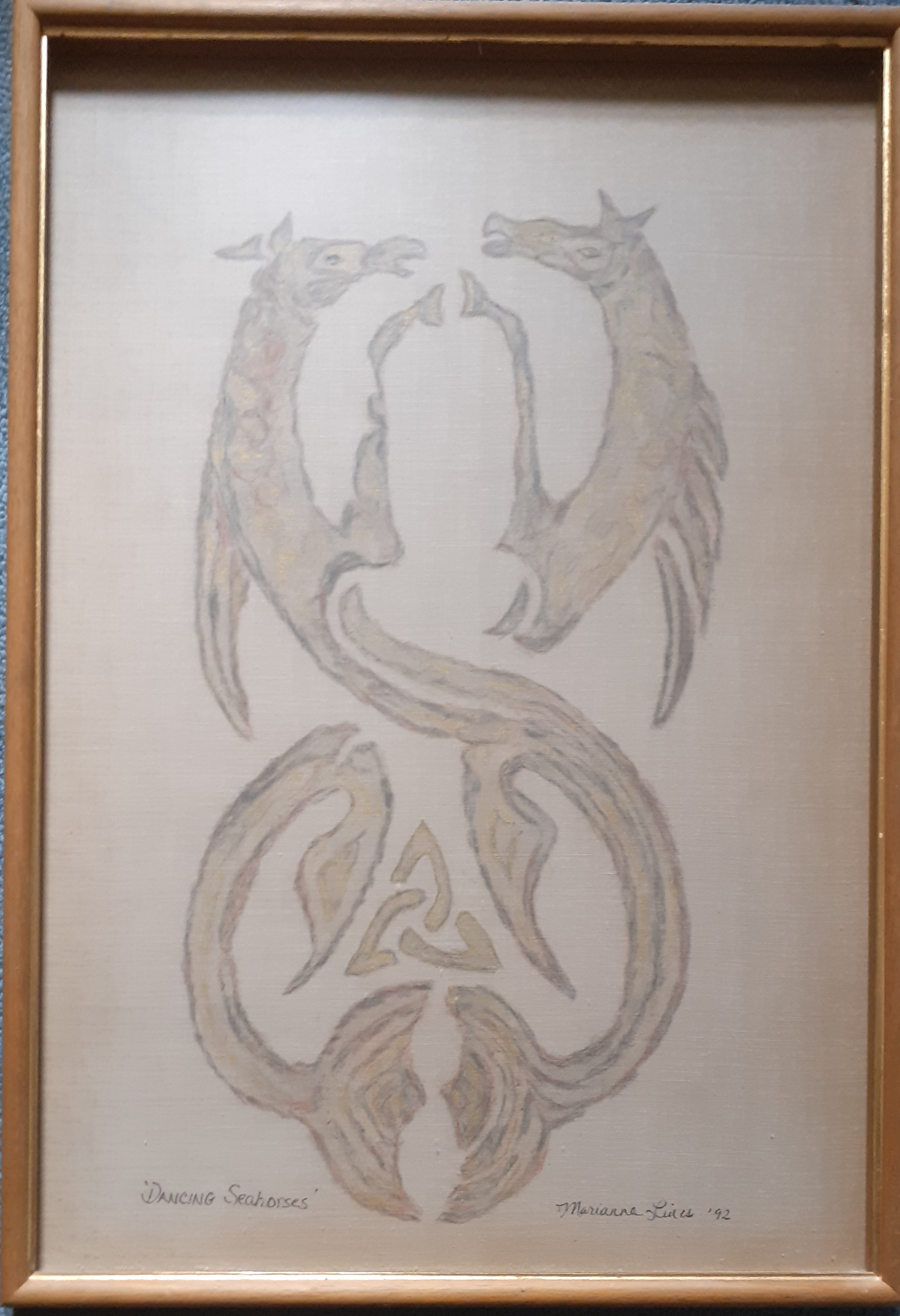
I have already written about the Dancing Seahorses image (1) found on a Pictish stone from Aberlemno in the Scottish county of Angus. After seeing the stone on a visit there, in 1992, I bought Marianne Lines’ painting. I have felt strongly involved with this image ever since. I think of it as a friend and guide. In a sense, this post is about the modern use of archaic images by people, like Druids, who are drawn to them.

I do not know the intentions of the original carver. beyond celebrating beings who are half of this world, half of the otherworld, and who embody powerful water energies for Celtic peoples on the Atlantic coasts of Britain, Ireland and Brittany in ancient times. They are remembered in folklore to this day. I do know that the carving made a strong impression on me, when I first saw it on the stone itself. It stayed in my imagination, and over time has deepened and grown new meanings.

Four years after acquiring the painting, I had the image tattooed on each arm. By that time I knew of the way in which it had influenced the cover design for R. J. Stewart’s The Prophetic Vision of Merlin (2). This variant form was used to refer to the story of the young Merlin at Vortigern’s subsidence prone tower in Snowdonia, prophesying his way out of becoming a human sacrifice, and identifying two contending dragons under the foundations. In the book illustration, there is a yin-yang reference, with a suggestions of interdependent primal forces, each of which already contains the seed of the other, seeking balance and alignment. In the Western Mysteries quest for healing and transfiguration, the energy bodies of the land and of humans are deeply interwoven.

There is another, more recent level of understanding, that I derive from the painting and tattoos, but not evident in The Prophetic Vision of Merlin. I see both the dancing seahorses and a second image, behind and containing the immediately apparent one. As I wrote before, “the space where the horses legs are raised defines a shape, suggesting a head. The very emptiness there is a paradoxical mark of presence. To me it became the head of a goddess, with the seahorses then becoming her body. Still clearly appearing as a water being, her arms – if they are arms – are raised in blessing”. I would now add that in this way, she demonstrates the dance of emptiness and form. They are balanced. Neither is privileged over the other. The Celtic knot points both to interconnection and infinity.

I identified the Goddess whilst gazing directly at the original Dancing Seahorses picture, which hangs of a wall directly above my altar. However I believe I received a subconscious nudge from the High Priestess card in The Druidcraft Tarot (3). She wears the image herself. Her hands are raised. She stands as the Goddess. In the Druidcraft narrative, she “represents the magical power of stillness and depth”. For me, the Goddess in Dancing Seahorses represents the ultimate union of emptiness and form, and the rebirth of the cosmos in each moment. Her representation combines the aware potential of the void and a primal aquatic generativity that can inhabit other elements. The Druidcraft priestess is human, but one who wears an image that bespeaks the divine to me, and her role asks for “stillness and depth”.

In my work, the entry into stillness and depth is, firstly, to enter into I-Thou communion with the primal Goddess (Modron) and then to recognise my own true nature, as (mythically) her divine child (Mabon) – sensitive and busted open to the world. This recognition becomes a prayer of gratitude and a surrender of my passing private concerns to Who I really am.

Words and pictures are not enough, but, cherished and contemplated lovingly over time, together they can point the way..

(1) https://contemplativeinquiry.blog/2020/06/25/dancing-seahorses/

(2) R. J. Stewart The Prophetic Vision of Merlin London & New York: Arkana, 1986

(3) Philip & Stephanie Carr-Gomm The Druidcraft Tarot: Use the Magic of Wicca and Druidry to Guide Your Life London: Connections, 2004 (Illustrated by Will Worthington)

BOOK REVIEW: SEEK TEACHINGS EVERYWHERE

This post is about Philip Carr-Gomm’s Seek Teachings Everywhere: Combining Druid Spirituality with Other Traditions. I highly recommend this book to anyone interested in the specific topic and/or the development of modern spiritual movements more generally.

Elegantly and accessibly presented, the book testifies both to a personal journey and a key role in developing modern British Druidry. Both the journey and the role are an interweaving of Pagan and Universalist threads. PCG’s approach has been to adopt Druidry as a ‘meta-path’, one able “to transcend religious distinctions”, and allowing of involvement in other paths as well. The Jain path, shared with his Druid mentor Ross Nichols, is the one given the greatest individual attention in the book, in a long section on Druidry and Dharmic traditions. This section touches also on other Indian derived movements and practices (Buddhism, Yoga Nidra) and speculates on ancient cultural and linguistic resonances between early Indian traditions and early European Druidry. PCG dedicates other sections of the book to Christianity and Wicca, with suggestions about how they too can harmonise with Druidry.

This overall approach is reflected in the lived culture of the Order of Bards, Ovates and Druids (OBOD), which PGC has led for thirty years. He is now in a process of stepping down from the role, and so the book is a timely account of both vision and legacy. He says: “each spiritual way has gifts to offer, and some people find in Druidry all the spiritual nourishment they need. Others combine their Druidry with other approaches, such as Wicca, Taoism, Christianity, Buddhism, Hinduism or Jainism”. OBOD’s ancestry as a movement derives from Celtic and Western Way currents within early twentieth century theosophy. The Order remains true to that heritage – as evidenced by a website that actively describes synergies with other paths and provides links to them – see www.druidry.org/ .

My personal takeaway from the book concerns PCG’s substantial presentation of Jain ethics, grounded in three key principles: ahimsa, aparigraha and anekant, here described as the Triple A. PCG explains: “Ahimsa is the doctrine of harmlessness or non-violence, made famous by Gandhi, and espoused by the other Dharmic traditions of Buddhism and Hinduism”. Aparigraha, the doctrine of non-attachment, non-possessiveness or non-acquisition, likewise appears in these other schools. Anekant, a doctrine of many-sidedness, multiple viewpoints, non-absolutism or non-one-sidedness, is unique to The Jains. The three principles can be seen as completing each other – with many-sidedness an aspect of non-violence and non-attachment, and so on.

PCG recommends these principles for our time. They inform his own vision of Druidry. “We know that the world suffers from too much conflict, too much fundamentalism, and too much consumption. This suffering can be alleviated by applying the Triple A doctrines: seeking non-violent solutions, respecting and learning from others’ opinions and beliefs, and reducing consumption to sustainable levels”. In the Jain tradition, such an approach to life is supported by practices of ritual and meditation that work towards the release of negative attachments. PCG recommends versions of these as well.

Part of the beauty of this book is that different readers will find different reasons to take note and learn from it. I have found it valuable both as an authoritative record of a current in modern Druidry, and as a personal inspiration.

Philip Carr-Gomm Seek Teachings Everywhere: Combining Druid Spirituality with Other Traditions Lewes, UK: Oak Tree Press, 2019 (Foreword by Peter Owen Jones)

Earth Eclectic

music that celebrates Earth and speaks to the heart

Sarah Fuhro Star-Flower Alchemy

Follow the Moon's Cycle

Muddy Feet

Meeting nature on nature's terms

Rosher.Net

A little bit of Mark Rosher in South Gloucestershire, England

Becoming Part of the Land

A monastic polytheist's and animist’s journal

selkiewife

Selkie Writing…

Charlotte Rodgers

Images and words set against a backdrop of outsider art.

Prof Jem Bendell

living with metacrisis and collapse

Towint

The pagan path. The Old Ways In New Times

The Druids Garden

Spiritual journeys in tending the living earth, permaculture, and nature-inspired arts

The Blog of Baphomet

a magickal dialogue between nature and culture

This Simple Life

The gentle art of living with less

Musings of a Scottish Hearth Druid and Heathen

Thoughts about living, loving and worshiping as an autistic Hearth Druid and Heathen. One woman's journey.

Wheel of the Year Blog

An place to read and share stories about the celtic seasonal festivals

Walking the Druid Path

Just another WordPress.com site

anima monday

Exploring our connection to the wider world

Grounded Space Focusing

Become more grounded and spacious with yourself and others, through your own body’s wisdom

The Earthbound Report

Good lives on our one planet

Hopeless Vendetta

News for the residents of Hopeless, Maine