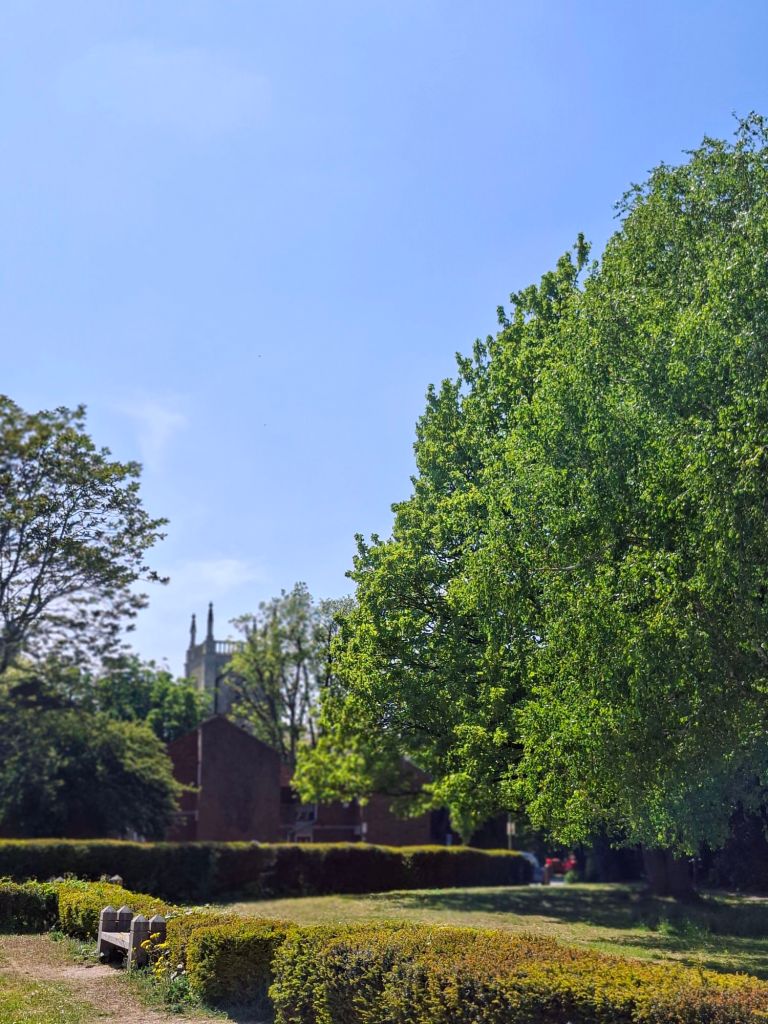
The church of St Mary de Lode, Gloucester, seems to sit among trees. The building salutes the sky without arrogantly trying to reach it. There is a bench towards the foreground of my picture. I am standing in a friendly urban space, a green space. It is one of many made possible by the Churches and Priories of the old city. This space is open to all.
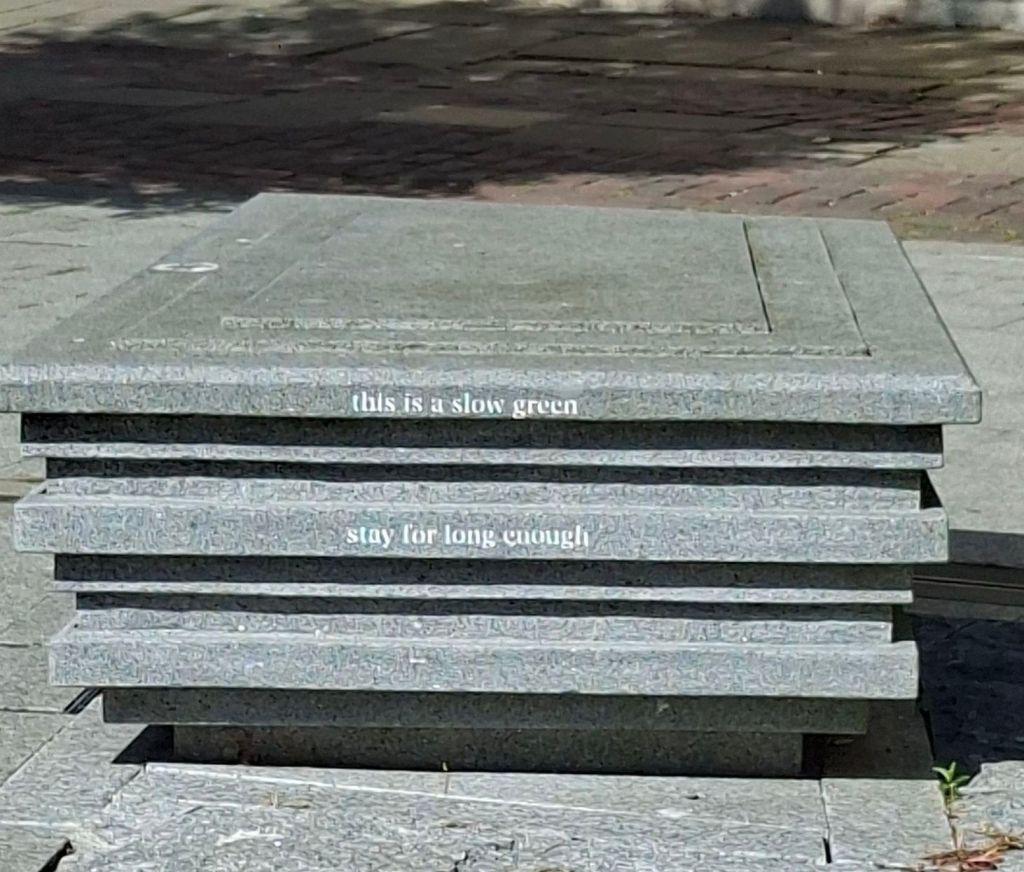
In another such space, on a granite seat close to my home, I recently noticed the words “this is a slow green, stay for long enough”. I have been savouring these words ever since.
They draw me into an easy receptively, not least when the month is May and the day is warm. The riddle of ‘a slow green’ invites immersion and reverie rather than effortful attention or strategies for problem solving. ‘Stay for long enough’ is probably the wisest counsel. Let’s take the time we need gently to befriend such nurturing spaces when we are blessed to find them.
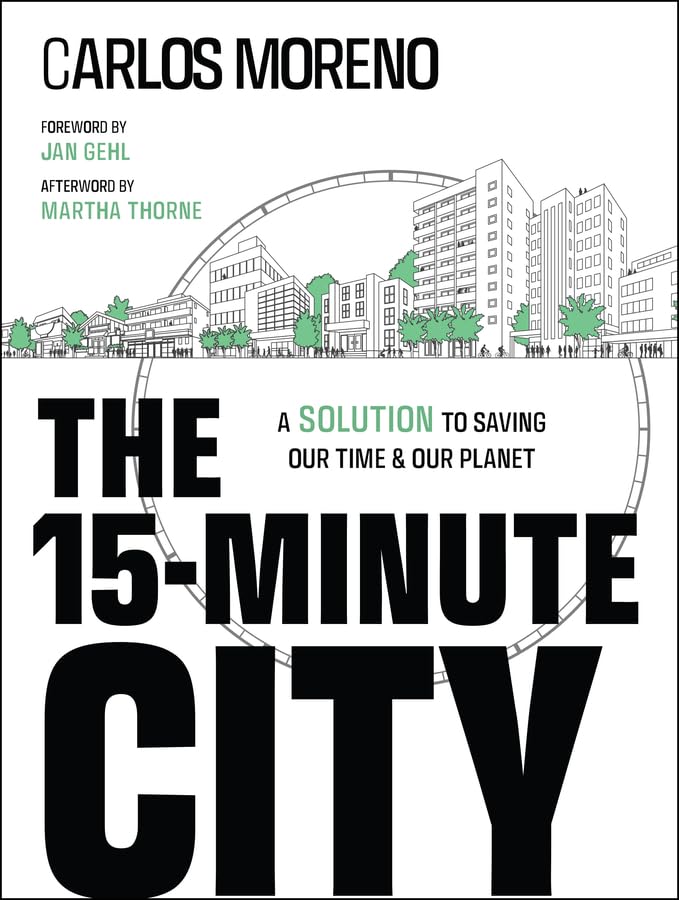
The 15-Minute City: A Solution for Saving Our Time and Our Planet (1) advocates that everyday destinations like schools, stores, and offices should only be a short walk or bike ride away from home. The intention is to make cars far less necessary for contemporary city-dwellers, and thereby “to reinvent our life-styles and rethink our relationship with space and time”. Its key values are proximity, interconnectedness and fulfilment.
This book is about how cities are run, who they are predominantly run for, and how they could be run more inclusively. It provides an inspiring store of information for people concerned with these issues, not least urban Druids. It has 21 chapters:
Chapter 1 is a call to action, emphasising “the urgency of reimagining urban ecosystems in the light of contemporary challenges”.
Chapters 2 to 4 discuss the ‘fragmentation’ of cities over time, especially due to city roads and zoning.
Chapter 5 is about learning lessons for “a more inclusive urban future”.
Chapters 6 & 7 look at changes beginning with the 1973 oil crisis and moving on to the “challenges and realisations of 2020”.
Chapters 8 to 11 focus on Paris, where the ’15-Minute City’ was invented.
Chapters 12 to 19 cover particular locations and their complex histories: Milan, Italy: Portland, Oregon, USA; Cleveland, Ohio, USA; Buenos Aires, Argentina; Sousse, Tunisia; Melbourne, Australia; Busan, South Korea.
Chapter 20 looks at the notion of the 20-Minute Territory as applied in Scotland and on the Ile de France.
Chapters 21 discusses the role of new technologies and summarises the book.
By 2050, 68% of the human population will be urban. Changes are needed in the ways that urban ecosystems work for people’s health and wellbeing, now more than ever because of the climate crisis. Author Carlos Moreno writes, “urban life is the heart of the problem, but it is also the solution if we enable it to be. Never in the history of humanity has survival been so compromised by lifestyle”.
Moreno also believes: “our journey through these cities is also an exploration of ourselves. By offering an urban setting that is conducive to conviviality and proximity, we can rediscover the value of mutual cooperation and sharing. We are nourished by authentic interaction and the solidarity of a reinvented urban life “
It may be that it is now too late to save the kind of civilisation in which we are living. From a seemingly uninvolved and above-the-battle standpoint we may even see advantages in its fall. But I have come to think that it is better to work from the opposite point of view – that there is something worth working for, despite the apparent odds. The work itself can be a spiritual discipline, taken on for its own sake. Carlos Moreno offers us one neighbourly way of addressing our apparent spiral into a dystopian world.
(1) Carlos Moreno The 15-Minute City: A Solution to Saving Our Time and Our Planet Wiley, 2024. Foreword by Jan Gehl. Afterword by Martha Thorne.
In Gloucester, England, we are entering the four lightest months of the year. The pictures above and below were taken after 7 pm. This lightness, and the long evening twilight that follows, still feel novel. The day-to-day weather here has been volatile, making evening sunshine all the more precious when it comes. I feel naturally enlivened and blessed, somehow shifted into a more immersive experience of the world around me.
I live in a flat where I have good views of the sky, the sun, the moon and their changes from indoors. This has subtly altered my experience of daily life from before dawn until after sunset – following the wheels both of day and year from a slightly elevated level. But there’s something also in experiencing the effects of April evening light at ground level. It’s an urban, curated landscape and I am (mostly) an urban Druid. I am fond of such spaces when they are done well and preserve a human scale.
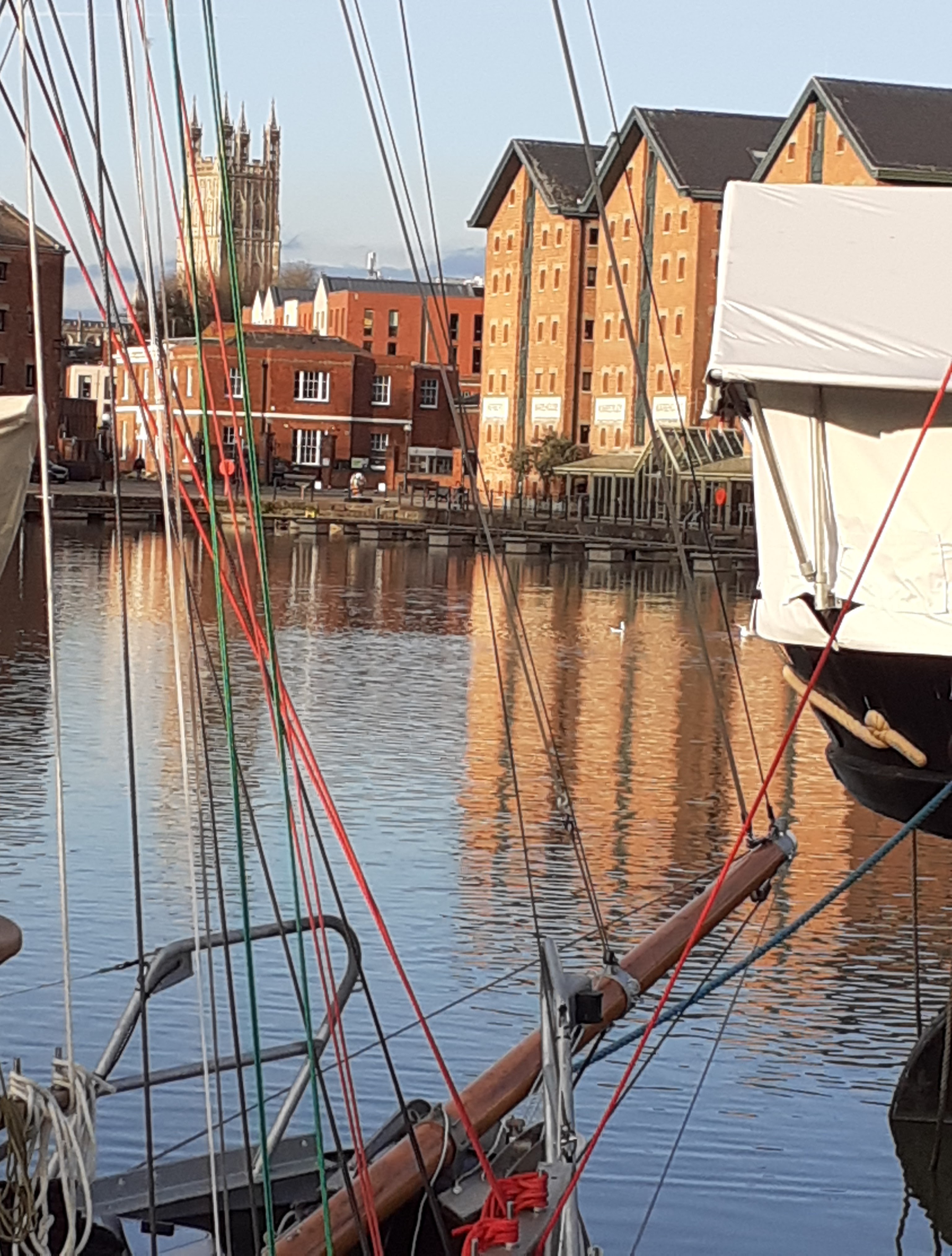
In the docks I notice rigging on a sailing boat at rest and brick warehouses reflected in tranquil sunlit water. The cathedral tower is in the distance, still the tallest building in sight. On Brunswick Road, I look into the grassy city garden of Brunswick Square, mostly in sunlight, partly in shade. Immediately in front of me there’s a cherry tree in blossom. Across the square, I enjoy an 1820’s terrace. At this moment in the year, I discover both freshness and familiarity. For me, the experience of an evening like this is an ideal way of being and belonging in place.
I took this picture from an upstairs window before 9 a.m. on18 February 2022,. It shows blue sky and the tower of St Mary de Crypt, Gloucester. The image is calm, and I enjoy its simple beauty. But I am bracing for a severe storm, officially named ‘Storm Eunice’. We are on red alert, which is very rare in this country. I contemplate the tower, which stands both for longevity and impermanence.
It is 10.15 a.m. now and the wind, at first just playful, has moved into serious gusting. Paper and leaves blow about in a courtyard. The sky is grey and there are raindrops on my window pane. Taking another picture, I notice I have lowered my sights. I have included more material substance, roof tops in particular. The invitation to skyward contemplation, so poignantly encouraged by towers like this, isn’t so present for me in this moment. The theme now is embodied endurance and solidity, weathering the winds of the world. For they don’t seem at all celestial, their current force at least partly the result of our own collective behaviour. Strong walls and a decent roof are the focus of my desire. I am, after all, a Pagan.
I am an urban Druid now, more clearly than before. It gives me a different view of nature. On one hand I am reminded that everything is included in ‘nature’. But in so far as I make a city/country distinction, I do notice a different experience of the elements, seasons, and the varieties of life. In an old and relatively small city (pop. 165,000) it is easier to see the evolution of human culture as a gradual and organic process than in other built environments. Today is a special day because raw and conceivably violent nature is coming on a visit. Whilst I notice fears around this, and am distressed by the notion of harm to anyone, I also find an aspect of Spring, and renewal, in this. I do feel energised, now, just after 11 a.m., and this at least is welcome. I have no idea of how the day is going to play out here, or what I am going to feel about my experience of Storm Eunice at the days end.



 Contemplative Inquiry