I like the way this presentation uses the word ‘knowing’ to point to our underlying condition. This usage is clearly separated from everyday knowledge of or about (something), or even of wisdom and understanding. It also avoids the term ‘consciousness’, which tends to invite metaphysical and scientific debates that lead us away from direct experience. ‘Awareness’ is a noun and so seems like a thing – we don’t generally talk about ‘awareing’. I personally like ‘being’ as an alternative, but it carries philosophical baggage and is not specific enough for the context of this presentation. Current usages within the Western Way of the term ‘gnosis’ do not generally reflect the view discussed here.
It may be true, as the Tao Te Ching says, that the Way that can be named is not the real Way. But we still need language, as a pointer, for that in us which needs to make sense of experience and to share it with others. Here, a skilful choice of words can make a difference, and I think this presentation models the skill. Dzogchen is a tradition within Tibetan Buddhism. ‘Rigpa’ is the Tibetan word used to describe ‘knowing’ in this sense.
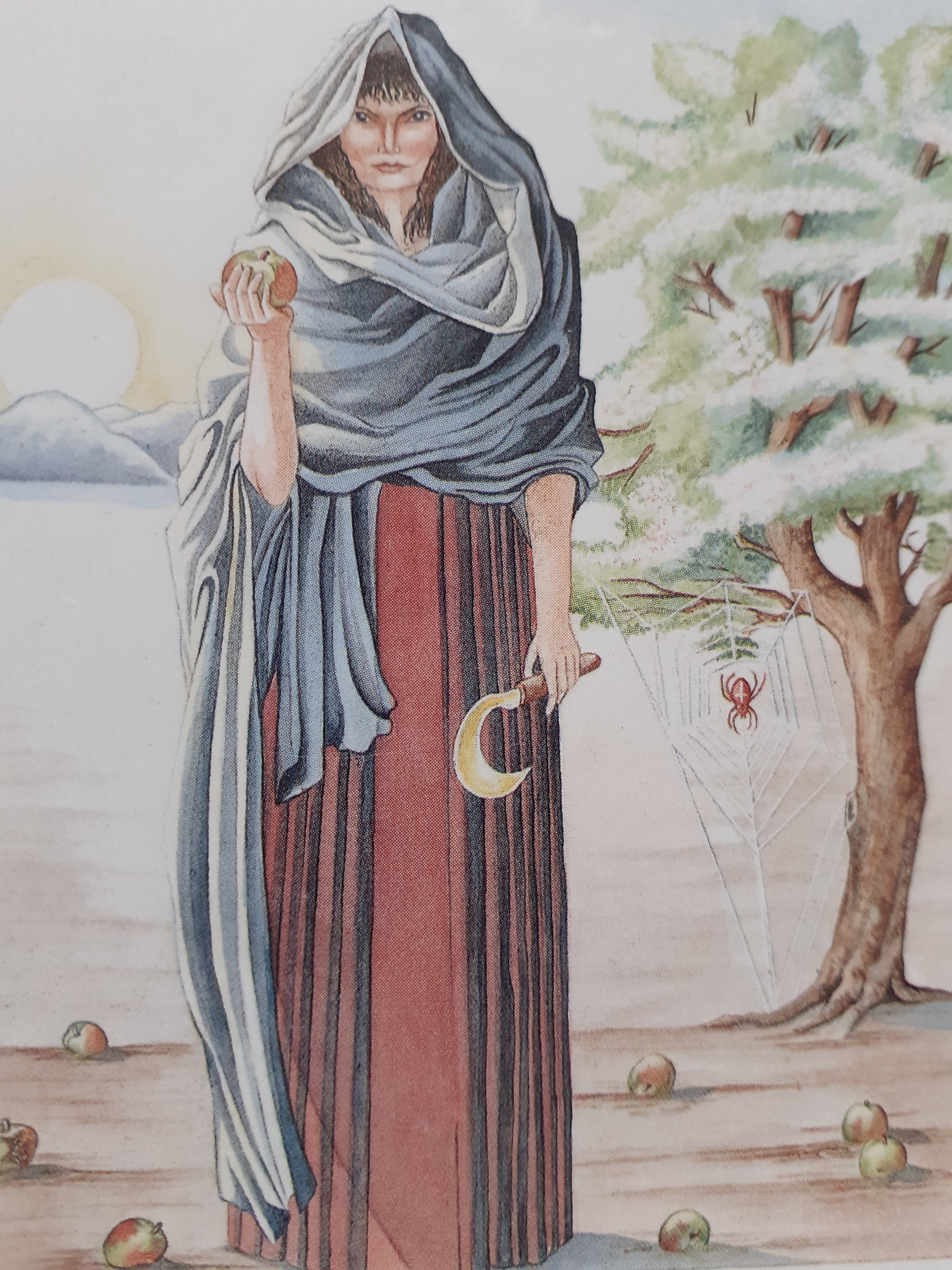
In the approach to Samhain, thoughts turn to death. In R. J. Stewart’s Merlin Tarot (1,2) the Death card has The Apple Woman as an alternate name.
Stewart explains that “the original image for Death is that of the taking or destroying Goddess”, for “who but the creatrix may truly destroy and withdraw created life?” He adds that, in Celtic tradition, she often appears as a female power offering magical fruit.
In his source text, Geoffrey of Monmouth’s Vita Merlini (Life of Merlin), we find a mysterious woman – ex-lover of Merlin – who lays out poisoned apples to entrap him. These apples, arranged “under a tree upon a pleasant green”, are eaten by Merlin’s boon companions: they are either killed or driven insane. Although Merlin escapes the apples, he does not escape his own later insanity in the Caledonian Forest, brought on by the traumatising Battle of Arfderydd.
For Stewart, the Apple Tree is one of the simplest expressions of the Tree of Life. “It is the Otherworld or Underworld Tree that reveals eternal potential, the fusion of ending and beginning in one paradoxical form”. The apples are the fruit of raw, untransformed power. Whereas Merlin’s companions snatch at the apples and eat them greedily, the legendary Thomas Rhymer volunteers to pick magic apples for the Fairy Queen, who recognises his gallantry by giving him the bread and wine that can nourish him. He wins the gift of prophecy and the tongue that cannot lie.
Both lover and killer, the Goddess of Death and Change is young and ancient, weaver and unweaver of a web that is the universe. She is destroyer of hope and giver of hope, for “in her hand she bears the fruit of perpetual life and rebirth, and the razor Sickle that cuts the tread of continuity”.
Stewart ends with this reflection: “perhaps Merlin’s sub-story of The Apple Woman simply means that adulthood is our most deluded period of life. We reject understanding and substitute self-image, habit and even dogma, in our convoluted attempts at survival; the hostility we experience is not that of the Goddess, but our own hostility reflected upon us. Reject love, risk poisoned apples – such fruits are deadly to the greedy and unprepared. But if we accept the fruit or any of its many transformations (such as bread and wine) from the Goddess, she blesses us with gifts of timeless understanding. These gifts may appear in the outer world as prophecy, attuning to the land; death itself is a timeless moment of understanding when all relative interactions cease. Ultimately, we are the fruit”.
(1) R. J. Stewart The Complete Merlin Tarot: Images, Insight and Wisdom from the Age of Merlin London: The Aquarian Press, 1992 . Illustrated by Miranda Grey ISBN 1 85538 091 9 No cards, but a full explanation and discussion of the system and its imagery.
(2) R. J Stewart The Merlin Tarot London: Element, 2003. Illustrated by Miranda Grey ISBN 000 716562 5 (First published by London: The Aquarian Press, 1992). Cards, handbook and notebook for record keeping.
The hermit card from The Merlin Tarot (1,2) shows a traditional image of the contemplative. The accompanying narrative points to evolution beyond the life of this world, whilst still in service to it. Stories of this kind characterise many spiritual paths. This one is Druid friendly, alive in my heart and imagination. Here, I want both to pay homage to heritage and to note a personal divergence.
Merlin has reached the top of the mountain, the austere end of his ascending path. All that remains is to bid the outer world farewell, “not as an inspired youth or madman seeking nature, but in full understanding”. The understanding is that of the Great Mother herself, typified by simplicity, clarity, and a will to withdraw from manifest existence. This is the moment to relinquish the earthly plane. A simple leap will do it. But Merlin’s destiny is not to abandon the world. In a greening of Mahayana Buddhism’s bodhisattva concept, Merlin, discarnate, will continue to serve the Goddess and the land.
Even as hermit, in this frozen moment on the cusp of anticipated transformation, Merlin is not quite alone. The seer is steadied by his staff, a branch from the tree of life itself. A wren, sacred bird of kingship and blessed of the Great Mother, has companioned and witnessed him throughout his journey. Soon it will be free to return to the green safety of its beloved low hedges. Merlin contemplates a crystal lamp – crystal being the underworld’s mineral equivalent of light. Caught inside the lamp, two primal dragons, dynamic yin and yang energies, underworld born, are held in a static balance that is described as “perfect”. A heretical thought arises: is the candidate for transformation, at the very last moment, questioning the ‘perfection’ of this absolute, frozen, stillness? What price the infinite?
In The Merlin Tarot, this is the last we see of Merlin. But for us, there is the path of descent, right down to its completion in an image of embodied realisation. The Tarot trump following that of the hermit Merlin, and complementary to him, is the Innocent, a young Sophian wisdom figure. Linking with the active energy of a Star Father who seeds the cosmos, she initiates pathways of giving and sharing on the descent, so that the earth itself may be changed.
R. J. Stewart is in a line of Western Mysteries teachers including Dion Fortune, Israel Regardie and W. C. Gray. In this tradition, discarnate beings linked to a cosmic hierarchy and dwelling on other, more spiritual planes, are real. They are not metaphors, aspects of the human psyche, or opportunities to think with stories. R. J. Stewart is clear about this, and I have always had to take respectful note of this view whilst not committed to sharing it. But I am moved and inspired by stories. On the contemplative path, the rational mind has at best an ancillary role. It doesn’t do well by itself. One option is to move into stillness and silence, and sometimes I do that. Another is to engage the heart and imagination, which are fed and watered by stories, their resonance, and their play intrapsychic relationships. The story told in The Merlin Tarot has nourished me for a long time, and continues to do so, in ways that satisfy me, without my wanting to be him.
(1) R. J. Stewart The Complete Merlin Tarot: Images, Insight and Wisdom from the Age of Merlin London: The Aquarian Press, 1992 . Illustrated by Miranda Grey ISBN 1 85538 091 9 No cards, but a full explanation and discussion of the system and its imagery.
(2) R. J Stewart The Merlin Tarot London: Element, 2003. Illustrated by Miranda Grey ISBN 000 716562 5 (First published by London: The Aquarian Press, 1992). Cards, handbook and notebook for record keeping.


 Contemplative Inquiry