Contemplative Inquiry

This blog is about contemplative inquiry

Tag: Truthfulness

CONTEMPLATING BELIEF

Spiritual commitment – faith in the path, and the perspectives underpinning it – need not depend on received understandings of ‘belief’. Buddhist teacher Stephen Batchelor discusses this issue below.

“The views that I hold about the things that really matter to me – meaning, truth, happiness, goodness, beauty – are finely woven tissues of belief and opinion. These views enable me to get by in my workaday world but would not stand up to a great deal of scrutiny from someone who was not sympathetic to them. I am prepared to defend some of them with greater vigor and passion than others. I drift and swim through life on a tide of derivative beliefs that I share with others who belong to the same kind of cultures as myself.

“Most Buddhists throughout Asia are and always have been polytheists. They believe in the existence of a range of spirits and gods whose worlds intersect with our own. These entities do not have a merely symbolic existence: they are real beings with consciousness, autonomy and agency … But since many of these spirits are fickle beings like ourselves, they cannot ultimately be trusted. On formally becoming a Buddhist, one ‘takes refuge’ in the Buddha, Dharma and Sangha, thereby renouncing reliance on those beings. But the spirits and gods are only downgraded, not abolished. They continue to play a role in one’s personal and social life. This is the thought-world one finds throughout the Pali Canon. Siddattha Gotama did not reject the existence of the gods, he marginalised them. He may have mocked their conceits, but he acknowledged their presence. At times they even functioned as inspirational voices that prompted him to act.

“However tempting it is for me to dismiss the existence of gods and spirits as outdated nonsense, I need to be aware of the equally tenuous foundations of my own beliefs. If challenged I would be incapable of persuading someone who does not already share my view of the universe or of human life that my beliefs about them are true. I once spent a couple of hours trying to persuade a learned and intelligent Tibetan lama that the world is spherical in shape – but with little success. I would have had even less success had I tried to convince him of other beliefs I held: those about the Big Bang, evolution by natural selection, or the neural foundations of consciousness. I believed in these on much the same ground as he believed in disembodied gods and spirits. Just as I unquestioningly accepted the authority of distinguished scientists, so he accepted the authority of eminent Buddhist teachers. Just as I trusted that what the scientist claimed to be true can be backed up by observation and experiment, so he trusted that what his teachers claim to be true can be backed up by direct meditational insight. I had to recognize that many of my truth claims were no more or less reasonable than his.

“Following the example of William James, John Dewey and Richard Rorty, I have relinquished the idea that a ‘true’ belief is one that corresponds to something that exists ‘out there’ or is beyond reality somewhere. For pragmatist philosophers such as these, a belief is valued as true because it is useful, because it works, because it brings tangible benefits to human beings and other creatures. Siddattha Gotama’s Four Noble Truths are ‘true’ not because the correspond to something real somewhere, but because, when put into practice, they can enhance the quality of your life. … What draws me to Buddhism is not because it has a more convincing explanation of the nature of reality than other religions, but that it offers a methodology which might actually work in addressing the question of suffering.” (1)

(1) Stephen Batchelor Confession of a Buddhist Atheist New York: Spiegel & Grau, 2011
SPRING CLARITY

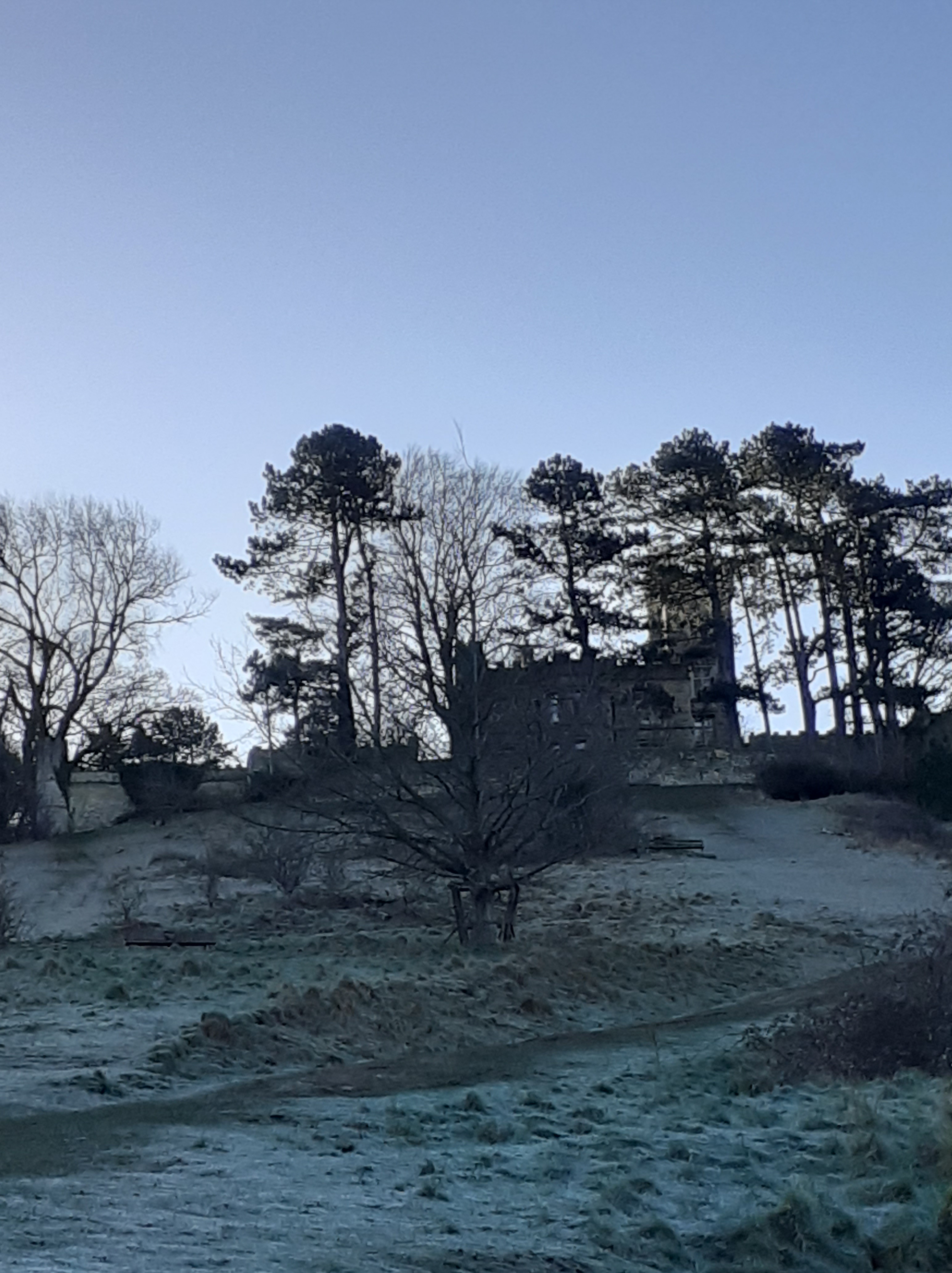
Looking out at the world, I see great variety. In one picture, above, I see a continuing wintry austerity. It is 26 February, somewhat before 9 am. I look up a hill on which the frost has yet to melt. It is daylight, with clear blue sky, but no direct sign of the sun. Light, indeed, but of a chilly kind. The trees have a stern look, reinforced by the battlements behind them – decorative though they might be on this nineteenth century folly of a fort.

The second picture, below, was taken a few minutes earlier, but lower down. There are no signs of frost. There wasn’t any, even on the ground where I was standing. here, I am physically closer to the trees and I feel closer to them. Sunlight is visible on their bark. The looks of these two pictures seem very different, even though they are not much separated in the world’s space and time. I am enchanted by small changes like this. I can lose myself in them.

On the morning of 26 February, there was still a tension between winter and spring characteristics. I do not feel that now, on 2 March, even though a return of frost is quite possible. The year has moved on and I seem to have moved with it. I feel re-invigorated. I feel clearer about the direction of my inquiry, now becoming a more focused contemplation on how I, as a human being, find “a balance between human and Being”, to use the words of Eckhart Tolle (1).

‘Being’ is a way to talk about the Divine, whilst keeping a distance from theistic language and its traditional associations. For Tolle, and I would say now for me, Being is found “in the still, alert presence of Consciousness itself, the Consciousness that you are. Human is form. Being is formless. Human and Being are not separate but interwoven”. This description deepens my existing “At-Homeness in the flowing moment”, identifying it unequivocally as the gateway to immersion in Being. I cannot state this as an objective truth claim. What I can say is that I am being truthful to my experience and deepest intuitions, and that there are many truthful people today and down the ages who have made sense, and continue to make sense of their experience in this way.

When I cast my Druid circle, asking for peace in the four horizontal directions, the below and the above, I finally turn to the centre as the seventh and final direction. Instead of saying, “may there be peace”, I say, “I stand in the peace of the centre, the bubbling source from which I spring, and heart of living presence”. I then chant the Awen. Peace, silence, stillness, emptiness, the space between thoughts, feelings and things – these in my experience do most to open me up to Being. Feelings of joy and lovingkindness are likely to enter in. The Headless Way community talk about our core, formless, identity – our true nature – as that of a clear awake space that is also ‘capacity for the world’. (2). Certainly for me, deepening into Being enriches the human dimension itself – with all of its relationships, activities and roles in 3D timebound reality. In older language, it brings heaven to earth. My contemplative inquiry continues, as a way of supporting this endeavour and sharing it, within the cultural framework of modern Druidry..

(1) Eckhart Tolle Oneness with All Life: Awaken to a Life of Purpose and Presence Penguin Random House UK, 2018 (First ed. published 2008)

(2) http://www.headless.org/

Earth Eclectic

music that celebrates Earth and speaks to the heart

Sarah Fuhro Star-Flower Alchemy

Follow the Moon's Cycle

Muddy Feet

Meeting nature on nature's terms

Rosher.Net

A little bit of Mark Rosher in South Gloucestershire, England

Becoming Part of the Land

A monastic polytheist's and animist’s journal

selkiewife

Selkie Writing…

Charlotte Rodgers

Images and words set against a backdrop of outsider art.

Prof Jem Bendell

living with metacrisis and collapse

Towint

The pagan path. The Old Ways In New Times

The Druids Garden

Spiritual journeys in tending the living earth, permaculture, and nature-inspired arts

The Blog of Baphomet

a magickal dialogue between nature and culture

This Simple Life

The gentle art of living with less

Musings of a Scottish Hearth Druid and Heathen

Thoughts about living, loving and worshiping as an autistic Hearth Druid and Heathen. One woman's journey.

Wheel of the Year Blog

An place to read and share stories about the celtic seasonal festivals

Walking the Druid Path

Just another WordPress.com site

anima monday

Exploring our connection to the wider world

Grounded Space Focusing

Become more grounded and spacious with yourself and others, through your own body’s wisdom

The Earthbound Report

Good lives on our one planet

Hopeless Vendetta

News for the residents of Hopeless, Maine