There is rain on the window pane, and bleakness beyond: the closing in of early winter, with more closing in to come. It is not yet the festive season.
But the geraniums are heralds of change. Leaves may turn brown. Petals may be shed. But the insistent continuity of these flowers is a bright blessing in a grey moment, a vivid affirmation of the life force itself.
Contemplating these geraniums marks for me a distinctive point in the wheel of time, and the timeless Now that holds it.
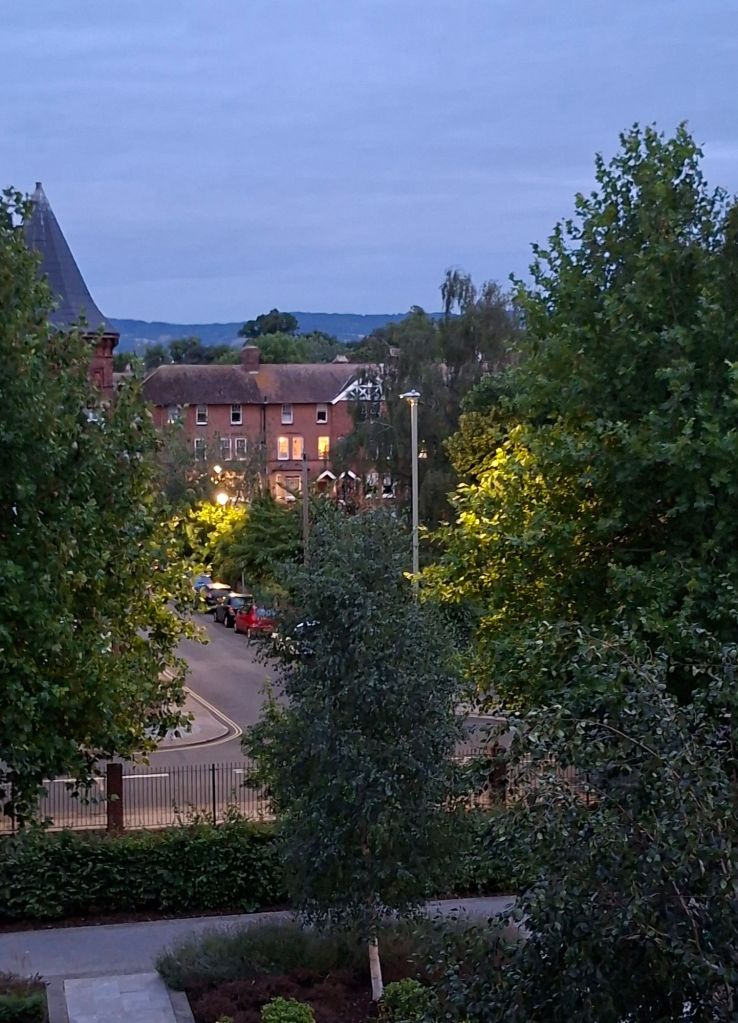
I see change in a familiar scene. Looking out from our apartment I contemplate a gentle twilight. It is modified by artificial light. During the recent heatwave I somehow had little consciousness of this moment in the day. But now, with lower temperatures and rain, my world is a tiny bit different. I discover myself in a twilit scene, and a twilight frame of mind, a little after sunset.
Although this sunset is only ten minutes earlier than the sunsets of the Solstice period, I feel, deep within me, the turning of the Wheel. It’s as if I am leaning in to the spirit of late summer, and the first of the harvest festivals that define the waning year. We are not there yet, though Lammas is but a fortnight away. I am simply becoming aware of a coming seasonal shift.
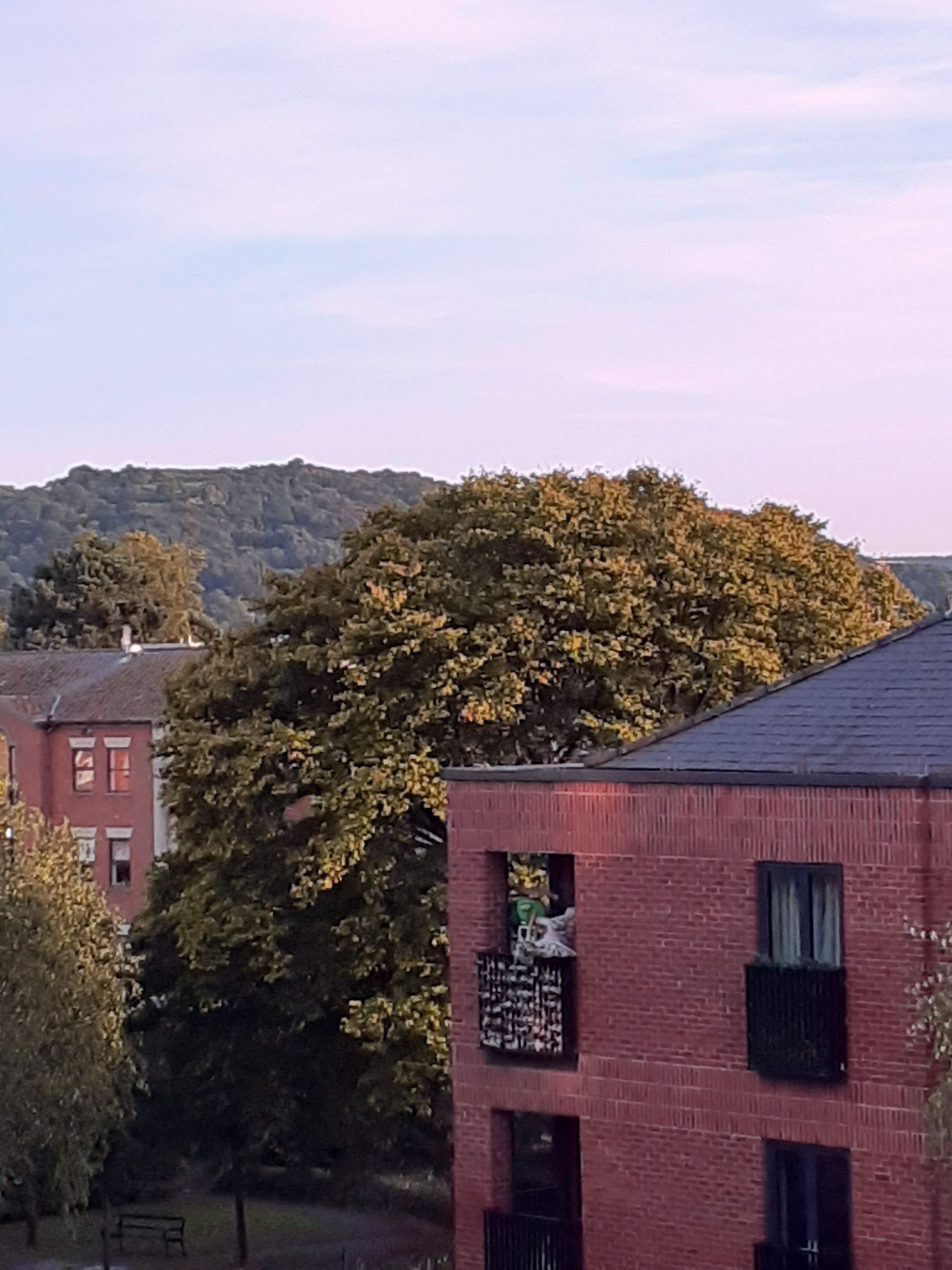
I am also aware of wanting to savour the sense of a change without wanting to hurry it on. Above, an image of trees, houses, hills and sky anchors me into a specific place and time. It’s a ‘now’ experience rather than an anticipation. Below, an image of birch leaves back-lit by electric light holds me in an appreciation of the pattern they make. I am held by the power of a simple pleasure.
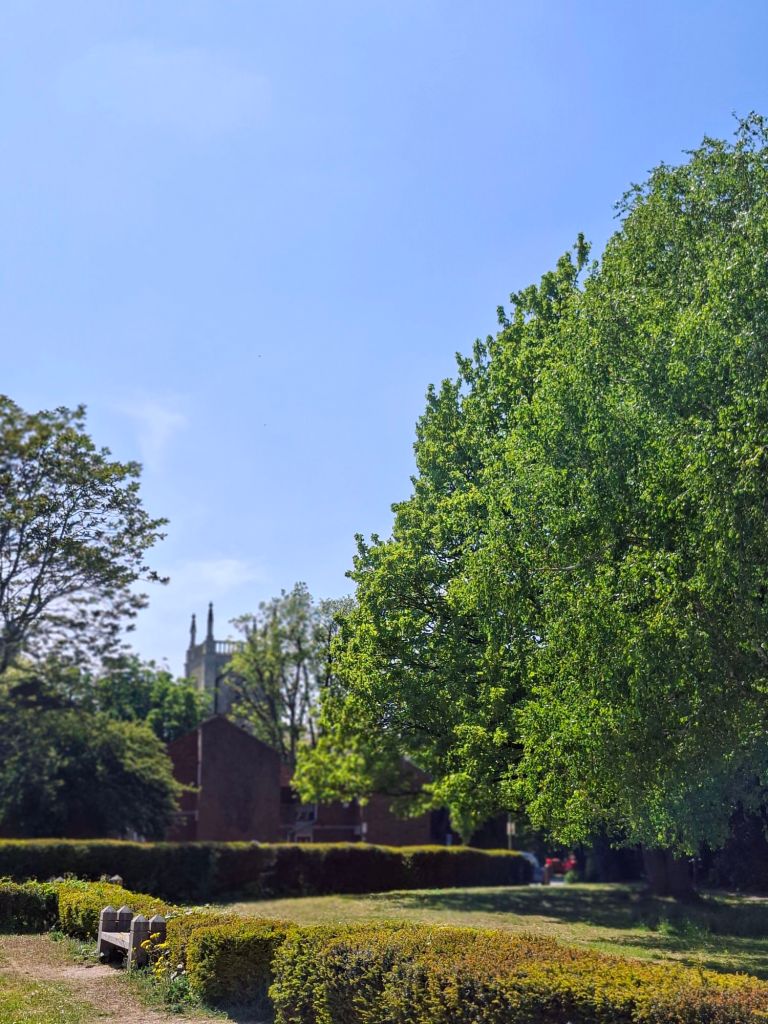
The church of St Mary de Lode, Gloucester, seems to sit among trees. The building salutes the sky without arrogantly trying to reach it. There is a bench towards the foreground of my picture. I am standing in a friendly urban space, a green space. It is one of many made possible by the Churches and Priories of the old city. This space is open to all.
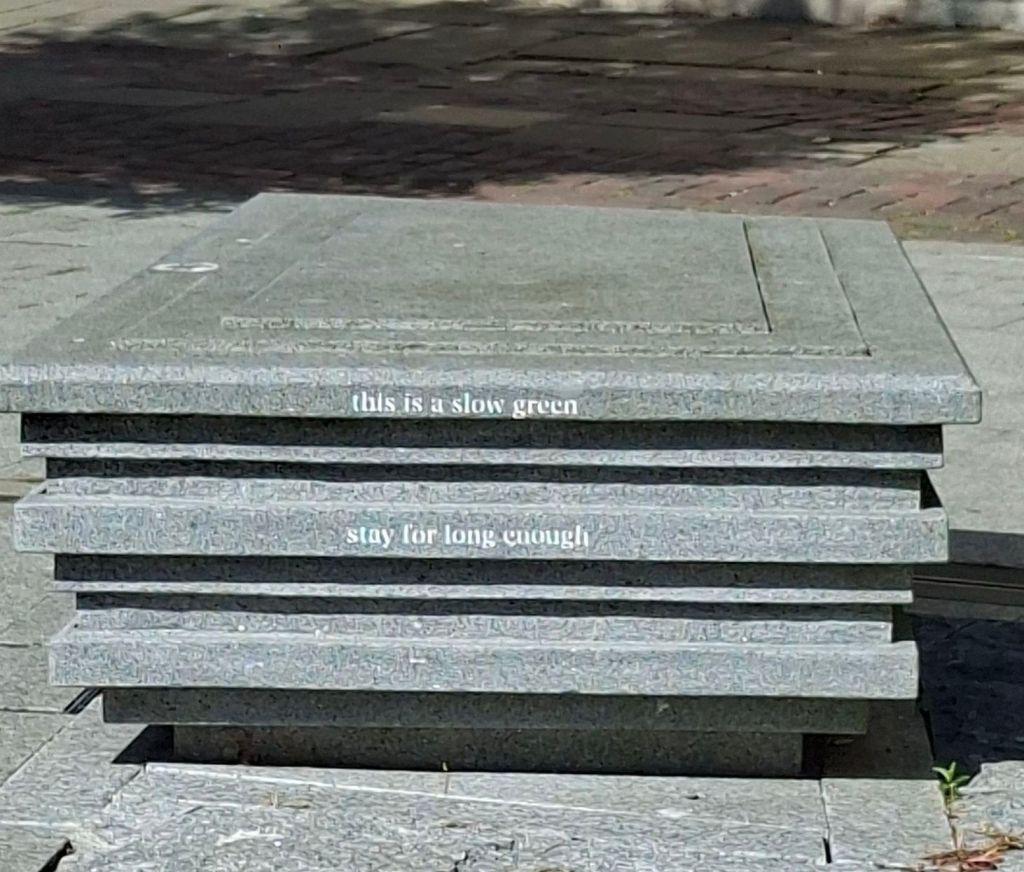
In another such space, on a granite seat close to my home, I recently noticed the words “this is a slow green, stay for long enough”. I have been savouring these words ever since.
They draw me into an easy receptively, not least when the month is May and the day is warm. The riddle of ‘a slow green’ invites immersion and reverie rather than effortful attention or strategies for problem solving. ‘Stay for long enough’ is probably the wisest counsel. Let’s take the time we need gently to befriend such nurturing spaces when we are blessed to find them.
Last weekend ‘the clocks changed’ as the saying goes in my part of the world. Without any change in the heavens, the dawn and sunset alike were, overnight, officially an hour earlier. It happens every year, as does the reverse process in March. This is now culturally unremarkable. It has been happening for many, many years.
Clock time has had a huge influence in my life, whether I like it or not. I was given my first wrist watch at the age of eight and it seemed like a move toward adult empowerment. I didn’t notice any loss, at first, until it became clear that the empowerment offered was largely a self-regulating capacity for meeting other people’s requirements, especially concerned with some form of work. No actual self-direction was involved.
Since the coming of the mobile phone and its evolution into a multi-purpose device, the regulation of our time has if anything tightened. There is the added sense of being permanently on call and indeed of round the clock surveillance. The wrist watch stands as a quaint form of relative freedom, or at any rate spaciousness. I carry a phone whilst also wearing a wrist watch out of habit, nostalgia and a slight element of defiance.
My watch is old and this year I nearly retired it, in a permanent summer time, to a pleasant space in my home. But I couldn’t do it. I would be losing the companionship it provides. I re-read a poem I wrote some years ago and decided to keep the watch with me on my wrist.
Am I out of date To wear a wrist watch? I carry a phone, after all.
Once you seemed so advanced and ‘digital’, For you did not tick and tick and tick, And I did not wind you up.
Over the years, Batteries have died, and been replaced. Straps have come and gone. But your face, just a little scratched, remains the same, Old friend,
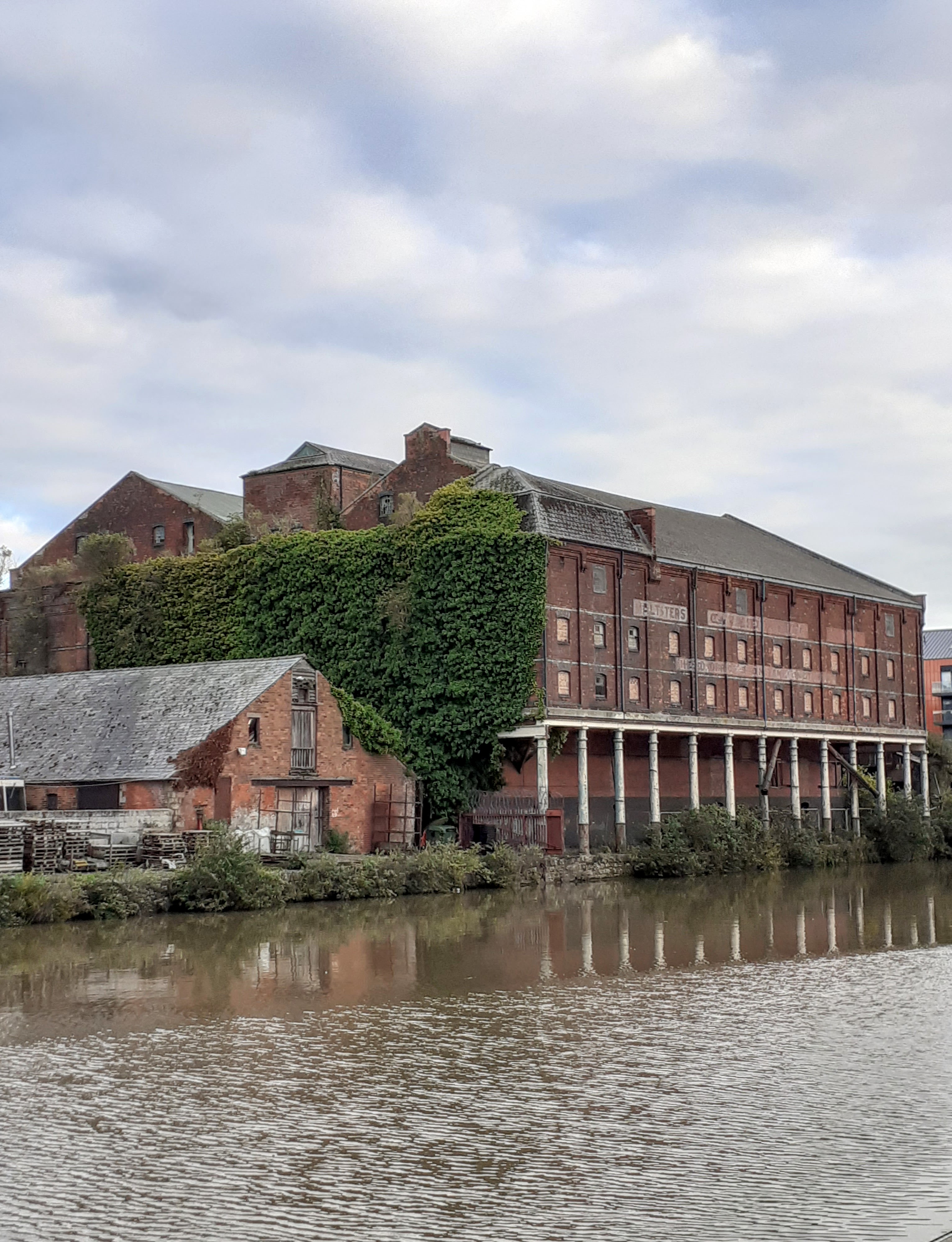
The stretch of water above leads from Gloucester Docks to the Gloucester-Sharpness Canal. The canal was completed in 1827 and the buildings (above) appeared a few years later. The larger, pillared building was known as Downing’s Malthouse and stayed in business until around 1980. For some years thereafter it was used for grain storage. Now it a a Grade II listed building awaiting another life.
From the far side of the canal, the erstwhile malthouse looks tranquil and attractively derelict – solid old brick with greenery on the walls. The forces of decay are relatively slow, and ‘listed’ status provides a degree of human protection. For a few moments I am charmed by by the view. I briefly wish that it could be frozen in time, through a flies-in-aspic form of conservation, admittedly sterile. But the thought doesn’t last. We earthlings experience time and life primarily in change, events and processes – through what happens, interacts and evolves (1). These buildings weren’t designed to be monuments.
So I am glad that people and activity will be returning to Downing’s Malthouse through the building of residential apartments. Housing is in short supply here and I find myself friendly to this kind of development. The shell of Downing’s Malthouse, and its distinctive pillars, will be retained. I dare say that the smaller building will go, and so I’m memorialising it in the picture below.
It is a calendar month since Elaine came home from the Gloucester Royal hospital, after her hip fracture in Gran Canaria on 11 April (1). She is slowly recovering, but still housebound.
Two days before her accident I attended a meeting that signed off on a collection of poetry by local writers (2) to which we had both contributed. Elaine’s haiku below is part of that collection.
(2) Random Writings by the Wrandom Writers Wroclaw, Poland: Amazon Fulfillment, 2024 (Editorial Copyright J.D. Warner; individual poems copyrighted by the authors).
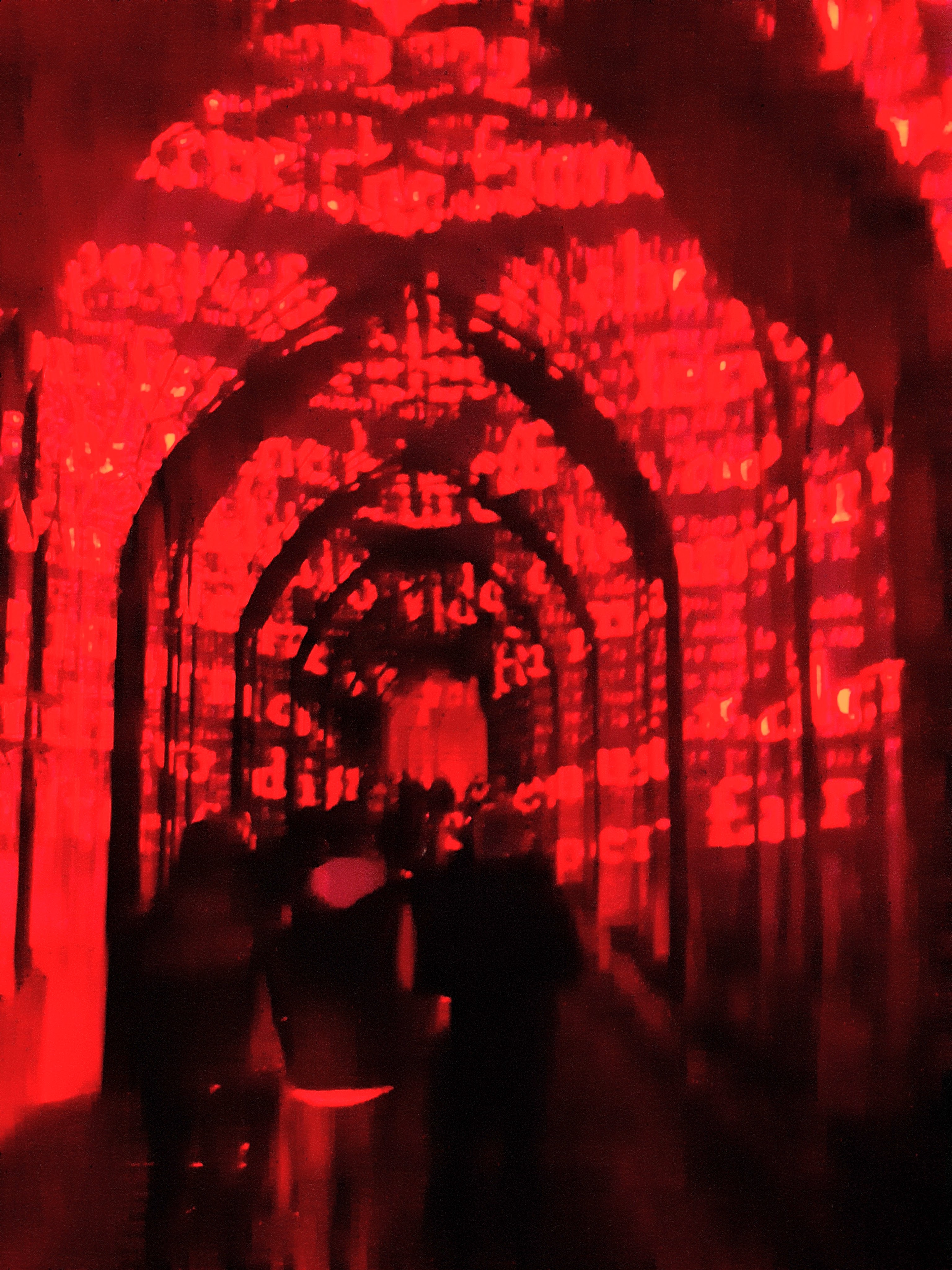
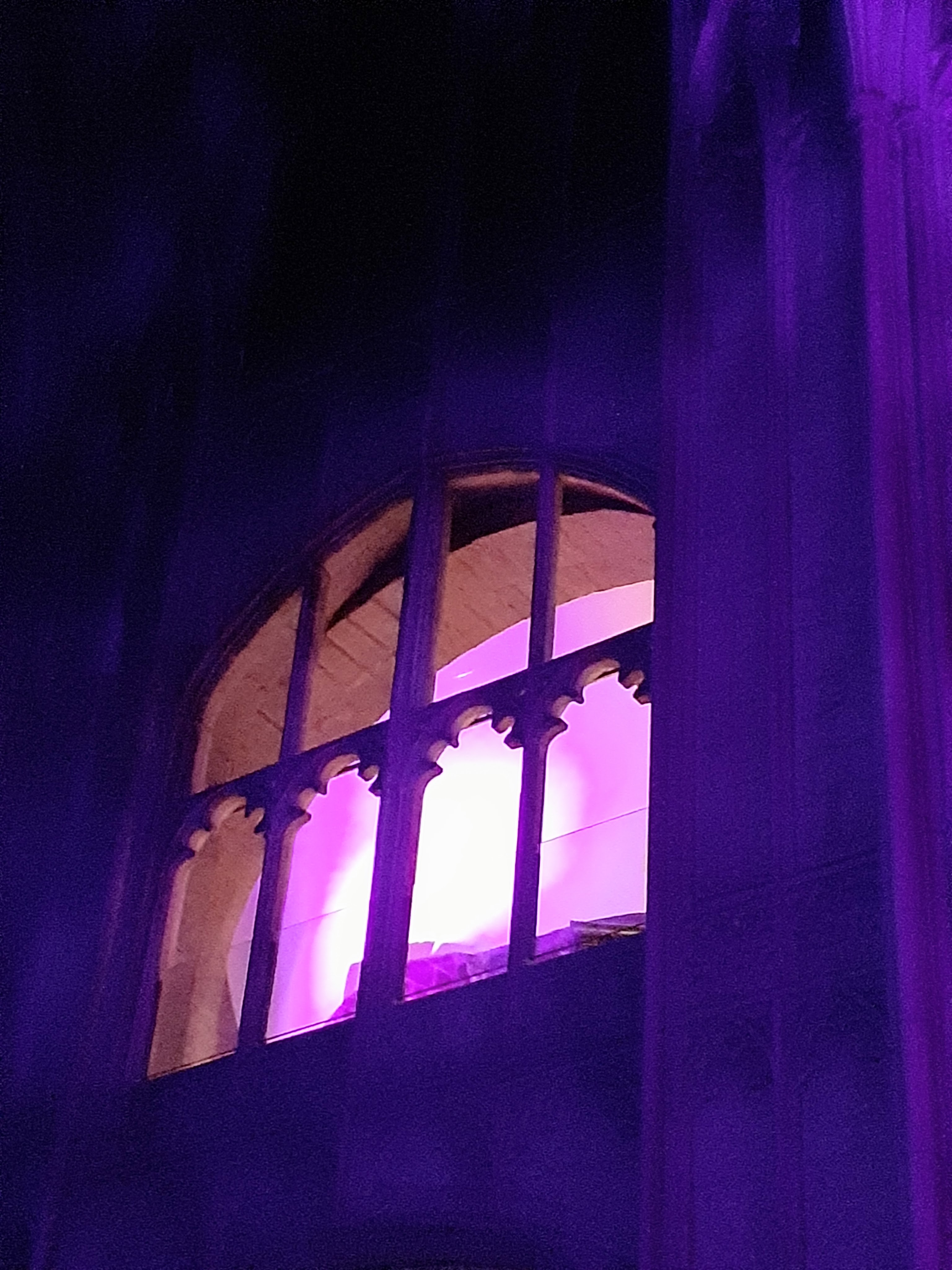
My wife Elaine and I went there early on Sunday evening, 22 October. It was my first visit, her second. She was very happy to repeat the experience. The picture above depicts entry to the building, and a brief walk towards what became a full immersion. The light effects and imagery were accompanied by a soaring and joyful music. The ancient building was packed with people sharing this experience. I was pleased to be held in such a celebratory space.
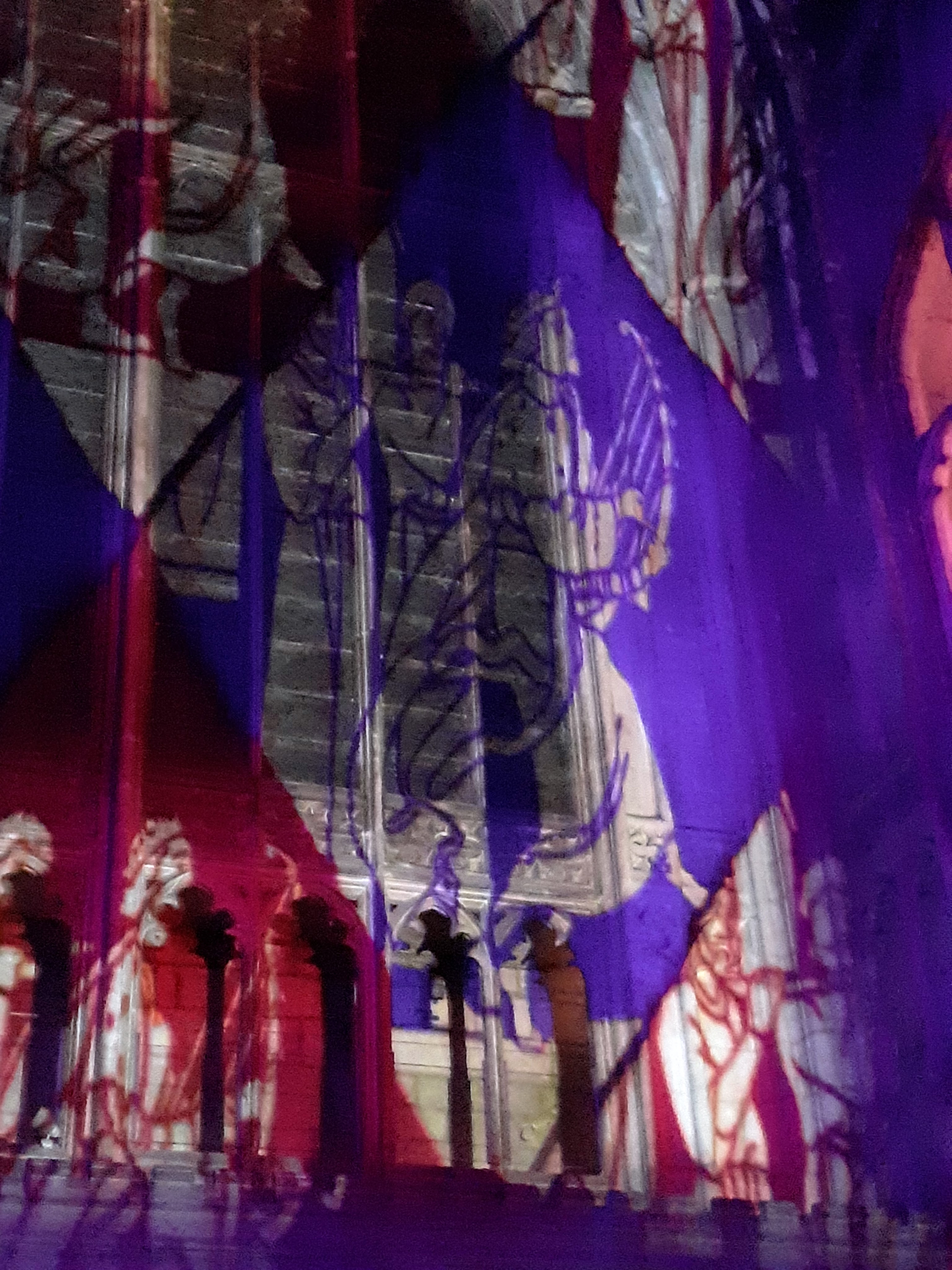
As I understood, or rather felt it at the time, the two images immediately below seem to show time and materiality coming into existence in an act of creation that speeds almost out of control. Certainly, for me, the rapidly changing sequence of images demonstrated a tremendous movement, power and energy. It looked, in those moments, more like sheer cosmic exuberance and play, than any kind of plan.
The installation as a whole had still spaces as well. It took advantage of the cathedral’s medieval architecture, where light and their colour could enhance its majestic serenity.
I also noticed the skill with which the installation incorporated medieval iconography, though I confess that it went past me in something of a blur. There was so much going on, and I found that I could not concentrate on individual images, or even identify them, as much as I would have liked. Then I let go, and surrendered to the experience as a gestalt.
Even the nooks and corners of the building that were largely left alone were washed in the magic of the light. I valued being briefly able to focus on them, their very plainess bringing something to the experience.
Finally, below, I show the tree of life, as light. It is an icon about which so many traditions have had so much to say, for such a long time. Certainly, it acted as a spiritual anchor for me, in that space: a comfort to a practising Druid. I loved the almost delicate fecundity of the portrayal. Gratitude to the Cathedral for enabling this installation, and to Projection Art Gallery for providing it.
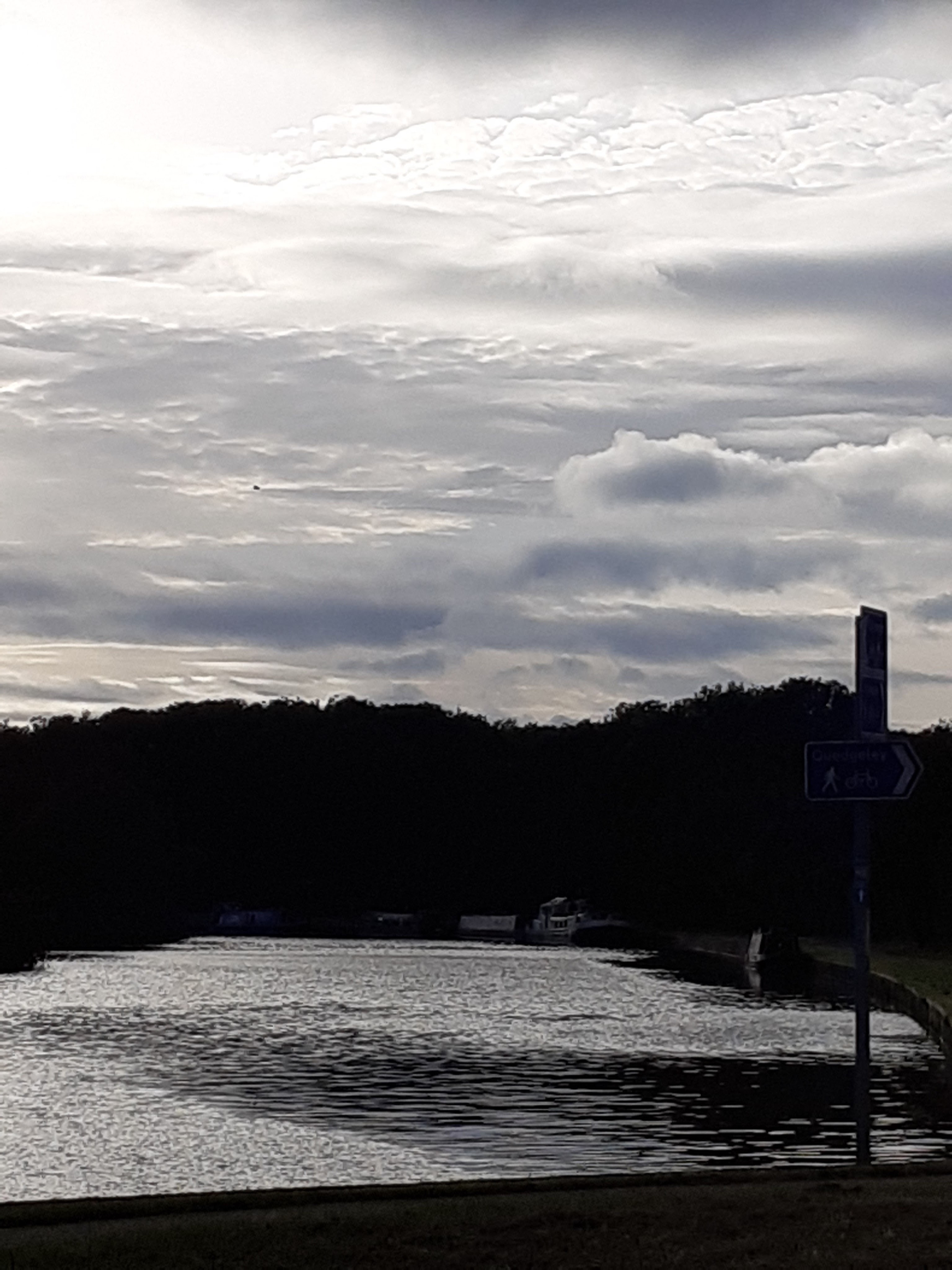
6.15 pm, 6 October 2023. The experience has gone. The images remain. At a surface level, I can use them to trigger memories of my early evening walk. Chiefly, I remember being surprised at how early the twilight was. I hadn’t caught up with the year and was almost shocked. I have caught up now, nearly a week later, as the darkening process speeds up and we approach Samhain. In today’s world, my country will experience a dramatic boost on 29 October as our clocks ‘fall back’. The 6.15 of one day will become the 5.15 of the next.
Looking at the images more deeply, really looking, and giving them time, I can let them nourish me. I connect with their liminal beauty. Both images present me with land, water, sky, and hints of the fiery sun. But they do so in different ways.
In the image above, I am mostly drawn to the energy of water. The variation in shade emphasises movement and different ripple effects. Land, trees, and artifacts are all in silhouette, but the water has light and shade. It is the water that feels most alive. There is variation in the clouds too, with their patterned layers and subtle access to sunlight just above the trees. But they are not as mobile as the water. The sunlight itself seems very subdued. It’s still there, though very much in the background.This is not yet a night sky.
In the image below the water is strong too, but my eyes are drawn above to the clouds, which here are more dramatic. The residual power of waning sunlight is very clearly present. For me, there’s a sense of the tree tops yearning upwards as they reach for the gifts of the sun whilst it still retains a presence. Although I am contemplating images and not immersed in the landscape I have a strong sense of living presence in a field of living presence. In this state I feel a conceivably irrational confidence in life and the world.. A fragile kind of faith, that my heart cannot resist.
I have a mixed response to this poem. I find it insightful, and I want to share it. I also find it theatrically harsh and sweeping. It feels like being shaken awake by an over zealous friend whilst gradually emerging into daylight at my own pace. I am not sure whether this is mainly due to Kabir or to his followers and successors, right down to translator Andrew Harvey. For Kabir never wrote anything himself – his songs were written down by others before being copied and circulated far and wide.
Make your own choice, friends.
Seek Truth while
You’re still in a body.
Find your own place.
When you’re dead
What house will you have?
O my friend,
You just don’t get
Your one true chance.
Don’t you see
In the end
No-one belongs to you?
Kabir says: it’s brutal
This turning wheel of time.
(1) Kabir Turn Me To Gold: 108 poems of Kabir Unity Village, MO: Unity Books, 2018 Translations by Andrew Harvey Photographs by Brett Hurd.








 Contemplative Inquiry