Contemplative Inquiry

This blog is about contemplative inquiry

Tag: Tibetan Buddhism

BOOK REVIEW: UNSEEN BEINGS

Highly recommended. Unseen Beings: How We Forgot the World Is More Than Human (1) is about the many beings we humans have actively ‘unseen’ and the consequences of our human-centric lens. Author Erik Jampa Andersson describes his book as a diagnostic exploration of the roots of the climate crisis, itself an extreme consequence of a much wider malaise. Whereas the common view of ‘saving the planet’ tends to be one of ‘guarding the storehouse’, a better focus would be on ‘supporting the welfare of living beings’.

Andersson has a background in Tibetan Buddhism and Tibetan medicine. In the manner of Buddhism’s Four Noble Truths, and of his medical training, he divides his book into four parts: Diagnosis, Causes and Conditions, Prognosis, Treatment.

Diagnosis concerns “our ecological disease”. Andersson reminds us of what the climate crisis is, how far it has been allowed to go, and the “fanciful stories” with which we have soothed our fears: “full of human exceptionalism, divine protection, techno-fixes and post-apocalyptic salvation”. For Andersson, the foundational root cause is “the sundering of human and non-human beings, and our perceptual separation from ‘Nature’. He refers to “the poison of anthropocentricity”. He reviews the evidence for plant and fungal sentience and awareness as well as that of the animal kingdom. He concludes that Nature is not a place, but “a tightly knit community of interconnected beings, some seen, many unseen, all engaged in their own affairs and with their own experience of reality”. He describes this relational approach to the living world as “what most scholars now call ‘animism’ … neither a religion nor a system of belief, but a paradigm of more-than-human relationship”. He sees this stance toward the world as “our natural state”.

Causes and Conditions A mini-ice age some 13,000 years ago interrupted an early agricultural period in some places and prompted a series of innovations. The domestication of the horse was especially significant. Andersson sees a move away from our ‘natural state’ beginning at this time. But it is not fully evident to us until the age of written philosophy and scripture. The Greek philosophers Plato and Aristotle declare a hierarchy of sentience from plants up to animals and then humans at the top, uniquely endowed with a rational soul. In the Hebrew book of Genesis, God gives dominion over the Earth and its animals to man for his use. In the Western Christianity of the 13th century CE, Thomas Aquinas says that Christians have no duty of charity to non-humans because they are resources, not persons. In the 17th century CE, early in the West European led colonial era, Descartes holds public vivisections of dogs and other animals declaring that they are soulless automata and that their apparent distress is meaningless. In the mid 19th century CE, Darwin restores other beings as our ancestors and cousins, but but without much sense of kinship or empathy.

Prognosis Here Andersson introduces two concepts from Tibetan medicine: ‘provocation’ and ‘spirit illness’. The provocation of other sentient beings is a health risk. He discusses the origins of the recent Covid-19 pandemic in these terms, as human become ever more invasive of our remaining wild spaces. In cases of deforestation, pollution, and any disruption of air, water, soil and trees, there is a price to pay for the wounding of other spirits, whether seen by the eye, seen through a microscope and normally unseen but recognised by tradition. (‘Supernatural’ is an unhelpful word here – everyone is part of nature). In Tibetan tradition, the cultivation of a clear mind is highly prized and works within human psychology, but not for disruptive events like these. There is a need to make amends. Rituals are held in sensitive and damaged places. The damage caused in these circumstances and the resultant chronic collective disease can only be addressed by learning how to care for eachother, non-human beings and the planet itself.

Treatment Using the Buddhist 8-fold path as a structure, Andersson recommends ‘cultivating care’ over a system of rules and regulations aimed at a ‘sustainability’ which tries to restore the old status quo. We cultivate care of the Earth, one another and non-human beings. Hence: 1 right view is a return to our ‘natural state’, as described under Diagnosis; 2 right intention describes commitment to a path of rewilding and regeneration; 3 right speech is the use of “life-affirming language” (e.g. using ‘they’ as an alternative to ‘it’ for non-human beings); 4 right action is causing as little harm as possible to other beings; 5 right livelihood means adopting principles of authentic sustainability and non-exploitation; 6 right diligence is based on “the durability of the heart-felt ethic; 7 right mindfulness means “paying attention to nature’s vitality”; 8 right concentration involves imaging a new future with “authentic myth-making”.

Concerning 8 above, Andersson has been profoundly moved by the work of J. R. R. Tolkien from his later childhood onwards. As a result, he developed a high valuation of authentic myth-making and enchantment. In this realm, the non-human is essential. Tolkien had his own life-changing moment of enchantment when, as a student, he first read the Old English words: Eala earendel engla beorhtast, ofer middangeard monnum sended. (Hail Earendel brightest of angels, above the middle-earth sent unto men). Of this evocation of Venus arising as the morning star, in the old language, Tolkien later wrote: “there was something very remote and strange and beautiful about these words, if I could grasp it, far beyond ancient English”. For Andersson, authentic myth and authentic science work together in support of a redemptive animist vision. By contrast, the form of discourse to worry about is ‘fallacy’ – a complete dissociation from the truth. Andersson again quotes Tolkien: “if men were ever in a state in which they did not want to know or could not perceive truth (facts and evidence) then Fantasy would languish until they were cured. If they ever get into that state (it would not seem at all impossible) Fantasy will perish and become morbid delusion”. For Andersson, this too has become a symptom of our current ecological disease, making the need for honest and healthy communication all the more urgent.

For me, Andersson has made a valuable addition to a growing literature about the current crisis, whose most alarming symptom is climate breakdown. He goes to the root of the problem, offering a clear and coherent view about how to stand in the face of it. It is a well-researched, well-crafted and compassionate contribution to the genre.

(1) Erik Jampa Andersson Unseen Beings: How We Forgot the World is More Than Human Carlsbad, CA & New York City; London; Sydney; New Delhi: Hay House, 2023

I attach a links to conversations between the author and Andrew Harvey below. It adds considerably to what I can present in a review:

TASTING SOLITUDE

“Three months after becoming a monk, I took off to the Himalayan foothills behind Dharamsala. I was 21 years old. My backpack contained a sleeping bag, groundsheet, towel, kettle, bowl, mug, two books, some apples, dried food and a 5-liter container of water. Monsoon had just ended: the sky was crystalline, the air cleansed, the foliage luxuriant. After 3 or 4 hours, I left the well-trodden footpath and followed animal trails up the steep, sparsely forested slope until I reached the grassy ledge hidden by boulders and sheltered by branches that I had identified earlier on an earlier foray.

“Inspired by stories of Indian and Tibetan hermits, I wanted to know what it would be like to be cut off from all human contact, alone and unprotected. I would stay here as long as my meager supply of food and water permitted. No one knew where I was. If I fell and broke my leg, was bitten by a cobra or mauled by a bear, I was unlikely to be found. High in this aerie, I could still hear the distant horn blasts and grinding gears of buses and trucks below, which I regarded as an affront.

“I would wake with my sleeping bag covered in dew. After peeing and meditating, I would light a fire, boil water, make tea, then mix it with roasted barley flour and milk powder to form a lump of dough. This was breakfast and lunch – following the monastic rule, I did not eat in the evening.

“My meditations included the sadhanas into which I had been initiated, where I visualised myself either as the furious bull-headed, priapic Yamantaka or the naked, menstruating red goddess Vajrayogini. I alternated these tantric practices with an hour of mindfully ‘sweeping’ my body from head to foot, noticing with precision the transient sensations and feelings that suffused it. When not eating or meditating, I intoned a translation of Santideva’s Compendium of Training, an 8th century Sanskrit anthology of Mahyana Buddhist discourses, which I had vowed to recite in its entirety while up there.

……….

“What remains of that solitude now is my memory of the sweeping panorama of the plains of the Punjab, the immense arc of the heavens, and the embrace of the mountains that harbored this fragile dot of self-awareness. Once, a fabulous multi-colored bird that launched itself from the cliff beneath, floated for an instant in the air, then disappeared from view. A herdsman and his goats came close to discovering me one afternoon. I peeked at them through a lattice of leaves as the animals grazed and the wiry, sun-blackened man in a coarse wool tunic lay on a rock.

“Supplies exhausted and text recited, I trekked back to my room in McLeod-ganj below. During my five days on the mountain I had acquired a taste for solitude that has been with me ever since.”

Stephen Batchelor The Art of Solitude: A Meditation on Being Alone with Others in This World New Haven, CT & London, England: Yale University Press, 2020

RED SKY AT DAWN

It is 7.30 am on Sunday 5 February 2023. Every dawn is different. Opening to this one, I am drawn, above all, into clarity and redness. I feel as if I have just about caught up with myself, after five days in a new home. In traditional language, my soul has caught up with me.

In recent days I have felt more like a slightly dated machine, reliable in getting the job done, though not super fast or shiny. Now I’m aware again of being a person, a living presence in communion with a living world. The key moment was when, yesterday afternoon, I found my Tibetan bells in a shopping bag with some electrical equipment. I feared that they had left me during the move. It was a more than expected relief to re-discover them.

Today, in celebration, I used them to demarcate a morning practice that I hadn’t done at all for a week. I was tentative, in a new and not yet fully established space. But the practice grounded me all the same. It set me up to meet the dawn. It’s been said, I think by Douglas Harding, that we are, essentially, clear awake space and capacity for the world. As today magnificently dawned, it seemed that way to me.

SPIRITUAL ‘KNOWING’

I like the way this presentation uses the word ‘knowing’ to point to our underlying condition. This usage is clearly separated from everyday knowledge of or about (something), or even of wisdom and understanding. It also avoids the term ‘consciousness’, which tends to invite metaphysical and scientific debates that lead us away from direct experience. ‘Awareness’ is a noun and so seems like a thing – we don’t generally talk about ‘awareing’. I personally like ‘being’ as an alternative, but it carries philosophical baggage and is not specific enough for the context of this presentation. Current usages within the Western Way of the term ‘gnosis’ do not generally reflect the view discussed here.

It may be true, as the Tao Te Ching says, that the Way that can be named is not the real Way. But we still need language, as a pointer, for that in us which needs to make sense of experience and to share it with others. Here, a skilful choice of words can make a difference, and I think this presentation models the skill. Dzogchen is a tradition within Tibetan Buddhism. ‘Rigpa’ is the Tibetan word used to describe ‘knowing’ in this sense.

WHERE THE LIGHT GETS IN

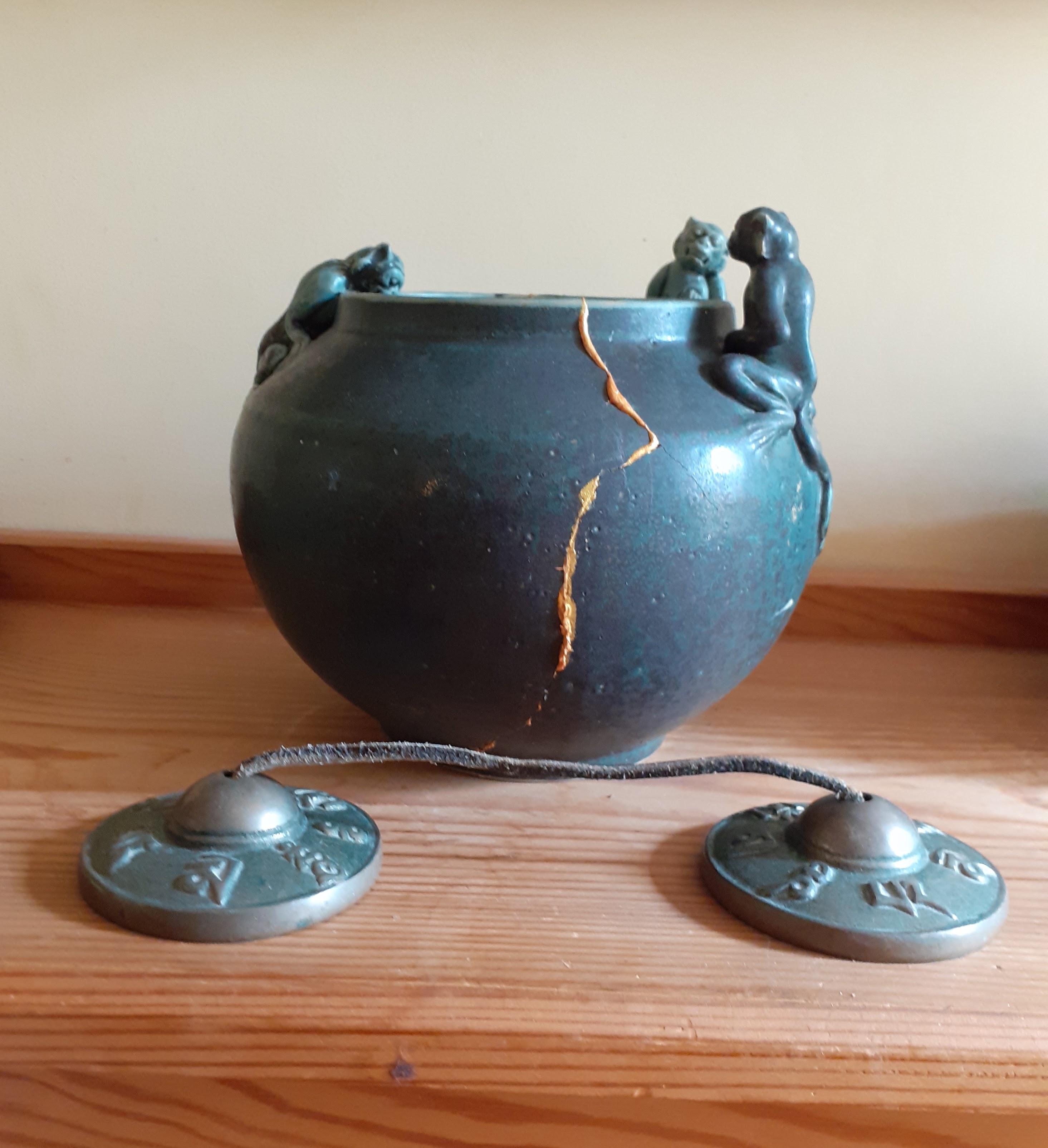
The pot belongs to my wife Elaine*, and used to live outdoors. Late in the winter it filled with rain. Then there were days of frost and the water turned into ice. The ice needed more room, and pushed against the sides of the pot. When the ice melted the pot fell apart in two neat halves. Nature in action, over time.

As part of her work, Elaine knows something about kintsugi, which literally means “golden joinery”. This treats breakage and repair as part of the history of an object, rather than something to disguise. Culturally, the approach is an aspect of wabi-sabi, the acceptance of transience and imperfection. Elaine’s repair, applying kintsugi, is literally illuminated.

The result reminds me of the refrain in Leonard Cohen’s Anthem.

“Ring the bells that still can ring.

“Forget your perfect offering.

“There is a crack in everything.

“That’s where the light gets in.”

After some hesitation, I added my Tibetan bells to the picture above. The cord attaching the two bells is about half its original length due to wear and tear. But the bells still ring. My ownership of them, here and now, is almost certainly the result of Tibet’s collective disaster and the resultant Tibetan diaspora. In the world of biological life and time, disaster and repair are a common theme. If the crack is where the light gets in, the work of repair is sacred.

*See https://elaineknight.wordpress.com

SKY AND WEATHER

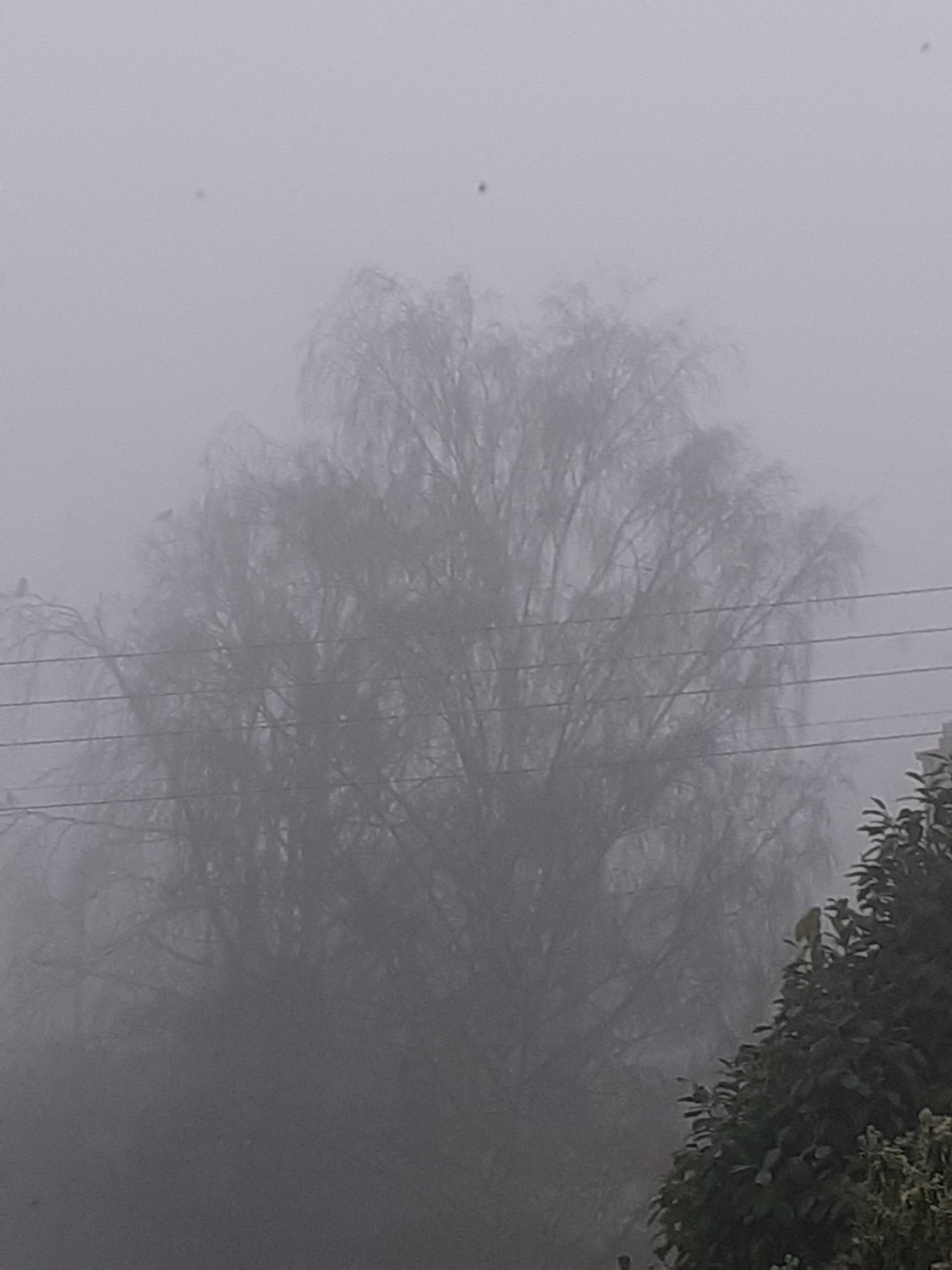
The fog has gone now, for the time being. But its memory still clings to me. I can acknowledge its beauty as seen through the window of a warm room. But I would rather not be out there, tasting the fog, breathing it, trying to find my way in a clammy kind of cold. To go out, I wait for another day, with clear light and the effects, however subtle, of the winter sun. What a difference a day makes.

Part of my Druidry is about cultivating dimensions of experience ignored or unvalued in mainstream culture. Practice keeps my connection to them open. Tibetan Buddhists are sky watchers and have the saying; ‘you are the sky; everything else is weather’. This recognition does not erase the fluctuations in our weather, without and within, or our response to them. It does point to a capacity to hold them within a hidden dimension of clarity and stillness.

In the opening days of 2021, I have been taking in the likelihood of another collectively hard year, perhaps harder than 2020 in a different way. Last year I was more hopeful about this year than I am now. I don’t find this easy and I don’t ask myself to. What I can do is find a home in this seemingly unboundaried and seemingly timeless dimension, here called ‘the sky’, without abandoning the day-to-day.

I am the sky, and I hold the weather – fog and sunlight alike.

HUNGRY GHOSTS

“These various spirits may live on the earth, beneath its surface, in the ocean or in the air. Although there are many different kinds, traditionally they are all pictured as one type, a kind of caricature expressing their hungry nature. They have tiny mouths, long thin necks and huge, swollen bellies, which can of course be a sign of starvation as well as greed. Their inability to satisfy their hunger manifests in different ways, according to whether they have distorted perceptions of the external world, of their own inner condition, or both.

“In the first cases, some search desperately for food and drink, but can never find any. Some imagine that they can see it in the distance, like a mirage, but when they get nearer, it turns out to be an illusion. Others can see a feast laid out for them and are just about to eat it when fearsome guards appear and chase them away.

“The second category of hungry ghosts have food available to them, but their mouths and throats are so small, and their stomach so large, that they would never be able to consume even a fraction of the amount they need. They have long, grasping fingers, with which they frantically grab and try to swallow whatever they can, but it only makes them feel more and more empty.

“Hungry ghosts in the third category are subject to various inner and outer hallucinations, so they cannot benefit from their food. For some of them, food and drink burst into flames inside them and burn them from within. For others, it turns into revolting substances like blood, pus and urine, which they eat; still others find that they are biting into their own flesh; and for some, food becomes inedible material, like iron or straw.

“The basic subjective feeling of this realm is overwhelming deprivation, a sense of poverty combined with greed. Paradoxically, the hungry ghosts are surrounded by an environment of richness and abundance; everything they want is already there, but their hunger prevents them from enjoying it. Self-preservation is very strong, so there is little sense of openness or relaxation. They are totally obsessed with trying to satisfy their own needs, so they cannot afford to feel the pain of others or arouse the slightest generous impulse. Birth in this condition of existence is the result of extreme avarice, meanness and stinginess.”

Francesca Freemantle Luminous Emptiness: Understanding the Tibetan Book of the Dead Boulder, CO: Shambhala, 2003

NOTE: In Tibetan Tantric Buddhism, there are six realms of existence in the wheel of life: two higher realms of gods and jealous gods, two intermediate realms of humans and animals, and two lower realms of hungry ghosts and hell-beings. Although not liberated from the wheel of life, the divine realms are places of reduced suffering and greater freedom. The results of positive actions outweigh the negative. In the lower realms, negative karma is very strong.

But these issues are not just something for another life. To Tantric Buddhists, nirvana and samsara are one. Every moment can be seen as a new birth. All realms are part of our lived experience, here and now. We do not have to look outside for hungry ghosts, or hell-beings (locked in a distorted logic of aggression that always puts the blame on others). They are part of us. There are times when we see them and times when we don’t.

Earth Eclectic

music that celebrates Earth and speaks to the heart

Sarah Fuhro Star-Flower Alchemy

Follow the Moon's Cycle

Muddy Feet

Meeting nature on nature's terms

Rosher.Net

A little bit of Mark Rosher in South Gloucestershire, England

Becoming Part of the Land

A monastic polytheist's and animist’s journal

selkiewife

Selkie Writing…

Charlotte Rodgers

Images and words set against a backdrop of outsider art.

Prof Jem Bendell

living with metacrisis and collapse

Towint

The pagan path. The Old Ways In New Times

The Druids Garden

Spiritual journeys in tending the living earth, permaculture, and nature-inspired arts

The Blog of Baphomet

a magickal dialogue between nature and culture

This Simple Life

The gentle art of living with less

Musings of a Scottish Hearth Druid and Heathen

Thoughts about living, loving and worshiping as an autistic Hearth Druid and Heathen. One woman's journey.

Wheel of the Year Blog

An place to read and share stories about the celtic seasonal festivals

Walking the Druid Path

Just another WordPress.com site

anima monday

Exploring our connection to the wider world

Grounded Space Focusing

Become more grounded and spacious with yourself and others, through your own body’s wisdom

The Earthbound Report

Good lives on our one planet

Hopeless Vendetta

News for the residents of Hopeless, Maine