“A sign is what characterises the appearance of something, its form. If we recognise things based on their sign, we may think that this cloud is different from that cloud, the oak tree is not the acorn, the child is not the parent. At the level of relative truth, these things are helpful. But they may distract us from seeing the true nature of life, which transcends these signs.
” ….
“You are always changing form. You are browsing through a family photograph album, and come across a photo of yourself as a young child. Where is that little child now? You know that it is you. You have the same name, and yet it doesn’t look like you. Are you still that child or are you someone else? This is a practice of contemplating your own signlessness. Today you look, speak, act and think differently. Your form, feelings, perceptions and consciousness are all very different. You are not fixed and permanent. You are not the same person, but you are not a totally different person either. When you are no longer caught in specific images or appearances, you can see things more clearly. You can see that the little child is still alive in every cell of your body. It is possible still to listen and take care of the little boy or little girl in you at any time.” (1)
(1) Thich Nhat Hanh The Art of Living London: Penguin Random House UK, 2017
“Toward all beings maintain unbiased thoughts and speak unbiased words. Toward all beings give birth to thoughts and words of kindness instead of anger, compassion instead of harm, joy instead of jealousy, equanimity instead of prejudice, humility instead of arrogance, sincerity instead of deceit, compromise instead of stubbornness, assistance rather than avoidance, liberation instead of obstruction, kinship instead of animosity.” (1,2)
Humanism extends our circle of care to all humans, clearly a high bar in our current state of culture. Druidry, certainly an animist Druidry embracing deep ecology, asks us to extend it further – to all beings. At first glance, it seems like a complicated and demanding ask in a world where life lives off other life, and where cooperation and competition necessarily co-arise. Yet for some people this stance towards the world is (or becomes) natural.
The passage in my first paragraph offers guidance on the Bodhisattva path in Mahayana Buddhism. Followers of the path let go of any quest for personal liberation to work for the liberation of all beings. Sometimes this is understood as a postponement of personal liberation, but the deeper insight is that ‘personal’ liberation makes no sense. In an interconnected and interdependent cosmos, only the liberation of all counts as any liberation at all.
In the Diamond Sutra (3) the definition of ‘beings’, put into the mouth of the Buddha himself, is as broad and inclusive as possible: “however many species of living beings there are – whether born from eggs, from the womb, from moisture, or spontaneously; whether they have form or no form; whether they have perceptions or do not have perceptions, we must lead all these beings to the ultimate nirvana so that they can be liberated.” Then the Buddha adds: “And when this innumerable, immeasurable, infinite number of beings has become liberated, we do not in truth think that a single being has been liberated”.
Thich Nhat Hanh (3) understands this last statement as saying “a true practitioner helps all living beings in a natural and spontaneous way, without distinguishing the one who is helping from the one who is being helped. When our left hand is injured, our right hand takes care of it right away. It doesn’t stop to say: ‘I am taking care of you. You are benefitting from my compassion’. The right hand knows very well that the left hand is also the right hand. There is no distinction between them. This is the principle of interbeing – co-existence, or mutual interdependence. ‘This is because that is’.”
I am not a Buddhist. I do not share the classical Buddhist views of karma and reincarnation. I do not associate final physical death with the term ‘liberation’. But I am aware of not, ever, being on my own – even when being, in the world’s terms, solitary. Apparent boundaries between me and my world are too soft: relationships are happening all the time. With this sense of the world in mind, the words below, repeated from the first paragraph, seem like common sense.
“Toward all beings maintain unbiased thoughts and speak unbiased words. Toward all beings give birth to thoughts and words of kindness instead of anger, compassion instead of harm, joy instead of jealousy, equanimity instead of prejudice, humility instead of arrogance, sincerity instead of deceit, compromise instead of stubbornness, assistance rather than avoidance, liberation instead of obstruction, kinship instead of animosity.” (1,2)
(1) From the Perfection of Wisdom in Twenty-five Thousand Lines translated into English by Edward Conze, Large Sutra on Perfect Wisdom Berkeley, CA: University of California Press, 1975 and cited in (2), below
(2) Red Pine, The Diamond Sutra: the Perfection of Wisdom. Text and Commentaries translated from Sanskrit and Chinese Berkeley, CA: Counterpoint, 2001 See: https://www.counterpointpress.com
(3) Thich Nhat Hanh The Diamond That Cuts Through Illusion: Commentaries on the Prajnaparamita Diamond Sutra Berkeley, CA Parallax Press, 201
NOTE: Versions of the Diamond Sutra appeared as written texts in Sanskrit in the 2nd century C.E. and this version was translated from Sanskrit into Chinese in the early 5th century C.E. Works of this kind were used more for recitation and chanting in monastic settings than they were for silent reading.
This post looks at Animism as the guiding principal of my Druidry. The term itself comes from nineteenth century anthropology, and is somewhat problematic. Scholars from European and North American backgrounds , formed by a mix of Christian and secular ideas, were studying, and labelling, the traditional practices of other people. The people themselves were mostly in the process of becoming colonial subjects and living in cultures under stress. So ‘Animism’ started out as a top-down classification, which gave Animists a lowly position in the hierarchy of cultural and spiritual life. A stigma persists to this day.
Despite this dubious history, the word ‘Animism’ is now being turned around by people from the global north itself, spiritually hungry in our now palpably faltering 21st century world. Some years ago, research by Graham Harvey distinguished two positive uses of the term Animism among modern western Pagans. “Some Pagans identified Animism as a part of their religious practice or experience which involved encounters with tree-spirits, river-spirits or ancestor-spirits. This Animism was metaphysical. … Other Pagans seemed to use ‘Animism’ as a short-hand reference to their efforts to re-imagine and re-direct human participation in the larger-than-human, multi-species community. This Animism was relational, embodied, eco-activist and often ‘naturalist’ rather than metaphysical” (1).
My Animism draws primarily on the second of the two accounts above. But it is deepened by a Buddhist influence, especially that of the Vietnamese Zen Master Thich Nhat Hanh: “There is no absolute dividing line between living matter and inert matter. If we took the so-called inanimate elements out of you and me, we would not be able to live. We are made of non-human elements. This is what is taught in the Diamond Sutra, an ancient Buddhist text that could be considered the world’s first treatise on deep ecology. We cannot draw a hard distinction between human beings and other living beings, or between living beings and inert matter. There is vitality in everything. The entire cosmos is radiant with vitality. If we see the Earth as a block of matter lying outside of us, then we have not yet truly seen the Earth. The Earth is also alive” (2).
Thich Nhat Hanh follows an old tradition. In thirteenth century Japan, Zen Master Eihei Dogen had taught that enlightenment is just ‘intimacy with all things’. Elsewhere in his own text, Thich Nhat Hanh says: “Just as a wave doesn’t need to go looking for water, we don’t need to go looking for the ultimate. The wave is the water. You already are what you want to become. You are made of the sun, moon and stars. You have everything inside you”. Thich Nhat Hanh explains that a flower is made only of non-flower elements. We can say that the flower is empty of separate self-existence. But that doesn’t mean that the flower is not there. “When you perceive reality in this way, you will not discriminate against the garbage in favour of the rose” (2).
This Buddhist wisdom doesn’t seem to me to come directly out of the four noble truths or eightfold path. The Buddhists of south-east and east Asia were at ease with the traditional Animism of their cultures, and the views expressed above appear to me to be at least partly a cultural gift from the Animists. Japan, for example, was intensely influenced by Buddhism without any thought of displacing Shinto, and the traditions readily interwove.
It was otherwise in the west. Already, In the first century CE, the Roman philosopher Plutarch wrote of the death of Great Pan, after the time of Jesus but before the rise of Christianity. James Hillman comments: “With Pan dead, so was Echo; we could no longer capture consciousness through reflecting within our instincts. … The person of Pan the mediator, like an ether who invisibly enveloped all natural beings with personal meaning, with brightness, had vanished. Stones became only stones – trees, trees; things, places, animals no longer this god or that, but became ‘symbols’, or were said to ‘belong’ to one god or another. When Pan is alive, then nature is too – the owl’s hoot is Athena and the mollusc on the shore is Aphrodite … Whatever was eaten, smelled, walked upon or watched, all were sensuous presences of archetypal significance”.” (3).
James Hillman, after service as Director of Studies as the Jung Institute in Zurich, went on to develop his own form of archetypal psychology. He was a strong proponent of Panpsychism, a world view very similar to forms of Animism being articulated today. Panpsychism literally means the ensoulment of everything (from the Greek), though the sound ‘Pan’ also associates us with the god. At the same time this view broadly fits with the understanding of Zen Buddhist Thich Nhat Hanh, described above.
‘Animism’ is for me a word, not a thing, or a another religious banner to raise. It points to a wide range of experiences, understandings, and articulations. Pinned down to a single, dictionary definition, it would lose its power and energy. Yet Animism has become the word that best describes my way of being a modern Druid, both as view and as practice. I find it grounding and regenerative to have decisively adopted this word.
(1) Graham Harvey (ed.) The Handbook of Contemporary Animism London & New York: Routledge, 2014 (First published by Acumen in 2013)
(2) Thich Nhat Hanh The Art of Living London: Rider, 2017 (Rider is part of Penguin Random House)
(3) James Hillman The Essential James Hillman: A Blue fire London: Routledge, 1989 (Introduces and edited by Thomas Moore in collaboration with the author)
“I remember one morning contemplating a mountain in the early light of dawn. I saw very clearly that not only was I looking at the mountain, but all my ancestors in me were looking at the mountain as well.
“As dawn broke over the mountain peak we admired its beauty together. There was nowhere to go and nothing to do. We were free. We needed only to sit there and enjoy the sunrise. Or ancestors may never have had the chance to sit quietly, peacefully, and enjoy the sunrise like that.
“When we can stop the running, all our ancestors can stop at the same time. With the energy of mindfulness and awakening, we can stop on behalf of all our ancestors. It is not the stopping of a separate self alone, but of a whole lineage. As soon as there is stopping, there is happiness. There is peace.” (1)
When Thich Nhat Hanh tells this story, he shows us ‘mindfulness’ as an art of living. He stops, looks at a mountain at dawn. His contemplation becomes a relationship, and the relationship is extended to the ancestors. For him, mindfulness sits together with interbeing, his word for interconnectedness. It is not a personal accomplishment, but the portal to an expanded, more inclusive, experience of life.
Thich Nhat Hanh was a great advocate and teacher of formal sitting meditation. But he didn’t fetishise it. The Mahayana Buddhist world view, and particularly its ethics, mattered more. I once heard a senior Vietnamese follower (also a psychiatrist) say that she was cautious about teaching meditation in Vietnam. She said that even in the 21st century, decades after the Japanese, French, American and Chinese wars, with elements of civil war thrown in, many people in Vietnam are too traumatised to benefit from meditation. What works best is participation in the Buddhist community and its ceremonial life, in a spirit of generosity and compassion. Mindfulness is essentially a value, not a contemplative technique.
I stop for my own ancestors, of both blood and other inheritances. I become aware of holding them in my heart. I let them in as I let in the world around me, and I experience that world with them and for them. We share a brief period of deep peace, and then let it go. For me, it feels mindful, Druidic, and very natural. Something to return to, whenever the moment feels right.
(1) Thich Nhat Hanh The Art of Living London: Rider, 2017 (Rider is an imprint of Penguin Random House UK)
Thich Nhat Hanh, the much loved Buddhist teacher from Vietnam, died on 22 January at the age of 95. He had been unwell for some time. He is remembered as peace activist, inventor of the term ‘interbeing’ and teacher of mindfulness practice. For him, this is the practice of being aware of what is going on in the present moment. We can be mindful at any moment, whether we are sad, joyful, angry, and whilst cooking, driving or about to send an email.
I am not a Buddhist. Instead, I feel and recognise Thich Nhat Hanh’s influence on my practice of Druidry – especially my sense of at-homeness, or presence, in the living moment. In memory and appreciation of him, I want to share a piece he wrote about aimlessness as as a ‘door of liberation’ (1).
“The concentration on aimlessness means arriving in the present moment to discover that the present moment is the only moment in which you can find everything you’ve been looking for and that you already are everything you want to become.
“Aimlessness does not mean doing nothing. It means not putting something in front of you to chase after. When we remove the objects of our craving and desires, we discover that happiness and freedom are available right here in the present moment.
“We have a habit of running after things, and this habit has been transmitted to us by our parents and ancestors. We don’t feel fulfilled in the here and now, and so we run after all kinds of things we think will make us happier. We sacrifice our life chasing after objects of craving or striving for success in our work or studies. We chase after our life’s dream and lose ourselves along the way. We even lose our freedom and happiness in our efforts to be mindful, to be healthy, to relieve suffering in the world, or to get enlightened. We disregard the wonders of the present moment, thinking that heaven and the ultimate are for later, not for now.
“To practice meditation means to have the time to look deeply and see these things. If you feel restless in the here and now, or you feel ill at ease, you need to ask yourself: ‘what am I longing for? what am I waiting for? what am I searching for?'”
(1) Thich Nhat Hanh The Art of Living London: Rider, 2017
“Just as a wave doesn’t need to go looking for water, we don’t need to go looking for the ultimate. The wave is the water. You already are what you want to become. You are made of the sun, moon and stars. You have everything inside you.”
If I had authored the words above, they would be a clear statement of my stance as a modern Druid. In fact they were written by the Vietnamese Zen monk and peace activist Thich Nhat Hanh, who has spent the latter part of his life making Buddhism accessible to westerners. For me, this shows the wider resonance of his core understanding. Indeed he continues by using the language of a third tradition – the best known to most westerners – to develop his theme.
“In Christianity there is the phrase, ‘resting in God’. When we let go of all seeking and striving, it is as if we are resting in God. We establish ourselves firmly in the present moment; we dwell in the moment. We rest in our cosmic body. Dwelling in the ultimate doesn’t require faith or belief. A wave doesn’t need to believe it is water. The wave is already water in the very here and now.
“To me, God is not outside us or outside reality. God is inside. God is not an external entity for us to seek, for us to believe in or not to believe in. God, nirvana, the ultimate, is inherent in every one of us. The Kingdom of God is available in every moment. The question is whether we are available to it. With mindfulness, concentration and insight, touching nirvana, touching our cosmic body or the Kingdom of God, becomes possible with every breath and every step.”
Thich Nhat Hanh The Art of Living London: Penguin Random House UK, 2017
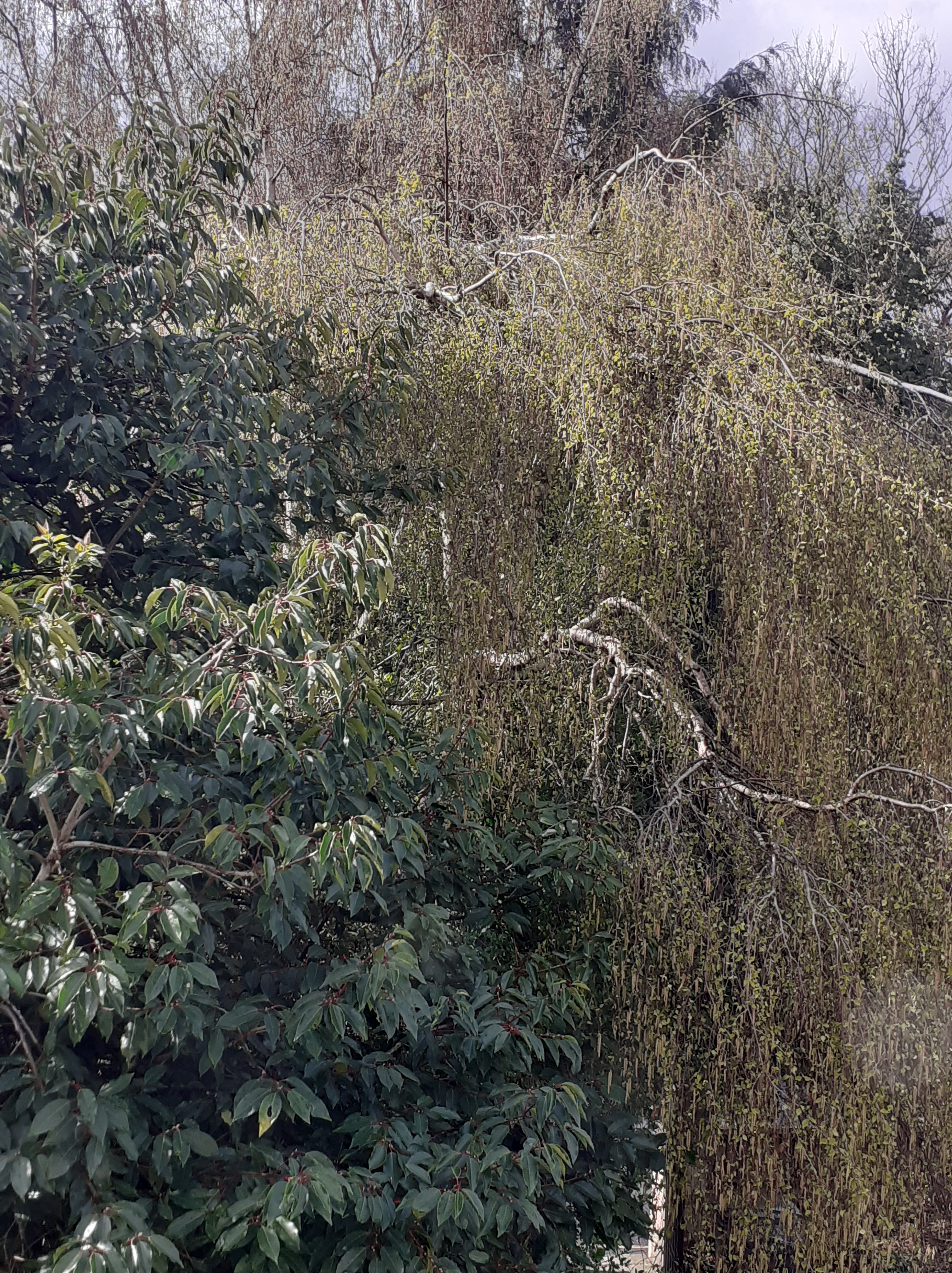
I am feeling more at home in a number of ways. A much loved view through a bedroom window is enough. I can look out and lose myself, holding an image both of continuity and change as the seasons move. One way in which I experience the year is in two halves. Beltane initiates the summer half of a two season year, with Samhain beginning winter.
I often find the extended six months ‘winter’ to be productive for my contemplative inquiry. In the six months now about to end, I have completed an important shift, a shift that reframes an inquiry insight dating from 2018. At that time I said: “I discovered an ‘at-homeness’ in the flowing moment, which nourishes and illuminates my life. Such at-homeness is not dependent on belief or circumstance, but on the ultimate acceptance that this is what is given.”
My view then was that it is best to steer away from metaphysical commitments, as the Buddha is said to have done. “At-homeness in the flowing moment” could work as a dignified existential choice for a humanist, an agnostic or a person with a stance of ‘sustainable nihilism’ (1). It could also work for people firmly based in contemplative versions of monotheist and polytheist spiritual traditions. Indeed it could work for anyone and would be blissfully light on doctrine and opportunities for argument and dissension.
That said, whist still fully embracing the original insight, I now find it incomplete. I have for some time been filled with the sense of a living cosmos, in a way that cuts across the grain of the culture I come from, with its parsimonious definition of ‘life’. I am animist in sharing Thich Nhat Hanh’s understanding of ‘Interbeing’, where everything is interconnected and nothing is really born, lives or dies in a state of separate selfhood (2). Life just changes. Now I have taken to heart the sense that the life which changes has a Source, or ground of Being, in which the whole web of life is embedded.
Hence I am human and I am also that ground of Being. Being cannot be found as an object, but I can apprehend Being in two ways. One is by looking in and finding my primordial and true nature in and as Being. The second is by looking out and finding Being everywhere and in everything. In each case, the inside/outside distinction finally dissolves. Humanly, I am distinct but not separate from Being, temporarily individuated in the world of space and time, as is everything else in this world. At the deepest level, as Being, I am no thing and yet present in and as everything.
I have reached a commitment to this view partly as a result of contemplative inquiry and partly as an act of faith, trusting my deepest understanding. In the wider world, this understanding is called ‘non-dual’ or ‘panentheist’. It is neither demonstrable nor falsifiable as a proposition, and I continue to appreciate that the map is not the territory. All words feel somehow wrong, just as the Tao Te Ching warns when it begins with “the name you can say isn’t the real name” (3). Yet Lao Tzu persisted with his writing, and gave the world one of its most loved scriptures. From time to time, the effort with language has to be made.
Modern movements (4,5) have made the experiential recognition of our true nature, or ultimate divinity, available to ordinary people through skilful means developed for our time. I have made connections with such movements, but I still anchor myself in Druidry. Humanly, a conscious I-I relationship with Source, or dwelling in and as Source, is not everything to me. I am drawn, too, to I-Thou relationship, honouring a devotional need that wants to be expressed. The Indian sages who first developed non-duality as a spiritual philosophy did not challenge or abandon the flourishing polytheism of their culture. They continued the practice of deity yoga. It serves the dance of being and becoming in this world. This, I believe, is the role of the Goddess in my life (6). I have much still to learn here. Meanwhile my at-homeness grows stronger.
(2) Thich Nhat Hanh The Other Shore: a New Translation of the Heart Sutra with Commentaries Berkeley, CA: Parallax Press, 2017
(3) Lao Tzu Tao Te Ching: A Book About the Way and the Power of the Way Boston & London: Shambhala, 1998 (New English version by Ursula K. Le Guin with the collaboration of J. P. Seaton)
In the extract below, Thich Nhat Hanh offers Buddhist thoughts, which seem to me to have considerable resonance for Druids, with their animist and earth-honouring perspective and their support for deep ecology.
“There is no absolute dividing line between animate and inanimate, between living matter and inert matter. In so-called inert matter there is life, and living beings are dependent on so-called inert matter. If we took the so-called inanimate elements out of you and me, we would not be able to live. We are made of non-human elements. This is what is taught in the Diamond Sutra, an ancient Buddhist text that could be considered the world’s first treatise on deep ecology. We cannot draw a hard distinction between human beings and other living beings, or between living beings and inert matter.
“There is vitality in everything.
“The entire cosmos is radiant with vitality.
“If we see the Earth as just a block of matter lying outside of us, then we have not yet truly seen the Earth. We need to be able to see that we are part of the Earth, and to see that the entire Earth is in us. The Earth is also alive; it has intelligence and creativity. … Looking with the eyes of non-discrimination, we can establish a very close relationship with the Earth. We look at the Earth with our heart and not with the eyes of cold reasoning. You are the planet, and the planet is you. The well-being of your body is not possible without the well-being of the planet. And that is why to protect the well-being of your body, we must protect the well-being of the planet. This is the insight of emptiness*.” (1)
To be empty, for Thich Nhat Hanh, is to be empty of a permanent, separate self. Hence ‘to be’ is to ‘inter-be’. He coined the word ‘inter-being’ to emphasise this point in his teaching.
(1) Thich Nhat Hanh The Art of Living London: Rider, 2017
Winter in the Wildwood Tarot lasts from Samhain (1 November) to Imbolc (1 February), whereupon the spring quarter begins. The hooded man, hermit of this deck, is shown as solstice figure whose influence pervades the whole winter. The image depicts a hooded figure, staff in the left hand and lantern in the right, standing by a great oak tree. The lantern illuminates a door in the tree, which itself suggests, through cracks in its timbers, an illuminated space inside. A wren sits on a stone nearby.
There is power in this image. The world tree, standing for life and wisdom, is both source and refuge. The hooded hermit seems to model intention and training, and his lantern and staff are potent tools. The wren once won a contest to be king of the birds by riding on the back of an eagle and thus flying highest. An animal ally, perhaps.
The face of the hooded hermit is hidden: no visible sign of a forest rebel; no sign, specifically, of a man. Does this suggest a talent for invisibility or shape-shifting? Perhaps. But what I chiefly sense is a Zen emptiness, of which Thich Nhat Hanh (2) says: “At first, we think emptiness is the opposite of fullness but, as we saw earlier, emptiness is fullness. You are empty of your separate self, but full of the cosmos.” According to another Zen writer (3), “the Buddha called himself tathagata or ‘that which is thus coming and going’ …a flowing occurrence, and the outward form ,,, was constant, calm, compassionate availability to people who came to him for help.”
I am not a Buddhist and I do not seek to appropriate the hooded hermit for Buddhism. Similar ideas about the emptying out of personality to make room for a greater life can be found in Taoism (4) and Douglas Harding’s Headless Way (5). There’s a reminder here that path and goal are one, and that an emptied fullness of experiencing is available at any point of the journey.
(1) Mark Ryan & John Matthews The Wildwood Tarot Wherein Wisdom Resides London: Connections, 2011. Illustrations by Will Worthington
(2) Thich Nhat Hanh The Other Shore: A New Translation of the Heart Sutra with Commentaries Berkeley, CA: Palm Leaves Press, 2017
(3) Ben Connelly Inside Vasubandhu’s Yogacara: A Practitioner’s Guide Somerville, MA: Wisdom Publications, 2016
(4) Lao Tzu Tao Te Ching: A Book about the Power and the Way Boston & London: Shambhala, 1998 (A new English version by Ursula K. Le Guin, with the collaboration of J.P. Seaton, Professor of Chinese, University of North Carolina, Chapel Hill)
At this point in my inquiry I want to refine my understanding of ’emptiness’. The Buddhist teacher Thich Nhat Hanh is a great help here, in his final commentary on the Prajnaparamita Heart Sutra .
Thich Nhat Hanh discusses Buddha’s teaching that everything is “a manifestation of causes and conditions” and that nothing is permanent or unchanging. This applies to the whole cosmos, and not just to the apparent world. “Whether you call it atman (the soul) or Brahman (ultimate divinity), whether you call it the individual self or the universal self, you cannot find anything there”. Buddha’s teaching was aimed at undermining both of these notions. Nothing has any ‘self-nature’ (we might use the term ‘essence’).
Thich Nhat Hanh pursues this right into the territory of emptiness. “There are still many people who are drawn into thinking that emptiness is the ground of being, the ontological ground of everything. But emptiness, when understood rightly, is the absence of any ontological ground. … We must not be caught by the notion of emptiness as an eternal thing. It cannot be any kind of absolute or ultimate reality. This is why it can be empty. Our notion of emptiness should be removed. It is empty.”
He goes on to say: “the insight of interbeing is that nothing can exist by itself alone, that each thing exists only in relation to everything else … looking from the perspective of space we call emptiness ‘interbeing’; looking from the perspective of time we call it ‘impermanence’ … to be empty is to be alive, to breathe in and breathe out. Emptiness is impermanence; it is change … we should celebrate. … When you have a kernel of corn and entrust it to the soil, you hope it will be a tall corn plant. If there is no impermanence, the kernel of corn will remain a kernel of corn forever and you will never have an ear of corn to eat. Impermanence is crucial to the life of everything”.
This is one side of an age old controversy within spiritualities of Indian origin. In this blog, I have given friendly attention to the other side as well – particularly Direct Path teachers like Rupert Spira and Greg Goode and the Indian influenced Douglas Harding. In the end I don’t make an absolute judgement about it. My Sophian ‘At-Homeness in the flowing moment’ is compatible with both views. But I’m now finding greater energy and aliveness in the framework here presented by Thich Nhat Hanh.
Increasingly, when I do Direct Path exercises I experience a breaking down of assumptions about experience itself, and a tremendous opening out … but no container called ‘Awareness’ to fill a God sized hole. It’s similar for me with the Harding exercises. My experience is broadly the same, but my felt sense has shifted, and my narrative with it. I’m moving away from big picture truth claims about this, because I have become sceptical that exercises like this provide any grounds for them, one way or the other. Rather, I lean in to an evolving personal understanding, always provisional, of my contemplative experiences.
As a shorthand, I can talk about the tension between a ‘Oneness’ framing and an ‘interbeing’ framing of what people call non-duality. The difference can seem subtle – and it may be best to use ambiguous, open-ended words like ‘Tao’ and preserve a sense of mystery. But at this turning of the year, ‘interbeing’ is my preferred term. It fits better with the eco-spirituality which I take from my Druid journey, and affirms the relational basis of my Sophian Way.
(1) Thich Nhat Hanh The Other Shore: a New Translation of the Heart Sutra with Commentaries Berkeley, CA: Parallax Press, 2017



 Contemplative Inquiry