Contemplative Inquiry

This blog is about contemplative inquiry

Tag: Taliesin

THE MYTH OF THE JOURNEY AND THE MYTH OF THE NOW

I use the word ‘myth’ in a positive sense. Myth is a gift of imagination. It is a way of seeing beyond the limiting horizons of everyday life and culture. We can intuit a fuller, more spacious and generous reality, a reality with multiple dimensions. The specific myth of the journey, or quest, has had a powerful role in human history at both the personal and collective levels.

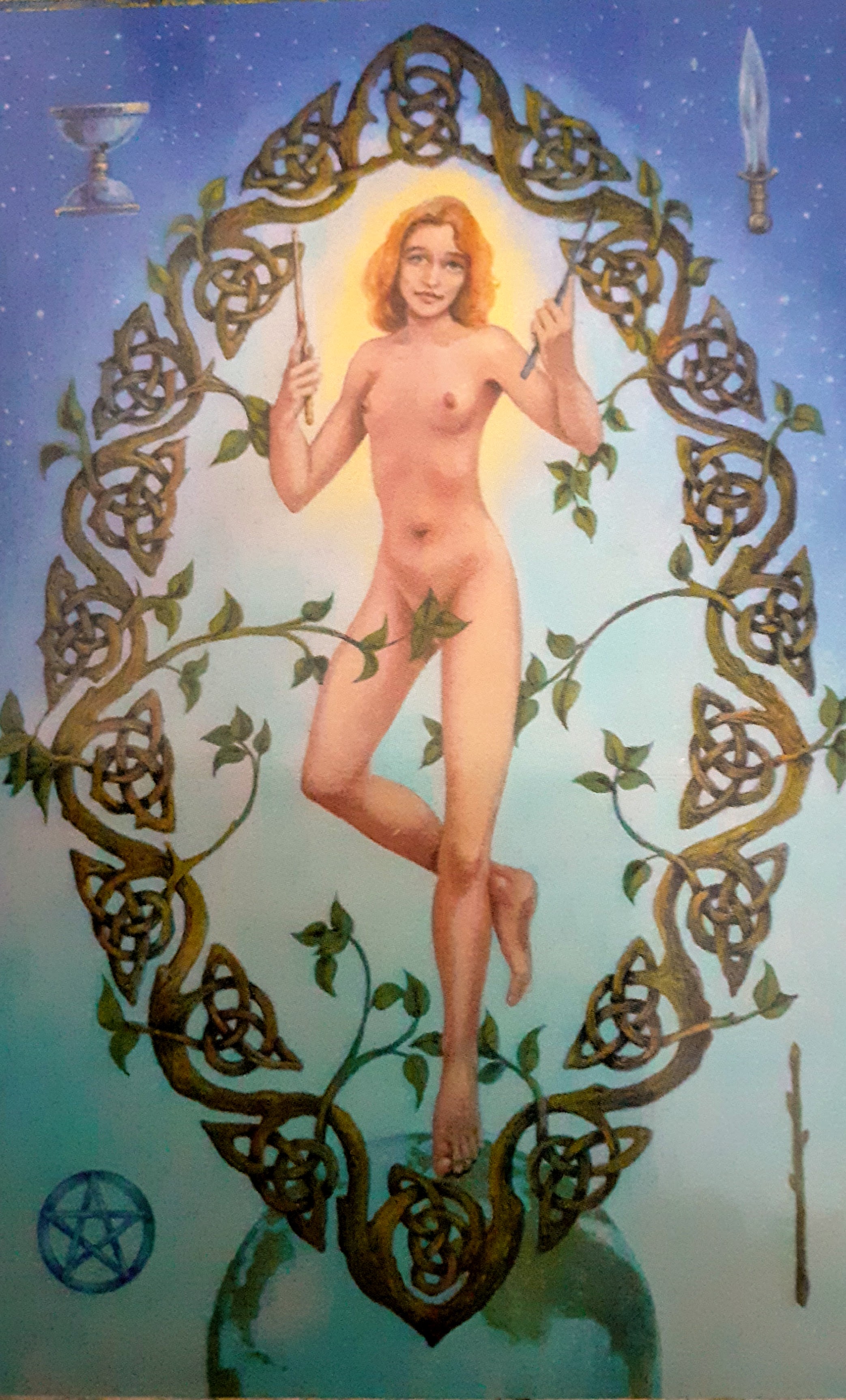
The picture above is the Fool, or innocent, as depicted the The Druidcraft Tarot (1). Trusting their inner knowing, the Fool steps over a cliff. It is a spring dawn, and a new beginning. The major Arcana are a map of the journey, which in essence, here, is seen as a refinement of the soul to the point where union with the divine is a lived experience. This experience is available here, in the world, and so the card indicating the completion of the journey (see picture below) is here called The World.

The mythology of the deck draws on the Welsh Celtic story of Taliesin and Ceridwen as well as the pan-European Arthurian grail quest, and broader Western Mysteries understandings derived from the Hermetic Order of the Golden Dawn. But any individual journey is its own new beginning and its fruits depend of making the journey in real time, and not clinging too tightly to traditional understandings.

In my own spiritual life, I have drawn both on the myth of the journey and another, apparently contradictory myth – that of the eternal moment, the transfigured here-and-now. Again, I find no disparagement in the word myth. This says that non-separation from the divine is a given. There is nowhere to go and nothing to do. Ultimately, there is no ontological difference in being awake to this reality than in being asleep to it. Yet lived experience is transformed by being awake to this reality and living from the awareness.

From a human perspective, coming to this awareness and then living it are, experientially, a journey in themselves. Another way of looking at it would be to say that I am the Fool and the Universe (my preferred term for the final card) at the same time, every day. In this way, I reconcile the myth of the journey with the myth of the now, and draw strength from both.

(1) Philip & Stephanie Carr-Gomm The Druidcraft Tarot: Using the Magic and Wicca and Druidry to Guide Your Life London, UK: Connections, 2004 (Illustrations by Will Worthington)

THE IMAGE AND THE SONG

“I am the Mabon. I am the child.

I am YR, the Golden Bough.

I am the dart that the yew lets fly

Three pure rays, the pillars of life.

I am the wren, the King of Birds.

I am the Bard and the teller of lies.

I am a song within the heart.

I am the light that will never die.

I am stars within the Void.

I am the eye of the Aeon.” (1)

For more than a decade, my spiritual practice has been mobilised around a contemplative inquiry. For me, this has been successful in its own terms, but I’m conscious now of something missing. It’s as if, for earnest, intelligent and ethical reasons, I have whitewashed the walls in the church of me. Now I want my murals back. So, recently I have started a course correction.

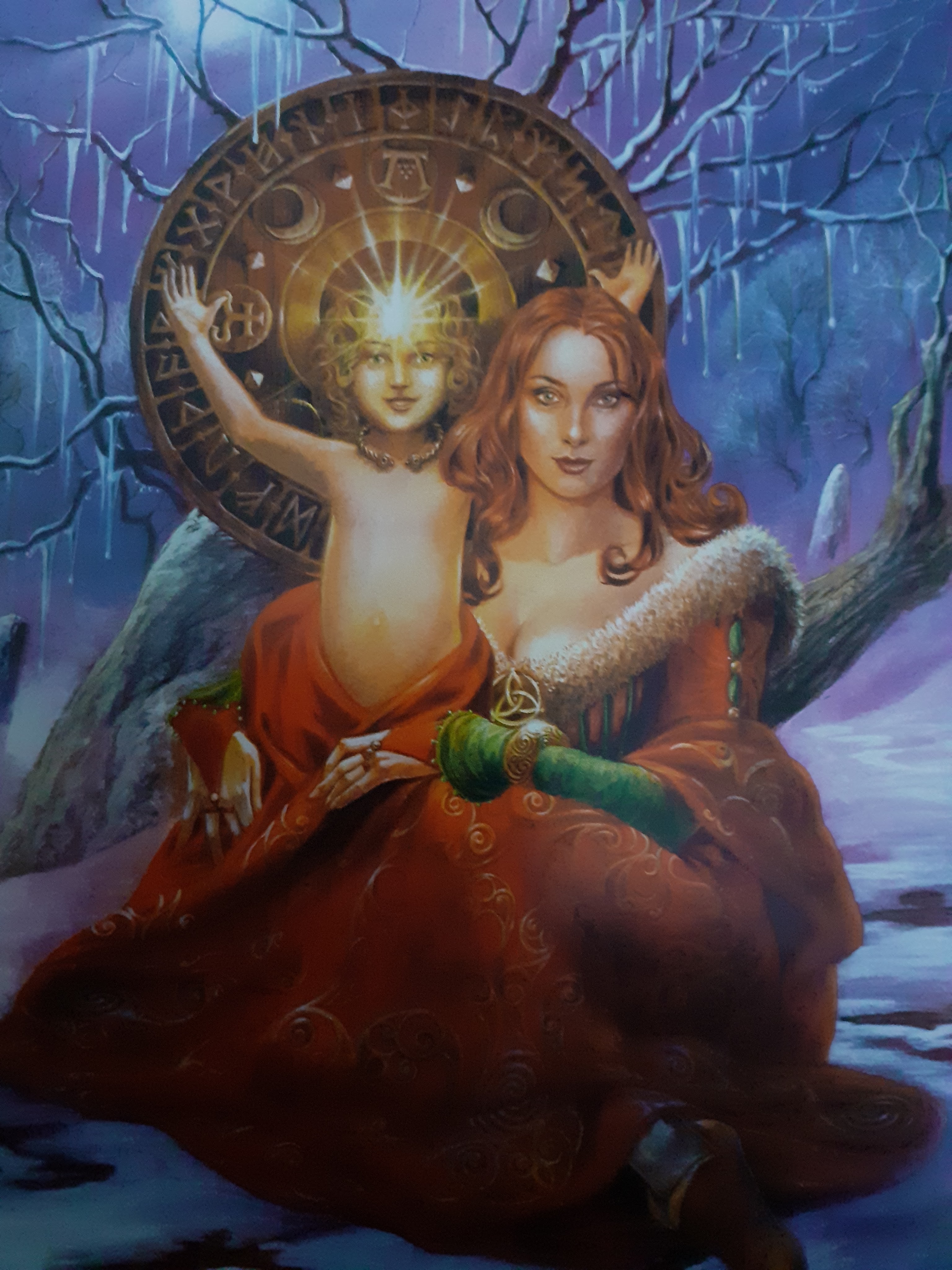
This course correction includes a glance back at my own pre-inquiry practices, happily well documented. The image of Modron and Mabon used to walk with me: Modron as the primal mother and Mabon as the primal child (2). They were archetypal figures, not everyday humans. My understanding was that these names were from a pre-Celtic language, retained in Brythonic speech. I am not sure if this is true, but for me it offered the possibility that even the surviving Celtic stories (3) were not the first. I was free to dream. In this dreaming I was powerfully influenced by the image at the top of this post (received as a midwinter holiday gift from my wife, then partner, Elaine, in 2007) and by the Silver on the Tree song that follows.

I see the child in the image as androgyne, and not in their earliest infancy. In the song, Mabon is not gendered. The mother in the picture is clearly the Goddess as Mother. Different stories can be drawn from this. In my own journey I tilt the child back somewhat to the masculine. In this pairing, She is Zoe, the life eternal. He is Bios, the life that comes and goes and comes again. Like Taliesin (4), transmuting out of his identity as Gwion, Mabon becomes in a sense his own father. So my midwinter picture appears to reference the Christmas story, but in important ways diverges from it. The image shows a magical midwinter child, who will indeed have an illuminating and transformational influence, but who is not exactly a redeemer in the Christian sense. This is drawn out in the Silver in the Tree song, which includes specifically Celtic references and extends beyond them.

Both Mother and Child live strongly within me, in the imaginal realm. I like and use the old language, Modron and Mabon, because of its sense of ancient mystery. But what it points to is universal. Part of my work now is to re-open my contact with them, who after another fashion I also am.

(1) Silver in the Tree in their 1991 album Eye of the Aeon

(2) NOTE: I am aware that there are divergent visions of Mabon. One centred the Autumn Equinox has become powerful and influential in recent years. Happily modern Druidry is not a religion of the Book though it is enriched by its books. This new literature follows the oral tradition practice of allowing stories to evolve and change in divergent directions. I see this as a strength.

(3) Caitlin Matthews Mabon and the Guardians of Celtic Britain: Hero Myths in the Mabinogion Rochester, VT: Inner Traditions, 2002 (Revised edition of Mabon and the Mysteries of Britain, 1987)

(4) If you visit Loch Maben in Dumfriesshire, in south west Scotland, you may find the feeling-tone similar to the much larger Lake Bala, strongly associated with Taliesin, in north Wales.

TALIESIN THE SHAPE SHIFTER

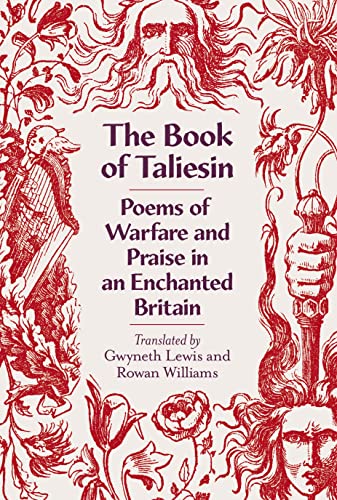
This is my third in a series of posts drawing on Gwyneth Lewis’ and Rowan Williams’ modern English version of The Book of Taliesin (1), an anthology of bardic poetry from medieval Wales. My first post introduced the book and offered extracts from A Song of the Wind (2). The second looked at the importance of ‘The Old North’ (territories in north-west England and southern Scotland that shared the same history, language and culture as the people of Wales) (3). This, final, post looks at the development of the Taliesin figure in the later middle ages. In particular, I focus on the anthology’s section entitled Legendary Poems and on the translators’ understandings of bardic poetry, shapeshifting and awen. I also look at their reasons for interpreting the Taliesin of these poems as “a kind of Christian shaman”.

In these poems, the use of shapeshifting language is presented as being a feature of competition between rival bards. “The Taliesin figure demonstrates his superiority … by spelling out at triumphant length the questions he can answer about which his rivals are ignorant, and by listing the various embodiments he has experienced”. The translators give an example of this in the opening of The Battle of the Trees.

“I was in many forms

Before my release:

I was a slim enchanted sword,

I believe in its play.

I was a drop in air,

The sparkling of stars,

A word inscribed,

A book in a priest’s hands,

A lantern shining

For a year and a half.

A bridge in crossing

Over threescore abers (= estuaries).

I was path, I was eagle,

I was a coracle at sea.

I was bubbles in beer,

I was a raindrop in a shower.

I was a sword in the hand;

I was a shield in battle.

I was a harp string,

Enchanted nine years

In water, foaming.

I was tinder in fire,

I was a forest ablaze”.

The editors comment: “these extraordinary poems reflect a sophisticated and complex understanding of poetic composition in which the concept of awen is central. It would be misleading to translate this idea of inspiration as ‘Muse’: it is better thought of as a state of altered consciousness in which the poet receives knowledge of matters beyond what can routinely be learned. According to Gerald of Wales’ description of the awenyddion, or inspired soothsayers, of the 12th century CE, the gift of awen produces the same kinds of extreme behaviour as are associated with spirit possession: loud shouting, trance and catalepsy, disconnected but also very elaborate speech, narrated experiences of supernatural encounters which trigger the exercise of this gift, and a subsequent inability to remember what was said under its influence”.

Poems like The Battle of the Trees may be “an attempt to reflect the style or register of such ecstatic states of consciousness”. However, the poems themselves may not be “transcriptions of specific compositions originating in altered states”. In cultures that have a “routine ritual space” for “ecstatic phenomena”, the irruption of the supernatural will follow a familiar pattern. “There will be expectations about both the actual expression and the transmission of what has been delivered”. If poetry is to be recognised as the authentic voice of ecstatic perception, “it must follow certain classical, normative exemplars of poetic ecstasy”. The Taliesin of these poems is a composite figure modelling how to speak as an awenydd. He demonstrates a particular way of being a poet and sounding like a poet of this kind.

Religious tensions appear in The Spoils of Annwfn. The bard rails against the ignorance of monks.

“And the monks herd together, a pack of dogs,

In the contest with those

Who have mastered the lore –

Whether wind takes one path,

Whether the sea is one water,

Whether fire’s unstoppable force is one spark.

The monks herd together, a pack of wolves,

In the contest with those who have mastered the lore –

They don’t know how darkness is severed from light,

They don’t know the course of the wind in its rushing,

Where the wind will lay waste, what land it strikes,

How many saints in the sky’s vault, and how many shrines.

I will praise the Prince, the Lord, the Great One.

Let me not be sad: Christ will repay me.”

The translators point out that the shapeshifter Taliesin of the 12th century CE, is “multifaceted” compared to the court bard of the 6th-9th centuries. The later literature links Taliesin “especially with stories involving the figure of the sorcerer Gwydion and the ‘children of Don'”. His status as dewin (sage or sorcerer) or occasionally derwyd (druid) is “so equal in importance to his standing as a poet that the two might more accurately be said to become inseparable”. But he is also shown, as in the extract above, dutifully commending his work to God and as “being familiar with theological questions, most notably those relating to the Incarnation, and with apocryphal traditions surrounding the biblical narratives”.

Lewis and Williams conclude that “this later Taliesin becomes a bridge figure between traditional Welsh lore and the cosmopolitan world of early medieval ecclesiastical learning”. The extract above reflects “a resentment of the new monastic foundations after the Norman Conquest, the Benedictine houses that sprang up in proximity to the new castles and settlements in the Welsh Marches (English/Welsh border counties). Monks from continental Europe are unlikely by this date to have been familiar with or sympathetic to the rather older style of clerical learning represented by the riddling and legendary elaborations of the Christian story found in the Irish or Anglo-Saxon texts of the early Middle Ages; Taliesin thus becomes a mouthpiece for this archaic Christian lore as well as the archetypal bard and seer”. This is why the translators characterise Taliesin in his shape-shifting period as a “Christian shaman”.

(1) Gwyneth Lewis and Rowan Williams The Book of Taliesin: Poems of Warfare and Praise in an Enchanted Britain Penguin Random House UK, 2020 (First published in hardback in Penguin Classics and 2019) Gwyneth Lewis was National Poet in Wales, 2005-6 and teaches at Middlebury College Vermont. Rowan Williams is a former Archbishop of Canterbury, subsequently Master of Magdalene College, Cambridge.

(2) https://contemplativeinquiry.blog/2023/08/07/

(3) https://contemplativeinquiry.blog/2023/08/10/

‘THE OLD NORTH’ IN THE BOOK OF TALIESIN

This is my second post about The Book of Taliesin: Poems of Warfare and Praise in an Enchanted Britain (1). The previous one introduced the book and included extracts from the poem A Song of the Wind. I am not qualified to judge the work of the translators Gwyneth Lewis and Rowan Williams. All I can say is that I find their their modern English version highly readable. I am also grateful for its detailed introduction, which has prompted me to write further posts drawing on it. This one shines a light on the ‘Old North’ (Hen Ogledd), a key location for this bardic tradition, and on poetry referencing the ‘heroic age’ of the 6th century CE (100 – 200 years after the Romans withdrew from Britain).

Llyvyr Taliessin is a 14th century manuscript bringing together “compositions ranging in date from the 9th century CE – possibly even the 6th – to the 13th century CE”. As such “it brings vividly into focus the history and culture of more than one unfamiliar world. It gathers together the kind of songs that might have been sung in the Northern British courts of the 6th century with the poems of Taliesin’s various anonymous successors in an ongoing bardic tradition, which transformed him into a North Welsh prophet, a kind of Christian shaman, and, eventually, an honorary laureate of Llewelyn the Great, the first medieval ruler to control practically the whole of an independent Wales” (1).

The oldest group of poems in the anthology, here grouped together as Heroic Poems, is linked to a Taliesin mentioned in chronicles of the early middle ages, a court bard of the 6th century ‘heroic age’. Here we find an “individual writer who appears in the chronicles and other early texts … celebrating the material and military exploits of a number of patrons, and enjoying the rich rewards of his work.” He is named in the early 9th century History of the Britons, composed in North Wales but showing considerable retrospective interest in in the struggles of various British rulers, some apparently from Cumbria and the Pennine regions, against the Angles of the territories that would by the later 7th century become the Kingdom of Northumbria.

The History of the Britons includes a list of five notable Bards said to have worked in that earlier period. These are Taliesin; Talhaearn, called ‘father of awen; Neirin (aka Aneirin); Blwchfardd; and Cian Guenith Guaut (Cian, wheat-harvest of song). Neirin is credited with the authorship of the Gododdin which laments the failure of a British King from Edinburgh, in or around the last decade of the 6th century, to defend or recapture territories from Northumbria. Taliesin is briefly mentioned in this poem as a contemporary. He is identified primarily as the court bard of King Urien of Rheged. Rheged was (probably, at least at times) an extensive territory including much of what is now north-west England and south-west Scotland. This Taliesin was concerned with warfare and praise rather than with enchantment.

The map below shows the heartlands of the culture that birthed this literature. Its northern border runs from modern Edinburgh to Dumbarton, along the Roman Antonine Wall. The people who lived between the two walls (Antonine in the north; Hadrian’s in the south) were not generally part of the Roman Empire but they were influenced by it. They identified as Britons, not Picts, who lived to the north of both walls and had always kept their independence. On the map everything to the east of the dotted line belongs to the Anglo-Saxons. The Britons hold the west, as far as the Mor Hafren/Bristol Channel. What isn’t shown on the map is the south-west peninsula, also mostly British at this time, but cut off by the fall of three crucial towns – Gloucester, Cirencester and Bath. The people who the West Saxons named as the West Welsh, and who remember their old identity in Cornwall to this day, seem to have no role in the literature that uses the name of Taliesin. Even within Wales, this literature has a northern orientation.

The role of court bard could be materially rewarding, as this extract from the poem Here At My Rest:

“Here at my rest

With the men of Rheged

Respect and welcome

And mead for me!

Mead for me

To mark his triumph,

Gifts of fine land

To win me wealth,

Wealth in plenty

Of glittering gold,

Golden good times

And high esteem.”

This is not just a personal boast. One way to make a patron look good was by pointing to his generosity. But the best way to show Urien to advantage was to describe his prowess as a warrior and war leader, as in the poem All Through One Year:

“Son, go to the door.

Listen to the noise.

What’s the commotion?

Is the earth shaking?

The sea rushing in?

Approaching, a tide

Of foot soldiers cry:

‘Foe on the hill,

Urien kills.

Foe in the vale,

Urien impales.

Foe on the mountain,

Urien smites him.

Foe on the slope,

Urien will slice him.

Foe on the ditch,

Urien will fright him.'”

Each of the poems extracted above has the same ending:

When I’m old, out breath,

Commanded by death,

I will feel delight

Praising Urien aright.”

This is formulaic completion of work in a very formal genre, though I find this translation fluid and lively. I have no idea of what it was like to be the person who wrote it, or even his real opinion of Urien. But that is not the point of these poems. The Brythonic Old North was situated within a world of warrior aristocracies and their ‘heroic’ values, in which the Britons were relentlessly harried by Angles, Saxons, Picts, Gaels and, to an extent, each other. In the context of time and place, the propagandist role of the court bards, and its importance to their warrior patrons, is very clear. What intrigues me more is the later transformation, where Taliesin morphs into the mythic shape-shifting figure described by Rowan Williams as a ‘Christian shaman’. I will write about this in a later post.

(1) Gwyneth Lewis and Rowan Williams The Book of Taliesin: Poems of Warfare and Praise in an Enchanted Britain Penguin Random House UK, 2020 (First published in hardback Penguin Classics in 2019)

For the two other posts about this translation, see: https://contemplativeinquiry.blog/2023/08/07 and:

https://contemplativeinquiry.blog/2023/08/12

THE BOOK OF TALIESIN: A SONG OF THE WIND

The Book of Taliesin: Poems of Warfare and Praise in an Enchanted Britain (1) is a modern English translation, first published in 2019, of the medieval Welsh collection brought together under the name The Book of Taliesin. It is translated and introduced by Gwyneth Lewis, National Poet of Wales 2005-6, who teaches at Middlebury College in Vermont, and Rowan Williams, formerly Archbishop of Canterbury and later Master of Magdalene College, Cambridge. Both are native Welsh speakers. I highly recommend this version to anyone who wants a translation tailored to a 21st century readership, and to improve their knowledge of the history and culture from which these poems spring.

The Song of the Wind, from which I present extracts, is an example of the Dyfalu (guessing) mode: the poet creates a sequence of riddles, metaphors and fanciful tropes in order to describe an object. When – as here – the answer is given by the title, the result is a performance of inventive paraphrase, designed to display the poet’s virtuosity. The evocation of the wind is connected to the part of Taliesin’s story in which Elffin, his patron, is imprisoned by Maelgwn Gwynedd in Deganwy Castle. Taleisin’s poetry conjures up a gale that demolishes the castle and frees Elffin. Evidently a capable bard could do that, back in the day.

“Guess who it is:

Made before the Flood,

A mighty creature,

No flesh, no bone,

No veins, no blood,

No head and no feet.

No older, no younger

Than he was before.

He’s not turned aside

By fear, nor by death.

He doesn’t experience

The needs of creatures.

…..

“He’s in fields, in woods,

With no hand, no foot;

Feels no age, isn’t struck

By pain or bad luck.

“And he wasn’t born,

So he can’t be seen.

He’s at sea and on land;

He’s unseeing and unseen.

“He’s brave, he’s bold

As he crosses the land.

He’s mute, he’s loud.

He’s full of sorrow,

He’s the noisiest one

On the face of the earth.

“He’s evil, he’s good,

He’s here, he’s there,

Creates a mess,

Makes no redress.

He makes no amends,

Because he’s blameless.

He’s wet, he’s dry;

He often comes by.”

(1) Gwyneth Lewis and Rowan Williams The Book of Taliesin: Poems of Warfare and Praise in an Enchanted Britain Penguin Random House UK, 2020 (First published in hardback Penguin Classics in 2019)

For the two other posts about this translation please see: https://contemplativeinquiry.blog/2023/08/10 and:

https://contemplativeinquiry.blog/2023/08/12

FINDING LOST GODS IN WALES

Professor Ronald Hutton’s fifth lecture in the Gresham College series on early Pagan history in Britain (1) is called Finding Lost Gods in Wales. Hutton’s main focus is on medieval Welsh literature. The language used is a 5th/6th century CE mutation of the Brythonic speech once used throughout Britain, further developed for literary purposes by court bards in the 6/7th century. Hutton describes it as “made for poetry” because of the concentration of meaning in the words. He gives as an example in a literal English translation:

‘Colour light waves spread boiling billows

‘Flood-tide river mouth on sea where nothing waits.’

He contrasts this with an English translation for English ears, demanding more words whilst sacrificing impact and immediacy.

‘Bright as the light that falls on the waves, where the boiling billows spread

That flashes a moment from the meeting of river flood and sea.’

This language was the public voice of a consciously dispossessed people, creating a new sense of Welsh Celtic nationhood in the 9th and 10th centuries, when the English, Scottish Gaels and Vikings had reduced their territory to less that 10% of Britain. It led to a flowering of Bardic culture throughout the medieval period.

Taliesin was celebrated as Wales’ greatest Bard. There is no certainty that he existed, though poems surviving from the 6th century have been attributed to him. There are no recorded statements of his pre-eminence before the 10th century. Later poets inspired by him continued to write in his name for a further 300 years. His link with Awen as the source of inspiration reveals the mystical roots of the whole Bardic tradition. But for instances or echoes of specifically Pagan motifs we are largely reliant on a small group of texts from the 11th -13th centuries: The Black Book of Carmarthen, The White Book of Rhydderch, the Red Book of Hergest, the Book of Taliesin and the Mabinogion, a collection of prose stories. (The full prose Hanes Taliesin is from a much later date.)

In contrast to Irish medieval literature, we do not find Goddesses, Gods or explicitly Pagan characters in these Welsh texts, even in the four branches of the Mabinogi, though these do seem to be set in Pagan times. Several characters have superhuman abilities, without being presented as Gods. However, we do have Annwn, an otherworldly realm of human-like beings who interact with ordinary humans. We also find shape-shifting abilities – people change into animal forms and back again; humans change their appearance; objects change their form.

There is certainly magic and magical poetry, as in the Preiddeu Annwn (The Lute of the Otherworld). This poem, though hostile to monks and their pretensions to scholarship, is overtly Christian. According to Hutton, poems of this kind delight in being difficult, allusive and packed with metaphor, references and wordplay. No one now can say with any certainty what they were originally intended to mean. But this, suggests Hutton, is a gift and invitation to the poets, story tellers and artists of later generations including our own.

On the specific question of deity, Hutton discusses Rhiannon, Cerridwen, Gwyn ap Nudd, and Arianrhod. None is described in this literature as divine and, according to Hutton, we do not find them in that role in Celtic antiquity.

Rhiannon is superhuman and comes from an enchanted world to find a husband of her own choosing. She stays the course despite horrible experiences. She has been thought of as a horse goddess, but this is not suggested in the Mabinogion and there is no indication of a horse Goddess in the archaeology of Iron Age Britain or in Romano-British inscriptions. She has also been seen as a Goddess of Sovereignty, but she does not confer sovereignty on either of her husbands, and there is no record of any sovereignty Goddess in Europe outside Ireland.

Cerridwen begins as a mother skilled in sorcery trying to empower her son but actually empowering a lowly servant boy instead. By the 13th century she has, through her association with Awen, become the muse of the Bards, giver of power and the laws of poetry. In 1809 the scholar Edward Davies made her the great Goddess of ancient Britain and many people have Iolo seen her in that light ever since.

In 11th and 12th century texts Gwyn ap Nudd was one of King Arthur’s warriors, imbued with a degree of magic power. By the 14th century, poets are making him a mighty power of darkness, enchantment and deception. In the 1880’s the scholar Sir John Rhys made him the Celtic God of the dead and leader of the Wild Hunt. This is largely how he is seen today.

In the fourth branch of the Mabinogi, Arianrhod is a powerful, beautiful and selfish enchantress with the capacity to make unbreakable curses. By the 13th and 14th centuries her magical powers are much increased. She can cast a rainbow about a court, and the Corona Borealis is called the Fortress or Arianrhod. In the 20th century she began to be seen as a Star Goddess.

Professor Hutton’s lecture includes a discussion of the Welsh Bardic revival at the end of the eighteenth century, inspired largely by Iolo Morgannwg, here presented as a mixed blessing given his willingness to forge ‘ancient’ documents to advance his cause. Hutton ends with a section on the legend placing Glastonbury as the site of King Arthur’s final refuge and eventual burial, and also the place in which the Holy Grail was buried. Both of these were concocted by the later medieval monks of Glastonbury Abbey as a potential source of patronage and a pilgrimage income. At the same time, post holes linked to a neolithic structure have recently been found near Chalice Well – which may well be a numinous site of great antiquity. Artefacts have also been recently found in the area, including the Abbey itself, from the early post-Roman period in which Arthur’s career has been set. We weave our stories from a mixture of fact, fiction, speculation and deep intuition. Being conscious of this circumstance may make them all the richer.

(1) https://www.youtube.com/watch?v=NTmIEE91D-k

See also: https://contemplativeinquiry.blog/2021/03/26/ for my review of Cerridwen Celtic Goddess of Inspiration by Kristoffer Hughes as an in-depth account of the Goddess and her evolution. He also discusses the Welsh Bardic tradition and the later work of Iolo Morgannwg

IOLO MORGANWG: 3 RAYS OF AWEN

According to Kristoffer Hughes, the three ray symbol for Awen, as it appears today: “is mostly inspired by the efforts of one individual, a Welsh bard of the late eighteenth and early nineteenth centuries called Edward Williams, who took the bardic name of Iolo Morganwg*”.

Hughes goes on to tell us something of Iolo’s story: “I touch briefly on the Awen-filled story of this remarkable individual, for it sings loudly of the power of Awen to transform, not just an individual, but the future. His symbol for the Awen has become directly associated in Neopaganism with Cerridwen, making an exploration of his influence a valuable exercise in our understanding of Awen in the modern world.

“Iolo Morganwg was a stonemason from South Wales, an imaginative, poetic genius who made elaborate claims of ancient documents and wisdom that he had discovered and preserved for the world to see. Blighted by ill health, he was addicted to the narcotic laudanum for over fifty years of his life, spending most of his days in a drug-induced state, and yet poems in their thousands fell from his frenzied mind onto scraps of parchment. He composed elaborate poetry, inspired prose, but falsely claimed that some of the poems were written by ancient bards. … And yet through all of the accusations of forgery and deception, Iolo dreamed something into being that those in the different streams of Celtic spirituality today, both monotheistic and polytheistic, are descendants of. He dreamed a new mythology into being and planted seeds that would gestate a profound wisdom in the future.

“In a time of great social crisis, he dreamed an identity for the Welsh that took as its foundation that the bardic tradition of Wales was a direct line to the ancient Druids of Britain, who he perceived as the true ancestors of the Welsh. He longed for his people to connect to the might and power that the Romantic movement imagined the Druids to express. And, in doing so, he deliciously imagined a new identity that the Welsh could be proud of: he blended fact with fiction, legend with history, myth with reality. His bewildering array of notes and journals continue to baffle modern academics who strive to make sense of this enigmatic figure.”

Reflecting on Iolo’s story, Hughes concludes that, “in a profoundly logocentric world where new thoughts and ideas were expected to be substantiated by manuscripts, Iolo simply invented a past that we, as the Welsh, could be proud of . … He carried the seeds of Awen and profoundly influenced a future he could not have imagined. In the twenty-first century, those drawn to the Cerridwen and Taliesenic mysteries (2) who may artistically express, understand, or wear the symbol of the Awen all carry the dream of Iolo Morganwg. He is testament to the Awen’s consistent stream and how it too changed its countenance to meet the needs of different people at different times. The period he occupied was a cauldron of new ideas, with the new era of bardic tradition in its infancy and occult fascination among the learned of the time increasing in popularity”.

(1) Kristoffer Hughes Cerridwen: Celtic Goddess of Inspiration Woodbury, MN: Llewellyn Publications, 2021. See also my review at: https://contemplativeinquiry.blog/2021/03/26/book-review-cerridwen-celtic-goddess-of-inspiration/

(2) See also: John Matthews Taliesin: Shamanism and the Bardic Mysteries in Britain and Ireland London: Aquarian Press, 1991. It includes a complete English translation of the Hanes Taliesin (Story of Taliesin) and English translations of the major poems of Taliesin Pen Beirdd from The Book of Taliesin as well as other medieval Welsh and Irish material. In the Taliesin story, the three rays of Awen become three drops from the brew in Cerridwen’s cauldron).

*NOTE: Iolo Morganwg (=Ned of Glamorgan, his native county). In his own words, the Awen sign /|\ is “a symbol of God’s name from the beginning”. He goes on to say: “from the quality of this symbol proceed every form and sign of voice, and sound, and name, and condition”. It is when God pronounced his Name that “all the universe leapt together into existence of life, with the triumph of a song of joy. The same song was the first poem that was ever heard, and the sound of the song travelled as far as God and His existence are, and the way in which every other existence, springing in unity with Him, has travelled for ever and ever. And it sprang from inopportune nothing; that is to say, so sweetly and melodiously did God declare his name, that life vibrated through all existence, and through every existing materiality”. J. William Ab Ithel (editor) The Bardas of Iolo Morganwg: A Collection of Original Documents, Illustrative of the Theology, Wisdom, and Usages of the Bardo-Druidic System of the Isle of Britain Forgotten Books, 2007 http://www.forgottenbooks.org (First published 1862, from notes and journals left by Iolo on his death at 79 years of age in 1826).

BOOK REVIEW: CERRIDWEN CELTIC GODDESS OF INSPIRATION

Highly recommended. Cerridwen: Celtic Goddess of Inspiration (1) is by Kristoffer Hughes, Chief of the Anglesey Druid Order (2) and a prominent figure in modern Druidry and Paganism. His aim in this book is to “provide you an in-depth exploration of Cerridwen, where she came from, the landscape and peoples that perpetuated her, and who she is today”.

Hughes, born in Anglesey and a first language Welsh speaker. is a scholar and practitioner of his inherited tradition. He has also embraced Druidry as an international movement within modern Paganism. He is at ease, too, with the Cerridwen of modern witchcraft. His whole stance is one of cultural generosity and active support for “appropriate appropriation”.

In its quest for Cerridwen, the book combines close reading of Bardic texts dated from the post-Roman period to early modernity; personal sharing of Hughes’ own path; and opportunities for experiential work. Like many people, my introduction to Cerridwen was through Charlotte Guest’s English version of the late-appearing Hanes Taliesin (Hughes provides his own version early in the book). This shows Cerridwen as a noblewoman skilled in the magical arts, not a Goddess. Like many people, I assumed that this was a demotion going back to the Roman period or the coming of Christianity. Hughes does not share this view. He cannot find Cerridwen among the goddesses of Celtic antiquity, but he welcomes her recent apotheosis within neo-Paganism and witchcraft. He is a devotee himself, and writes: “the New Age traditions, whilst inspired by the distant times, do not need or require to be authenticated by the past; it is a living, breathing spirituality … if it works, keep doing it, and the more you do it, the more life you breath into it”.

Hughes sketches out Cerridwen’s history in the early written material. Sometimes her presence is only implicit – glimpsed, perhaps, as the Annuvian sow (hwch) who guides the magician Gwydion to the base of the world tree in the fourth branch of the Mabinogion. Sometimes we find her lauded and identified as the Mam yr Awen (mother of the Awen). Later, after Wales’ loss of independence and the decay of the Bardic tradition, we find her stigmatised as an evil hag with her connection to Awen erased. But when we come to the Hanes Taliesin, her connection to Awen, and to the initiation of Taliesin (radiant brow) is plain and clear. Her best time is now, though her modern strength lies largely outside her country of origin.

For Hughes, Cerridwen (pronounced Ker ID ven) is a goddess “of angular, bending magic”, and her cauldron is “a vessel of inspiration, a transformative device, a vessel of testing”. This Cerridwen is “the divine conduit of transformative, creative, magical inspiration gleaned from the cauldron of Awen”. Awen itself is “the creative, transformative force of divine inspiration that sings in praise of itself; it is the eternal song that sings all things into existence, and all things call to Awen inwardly”. Gwion, who tastes the three drops distilled from the cauldron in Hanes Taliesin, after a series of further trials becomes Taliesin, “the outward expression of the power, magic and action of the Awen”, indicated by his radiant brow. The final section of the book, Stirring the Cauldron: Ritual and Practise, offers readers a chance to meet Cerridwen and work with her Bardic mysteries themselves.

As issues relevant to Cerridwen and what she stands for, the book looks at the meaning of annwfn and its denizens the andedion. ‘Underworld’ and ‘Otherworld’ are not quite accurate as descriptors, and the andedion, though different from us, are not best thought of as ‘supernatural’. Hughes also explains that medieval Wales, except to a limited extent in the border counties, did not share in the English and continental persecution of witches. Swyngyfaredd (enchantment/sorcery/magic) was part of life and its practitioners respected. This changed only with the early modern Anglicisation of culture. Hughes also includes a chapter on Iolo Morganwyg (Edward Williams, 1747-1826) and his ‘awen-filled legacy’. It was he who invented the awen symbol /|\ and much else in modern Druid and Bardic culture. He is often remembered as a literary forger because he presented his contributions as a rediscovery of lost texts. They nonetheless revitalised a dying culture at a time when sensibilities were changing again, and becoming more receptive to the value of old traditions.

With all these riches, Cerridwen: Celtic Goddess of Inspiration is a must-read for anyone with a serious interest in modern Druidry.

(1) Kristoffer Hughes Cerridwen: Celtic Goddess of Inspiration Woodbury, MN: Llewellyn Publications, 2021

(2) http://www.angleseydruidorder.co.uk/

THE SACRED HEAD OF BLADUD

The historic city of Bath is about thirty miles from where I live and – from another direction – thirty miles from where I was born. It has always been part of my psychogeography. This post concerns both its ‘historical’ and ‘legendary’ past.

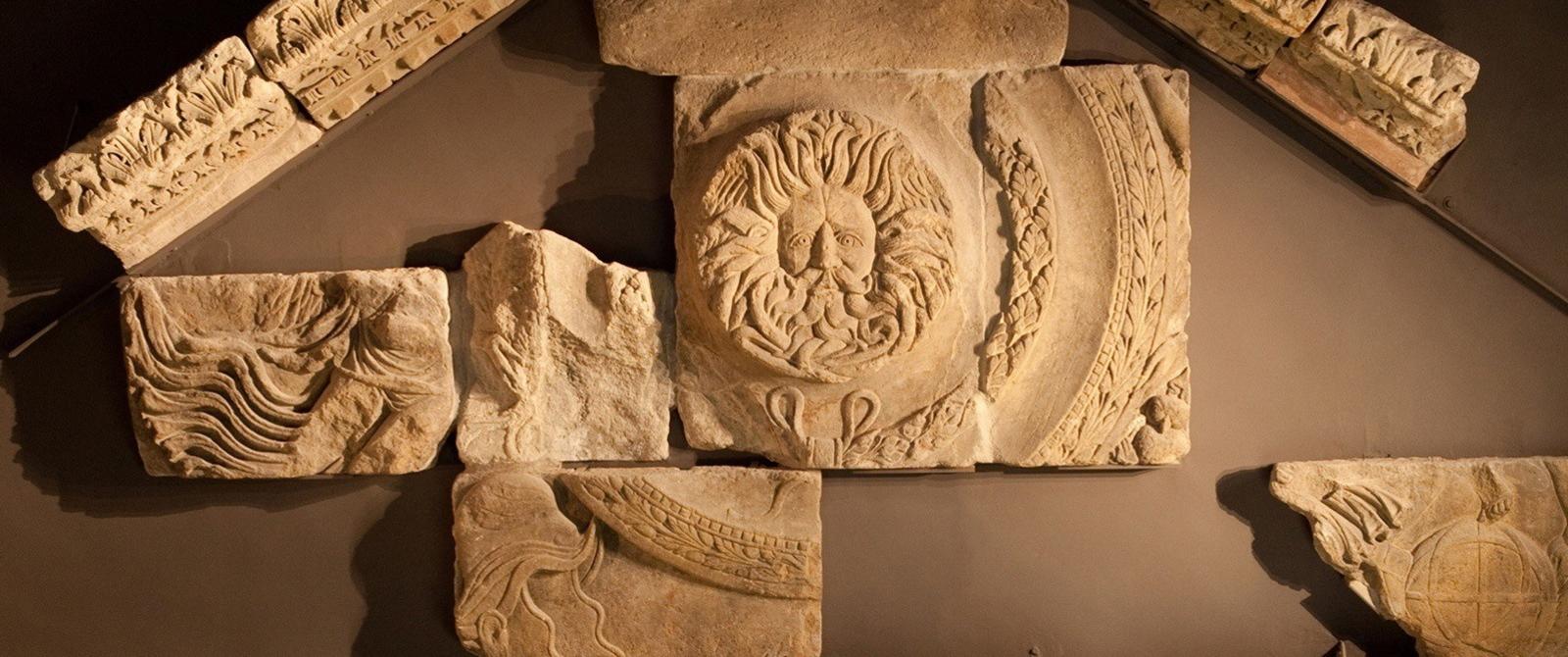
“A satisfying connection between modern archaeology, ancient legend, sacred kingship and Celtic religion is found at Aquae Sulis, the Roman name for Bath, England. In his legendary Historia Regum Britanniae [History of the Kings of Britain] (1) Geoffrey of Monmouth reports that King Bladud, grandfather of Bran and Branwen, founded the site and taught the druidic arts of ancestor magic and flight, eventually crashing to his death on the site of what is now London (the name Bladud means ‘light-dark’ or ‘bright-shadow’). In his Vita Merlini [Life of Merlin] (2), Geoffrey of Monmouth has Bladud and his consort Aleron (‘wings’) presiding over the hot springs of Bath, which are at the centre of the Bardic universe described by Taliesin to Merlin, forming the gateway to the Otherworld.

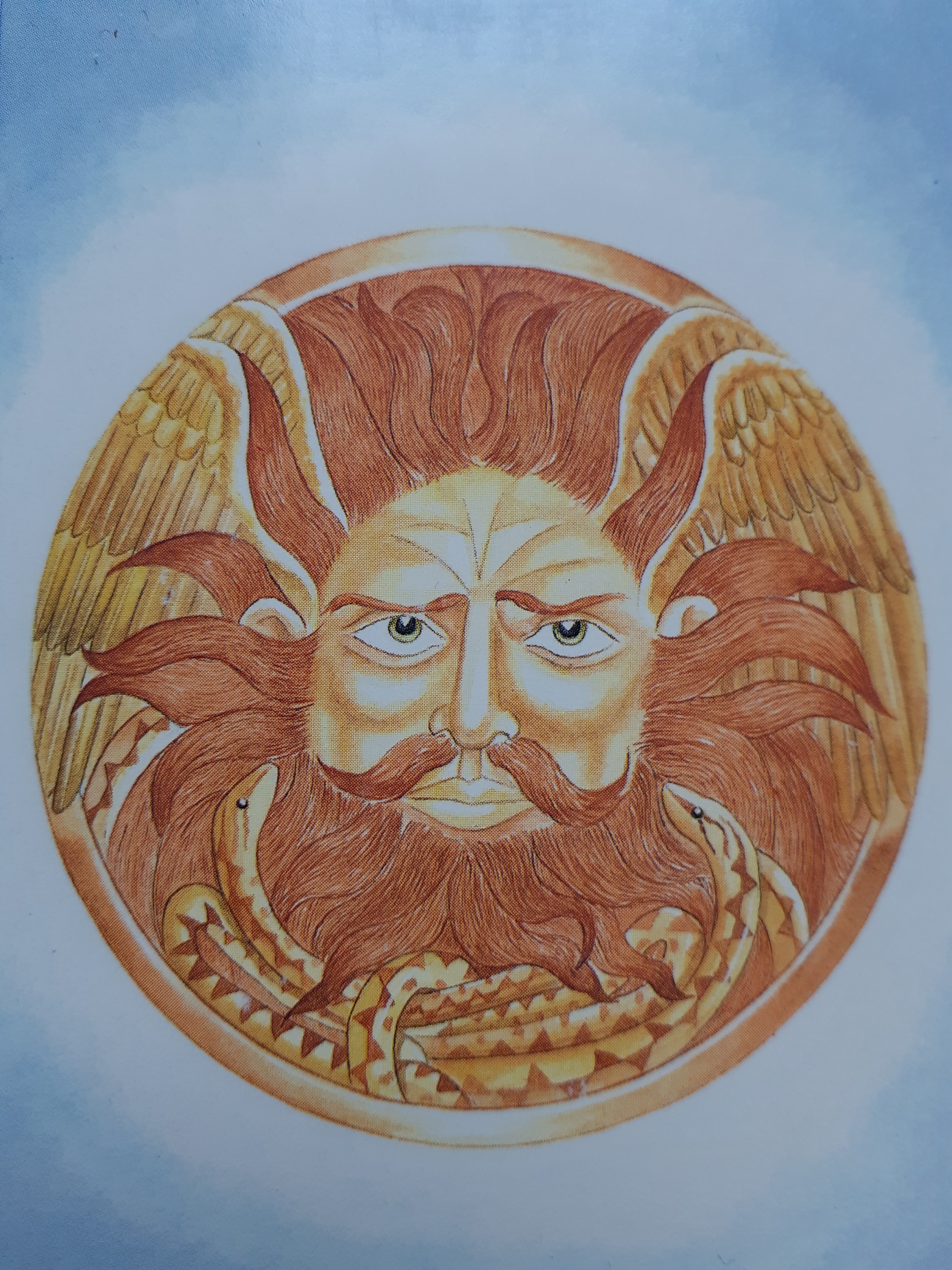
On show in the museum at Bath is a superb Celtic solar head (often inaccurately called a Gorgon’s head). The carving is a circular relief of an imposing male face with wild hair, long moustaches and staring eyes. He has wings on either side of his head and is surrounded by flames. Beneath his chin are two serpents, linked in the manner of a torque, the Celtic symbol of royalty. This solar deity is probably the being called Bladud in the legendary histories, connected to magic, flight and a fall from the heights to the depths. He has upon his brow the mark of the three rays, which are very often described as the primal three powers of universal creation.

The goddess at Bath, presiding over the sacred hot springs, was called Sul or Sulis, which means ‘eye’ or ‘gap’ (with a sexual connotation), for she is a variant of Ceridwen, the goddess of the Underworld. The entire Celtic/Roman complex of Aquae Sulis is an excellent example of ancestral Underworld magic refined by Roman politics into a temple of Minerva.

“The sacred or prophetic head is an embodiment of the relationship between the three worlds, for it is aware in all worlds, through all time. While we may have ideas that an anthropologist would suggest originated in primitive head-hunting magic, the theme of the sacred head becomes an allegory of divine and human perception and declaration.

“There is a further element to the sacred-head theme, for it is also interlinked with beliefs and practices concerning the regeneration of life, particularly with the cauldron. Titanic figures such as Bran, acting as sacred kings and guardians of the land, also partake of the mystery of the sun at midnight, light regenerating out of darkness. And this, after all, is the secret of inspiration, a sudden light born out of fruitful darkness.”

R. J. Stewart and Robin Williamson Celtic Bards, Celtic Druids London: Blandford, 1996

(1) Geoffrey of Monmouth History of the Kings of Britain London: Penguin, 1966 (Translated with an introduction by Lewis Thorpe)

(2) Mark Walker Geoffrey of Monmouth’s Life of Merlin: A New Verse Translation Stroud: Amberley, 2011

NOTE: the first illustration is from R. J. Stewart The Merlin Tarot London: Element, 2003 , illustrated by Miranda Grey. The Bladud image is on the reverse of each card, implicitly re-ascribed to Merlin as embodying the same archetype in a different way. The second illustration can be found on http://www.romanbaths.co.uk – click on discover and then walkthrough.

JOHN COWPER POWYS: PORIUS AND TALIESIN

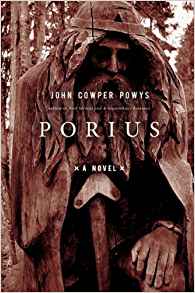
Porius (1) is John Cowper Powys’ last novel. It took him seven years to write, and he completed it in 1949, when he was 77. It is set in the year 499 CE, in North Wales. Porius is a Romano-British prince. Arthur, a suspect foreigner to most local people, reigns as Emperor. Rome is ruled by Goths, but links are maintained with Constantinople. The Saxons are an existential threat. People have to find a way of dealing with the situation in which they find themselves. But the book is at least as much about the inner lives of the characters as it is about the action they take.

Powys thought of Porius as his masterpiece. His publishers did not agree and insisted that he cut it by a third, which he did over two agonising years. Fortunately, a complete edition is available now thanks to modern editors Judith Bond and Morine Krissdottir. In her foreword Krissdottir says, “I am always reminded when I read the novel of these lines: ‘we are always in error, lost in the wood, standing in chaos, the original mess, creating a brand-new world’. Powys was as gloriously lost by the time he had written Porius as the reader sometimes is … but he was still the superb craftsman, who knew that it was the story itself that had the power to shape the forest within and without, that had the power to create a brand-new world”.

Instead of writing a review, I want to focus on one character, Taliesin, and what Powys has to say through him about the creative life. Powys has a number of point of view characters, with a variety of stances. He seems to give them equal air-time, making Porius a genuinely multi-vocal novel. Taliesin is portrayed as a young, mercurial bard, popular thanks to outstanding skill in cooking as well as poetry. (The cover illustration above is of Merlin – old, saturnine, more central to the book as a whole). Powys builds Taliesin’s bardic character, and the idiosyncratic working of his awen, with care.

“Taliesin had indeed worked out for himself, quite apart from his power of expressing it in such assonances and alliterations as had never been heard before, a really startling philosophy of his own. This philosophy depended on a particular and special use of sensation; and its secret had the power of rendering all matter sacred and pleasure giving to the individual soul. And it had the power … of fusing the immense past with the immeasurable future and of doing this, moreover, not by means of an ‘eternity’ beyond experience and imagination, but by means of a quivering vibrating, yet infinitely quiescent moment of real Time.”

Taliesin can rely on an easy fluency with language. More important is his capacity for open creative reverie, based on a deep sensitivity to the perceptions of the moment. He is described as sitting on a four-legged stool in the deepening of a late October evening. As he sits, he feels the full warmth of a fire and is able to see “the glittering path of moonlight on wind-ruffled water”. He can see a hawk’s nest, and the “ancestral sword of Cynan ap Clydno, thrust to the depth of half its blade, in the buried stump of a vanished oak tree”. The sword is reminiscent of a cross. Taliesin muses that “any sort of thing happening near a cross, not to speak of a sword, always seems in some way to be watched – if not heard and guarded against”. J.C. Powys comments, “considering the sword and the cross, the moonlit space between that figure on the four-legged stool and Clydno’s rusty weapon may well have vibrated with dangerous antipathy as the words ‘The Mothers’ and ‘Nothingness’ and ‘Annwfn’ floated away towards the lake. Rather than writing, Taliesin speaks into the darkness. Writing may come later. The piece that follows is lengthy, and eventually settles into a contemplation of “the thing none can utter, the thing inexpressible” yet “known from before the beginning”. Here is the final section:

“I know it from pond slime and

frog spawn and grub spit,

From bracken’s green coral,

white lichen, yellow mosses,

Newts sinking with their arms

out to reedy pools’ bottoms,

Swords rusting in their oak

stumps, wrapped in the long rains,

Eggs rotting in their lost nests,

enjoying the wild mists, I know it from all these, and to

men proclaim it:

The ending forever of the Guilt

sense and God sense,

The ending forever of the Sin

sense and Shame sense,

The ending forever of the Love

sense and Loss sense,

The beginning forever of the Peace paradisic,

The ‘I feel’ without question,

The ‘I am’ without purpose,

The ‘it is’ that leads nowehre,

the life with no climex,

The ‘Enough’ that leads forward

to no consummation

The answer to all things, that

yet answers nothing,

The centre of all things, yet all

on the surface,

The secret of Nature, yet Nature goes blabbing it

With all of her voices from

earth, air, fire, water!

Whence comes it? Whither

goes it? It is nameless; it is

shameless;

It is Time free at last from its Ghostly Accuser,

Time haunted no more by a

Phantom Eternal;

It is godless; but its gods are as

sea sand in number;

It’s the square with four sides

that encloses all circles;

Four horizons hath this Tetrad

that swallows all Triads;

It includes every creature that

Nature can summon.

It excludes from Annwfyn nor

man, beast nor woman!”

The mid twentieth century was a time of considerable interest in the Matter of Britain and Arthurian themes. But generally, then, we find a polished and rather conservative Christian perspective, applicable even to Taliesin. The Inkling Charles Williams wrote two collections of linked verse about him – Taliessin Through Logres and The Region of the Summer Stars (2). The latter collection includes these lines from the poem Taliessin in the Rose Garden:

“I was Druid-born and Byzantium trained.

Beyond Wye, by the Cauldorn of Ceridwen, I saw

the golden cycle flash in the forest, and heard

the pagans mutter a myth; thence by the ocean

dreaming the matter of Logres I came where the heirarchs

patter the sacred names on the golden floor

under the throne of Empire.”

John Cowper Powys, too, was a man of his time. But insofar as his Porius relies on legendary history, he borrows more from archaic Welsh tradition than the better known pan European literature that developed out of it. He himself is much more nature friendly and Pagan in sensibility. I see him as following a broadly emancipatory direction in modern spiritual culture, and we are his heirs.

(1) John Cowper Powys Porius: a Romance of the Dark Ages Overlook Duckworth, 2007. Edited by Judith Bond and Morine Krissdottir, with a foreword by Morine Krissdottir. The first abbreviated edition was published in 1951.

(2) Charles Williams Taliessin Through Logres & The Region of the Summer Stars Berkeley, CA: The Apocryphile Press, 2016. Edited with an introduction by Sorina Higgins. (Taliesin Through Logres first published in 1938; The Region of the Summer Stars in 1944)

Earth Eclectic

music that celebrates Earth and speaks to the heart

Sarah Fuhro Star-Flower Alchemy

Follow the Moon's Cycle

Muddy Feet

Meeting nature on nature's terms

Rosher.Net

A little bit of Mark Rosher in South Gloucestershire, England

Becoming Part of the Land

A monastic polytheist's and animist’s journal

selkiewife

Selkie Writing…

Charlotte Rodgers

Images and words set against a backdrop of outsider art.

Prof Jem Bendell

living with metacrisis and collapse

Towint

The pagan path. The Old Ways In New Times

The Druids Garden

Spiritual journeys in tending the living earth, permaculture, and nature-inspired arts

The Blog of Baphomet

a magickal dialogue between nature and culture

This Simple Life

The gentle art of living with less

Musings of a Scottish Hearth Druid and Heathen

Thoughts about living, loving and worshiping as an autistic Hearth Druid and Heathen. One woman's journey.

Wheel of the Year Blog

An place to read and share stories about the celtic seasonal festivals

Walking the Druid Path

Just another WordPress.com site

anima monday

Exploring our connection to the wider world

Grounded Space Focusing

Become more grounded and spacious with yourself and others, through your own body’s wisdom

The Earthbound Report

Good lives on our one planet

Hopeless Vendetta

News for the residents of Hopeless, Maine