Contemplative Inquiry

This blog is about contemplative inquiry

Tag: Sufism

POEM: THE GOOD DARKNESS

There is great joy in darkness.

Deepen it.

…..

Keep your deepest secret hidden

in the dark beneath daylight’s

uncovering and night’s spreading veil.


Whatever is given you by those two

is for your desires. They poison,

eventually. Deeper down, where your face

gets erased, where life water runs silently,

there’s a prison with no food and drink,

and no moral instruction, that opens on a garden,

where there’s only God. No self,

only the creation word BE.


You, listening to me, roll up the carpet

of time and space. Step beyond,

Into the one word.

In blindness, receive what I say.

Take ‘There is no good…’

for your wealth and strength.

Let ‘There is nothing’ be

a love-wisdom in your wine.


Sanai, in The Hand of Poetry: Five Mystic Poets of Persia. New Lebanon, NY: Omega Publications, 1993. (Translations from the poems of Sanai, Attar, Rumi, Saadi and Hafiz by Coleman Barks.

SAILING TO BYZANTIUM

This post is inspired by The Byzantine Tarot, a collaboration between two notable talents – John Matthews as writer and Cilla Conway as artist. It’s an excellent piece of work, but this post is not a review. It’s about two of the major trumps and their effect on me.

I impulse-bought the pack about a month ago. I didn’t get it for divination. I wanted it for the iconography of the major trumps, though in fact all the cards are carefully chosen and beautifully rendered. Part of the integrity of this tarot is that the images are drawn from the culture they reference – a culture itself very busy with sacred images, though at times its ruling circles reacted against them. Cilla Conway’s work is a wonderful evocation of this culture and its imagery, an imagery consciously crafted in the service of Christian Orthodoxy*.  It’s an interesting subject for a tarot pack, since the tarot form itself introduces an element of gnostic subversion into the work.

In the Byzantine Tarot, Sophia appears as the Papesse/High Priestess. She mediates “between the higher and lower realms of creation, watching over the Holy Fool on his journey and guiding those who seek her blessings to find their own path through the world”. In the apparent world, Byzantine Orthodoxy had no vacancy for a Papesse/High Priestess, and was not in business to encourage people to find their own way unless it was also the Churches’ way. The Fool of this tarot is a Holy Fool and draws on the history of the Desert Fathers, though the specific image is from Moscow, for the Slav world inherited the Orthodox tradition and the role of the Holy Fool. There is a happy reframing of these formidable world-renouncing ascetics in the text. A naked, haloed man steps outside his cell raising his hands towards the dove of the Holy Spirit and “prepares to step off into the air above the sea, asking without words to be allowed to access the joy and wonder of the world”. He is said to represent ‘crazy wisdom’, also known to Sufi and Buddhist tradition.

I feel engaged with these images, but not close to the Orthodox Church. Fortunately good images transcend doctrine. They have a larger suggestive power. I see a Goddess, depicted in one card as an angelic intercessor and in the other as a dove. I see a devotee who is a completely opened up. I’m learning how development works in spirals. A few years ago I was taken up with the image of Sophia and this modified my experience of Druidry. It was initially her influence that got me to explore meditative disciplines and see through the eye of contemplation more systematically. When my exploration took me further East, my specific sense of Sophia began to diminish.

Two tarot images have brought her back into my life. Now that she’s in my life, I have to move on from the specific images, for all their potent catalyst role. In relation to my life and practice, the Sophia depicted is too hierophantic and static. I like the Holy Fool icon, but the ‘Crazy Wisdom’ references in the text open up unwelcome possibilities of dogmatic intuitionism and licensed abuse-by-Guru that we find in Crazy Wisdom Masters from many traditions.

If I want to orient myself to the ‘Holy Fool’ archetype, there are lines within W. B. Yeats’ poem Sailing to Byzantium, which act as a better guide. He starts with the complaint “That is no country for old men” – Ireland, but more essentially the world of “whatever is begotten, born and dies, caught in … sensual music”. Then he says:

“An aged man is but a paltry thing,

A tattered coat upon a stick, unless

Soul clap its hands and sing, and louder sing

For every tatter in its mortal dress.”

On my reading the world of begetting, birthing and dying – with all its sensual music – is absolutely fine and to be celebrated. It’s the being “caught” in it that’s the problem. For there is another dimension. The seven directions operate vertically as well as horizontally, with eternity at the centre, within, around and throughout.  Sophia reminds me of this, and it changes everything.

* Early in the 4th century C.E. the Roman Emperor Constantine began the Christianisation of the Empire and moved the capital eastwards from Rome to the old Greek city of Byzantium which he rebuilt and modestly renamed Constantinople. Two hundred years later when Orthodox Christianity was dominant and enforceable, a new Cathedral of Hagia Sophia (Holy Wisdom) became the greatest building of the city. It still is in some ways, having survived two conversions since the fall of the city in 1453, first into a mosque and later into a museum in today’s Istanbul.

Matthews, John & Conway, Cilla The Byzantine Tarot: Wisdom from an Ancient Empire London: Connections Book Publications, 2015

Yeats, W. B. Poems of W. B. Yeats London: MacMillan & Co, 1964 (Selected with an introduction and notes by A. Norman Jeffares)
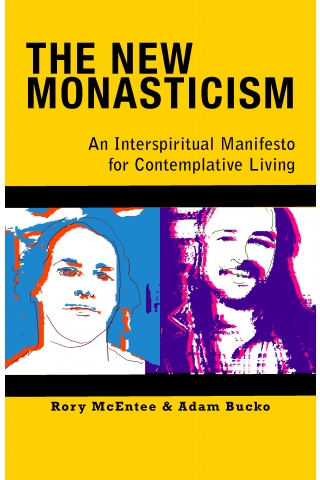
BOOK REVIEW: THE NEW MONASTICISM

New_MonasticismHighly recommended. I knew I would be in business with this book as soon as I got wind of it, and it will take further contemplation and inward digestion before I fully understand my relationship with it. I believe that this is the kind of effect that what The New Monasticism: an Interspiritual Manifesto for Contemplative Living intends to create.

‘Monasticism’ is refreshingly used here “simply to denote a level of commitment to a spiritual life”. It is not about specific beliefs or a specific lifestyle. It asks us to free ourselves from our cultural conditioning and an unquestioning and un-questing life. Avoiding identification with material success, living in the midst of a contemporary society that does not support such a calling, we may enter a space of “radical profundity and divine transformative energy”. We seek simplicity not through renunciation but through ‘integration’.  We do need retreat space, so some people will indeed be called as specialists to hold the “containers of silence”. But most will pursue vocation in the world, in a life made up of contemplative practice, heartfelt conversation and sacred activism.

Authors Rory McEntee and Adam Bucko are situated within the Roman Catholic tradition, in an emancipatory strand which is reaching out to others and hoping to transcend itself. The term ‘interspirituality’ was coined by Brother Wayne Teasdale, an ordained Christian Sannyasin who  presided over an ashram in India. The authors see interspirituality as “humbly placing itself in partnership and collaborative discernment with our time-honoured religious traditions”.  In the last decade we have also seen the linking of Father Thomas Keating (who developed ‘centering prayer’ as a Christian answer to Buddhist-style meditation) with Ken Wilber’s Integral Life project, which is itself increasingly seeking alliance with like-minded Christian communities. Indeed a lot of the philosophy, psychology and social science in this book comes straight from Ken Wilber and the stance of the Integral movement. The authors come from a collectively confident and mature spiritual base, and there are advantages in that. The book is rich with specific suggestions about life and practice in the new monasticism, drawing for its core inspiration on an ‘Interspiritual Manifesto for Contemplative Life in the 21st. Century’ following a week long dialogue with Father Thomas Keating at his monastery in Colorado in 2012.

McEntee and Bucko are both “under 40” and feel a connection with the younger generation now coming into adulthood. Bucko works with young homeless men in New York City. They see a potentially emergent spiritual culture that is: “spiritual not religious”; this worldly and concerned with nature and the fate of the earth; has (post) modern commitments to personal ‘authenticity’; and finds the sacred in the secular. They believe that these values can be championed within a further development of their own tradition, transforming the tradition itself. For them the path is as much about the life and health of the earth as it is with an individual communion with the Divine: indeed, it is false to separate the two. Realisation is less a “gnostic quest for truths beyond the world” than “a reflection on certain processes taking place within the world”. Interspirituality wants to be the midwife of this, and in doing so become attractive to people, especially young people, who would not be drawn to more traditional approaches.

The New Monasticism is a valuable contribution to the re-visioning of spirituality and concomitant life practices. Given its provenance, it is not surprising that the reaching out to other traditions is quite selective. Beyond Christianity, the traditions being engaged with are neo-Vedanta, Tibetan Buddhism and to a lesser extent Zen, modern Sufism and to some degree the Hasidic movement in Judaism and Martin Buber. ‘Indigenous religions’ are mentioned in two inclusivity lists, without definition or description. Shamanism is mentioned as a particular model of spiritual service. There is nothing specific from the Western Way outside Christianity.  Within Christianity, much is drawn from the contemplative strand in Orthodoxy, including an understanding of theosis (or divinisation) and the role of Sophia as guide. This is accompanied by an intent to “claim the wisdom dimension of all traditions and let the wisdom guide you” – a view which they attribute to Matthew Fox. Ethics is seen as “the call to active co-operation with the sophianic transfiguration of the world”. Quaker processes also get a mention because of their democratic and dialogical way of bringing people into Presence with each other. Since I am personally positioned in modern Druidry, Paganism and Earth Spirituality I have to express some disappointment here. However I don’t feel deliberately excluded. It’s just that these authors have their attention focused elsewhere.

I do have a worry, all the same, an area where I think that Earth and Goddess traditions could do with being heard. This is when McEntee and Bucko talk about ‘axial ages’, a view of spiritual/religious history once again taken from Ken Wilber. It depends on an evolutionary view of human culture as an aspect of a Divine awakening. In this view, the first axial age, from 800 BCE – 200 CE was a time of radical transformation marked by the appearance of great teachers who catalysed major literatures: Lao-Tzu, Confucius, Buddha, Mahavir (of the Jains), Zoroaster, the Jewish prophets and Greek philosophy, as well as Jesus and the gospels. These people could stand apart from the tribe, question the worldview they had been given, and think for themselves. They could also wake up from the trance of complete immersion in nature and objectify it – seen here as a positive step, albeit one with a shadow side. They represented the coming of reflexive subjectivity and the technology (writing) that made it sustainable. Admittedly, the narrative goes, this tended to take world denying, sex denying, misogynist and more generally oppressive forms. But overall it is read as a cultural gain. Now we are seen to be in a second axial age where the perceived challenge is to transcend the limitations of the first whilst preserving the gains, and thus renew our overall movement onward. “We need both our individuality … and an understanding of our intrinsic belonging within a vast Kosmos”. I’ve been aware of Wilber’s position on this since he wrote Up from Eden in the mid 1980’s. It has always read to me as a one-eyed narrative, the mirror image of the primitive matriarchy still espoused by many Pagans.  One of its effects has been to offer a language of canny and limited concession by hitherto dominant traditions as they respond to an unstoppable shift in culture. Here is where the Earth traditions could have a role in the dialogue, to support a view of individuality and inter-connectedness, indeed, but which is less masculinist in language (I’m thinking about how the book suggests “dialogical sophiology” as the way of meeting with the divine feminine), more open, and more widely informed than this.

I am glad to be living in a time of spiritual ferment. It breathes life and hope in an otherwise darkening time. I acknowledge and celebrate the achievement of The New Monasticism and am already involved in exploring contemplative life in Druidry. I notice that I, and others who I have been linked with, have in some ways come to similar conclusions about life and practice, if not entirely of view. This book, although from a very different background, has stimulated and encouraged me. I hope it has this role for many other readers.

HEART LANGUAGE

I tend to feel most centred and empowered when using heart language. By ‘heart’ I don’t mean the physical heart, or even the heart chakra, but the mystical Great Heart, a place of ultimate stillness, where the microcosm of the human heart opens to the macrocosm. Some people, for example in the tradition of Kashmir Shaivism, think of this as the consciousness that underlies all forms, the divine mind, the Self (1).

There are those, like the Sufi teacher Kabir Edmund Helminski (2) who, for the very best reasons, make a separation between Heart as “the subconscious/superconscious mind and all the faculties that are non-intellectual” and the thinking mind activated by will and reason. For me this creates a separation and dualism. In my world Heart includes the reasoning mind, and continues to hold it at some level, even though the existential angst of the reasoning mind itself may defensively lose connection with the greater whole.

I do however share the view that Heart is accessed through the growth of a sensitive awareness that allows us to be receptive and whole by entering in to a more spacious ‘I’, a more integrated quality of presence. Through a fine balance of passive and active attention we can view the present moment through the eye of eternity, a viewpoint from which many wounds can be healed, many mistakes forgiven, many losses accepted. Whilst Great Heart cannot be grasped or understood through consciousness alone, “we can see with its eyes, hear with its ears, act with its will, forgive with its forgiveness, and love with its love” (2).

1: Sally Kempton (2011) Meditation for the love of it: enjoying your own deepest experience  Boulder, Colorado: Sounds True

2: Kabir Edmund Helminski (1992) Living presence: a Sufi way to mindfulness and the essential self   New York, New York: Penguin Putnam

Earth Eclectic

music that celebrates Earth and speaks to the heart

Sarah Fuhro Star-Flower Alchemy

Follow the Moon's Cycle

Muddy Feet

Meeting nature on nature's terms

Rosher.Net

A little bit of Mark Rosher in South Gloucestershire, England

Becoming Part of the Land

A monastic polytheist's and animist’s journal

selkiewife

Selkie Writing…

Charlotte Rodgers

Images and words set against a backdrop of outsider art.

Prof Jem Bendell

living with metacrisis and collapse

Towint

The pagan path. The Old Ways In New Times

The Druids Garden

Spiritual journeys in tending the living earth, permaculture, and nature-inspired arts

The Blog of Baphomet

a magickal dialogue between nature and culture

This Simple Life

The gentle art of living with less

Musings of a Scottish Hearth Druid and Heathen

Thoughts about living, loving and worshiping as an autistic Hearth Druid and Heathen. One woman's journey.

Wheel of the Year Blog

An place to read and share stories about the celtic seasonal festivals

Walking the Druid Path

Just another WordPress.com site

anima monday

Exploring our connection to the wider world

Grounded Space Focusing

Become more grounded and spacious with yourself and others, through your own body’s wisdom

The Earthbound Report

Good lives on our one planet

Hopeless Vendetta

News for the residents of Hopeless, Maine